USA using Westinghouse nuclear reactors and fuel to compete with Russia for European dominance
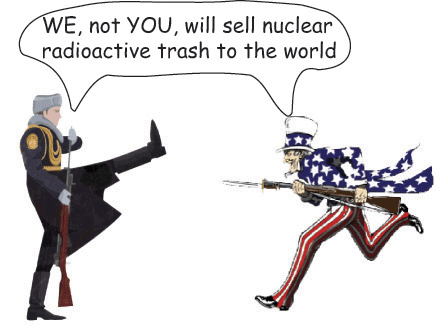
The U.S. is going after Russian nukes in Europe. And they’re counting on just one company to do it. Oddly enough, it’s Japanese.
If you thought the energy security issue the U.S. has been selling to Europe was only about American liquefied natural gas, look closer. It’s also about Russian nuclear energy behind the old Iron Curtain.
Energy security in Eastern Europe is a thermo-nuclear reactor war that mainly pits Westinghouse Electric (WEC) against Russian Rosatom. It’s a drawn-out and extremely costly energy game the U.S. is trying desperately to win. State Department chief Hillary Clinton even “lobbied” for Westinghouse in Prague in 2012.
It’s not a secret.
Westinghouse Chief Executive Danny Roderick says Clinton’s showing made a big impression on the Czechs. “I was proud that she was in the trenches with me,” he reportedly said.
The unstated goal: lessen Russian control of the nuclear power market in Eastern Europe, even if that does not translate into an immediate market share for Westinghouse. Historically, for some of those countries Rosatom and its fuel assembly maker TVEL are the only game in town. Continue reading
America gets Ukraine to hop on its nuclear power marketing bandwagon
How Washington Is Fighting For Russia’s Old Europe Energy Market, Forbes, Kenneth Rapoza , 17 May 16
“……..Nuking Ukraine
Getting Ukraine to hop on the Westinghouse band wagon was particularly crafty. Either it was simply fantastic timing on the part of Westinghouse, or the U.S. government and the new, post-Euromaidan government of Ukraine colluded to kick Russia to the curb.
“I think that Westinghouse was somehow involved in getting the EC to push Ukraine away from Russia on this front,” says Tomas Vlcek, an nergy security expert based out of Masaryk University in the Czech Republic.
In March 2014, just two months after the pro-Russian president Viktor Yanukovych was ousted, a European environmentalist group called Bellona sent out stories saying that the Russian government was ready to punish Ukraine with an embargo on nuclear fuel supplies from TVEL.
When compared to what Gazprom has done with gas supplies, Putin ordering a stop on TVEL sales of nuclear fuel assemblies simply sounded like something he would propose. Only, it is not possible to ban nuclear fuel supply. Not only does the fuel rod stay in the reactor for years, someone else can make it for the reactor instead of the Russians. Like Westinghouse.
The Bellona coverage brandished Russia as a villain in the nuclear energy business too. Brussels called for “diversification” in Ukraine’s nuclear fuel market and gave Westinghouse’s European fuel division millions of euros in subsidies for the sake of “energy security”.
The whole shebang had nothing to do with Westinghouse in Pennsylvania. Their spokeswoman said she’s never heard of Bellona. Her colleagues in Europe, on the other hand-
Derek Taylor, the former E.U. civil servant who works at the Brussels branch of Bellona is also a Senior Advisor on energy at Burson-Marsteller which, in turn,is a public affairs firm working for Westinghouse worldwide.
Despite the civil war in East Ukraine, sanctions and Gazprom gas disputes, the Russians have never missed any scheduled nuclear fuel delivery to Ukrainian nuclear power plants.
Westinghouse is more than a brand name American power company. It’s a battering ram used by Washington to promote energy security.
In 2012, Ukraine’s nuclear regulator banned the use of Westinghouse fuel assemblies in the country pending an investigation. Two years later, according to sources in Ukraine, then-Prime Minister, Arseniy Yatsenyuk consulted Westinghouse on picking a new nuclear safety regulator for his new government.
In 2015 during a scheduled outage at a reactor unit at the South Ukraine nuclear power plant, two of the Westinghouse-made fuel assemblies were found to be leaking contrary to Westinghouse’s claims that those were of an ‘improved’ modification to fit the Rosatom VVER-1000 type nuclear reactors there.
Regardless, anti-Russia politics trumps technological problems. Westinghouse is currently planning to deliver five reloads of fuel to the South Ukraine and Zaporizhia nuclear power plants, the company said on April 28, meaning the new regulator has concluded its study and their VVER-1000 fuel assemblies are as good as those made in Russia. Capturing that market, as Toshiba says it will in corporate presentations, serves as a means to punish the Russians. It’s a political convenience the Russian’s are not willing to ignore.
“Our ability to make VVER fuel is not in question,” says Westinghouse Roderick. “We will continue to sell to VVER-1000s. I think it’s good to have competition in that market.”
It is good. Political pressure, whether Russian or American, is probably more harm than good. And it’s going to really irk countries, like Russia, who clearly see it as Washington poking them in the eye on purpose.
Energy security is therefore as much fact as it is fiction. It is as much a means to market Russian rivals as it is to limit the serious role energy politics plays in Russian-European relations.
But derailing nuclear projects while running into technical difficulties with Westinghouse fuel assemblies in Rosatom reactors is a dangerous way to promote energy security there. Paradoxically as it might seem, it plays into Russia’s hands when those projects to work according to plan. The Russians look reliable and solid by comparison.
“On the finance side too, I think Rosatom has Westinghouse beat,” says Jirusek about the Russian company’s ability to finance the construction of a new power plant and long term fuel supply deals.
Apart from Ukraine, where diversification was imposed for political reasons, Rosatom’s TVEL still holds its market share. Japan’s Westinghouse, despite paying no corporate tax in the U.S., will continue applying the pressure with the help of Washington and the U.S. taxpayer.
For the Russia-United States nuclear stand off , once again it is a war of attrition.
On May 12, Toshiba said it is coming back from the brink. It will post an operating profit of $1.1 billion this year after losing $6.6 billion last year due to massive write downs associated with Westinghouse and restructuring costs in the wake of a damaging accounting scandal.
No one should bet that Washington will suddenly stop selling their Westinghouse nukes to the Europeans. They could promote another Japanese-American hybrid, like the General Electric/Hitachi boiled water reactors. Or Oregon-based NuScale, who make a smaller modular reactor that is less capital intensive and is designed to be integrated into a renewable energy grid. But they do not, obviously. It’s not because those are inferior products or even that Europe is currently a pressurized water reactor market. They do it because Westinghouse competes directly with the Russians. That’s what Washington is really after. http://www.forbes.com/sites/kenrapoza/2016/05/17/washingtons-european-energy-security-boondoggle/#4247a5f362ef
Toshiba’s Economic Nuclear Meltdown
How Washington Is Fighting For Russia’s Old Europe Energy Market, Forbes, Kenneth Rapoza , 17 May 16
“………Toshiba’s Economic Meltdown
Toshiba’s problems are Westinghouse’s problems. In Europe, going after the Russian market is a survival tactic.
Toshiba used to design and build reactors for half of Japan, also supplying those reactors with fuel. The March 2011 Fukushima disaster lit a match to those service contracts. Toshiba’s Fukushima reactors are decommissioned.
After Fukushima, Germany shut its reactors down, and they also used Westinghouse as a source for fuel rods, the assembly units that store the uranium that ultimately powers the reactor and makes energy. In less than two years, the company lost contracts at 60 reactors.
They were hemorrhaging money. Between 2012 and 2014, Westinghouse Electric’s cumulative operating losses reached $1.43 billion, according to Toshiba. Which means the company has no taxable income and, thus, is not paying taxes in the U.S. until its cumulative profits exceed that amount.
Their fuel fabrication plant in Västerås was on the verge of closing down.
Then the Ukrainian crisis came along. The Russians became super-duper bad guys and energy diversification was quickly put in play. While gas makes the headlines, nuclear power accounts for more than half of Ukraine’s electricity.
In March 2014, shortly after the annexation of Crimea and the first round of sanctions, the European Commission published an energy security strategy that included nukes as part of Europe’s energy diversification away from Russia. The EU issued a grant for $2.2
million to subsidize nuclear fuel diversification for Eastern European reactors. Guess who got the grant?
After the Czech Republic deal, Westinghouse secured a contract with the Bulgarian government to build a new AP1000 reactor at the Kozloduy nuclear power plant. It followed Bulgaria’s Prime Minister Boyko Borisov’s decision to suspend the construction of a two reactor power plant in Belene, a joint project between Bulgaria’s National Electric Company and Rosatom. What became known as the “Belene saga” would later cost the Bulgarians $1.3 billion in payments and legal fees to Rosatom for not honoring a 2008 contract. The Russians, of course, think they were boondoggled.
Borisov practically admitted that the decision to scrap Belene and award the Kozloduy project to Westinghouse was more political than not. During a meeting with the American Chamber of Commerce, the Bulgarian News Agency quoted Borisov saying “We are one. We are friends… We stop Russian planes, we also stop three Russian (energy) projects, and if we aren’t your partners, then who is?”
Cheerleading From The State Department
An Oct. 30, 2015 unclassified State Department emails dated March 28, 2012 from Richard Morningstar, Special Envoy for Eurasian Energy, addressed to Clinton’s Chief of Staff Huma Abedin, showed that Morningstar asked Abedin to pass on the message to Clinton that Bulgarian Foreign Minister Nikolay Mladenov told Morningstar his government had just canceled the Belene nuclear power project with Rosatom. He added that “Westinghouse is talking with the Bulgarians about doing a project at Kozloduy using the Russian reactor,” which probably means being the supplier of fuel rods instead of TVEL. The director of policy planning, Jacob Sullivan, was forwarded the email by Morningstar, to which Sullivan replied, “Not bad work.”
As competition between TVEL and Westinghouse continues, the United States will keep supporting Westinghouse projects, both politically and financially, to diminish the Kremlin’s influence, according to Stratfor.
“It would be wrong to suggest that no political influence takes place in the bidding process,” wrote Trusted Sources energy analysts led by James Henderson in an October 2014 study.
Nuclear power accounts for 27% of the EU’s electricity generation via 131 units in 16 countries, according to a June 2014 study by the European Commission. Historically, in Eastern Europe, Russian share in nuclear tech market has been nearly 100%. Over the years, the industry has modernized to a point where any third party can build fuel rods to fit a competitor’s reactor.
Westinghouse can build fuel assemblies for Rosatom’s new and old-model reactors and vice-versa, with varying degrees of success and almost always at a higher price. Russia is the cheaper producer of the two, so when countries turn to Westinghouse for the fuel assemblies, they have to pay a premium for diversification.
The Russians have an edge. Rosatom has won all fuel supply tenders in Eastern Europe in the last 10 years, but back home in Russia there are no tenders to be head. None of 35 reactors operated by Rosatom in Russia have fuel suppliers other than TVEL. It’s a monopoly. That’s how they both get volume, money and the data necessary for quality improvement; a luxury Westinghouse does not have.
One source who wished to remain anonymous said Westinghouse is looking for market share in the fuel services markets of East Europe, because, “It’s the only way to prevent their looming insolvency,” this source said. “Their new reactor division is loss-making, the fuel division is their only cash cow and it is not growing and existing margins are getting slimmer and slimmer. We think Westinghouse has spent millions of dollars to include nuclear fuel as part of the energy security narrative, and the current E.U. sentiment against Russia play into their hand.”…….. http://www.forbes.com/sites/kenrapoza/2016/05/17/washingtons-european-energy-security-boondoggle/#4247a5f362ef
After 26 year battle for justice, Rocky Flats residents get some kind of deal from nuclear weapons plant operators
Deal reached between homeowners, weapons plant operators, Albuquerque Journal By Dan Elliott / Associated Press May 19th, 2016 DENVER — Thousands of homeowners have reached a $375 million settlement over their claims that plutonium releases from a nuclear weapons plant in Colorado damaged their health and devalued their property, officials said Thursday.
A federal judge must approve the agreement before it officially ends the 26-year legal battle between the residents and two corporations that ran the Rocky Flats plant for the federal government.
Perched on a wind-swept mesa west of Denver, Rocky Flats manufactured plutonium triggers for nuclear warheads until it closed in 1989 because of safety and environmental concerns. It’s the most prominent of Colorado’s Cold War relics, which also included a nerve gas manufacturing site east of Denver.
Few details of the settlement were available. The lead attorney for the plaintiffs, Merrill Davidoff, said the agreement has been submitted to the judge overseeing the case but no documents have been made public…….
The lawsuit took years to go to trial. In 2006, a jury found the companies had damaged nearby land and hurt residents’ health. In 2008, a judge ordered the companies to pay a combined $925 million.
An appeals court overturned the verdict and the award on Sept. 3, 2010, saying the homeowners hadn’t proved that plutonium releases from the plant had hurt their health or their property. The court said a decline in property value can’t be considered damage.
The case had been appealed to the Supreme Court, but the appeal has been dropped.
After a $7 billion cleanup that took 10 years, most of the 8-square-mile property became a wildlife refuge managed by the U.S. Fish and Wildlife Service. The most heavily contaminated area remains off-limits to the public. http://www.abqjournal.com/777588/deal-reached-between-homeowners-weapons-plant-operators-3.html
Boston Edison Company, now known as NSTAR Electric Company sues US Dept of Energy
DOE Sued for $40M Over Nuclear Waste Storage, Courthouse News Service By LORRAINE BAILEY CN), 19 May 16 — Blaming the government for not settling on a nuclear-waste storage scheme, a nuclear energy company has filed a federal complaint to recover $40 million.
The Nuclear Waste Policy Act of 1982 required the U.S. Department of Energy to accept and dispose of spent nuclear fuel and high-level radioactive waste by Jan. 31, 1998, in return for fees paid by owners of such waste.
It also effectively made it mandatory for nuclear utilities to enter into contracts for such disposal.
When the Department of Energy failed to meet the 1998 deadline, however, utilities began to incur substantial costs for storage and management of the waste accumulating at reactor sites.
By 2006, the U.S. Court of Federal Claims had found that the Department of Energy partially breached its contractual obligations to Yankee Atomic Electric Co., Connecticut Yankee Atomic Power Co., and Maine Yankee Atomic Power Co., all of which are now decommissioned, to the tune of $235 million
It sued the U.S. in the Court of Federal Claims Wednesday over its continued obligation to pay for highly reactive waste storage.
Boston Edison says it paid Entergy $40.3 million to cover the cost to store spent nuclear fuel through 2012, the expected decommissioning date for the plant.
That fuel would have been disposed of by the government had it kept its pledge.
But now, Entergy has stated that operations at Pilgrim will continue through 2019, and there is still no government plan for a permanent repository for high level nuclear waste.
Most nuclear power plants continue to keep their reactor waste on-site in steel and concrete casks……. The Department of Energy has expressed the urgency need to find a permanent repository, but the Congress has taken no action since abandoning the Yucca Mountain project.
Boston Energy seeks damages for breach of contract, and breach of the covenant of good faith. http://www.courthousenews.com/2016/05/19/doe-sued-for-40m-over-nuclear-waste-storage.htm
Exelon nuclear corporation pressing for tax-payer funding at State and Federal level, USA
 Exelon presses for help at state, federal levels, E & E, Jeffrey Tomich, E&E reporter EnergyWire: Friday, May 20, 2016 The nation’s largest nuclear operator put on the full-court press yesterday in Washington, D.C., and Springfield, Ill., for policies to keep some its struggling plants afloat amid increasing competition from wind energy and a glut of cheap shale gas that’s depressing energy prices.
The case for helping preserve Exelon Corp.’s endangered nuclear plants — the Clinton and Quad Cities plants in Illinois and the R.E. Ginna and Nine Mile Point plants in New York — isn’t new.
Chicago-based Exelon has threatened for more than two years to shut money-losing plants in an effort to prod state lawmakers to act. In New York, Democratic Gov. Andrew Cuomo’s administration has come to the rescue with an evolving plan to help existing plants survive the downturn in energy markets (EnergyWire, March 18). In Illinois, Exelon is proposing a similar remedy, but it remains to be seen if the General Assembly will come to the rescue.
Earlier this month, Exelon’s chief executive, Chris Crane, said he has authority from the board to shut the “distressed assets” if lawmakers don’t approve a proposal requiring up to $290 million a year in subsidies from Illinois consumers to keep them profitable.
The company offered a revamped proposal on May 5 and gave the Legislature until the end of the month to pass it (EnergyWire, May 6). If not, the 1,087-megawatt Clinton plant would be closed when its obligation to run ends a year from now, Crane said. The Quad Cities plant is required to run an extra year, but unless the bill passes or the plant clears this year’s PJM Interconnection capacity auction for 2018-19, it, too, will be shut down.
If Exelon’s nuclear proposal isn’t complex and controversial enough, it is woven into a sweeping, 316-page energy bill that would rewrite Illinois energy policy……
Exelon said the two plants have lost a combined $800 million over the last six years, and they are projected to lose another $500 million over the next five years.
“We are unable to sustain those type of economic losses any longer,” Tim Hanley, the company’s senior vice president of nuclear projects, told the committee……
Exelon’s claims were challenged, however, by consumer groups including AARP and by the Illinois attorney general, as well as by Illinois industrial energy users and downtown Chicago building owners. The same groups opposed the nuclear proposal a year ago.
Cara Hendrickson, an assistant attorney general, told committee members the measure was nothing more than “another nuclear bailout, dressed up differently.” …..http://www.eenews.net/stories/1060037598 Twitter: @jefftomich Email: jtomich@eenews.net
USA Energy secretary Ernest Moniz keen to get tax-payer funding for Exelon nuclear power
 Fifteen to 20 nuclear units in US ‘at risk’ of shutdown: industry official Washington (Platts)–19 May 2016 Some 15 to 20 nuclear power units in the US are “at risk” of being shut over the next five to 10 years due to economic challenges such as low power prices, competition from natural gas-fired generation and subsidized renewables, a nuclear industry official said Thursday.
Marvin Fertel, president and CEO of the Nuclear Energy Institute, did not name any of the reactors considered to be most at risk in his remarks at a US Department of Energy summit on the future of nuclear power. He did say that small, single-unit nuclear power plants are the most economically challenged.
Two such plants, Dominion’s Kewaunee in Wisconsin and Entergy’s Vermont Yankee, have closed for economic reasons since 2013. Entergy’s FitzPatrick in New York and Pilgrim in Massachusetts are scheduled to be shut in 2017 and 2019, respectively, due to such factors, the company has said. The Omaha Public Power District said last week it is recommending to the district’s board of directors that its Fort Calhoun plant in Nebraska be shut because other generating options are less costly…….
Fertel noted that Exelon’s two-unit Quad Cities nuclear plant in Illinois, which the company has said is losing money and will be shut in the next few years without further legislative and market support, “……
Secretary of Energy Ernest Moniz, who spoke immediately before Fertel at the summit, agreed in his remarks that continued operation of some operating nuclear power plants is at risk.
Moniz said that DOE’s Quadrennial Energy Review currently underway is assessing the future of the existing nuclear fleet in a subcommittee chaired by former deputy secretary of defense John Deutch, and is considering how nuclear plant operators might be compensated for the various benefits of their generation. Those issues will be “at the heart of the analysis work going on right now in developing this QER,” he said.
“I’m expecting an excellent report” from the subcommittee on what can be done to sustain operation of existing nuclear units, Moniz said. “This question of valuation [of nuclear generation] is one that is absolutely central. It’s one that we’re certainly paying attention to.”……. http://www.platts.com/latest-news/electric-power/washington/fifteen-to-20-nuclear-units-in-us-at-risk-of-21497100
Illinois General Assembly split on the idea of bailing out Exelon’s financially distressed nuclear station
Bill to help Clinton nuclear plant on back burner Bloomington Pantograph Dan Petrella dan.petrella@lee.net SPRINGFIELD, 20 May 16 — It remains unclear whether the Illinois General Assembly will act before the scheduled end of its spring session on legislation that Exelon Corp. says is essential to the future of its financially struggling nuclear power plants in Clinton and near the Quad Cities.
Near the end of a committee hearing Thursday that lasted more than three hours, Democratic Sen. Mattie Hunter of Chicago, chairwoman of the Senate Energy and Public Utilities Committee, said the measure won’t be coming to the Senate floor for a vote anytime soon.
Exelon has said that it will shut down the Clinton Power Station next year “if adequate legislation is not passed that properly values nuclear power for its economic, environmental and reliability benefits during the spring Illinois legislative session scheduled to end May 31.”…….
“It appears our committee is split,” Hunter said. “I don’t know if we even have enough votes to get it passed anyway.”…..
Exelon’s proposal also faces stiff opposition from groups like AARP Illinois, the Illinois Public Interest Research Group and the Illinois attorney general’s office. Opponents say a shift in the way customers are charged could result in wide month-to-month variations in power bills. http://www.pantagraph.com/news/state-and-regional/bill-to-help-clinton-nuclear-plant-on-back-burner/article_4f2fcbbf-84bd-52a5-a2e0-991c7e7fda74.html
New York’s proposed Clean Energy Standard a financial gift to the nuclear industry
 A gift to the nuclear power industry, The River Reporter May 18, 2016 — State officials are in the midst of a round of meetings regarding the state’s proposed Clean Energy Standard (CES), which will determine how much renewable electricity will be distributed to customers by utilities in years to come. The proposed plan calls for the state to generate 80% of electricity from renewable power by 2050, which is certainly a laudable goal.
Incredibly, however, the proposed CES mandates that rate-payers keep the state’s four nuclear power plants alive by paying higher-than-market prices for the expensive electricity produced by the plants.
As Jessica Azulay, program director of Alliance for a Green Economy, wrote in a memo, “The proposed Clean Energy Standard also includes a gift to nuclear corporations operating in Upstate New York. Due to low electricity prices, declining demand, competition from wind power, and rising nuclear costs, New York’s four upstate reactors have been struggling economically. Two are on the verge of closure unless they receive a financial lifeline. Tucked into the ‘Clean Energy Standard’ is that lifeline. In addition to requiring that utilities and ESCOs [Energy Supply Companies] purchase renewable energy, the policy would mandate that utilities buy 4.6% of the electricity they deliver in 2017 from nuclear reactors ‘facing financial difficulty.’ By 2020, utilities would be required to buy 15.7% of electricity from unprofitable nuclear plants.”….
while proponents call nuclear power a form of clean energy because it doesn’t release any carbon into the air while electricity is being generated, the process of collecting uranium to power the nuclear plants could hardly be considered clean.
Again, according to Azulay, the mining of uranium is largely unregulated and there are over 15,000 abandoned uranium mines in this country that have not been cleaned up. She says, “After mining, uranium is processed into uranium dioxide ore at a mill; milling generates vast amounts of radioactive and toxic tailings that are deposited on the ground or in open ponds. The fuel is then enriched in an energy-intensive process. By the time fuel is delivered to a reactor for use, approximately 25,000 pounds of mining waste (rock, mill tailings, and depleted uranium) have been generated for each pound of nuclear fuel.”
Nuclear power plants are not the answer to present or future energy needs, and New York State taxpayers should not be asked to pay for those that become unprofitable. Comments regarding the CES are due by June 6, and a sample comment and submission instructions can be found at www.allianceforagreeneconomy.org/nukes-are-not-clean. http://www.riverreporter.com/editorial/4302/2016/05/18/gift-nuclear-power-industry
‘Generation IV’ nuclear companies desperate for tax-payers’ money
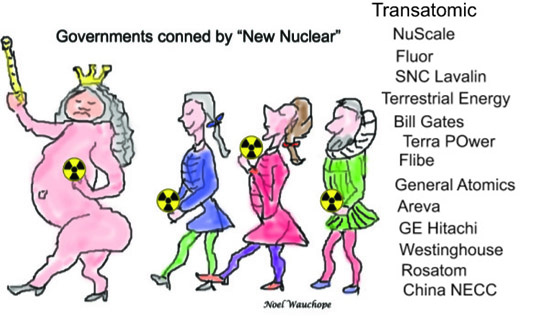
 Nuclear Firms: More Federal Money for Advanced Reactors. Bloomberg BNA, By Rebecca Kern May 17 — Nuclear companies said in a Senate hearing that continued support from Congress is needed to further develop and commercialize advanced nuclear reactors, several of which are getting some Department of Energy funding.
“Successful completion of the DOE cost-share program depends on sustained congressional support and continued appropriations,” John Hopkins, chairman and chief executive officer of NuScale Power LLC, an advanced nuclear reactor company, said at a May 17 Senate Energy and Natural Resources hearing on advanced reactors. “We appreciate your past support and we ask that you continue to prioritize small modular reactor programs in a tight budgetary environment.”……
NuScale has been receiving cost-share grants from the DOE since 2013 and expects to submit its first-of-a-kind small modular reactor licensing application to the Nuclear Regulatory Commission by the end of 2016, Hopkins said……
John Gilleland, chief technical officer of TerraPower LLC—a nuclear design company developing a generation-four reactor—also said there is a need for more government funding….
TerraPower is working with the China National Nuclear Corporation, an economic corporation overseen by the Chinese government, to develop a 1,200 megawatt electric liquid sodium-cooled fast reactor that uses depleted uranium as fuel in the metallic form. They hope it will be commercially deployable in the 2020-2030 time frame, Gilleland told Bloomberg BNA May 17.
Support for Advanced Nuclear Bills
Jacob DeWitte, co-founder and chief executive officer of Oklo, an advanced reactor start-up company, lauded the work done by the committee to pass the Energy Policy Modernization Act (S. 2012) in late April (76 ECR, 4/20/16). The bill included language from a bill sponsored by Sen. Mike Crapo (R-Idaho) that would establish a National Nuclear Innovation Center between the Energy Department and the NRC to establish capabilities for the private sector to test and demonstrate advanced reactor concepts.
He also supported S. 2795 introduced by Sen. James Inhofe (R-Okla.) that would promote the development of advanced nuclear technologies, which is being marked-up by the Senate Environment and Public Works committee this week…..
Also, Rep. Bob Latta (R-Ohio) has introduced H.R. 4979 which would direct DOE and the NRC to work together on an advanced nuclear reactor framework. This bill will be marked up by the House Energy and Commerce committee this week (92 ECR, 5/12/16)……
To contact the reporter on this story: Rebecca Kern in Washington atrkern@bna.com
To contact the editor responsible for this story: Larry Pearl atlpearl@bna.com http://www.bna.com/nuclear-firms-federal-n57982072580/
USA House and Senate committees approve bills favouring “new nuclear” companies
 environmental groups raised concerns with H.R. 4979 in a May 17 letter to the House Energy and Commerce Committee, saying changes to the NRC’s licensing framework could lead to safety concerns.
 Ed Lyman, a senior scientist at the Union of Concerned Scientists, said he had concerns with requiring the Energy Department to split the costs of advanced reactor development, because this ultimately would be borne by taxpayers.
House, Senate Panels OK Advanced Nuclear Reactor Bills Bloomberg BNA, By Rebecca Kern May 18 — House and Senate committees approved two bills May 18 that would create a new licensing framework at the Nuclear Regulatory Commission for the review of advanced reactors.
During separate hearings, the House Energy and Commerce Committee favorably reported out the Advanced Nuclear Technology Development Act (H.R. 4979), and the Senate Environment and Public Works Committee approved the Nuclear Energy Innovation and Modernization Act (S. 2795)………
NuScale Power LLC will be the first company to submit a licensing application to the NRC by year-end for its advanced small modular reactor that is 50 megawatts and can be transported by rail, truck or barge (95 ECR, 5/17/16).
The bills will next go to the House and Senate floors, although no schedules for votes have been announced.
Dan Schneider, the Energy and Commerce’s press secretary, told Bloomberg BNA May 18 that the committee members look forward to working with the co-sponsors of S. 2795 once the House passes H.R. 4979 to work out differences between the bills.
Environmentalists Cite Concerns
Berkely Lab finds that Solar Power brings Environmental and Public Health Benefits
 New Berkeley Lab Study Tallies Environmental and Public Health Benefits of Solar Power, Berkely Lab, Jon Weiner 510-486-4014 • MAY 18, 2016 Berkeley, CA — Solar power could deliver $400 billion in environmental and public health benefits throughout the United States by 2050, according to a study from the U.S. Department of Energy (DOE)’s Lawrence Berkeley National Laboratory (Berkeley Lab) and National Renewable Energy Laboratory (NREL).
“We find that a U.S. electric system in which solar plays a major role—supplying 14% of demand in 2030, and 27% in 2050—would result in enduring environmental and health benefits. Moreover, we find that the existing fleet of solar plants is already offering a down-payment towards those benefits, and that there are sizable regional differences in the benefits,” said Ryan Wiser of Berkeley Lab’s Energy Technologies Area.
The total monetary value of the greenhouse-gas and air pollution benefits of the high-penetration solar scenario exceeds $400 billion in present-value terms under central assumptions. Focusing on the existing end-of-2014 fleet of solar power projects, recent annual benefits equal more than $1.5 billion under central assumptions.
The report, The Environmental and Public Health Benefits of Achieving High Penetrations of Solar Energy in the United States, may be downloaded here. The report is part of a series of papers published as part of the U.S. Department of Energy’s On the Path to SunShot study. The DOE launched the SunShot Initiative in 2011, with the goal of driving down the cost of solar energy so that it was cost-competitive with other forms of electricity by the end of the decade. The new reports take stock of the progress already made, and highlight various barriers and opportunities that remain to achieving SunShot-level cost reductions. The full set of reports, including two others involving Berkeley Lab, can be found here…..http://newscenter.lbl.gov/2016/05/18/berkeley-lab-study-tallies-benefits-solar-power/
Confronting nuclear proponents on the real costs of “new nuclear” – US Senate hearing
Hearing on new reactors turns into colloquy on subsidies Hannah Northey, E&E reporter E&E Daily: Wednesday, May 18, 2016 A Senate hearing focused on the challenges of building the nation’s next-generation nuclear fleet yesterday quickly pivoted to concerns about cost and competition from cheap natural gas, with senators needling each other over energy subsidies…….
senators on the panel repeatedly turned back to the question of cost and whether the developers could make their projects compete financially.
Sen. Martin Heinrich (D-N.M.) said he was having a hard time reconciling the closure of nuclear power plants, including units in Illinois that had lost hundreds of millions of dollars in past years, with the industry’s push for new reactor designs. Heinrich asked witnesses what cost per kilowatt-hour they were targeting to ensure the advanced technologies would be competitive in the marketplace…….
Independent Sen. Angus King of Maine also questioned the industry’s math, noting that it could cost $7 million per megawatt to build an advanced reactor, whereas the costs for wind and natural gas are substantially lower……
The senator went on to ask Kuczynski whether a “level playing field” also meant scrapping federal support for the nuclear industry in the form of the Price-Anderson Act — a 1957 law that created a $12 billion pot of money to cover injuries and property damage during accidents.
When Kuczynski said the industry doesn’t view the law as a subsidy, King was quick to respond.
“It walks like a duck, it talks like duck, it’s a duck. It’s a subsidy,” King said. “If you had to buy that insurance, it would cost you a fortune, is that not correct?” http://www.eenews.net/stories/1060037434
Republican U.S. Sen. Lamar Alexander opposes wind power
 Pro-Nuclear GOP Senator Urges Tennessee to Reject Wind Farm, abc news,By ERIK SCHELZIG, ASSOCIATED PRESS NASHVILLE, Tenn. — May 19, 2016, Republican U.S. Sen. Lamar Alexander is urging his fellow Tennesseans to oppose what he calls an “unsightly” wind farm near the Cumberland Mountain State Park.
The longtime supporter of nuclear power argued on the Senate floor this week that the 23 wind turbines Apex Clean Energy wants to install are “massive” and would spoil the “natural beauty of our state.”
“We should not allow anyone to destroy the environment in the name of saving it,” said Alexander, arguing that wind energy is being fueled by “billions in wasteful taxpayer subsidies” to out-of-state companies.
Apex countered that the $130 million project will emit no pollution and create no hazardous waste as it provides a safe energy alternative near wildlife and natural areas…….
The wind farm near Crossville, about 100 miles east of Nashville, is projected to power 20,000 homes. It is located on a privately-owned 1,800-acre site behind a limestone quarry, though the turbines would be visible from Interstate 40.
“This project will help bring about cleaner, healthier air, reduce pollution, and create economic growth and jobs in Cumberland County,” Chandler said……http://abcnews.go.com/US/wireStory/pro-nuclear-gop-senator-urges-tennessee-reject-wind-39229291
New York Public Service Commission hearing on nuclear power stations
New York weighs future of Indian Point, upstate nuclear power plants Thomas C. Zambito, The Journal News May 17, 2016 “……..“Work with us to plan this just transition,” anti-nuclear activist Manna Jo Greene, the environmental director for the Beacon-based Clearwater, urged workers who crowded an Albany-area hearing held by the state Public Service Commission. “The handwriting is on the wall.”
The hearing was one of 22 being held across the state this month as the Public Service Commission weighs Gov. Andrew Cuomo’s proposal to establish clean energy standards so the state can continue reducing its carbon emissions.
Cuomo wants the state to rely on renewable energy sources for 50 percent of its electricity by 2030. While he’s advocated Indian Point’s shutdown, he’s pushing for the commission to offer financial incentives that would aid three upstate nuclear power plants – two in Oswego and a third near Rochester.
The owners of the James A. FitzPatrick nuclear power plant in Scriba say they will shut the plant’s doors in January 2017 and lay off half of the plant’s 600 workers.
Cuomo’s proposal envisions keeping the upstate nuclear plants open to act as a “bridge” until the state is able to rely on renewable energy sources for its electricity.
Several anti-nuclear speakers cast Cuomo’s effort to save the upstate plants as a “bailout” that shouldn’t be borne by ratepayers.
“Right now the nuclear industry, even though it’s over 50 years old still is unable to support itself,” said Susan Shapiro, a Rockland County attorney who works with the Indian Point Safe Energy Coalition. “It’s received more bailouts from the federal government than any other industry and it continues to receive bailouts from taxpayers.”…….
The Public Service Commission is scheduled to hold a vote on Cuomo’s proposals next month. http://www.lohud.com/story/tech/science/environment/2016/05/17/new-york-indian-point/84511734/
-
Archives
- October 2026 (129)
- September 2026 (339)
- August 2026 (330)
- July 2026 (355)
- June 2026 (287)
- May 2026 (306)
- April 2026 (356)
- March 2026 (251)
- February 2026 (267)
- January 2026 (308)
- December 2025 (358)
- November 2025 (359)
-
Categories
- 1
- 1 NUCLEAR ISSUES
- business and costs
- climate change
- culture and arts
- ENERGY
- environment
- health
- history
- indigenous issues
- Legal
- marketing of nuclear
- media
- opposition to nuclear
- PERSONAL STORIES
- politics
- politics international
- Religion and ethics
- safety
- secrets,lies and civil liberties
- spinbuster
- technology
- Uranium
- wastes
- weapons and war
- Women
- 2 WORLD
- ACTION
- AFRICA
- Atrocities
- AUSTRALIA
- Christina's notes
- Christina's themes
- culture and arts
- Events
- Fuk 2022
- Fuk 2023
- Fukushima 2017
- Fukushima 2018
- fukushima 2019
- Fukushima 2020
- Fukushima 2021
- general
- global warming
- Humour (God we need it)
- Nuclear
- RARE EARTHS
- Reference
- resources – print
- Resources -audiovicual
- Weekly Newsletter
- World
- World Nuclear
- YouTube
-
RSS
Entries RSS
Comments RSS

