How America carefully DIDN’T tests workers contaminated with plutonium
 Decades Later, Sickness Among Airmen After a Hydrogen Bomb Accident, NYT, by DAVE PHILIPPSJUNE 19, 2016 “….. Tests Thrown Out During the cleanup, a medical team gathered more than 1,500 urine samples from the cleanup crew to calculate how much plutonium they were absorbing. The higher the level in the samples, the greater the health hazard.
The records of those tests remain perhaps the most prominent artifact from the cleanup. They show about only 10 of the men absorbed more than the allowed safe dose, and the rest of the 1,500 responders were not harmed. The Air Force today relies on the results to argue that the men were never harmed by radiation. But the men who actually did the testing say the results are deeply flawed and are of little use in determining who was exposed.
“Did we follow protocol? Hell, no. We had neither the time nor the equipment,” said Victor B. Skaar, now 79, who worked on the testing team. The formula for determining the contamination level required collecting urine for 12 hours, but he said he was able to get only a single sample from many men. And others, he said, were never tested at all.
He sent samples to the Air Force’s chief of radiation testing, Dr. Lawrence T. Odland, who started seeing alarmingly high results. Dr. Odland decided the extreme levels did not indicate a true health threat, but were caused by plutonium loose in the camp that contaminated the men’s hands, their clothes and everything else. He threw out about 1,000 samples — 67 percent of the results — including all samples from the first days after the blasts when exposure was probably highest.
Now 94 and living in a rambling Victorian house in Hillsboro, Ohio, where a photo from the Greenland crash hangs in his hall, Dr. Odland questioned his decision.
“We had no way of knowing what was from contamination and what was from inhalation,” he said. “Was the world ending or was everything fine? I just had to make a call.”
He said he never got accurate results for hundreds of men who may have been contaminated. In addition, he soon realized plutonium lodged in the lungs could not always be detected in veterans’ urine, and men with clean samples might still be contaminated.
“It’s sad, sure, it’s sad,” he said. “But what can you do? You can’t take the plutonium out; you can’t cure the cancer. All you can do is bow your head and say you are sorry.”
Monitoring Program Killed
Convinced that the urine samples were inadequate, Dr. Odland persuaded the Air Force in 1966 to set up a permanent “Plutonium Deposition Registry Board” to monitor the men for life.
Experts from the Air Force, Army, Navy, Veterans Administration (now the Department of Veterans Affairs) and Atomic Energy Commission met to establish the program shortly after the cleanup. In welcoming remarks, the Air Force general in charge said the program was “essential” and following the men to their graves would provide “urgently needed data.”
The organizers proposed not notifying troops of their radiation exposure and keeping details of testing out of medical records, according to minutes of the meeting, out of concern notifying them could “set a stage for legal action.”
The plan was to have Dr. Odland’s staff follow the men. Within months, though, he had hit a wall.
“He is not able to get the support from the Department of Defense to go after the remaining people or set up a real registry because of the sleeping-dog policy,” an Atomic Energy Commission memo from 1967 noted.
“The sleeping dog policy? It was to leave it alone. Let it lie. I didn’t agree. Hell no, I didn’t agree,” Dr. Odland said. “Everyone decided we should watch these guys, take care of them. And then from somewhere up high they decided it was better to get rid of it.”
Dr. Odland did not know who gave the order to terminate the program, but said since the board included all the military branches and the veterans agency, it likely came from top-level officials.
The Air Force officially dismantled the program in 1968. The “permanent” board had met just once…….. http://www.nytimes.com/2016/06/20/us/decades-later-sickness-among-airmen-after-a-hydrogen-bomb-accident.html
South Carolina Electric and Gas Co slugging customers for costs of nuclear reactors that might never be built
 Power surge: Cost overruns at South Carolina nuclear plant growing part of SCE&G customer bills, Post and Courier David Wren Email @David_Wren_ 19 June 16 The state legislation allowing South Carolina Electric & Gas Co. to charge customers for two new reactors at its nuclear power plant years before they are completed has been compared to making payments on a new car without knowing the final price and before it leaves the assembly line.
The monthly payments continue to rise, but it’s not certain whether the customer making those payments will ever drive the car.
At least now, SCE&G’s customers have an idea how much the expansoin of the V.C. Summer Nuclear Station is costing them each month. The state’s Office of Regulatory Staff, which represents the public’s interest in utility issues, this month said SCE&G’s customers are paying an average of $23.16 each billing period — or 16.1 percent of their total bill — toward building the Midlands nuclear plant
And that’s likely to increase if the state Public Service Commission approves the company’s request to boost the project’s cost by another $852 million to $14 billion — more than $4 billion higher than original cost estimates.
SCE&G is using a state law called the Base Load Review Act to finance the nuclear project near Jenkinsville.
The law allows the utility to charge its 700,000 customers for construction as the project proceeds. ……
Critics like Frank Knapp, president and CEO of the state’s Small Business Chamber of Commerce, say the act “has turned into a blank check” for SCE&G.
The utility is allowed by state regulators to take up to 10.5 percent of the construction costs as profit. And Knapp says the pay-as-you-go method is unfair because some customers now paying for the project will leave the utility’s service area before it comes online……. http://www.postandcourier.com/20160618/160619424/power-surge-cost-overruns-at-south-carolina-nuclear-plant-growing-part-of-sceg-customer-bills
America does not need the new $30 billion Long-Range Standoff Weapon
The Air Force is set next year to accelerate the development of this new nuclear cruise missile. It would carry an upgraded W-80 nuclear warhead and be able to penetrate the world’s most advanced air-defense systems…….
There are three key questions that remain unanswered.
“hold at risk” using existing nuclear and conventional weapons and the platforms used to deliver them? We are aware of no such military necessity.Next, what role does the military intend this weapon to serve? The Pentagon says it would “provide the president with uniquely flexible options in an extreme crisis.” This suggests a lowering of the threshold for nuclear war, a perilous approach that would endanger not only America but allies that we are pledged to protect, like Japan and South Korea.
Finally, what is the weapon’s cost? The Defense Department and the National Nuclear Security Administration have yet to provide concrete estimates for the program, but the Federation of American Scientists hasreported that it could cost as much as $30 billion.
At a time when the Defense Department is set to modernize every leg of the nuclear triad, investing $30 billion in an unnecessary and dangerous new nuclear weapon is irresponsible………http://www.nytimes.com/2016/06/18/opinion/a-nuclear-weapon-that-america-doesnt-need.html?_r=0
USA nuclear plants going down like ninepins. Diablo next?
Closing Diablo would make California entirely nuke-free
Along with most nukes around the world, the only other remaining west coast reactor, WPPS2 on Washington’s Hanford military reservation, is also losing massive amounts of money.
Should California follow suit at Diablo, its conversion to a wholly green-powered economy would accelerate, likely leading Los Angeles to become the world’s first Solartopian megalopolis.
Ironically, with citizen action, a big push in that direction could now come from a state commission’s decision to enforce environmental protections signed into law by California’s most pro-nuke governor.
 Because they can’t evenly compete with renewable energy or gas, a tsunami of shut-downs has swept away a dozen U.S. reactors since October, 2012. Dozens more teeter at the brink, including two at Indian Point, just north of Manhattan, and Ohio’s rapidly crumbling Davis-Besse reactor near Toledo.
5 More U.S. Nukes to Close, Will Diablo Canyon Be Next? http://ecowatch.com/2016/06/17/diablo-canyon-meeting/ Harvey Wasserman | June 17, 2016 A rising tsunami of U.S. nuke shut-downs may soon include California’s infamous Diablo Canyon double reactors. But it depends on citizen action, including a statewide petition.

Five U.S. reactor closures have been announced within the past month. A green regulatory decision on California’s environmental standards could push the number to seven.
The focus is now on a critical June 28 California State Lands Commission meeting. Set for Sacramento, the hearing could help make the Golden State totally nuke free, ending the catastrophic radioactive and global warming impacts caused by these failing plants. A public simulcast of the Sacramento meeting is expected to gather a large crowd at the Morro Bay Community Center near the reactor site. The meeting starts at 10 a.m., but environmental groups will rally outside the community center starting at 9 a.m.
The three State Lands Commissioners will decide whether to require a legally-mandated Environmental Impact Report under the California Environmental Quality Act (CEQA). If ordered, a public scoping process will begin, allowing interested groups and individuals to weigh in on the environmental impacts of operation of two nuclear reactors on California’s fragile coastline. Continue reading
America’s unnecessary $1 trillion nuclear missile splurge
 America Already Has More Than Enough Nuclear Missiles. FP.com BY ADAM SMITH, JUNE 17, 2016But Republicans are pushing a $1 trillion nuclear modernization program, which would not only bankrupt the Pentagon but could spark a global nuclear arms race. This summer, Congress has been tying itself up in knots, trying to decide how to adequately fund U.S. national defense priorities, given the limits imposed by sequestration. But the difficult reality is that, however we choose to address immediate challenges, any rational attempt to plan for America’s future security must begin with a clear-eyed reassessment of the costs, trade-offs, and dangers of the trillion-dollar plan Washington is undertaking to modernize the U.S. nuclear weapons complex. That reassessment should include an effort to eliminate the new nuclear cruise missile.
The truth is that the United States can retain a credible nuclear deterrent with significantly fewer nuclear weapons and fewer delivery systems, at a fraction of the cost.
Instead, and with little debate, Congress has embarked on a plan to modernize all of these systems and increase these capabilities at an estimated total cost of $1 trillion over 30 years. This effort largely results fromdecisions made before the advent of the Budget Control Act and an ideological commitment to nuclear weapons by the Republican majority, which recently described them as our national security priority and “the foundation of all our defense efforts” in its security strategy. That plan means purchasing new nuclear weapons production facilities and labs, refurbishing warheads, land-based ballistic missiles, ballistic missile submarines, building new strategic bombers and nuclear-capable fighter aircraft, and, to top it all off, a new nuclear cruise missile.
These expenses will soon constitute a huge proportion of the U.S. defense budget: Yearly nuclear modernization costs will soon balloon and then more than double in the ensuing years, requiring at least $40 billion annually between 2024 and 2036, or nearly 10 percent of defense costs………
Now is the time for serious oversight and a realistic approach to these issues in order to stop an emerging arms race and avoid wasting billions of dollars we cannot afford. http://foreignpolicy.com/2016/06/17/nuclear-missiles-triad-congress-budget/
Alarm at the push to bail out Central New York nuclear plants
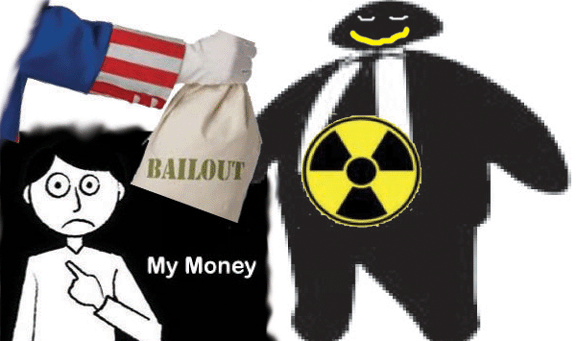 Critics sound alarm over rush to bail out Central New York nuclear plants, Syracuse.Com, By Tim Knauss | tknauss@syracuse.com , 17 June 16 SYRACUSE, N.Y. – The state’s frantic effort to save Upstate nuclear plants is drawing cheers from Oswego County. But it’s also raising alarms from critics who worry that key decisions about state energy policy are being rushed without enough public debate.
Exelon Corp.’s recent threat to close the Nine Mile 1 and Ginna nuclear reactors if it doesn’t get a subsidy from utility ratepayers by September has drawn barbed complaints from business, municipal and green energy advocates.
Critics point out that Exelon is asking the state Public Service Commission to determine how much of a subsidy the company’s nukes could get before the commission has even determined to what extent nuclear power should be subsidized.
Exelon “appears to be attempting an end run around the commission-established process,” wrote Albany attorney Michael Mager, who represents 60 large commercial and industrial utility customers in PSC rate proceedings. “The last thing that New York needs now is some ‘backroom deal.’ ”
Utility ratepayers could be on the hook for hundreds of millions in higher energy bills if the nuclear subsidies are approved – money that many renewable energy advocates would prefer to see spent on wind or solar power……..
A sudden focus on nuclear issues
The New York state energy plan, issued last year after much deliberation and 100,000 comments from the public, set an ambitious goal to make half of New York’s power from renewable energy by 2030. The plan barely mentioned nuclear power.
But hard times at Upstate’s nuclear plants – and hardball tactics by the owners – have suddenly forced Albany leaders to place a value on nuclear’s role in meeting the goals. Exelon’s recent ultimatum is the latest instance of brinksmanship during the past year from New York’s two nuclear operators.
Entergy Corp. last September threatened to close its 850-megawatt FitzPatrick plant in Scriba. After weeks of negotiations with Gov. Andrew Cuomo, punctuated by a war of words, Entergy made good on the threat and scheduled the shutdown for January 2017.
Now a similar warning has come from Exelon, the nation’s largest utility company, which owns the two-unit Nine Mile Point Nuclear Station near Oswego and the Ginna reactor in Wayne County.
Exelon has suggested in regulatory filings at the PSC that it is looking for a 12-year agreement that guarantees revenue of about $1 billion a year for its three Upstate reactors, an increase over what it makes now selling power in the wholesale market. The company did not estimate how much of a subsidy that would require…….
Based on current wholesale prices, two anti-nuclear groups estimated that subsidizing the two Nine Mile units and the Ginna plant would cost at least $190 million a year. In a filing with the PSC, the Alliance for a Green Economy and the Nuclear Information and Referral Service said their estimate was conservative……..http://www.syracuse.com/news/index.ssf/2016/06/critics_sound_alarm_over_rush_to_bail_out_central_new_york_nuclear_plants.html
Time that USA government backed its Iran nuclear deal and promoted investment


 The Obama Administration Needs to Double Down on the Iran Deal http://foreignpolicy.com/2016/06/16/the-obama-administration-needs-to-double-down-on-the-iran-deal/If Washington doesn’t move to help get banks and business into Iran, the nuclear deal will collapse. esident Barack Obama spent enormous political capital to cement an agreement with Iran that constrained its nuclear program for more than a decade. That agreement, however, is now at risk of unraveling.
The danger of the agreement collapsing, to the detriment of U.S. interests, is now evident. Under the nuclear accord, Iran agreed to constrain its nuclear program in return for economic reprieve from U.S. sanctions. While Iran has so far lived up to its nuclear-related obligations — addressing U.S. concerns over its nuclear program by reducing its number of operating centrifuges, reconfiguring its heavy-water reactor, and permitting an unprecedented inspections regime — the United States has struggled to fulfill its end of the nuclear bargain.
Hard-liners in Iran are touting the sanctions issue as an example of why the United States cannot be trusted.That message is having an effect: Recent pollingindicates that the Iranian people are growing increasingly skeptical that Washington is acting in good faith in meeting its commitments. Iranian moderates who support the accord, meanwhile, risk being undermined by this development. Absent a turn in Iran’s economic fortunes, the hopes and aspirations of the Iranian people will continue to be denied and their political engagement — as evidenced by recent parliamentary elections, in which Iranian hard-liners were dealt a significant defeat — stymied.
To its credit, the Obama administration is actively seeking to resolve concerns over the sanctions-lifting. A few weeks ago, Secretary of State John Kerry hosted a meeting of the British Bankers Association to encourage major European banks to re-engage their Iranian counterparts. High-level U.S. officials have likewise been touring the world, seeking to provide practical guidance on what the lifting of sanctions means and the scope of remaining U.S. sanctions. More public written guidance will soon be forthcoming.
But such guidance has been insufficient — and is likely to remain so. Following their meeting with Kerry, most of the banks in attendance stated publicly that they would not engage in Iran-related business for the foreseeable future, due to persistent U.S. sanctions risks. Without major European banks willing to re-engage Iran, financing will be unavailable for some of Iran’s bigger trade and investment opportunities.
The Obama administration needs a new game plan.Just as it expended political capital to secure the deal, it must expend the political capital to sustain it. Otherwise, the administration risks snatching defeat out of the jaws of victory and upending this historic diplomatic achievement.
Such additional steps come in two parts. First, the Obama administration will need to provide detailed written guidance to foreign banks and companies explaining what steps are required to ensure that they do not risk exposure to U.S. sanctions. Absent such guidance, non-U.S. banks and companies will continue to lack the confidence to engage in Iran-related dealings.
The Obama administration reportedly has been reluctant to provide the level of detail necessary to instill confidence in companies that they can do business in Iran. For instance, companies have long sought to understand the necessary level of due diligence to avoid exposure to U.S. sanctions — perhaps through a checklist of sorts. But U.S. officials, unwilling to act outside their comfort zone, have rejected calls to provide such detailed guidance, thus failing to address many firms’ primary concern.
Second, the Obama administration will need to take action to ease market entry into Iran. Banks have been hesitant to facilitate trade with Iran so long as Iran remains cut off from the U.S. financial system, and large foreign enterprises have been reluctant to pursue trade and investment opportunities in Iran so long as the U.S. primary trade embargo remains intact.
The administration can resolve these persistent concerns through a broader licensing scheme. For instance, the United States could re-authorize the U-turn license, which permitted U.S. dollar transactions involving Iran to be cleared through a U.S. bank, or license American banks to provide dollars to foreign financial institutions so that dollar-clearing can take place offshore. Similarly, the administration could take a hard look at the sense of maintaining a unilateral trade embargo with Iran while it is encouraging foreign parties to engage in trade with Iran. In lieu of those more dramatic steps, the administration could also license U.S. persons to facilitate certain transactions with Iran, particularly if those U.S. persons are employed in non-U.S. companies.
The politics of such action may not prove appetizing. Uber-hawks in Congress are bent on denying the Obama administration this diplomatic success and will try to block any action aimed at resolving sanctions concerns. But the sustainability of the nuclear accord is dependent on the Obama administration taking these steps. Absent such measures, the Iran deal threatens to unravel with the United States being the scapegoat, as Iran will continue to be denied the benefit of its bargain.
Passing off current problems with the lifting of sanctions to the next administration is not an option. Obama has made a big investment in limiting Iran’s nuclear program — the time is now to secure that investment.
US agencies and prosecutors influence Europe’s banks to impede Iran nuclear deal
Why our nuclear deal with Iran is turning to dust, The Independent, Robert Fisk @indyvoices 16 June 16
Many of Europe’s largest banks won’t do business with Iran for fear of breaching other US sanctions, which have nothing to do with the nuclear agreement – but a lot to do with US agencies and prosecutors.
The Middle East is littered with missed opportunities, lost chances and dreams turned to dust. The Iranian nuclear deal is now heading in the same direction. President Hassan Rohani, hero of the hour and Iran’s new Mr Good Guy in America, even obtained the support of Iran’s Supreme Leader, Ayatollah Ali Khamenei, when he signed off on the agreement with six world powers last year to reduce the country’s nuclear activities in return for an end to Western sanctions. But he’s beginning to look like a patsy.
And all of the old Iranian revolutionaries, the sons of martyrs and the war veterans and the Revolutionary Guard Corps and the managers of its billion-dollar conglomerates are turning out to have been right all along. The sanctions have been lifted – but they haven’t been lifted. Western investments are not, despite all the promises, pouring into Iran because banks – especially European banks – are too frightened of breaching the rest of America’s sanctions laws to do business with the Islamic Republic. Washington both giveth and taketh away; it’s a slogan that every Iranian president should learn.
Mohamed Khatami was the only real statesman the Middle East produced in half a century and he was elected president of Iran in 1997. He wanted a “civil society”, the nearest you can get to a secular nation ruled by Shiite democracy-necrology-government for and by the dead. But the United States treated Khatami with scorn – and so the crackpot Mahoud Ahmedinejad became the next president, a man with whose ravings America’s right-wing felt far more comfortable.
Hadn’t they said all along that Iran’s leaders were anti-Semitic nuclear crazies, even – this from the Israelis – worse than Hitler? Now Rohani, the man-America-could-do-business-with, may lose next year’s presidential election because he, too, forgot the slogan which, at its simplest, reads: don’t trust America.
Iran has not been reintegrated into the global financial system – and it’s not going to be – though the Chinese will be happy to do business. Khamenei’s supporters are now suggesting that the Supreme Leader – not the shrewd but naïve president – is the great hero of modern Iranian history (after Ayatollah Ruhollah Khomeini, of course). The banks, he says, fear the Americans who “have not acted on their promises and [only] removed the sanctions on paper”. Worse still, he’s right. “Khamenei’s life is the one you should be writing about,” one of his believers announced last week. “He is the saviour.” Yes, thanks to America.
For many of Europe’s largest banks won’t do business with Iran for fear of breaching other US sanctions, which have nothing to do with the nuclear agreement – but a lot to do with US agencies and prosecutors, hunting for evidence of Iranian money laundering, the financing of “terrorism” and monetary crime. The French BNP Paribas shelled out £6.3bn for its Iranian dealings a couple of years ago – over five years, along with StanChart and HSBC, the figure comes to a whopping £10.7bn.
So why should the UK’s Standard Chartered, Societe Generale, Credit Suisse or Deutsche Bank line up to pay more fines just because their governments want to do business in Tehran? Some American bankers – this from the Economist – won’t even hand over their business cards to Iranians. Now that’s what you call fear………
While Iran cannot break free of sanctions from which it thought it had been unshackled, its own paid militia in Lebanon – a nation which a Shiite prelate once described as “the lung through which Iran breathes” – is being caught up in the same financial net. So it’s not difficult for the Iranians to spot what they call in Persian the “dasisa” – and what the Hezbollah, in Arabic, refer to as the “muamara” – which means, quite simply: THE PLOT.
Decide for yourself if it’s true. But in Iran, the lifting of sanctions is a promise un-kept, the Revolutionary Guards are smiling and the nuclear deal is, surely, going downhill. A dream, in other words, fast turning into dust http://www.independent.co.uk/voices/why-our-nuclear-deal-with-iran-is-turning-to-dust-a7084981.html
Watts Bar-2 nuclear reactor – 43 years to build – shut down after 2 days
Nuclear fail: New reactor took 43 years to build, shut down after 2 days, REneweconomy, By Craig Morris on 16 June 2016 Renewables International
More than four decades after construction began, the Watts Bar-2 reactor was finally connected to the grid on 3 June 2016. However, two days later, while operating at 12.5 percent power, the reactor automatically shut down.
According to the U.S. Nuclear Regulatory Commission (NRC), the reactor tripped when a high pressure turbine valve failed to open. As of 8 June 2016, the reactor has not restarted and no restart schedule has been fixed yet, according to a spokesperson for plant owner the Tennessee Valley Authority (TVA)……….
TVA filed the construction license application for Watts Bar on 18 May 1971. On 18 September 1972, TVA applied for the exceptional authorization of certain site preparation activities, although it had not transmitted the final environmental impact statement and the construction license was still pending. TVA argued that startup of unit 1 by May 1977 “is vital in order to permit-TVA to meet its summer 1977 peak loads” and beyond:
“The present schedule for constructing the Watts Bar Nuclear Plant is predicated on beginning construction in October 1972. This schedule is extremely tight and failure to begin construction in October casts serious doubts on TVA’s ability to meet its load commitments in the 1977-78 period.”
TVA also insisted that cost of any delay be passed on to the ratepayer:
Fort Calhoun nuclear plant too expensive to run
 OPPD’s Fort Calhoun nuclear plant has become too expensive to run, company says, Omaha.com By Cole Epley / World-Herald staff writer
The nuclear plant at Fort Calhoun is simply too expensive to run when compared to other, cheaper forms of power, the Omaha Public Power District’s chief executive said Thursday. So it needs to shut down by the end of the year, he said.
OPPD President and Chief Executive Tim Burke told the utility’s board of directors that it no longer makes financial sense to continue operations at Fort Calhoun, which is the smallest nuclear power plant in the United States. The site for the plant was purchased in 1965.
The board will reconvene on June 16 to make a decision on Burke’s recommendation.
Closing the plant would mean lower overhead costs when it comes to complying with federal nuclear regulations and other expenses — including the $20 million a year OPPD pays an outside firm to run the plant. That firm, Exelon, has run Fort Calhoun since 2013 after OPPD was rapped hard by federal regulators for serious safety lapses; the plant was shut from mid-2011 until December 2013 as the utility dealt with Missouri River flooding and correcting violations of federal nuclear safety rules.
Shutting the plant permanently would move the utility away from relatively expensive-to-generate nuclear energy in an era of low-priced natural gas and an increasing reliance on wind power.
The recommendation to shut the plant comes with a guarantee, Burke said: Ratepayers won’t see a general rate increase until at least 2022 because of the savings from shuttering Fort Calhoun.
“You have to say enough is enough and curb the costs,” OPPD board member Tom Barrett said. “That’s the cold, hard facts of this business.”
The costs of nuclear generation put it at a disadvantage to wind and natural gas, according to the federal Energy Information Administration. The EIA in June of last year reported the total costs per megawatt-hour for a new nuclear plant to be about $95. In comparison, the cheapest natural gas-fired generation is about $75 or less per megawatt-hour and wind generation is about $74 per megawatt-hour…….
John Keeley, a spokesman for the Washington, D.C.-based Nuclear Energy Institute, an industry advocate, said the Fort Calhoun situation is an example of the vulnerability of similar nuclear plants to market conditions — mainly, the sources of energy that, at the moment, can produce electricity more cheaply, like natural gas and wind. (Five nuclear plants have closed in the past few years; two others are set to close.)…….
OPPD ratepayer Mark Welsch, who attended Thursday’s meeting, commended the utility’s management team and board for taking up the issue. Welsch is the head of the Omaha chapter of the advocacy group Nebraskans for Peace. He said the utility should be tilting toward renewable sources of energy, like wind.
“I’m very proud to be a customer-owner of OPPD right now,” he said. “The board is taking a hard look at a very hard potential decision it will have to make.”
If the board follows through on the recommendation, OPPD’s wind and renewable generation will make up 49 percent of its energy portfolio by 2020, up from 38 percent that is currently forecast.
OPPD’s relationship with renewables grew in 2014 when the utility approved a long-term generation plan that included the phase-out some of its coal-burning units, conversion of others to natural gas and the addition of 400 megawatts of wind power from a massive wind farm near O’Neill, Nebraska.
Under the plan presented Thursday, those plans would remain intact, but Burke said the most economically viable course is one that does not include nuclear power and effectively ends more than 40 years of nuclear generation…….
Decommissioning can take 10 years under a process known as Decon, under which a plant is dismantled and contaminated materials are either decontaminated or removed. In a deferred dismantling process known as Safstor, facilities are maintained for a period of up to 60 years and radioactivity decays to a safe level.
OPPD in its 2015 annual report estimated that the costs to decommission Fort Calhoun would be about $884 million. The utility has socked away about $373 million for those costs.
The board will take 30 days to consider management’s proposal, during which time it will field concerns and suggestions from stakeholders and ratepayers…………. Contact the writer: 402-444-1534, cole.epley@owh.com http://www.omaha.com/money/oppd-s-fort-calhoun-nuclear-plant-has-become-too-expensive/article_f8b86658-184e-11e6-b852-8f5144170b67.html
Entergy’s Pilgrim Nuclear Power Station decrepit facility with radioactive waste problem
 OF NUCLEAR INTEREST: Pilgrim’s nuclear waste dilemma http://plymouth.wickedlocal.com/news/20160616/of-nuclear-interest-pilgrims-nuclear-waste-dilemm Entergy’s Pilgrim Nuclear Power Station is a decrepit facility based on 1950s design. By Janet Azarovitz Jun. 16, 2016
Entergy’s Pilgrim Nuclear Power Station is a decrepit facility based on 1950s design. The design was acknowledged to be substandard by the time Pilgrim went online in December 1972. Its main design flaw is in the containment vessel, which is known to be incapable of “containing” the radiation if an accident in the reactor were to occur. The design also led to the construction of the “spent fuel pool” within the reactor building to store “spent” fuel rods, which are made of uranium and packaged in assemblies.
For the past 44 years and until Pilgrim shuts down in 2019, every 18 months one-third of Pilgrim’s fuel rods in the reactor core become spent. This means that they become too hot to control in the reactor and must be replaced. These spent rods must be kept in 40 feet of water in the spent fuel pool to shield radiation and be constantly cooled to prevent a fire that would release huge amounts of radioactivity.
Although Pilgrim’s spent fuel pool was originally designed to hold 880 assemblies, it now holds more than 3,000. Since there is no offsite national repository planned (i.e., Yucca Mountain was not approved), Pilgrim’s spent fuel pool is seriously over-crowded. There are currently discussions about centralized siting of nuclear waste by the U.S. Department of Energy, however it will be a long time before these discussions help those of us living in the shadow of Pilgrim. Even after Pilgrim shuts down in 2019, the pool will contain highly unstable radioactive fuel for many years.
America’s Hometown will be a hazardous waste dump for this nuclear fuel for many years to come. When the pool is finally emptied, the spent nuclear fuel will still be stored onsite. Entergy, the present owner of Pilgrim, has designed and constructed an “Independent Spent Fuel Storage Installation” (ISFSI) for the storage of spent fuel in “dry casks.” Three casks have been filled so far and approximately 100 casks will be needed to hold all of Pilgrim’s nuclear waste.
These dry casks are supposed to last 100 years, but we know that some don’t. Generally, scientists agree that dry cask storage is a safer system than wet pool storage, because electricity and pumping water are not required for cooling casks. Nor do casks require the critical, yet high-maintenance, boron panels that the densely packed pools need to prevent a nuclear reaction from occurring. For decades these panels have been known to deteriorate. A recent incident of “boron slippage” was reported last month at Pilgrim.
Unfortunately, no one, not the town of Plymouth, nor the U.S. Nuclear Regulatory Commission (NRC) reviewed the location of Entergy’s ISFSI. The facility is about 120 feet from Cape Cod Bay and only a few short feet higher than the outdated flood zone. There is currently a citizen lawsuit challenging the town of Plymouth Zoning Board of Appeals’ decision that allowed the construction of the ISFSI without review. The trial will occur this August, and if successful residents will have another opportunity to get real answers.
It is critically important that the problem of Pilgrim’s nuclear waste storage is addressed and its spent fuel is moved to dry casks as quickly as possible, and sited in a safe location away from flooding and extremists. It is essential that regulatory agencies deal with where this dangerous material will go and how it will get there, since leaving it by the ocean when the sea level is rising and storms are getting worse is clearly a recipe for disaster.
Janet Azarovitz is a Falmouth resident and a member of Cape Downwinders Cooperative, which works to protect the welfare of residents of the Cape and the Islands from nuclear-related risks. She is also a representative of the Pilgrim Legislative Advisory Coalition, which seeks to achieve passage of nuclear-related legislation. Cape Downwinders Cooperative works collaboratively with Cape Cod Bay Watch.
USA’s Pro Nuclear Energy Secretary Moniz announces $82 Million for Nuclear Energy Research
 Feds Announce $82 Million for Nuclear Energy Research, Sci Tech Today, 16 June 16 US Energy Secretary Ernest Moniz has announced $82 million for nuclear energy projects in 28 states……The Idaho-based Snake River Alliance describes itself as Idaho’s nuclear watchdog and clean energy advocate.
“Nuclear waste is certainly a place where we want as much research as possible,” said Wendy Wilson, the group’s interim executive director, about Tuesday’s announcement. “If they put that much money into renewables that are here today, we could have really safe and clean energy.”
U.S. Court of Appeals rules nuclear waste can stay on indigenous land
Ruling will keep nuclear waste at Prairie Island indefinitely, Post Bulletin Brian Todd, btodd@postbulletin.com 16 June 16, WELCH — A ruling from the U.S. Court of Appeals for the District of Columbia Circuit will leave the spent nuclear fuel at the Prairie Island Nuclear Generating Plant right where it’s sitting for the foreseeable future.
The Court of Appeals on June 3 upheld a 2014 ruling that allows for the continued onsite storage of radioactive material, mostly spent nuclear fuel. The 2014 ruling is from a case brought by several states regarding the environmental impact, and potential health and safety concerns regarding on-site storage of radioactive materials.
Shelley Buck, Prairie Island Indian Community Tribal Council president, said the community’s worst fear is that the nuclear waste will remain on the tribe’s ancestral homeland forever.

“Our fears are much closer to reality because of this ruling,” Buck said.
Buck described the spent fuel as “some of the most dangerous and toxic substances known to mankind.” That nuclear waste, she said, is stored 600 yards from the homes of some of the community’s members.
“We are frustrated that the U.S. Court of Appeals has failed to consider the very real health and safety impacts of permanent on-site storage of highly radioactive nuclear waste,” she said…….http://www.postbulletin.com/news/local/ruling-will-keep-nuclear-waste-at-prairie-island-indefinitely/article_c2774613-7455-5c92-a87d-8bc0bd2d3339.html
Company wants customers to pay more in advance for building nuclear project
“The amount that SCE&G customers are unjustly forced to pay in advance for the nuclear project has become a significant burden”
“That SCE&G customers are now paying over 16 percent of the bill for a project that may face more delays and cost overruns should cause alarm about skyrocketing rates, rates that are certain to go even higher due to the nuclear project.”
SCE&G asking for $852 million more to finish Summer nuclear plants BY RODDIE BURRIS rburris@thestate.com The State, 13 June 16, COLUMBIA, SC
The SCANA-owned utility also seeks a new fixed price contract option
Utility says future cost overruns would belong to construction contractor Westinghouse
S.C. public interest agency says price tag would not be “fixed”; likely to cost more
SCE&G is asking state regulators to approve an $852 million increase in the projected cost of building two nuclear reactors in Fairfield County, but the company says the potential for any other cost increases is limited.
Critics of the requested increase — which would be paid for by customers — call the request “stunning.” If the state Public Service Commission approves the higher cost, South Carolina Electric & Gas Co.’s 702,000 electric customers would likely face higher rates.
But SCE&G says its contract with the project’s new construction company essentially “fixes” the reactors’ cost in place. “The fixed-price option provides substantial value to our customers, investors and our company by limiting the risk of future cost increases,” said Eric Boomhower, SCE&G spokesman.
The S.C. Office of Regulatory Staff said Monday it is skeptical. The agency represents the public’s interest in utility regulation and must make a recommendation on SCE&G’s request to the S.C. Public Service Commission by Sept. 1……
“(This proposal’s) got some aspects of a fixed price, but there’s stuff in there that’s not fixed and we are going through that now.”
The latest proposed increase follows the company’s decision in October to replace the construction project’s contractor with Westinghouse Electric Co. After a review of the project, Westinghouse and SCE&G agreed on the new contract with the higher projected cost. The project’s new total cost would be $14 billion, about 43 percent higher than the $9.8 billion price tag announced in 2008.
SCANA, parent company of SCE&G, and Santee Cooper, the state-owned utility, have partnered to build Reactors 2 and 3 at the V.C. Summer plant in Jenkinsville. SCANA owns 55 percent of the project.
The 2005 Energy Policy Act provides a production tax credit for electricity produced by new nuclear power plants. But to qualify for the nuclear production tax credit, a new nuclear power plant must be in service by Dec. 31, 2020.
The Unit 2 and Unit 3 reactors under construction at the Summer plant are eligible for the tax credits. But construction delays, which also drive cost overruns, have plagued progress and some are concerned about the project qualifying for the tax credits…….
Within 30 days, SCE&G will outline an electric rate increase request to the PSC under the state’s Base Load Review Act, which allows utilities to collect construction finance costs on nuclear construction projects prior to completion of the plants. SCE&G said the practice saves ratepayers additional costs later on……
critics aren’t happy. “The amount that SCE&G customers are unjustly forced to pay in advance for the nuclear project has become a significant burden, as revealed by” Scott’s office, said Tom Clements, director of Savannah River Site Watch, a watchdog group.
“That SCE&G customers are now paying over 16 percent of the bill for a project that may face more delays and cost overruns should cause alarm about skyrocketing rates, rates that are certain to go even higher due to the nuclear project.” http://www.thestate.com/news/business/article83609292.html
US Energy Secretary Moniz announces more money for nuclear industry
Feds Announce $82 Million for Nuclear Energy Research abc News, By KEITH RIDLER, ASSOCIATED PRESS BOISE, Idaho — Jun 14, 2016, U.S. Energy Secretary Ernest Moniz has announced $82 million for nuclear energy projects in 28 states as part of the government’s plan to reduce carbon emissions.
Moniz said Tuesday that the 93 research projects will help scientists innovate with nuclear technologies that can eventually enter the commercial market. He made the announcement while  visiting the Department of Energy’s Idaho National Laboratory in eastern Idaho…..
Much of the money announced Tuesday is heading for universities, about $36 million for 49 university-led projects. Fifteen universities also will receive nearly $6 million for research reactor and infrastructure improvements…….
The funding includes $21 million for joint projects involving the Office of Nuclear Energy and the Office of Environmental Management for nuclear waste immobilization. Collaboration between those two entities is part of Moniz’s plan to combine the Energy Department’s advanced nuclear research and remediation efforts……
The Idaho-based Snake River Alliance describes itself as Idaho’s nuclear watchdog and clean energy advocate.
“Nuclear waste is certainly a place where we want as much research as possible,” said Wendy Wilson, the group’s interim executive director, about Tuesday’s announcement. “If they put that much money into renewables that are here today, we could have really safe and clean energy.”
In Idaho, nuclear waste is a touchy subject involving federal court battles between the state and federal government over concerns the state was becoming a nuclear waste repository.
Currently, research on spent nuclear fuel the Energy Department wants to do at the Idaho National Laboratory is being prevented by a 1995 agreement prohibiting such shipments into Idaho until 900,000 gallons of high-level liquid radioactive waste stored at the site is converted to a solid form and shipped out of the state.
-
Archives
- October 2026 (120)
- September 2026 (339)
- August 2026 (330)
- July 2026 (355)
- June 2026 (287)
- May 2026 (306)
- April 2026 (356)
- March 2026 (251)
- February 2026 (267)
- January 2026 (308)
- December 2025 (358)
- November 2025 (359)
-
Categories
- 1
- 1 NUCLEAR ISSUES
- business and costs
- climate change
- culture and arts
- ENERGY
- environment
- health
- history
- indigenous issues
- Legal
- marketing of nuclear
- media
- opposition to nuclear
- PERSONAL STORIES
- politics
- politics international
- Religion and ethics
- safety
- secrets,lies and civil liberties
- spinbuster
- technology
- Uranium
- wastes
- weapons and war
- Women
- 2 WORLD
- ACTION
- AFRICA
- Atrocities
- AUSTRALIA
- Christina's notes
- Christina's themes
- culture and arts
- Events
- Fuk 2022
- Fuk 2023
- Fukushima 2017
- Fukushima 2018
- fukushima 2019
- Fukushima 2020
- Fukushima 2021
- general
- global warming
- Humour (God we need it)
- Nuclear
- RARE EARTHS
- Reference
- resources – print
- Resources -audiovicual
- Weekly Newsletter
- World
- World Nuclear
- YouTube
-
RSS
Entries RSS
Comments RSS

