Historic nuclear free agreement between Pacific Gas and Electric and Friends of the Earth

 Diablo Canyon nuclear plant to be shut down, power replaced by renewables, efficiency, storage
California, world’s sixth largest economy, going nuclear-free http://www.foe.org/news/news-releases/2016-06-diablo-canyon-nuclear-plant-to-be-shut-down June 21, 2016 BERKELEY, CALIF. –
An historic agreement has been reached between Pacific Gas and Electric, Friends of the Earth, and other environmental and labor organizations to replace the Diablo Canyon nuclear reactors with greenhouse-gas-free renewable energy, efficiency and energy storage resources. Friends of the Earth says the agreement provides a clear blueprint for fighting climate change by replacing nuclear and fossil fuel energy with safe, clean, cost-competitive renewable energy.
The agreement, announced today in California, says that PG&E will renounce plans to seek renewed operating licenses for Diablo Canyon’s two reactors — the operating licenses for which expire in 2024 and 2025 respectively. In the intervening years, the parties will seek Public Utility Commission approval of the plan which will replace power from the plant with renewable energy, efficiency and energy storage resources. Base load power resources like Diablo Canyon are becoming increasingly burdensome as renewable energy resources ramp up. Flexible generation options and demand-response are the energy systems of the future.
By setting a certain end date for the reactors, the nuclear phase out plan provides for an orderly transition. In the agreement, PG&E commits to renewable energy providing 55 percent of its total retail power sales by 2031, voluntarily exceeding the California standard of 50 percent renewables by 2030.
“This is an historic agreement,” said Erich Pica, president of Friends of the Earth. “It sets a date for the certain end of nuclear power in California and assures replacement with clean, safe, cost-competitive, renewable energy, energy efficiency and energy storage. It lays out an effective roadmap for a nuclear phase-out in the world’s sixth largest economy, while assuring a green energy replacement plan to make California a global leader in fighting climate change.”
A robust technical and economic report commissioned by Friends of the Earth served as a critical underpinning for the negotiations. The report, known as “Plan B,” provided a detailed analysis of how power from the Diablo Canyon reactors could be replaced with renewable, efficiency and energy storage resources which would be both less expensive and greenhouse gas free. With the report in hand, Friends of the Earth’s Damon Moglen and Dave Freeman engaged in discussions with the utility about the phase-out plan for Diablo Canyon. NRDC was quickly invited to join. Subsequently, International Brotherhood of Electrical Workers Local 1245, Coalition of California Utility Employees, Environment California and Alliance for Nuclear Responsibility partnered in reaching the final agreement. The detailed phase out proposal will now go to the California Public Utility Commission for consideration. Friends of the Earth (and other NGO parties to the agreement) reserve the right to continue to monitor Diablo Canyon and, should there be safety concerns, challenge continued operation.
The agreement also contains provisions for the Diablo Canyon workforce and the community of San Luis Obispo. “We are pleased that the parties considered the impact of this agreement on the plant employees and the nearby community,” said Pica. “The agreement provides funding necessary to ease the transition to a clean energy economy.”
Diablo Canyon is the nuclear plant that catalyzed the formation of Friends of the Earth in 1969. David Brower left the Sierra Club and founded Friends of the Earth over a disagreement about nuclear power and the Diablo Canyon plant specifically. The plant was the first issue on the organization’s agenda and it has been fighting the plant ever since. This agreement is not only a milestone for renewable energy, but for Friends of the Earth as an organization.
For more information, see the final, signed Joint Proposal and the Joint Letter to the State Lands Commission.
===========================================================================
Growing list of reactor closures and looming closures
The average age of the U.S. nuclear power fleet is 35 years. That’s the equivalent of about 70 human years so it’s no surprise that a growing number of reactors are falling off the perch:
- Dominion’s Kewaunee in Wisconsin and Entergy’s Vermont Yankee have closed for economic reasons since 2013. Both plants were licensed to keep operating into the 2030s.
- Southern California Edison permanently shut down the last two operating reactors at the San Onofre plant in California in 2013, after steam generators replaced in a US$700 (€628m) million upgrade failed, only a couple of years after their installation.
- In February 2013 Duke Energy announced that the Crystal River nuclear plant in Florida would be permanently shut down, following a botched attempt to repair the concrete containment dome.
- Entergy’s FitzPatrick plant in New York will be closed in 2017, and Entergy’s Pilgrim plant in Massachusetts is slated to be closed in 2019, but could close sooner.
- Exelon’s Oyster Creek plant in New Jersey is scheduled to be permanently shut down by December 2019.
Matt Crozat from the Nuclear Energy Institute said that “several nuclear power plants around the country are vulnerable to weak market conditions, particularly smaller facilities in competitive markets.” Marvin Fertel from the same organization said on May 19 that 15‒20 reactors in the U.S. are at risk of being shut over the next 5‒10 years due to economic challenges such as low power prices, and competition from gas and renewables. He said that small, single-unit plants are the most vulnerable.
It can now be said with certainty that new build (five reactors are under construction) will be outpaced by closures this decade in the U.S., and it’s highly likely that the pattern will repeat itself in the 2020s. BP’s recently-released ‘Energy Outlook: 2016 Edition’ projects a 13% decline in nuclear power generation in North America from 2014‒2035 (and a 29% fall in the EU).
California to move on to nuclear free, really clean action on climate change
California’s Last Nuclear Power Plant, NRDC, June 21, 2016 Rhea Suh For years, some have claimed that we can’t fight climate change without nuclear power, because shutting down nuclear plants would mean burning more fossil fuels to generate replacement electricity.
That’s wrong, of course, and now we have the proof.
Today, California’s Pacific Gas and Electric became the first power company to announce plans to replace an aging nuclear reactor with sound investments that make us more energy efficient and help us get more clean power from the wind and sun. The announcement was part of a joint proposal negotiated with help from NRDC and Friends of the Earth, since joined and improved on by labor and other environmental groups.

When PG&E retires its two Diablo Canyon nuclear reactors, in 2024 and 2025, the electricity they generate will be replaced with gains in energy efficiency, renewable power, and pollution-free energy technologies. Closing California’s last nuclear power plant will also make the state’s grid more flexible, so more renewable energy can power California’s businesses and homes. And all of this will cost less than keeping Diablo Canyon open for another 20 years after its current Nuclear Regulatory Commission licenses expire, ultimately saving customers more than $1 billion………
- Last year, 62 percent of all the new electric-generating capacity installed in our country was powered by solar or wind, and growth in electricity use has slowed dramatically since 2000, thanks largely to energy efficiency improvements.The joint proposal — subject to approval by state and federal regulators — shows how we can keep the momentum going, and that’s what it’s going to take to protect future generations from the growing dangers of climate change.
- Last year was the hottest since global recordkeeping began in 1880. This year is on track to be hotter still, with the hottest first five months of the year on record. And 19 of the hottest years on record have all occurred in the past 20 years.We’ve got to cut carbon pollution today so our kids don’t inherit more climate chaos tomorrow. That’s why, last December in Paris, the United States led China, India, and more than 180 other nations to put real plans on the table for shifting away from the dirty fossil fuels driving climate change to cleaner, smarter ways to power our future.
The plan to replace nuclear reactors with efficiency gains and renewable power puts PG&E at the forefront of that global transition. It proves we can cut our carbon footprint with energy efficiency and renewable power, even as our aging nuclear fleet nears retirement. And it strikes a blow against the central environmental challenge of our time, the climate change that threatens our very future. https://www.nrdc.org/experts/rhea-suh/californias-last-nuclear-power-plant
Germany criticises NATO’s warmongering policy towards Russia
Germany slams NATO ‘warmongering’ on Russia Berlin , Yahoo News, 18 June 16 (AFP) – German Foreign Minister Frank-Walter Steinmeier has criticised NATO for having a bellicose policy towards Russia, describing it as “warmongering”, the German daily Bild reported.
Steinmeier pointed to the deployment of NATO troops near borders with Russia in the military alliance’s Baltic and east European member states.
“What we should avoid today is inflaming the situation by warmongering and stomping boots,” Steinmeier told Bild in an interview to be published Sunday. “Anyone who thinks you can increase security in the alliance with symbolic parades of tanks near the eastern borders, is mistaken,” Germany’s top diplomat added.
NATO had announced on Monday that it would deploy four battalions to Estonia, Latvia, Lithuania and Poland to counter a more assertive Russia, ahead of a landmark summit in Warsaw next month…….https://www.yahoo.com/news/germany-slams-nato-warmongering-russia-115515814.html
China not happy with USA’s promotion of India to join Nuclear Suppliers Group
 China Takes Swipe At US Over India’s Nuke Club NSG Bid
“I have not seen the US statement supporting India. But the US is one of those who made the rule that non-NPT countries should not join the Nuclear Suppliers Group,” she said.
“According to my understanding, it (entry of new members) is not on the agenda of the NSG meeting in Seoul. The door is open for the admission of the non-NPT members. It is never closed. It is open. But the members of the NSG should stay focused on whether the criteria should be changed and whether non-NPT members should be admitted into the NSG”, she added.
Talking to journalists about the implications of India’s membership, the Chinese official said, “If the non-proliferation regime is changed how can we explain the Iranian nuclear treaty. We have North Korean issues there. So this concerns the core issue whether NPT and non-proliferation system could be impacted by this.”
On Monday, the United States gave a fresh push to India’s membership by asking members of the NSG to support India’s entry. White House Press Secretary josh Earnest said, “We believe, and this has been US policy for some time, that India is ready for membership and the United States calls on participating governments to support India’s application at the plenary session of Nuclear Suppliers Group (NSG)”……
China has also been batting for its close ally Pakistan’s entry if NSG extends any exemption for India.
The NSG looks after critical issues relating to the nuclear sector and its members are allowed to trade in and export nuclear technology. Membership of the grouping will help India significantly expand its atomic energy sector. http://www.ndtv.com/india-news/china-takes-swipe-at-us-over-indias-nuke-club-nsg-bid-1421679
California’s nuclear energy era coming to a close
 End of California Nuclear Era: Last Plant to Close by 2025, abc news, By ELLEN KNICKMEYER, ASSOCIATED PRESS SAN FRANCISCO — Jun 21, 2016, California’s last nuclear power plant will close by 2025 under an accord announced Tuesday, ending three decades of safety debates that helped fuel the national anti-nuclear power movement.
The state’s largest utility, Pacific Gas & Electric Co., and environmental groups reached an agreement to replace production at Diablo Canyon nuclear plant with solar power and other energy sources that do not produce climate-changing greenhouse gases.
The facility, which sits along a bluff on California’s central coast, supplies 9 percent of the state’s power.
Environmentalists have pressed the Nuclear Regulatory Commission to close Diablo given its proximity to seismic faults in the earthquake-prone state. One fault runs 650 yards from the plant’s reactors.
Worries of earthquakes fracturing the facility have been a dominant theme since PG&E first announced plans for Diablo Canyon in the 1960s. The project helped consolidate opposition to nuclear power within the country’s then-fledgling environmental movement.
“This is an historic agreement,” said Erich Pica, president of the Friends of the Earth environmental group, founded in 1969 in opposition to Diablo Canyon.
PG&E has long said the plant is safe from the largest potential earthquake in the region. But new research has led to more questions about nearby faults, their shaking potential and how the company evaluates them.
Under the deal, the utility agreed not to renew Diablo Canyon’s license. Closing the plant should be cheaper than operating the facility through 2044 as planned, meaning the utility probably won’t have to increase rates, PG&E said………
The country has 61 nuclear plants, including Diablo Canyon, according to the U.S. Energy Information Administration. California already has banned construction of new facilities until the federal government finds a permanent disposal site for radioactive waste. http://abcnews.go.com/Technology/wireStory/california-closing-nuclear-plant-decades-40014195
USA’s supposed nuclear renaissance is just fizzling out
 The U.S. Nuclear Boom Has Turned Into a Dud, The Motley Fool, 21 June 16 One of America’s biggest nuclear power plant owners doesn’t see a future for two of its plants. Five years ago, we were supposed to be entering a nuclear renaissance. A string of new nuclear plants were being planned and there were loan guarantee programs in place from the federal government to make their construction possible.
Alas, today, the nuclear industry in the U.S. is dying. Old plants are shutting down, new plants are vastly over budget, and there doesn’t seem to be any appetite to take a risk on starting construction on next-generation plants. Where did things go wrong?
America’s nuclear champion abandons its post
Exelon (NYSE:EXC) is the country’s largest nuclear plant operator and has a huge incentive to see nuclear succeed. But it’s losing the battle to keep its older nuclear plants alive. ……
After the Illinois legislature declined to provide financial incentives to the Clinton Power Station and Quad Cities Generating Station it appears the plants are going to be the next to shut down. The company said it will close the Clinton plant next June and the Quad Cities plant a year later.
This could be a bad sign for Duke Energy (NYSE:DUK), FirstEnergy (NYSE:FE), andEntergy (NYSE:ETR), all of whom own multiple nuclear plants across the country. If Exelon can’t justify keeping plants open based on economics, how long will other plants last?
New nuclear plants have been a disaster
Older plants are being shut down, but new plants aren’t faring much better. Southern Company’s (NYSE:SO) Vogtle nuclear plant addition has seen costs surge more than 50% over the original budget to over $21 billion. And at that price, there’s no chance nuclear would be competitive on a cost basis with natural gas or renewable energy. …….http://www.fool.com/investing/2016/06/21/the-us-nuclear-boom-has-turned-into-a-dud.aspx
USA’s Department of Evil Nuclear Promotion, – I mean of Energy
 DOE plan targets 200 GW of nuclear capacity by mid-century, Utility Dive By Robert Walton | June 21, 2016 “…….DOE’s “Vision and Strategy for the Development and Deployment of Advanced Reactors,” calls for at least two advanced reactor concepts to be developed, have reached technical maturity and completed licensing reviews, by 2030…….
Spanish village scarred by American air crash, with 4 hydrogen nuclear bombs on board
Even Without Detonation, 4 Hydrogen Bombs From ’66 Scar Spanish Village NYT, By RAPHAEL MINDER JUNE 20, 2016 PALOMARES, Spain — José Manuel González Navarro, a mechanic, headed out of this seaside village on his motorbike one morning 50 years ago when he heard explosions overhead and looked up to see a ball of fire in the sky. Debris started to shower down, some “falling very slowly, like if a giant tree was shedding shiny metal leaves,” he recalled in an interview.
“I was just thinking about what objects might prove useful,” he said. “I liked fishing, and those parachute straps, thin but very solid, were clearly perfect to be turned into a weight belt for diving.”
Like many in Palomares, Mr. González Navarro, now 71, figured he had witnessed a military air crash. But he was unaware that a United States Air Force bomber and a refueling jet collided, accidentally sending four hydrogen bombs hurtling toward Palomares. Although no warheads detonated, two of the bombs shattered, spreading plutonium over the village.
Whereas American service members are complaining that the hurried cleanup effort carried out by the military jeopardized their health, many in Palomares lament the damage the accident has done to their community.
“Living in a radioactive site that nobody really has wanted to clean has brought us a lot of bad publicity and has been something hanging over our head like a sword of Damocles,” said Juan José Pérez Celdrán, a former mayor of Palomares. For years after the crash, local tomatoes, lettuce and watermelons did not carry any Palomares label because of the stigma associated with the place.
And the cleanup effort continues half a century later.
In 1966, American troops removed about 5,000 barrels of contaminated soil after the accident and called the cleanup complete. But about a decade ago, the Spanish authorities found elevated levels of plutonium over 99 acres. Some of the areas of elevated radioactivity almost touched private homes, as well as fields and greenhouses. Scientists from Ciemat, the Spanish nuclear agency, fenced off the most hazardous sections and began pressuring the United States to remove about 65,000 cubic yards of radioactive soil — far more than was removed right after the accident……..http://www.nytimes.com/2016/06/21/world/europe/spain-palomares-hydrogen-bombs.html?_r=1
Coal companies must not get away with not paying for mine cleanups
 Hold coal companies accountable for toxic mine cleanup, 18 June 16 http://act.credoaction.com/letter/bonding_comments Coal companies are supposed to pay for the toxic cleanup of their mines.
But recent bankruptcies — including of the world’s largest coal company Peabody Energy — combined with an antiquated federal policy called self-bonding, could stick us with the bill for billions of dollars in toxic mine cleanup costs.
President Obama’s Office of Surface Mining is currently taking comments on a plan to strengthen these mine cleanup laws.1 This is an important opportunity to speak out in favor of holding coal companies accountable and making sure that coal giants like Peabody aren’t let off the hook for their toxic mess.
Submit a comment before the June 20th deadline: Don’t let coal companies off the hook for toxic mine cleanup.
“Self-bonding” allows coal companies to forgo private cleanup insurance if they possess sufficient financial resources. This policy is, in effect, a massive subsidy to the coal industry, allowing them to reap substantial savings over buying insurance on the open market, and trusting that coal companies will act in good faith to clean up their mess in a timely manner.
Federal regulators have continued to extend self-bonding privileges to coal companies even as they lack the assets to cover their cleanup responsibilities. Wyoming even went so far as to reduce Peabody Energy’s cleanup obligation by $138 million shortly before the company filed bankruptcy.2
Making self-bonding even worse, coal companies have effectively used the savings extended to them to fund an all-out assault on science and federal climate policies. Bankruptcy filings from Peabody Energy reveal the company has funded at least two dozen groups at the heart of the climate denial machine, and — even as the company has declared bankruptcy — will spend almost half a million dollars this year on a legal challenge to President Obama’s Clean Power Plan.3
The four largest coal companies alone have $2.7 billion in outstanding mine cleanup costs, and no insurance to defray the costs.4, 5 Three of them have filed for bankruptcy in the last year, threatening to leave billions in cleanup – on top of the $4 billion worth of mine cleanup the coal industry has already abandoned.
Last summer, more than 90,000 CREDO activists urged the Obama administration to hold Peabody Energy accountable for its cleanup. Now, the administration is considering a plan to strengthen self-bonding rules, so it’s vital to speak out in this moment.
It’s long past time to fix this broken system which has allowed coal companies to foist their toxic cleanup responsibility onto the public — while denying the dirty reality of their dirty product. Submit a comment now.
- “Office of Surface Mining Reclamation and Enforcement Seeks Public Comment on a Petition Regarding Self-Bonding for Coal Mines,” OSMRE, 5/18/16
- “Faced with massive cleanup bill, state lowers Peabody Energy self-bonds by $138 million,” Casper Star Tribune, 4/30/16
- “Court Documents Show Coal Giant Peabody Energy Funded Dozens Of Climate Denial Groups,” DeSmog Blog, 6/13/16
- “The U.S.’s Biggest Coal Company Can’t Pay To Clean Up Its Own Mines,” ThinkProgress, 6/8/2015
- “Regulators Fear $1 Billion Coal Cleanup Bill,” New York Times, 6/6/2016
New radiation guidelines for U.S. Environmental Protection Agency would endanger public health
 How much radiation is OK in an emergency? By Rebecca Moss The New Mexican, 19 June 16
New guidelines proposed by the U.S. Environmental Protection Agency would significantly increase the amount of radiation that people can ingest in the days and years following a radiological accident — levels far higher than existing limits set by the Safe Drinking Water Act of 1974.
Watchdog groups, academics and even some EPA officials worry the change could severely compromise public health. The agency’s proposal, released in early June and open for public comment until July 25, suggests a two-tiered system to advise the public when water is too dangerous for consumption after a radiological release — an event ranging from an accident at a nuclear power plant, such as the 1979 reactor meltdown at the Three Mile Island plant in Pennsylvania, to a roadside spill of Cold War-era transuranic waste from Los Alamos to a deliberate act of terrorism. The agency has capped the proposed limits at 500 millirems per year for people over 15, and no more than 100 millirems for younger children, the elderly, and pregnant or nursing women.
The new emergency guidelines are at least 25 times higher than the current guidelines, which cap public consumption of radiation at 4 millirems per year. Opponents of the proposal say it will allow radiation exposure equivalent to 250 chest X-rays each year without medical need or consent……
The EPA proposal has significant ramifications for New Mexico, home to two nuclear weapons research laboratories and the nation’s only permanent underground repository for radioactive waste, all of which were built near underground aquifers.
New Mexico’s highways pose concerns under the new EPA proposal because truck transportation of nuclear waste to the Waste Isolation Pilot Plant near Carlsbad will resume if the now-shuttered underground storage facility reopens, as planned, by the year’s end. When operations restart at the waste site, which has been closed since a radiation leak in February 2014, U.S. 62-180, Interstate 25, Interstate 40 and U.S. 285 would once again be used to transport nuclear waste to WIPP from Los Alamos, as well as from out-of-state defense sites.
In the first decade of the waste plant’s opening, at least 900 trucks carrying transuranic waste traveled those roads to reach the Carlsbad facility. The New Mexico Environment Department documented 29 accidents between 2002 and 2013, though none led to a spill.
Proposals by the U.S. Energy Department show the federal government also plans to store some foreign plutonium at WIPP, after the material has been processed at a facility in South Carolina. Continue reading
US plane with hydrogen bomb crashed in Spain: cleanup workers sick from plutonium exposure
 Decades Later, Sickness Among Airmen After a Hydrogen Bomb Accident, NYT, by DAVE PHILIPPSJUNE 19, 2016Alarms sounded on United States Air Force bases in Spain and officers began packing all the low-ranking troops they could grab onto buses for a secret mission. There were cooks, grocery clerks and even musicians from the Air Force band.
It was a late winter night in 1966 and a fully loaded B-52 bomber on a Cold War nuclear patrol had collided with a refueling jet high over the Spanish coast, freeing four hydrogen bombs that went tumbling toward a farming village called Palomares, a patchwork of small fields and tile-roofed white houses in an out-of-the-way corner of Spain’s rugged southern coast that had changed little since Roman times.
 It was one of the biggest nuclear accidents in history, and the United States wanted it cleaned up quickly and quietly. But if the men getting onto buses were told anything about the Air Force’s plan for them to clean up spilled radioactive material, it was usually, “Don’t worry.”
“There was no talk about radiation or plutonium or anything else,” said Frank B. Thompson, a then 22-year-old trombone player who spent days searching contaminated fields without protective equipment or even a change of clothes. “They told us it was safe, and we were dumb enough, I guess, to believe them.”
Mr. Thompson, 72, now has cancer in his liver, a lung and a kidney. He pays $2,200 a month for treatment that would be free at a Veterans Affairs hospital if the Air Force recognized him as a victim of radiation. But for 50 years, the Air Force has maintained that there was no harmful radiation at the crash site. It says the danger of contamination was minimal and strict safety measures ensured that all of the 1,600 troops who cleaned it up were protected.
Interviews with dozens of men like Mr. Thompson and details from never before published declassified documents tell a different story. Radiation near the bombs was so high it sent the military’s monitoring equipment off the scales. Troops spent months shoveling toxic dust, wearing little more protection than cotton fatigues. And when tests taken during the cleanup suggested men had alarmingly high plutonium contamination, the Air Force threw out the results, calling them “clearly unrealistic.”
In the decades since, the Air Force has purposefully kept radiation test results out of the men’s medical files and resisted calls to retest them, even when the calls came from one of the Air Force’s own studies.
Many men say they are suffering with the crippling effects of plutonium poisoning. Of 40 veterans who helped with the cleanup who The New York Times identified, 21 had cancer. Nine had died from it. It is impossible to connect individual cancers to a single exposure to radiation. And no formal mortality study has ever been done to determine whether there is an elevated incidence of disease. The only evidence the men have to rely on are anecdotes of friends they watched wither away.
“John Young, dead of cancer … Dudley Easton, cancer … Furmanksi, cancer,” said Larry L. Slone, 76, in an interview, laboring through tremors caused by a neurological disorder.
At the crash site, Mr. Slone, a military police officer at the time, said he was given a plastic bag and told to pick up radioactive fragments with his bare hands. “A couple times they checked me with a Geiger counter and it went clear off the scale,” he said. “But they never took my name, never followed up with me.”
Monitoring of the village in Spain has also been haphazard, declassified documents show. The United States promised to pay for a public health program to monitor the long-term effects of radiation there, but for decades provided little funding. Until the 1980s, Spanish scientists often relied on broken and outdated equipment, and lacked the resources to follow up on potential ramifications, including leukemia deaths in children. Today, several fenced-off areas are still contaminated, and the long-term health effect on villagers is poorly understood.
Many of the Americans who cleaned up after the bombs are trying to get full health care coverage and disability compensation from the Department of Veterans Affairs. But the department relies on Air Force records, and since the Air Force records say no one was harmed in Palomares, the agency rejects claims again and again.
The Air Force also denies any harm was done to 500 other veterans who cleaned up a nearly identical crash in Thule, Greenland, in 1968. Those veterans tried to sue the Defense Department in 1995, but the case was dismissed because federal law shields the military from negligence claims by troops. All of the named plaintiffs have since died of cancer…….
“First they denied I was even there, then they denied there was any radiation,” said Ronald R. Howell, 71, who recently had a brain tumor removed. “I submit a claim, and they deny. I submit appeal, and they deny. Now I’m all out of appeals.” He sighed, then continued. “Pretty soon, we’ll all be dead and they will have succeeded at covering this whole thing up.”……
The Pentagon focused on finding the bomb lost in the ocean and largely ignored the danger of loose plutonium, the Air Force personnel at the site said. Troops traipsed needlessly through highly contaminated tomato fields with no safety gear. http://www.nytimes.com/2016/06/20/us/decades-later-sickness-among-airmen-after-a-hydrogen-bomb-accident.html
Financially imprudent for India to let Westinghouse build nuclear reactors
 The cost of nuclear diplomacy, THE HINDU, SUVRAT RAJU, 20 JUNE 16 The government’s decision to let Westinghouse build six nuclear reactors in India smacks not only of arbitrary use of executive authority but is also financially imprudent
 In their recent joint statement, Prime Minister Narendra Modi and President Barack Obama “welcomed the start of preparatory work… in India for six AP1000 reactors to be built by Westinghouse…” Judging by the cost of similar reactors under construction in the U.S., these six reactors may cost as much as Rs.4 lakh crore. This makes the deal potentially the largest commercial contract in the offing between the two countries.
Economically unviable When the United Progressive Alliance government announced its intention to start work on two reactors each from Westinghouse and General Electric (GE) in the 12th Plan period (2012-2017), it did little to pretend that these contracts made sense on their own merits. Instead, as the former chairperson of the Atomic Energy Commission, Anil Kakodkar, explained, India had “to keep in mind the commercial interests of foreign countries and of the companies there” and was obliged to purchase these reactors in return for U.S. diplomatic support on other issues.
Last year, GE backed out of this arrangement citing concerns about India’s liability law. This was good riddance; GE was offering India an untested design that it has not yet managed to sell anywhere in the world. But the government’s decision to deepen India’s investment in Westinghouse — even as negative news about the company has accumulated — makes little sense.
In April, Toshiba, which acquired Westinghouse in 2006, announced a $2.3 billion write-down in its value, largely because of persistent concerns about the economic viability of Westinghouse’s AP1000 design. Of more than a dozen orders that Westinghouse expected from within the U.S. a decade ago, only four have materialised. Just last month, a utility called Florida Power and Light postponed its plans for two AP1000 reactors by at least four years. And in February, the Tennessee Valley Authority, a U.S. government company, cancelled its plans for two AP1000 reactors explaining that this was “the fiscally responsible action”.
- the government has persisted in making concessions to Westinghouse. In February, it ratified the “Convention on Supplementary Compensation” (CSC) for Nuclear Damage that contradicts India’s domestic liability law and protects nuclear suppliers from liability for an accident. Now, in the event of a disaster, Indian courts may find it difficult to exercise jurisdiction over Westinghouse that is not based in India and could point to India’s international commitments under the CSC to block any potential claims against it.
- For example, Dow Chemicals has rebuffed attempts to make it contribute to a clean-up in Bhopal by arguing that Indian courts have “no jurisdiction over it”. And in a cautionary tale about how flawed international agreements can subvert the domestic legal system, in 2011, an international arbitration tribunal awarded White Industries Australia Ltd. AU$4 million under a bilateral investment treaty even as its dispute with the Indian government was sub judice in India’s Supreme Court……..http://www.thehindu.com/opinion/op-ed/the-cost-of-nuclear-diplomacy/article8748864.ece
Groups Unite Against Gas and Nuclear Power in Clean Energy Standards Proposal
June 18, 2016 by Charlie Olson On June 16, 2016, a group of concerned citizens representing grassroots organizations came together to express their concerns and raise questions with the Public Service Commission on the role of gas and nuclear power in the Clean Energy Standards.
Calling nuclear power clean and carbon free, as is done in the CES is simply not true. Mislabeling it in the CES provokes deep distrust of the process and calls into question both the methodology and integrity of the Commission. If we are to move towards a truly green energy policy coal, oil, gas and uranium must be left in the ground. Tier 3 of the plan which supports nuclear power must be eliminated.
We need a policy for New York State that phases out dirty, dangerous generators such as nuclear power and replaces it with clean and green renewables. We stand in solidarity with the Sierra Club and many others, who understand the importance of off shore wind as an abundant source of clean energy and advocate for a special Tier for this important resource. Conservation, efficiency, demand response, and transmission improvements must receive greater weight in the Clean Energy Standards and results must be carefully monitored. There is no bridge to clean energy except clean energy!………… https://www.facebook.com/groups/277245265712386/
America fails to monitor health of Spanish community affected by hydrogen bomb accident
Decades Later, Sickness Among Airmen After a Hydrogen Bomb Accident, NYT, by DAVE PHILIPPS JUNE 19, 2016 “……….Spain’s Monitoring
The United States promised to pay for long-term monitoring of health in the village, but for decades it provided only about 15 percent of funding, with Spain paying the rest, according to a declassified Department of Energy summary. Broken air-monitoring stations went unfixed and equipment was often old and unreliable. In the early 1970s, an Atomic Energy Commission scientist noted, the Spanish field monitoring team consisted of a lone graduate student.
Reports of two children dying of leukemia during that time went uninvestigated. The lead Spanish scientist monitoring the population told American counterparts in a 1976 memo that, in light of the leukemia cases, Palomares needed “some kind of medical surveillance of the population to keep watch for diseases or deaths.” None was created.
In the late 1990s, after years of pressure from Spain, the United States agreed to increase funding. New surveys of the village found extensive contamination that had gone undetected, including some areas where radiation was 20 times the permissible level for inhabited areas. In 2004, Spain quietly fenced off the most contaminated land near the bomb craters.
Since then, Spain has urged the United States to finish cleaning the site.
Because of the uneven monitoring, the effect on public health is far from clear. A small mortality study in 2005 found cancer rates had gone up in the village compared with similar villages in the region, but the author, Pedro Antonio Martínez Pinilla, an epidemiologist, cautioned that the results could be because of random error, and urged more study.
At that time, a United States Department of Energy scientist, Terry Hamilton, proposed another study, noting problems in Spain’s monitoring techniques. “It was clear the uptake of plutonium was poorly understood,” he said in an interview. The department did not approve his proposal…..
About a fifth of the plutonium spread in 1966 is still estimated to contaminate the area. After years of pressure, the United States agreed in 2015 to clean up the remaining plutonium, but there is no approved plan or timetable…….http://www.nytimes.com/2016/06/20/us/decades-later-sickness-among-airmen-after-a-hydrogen-bomb-accident.html
83-year-old environmentalist Kay Drey will not give up on quest for cleanup of St Louis’ nuclear waste area
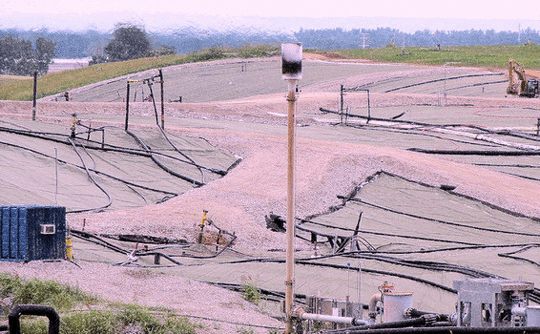 Messenger: Activist won’t back down in quest to rid St. Louis of nuclear waste By Tony Messenger St. Louis Post-Dispatch Jun 17, 2016 “…….For decades now, 83-year-old environmentalist Kay Drey has been on a quest: Get the federal government to excavate and move the waste. It’s a story that can get more complicated the deeper you dig. It involves multiple federal agencies, dense reports on various radiological elements and their “daughter products,” half-lives, warring special interest groups, lawsuits and, ultimately, a dispute over who will pay the hundreds of millions of dollars to clean it up or otherwise protect the citizens who live near the landfill.
But Drey has a way of simplifying things.
“It’s in the Missouri River flood plain,” she says of the nuclear waste. “I can’t think of a worse location. The Missouri River floods all the time. We cannot leave it there.”
That was the basic theme of the first of two reports she gave me. It’s 14 pages of testimony she submitted to the U.S. Environmental Protection Agency and the Missouri Department of Natural Resources 10 years ago. In painstaking detail, Drey outlines what is known of the waste, how it might affect groundwater and the potential for disaster if the Missouri River were to reclaim its floodplain now protected by the Earth City levee.
She quotes two old Nuclear Regulatory Commission reports, one from 1982 and the other from 1988, that outline how “hot” the waste is in West Lake and call for some sort of “remedial action.” She quotes one of the foremost flooding experts in the region, Bob Criss from Washington University, who said, “This is the wrong place to store hazardous material. It does not belong in a flood plain.”
Nobody who read Drey’s words from a decade ago would have been surprised by the release this week of a secret EPA report that reached similar conclusions.
The report, internal findings by EPA scientists that had been kept secret since 2013, concluded that it was feasible to remove the nuclear waste from West Lake. The scientists also found that doing so would reduce long-term risks.
Money.
The EPA has long wanted to simply put a cap over the waste and leave it there, at a cost of $40 million or so. It’s much less expensive than having the Army Corps of Engineers unearth the waste and dispose of it elsewhere, which might cost 10 times as much. Putting a cap in place is the preferred option of Republic Services, the company that currently owns the landfill.
Drey doesn’t care about the cost. She doesn’t care about how long cleaning up the waste would take. And she doesn’t want Republic to pay, either.
“The government put it there,” she said. “The government needs to clean it up. If we can keep making bombs, we can find the money to clean up the waste from the 1940s.”
The U.S. Senate passed a bill this year to carry out Drey’s preferred solution — have the Corps of Engineers take over the project and clean it up. But the measure appears to be dead in the House. Here’s what lawmakers need to know about Drey:
She’s not giving up…… “We need to get both houses of Congress to say they’re going to clean it up,” Drey says. “It just can’t stay there.” http://www.stltoday.com/news/local/columns/tony-messenger/messenger-activist-won-t-back-down-in-quest-to-rid/article_3da42a06-a587-53cc-bd86-e3844af3d6e1.html
-
Archives
- October 2026 (120)
- September 2026 (339)
- August 2026 (330)
- July 2026 (355)
- June 2026 (287)
- May 2026 (306)
- April 2026 (356)
- March 2026 (251)
- February 2026 (267)
- January 2026 (308)
- December 2025 (358)
- November 2025 (359)
-
Categories
- 1
- 1 NUCLEAR ISSUES
- business and costs
- climate change
- culture and arts
- ENERGY
- environment
- health
- history
- indigenous issues
- Legal
- marketing of nuclear
- media
- opposition to nuclear
- PERSONAL STORIES
- politics
- politics international
- Religion and ethics
- safety
- secrets,lies and civil liberties
- spinbuster
- technology
- Uranium
- wastes
- weapons and war
- Women
- 2 WORLD
- ACTION
- AFRICA
- Atrocities
- AUSTRALIA
- Christina's notes
- Christina's themes
- culture and arts
- Events
- Fuk 2022
- Fuk 2023
- Fukushima 2017
- Fukushima 2018
- fukushima 2019
- Fukushima 2020
- Fukushima 2021
- general
- global warming
- Humour (God we need it)
- Nuclear
- RARE EARTHS
- Reference
- resources – print
- Resources -audiovicual
- Weekly Newsletter
- World
- World Nuclear
- YouTube
-
RSS
Entries RSS
Comments RSS

