South Carolina Electric and Gas wants more ratepayers’ money for building nuclear reactors
 SCE&G files for 3.1 percent rate increase to fund nuclear plant construction, The Post and Courier David Wren Email @David_Wren_ Jun 28 2016 South Carolina Electric & Gas is asking state regulators to approve the largest single rate increase yet under a state law that lets the utility charge customers for construction of two new reactors at the V.C. Summer nuclear plant in Jenkinsville years before they are completed.
The proposed increase, which needs approval from the state’s Public Service Commission, would boost residential customers’ rates by 3.1 percent, or an average of $4.44 per bill for those using 1,000 kilowatt hours of electricity per month. Commercial customers would see their rates increase by between 3 percent and 3.3 percent, depending on the size of the business, if the new rate structure is approved.
Until now, the biggest annual increase was 2.87 percent in 2013……..If the increase is approved, nearly 19 percent of residential customers’ monthly bills will be going solely toward construction of the new reactors, according to Dukes Scott, executive director of the state’s Office of Regulatory Staff, which represents consumers’ interests in utility matters.
To date, SCE&G has charged its customers more than $1 billion for construction of the units, Scott said. The proposed rate increase would raise another $74.2 million and would take effect at the end of November if approved……..
The proposed rate increase is part of the Base Load Review Act, passed in 2008 by the General Assembly. The law allows the utility to charge its 700,000 customers for construction as the nuclear project proceeds. Historically, utilities have financed construction through bond sales that are repaid after the project is completed.
The Base Load Review Act amounts to a “blank check” for SCE&G, according to Frank Knapp, president and CEO of the S.C. Small Business Chamber of Commerce and an opponent of the rate increases.
“The law was written by the industry, the General Assembly didn’t understand it and there has been no good evaluation of it since it was passed,” Knapp said. “Consequently, here we are.”……..
The nuclear reactors initially were supposed to go online in 2016 and 2018, but are now about two years behind schedule. Further construction delays could lead to more rate increases. SCE&G plans to receive $2.2 billion in federal Production Tax Credits, but those credits — part of the Energy and Policy Act of 2005 — expire if the units aren’t up and running by Dec. 31, 2020……http://www.postandcourier.com/20160628/160629448/sceg-files-for-31-percent-rate-increase-to-fund-nuclear-plant-construction
Route 66 – America’s first public solar road
The street pavers were developed by Solar Roadways, a company created by inventors Scott and Julie Brusaw which raised more than $2.2 million in crowdfunding in 2014 to bring their technology to market. The Brusaws claim that replacing all of America’s roads and parking lots with their solar pavers would generate more than three times the country’s electricity consumption in 2009.
Missouri’s transportation department is set to launch their own crowdfunding campaign to support their energy experiment, and expects the hexagonal solar panels to be fully installed and operational by the end of the year.
Nuclear weapons risk could spread if laser uranium enrichment technology is adopted
Laser uranium enrichment technology may create new proliferation risks, Science Daily, June 27, 2016
- Source:
- Princeton University, Woodrow Wilson School of Public and International Affairs
- Summary:
- A new laser-based uranium enrichment technology may provide a hard-to-detect pathway to nuclear weapons production, according to a forthcoming paper.
- A new laser-based uranium enrichment technology may provide a hard-to-detect pathway to nuclear weapons production, according to a forthcoming paper in the journalScience & Global Security by Ryan Snyder, a physicist with Princeton University’s Program on Science and Global Security.
- One example of this new third-generation laser enrichment technique may be the separation of isotopes by laser excitation (SILEX) process which was originally developed in Australia and licensed in 2012 for commercial-scale deployment in the United States to the Global Laser Enrichment consortium led by General Electric-Hitachi. Research on the relevant laser systems is also currently ongoing in Russia, India and China.
The paper explains the basic physics of the new uranium separation concept, which relies on the selective laser excitation and condensation repression of uranium-235 in a gas. It also estimates the key laser performance requirements and possible operating parameters for a single enrichment unit and how a cascade of such units could be arranged into an enrichment plant able to produce weapon-grade highly enriched uranium.
Using plausible assumptions, the paper shows how a covert laser enrichment plant sized to make one bomb’s worth of weapon-grade material a year could use less space and energy than a similar scale plant based on almost all current centrifuge designs, the most efficient enrichment technology in use today. The results suggest a direct impact on detection methods that use size or energy use as plant footprints……..https://www.sciencedaily.com/releases/2016/06/160627160941.htm
An end to debating nuclear power: Diablo Canyon agreement wraps it up
Diablo Canyon agreement should put an end to debate about nuclear power http://www.sacbee.com/opinion/california-forum/article85614127.html
PG&E concluded Diablo Canyon nuclear plant is not economical
Nuclear power can’t compete with solar, wind in new wholesale market
21st century approach emphasizes flexibility, distributed generation
BY S. DAVID FREEMAN
The agreement between PG&E, Friends of the Earth, organized labor and other environmental organizations is the final chapter in the tumultuous history of nuclear power in California.
It began in the 1960s, when Chet Holifield, then chairman of the Congressional Joint Committee on Atomic Energy, envisioned nuclear power plants dotting the Pacific Coast every 50 miles. That dream never came true, but as Sacramento citizens will recall, we did build Rancho Seco. And Southern California Edison and PG&E completed large nuclear power plants of their own.
I helped bury Rancho Seco when I was general manger of the Sacramento Municipal Utility District in 1990. And contrary to the dire predictions, the lights stayed on, the rates didn’t go up and SMUD has behaved rather well ever since.
The other large nuclear plants, San Onofre in Southern California and Diablo Canyon in San Luis Obispo created their own controversies. Their costs spiraled out of control to the tune of billions of dollars that triggered massive rate increases. In fact, it is fair to conclude that these cost overruns at the nuclear plants triggered the deregulation policies the state adopted more than 20 years ago.
Nuclear power plants epitomize the 20th century approach to electricity production: the plants take lots of time and money to build, and generate immense amounts of electricity, but their inherent design requires them to be operated around the clock (except for refueling and repair pauses).
By contrast, the 21st century approach to electricity production emphasizes flexibility, distributed generation and seeks to reduce overall demand. In 2030, California law will require that 50 percent of electricity be from renewables like wind and solar. That power must be used when available, except for the amount stored. On most days for many hours, these renewable resources will provide 100 percent of the electricity needed. In those hours, a “must run” nuclear plant would crowd out that renewable energy and actually cause us to waste it.
This new concern is called “overcapacity.” It is a shorthand way of saying a large base load of must-run power, like from Diablo Canyon, just doesn’t fit into the power supply of the future. That was the conclusion reached not by me, but by PG&E.
Adapting to change is a challenge for environmental leaders as well as the electric utilities. Nuclear power, in decades past, was heralded as the alternative to burning dirty coal and other fossil fuels to generate electricity. There was no apparent alternative. Three Mile Island, Chernobyl and Fukushima had not yet happened. We didn’t have the sophisticated, affordable and powerful renewable technologies we have today.
Now we know better about nuclear power. It is dangerous and extremely expensive. No nuclear plant would ever have been built in America without giant subsidies from the federal government. The highly radioactive spent fuel is piling up at each reactor site.
After 50 years of looking, we must conclude there is no safe place to store it. Nuclear proliferation in the age of terror is a real threat, and the fuel in power plants can be exploited for bombs. America’s goal of eliminating nuclear weapons must start with ending nuclear power plants.
Whether or not you think nuclear power is a problem, it is economics that explains PG&E’s willingness to leave nuclear power behind. This is the kind of clear-eyed acceptance of change that today’s world requires of successful executives. By seizing the future rather than clinging to the past, PG&E’s leaders are setting an example their colleagues throughout the utility industry should study and emulate.
The Diablo Canyon agreement should put an end to the debate about nuclear power. It provides a template for a timely transition for all the nuclear and fossil fueled plants to an all-renewable future.
S. David Freeman is the former general manager of SMUD, chairman of the Tennessee Valley Authority and other utilities. Contact him at greencowboysdf@gmail.com.
Nuclear Plant Closure will be a boon for marine life
Nuclear Plant Closure Will Benefit California Marine Species NRDC.org June 23, 2016 Elizabeth Murdock “…….Closing the Diablo Canyon nuclear facility would finally end decades of harm to marine life in the region where the plant operates. The plant’s intake pipes draw in more than 2.5 billion gallons of water per day, or 2.8 million acre-feet annually. This large and continuous seawater withdrawal is estimated to kill roughly 1.5 billion fish in early life stages each year, as creatures are sucked into the cooling systems or become impinged against the screens on the open-water pipes. The cooling water is also discharged back into the ocean water at a warmer temperature, which can cause additional harm to fish and other marine life in the area.
Moreover, Diablo Canyon’s open-ocean intake is located less than one mile from the Point Buchon State Marine Reserve and the adjacent Point Buchon State Marine Conservation Area, which together protect an ecologically diverse seascape and provide a home to more than 700 species of invertebrates, as well as 120 fish species, marine plants, seabirds, and marine mammals. This “MPA (marine protected area) cluster” is important in its own right, as well as being an important part of an ecologically connected network that runs along the coast of California. While Diablo Canyon’s intake is not directly within the MPA cluster, the area of source water being drawn into the plant likely overlaps with the MPA boundaries and has the potential to withdraw marine life out of the protected area. NRDC was a leader in the effort to design and secure California’s landmark system of marine protected areas, and we remain deeply committed to ensuring the integrity of the network the marine species and habitats it shelters.
Other power plants in California that use “once-through-cooling” (OTC) technology have similar impacts on the ocean, although Diablo Canyon and the recently closed San Onofre Nuclear Generating Station near San Diego have been responsible for the largest ocean water withdrawals in the state. The Diablo Canyon Nuclear Power Plant is now the largest of the remaining once-through-cooling facilities, accounting for nearly 80 percent of all OTC ocean withdrawals in California.
Because of the significant impacts of OTC, NRDC has played a central role in advocating that California phase out the destructive practice altogether. Most notably, we have been deeply involved in the drafting, passage, and implementation of the State Water Board’s 2010 Once-Through-Cooling (OTC) Policy, which seeks to reduce the extreme impacts of power plant OTC systems on marine life and habitats. The policy directs plants to reduce their ocean intake flow rates by roughly 93 percent. For the Diablo Canyon facility to come into compliance, PG&E would have had to build close-cycle cooling towers by the end of 2024, which would have cost billions. But under the Joint Proposal, once PG&E begins decommissioning the Diablo Canyon facility, it will reduce its water intake rates—and thus its impacts on marine life—even more than it would be required to do under the OTC Policy. And ultimately, upon complete shutdown, it will cease its ocean water intakes and the associated impacts altogether.
California’s iconic ocean habitats and their marine species are of immense ecological, economic, and cultural value, within California and beyond. For three decades, the Diablo Canyon Nuclear Power Plant has had a significant impact on the marine life in the region of the plant and the once-pristine bay where it is located. Removing this impact to California’s treasured marine wildlife and coastal habitats—and replacing it with clean energy—is something all Californians can celebrate. https://www.nrdc.org/experts/elizabeth-murdock/nuclear-plant-closure-will-benefit-california-marine-species
Fake story from Wall Street Journal claiming environmentalists support nuclear power
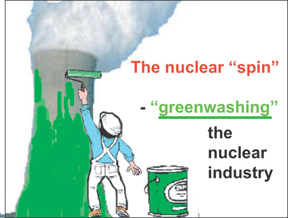
So are there prominent climate scientists and self-described environmentalists advocating for nuclear power? To be sure. But their stance doesn’t necessarily define the larger movement of low-carbon, renewable energy advocates who hold a decidedly different position.
WSJ Fakes a Green Shift Toward Nuclear Power http://fair.org/home/wsj-fakes-a-green-shift-toward-nuclear-power/ By Miranda C. Spencer The Wall Street Journal(6/16/16) published an article headlined “Environmental Groups Change Tune on Nuclear Power: Focus on Climate Change Has Raised Profile of Reactors, Now Viewed as Reliable, Carbon-Free Source of Energy.” Written by Amy Harder, the approximately 600-word piece appeared on the front page of the Journal’s B section.
Its dramatic lead-in: Continue reading
Plan for closing Diablo Canyon Nuclear Plant to save money and carbon
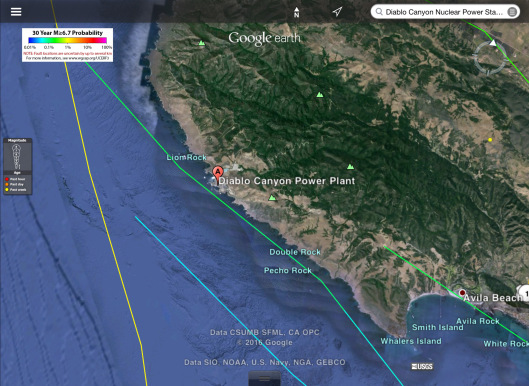 Closing Diablo Canyon Nuclear Plant Will Save Money And Carbon, Forbes, Amory B. Lovins, Cofounder and Chief Scientist, Rocky Mountain Institute, ablovins@rmi.org,www.rmi.org
A widespread claim—that dozens of nuclear plants, too costly to run profitably, now merit new subsidies to protect the earth’s climate—just collided with market reality.
The CEO of one of America’s most prominent and technically capable utilities, Pacific Gas & Electric Company—previously chairman of the Nuclear Energy Institute and the Edison Electric Institute—just announced its decision (subject to regulatory approvals) to close PG&E’s well-running twin nuclear reactors at Diablo Canyon because they’re uneconomic and won’t be needed.
Unlike previous nuclear shutdowns, some of which were too abrupt for immediate replacement with carbon-free resources, PG&E’s nuclear output will be phased out over 8–9 years, replaced timely and cost-effectively by efficiency and renewables. That means no more fossil fuel burned nor carbon emitted, all at less cost to ratepayers. How much less? Natural Resources Defense Council (NRDC) says at least $1 billion (net present value to 2044).
PG&E also agrees that removing the inflexible “must-run” nuclear output, which can’t easily and economically ramp down much, will help integrate more renewable power reliably into the grid. Midday solar, rather than being increasingly crowded out by continued nuclear overgeneration, will be able to supply more energy. As Germany found, integrating varying solar and windpower with steady “baseload” plants can present challenges for the the opposite of the reason originally supposed: not because wind and solar power vary (demand varies even less predictably), but because “baseload” plants are too inflexible.
The big economic lesson here is that nuclear power’s ability to displace fossil-fueled generation is not simply about tons of carbon dioxide saved. Nuclear power also incurs an operating cost that for many reactors, including Diablo Canyon, has become very high. Saving and reinvesting that avoidable cost can buy a larger quantity of cheaper carbon-displacing resources, saving even more carbon. Nearly all commentators, even Bloomberg’s astute editorial board(twice), have overlooked this advantageous swap.
As the Italian proverb says, arithmetic is not an opinion. So let’s do the math.
Renewables and efficiency cost less than operating many nuclear plants
Diablo Canyon’s forward operating cost, about $70/MWh (levelized 2014 $), is in the top quartile of the national nuclear fleet according to the industry’s latest published data. That quartile’s national average operating cost in 2010–12 averaged $62/MWh in 2013 $. (These operating costs include major repairs, called Net Capital Additions, that tend to rise in the aging fleet, but they exclude all charges for the original construction cost and its financing.)
But carbon-free replacements cost far less. In California, windpower and utility-scale photovoltaics cost around $30–50/MWh to build and run. U.S.-average renewables cost roughly $10/MWh less than in California. Here are their empirical market prices:……..
Saving carbon by closing uneconomic reactors…….
Propaganda meets reality
PG&E’s historic proposal contradicts each key premise of the crusade for more subsidies to avert the shutdown of uncompetitive nuclear plants. Most prominently, PG&E’s resource plan is designed specifically to get carbon-free replacements online to displace nuclear output before it’s turned off—not to substitute fossil fuels, as critics are vehemently assuming (as if they hadn’t read the proposal)……… http://www.forbes.com/sites/amorylovins/2016/06/22/close-a-nuclear-plant-save-money-and-carbon-improve-the-grid-says-pge/:
Diablo Canyon Nuclear Power Plant can and should close today
 Lies, damned lies and the nuclear industry! Media With Conscience News, Ace Hoffman 26 June 16
 Three important nuclear power events occurred in the past seven days — one in Nebraska and two in California — which together show just how doomed and unworkable nuclear power really is.
In Nebraska, the Omaha Public Power District (OPPD) Board of Directors unanimously decided to shut down Fort Calhoun Nuclear Power plant because its cost of operation could not be justified against the current and expected future price of natural gas, solar and wind power (but mainly natural gas). Certainly natural gas prices are at an unnatural low compared to the price of oil and nuclear power, and that might change over the coming years, but natural gas prices cannot go up too much if they are to stay competitive with renewable energy prices — which are going to continue to plummet over the next few decades.
Solar panels thinner than a human hair have been developed in the labs. They don’t use many natural resources to make. Solar panels as flexible as a human hair have also been developed. They can be placed virtually anywhere. Wind turbine output keeps going up for the exact same land requirements, which of course, are already minimal to begin with. Power requirements of all the major household appliances keep coming down as better motors, coolers and pumps are developed. The future is bright for renewables, and getting brighter.
All this spelled doom for Fort Calhoun, a “small” (478 megawatts, the smallest operating reactor in the United States) lone reactor that cost about $178 million dollars to build when construction began in 1966, and now costs over $250 million annually to operate. It was “simply an economic decision” to close the facility according to the operators.
Being so old and run-down, it went offline yesterday suddenly, for a turbine issue, (its speed controller failed). But no matter how often a nuclear power plant goes offline without warning, regulators and operators still assure the public they are necessary for “baseload capacity.”
Lies, damned lies and the nuclear industry strike out again
In California, an apparently momentous decision was made regarding Diablo Canyon’s pair of massive nuclear reactors (~1,100 megawatts each), which first went online in the mid-1980s and were originally scheduled to close by this year, but were granted a 10-year extension a few years ago for no apparent reason at all.
After years of threatening to try to extend their license another 20 years to 60 years and beyond, its operator, Pacific Gas & Electric (PG&E) announced that they would only run out their current license (good to 2024 and 2025 for units 1 and 2, respectively) and then be shut down permanently. The decision was made in cooperation with several environmental organizations (FoE, NRDC and A4NR) in some sort of secret backroom arrangement — an arrangement which has some good points, but has some very bad points, too.
First and foremost among the good points is, of course, that the plant will shut down. And second is that it will be replaced with renewable energy and increased energy conservation.
But first and foremost among the bad points is not only that it will take 10 more years, and not only that the decision is potentially reversible, but also that the aforementioned environmental groups apparently have lost interest in shutting the plant down earlier. That means another two million pounds of high-level nuclear waste will be generated in the meantime, with their approval. And worst of all, it means that if the San Andreas earthquake fault does what it’s been threatening to do for decades, and is actually considered late in doing, southern California will be ruined financially and environmentally. Not to mention the dozens of other faults that could shake the plant to smithereens any day of the week.
Additionally, while Fort Calhoun’s operators have promised to help the employees of that plant find other work (probably installing solar panels on rooftops, making new interconnections to the power grid, building wind turbines and so forth), Diablo Canyon has promised to take more than a third of a billion dollars of ratepayer money to do the same. As if it was the ratepayers who chose to make the workers work in a dying industry with high-paying jobs. As if there aren’t other nuclear power plants around the country that are having trouble finding workers, for those who want to stay in a dying industry. And as if there won’t be plenty of renewable energy jobs they can find for themselves.
In short, the deal stinks so badly, one activist in the Diablo Canyon area described it as being “sold down the river.”
n both cases, a major part of the decision was based on the fact that the electricity generated by Fort Calhoun and Diablo Canyon (and virtually every other nuclear power plant in the country) can be replaced immediately with other power sources, without the lights going out or reliability of the grid falling below set point levels. This is as it must be: Nuclear power plants require the rest of the grid to be operating or they themselves must shut down.
That’s why, when a massive power outage struck the northeastern United States in 2003, all the nuclear power plants in the area automatically shut down and could not help keep the grid up. They require about 30 megawatts of continuous power to operate, and as much as 100 megawatts during restart once they shut down for any reason. It took many days for the nuclear power plants to come back online even after the rest of the grid was restored. So much for the reliability of the “baseload” power system!
Diablo Canyon can and should close today. Even its owners have now admitted that its electricity output can be replaced entirely by renewables (although that might take a couple of years to accomplish, it would free up about 1500 workers (1200 PG&E employees, 200 subcontractors, and miscellaneous high-paid executives) to start installing solar panels and wind turbines. Its total output could be replaced in a matter of months.
Meanwhile, the nuclear waste at San Onofre is no longer being generated (SanO closed permanently in 2013 after a leaky steam generator could not be repaired). But the lies and damned lies continue spewing forth unabated from that complex as well. Last night, the quarterly Citizen’s Engagement Panel met once again, supposedly to engage with citizens but in fact, to push the utility’s agenda of cheap, ineffective, dangerous solutions to its nuclear waste problem — which it will have for 500,000 years unless something is done about it.
The meeting was attended by some high-powered outsiders from the Department of Energy and a former Nuclear Regulatory Commission chairman, Dr. Allison Macfarlane. Earlier in the day several localized meetings were held with these outsiders for additional discussions. It all looks very cooperative on paper, but in reality it’s nothing but the regular dog-and-pony shows the nuclear industry and the NRC have been putting on for decades.
Time was, speakers at an NRC hearing were sworn in, swore to tell the truth, the whole truth, and nothing but the truth. That ended about 20 years ago, and now we have a non-governmental body making nonsense plans and decisions which will affect the local population for decades to come, will solve nothing, will obstruct real solutions (more on that in a moment), and will push the utilities’ agenda down everybody’s throats (literally, when the waste escapes its escarpments)………http://mwcnews.net/focus/analysis/59553-nuclear-industry.html
Pentagon’s nuclear-powered spending: a $trillion and climbing
Behold the Pentagon’s Amazing, Nuclear-Powered ATM, Mother Jones
 When the going gets tough, the world’s toughest military sends out RFPs.

ANDREW COCKBURNJUN. 24 “………creating and maintaining an effective fighting force becomes a secondary consideration, reflecting a relative disinterest—remarkable to outsiders—in the actual business of war, as opposed to the business of raking in dollars for the Pentagon and its industrial and political partners. A key element of the strategy involves seeding the military budget with “development” projects that require little initial outlay but which, down the line, grow irreversibly into massive, immensely profitable production contracts for our weapons-making cartels……
ongoing and dramatic programs to invest vast sums in meaningless, useless, or superfluous weapons systems are the norm. There is no more striking example of this than current plans to rebuild the entire American arsenal of nuclear weapons in the coming decades, Obama’s staggering bequest to the budgets of his successors.
These nuclear initiatives have received far less attention than they deserve, perhaps because observers are generally loath to acknowledge that the Cold War and its attendant nuclear terrors, supposedly consigned to the ashcan of history a quarter-century ago, are being revived on a significant scale. The US is currently in the process of planning for the construction of a new fleet of nuclear submarines loaded with new intercontinental nuclear missiles, while simultaneously creating a new land-based intercontinental missile, a new strategic nuclear bomber, a new land-and-sea-based tactical nuclear fighter plane, a new long-range nuclear cruise missile (which, as recently as 2010, the Obama administration explicitly promisednot to develop), at least three nuclear warheads that are essentially new designs, and new fuses for existing warheads. In addition, new nuclear command-and-control systems are under development for a fleet of satellites (costing up to $1 billion each) designed to make the business of fighting a nuclear war more practical and manageable.
This massive nuclear buildup, routinely promoted under the comforting rubric of “modernization,” stands in contrast to the president’s lofty public ruminations on the topic of nuclear weapons. The most recent of these was delivered during his visit—the first by an American president—to Hiroshima last month. There, he urged“nations like my own that hold nuclear stockpiles” to “have the courage to escape the logic of fear, and pursue a world without them.”
In reality, that “logic of fear” suggests that there is no way to “fight” a nuclear war, given the unforeseeable but horrific effects of these immensely destructive weapons. They serve no useful purpose beyond deterring putative opponents from using them, for which an extremely limited number would suffice. During the Berlin crisis of 1961, for example, when the Soviets possessed precisely four intercontinental nuclear missiles, White House planners seriously contemplated launching an overwhelming nuclear strike on the USSR. It was, they claimed, guaranteed to achieve “victory.” As Fred Kaplan recounts in his book Wizards of Armageddon, the plan’s advocates conceded that the Soviets might, in fact, be capable of managing a limited form of retaliation with their few missiles and bombers in which as many as three million Americans could be killed, whereupon the plan was summarily rejected.
In other words, in the Cold War as today, the idea of “nuclear war-fighting” could not survive scrutiny in a real-world context. Despite this self-evident truth, the US military has long been the pioneer in devising rationales for fighting such a war via ever more “modernized” weapons systems. ……..
The drive to develop and build such systems on the irrational pretense that nuclear war fighting is a practical proposition persists today. One component of the current “modernization” plan is the proposed development of a new “dial-a-yield” version of the venerable B-61 nuclear bomb. Supposedly capable of delivering explosions of varying strength according to demand, this device will, at least theoretically, be guidable to its target with high degrees of accuracy and will also be able to burrowdeep into the earth to destroy buried bunkers. The estimated bill—$11 billion—is a welcome boost for the fortunes of the Sandia and Los Alamos weapons laboratories that are developing it.
The ultimate cost of this new nuclear arsenal in its entirety is essentially unknowable. The only official estimate we have so far came from the Congressional Budget Office, which last year projected a total of $350 billion. That figure, however, takes the “modernization” program only to 2024……..
Assiduously tabulating these projections, experts at the Monterey Center for Nonproliferation Studies peg the price of the total program at a trillion dollars. In reality, though, the true bill that will come due over the next few decades will almost certainly be multiples of that. For example, the Air Force has claimed that its new B-21 strategic bombers will each cost more than $564 million (in 2010 dollars), yet resolutely refuses to release its secret internal estimates for the ultimate cost of the program.
To offer a point of comparison, the F-35 Joint Strike Fighter, the tactical nuclear bomber previously mentioned, was originally touted as costing no more than $35 million per plane. In fact, it will actually enter service with a sticker price well in excess of $200 million.
Nor does that trillion-dollar figure take into account the inevitable growth of America’s nuclear “shield.”……..http://www.motherjones.com/politics/2016/06/pentagon-budget-nuclear-spending
Illinois nuclear plant shutdown situation – defacto radioactive dump
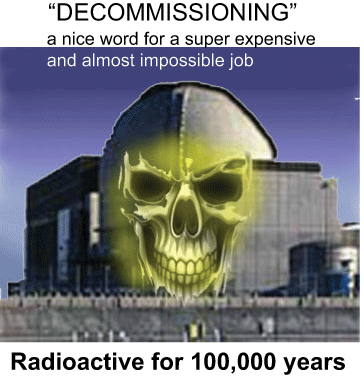 Nuclear plant shutdown in Illinois could offer lessons for SLO County Power plant in Zion, Illinois, closed nearly 2 decades ago because of an employee’s mistake. Tribune, 26 June 16
Community leaders say storage of spent nuclear fuel is preventing redevelopment of desirable lakefront property
They are leading a push to obtain federal financial compensation for communities that become de facto storage sites for waste BY STEPHANIE FINUCANE sfinucane@thetribunenews.com. Nearly 20 years after the shutdown of a nuclear power plant in the small community of Zion, Illinois, the city’s finance director describes the local economy in a single word: struggling.
“We’ve lost about $18 million communitywide,” said David Knabel, referring to the annual property tax that used to be generated by the power plant. “That tax burden got shifted to businesses and residents.”
Since the plant closed, property tax rates rose 143 percent, according to city documents. That’s made it tough to attract new employers.
“With the tax rate going through the roof … who wants to buy a house or bring businesses in?” asked Knabel.
Yet Zion isn’t blaming the nuclear power plant. As local pastor and City Commissioner Mike McDowell pointed out, that was a business decision.
The city is upset, though, that it’s become a long-term storage site for highly radioactive spent fuel — something it never signed on for.
Officials say the spent fuel is preventing redevelopment of the prime lakefront property where the plant was built, and they’re looking to the federal government for financial relief.
“We can’t get the federal government to move it,” said McDowell, “and at this point, we’re not being compensated for the impact.”……..
Once the decommissioning is complete, the property will be returned to Exelon Corp., the parent of Zion’s operator, Commonwealth Edison.
Officials in the city of Zion don’t know when that will be, nor do they know how much of the property could be permanently off-limits because of the spent fuel storage facility.
Like reactor communities across the nation — including San Luis Obispo County — the citizens of Zion did not expect to store spent nuclear fuel indefinitely. They believed the federal government would make good on its commitment to accept the waste, which at one time was destined for Yucca Mountain, Nevada. That plan fell apart, however, and the federal government has yet to identify an alternative site for permanent storage.
Zion is leading a push for federal legislation that would provide financial compensation to communities that have become de facto storage sites for spent fuel………http://www.sanluisobispo.com/news/local/article86054762.html
Sierra Club remains categorically opposed to nuclear power
June 23, 2016 “Green Groups Ease Opposition to Nuclear Power” (Business & Tech, June 17) gets it wrong. The Sierra Club remains in firm opposition to dangerous nuclear power. The article reflects wishful thinking on the part of the nuclear industry but doesn’t accurately represent the position of the Sierra Club.It is categorically incorrect to suggest that the Sierra Club considers nuclear power a “bridge” to clean energy. Nuclear power, much like coal, oil and gas, is a bridge to nowhere. In Illinois the Sierra Club is part of a coalition to increase renewable energy and energy efficiency, not preserve nuclear reactors. America’s energy future must be powered by 100% clean, renewable energy like wind and solar—and nuclear in no way meets this requirement.
The Sierra Club’s successful work to stop and retire coal and gas operations has never precluded our efforts to oppose nuclear power, nor will it ever. Decades of evidence around the world clearly demonstrates that nuclear power remains a dirty and extremely dangerous energy source, and we will continue our efforts to block new reactors from being built and replace existing ones with 100% clean, renewable energy.
Every State can go Nuclear Free: California shows the way with a blue-green alliance
 California Is Going Nuclear-Free, Which Means Everyone Else Can, Too, Fast Coexist.com MICHAEL SHANK 06.21.16
A historic deal to replace the Diablo Canyon nuclear plant with renewable energy could be a model for the rest of the country. “……, a new historic agreement between a major American power company and environmental groups shows that another way is possible. America can, in fact, transition off nuclear in the short-term and replace it with renewable energy, efficiency and energy storage resources. It’s totally feasible. Take a look at the groundbreaking agreement:
First, the 100-plus year-old California-based power giant, Pacific Gas and Electric (PG&E), just agreed to shut down its two 30 year-old nuclear reactors in Diablo Canyon, letting the licenses expire in 2024 and 2025, respectively. This is a big deal, and it’ll make California, the world’s sixth largest economy, nuclear free.
This is no small thing. These two PG&E nuclear reactors, which spurred the start of the environmental organization Friends of the Earth, comprise roughly 20% of the annual electricity production in the company’s service territory and 10% of California’s annual production.
That’s a lot of power. And yet the transition off these kinds of plants is entirely doable and illustrative of switches that should happen across the U.S., including much older plants with long-expired licenses. Entergy’s Indian Point nuclear reactors north of New York City, for example, could be closed even sooner than Diablo Canyon and replaced with a portfolio of renewables, efficiency, and storage. Taking a cue from California, we should be replicating this everywhere.
Second, this agreement indicates that California is outpacing other states in how its utilities are redefining their future, as PG&E didn’t stop with the Diablo Canyon closure. They committed to ramping up their renewable energy portfolio over the next 15 years so that renewables will comprise the majority of their total retail power, at 55%, voluntarily exceeding California’s standards for 2030.
That’s also a big deal and heralds a new tide of utility leadership. PG&E sees the markets moving and wants to make the switch early. Utilities across the U.S., many of which are notoriously conservative in thinking and practice, are seeing the writing on the wall. And in the coming years, we’ll only see more of this switching as the economics are rapidly driving the conversion.
A model for nuclear plant closure: Diablo Canyon co-operative plan
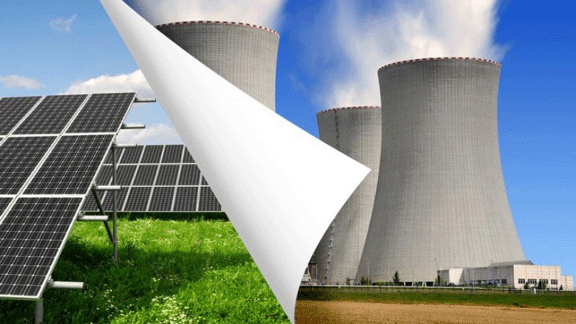 Diablo Canyon Nuclear Closure Plan: An Important Model, Natural Resources Defense Council, June 22, 2016 Matthew McKinzie Fourteen U.S. nuclear reactors have now been shut down or their owners have announced their closures since 2010, either because they were uneconomic in today’s electricity markets or had operational or environmental problems. The Joint Proposal announced yesterday for the two reactors at California’s Diablo Canyon Power Plant is historic, because it is the first time any utility owner has committed to a plan to replace retiring nuclear generation with 100 percent, zero-emissions, clean electricity-generating resources that are also lower cost. This shows that with careful planning, there is no need to substitute polluting fossil fuels for retiring nuclear generation –-an important model for the rest of the world.
The Diablo Joint Proposal signed by Pacific Gas & Electric (PG&E), Friends of the Earth, NRDC, labor and other environmental groups is further proof that our energy system is changing, and renewable energy and other resources can fill the gaps left from shuttering nuclear plants.
Energy efficiency, wind, and solar address climate change without nuclear energy’s burdens of highly radioactive waste, the need for physical and cyber security to guard against terrorist nuclear threats, the risk of radiation release in a major accident, and the nuclear weapons proliferation problem.
To see just how monumental the Joint Proposal for Diablo is, it’s important to take a look at what’s happening today in the nuclear industry. Since 2010, across Vermont, Massachusetts, New York, New Jersey, Florida, Illinois, Wisconsin, Nebraska and California, 14 nuclear reactors at 11 power plants totaling 11.9 gigawatts of electric capacity have either closed, or their owners have announced they will close.
Information on these closed or closing nuclear reactors is summarized in this table, and patterns are evident. Three of the reactors closed for primarily mechanical/safety reasons, whereas 11 reactors closed or will close primarily for market reasons. In other words, in today’s wholesale electricity markets (which largely do not reflect external costs imposed by carbon pollution), these reactors were unable to compete with other forms of electricity generation, including natural gas and wind, when utilities are procuring energy sources to help meet their customers’ needs……….
A carbon-free, renewable futureFortunately, both the United States and the world are making great strides forward on carbon-free energy efficiency and renewable energy, as well as technologies like demand response and battery storage. An October 2015 NRDC report “Tectonic Shift” describes how economic growth is now decoupled from energy usage, and that in fact energy usage is flat. California has adopted a requirement that half of its electricity come from renewable energy resources by 2030, and New York is about to adopt the same requirement. In 2015,in data compiled by AWEA, more than 30 percent of Iowa’s electricity came from wind power alone and three other states generated more than 20 percent of their electricity from wind power alone.
And the National Renewable Energy Laboratory has concluded that “renewable electricity generation from technologies that are commercially available today, in combination with a more flexible electric system, is more than adequate to supply 80 percent of total U.S. electricity generation in 2050 while meeting electricity demand on an hourly basis in every region of the country.”……
the Diablo Canyon proposal shows that given sufficient time to prepare, retiring nuclear capacity can transition smoothly to a mix of energy efficiency measures; clean, renewable resources; and energy storage without any role for fossil fuels – an outcome that can be optimal for the environment, the market, and the reliability of the electric grid.The Joint Proposal governing the shutdown of Diablo Canyon within nine years is exactly that – full replacement of retiring nuclear generating capacity with lower cost, zero-carbon resources. The proposal is a robust model of planned, orderly transition that takes into account sound energy policy, the values of jobs and community, the threat of climate change, and nuclear safety concerns. https://www.nrdc.org/experts/matthew-mckinzie/diablo-canyon-nuclear-closure-plan-important-model
USA’s Department of Energy seeks “consent-based” #nuclear waste sites
 Nuclear waste, anyone? Feds look to willing states, The Orange County Register, June 22, 2016 By TERI SFORZA / STAFF WRITER Federal officials unleashed bubbles of hope in San Juan Capistrano on Wednesday – we’re developing a plan that can remove deadly nuclear waste from San Onofre earlier than we thought! – while others worked feverishly to pop them.
Speaking to a raucous audience at the San Juan Capistrano Community Center, John Kotek, the U.S. Department of Energy’s acting assistant secretary for nuclear energy, detailed the federal government’s new push for temporary nuclear waste storage in regions allegedly eager for the business.
Several such “consent-based” sites – currently envisioned in West Texas and New Mexico – could be up and running while the prickly question of finding a permanent home for the waste is hashed out……..
Some in Texas and New Mexico say they’ll never consent to importing our deadly castoffs, and they’re ready to do battle.
“Please be aware that many people in Texas and New Mexico are solidly opposed to having high-level radioactive waste stored in our region,” said Karen Hadden of the Sustainable Energy & Economic Development Coalition, a Texas-based nonprofit focusing on clean energy and public health, in a letter to San Onofre officials.
The DOE scheduled eight meetings about consent around the country, but none in Texas or New Mexico, the targeted region. … Dumping this dangerous waste on communities that are largely Hispanic and lack the resources to fight back, people who never had a say in the nuclear reactors to begin with or benefited from any electricity from them, would be an extreme example of environmental injustice.”
The Texas Democratic Party has gone on record opposing the import of nuclear waste, conjuring the stalemate at Yucca Mountain. The federal government spent $10 billion to put a permanent repository there, despite the opposition of Nevada residents. That effort is essentially dead……
 Former Nuclear Regulatory Commission Chairwoman Allison Macfarlane explained the tortured landscape: a Congress that only sees two, four and six years into the future, and is satisfied that the waste is safe where it is today, at 75 different sites across the nation; utilities that want to reduce costs, and thus aren’t eager to make changes; a Department of Energy that doesn’t have the legal authority to solve the problem entirely; and a Department of Justice that is paying billions to utilities from a judgment fund of taxpayer money, because the federal government promised the utilities it would permanently dispose of that waste in exchange for payments, but has failed utterly to do so……
It’s our ethical responsibility to not stick this problem to future generations, Macfarlane said to applause from the audience.
“I’m not hopeful new physics will be discovered to magic this stuff away. We have to grapple with it. It’s there.” http://www.ocregister.com/articles/waste-720291-nuclear-new.html
USA promotes a nuclear arms race in Asia, by Supporting India’s entry to Nuclear Suppliers Group
 Promoting a nuclear race?, Business Recorder June 23, 2016 IKRAM SEHGAL India clandestinely diverted nuclear fuel from the Canadian supplied civilian nuclear reactor in Tarapur for conducting its nuclear test in 1974. Created in 1974 as a direct result of the Indian subterfuge, the Nuclear Suppliers Group (NSG) was meant to prevent in future what India had done, being tasked with regulating nuclear commerce for civilian uses and preventing proliferation of nuclear weapons.
On the back of the US-India nuclear deal in 2008, the Bush Administration applied immense political pressure to exempt India from the NSG’s rules on civilian nuclear trade when it was under US sanctions for proliferation activities. This double standards waiver was engineered when Pakistani’s letter vehemently objecting to it was suddenly and surprisingly withdrawn in Vienna during NSG deliberations at the last minute on the express telephonic instructions from President Asif Zardari. This unparalleled “personal” initiative appeased the US and India but it destroyed the original concept of the NSG and cost Pakistan dearly. It “officially” allowed India to expand its arsenal massively by using imported fuel for civilian nuclear reactors and replenish stocks for weapon production. “Harvard’s Belfer Center” and US think tank “Arms Control Today” confirmed that this defeated the very purpose why the NSG was created in the first place.
What about nuclear balance in South Asia? In an article published by the International Committee of the Fourth International (ICFI), in September 2008 the writers correctly assessed that, “The action the NSG has been goaded into taking by the US has immense and incendiary strategic implications for South Asia, tilling the balance of power between India and its historic rival Pakistan sharply in India’s favour. It also rubbishes the basic principle of the nuclear regulatory regime the US championed earlier that States which pursue nuclear weapons will be “punished” by an embargo on all nuclear trade and those that adhere to the NPT will, in return, be assisted in developing civilian nuclear energy. And, as was foreshadowed in the events at the NSG meeting itself, it will intensify and complicate the ongoing and ever more explosive rivalry amongst the big powers for markets, raw materials, and geo-strategic advantage.”
A Senate hearing on 24 May saw US Senator Markey saying something extremely relevant, “Since 2008 when (we) also gave them an exemption, India has continued to produce fissile material for its nuclear weapons programme virtually un-checked. At that time Pakistan warned us that the deal would increase the chances of the nuclear arms race in South Asia”. Some countries, led by China and Turkey, are resisting this pressure on principle, arguing that if any exception to the rules is made, it should apply equally to both India and Pakistan. Since all 48 member NSG decisions are made by consensus, even one member can block a decision.
India has not honoured its limited commitments under the international non-proliferation regime that earned it the 2008 waiver, adhering to limited IAEA Additional Protocol as well as US laws (Hyde Act) for transparency in use of imported fissile material, agreeing to a moratorium on fissile material production for weapons use; signing and ratifying the CTBT and putting a cap on its nuclear weapons production. In the face of these obvious deficiencies, allowing India NSG membership will intensify the nuclear/strategic arms race in South Asia, undermine NSG’s credibility and will give India the legitimacy of a nuclear weapon state. Bent on using India as a counterweight to China, the US must realise the dangerous confrontation that will erupt in South Asia………http://www.brecorder.com/articles-a-letters/187/59532/
-
Archives
- October 2026 (120)
- September 2026 (339)
- August 2026 (330)
- July 2026 (355)
- June 2026 (287)
- May 2026 (306)
- April 2026 (356)
- March 2026 (251)
- February 2026 (267)
- January 2026 (308)
- December 2025 (358)
- November 2025 (359)
-
Categories
- 1
- 1 NUCLEAR ISSUES
- business and costs
- climate change
- culture and arts
- ENERGY
- environment
- health
- history
- indigenous issues
- Legal
- marketing of nuclear
- media
- opposition to nuclear
- PERSONAL STORIES
- politics
- politics international
- Religion and ethics
- safety
- secrets,lies and civil liberties
- spinbuster
- technology
- Uranium
- wastes
- weapons and war
- Women
- 2 WORLD
- ACTION
- AFRICA
- Atrocities
- AUSTRALIA
- Christina's notes
- Christina's themes
- culture and arts
- Events
- Fuk 2022
- Fuk 2023
- Fukushima 2017
- Fukushima 2018
- fukushima 2019
- Fukushima 2020
- Fukushima 2021
- general
- global warming
- Humour (God we need it)
- Nuclear
- RARE EARTHS
- Reference
- resources – print
- Resources -audiovicual
- Weekly Newsletter
- World
- World Nuclear
- YouTube
-
RSS
Entries RSS
Comments RSS

