Why is New York Times shilling for the clearly failing technology of nuclear power, while dismissing renewables?
 New York Times Shills For Moribund Nuclear Power, Disses Renewables Revolution, Climate Progress BY JOE ROMM JUL 25, 2016 Why does The New York Times keep pushing nuclear power, whose prices keep rising even as demand has collapsed in every market economy? And why do they keep dissing renewables, whose prices have dropped precipitously while demand has grown beyond expectation here and around the world?
This month alone, the Times managed to publish two pieces whining that the poor, neglected nuclear power industry is having trouble competing with renewables because solar and wind have become … so darn cheap.
Utterly lost on the Times is the irony that nuclear power was originally touted as a key part of a future where electricity was “too cheap to meter.” Now it’s just another inflexible but powerful dinosaur industry being crushed in the marketplace by a superior product — kind of like mainframe computers or the horse and buggy or … print newspapers.
The fact is that on a purely economic basis, nuclear power has to a great extent priced itself out of the market for new power, even for new carbon-free power. Heck, even the French can’t build an affordable, on-schedule next generation nuclear plant in their own nuclear-friendly country!!
But rather than report accurately on the renewable energy miracle, as, say, the International Energy Agency (IEA) and Bloomberg New Energy Finance (BNEF) have, the Times manages to publish articles in its business section headlined, “How Renewable Energy Is Blowing Climate Change Efforts Off Course.” Seriously.
I will be debunking this wildly misleading piece — which is by Eduardo Porter, an economics correspondent (!) — point by point in my next post, but for now, let me just post some actual numbers (and quantified projections). In its latest report on the subject, “The Low Carbon Economy: Our Thesis In 60 CHARTS,” Goldman Sachs has several charts on “Emissions: How low carbon technologies begin to bend the curve.” Here’s just one: [on original]
Goldman Sachs concludes, “On our wind and solar numbers, emissions in IEA scenarios could peak as early as c.2020, rather than 2030.” So, yeah, “Renewable Energy Is Blowing Climate Change Efforts Off Course” — off course from failure to possible success.
The Times piece is the kind of nonsense you would expect to see on an ultra-conservative website with the headline “There Are Serious Problems With Wind And Solar.” Still, it’s probably just a coincidence that the ultra-conservative Daily Caller website repackaged the Times piece with that headline, and this lead: “Wind and solar power have been expensive boondoggles that won’t develop fast enough to affect global warming, according to a New York Times (NYT) article published Wednesday.”
It’s probably just a coincidence that the Times has a history of inflating nukes and deflating renewables….
It’s probably just a coincidence that one of the leading energy reporters for the Times, 30+ year veteran Matt Wald, after leaving the paper joined the Nuclear Energy Institute to become senior director of policy analysis and strategic planning last year.
It’s probably just a coincidence that the Times has been running this sponsored post from a pro-nuke group: http://paidpost.nytimes.com/nuclear-matters/nuclear-energy-in-the-us.html#. Don’t worry, that’s all made clear in small type to readers who can breathe easy that “The news and editorial staffs of The New York Times had no role in this post’s preparation.”
OK, on closer inspection, it does not appear to be a coincidence that, for a long time now, ridiculous stories dissing renewables and favoring nukes have been the norm (see, for instance, my 2009 post “NYT’s Matt Wald blows the ‘Alternative and Renewable Energy’ story, quotes only industry sources, ignores efficiency and huge cost of inaction” and my 2011 post, “The New York Times Abandons the Story of the Century and Joins the Energy and Climate Ignorati”). I will examine a number of more recent pieces below………
Let’s look at some pieces in just the last year that reveal the Times’ apparent ongoing slant……
For decades, the entire conservative political establishment and right-wing media have devoted themselves to blocking all climate action, to spreading disinformation on climate action, and, sometimes, even opposing the use of the word “climate change.” They have also generally devoted themselves to spreading misinformation on clean energy and opposing policies that promote it. For decades, the liberal Democratic “establishment” has supported nuclear power and enacted pro-nuclear policies in national energy bill after national energy bill — including tax incentives andloan guarantees for new plants. And let’s not forget the repeated renewal of the Price-Anderson Nuclear Industry Indemnity Act, which puts the taxpayer on the hook for the cost of a truly major disaster and is probably a $100 billion-dollar subsidy by itself.
In any case, even with all those subsidies, new nuclear power has priced itself out of the marketplace, something this article [from New York Times] never mentions — and so it is perfectly rational for someone who is concerned about climate change to understand that new nuclear power is at best a relatively modest piece of the solution (as the IEA and Nuclear Energy Agency concluded last year), and at worst a very expensive distraction……
And you don’t have to take my word — or the Times’ word. “Ever since the completion of the first wave of nuclear reactors in 1970, and continuing with the ongoing construction of new reactors in Europe, nuclear power seems to be doomed with the curse of cost escalation,” read one 2015 journal article, “Revisiting the Cost Escalation Curse of Nuclear Power.”
Then there’s the Financial Times reporting last October on France’s newest Normandy plant, which originally was projected to cost €3bn ($3.3 billion) and start producing power in 2012. Instead, it “will not start until 2018 at a cost of €10.5bn [$11.3 billion].” Yes, even the French can’t build an affordable, on-schedule next-generation nuclear plant in their own nuclear-friendly country. Does that make them anti-science, too?…..
The key question is why does the Times have a pattern in which it overhypes nuclear power well beyond what the facts warrant — while at the same time generally underselling and minimizing the solar and wind well beyond what the facts warrant? Perhaps, just for the sake of appearance, they should stop running paid pro-nuke ads (that are virtually indistinguishable from their own unbalanced pro-nuke pieces) until they can answer this question. http://thinkprogress.org/climate/2016/07/25/3800630/nuclear-power-renewables-times/
USA marketing nuclear power to Mexico
 US and Mexico map out agreement on nuclear power issues Utility Dive| July 26, 2016
Dive Brief:
- United States and Mexico have committed to negotiate a bilateral agreement for peaceful nuclear cooperation, according to the White House.
- The agreement is aimed at strengthening the existing legal framework and providing an enhanced basis for the transfer of nuclear technology, fuel, and components between the countries.
- In addition to enhancing potential power sector emissions reductions, the agreement aims to enhance the capacities of both nations in the supply chain and nuclear fuel services and to facilitate the sharing of best practices.
Nuclear industry to get a heft subsidy from New York residents
 A hefty nuclear subsidy Times Union, July 25, 2016 “……… It’s one thing to keep nuclear plants running temporarily while the state transitions to green energy. It’s another to hand nuclear plant operators billions of dollars that could instead be used to move New York that much more quickly to a clean energy future.
The nuclear subsidies are being proposed in the state’s Clean Energy Standard. The CES, also known as the “50-by-30” plan — because it seeks to achieve the 50 percent clean energy goal by 2030 — would shift more of the state’s electricity supply to sources like wind, solar, hydropower and biomass, and away from fossil fuels.
Some want nuclear power in the mix, too, but it has some not-insignificant problems — the risk of an accident, and the still-unresolved question of safe disposal of radioactive waste. It’s hard to see nuclear power plants as being part of an environmentally sound energy future.
As a short-term bridge to that future, however, they could play a part, if they can stand on their own. Supporters say they can’t in the current market.
So the CES would include a program of “zero emissions credits” — a charge that utilities and energy service companies would pay to keep nuclear plants open. Those costs are expected to start at $965 million for the first two years, rising to about $1 billion a year, paid for by, well, pretty much anyone with an electricity bill……
What, however, is a reasonable windfall? Just how much do these plants realistically need to stay open? Is the state fattening nuclear plant profits with money that could be used to fund more alternative energy, and more energy savings programs, and achieve the CES goals even sooner?…….http://www.timesunion.com/tuplus-opinion/article/Editorial-A-hefty-nuclear-subsidy-8416153.php
EPA’S OWN EXPERTS DISAGREE ON ASSESSMENT OF WASTES AND SOLUTION AT WEST LAKE LANDFILL
 NEW REPORT SHOWS EPA’S OWN EXPERTS DISAGREE ON REGION 7 ASSESSMENT OF WASTES AND SOLUTION AT WEST LAKE LANDFILL, Just Moms St Louis, 07/22/2016
New Report shows EPA’s own experts disagree on Region 7 assessment of wastes and solution at West Lake Landfill.A new report released by Bob Alvarez and Lucas Hixson draws conclusion from the newly released EPA National Remedy and Review Board critique as well as documents and emails discussing the 2008 decision to cap-and-leave the wastes at West Lake Landfill. This report is short and a must read for everyone. There are links to source documents at the end of the report.This report clearly describes the disastrous decisions being made by Region 7, despite EPA’s own top scientists.
This, in fact, is why Missouri’s Federal Representatives and Senators all cast a vote of no confidence in EPA’s ability to successfully manage and remediate the atomic weapons waste at the landfill. Thus, prompting legislation this past fall to take control of the radioactive wastes away from EPA and give jurisdiction to the Army Corps of Engineers FUSRAP.
Based on the linked report, It sounds like EPA’s review board and top scientists have also cast their own vote of no confidence in Region 7.
You can find the report here.
To learn more about FUSRAP and its involvement in St. Louis clickhere.
To follow the status of bipartisan legislation, HR4100, click here.
Dangerous events that were not considered in the 2008 EPA Record of Decision.
An underground fire, or smoldering subsurface event, has been burning since 2010 and is expected to burn for another 5-10 years. This underground fire is the size of 6 football fields. Everyday this fire burns it is inching its way closer to the known nuclear waste. Attorney General Chris Koster warned that a Chernobyl-like event could occur if the fire meets the radioactive waste, i.e. radioactive particles could attach to steam or smoke and be released into the atmosphere……… http://www.stlradwastelegacy.com/new-report-shows-epas-own-experts-disagree-on-region-7-assessment-of-wastes-and-solution-at-west-lake-landfill-07222016/
San Onofre nuclear waste stranded on the beach
“That site will not survive for 10,000 years, just based on the normal erosion and other factors,”
“For most in Congress, their political horizon is two years, four years, six years out,” McFarlane said. “They’re not motivated.”

 FOCUS: WHY SAN ONOFRE’S NUCLEAR WASTE STAYS ON THE BEACH Policy stalemate leaves toxic spent fuel stranded, San Diego Union Tribune BY ROB NIKOLEWSKI July 22, 2016 Some 3.6 million pounds of nuclear waste at the shuttered San Onofre Nuclear Generating Station is all stored up with no place to go.
The plant has not produced electricity since January 2012 for the nearly 19 million people served by Southern California Edison, the majority owner of the facility, andSan Diego Gas & Electric, which owns 20 percent.
Edison officials overseeing the plant’s decommissioning have set a target date of the end of 2032 to remove nearly every remnant of the generating station, which hugs the Southern California coastline at the northern tip of San Diego County in Camp Pendleton.
The operative word is “nearly” because, in all likelihood, the waste — also called spent fuel or used fuel — will stay behind for years to come, stranded until a long-term solution is reached on what to do with it. Going back to the 1960s when the plant broke ground, anti-nuclear critics and Edison officials have not often seen eye-to-eye. But when it comes to the spent fuel, they are in complete agreement: Both sides want it off the premises as soon as possible.
“This is not the right solution, putting the waste on the beach,” said Ray Lutz, El Cajon resident and founder of the nonprofit Citizens Oversight. Lutz made the comment on June 22, just before a Community Engagement Panel, one of a series of public meetings Edison hosts every three months.
“It’s very frustrating,” Tom Palmisano, Edison’s vice president of decommissioning and the chief nuclear officer, said earlier this month.
So why is the waste stuck near the beach? Continue reading
REGIONAL RISKS in America’s Spent Nuclear Fuel Rods and Storage Pools
 Spent Nuclear Fuel Rods and Storage Pools: A Deadly and Unnecessary Risk in the United States. Based on an Institute for Policy Studies report by Robert Alvarez entitled “Spent Nuclear Fuel Pools in the U.S.: Reducing the Deadly Risks of Storage.”
“…….New York. If a spent fuel fire were to happen at one of the two Indian Point nuclear reactors located 25 miles from New York City, it could result in as many as 5,600 cancer deaths and $461 billion in damages. Indian Point spent fuel storage has about three times more radioactivity than the combined total in the spent fuel pools at the four troubled Fukushima reactors.
Los Angeles. The spent fuel at Diablo Canyon nuclear reactors have nearly 2.7 times more radioactivity than the combined total in the spent fuel pools at the four troubled Fukushima reactors.
Miami. Turkey Point reactors 65 miles from Miami have 2.5 times more radioactivity than the combined total in the spent fuel pools at the four troubled Fukushima reactors.
Dallas. The Comanche Peak nuclear station 60 miles southwest of Dallas has spent fuel that contains about 2.3 times more radioactivity than the combined total in the spent fuel pools at the four troubled Fukushima reactors.
Atlanta. The Vogtle nuclear reactors near Augusta are 147 miles northeast of Atlanta. These reactors have generated 2.5 times more radioactivity than the combined total in the spent fuel pools at the four troubled Fukushima reactors. https://ratical.org/radiation/NuclearExtinction/IPS-RA-ReportFactSheet.pdf
New York’s nuclear subsidy plan will grow to a $multibillion cost to ratepayers
 Nuclear Subsidies Are Key Part of New York’s Clean-Energy Plan, NYT By VIVIAN YEE JULY 20, 2016 “………The commission is considering a proposal that makes the state’s three upstate nuclear plants important parts of its efforts to wean itself off fossil fuels, offering nearly $1 billion in ratepayer-financed subsidies over the next two years to save plants battered by rising costs and competition from cheap natural gas.
With very little process, and very little time for the public to even know this is happening, what they’re proposing here is a multibillion-dollar uncompetitive subsidy to one company,” said Jessica Azulay, a spokeswoman for the Alliance for a Green Economy, an environmentalist group.
The alliance has calculated the total cost over 12 years as more than $7.6 billion…..http://www.nytimes.com/2016/07/21/nyregion/nuclear-subsidies-new-york-clean-energy-plan.html?_r=0
USA trying to market nuclear power to Mexico
 U.S., Mexico talk nuclear energy, Washington Examiner By 7/22/16 “….President Obama discussed the nuclear energy collaboration with Mexican President Enrique Pena Nieto after a meeting Friday….. we are pursuing an agreement this year on sharing civilian nuclear technology,” the president said. “This fall our new U.S.-Mexico Energy Business Council will meet for the very first time to strengthen the ties between our energy industries.”
What if you were not informed when a nuclear emergency occurred?
What if there were a nuclear plant emergency and you didn’t know? Bill Gallo Jr. | For NJ.com 22 July 16 MANNINGTON TWP. — What if there’s an emergency at a nearby nuclear power plant that requires you to take action but you are never informed?
That was the fear expressed by speakers this week during the state’s annual review of the plan that would be put into action in case of a large-scale accident at one of New Jersey’s four nuclear reactors.
“The deteriorating telecommunications infrastructure throughout in South Jersey will have a disastrous impact in executing this plan,” said Barbara Stratton who lives in Stow Creek Township in Cumberland County within the 10-mile emergency planning zone around PSEG Nuclear’s Artificial Island generating complex.
Without reliable service how would a person in harm’s way receive a call alerting them of an emergency, she asked.
Stratton spoke at the Salem County Department of Emergency Management headquarters Wednesday night where officials from the New Jersey Department of Environmental Protection, New Jersey State Police and New Jersey Department of Health held the local hearing.
The New Jersey Radiological Emergency Response Plan deals with how emergency officials would respond if there was a major release of radiation from one of the four reactors in the state. It addresses what evacuations, if any, would be needed and testing of the environment after a radiation release. A key part of the plan is communicating with the public about what actions they would need to take.
“Many area within and surrounding the emergency response zone do not have anything other that deteriorating copper landline telephone service that does not work in wet or damp weather,” Stratton said. “The citizens in these areas have no alternatives …. Cell service is non-existent or spotty at best.”……..
A public hearing has been scheduled by the state Board of Public Utilities on the matter on Aug. 4 in Estell Manor.
Both Stratton and Facemyer urged officials involved with nuclear emergency planning to attend the BPU hearing. ……http://www.nj.com/salem/index.ssf/2016/07/what_if_there_were_a_nuclear_plant_emergency_and_y.html
Facebook successfully trials solar-powered internet drone
Aquila: Facebook’s solar-powered internet drone takes flight ABC News 23 July 16 Facebook has completed a successful test flight of a solar-powered drone that it hopes will help it extend internet connectivity to every part of the planet.
Aquila, Facebook’s lightweight, high-altitude aircraft, flew at a few thousand feet for 96 minutes in Yuma, Arizona, chief executive Mark Zuckerberg wrote in a post on his Facebook page.
The company ultimately hopes to have a fleet of Aquilas that can fly for at least three months at a time at 18,300 metres and communicate with each other to deliver internet access.
Google parent Alphabet Inc has also poured money into delivering internet access to underserved areas through Project Loon, which aims to use a network of high-altitude balloons to made the internet available to remote parts of the world………
Zuckerberg laid out the company’s biggest challenges in flying a fleet of Aquilas, including making the plane lighter so it can fly for longer periods, getting it to fly at 18,300 metres and creating communications networks that allow it to rapidly transfer data and accurately beam down lasers to provide internet connections……http://www.abc.net.au/news/2016-07-22/aquila-facebook-solar-powered-internet-drone-takes-flight/7651394
Assembly Energy Committee queries New York Governor on push for nuclear subsidies
Assembly energy chair questions Cuomo push for nuclear subsidies, Politico By Scott Waldman 07/21/16 ALBANY—The chair of the Assembly Energy Committee is questioning the Cuomo administration’s plan to subsidize upstate nuclear reactors and its potential cost to New York residents.
On Tuesday, Assemblywoman Amy Paulin of Westchester sent a list of pointed questions to the Cuomo administration seeking more information about how much the plan would cost consumers and how much of the subsidy would go to jobs. Paulin, a Democrat, also questioned how it would affect low-income energy customers and asked if the administration had considered whether offshore wind farms could account for some of the emissions-free energy sources the state hopes to cultivate.
Paulin’s request touched on many of the key details about the plan that the administration has yet to release. The administration projected that the plan would cost $1 billion over the next two years, but that costs would climb steeply thereafter. The plan could cost more than $8 billion in the next 12 years, with all of the cost spread through utility bills.
Paulin asked how the plan will spread costs to all utility customers.
“Will the cost for the nuclear tier be evenly distributed among all ratepayers in the state, or will there be some accommodation made for ratepayers who are not served directly from the power produced?” she asked.
The administration has set an aggressive schedule for its plan, and Paulin said the two-week public comment period for the plan was “unusually tight” and requested a response to 13 questions before any action is taken. The PSC is expected to act at its August 1 meeting.
Exelon, which owns three of the four upstate reactors and is seeking to buy the fourth, has said it will close one of them if subsidies are not in place by September………
A coalition of good government groups on Wednesday requested additional time for public comment on the plan. ReInvent Albany, Common Cause and the New York Public Interest Research Group, said they were joining with dozens of environmental and community groups in calling for a 45-day public comment period because of the “magnitude of the potential costs.”
Washington State asks judge for immediate worker protection at Hanford
State asks judge for immediate protection at Hanford
State attorney general, others request injunction
Detail worker illnesses
Ask court to mandate supplied air respirators
TRI CITY HERALD, BY ANNETTE CARY acary@tricityherald.com 22 July 16 Washington state’s attorney general wants a federal judge to immediately protect Hanford workers from chemical vapors at the nuclear reservation’s tank farms.
The state alleges that safety measures at the tank farms have been reduced since it and others sued in September to better protect workers.
A request for a preliminary injunction was filed by the state on Thursday. It’s part of the federal court lawsuit that Attorney General Bob Ferguson filed against the Department of Energy and its tank farm contractor, Washington River Protection Solutions.
Seattle-based Hanford Challenge and Union Local 598 followed with a similar request for preliminary injunction.
The matter is not scheduled to go to trial until May 2017, and Ferguson and other plaintiffs in the consolidated lawsuits want a judge to step in sooner to ensure worker protection until the case is heard.
“We are acting today to protect the Hanford work force and end exposure to toxic chemical vapors at Hanford,” Tom Carpenter, executive director of Hanford Challenge, said in a statement. “Too many workers have already gotten sick and even disabled by brain and lung diseases.”
The state is asking that a judge order the mandatory use of supplied air respirators at all time for workers within the fence of Hanford tank farms, where waste is stored in underground tanks from the past production of weapons plutonium. The chemical vapors are associated with the waste in the tanks.
The Hanford Atomic Metal Trades Council, a coalition of 15 Hanford unions, made the same demand in June and then called a halt to work this month unless the demand was met. Washington River Protection Solutions has said it is now mandating supplied air respirators for any work done inside the tank farms.
The federal court filing also asks the judge to order mandatory use of the supplied air respirators in the area at least 200 feet outside the fence of tank farms if work that disturbs waste is being done within a farm.
It also would require barricading of roads and access points in the expanded area, called the vapor control zone.
The state also wants the judge to require immediate installation of improved monitoring and alarm equipment when waste is disturbed, which can cause the release of chemical vapors. The improved equipment would warn workers when vapors are emitted.
“I’ve been asking for months: How many sick Washington workers will it take before the federal government fixes this problem?” Ferguson said in a statement.
From April through June more than 50 Hanford employees were given medical evaluations for possible exposure to chemical vapors. Those with symptoms had nosebleeds, chest and lung pain, headaches, coughing, sore throats, irritated eyes and difficulty breathing, according to the lawsuit.
Worker descriptions of exposures over more than a decade are remarkably similar, according to court documents. Workers typically report a musty or metallic odor, followed by symptoms.
Documents filed by Hanford Challenge and Local 598 detailed some of the illnesses workers have experienced over the last 20 years after working in or near the tank farms……..
The state’s court documents say many of the exposures happened after work began this spring to empty a double-shell tank with an interior leak and transfer its contents to another tank, creating a high potential for vapor exposures in and around the transfer site.
As work progressed, Hanford officials repeatedly reduced the area in which workers were required to wear supplied air respirators based on sampling data, according to the state.
Two weeks later more than 40 workers received medical checks for possible chemical vapor exposure over a five-day period, the state said. Many of the exposures were outside tank farm fences, with some up to 200 feet away from the farms. http://www.tri-cityherald.com/news/local/hanford/article91011762.html
Low income earners to benefit from Obama’s new solar energy project
White House’s New Initiative to Install 1GW of Solar for Needies, Energy trend, 21 July 16 Under name of President Obama, the White House announces “Clean Energy Savings for All Initiative” and aims to offer a total of 1GW solar to low- and moderate-income families by 2020.
The Initiative, which was announced through a FACT SHEET on July 19, includes an investment of approximately US$288 million from housing associations, energy corporations, and power companies for solar deployment. The Initiative targets installing 1GW of solar systems for around 200,000 low- to moderate-income families by 2020.
President Obama’s Climate Action Plan set a goal of installing 100MW of renewable energy on federally-assisted affordable housing by 2020. The new initiative, depicted as “new catalytic goal,” will bring 10 fold of solar to the needy Americas. The Clean Energy Savings to All Initiative is the successor to the Climate Action Plan.
The new scheme will be implemented in collaboration with state agencies. Propergy-Assessed Clean Energy (PACE) funding, a community solar competition and jobs programs will also be involved in.
The Initiative is supported by government agencies include the Departments of Energy (DOE), Housing and Urban Development (HUD), Agriculture (USDA), Health and Human Services (HHS), Veteran’s Affairs (VA), and the Environmental Protection Agency (EPA).
Celeste Tsai, analyst at EnergyTrend, describes this new initiative as “an American version of PV Poverty Alleviation Project.” This program will be helpful for expanding renewable energy installations and relevant jobs as well as creating economical supports for needy families……., the new program will further declare Obama’s commitment to developing renewable energy and creating new jobs for the United States. http://pv.energytrend.com/news/White_House_New_Initiative_to_Install_1GW_of_Solar_for_Needies.html
The dark money behind Stewart Brand’s advocacy of nuclear power
his affiliations with questionable institutes, corporations focused on energy-for-profits, and government agencies whose interests very likely contradict the people’s, brings to question the validity of his expertise on the matter of nuclear energy, as it very well may be influenced by those who funded and mandated his research.
The news that the EPA plans to raise the allowed dosage of radiation should not only concern you, it should piss you off; there is nothing “safe” about ionizing radiation, and the only reason the public is being convinced otherwise is so the US government can keep hold of nuclear technology.

Radioactive Drinking Water in the U.S. Raises the Nuclear Debate, WeAre Anonymous, July 18th, 2016 | by EV Reports have recently surfaced that the EPA plans to raise the allowable radioactivity levels in drinking water by 3,000 times, which is the equivalent of receiving over 250 chest x-rays in one year. The notion that there is a safe level of radiation has been perpetuated by the US government for generations to promote the idea that nuclear energy is safe, but of course the government’s true motives behind the use of nuclear technology has little to do with energy, and more to do with weapons of mass destruction…..
There are a few things readers need to know about Stewart Brand,[pro nuclear advocate]
From 1987 to 1989, Brand worked for corporations such as Royal Dutch/Shell—an energy-for-profit company—as a “private-conference” organizer for the corporation’s strategic planners. In 1988 he joined the Board of Trustees at the Santa Fe Institute, an organization founded by George Cowan, who was an American physical chemist known for his participation in the Manhattan Project (for those who are unfamiliar with the Manhattan Project, see our List of Most Horrifying US Government Experiments).
The Santa Fe Institute receives funding from various sources including government and corporate. This is normal for many institutes, but in the case of the Santa Fe Institute, it’s also a little… thought provoking, considering some of the areas of research at the institute are: Evolutionary diversification of viral strains, interactions and conflicts in primate social groups (primal traits still held by humans), as well as structures and dynamics of species interactions that includes food webs.
These topics of study might not seem too ominous at first, except the institute also has an interest in researching the emergence of hierarchy and cooperation in the human species, (Cowan, 2010). Cooperation sounds cool, but when it follows the word “hierarchy,” and when you mix it all together with government and corporate interests, it doesn’t immediately paint a pretty picture.
In 1987 Brand wrote “The Media Lab: Inventing the Future at MIT.” MIT, or the Massachusetts Institute of Technology, is also known for receiving extensive funding from the government and corporations, and they work closely with other institutes such as the David H. Koch Institute for Integrative Cancer Research—David Koch being one of the infamous “Koch brothers.”
The name “Koch” is almost synonymous with Rockefeller and Rothschild in the corporate-world. In recent years, the oil-tycoon brothers have been known to invest millions of dollars into the US’s higher education system—introducing curriculums focused on capitalism and industry rather than helping the poor or protecting the environment—and they’re known to influence elections through “dark money” groups. Continue reading
Total cost of Pentagon’s secretive bomber program estimated at $100 billion
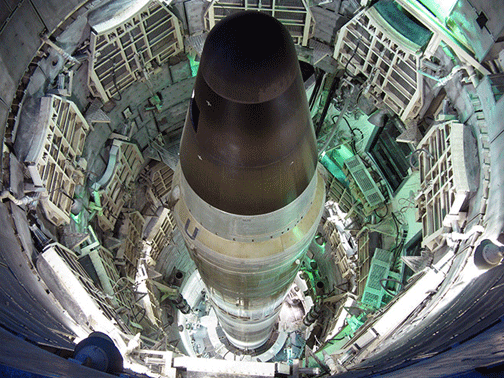
 How much does the Pentagon’s secretive bomber really cost? (And should you be allowed to know?), WP By Christian Davenport July 20 There’s been controversy swirling around the Pentagon’s newest bomber program ever since last year, when the Air Force awarded the contract for what’s considered to be the most important national security procurement project over the next decade.
First, the losers, a team made up of defense giants Boeing and Lockheed Martin, filed a legal challenge, saying the Air Force’s selection of Northrop Grumman “was fundamentally flawed.” Northrop successfully fended off that protest, but now it faces more challenges, this time on Capitol Hill, where a backroom fight for funds and arguments over the largely classified bomber’s secrecy have begun.
Earlier this month, Sen. John McCain (R-Ariz.), the powerful chairman of the Armed Services Committee, led an effort that would have forced the Air Force to reveal the total cost of the program—which one analyst estimated could reach $100 billion. But in a closed-door session, a band of senators blocked the move, arguing that revealing the figure would also divulge the bomber’s capabilities and allow potential enemies to defend against it……….
Falls Church-based Northrop is working on building 100 of the so-called B-21 bombers, designed to penetrate deep into enemy territory and capable of carrying nuclear weapons. The fleet is slated to enter service in the 2020s and would eventually replace the aging B-52s and the B-1…..
Since the company won the contract to build the Pentagon’s stealthy and highly classified bomber, some details about the project have begun to seep out. But one significant detail has remained under wraps: what it will end up costing.
Air Force officials have maintained that revealing the projects total price tag would also allow enemies to glean details about it, such as how far it can fly and how many bombs it can carry.
To which McCain had this to say: “Nonsense.”
The Air Force has already revealed the so-called average “unit cost” of each B-21 bomber in 2016 dollars: $564 million. It has also disclosed the development cost: $23 billion. But it has not said what the total costs would add up to over the life of the program with inflation added……
Todd Harrison, a defense analyst at the Center for Strategic and International Studies, said that adversaries could, in fact, glean insights into the program by knowing the cost. But that argument is problematic, he said, since the Pentagon has already revealed so much about the cost already.
“It baffles me,” he said. “They may be politically naïve and think they don’t have to tell Congress or the public. It’s going to create a headache for them every year because folks like John McCain are going to continue to demand the total cost.”
Based on the unit cost and the development figures, Harrison estimates that the total cost is about $100 billion. https://www.washingtonpost.com/news/checkpoint/wp/2016/07/20/how-much-does-the-pentagons-secretive-bomber-really-cost-and-should-you-be-allowed-to-know/
-
Archives
- October 2026 (120)
- September 2026 (339)
- August 2026 (330)
- July 2026 (355)
- June 2026 (287)
- May 2026 (306)
- April 2026 (356)
- March 2026 (251)
- February 2026 (267)
- January 2026 (308)
- December 2025 (358)
- November 2025 (359)
-
Categories
- 1
- 1 NUCLEAR ISSUES
- business and costs
- climate change
- culture and arts
- ENERGY
- environment
- health
- history
- indigenous issues
- Legal
- marketing of nuclear
- media
- opposition to nuclear
- PERSONAL STORIES
- politics
- politics international
- Religion and ethics
- safety
- secrets,lies and civil liberties
- spinbuster
- technology
- Uranium
- wastes
- weapons and war
- Women
- 2 WORLD
- ACTION
- AFRICA
- Atrocities
- AUSTRALIA
- Christina's notes
- Christina's themes
- culture and arts
- Events
- Fuk 2022
- Fuk 2023
- Fukushima 2017
- Fukushima 2018
- fukushima 2019
- Fukushima 2020
- Fukushima 2021
- general
- global warming
- Humour (God we need it)
- Nuclear
- RARE EARTHS
- Reference
- resources – print
- Resources -audiovicual
- Weekly Newsletter
- World
- World Nuclear
- YouTube
-
RSS
Entries RSS
Comments RSS

