The increasing danger as USA revs up its nuclear arsenal
 Wall Street, the Military-Industrial Complex, corporations and the politicians are willing to lead the world into an Armageddon-type scenario. Washington is confident that they can defeat its adversaries with their military power but the U.S. has never faced countries like Russia, China or Iran. Russia has more advanced military technologies including its air and missile defense systems known as the S-500 which can counter any US-NATO missile or fighter jet at a moment’s notice. Irrational decisions made by Washington’s establishment means two things, first, they must be really politically and historically ignorant on Russia’s stance when it comes to its sovereignty and they must really despise humanity, but one thing is certain; they want the U.S. to remain as the world’s standing superpower.
The American Empire is playing a dangerous game with its nuclear weapons arsenal. The US-NATO and Israel alliance has declared directly and indirectly that Russia, China, North Korea and Iran are a threat to world peace and security.
Let’s be clear on who is the real threat to world peace and it is not the countries I just mentioned, it is Washington’s geopolitical ambitions to bring its enemies under their sphere of control. Washington’s geopolitical moves are antagonizing its enemies which can ignite a catastrophic world war that can go to nuclear at a moment’s notice. The threat of a nuclear war is at almost the same level of the 1962 Cuban Missile Crisis, but if you listen to the main-stream media (MSM) you may never know what is really going on concerning world events.
The first woman and U.S. Democratic presidential nominee Hillary Clinton has threatened Iran with nuclear strikes while Israel maintains its own nuclear weapons arsenal which is also a threat to its neighbors in the Middle East, especially Iran.
Washington is placing NATO troops and Missile Defense Systems close to Russia’s borders and giving the U.S. Navy the green light to a possible confrontation with China’s naval fleet in the South China Sea. Washington’s bellicose actions are indeed provocative. Continue reading
Huge wildfire getting close to Hanford nuclear reservation
 Large fire burning toward Hanford nuclear reservation A fire burning on the Yakima Training Center near Moxee, shown here, has spread into Benton County near the Hanford nuclear reservation. Ronnie Butler Yakima Herald Republic Tri-City Herald,Yakima Herald-Republic and Walla Walla Union-Bulletin, 1 August 16 A large wildfire was burning toward the Hanford nuclear reservation Sunday after spreading from Grant and Yakima counties into Benton County overnight Saturday.
It was one of at least five wildfires burning Sunday in eastern Washington and Oregon, including a 1,000-acre fire that had residents evacuating a rural area near Prosser Sunday evening.
The larger Benton County fire burning toward Hanford, called the Range 12 Fire, was estimated to have burned 60,000 acres or about 94 square miles by early Sunday evening.
Sunday afternoon it was spreading across an unpopulated area between Highways 240 and 241, according to Benton County Emergency Services.
Firefighters were working to stop the fire before it reached the large wildland security zone maintained around the contaminated portion of the nuclear reservation. The security zone, which includes the peak of Rattlesnake Mountain, is part of the Hanford Reach National Monument………http://www.tri-cityherald.com/news/local/hanford/article92931342.html
No German spent nuclear fuel for Savannah – Citizens’ Advisory Board votes
 Savannah River board votes to officially oppose accepting German spent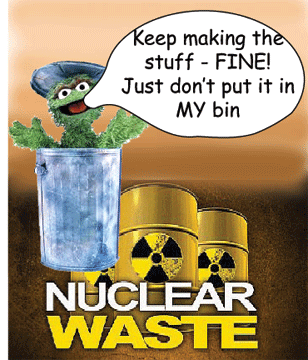
nuclear fuel, Augusta Chronicle By John Boyette NEW ELLENTON — The Savannah River Site Citizens Advisory Board is not in favor of accepting spent nuclear fuel from Germany. In two separate votes Tuesday, the group voted down a draft recommendation to accept the spent fuel and endorsed a draft position statement that opposes receiving the spent fuel for treatment and storage in the U.S.
The spent fuel, which comes from two German reactors that have ceased operations, originated in the U.S. It takes the form of about one million graphite spheres that contain uranium and thorium and are currently stored in 455 casks…….
The draft recommendation failed to pass, getting only six votes in favor. Eleven board members voted against, and one abstained.
The position statement, which opposed receiving the spent fuel, was voted on next. It passed 13 to five.
The board also voted in favor of a position statement that opposes the storage of commercial spent nuclear fuel and high level radioactive waste atSRS until 2048 or longer.
Tom Clements, the director of nuclear watchdog group SRS Watch, was pleased with the outcome of the votes.
“I thought it was quite strange that they allowed the two positions that had opposite statements to get this far,” Clements said. “I think they should have resolved this in the committee and presented one unified statement and not two.”
Clements said that a final Environmental Assessment from the Department of Energy is pending on the German spent nuclear fuel issue. He said it was supposed to be released in June but now there is no timetable.
“I personally think part of the reason for that is what’s happening in Germany, both the terrorism issue, and that there may be hesitancy to pay more to Savannah River National Laboratory for a program they don’t think is going to go forward.” fuel http://chronicle.augusta.com/news/government/2016-07-26/srs-board-votes-officially-oppose-accepting-german-spent-nuclear-fuel
Bill Gates – wrong about renewable energy
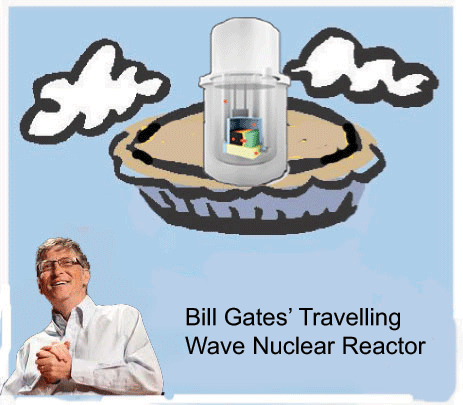 Jigar Shah rebuts Bill Gates’ fossil fuel vision for energy access in developing countries. GreenTech Media by Jigar Shah August 22, 2014 “……In 2012, I wrote in the Huffington Post that Bill Gates had zero qualifications to understand energy and its costs. I also acknowledged that I am not qualified to run a global software company.
So, Bill Gates doesn’t know much about energy outside of his vested interests in nuclear power, and I don’t know much about running a software company outside of my bumbling with my Android apps. I say this about myself even though I have helped with smart metering and oversaw the global implementation for monitoring solar systems worldwide for SunEdison.
But Bill Gates has more money and power than I, as well as a powerful — and wonderful — charity. In this instance, however, his charity is misguided. And nothing is more dangerous than misguided charity.
Gates’ misguided path starts with the fact that he cited a notorious climate confusionist, Bjorn Lomborg. Lomborg has stubbornly refused to acknowledge the fact that renewable energy is cost-competitive with fossil fuels as an energy source.
Given Gates’ stature, framing energy poverty as a climate issue reveals a depth of ignorance that poses a serious problem. So here is reality.
Ending energy poverty requires the right tool for the job: distributed energy
The truth is that an over-reliance on centralized grid extension and large-scale power plants will keep a billion people in the dark. It is time to recognize what even the IEA says is overwhelmingly necessary, but dramatically under-invested in: distributed renewable energy for those living beyond the grid.
To understand why this is so important, take a step back and consider the reaction if Gates wrote a blog suggesting that Mark Zuckerberg is a fool and that the solution for universal internet access around the world is connecting every home around the world via physical fiber-optic cable. The reaction would be riotous laughter. In emerging markets, they are busy ripping out copper and everyone is using wireless. Yet that’s exactly analogous to what Gates is proposing for energy.
No expert on energy access is paying any attention to Gates’ folly on energy for the poor…… When it comes to energy poverty, Gates is arguing for outdated and ineffective solutions that will keep people energy-poor. It is time that we deploy our 21st century energy solutions and put power directly in the hands of the impoverished. http://www.greentechmedia.com/articles/read/sorry-bill-gates-you-are-wrong-on-clean-energy
Midwest USA’ s sizzling heat carries health dangers

 Sizzling Midwest Previews a Hotter Future Climate, Skeptical Science, 29 July 16 Extreme heat waves like the current string of scorching days in the Midwest have become more frequent worldwide in the last 60 years, and climate scientists expect that human-caused global warming will exacerbate the dangerous trend in coming decades. It comes with potentially life-threatening consequences for millions of people.


Research has shown that overall mortality increases by 4 percent during heat waves compared to normal days in the U.S. A study in the journal Environmental Health Perspectives in 2011 suggested that rising summer temperatures could kill up to 2,200 more people per year in Chicago alone during the last two decades of the 21st century.
“The climate is changing faster than we’ve ever seen during the history of human civilization on this planet, and climate change is putting heat waves on steroids,” Katharine Hayhoe, director of the Climate Science Center at Texas Tech University, said during a news conference on Thursday. “Heat waves are getting more frequent and stronger.”
Temperatures this week soared into the 90s from Minnesota to Iowa, combining with high humidity to send heat indices well above the 100-degree Fahrenheit mark, considered a threshold for conditions dangerous to human health.
Current temperatures in large parts of the Midwest have been rising steadily for more than 100 years, with accelerated warming in the past few decades. According to the 2014 National Climate Assessment, the average temperature in the region increased by more than 1.5 degrees Fahrenheit between 1900 and 2010. Between 1950 and 2010, the rate of increase doubled, and since 1980, the pace of warming is three times faster than between 1900 and 2010…….
“And when nighttime temperatures don’t cool off enough to give us a respite, that’s when we start to see an impact on health. Especially the elderly and people with respiratory problems start flooding emergency rooms.”
“The bottom line is we face a new normal and we’re adapting to it on the city and regional level,” said Christopher B. Coleman, mayor of St. Paul, Minn., and co-chair of the Mississippi River Cities & Towns Initiative. Also speaking during the press conference, he called the Mississippi River Valley an “acute climate impact zone,” and said some of the less obvious impacts of extreme heat includes urban stormwater runoff that creates thermal pollution when it hits hot pavement……
“The health consequences of climate change run an entire gamut, from worsening chronic disease, to an increase in vector and waterborne illnesses and disruption to food safety,” said Rev. Miriam Burnett, president of Resource and Promotion of Health Alliance, Inc, a faith-based nonprofit focusing on public health in African-American communities. Extremeheat events even have social consequences, including putting strain on human interactions and generating anger and hostility, she said.
Scientists say there’s little doubt that the buildup of heat trapping greenhouse gases is already causing more deadly heat waves worldwide. The increase has been widely documented and summarized in the latest Intergovernmental Panel on Climate Changeassessment…http://www.skepticalscience.com/sizzling-midwest-previews-hotter-climate.html
New York on brink of decision to bail out nuclear industry
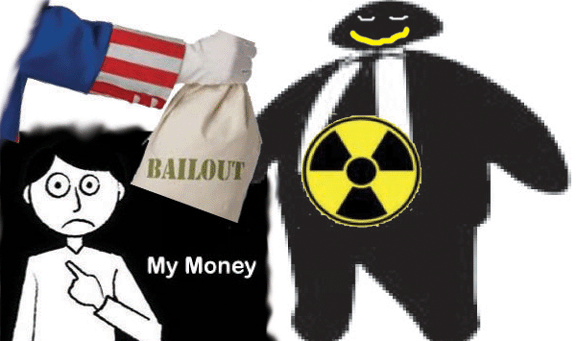 New York to Decide on $500 Million-a-Year Nuclear Power Lifeline, Jim Polson jpolson9 Bloomberg, 29 July 16
-
Upstate reactors may close if state bailout plan fails
-
Critics say subsidies will undermine clean energy goals
-
New York is poised to decide whether customers should spend about $500 million a year to save its money-losing nuclear reactors.
If New York approves the subsidies Monday, it would be the first state to throw such a lifeline to nuclear plants and the emission-free power they produce. The proposal is part of Governor Andrew Cuomo’s initiative to get half the state’s power from renewable sources by 2030. It’s a far cry from the approach in other states where reactors are being allowed to fail under their own weight.
Nuclear aid is among controversial measures the state Public Service Commission is weighing as renewable power becomes a larger part of its power portfolio. New York is also considering changes to regulations that require utilities to buy back excess power from homeowners and businesses with rooftop solar panels. So-called net metering rules have pitted utilities against renewable energy developers in states across the U.S.
- “The public service commission and the governor intend to throw away billions of dollars on uneconomical, dirty nuclear plants when we should be investing in renewables and efficiency,” Jessica Azulay, program director for the Alliance for a Green Economy, based in Syracuse, New York, said by phone July 28. “New York needs a plan for a real long-term decarbonization of our energy system, not short-sighted bailouts.”
Market Signals
Exelon Corp. said it may close its Ginna and Nine Mile Point 1 units before their licenses expire unless subsidies are approved by September. Entergy Corp. plans to shut its FitzPatrick reactor around year-end, though Exelon said it’s willing to buy that plant and keep it running if subsidies are approved. Both companies back the proposal.
Others aren’t so sure. Independent power producers say the financial aid will put them at a disadvantage by making their product more costly by comparison.
“The competitive market is signaling that the nuclear facilities should be retired,” according to a filing by a group that includes Calpine Corp. and Dynegy Inc.
The proposal would be a “a blatant exercise of buyer-side market power,” and would suppress revenue for other generators according to the filing………http://www.bloomberg.com/news/articles/2016-07-29/new-york-to-decide-on-500-million-a-year-nuclear-power-lifeline
Retaliation and harassment is very, very real at Hanford
 Ex-Hanford nuclear facility employee gravely ill after inhaling toxic fumes Nuclear worker: ‘Retaliation is very real at Hanford’ Susannah Frame, KING5.com, July 29, 2016 A veteran worker at the Hanford Site says he was harassed, isolated and reassigned to cleaning tasks after he made repeated attempts to bring attention to safety problems in the lab where he works.
“Retaliation and harassment is very, very real at Hanford and that’s a fact. I lived it and I’m living it right now,” said Dave Lee, an instrument technician assigned to the 222-S Lab at Hanford. “I’m cleaning closets and I’m replacing filters and if that’s not degrading and retaliatory, explain to me what is.”
Ex-Hanford nuclear facility employee gravely ill after inhaling toxic fumes
The 222 S Lab is a 70,000 square foot facility operated by the U.S. Department of Energy’s contractor, Washington River Protection Solutions (WRPS). Work in the lab consists of analyzing samples of lethal radioactive nuclear waste taken from underground storage tanks.
Technicians also analyze vapors captured from the headspaces of the tanks. The vapors contain a mix of poisonous chemicals that were used to extract plutonium from spent fuel rods. Production took place at Hanford from the 1940s through the 1980s to support the country’s nuclear weapons program. Since then, work at the site has been exclusively dedicated to cleanup – one of biggest environmental remediation projects in the world.
Since last November, Lee says he’s repeatedly brought up safety concerns related to a piece of machinery used to analyze vapors. He noticed oil leaking from a Gas Chromatograph/Mass Spectrometer (GC-MS) instrument. A GC-MC machine measures the presence of selected chemicals in materials fed into it.
His research of the GC-MC factory manuals found that oil in the GC-MC is contaminated with whatever is being tested. That means toxic vapors could be emanating from the oil, into the breathing space of lab workers, who don’t wear protective gloves or respiratory protection as WRPS has never required it.
According to the Clarus 560/600 MS Hardware Guide: “When using toxic samples, the mechanical pump oil is toxic waste….If you were running toxic samples, the oil is contaminated as toxic waste. Handle and dispose of waste oil appropriately.”
“I come to find out this roughing pump oil is part of the process stream (which means it’s in contact with contaminated substances),” said Lee. “I was mad (when I found out)……..
According to a discrimination complaint filed against WRPS with the U.S. Department of Labor Occupational Safety and Health Administration, Lee reported his concerns to many people, including his direct manager and other managers present in lab meetings, the maintenance manager of the lab, the site wide manager of the lab, a field representative from the Defense Facilities Nuclear Safety Board, members of the Department of Energy’s Employee Concerns Council, the Employee Concerns Council manager, in addition to writing up a Problem Evaluation Request (PER) about inadequate venting in the lab. PERs are designed to formally document a concern that is supposed to be addressed by the company.
Lee said after all that, nothing changed. Managers allegedly told him not to worry about it.
“’This is common practice, Dave. You’re fine,’” was the alleged response.
That led to a more dramatic action. On May 2, Lee issued what is called a stop work action at the lab. All Hanford workers have the right to shut work down if they feel the conditions are unsafe. Lee wanted no work to take place with the oil until it was fully analyzed to ascertain if it were indeed hazardous. The next day, WRPS human resources asked for his badge. He was sent home, placed on “investigative removal” for allegations of “extremely serious misconduct”……..
According to a newly released report from the Government Accountability Office, which is the investigative arm of Congress, Dave Lee’s experience isn’t isolated. The investigators found the U.S. Department of Energy routinely allows “unlawful retaliation” perpetrated by its contractors at sites such as Hanford.
“It’s clear the Department of Energy contractors are going to go to amazing lengths to send a signal to their employees that when you blow the whistle it is going to be the end of your career,” said Sen. Ron Wyden (D-OR) in response to the GAO findings………
Pattern at Hanford
Hanford has been embroiled in high-profile whistleblower retaliation cases in recent years. ……..http://www.king5.com/news/local/investigations/nuclear-worker-retaliation-is-very-real-at-hanford/283622616
Inspector of welds at nuclear station falsified results
U.S. Attorney: Sulphur man inspecting Lake Charles nuclear facility lied about certification BY Lanie Lee Cook | LCOOK@THEADVOCATE.COM JUL 29, 2016 A Sulphur man who lied about being certified to inspect welds on a Port of Lake Charles nuclear module will be sentenced in November after pleading guilty to a federal criminal charge for providing the false information, U.S. Attorney Stephanie Finley’s office announced Friday.
Joseph B. Burnworth, 35, admitted to one count of submission of false information as part of a plea agreement, the release states.
Burnworth’s plea agreement shows he conducted more than 150 visual inspections of welds on an under-construction nuclear module, a large metal structure designed to hold a nuclear reactor, from April 2013 to August …..2013. http://www.theadvocate.com/acadiana/news/courts/article_e58a3cb0-55b5-11e6-b2ff-8b7759ceb4a1.html
5 reasons not to rush into NY’s $7 billion plan to rescue nuclear plants
5 reasonable criticisms of NY’s $7 billion plan to rescue nuclear plants , Syracuse.com By Tim Knauss | tknauss@syracuse.com Email the author | Follow on Twitter July 29, 2016 “……..
2. The nuclear subsidy might be illegal
Three months ago, the Supreme Court of the United States invalidated a Maryland incentive program for new power plants on the grounds that it interfered with wholesale markets, which operate under federal – not state – authority.
To some observers, including a group of non-nuclear power plant owners and energy suppliers in New York, the Supreme Court’s decision in Hughes v. Talen Energy Marketing is directly applicable to what New York is attempting.
Upstate nuclear plants that receive state-mandated subsidies will have an unfair advantage in the wholesale market and will drive down the prices other power plants can charge, the group argues…..
3. The price of the subsidy is too high
In April, Exelon told the PSC it would need to recover $50 per megawatt-hour to justify the continued operation of its Upstate nuclear plants. But the PSC staff proposal would guarantee the company $56.50 per megawatt-hour, or 13 percent more. And every two years, the minimum price would be revised upward.
Lawyers for the Nucor Steel plant in Auburn suggest that even the $50 price sought by Exelon is more than the nuke operator needs. …..
4. The contract term is too long
According to the long-term price forecast by PSC analysts, wholesale power prices will rise steadily over the next decade until they exceed the price guaranteed to the nuclear plants…….long-term price forecasts are notoriously unreliable. National Grid recommended limiting nuclear subsidy contracts to six years……
5. There has not been enough time to ponder details
This is a big decision. It will affect the Upstate economy and the NY energy industry for years to come. Yet the details of the PSC staff proposal were released just three weeks ago. Comments were accepted for just two weeks…….http://www.syracuse.com/news/index.ssf/2016/07/5_reasonable_criticisms_of_nys_7_billion_plan_to_rescue_nuclear_plants.html
Hillary Clinton and Donald Trump on nuclear weapons

 How Close Are We to Nuclear War? By William Boardman Global Research, July 28, 2016 And what might we expect from the next American President?
“……….Republican Donald Trump seems to have published no formal policy on nuclear weapons or foreign policy. In interviews, Trump has indicated a dislike of nuclear proliferation, but has also said it’s probably “going to happen anyway,” and maybe the U.S. “may very well be better off” if countries like Saudi Arabia, Japan, and South Korea had their own nuclear weapons. He implied a willingness to use nuclear weapons against the Islamic State, or even in Europe under undefined circumstances: “I’m not going to take it off the table.” He also told the New York Times on July 20 that if Russia, for no particular reason, attacked one of the Baltic states, he’d want to make sure that they “have fulfilled their obligations to us” before coming to their defense. He did not address the U.S. treaty obligations under NATO. He has called for re-negotiating treaties that he says are too expensive for the U.S. But, in an odd and perhaps inadvertent way, his answer on the Baltic states speaks indirectly to the 20-year madness of putting Russia’s neighboring countries into the hostile NATO alliance. Trump has also spoken of pulling back forward deployments of American forces around the world, including elements of nuclear deterrence.
Democrat Hillary Clinton has called Trump’s positions “truly scary.” Clinton has indicated her willingness to use nuclear weapons – “massive retaliation” – against Iran in defense of Israel. She has expressed but limited support and limited opposition to the Obama administration plan to spend $1 trillion upgrading the U.S. nuclear arsenal. In an ad falsely claiming she was responsible for “securing a massive reduction in nuclear weapons,” Clinton has over-stated the impact of the new START treaty, which has been minimal in reducing nuclear weapons. As Secretary of State, Clinton appointed an utterly unqualified political donor to the International Security Advisory Board dealing with nuclear weapons. Clinton, like Trump, seems to have published no formal foreign policy on nuclear weapons of foreign policy. She has opposed the idea of Japan having its own nuclear arsenal, while at the same time falsely saying Trump “encouraged” the idea.
Where is the candidate who speaks truthfully of reality?………..
Those who don’t speak up are complicit in silence
In 1996, Secretary of Defense William J. Perry was the only member of President Clinton’s cabinet who got it right, including the President himself. Perry was the only cabinet member who opposed enlarging NATO with former Soviet bloc countries. Perry was the only cabinet member then, and perhaps since, to object to the American policy of steady, stealthy, soft aggression against Russia (including the Ukraine coup) that would lead inevitably to direct confrontation between the world’s largest nuclear weapons states. Perry has called for radical change in the U.S. nuclear force structure consistent with actual deterrence, actual defense, not aggressive war. He would reduce the nuclear triad (about which Trump apparently knew nothing last October), keeping only the sea-based missiles in nuclear submarines and eliminating nuclear bombers and nuclear missiles. This would save millions of dollars and reduce the risk of accidental nuclear war. But it is heresy among the believers in faith-based nuclear policy.
And yet, in an election year, “no one is discussing the major issues that trouble Perry,” as Jerry Brown wrote: “And why does most all of official Washington disagree with him and live in nuclear denial?” In January 2016, while promoting his book, Perry wrote:
What I am really advocating is not so much a particular force structure, but a serious national discussion on this issue, the outcome of which has hugely important security and financial consequences — for the U.S. and for the world. Considering the huge costs entailed, and, even more importantly, the transcendental security issues at stake, we must not simply drift into a decision….
And yet the country drifts on, blissfully unaware, and it’s a mystery why a man as accomplished and respected as Perry has not done more to wake the country out of its sleepwalking incomprehension. But it may be a tragedy that we have neither a President nor a would-be President who would or could confront our potentially fatal collective denial.
William M. Boardman has over 40 years experience in theatre, radio, TV, print journalism, and non-fiction, including 20 years in the Vermont judiciary. He has received honors from Writers Guild of America, Corporation for Public Broadcasting, Vermont Life magazine, and an Emmy Award nomination from the Academy of Television Arts and Sciences. http://www.globalresearch.ca/how-close-are-we-to-nuclear-war/5538453
New York Times continues to ignore the renewable energy revolution, and talk up nuclear
you’d never know any of this big picture once-in-a-century transformation from reading the New York Times, which just continues to write article after article that misses the forest for the trees.
the clean energy revolution means other low-carbon or zero-carbon technologies that haven’t reached the point of exponential growth — and that are not experiencing learning curve improvements in cost and performance — are very likely to fall further and further behind. That is where nuclear power finds itself. As do hydrogen fuel cell cars.
It also means that the electric grid in particular will go through some growing pains as it starts to integrate renewables at a faster pace than anybody thought possible just a few years ago. The Times, bizarrely, has chosen to publish article after article over-emphasizing and indeed exaggerating those growing pains, while projecting a future for nuclear power that currently doesn’t exist
 Nuclear Power Advocates Claim Cheap Renewable Energy Is A Bad Thing, Climate Progress BY JOE ROMM JUL 28, 2016 Nuclear power advocates are trying a new line of attack on solar and wind energy — it’s too darn cheap!
In the real world, however, the unexpectedly rapid drop in the price of cleantech, especially renewable power and batteries, is a doubly miraculous game-changer that is already cutting greenhouse gas emissions globally and dramatically increasing the chances we can avoid catastrophic climate change.
As I detailed on Monday, the New York Times in particular keeps running slanted articles talking up nuclear and talking down renewables — articles that totally miss the forest for the trees. That culminated in a truly absurd piece last week, “How Renewable Energy Is Blowing Climate Change Efforts Off Course,” which is the exact opposite of reality, as Goldman Sachs has detailed in its recent reports on “The Low Carbon Economy.”
This post will focus primarily on the big picture, the forest. I will deal in later posts with a few of the more interesting trees, such as whether, the U.S. should consider give existing nukes some sort of short-term carbon credit so they are not shut down prematurely and replaced by natural gas.
The big picture reality of the clean energy revolution
The big picture reality is this: The world is finally starting to take some serious action to avoid catastrophic climate change, which means first the electric grid will decarbonize, and then the transportation system. That means global coal use peaks or plateaus first — and then oil does. Continue reading
The New York Times utterly misrepresents whats happening in Germany
Nuclear Power Advocates Claim Cheap Renewable Energy Is A Bad Thing, Climate Progress BY JOE ROMM JUL 28, 2016
“…………..For instance, in their “How Renewable Energy Is Blowing Climate Change Efforts Off Course” story, the Times asserts:
In Germany, where renewables have mostly replaced nuclear power, carbon emissions are rising, even as Germans pay the most expensive electricity rates in Europe.
I have kept both of the hyperlinks from the Times piece so you can see for yourself what game they are playing. It is quite rare that a newspaper story links to two articles that so thoroughly debunk the points the story is trying to make.
The first hyperlink is apparently meant to cover the assertion, “In Germany, where renewables have mostly replaced nuclear power.” But as you can see, the link goes to a December 2015 “Clean Energy Wire” story with this lead chart: [on original]
This chart does not, however, show “renewables have mostly replaced nuclear power” (orange). Quite the reverse. The chart explicitly shows that, for example, from 2013 to 2015, renewable generation rose 42 billion kilowatt-hours (bkwh) — while natural gas dropped 11 bkwh, hard coal dropped 9 bkwh, lignite dropped 6 bkwh, and nuclear dropped 5 bkwh. In short, renewables up 42 bkwh, fossil fuels down 26 bkwh, and nuclear down 5 bkwh (while overall, generation was up). Oops!
Since renewables have been mostly replacing fossil fuels, as the chart shows, you can probably guess that carbon emissions haven’t actually been rising. The second hyperlink goes to a March 2016 story that contains this chart: [on original].
As you can plainly see, this chart does not show that “carbon emissions are rising.” Quite the reverse. German emissions have generally been falling.
So how does the Times get to its claim that German will “carbon emissions are rising” when the most one can objectively say is in recent years they have been flat? Well the links do note that CO2 emissions rose a whopping 1 percent in 2015. Or, as the first article put it, “Germany’s CO2 emissions have inched up in 2015 despite a rapidly increasing share of renewables in electricity production.”
Why did emissions inch up? The first link immediately goes on to explain, “The main cause for the year-on-year rise were cooler temperatures compared to 2014.” Not exactly a compelling argument for “How Renewable Energy Is Blowing Climate Change Efforts Off Course.”
Yes, German electrical rates are high. The Times could have written an interesting story on why. It is actually a gift the Germans gave the world in its fight against global warming. The Germans decided to rapidly deploy solar power during a time when it was quite expensive to do so. Indeed, it was over five times more expensive to deploy in Germany back then than it is to deploy in the U.S. Southwest now!
That massive German investment helped solar power come down the learning curve faster than people expected, and today, as I’ve reported, utilities in this country and around the world are signing contracts for solar power at the unheard-of price of four cents a kilowatt hour or less — which is roughly one third of the average residential rate in this country.
Rather than trashing the Germans the way the New York Times does, we should all be thanking them! But the Times is not in the thanking business. They are in the slanting business.
The bottom line is that nothing that has happened in Germany supports the ridiculous thesis: “How Renewable Energy Is Blowing Climate Change Efforts Off Course.” The truth, as the second link the Times itself provides explains, is that “a 2011 decision to phase out nuclear power within a decade, lent impetus by Japan’s Fukushima disaster, has seen dirty coal maintain a significant share of the energy mix.”
It was Germany’s decision to speed up the shutdown of its nuclear reactors that caused the drop in CO2 emissions to (temporarily) stall. Personally, I wouldn’t have made that decision, since the short-term consequences were almost inevitable. But for reasons only known to itself, the Times seems to be trying to make one of the biggest heroes of the climate action story in Germany — renewable power — into a villain.
The Times piece tries to do the same thing in its discussion of the competition between renewables and nuclear power (and natural gas) in this country. I’ll deal with that in my next piece. http://thinkprogress.org/climate/2016/07/28/3802326/nuclear-power-renewables-cheap/
USA’s aggressive military policies in Europe increase risk of nuclear annihilation
US must stop playing with nuclear hellfire, Ecologist ,Conn Hallinan 26th July 2016
Thanks to an increasingly aggressive US foreign policy pursued over decades, NATO nuclear missiles and armed forces are poised on Russia’s border, writes Conn Hallinan – forcing it to abandon its ‘no first use of nuclear weapons’ pledge in view of the massively asymmetrical threat it faces. The world must step back from the brink of nuclear annihilation……….

What has made today’s world more dangerous, however, is not just advances in the destructive power of nuclear weapons, but a series of actions by the last three US administrations.
- First was the decision by President Bill Clinton to abrogate a 1990 agreement with the Soviet Union not to push NATO further east after the reunification of Germany or to recruit former members of the defunct Warsaw Pact.
NATO has also reneged on a 1997 pledge not to install “permanent” and “significant”military forces in former Warsaw Pact countries. This month NATO decided to deploy four battalions on, or near, the Russian border, arguing that since the units will be rotated they are not ‘permanent’ and are not large enough to be ‘significant’. It is a linguistic slight of hand that does not amuse Moscow. - Second was the 1999 US-NATO intervention in the Yugoslav civil war and the forcible dismemberment of Serbia. It is somewhat ironic that Russia is currently accused of using force to “redraw borders in Europe” by annexing the Crimea, which is exactly what NATO did to create Kosovo. The US subsequently built Camp Bond Steel, Washington’s largest base in the Balkans.
- Third was President George W, Bush’s unilateral withdrawal from the Anti-Ballistic Missile Treaty and the decision by the Obama administration to deploy anti-missile systems in Romania and Poland, as well as Japan and South Korea.
- Last is the decision by the White House to spend upwards of $1 trillion upgrading its nuclear weapons arsenal, which includes building bombs with smaller yields, a move that many critics argue blurs the line between conventional and nuclear weapons.
The Yugoslav War and NATO’s move east convinced Moscow that the Alliance was surrounding Russia with potential adversaries, and the deployment of anti-missile systems (ABM) – supposedly aimed at Iran’s non-existent nuclear weapons – was seen as a threat to the Russian’s nuclear missile force.
One immediate effect of ABMs was to chill the possibility of further cuts in the number of nuclear weapons. When Obama proposed another round of warhead reductions, the Russians turned it down cold, citing the anti-missile systems as the reason.
Playing with hellfire
What has made today’s world more dangerous, however, is not just advances in the destructive power of nuclear weapons, but a series of actions by the last three US administrations.
- First was the decision by President Bill Clinton to abrogate a 1990 agreement with the Soviet Union not to push NATO further east after the reunification of Germany or to recruit former members of the defunct Warsaw Pact.
NATO has also reneged on a 1997 pledge not to install “permanent” and “significant”military forces in former Warsaw Pact countries. This month NATO decided to deploy four battalions on, or near, the Russian border, arguing that since the units will be rotated they are not ‘permanent’ and are not large enough to be ‘significant’. It is a linguistic slight of hand that does not amuse Moscow. - Second was the 1999 US-NATO intervention in the Yugoslav civil war and the forcible dismemberment of Serbia. It is somewhat ironic that Russia is currently accused of using force to “redraw borders in Europe” by annexing the Crimea, which is exactly what NATO did to create Kosovo. The US subsequently built Camp Bond Steel, Washington’s largest base in the Balkans.
- Third was President George W, Bush’s unilateral withdrawal from the Anti-Ballistic Missile Treaty and the decision by the Obama administration to deploy anti-missile systems in Romania and Poland, as well as Japan and South Korea.
- Last is the decision by the White House to spend upwards of $1 trillion upgrading its nuclear weapons arsenal, which includes building bombs with smaller yields, a move that many critics argue blurs the line between conventional and nuclear weapons.
The Yugoslav War and NATO’s move east convinced Moscow that the Alliance was surrounding Russia with potential adversaries, and the deployment of anti-missile systems (ABM) – supposedly aimed at Iran’s non-existent nuclear weapons – was seen as a threat to the Russian’s nuclear missile force.
One immediate effect of ABMs was to chill the possibility of further cuts in the number of nuclear weapons. When Obama proposed another round of warhead reductions, the Russians turned it down cold, citing the anti-missile systems as the reason……..
There is no evidence that Russia contemplates an attack on the Baltic states or countries like Poland, and, given the enormous power of the US, such an undertaking would court national suicide.
Moscow’s ‘aggression’ against Georgia and Ukraine was provoked. Georgia attacked Russia, not vice versa, and the Ukraine coup torpedoed a peace deal negotiated by the European Union, the US, and Russia. Imagine Washington’s view of a Moscow-supported coup in Mexico, followed by an influx of Russian weapons and trainers.
In a memorandum to the recent NATO meetings in Warsaw, the Veteran Intelligence Professionals for Sanity argued, “There is not one scintilla of evidence of any Russian plan to annex Crimea before the coup in Kiev and coup leaders began talking about joining NATO. If senior NATO leaders continue to be unable or unwilling to distinguish between cause and effect, increasing tension is inevitable with potentially disastrous results.”
The organization of former intelligence analysts also sharply condemned the NATO war games. “We shake our heads in disbelief when we see Western leaders seemingly oblivious to what it means to the Russians to witness exercises on a scale not seen since Hitler’s army launched ‘Unternehumen Barbarossa’ 75 years ago, leaving 25 million Soviet citizens dead.”
European states are getting scared – and so they should be!
While the NATO meetings in Warsaw agreed to continue economic sanctions aimed at Russia for another six months and to station four battalions of troops in Poland and the Baltic states – separate US forces will be deployed in Bulgaria and Poland – there was an undercurrent of dissent. Greek Prime Minister Alexis Tsipras called for deescalating the tensions with Russia and for considering Russian President Vladimir Putin a partner not an enemy.
Greece was not alone. German Foreign Minister Frank-Walter Steinmeler called NATO maneuvers on the Russian border “warmongering” and “saber rattling”. French President Francois Hollande said Putin should be considered a “partner”, not a “threat”, and France tried to reduce the number of troops being deployed in the Baltic and Poland. Italy has been increasingly critical of the sanctions.
Rather than recognizing the growing discomfort of a number of NATO allies and that beefing up forces on Russia’s borders might be destabilizing, US Secretary of State John Kerry recently inked defense agreements with Georgia and Ukraine.
After disappearing from the radar for several decades, nukes are back, and the decision to modernize the US arsenal will almost certainly kick off a nuclear arms race with Russia and China. Russia is already replacing its current ICBM force with the more powerful and long range ‘Sarmat’ ICBM, and China is loading its ICBM with multiple warheads.
Add to this volatile mixture military maneuvers and a deliberately opaque policy in regards to the use of nuclear weapons, and it is no wonder that Perry thinks that the chances of some catastrophe is a growing possibility.
Conn Hallinan is a columnist for Foreign Policy In Focus, A Think Tank Without Walls, and an independent journalist. A winner of a Project Censored ‘Real News Award’, he lives in Berkeley, California, and blogs at Dispatches from the Edge. http://www.theecologist.org/blogs_and_comments/commentators/2987941/us_must_stop_playing_with_nuclear_hellfire.html
Hans Kristensen verified Ploughshares’ facts on America’s nuclear arsenal and its costs
GRANTEE SPOTLIGHT: HANS KRISTENSEN http://www.ploughshares.org/issues-analysis/article/grantee-spotlight-hans-kristensen Nuclear weapons information vital to debate in Washington State, Ploughshares.org. Will Lowry, July 26, 2016
A growing number of leaders like Representative Adam Smith (D-WA), Ranking Member of the House Armed Services Committee, are increasingly concerned about the US government’s $1 trillion plan to rebuild our nuclear arsenal – a plan that could trigger a new arms global arms race with Russia and China. “I think to have a Cold War nuclear [weapons] policy is completely inappropriate to the current times,” the US Congressman from Washington State recently said.
He has reason to worry. Few people in the US are aware of this dangerous taxpayer-funded plan that could profoundly impact Washington State. And few locals know that if Washington State were a country, it would be the third largest nuclear state in the world, that just 20 miles west across the Puget Sound is the largest concentration of deployed nuclear weapons in the United States at the Kitsap-Bangor base, and that the US Navy is planning to expand the Kitsap-Bangor base to accommodate Trident-class nuclear weapons submarines.
That is why the Ground Zero Center for Nonviolent Action recently sponsored a public bus advertising campaign in Seattle to raise public awareness of the nuclear threat so close to home.
“We hope to generate a measure of citizen interest, and to begin a public discussion of nuclear weapons in the Puget Sound region. In this election year the danger of nuclear weapons ought to be a topic of discussion,” Ground Zero member Rodney Brunelle recently said of the bus ad campaign.
However, Ground Zero encountered an unanticipated problem. According to the group, the county was hesitant to run the ad, doubting the accuracy of the claim.
That’s where Ploughshares Fund grantee, renowned nuclear expert Hans Kristensen, came into the picture.
Ground Zero contacted Kristensen, Director of the Nuclear Information Project at the Federation of American Scientists, to verify the facts in order to convince the county that their ad was not making false claims. He regularly provides the general public and policymakers with information and analysis on the status, number, and operation of nuclear weapons, the policies that guide their potential use and nuclear arms control.
We believe the public needs this type of information and analysis if for no other reason than that we live in a democracy where people should have a say in the most important decisions the country makes – and this includes policy decisions related to nuclear weapons.
Funding expert sourcing and verification of information around nuclear weapons can help democratize important decisions and inform expert policy analysis at the same time. We are proud to support Kristensen and the Nuclear Information Project at the Federation of American Scientists. Information is the lifeblood of a democracy. We believe that through reason, information and dialogue, the threat of nuclear weapons can be reduced – and one day – even eliminated.
Georgia Public Service Commission (PSC) authorizes Georgia Power to spend up to $99 million on new nuclear station

 Georgia Power gets green light on new nuclear plant, Atlanta Business Chronicle, Jul 28, 2016, State energy regulators gave Georgia Power Co. the go-ahead Thursday to start laying the groundwork for a new nuclear power plant south of Columbus, Ga.
But the Atlanta-based utility won’t be able to charge customers as much as it wanted to conduct preliminary site work and seek an operating license for a proposed nuclear facility at a 7,000-acre site in rural Stewart County.
The Georgia Public Service Commission (PSC) voted 4-1 to authorize Georgia Power to spend up to $99 million on the early stages of the project through the second quarter of 2019. The utility was asking the commission for authority to recover from customers up to $175 million in costs associated with the work.
The PSC’s staff had recommended that the commission put off a decision on the new nuclear plant until 2019…..
Commissioner Lauren “Bubba” McDonald, who voted against Wise’s motion, said Georgia Power should be willing to invest its own money in the Stewart County project rather than charge customers.
“If they’re as sure about another nuclear program in 2025 and beyond … let their investors make the first investment,” he said.
McDonald questioned the wisdom of building a nuclear plant along the Chattahoochee River because of the huge volumes of water consumed in nuclear power generation and noted that the federal government still doesn’t have a long-term plan for disposing of the nuclear wastes being generated today at plants across the country…..http://www.bizjournals.com/atlanta/news/2016/07/28/georgia-power-gets-green-light-on-new-nuclear.html
-
Archives
- October 2026 (120)
- September 2026 (339)
- August 2026 (330)
- July 2026 (355)
- June 2026 (287)
- May 2026 (306)
- April 2026 (356)
- March 2026 (251)
- February 2026 (267)
- January 2026 (308)
- December 2025 (358)
- November 2025 (359)
-
Categories
- 1
- 1 NUCLEAR ISSUES
- business and costs
- climate change
- culture and arts
- ENERGY
- environment
- health
- history
- indigenous issues
- Legal
- marketing of nuclear
- media
- opposition to nuclear
- PERSONAL STORIES
- politics
- politics international
- Religion and ethics
- safety
- secrets,lies and civil liberties
- spinbuster
- technology
- Uranium
- wastes
- weapons and war
- Women
- 2 WORLD
- ACTION
- AFRICA
- Atrocities
- AUSTRALIA
- Christina's notes
- Christina's themes
- culture and arts
- Events
- Fuk 2022
- Fuk 2023
- Fukushima 2017
- Fukushima 2018
- fukushima 2019
- Fukushima 2020
- Fukushima 2021
- general
- global warming
- Humour (God we need it)
- Nuclear
- RARE EARTHS
- Reference
- resources – print
- Resources -audiovicual
- Weekly Newsletter
- World
- World Nuclear
- YouTube
-
RSS
Entries RSS
Comments RSS

