Russian, USA, Japanese nuclear salesmen move their Indian nuclear plans to Andhra Pradesh
 A.P. set to be country’s nuclear power hub http://www.thehindu.com/
 news/national/andhra-pradesh/ap-set-to-be-countrys-nuclear-power-hub/article8876943.ece SUHASINI HAIDAR
Govt. is pinning its mega plans for generating the ‘clean’ energy on coastal Andhra Pradesh.
Weeks after the government announced that U.S. company Westinghouse’s Nuclear Power Project (NPP), planned in Gujarat’s Mithi Virdi, is being moved to Andhra Pradesh, sources confirmed to The Hindu that Russian-owned Rosatom will build its next phase of six reactors in Andhra Pradesh as well.
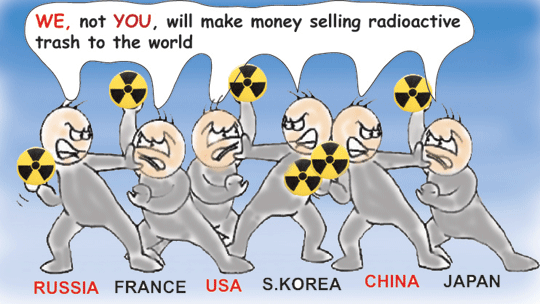
With other States like Gujarat, Tamil Nadu, West Bengal and Maharashtra facing local protests over NPPs, the government is now pinning its mega plans for generating the ‘clean’ energy on coastal Andhra Pradesh. In fact, if all the projects under consideration from Russia, the U.S. and NPCIL were to actually go through, NPPs in Andhra could account for more than 30,000 MW of the Modi government’s goal of 63,000 MW installed capacity by 2031. The site for the next set of six Russian reactors was discussed during A.P. Chief Minister Chandrababu Naidu’s recent visit to Russia, where he met Russian PM Dmitry Medvedev.
Sources told The Hindu the project site identified, believed to be Kavali in Nellore district, could be announced during President Vladimir Putin’s visit to India in October. “It’s huge,” said Commerce Minister Nirmala Sitharaman, who had led the delegation to Russia. “In Andhra Pradesh, six nuclear centres are going to be created, totalling thousands of megawatts in capacity. Of course, Andhra Pradesh will have both American and Russian participation in nuclear energy generation, but the Russians will be the first to “Make in India” in the nuclear sphere in Andhra,” Ms. Sitharaman told The Hindu.
The “American participation” referred to is the plan for Toshiba-Westinghouse to set up 6 AP1000 reactors of 1,100 megawatts each, a proposal that had run into trouble in Gujarat due to “stiff protests from farmers” during the land acquisition process for 777 hectares, a senior official in the Gujarat government said.
“In addition, Tata, Adani and Essar, which are the largest power producers in the State, were never comfortable with another giant plant being set up in the State,” the official said. During Prime Minister Narendra Modi’s visit to Washington in June 2016, NPCIL and Westinghouse had announced the move to Andhra Pradesh, with a commitment to complete the commercial agreement for 6 reactors by June 2017.
Meanwhile, another Russian project that has been hanging fire for years, to build 6 ‘VVER’ (Water-Water Energy) Reactors of 1000 MWe in West Bengal’s Haripur may also be moved to Andhra Pradesh due to local protests. “We are looking for a site in some coastal area of Andhra Pradesh where a similar reactor, which was meant for Haripur, will come up,” Dr. Sekhar Basu, now Chairman of the Atomic Energy Commission, had told reporters last September, although West Bengal officials told The Hindua final decision has not been taken.
State officials hope Tamil Nadu, Gujarat and West Bengal’s loss will soon be Andhra Pradesh’s gain, and the State already has the Kovvada nuclear park project for 6 1000MW reactors in Srikakulam under way. However, the coast isn’t completely clear. Kovvada has seen some protests of the kind seen at Kudankulam, Mithi Virdi and Haripur. While many local residents are unwilling to part with land, others have concerns over environmental hazards, especially given that some of the sites identified for nuclear projects are in a seismically sensitive zone, and have seen tremors in the past.
Confirming that several projects are only in “preliminary stages”, the Andhra Pradesh government’s media adviser Parkala Prabhakar told The Hindu: “The Central government has asked some more sites for other plants. We have asked the Collectors of Prakasam and Nellore to spot the sites. Once those sites are identified, the NPCIL will come for inspection to check the compatibility,” indicating that while Andhra’s nuclear power-hub dreams are in sight, they may take a while to come to fruition. (With Appaji Reddem in Vijayawada & Mahesh Langa in Ahmedabad)
Democratic senators Urge Obama To Cancel super costly Nuclear Cruise Missile

 Senators Urge Obama To Cancel Nuclear Cruise Missile Aaron Mehta, Defense News July 21, 2016 WASHINGTON — A group of ten Democratic senators have penned a letter to US President Barack Obama urging him to cancel development of a new nuclear-capable cruise missile, in what appears to be the next salvo from nonproliferation advocates on Capitol Hill against the weapon.
At issue is the Long-Range Standoff (LRSO) cruise missile, which will replace the Air-Launched Cruise Missile (ALCM) program with 1,000 to 1,100 cruise missiles, representing the US Air Force’s standoff nuclear delivery capability. The ALCM program is scheduled to age out in 2030.
Proponents say the LRSO is vital to maintaining America’s nuclear posture into the future. But opponents argue the weapon is too costly and unnecessary given other nuclear options, with a vocal minority in Congress starting to advocate heavily for that position.
“Independent estimates suggest that nuclear weapons sustainment and modernization plans could cost nearly one trillion dollars over the next 30 years, putting enormous pressure on our defense budget at a time when non-nuclear systems will also require major expenditures,” wrote the authors of the letter. “In particular, we urge you to cancel plans to spend a least $20 billion on a new nuclear air-launched cruise missile, the Long Range Standoff weapon, which would provide an unnecessary capability that could increase the risk of nuclear war.”
The letter was signed by Sens. Ed Markey and Elizabeth Warren of Massachusetts, Diane Feinstein and Barbara Boxer of California, Al Franken of Minnesota, Jeff Merkley of Oregon, Sherrod Brown of Ohio, Patrick Leahy of Vermont, Ron Wyden of Oregon, and Bernie Sanders, the Vermont senator who recently ended his campaign for the presidency…….
The letter also urged Obama to officially adopt a policy of no-first-use of nuclear weapons, something the United States has traditionally been unwilling to do.
“In light of our unmatched conventional military capabilities, we do not need to rely on the threat of nuclear first-use to deter non-nuclear attacks on our homeland or our allies,” the authors wrote. “By adopting a policy of no-first-use of nuclear weapons, the United States could reduce the risk of accidental nuclear conflict while deterring both conventional and nuclear threats to our security.”
Neither the desire to drop the LRSO, nor the goal of a no-first-use policy, appears likely to gain much traction with Donald Trump, officially named the Republican nominee for president this week.
Speaking to The New York Times, Trump reaffirmed a commitment to the so-called nuclear triad but was noncommittal on the no-first-use idea………http://www.defensenews.com/story/defense/policy-budget/congress/2016/07/21/senators-obama-nuclear-missile-lrso/87384128/
Green State, Golden State: Clean Energy Policy Creates Good Jobs
 http://capitalandmain.com/latest-news/issues/labor-and-economy/green-state-golden-state-clean-energy-policy-makes-good-jobs-0719/ by Dean Kuipers July 19, 2016 California’s deserts are blooming with windmills and solar farms and, according to a new University of California, Berkeley report, these large-scale projects are creating top quality jobs. The Link Between Good Jobs and a Low Carbon Future, issued by the Don Vial Center on the Green Economy at Berkeley’s Labor Center, finds that despite the one-off nature of large, clean energy construction projects, these renewable-power enterprises are creating high-paying, long-lasting blue-collar jobs.
USA Dept of Energy funds Florida research into nuclear recycling
 Florida State receives #10 million for nuclear research center Florida State 24/7 JULY 21, 2016
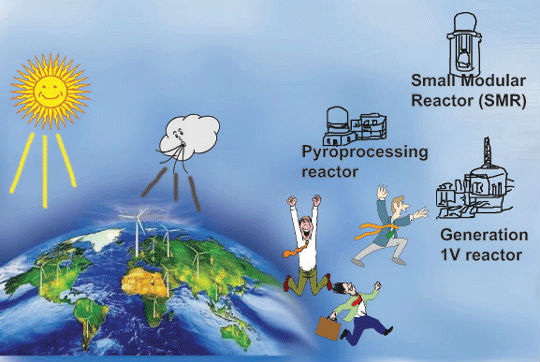
Kathleen Haughney Florida State University will receive $10 million from the U.S. Department of Energy to create a new Energy Frontier Research Center… The center will focus on developing technologies for recycling nuclear fuel and cleaning up Cold War-era weapon production sites. It will be led by Thomas Albrecht-Schmitt, the Gregory R. Choppin Professor of Chemistry at FSU……..Three other institutions will also host research centers. They are The Ohio State University, the University of South Carolina and DOE’s Pacific Northwest National Laboratory. http://news.fsu.edu/Top-Stories/Florida-State-receives-10M-for-nuclear-research-center
As with tobacco, the climate wars are going to court


Déjà vu: as with tobacco, the climate wars are going to court Skeptical Science
18 July 2016 by dana1981, JohnMashey Investigative journalism has uncovered a “web of denial” in which polluting industries pay “independent” groups to disseminate misinformation to the public and policymakers. The same groups and tactics were employed first by the tobacco industry, then fossil fuel companies. Big Tobacco has been to court and lost; now it’s Big Oil’s turn. Political leaders are choosing sides in this war.
Elizabeth Warren Rips Think Tanks & Policy Groups For Fake Climate Change Research
Research by Inside Climate News revealed that Exxon did top notch climate science research in the late 1970s and early 1980s, which revealed the dangers its products posed via climate change. Soon thereafter, Exxon launched misinformation campaigns by funding “think tanks” and front groups to manufacture doubt about climate science and the expert consensus on human-caused global warming.Exxon wasn’t alone. Koch Industries, Peabody Energy, and other fossil companies have similarly funneled vast sums of money to these groups. Last week, Senate Democrats, including presidential candidate Bernie Sanders and vice presidential contenders Elizabeth Warren and Al Franken signed a Resolution expressing congressional disapproval of the fossil fuel industry’s misinformation campaign.19 Senate Democrats also took to the floor of the Senate to speak out against the web of denial, with repeated references to the tobacco/fossil connections.
Senator Elizabeth Warren speaking about the web of denial on the Senate floor.
The climate battle goes to court
The fossil fuel industry has already put forth its best scientific argument in court,and lost. Now 17 state attorneys general, led by New York Attorney General Eric Schneiderman, have formed a coalition to investigate ExxonMobil’s activities. As Schneiderman put it:
The First Amendment, ladies and gentlemen, does not give you the right to commit fraud
However, Lamar Smith (R-TX), chairman of the House Science Committee, along with his Republican colleagues last week issued subpoenas to Schneiderman and Massachusetts Attorney General Maura Healey, accusing them of violating Exxon’s First Amendment rights. As Smith claimed:
The Committee has a responsibility to protect First Amendment rights of companies, academic institutions, scientists, and nonprofit organizations. That is why the Committee is obligated to ask for information from the attorneys general and others.
In this battle of First Amendment claims, Big Oil & Coal use the same argument as Big Tobacco, who lost.
The fossil fuel industry copied the tobacco playbook
Last century, we saw a similar battle with tobacco. By the 1950s, the tobacco industry knew that its products caused cancer and other diseases. They still marketed their harmful products to children, and soon created pseudo-academic institutes like the Council for Tobacco Research to cast doubt on smoking’s damage. However, the institutes’ connections to the tobacco industry were too obvious; they wanted “independent” voices.In the 1980s the Koch brothers started creating a vast web of “think tanks” that could simulate credible independence, funded via dark money, often tax-exempt. Big Tobacco eagerly joined, to “quarterback behind the scenes.” They contributed great marketing talent, some later hired by Kochs.As extensively documented at DeSmogBlog, Big Tobacco has long funded science-denying think tanks, such as the Heartland Institute, Heritage Foundation, Cato Institute, George Marshall Institute, American Legislative Exchange Council (ALEC), and Manhattan Institute, to name a few. ExxonMobil later funded these same groups.The fossil fuel industry has adopted the tobacco industry’s playbook, and shared the same web of denial. The Senate Resolution made this point, calling out both the tobacco and fossil fuel industries for having:
(A) developed a sophisticated and deceitful campaign that funded think tanks and front groups, and paid public relations firms to deny, counter, andobfuscate peer-reviewed science; and(B) used that misinformation campaign to mislead the public and cast doubt in order to protect their financial interest
Their tactics have grown more sophisticated, for example using money anonymizers like Donors Trust to ensure their “dark money” becomes even harder to trace.
The tobacco industry lost in court
In 1999, the US Justice Department filed a civil Racketeer Influenced and Corrupt Organizations Act (RICO) lawsuit against the major tobacco companies and their associated industry groups. In 2006, US District Court Judge Gladys Kessler ruledthat the tobacco industry’s campaign to “maximize industry profits by preserving and expanding the market for cigarettes through a scheme to deceive the public” about the health hazards of smoking amounted to a racketeering enterprise. She wrote a clear statement, appealed fruitlessly by tobacco companies:
The First Amendment Does Not Protect Defendants’ False and Misleading Public Statements
The attorneys general investigating Exxon have a strong case that the fossil fuel industry is similarly guilty of racketeering by deceiving the public in order to maximize profits. Exxon and other fossil fuel companies knew of the dangers of carbon pollution more than three decades ago, and yet funneled tens of millions of dollars to think tanks that disseminate misinformation to try to convince the public and policymakers otherwise.Sharon Eubanks led the Justice Department trial team, as documented in the book Bad Acts: The Racketeering Case Against the Tobacco Industry and was a key contributor to the report Establishing Accountability for Climate Change Damages. Of the Exxon case, she said:
I think a RICO action is plausible and should be consideredThe First Amendment defense of the fossil fuel industry by House Republicans simply doesn’t hold water. Defending the fossil fuel industry today is no different than defending the tobacco industry in the 1990s, as did Lamar Smith’s colleague“Smokey Joe” Barton (R-TX).Unsurprisingly, oil & gas is the top industry donor to Lamar Smith. History books will reflect poorly on those who sold out millions of peoples’ health for personal gain or industry profits, and on those who worked to destabilize the climate on which future generations will rely for the sake of their own political power orExxonMobil’s record profits. http://www.skepticalscience.com/deja-vu-climate-wars-going-to-court-like-tobacco.html
Lawsuit against USA’s The Federal Energy Regulatory Commission (FERC)’s rules disincentivising renewable energy
Did An Entire Region Of The U.S. Just Disincentivize Renewables? This Lawsuit Says Yes. Climate Progress BY SAMANTHA PAGE JUL 15, 2016 DURING THE POLAR VORTEX OF 2014, POWER COMPANIES STRUGGLED. THERE WASN’T ENOUGH NATURAL GAS POWER IN THE PIPELINE (PUN INTENDED), AND PRICES SKYROCKETED.
The shortage was expensive for homeowners — some saw their monthly bill go up five-fold from January to February — but for utilities, it was expensive, dangerous, and scary. No one wants to be on the hook for a bunch of families losing power in the middle of a -7°F night.
Following the prolonged cold snap, PJM, the entity that oversees utilities in the Mid-Atlantic and parts of Appalachia and the Midwest, put a plan into action: It would help the local utilities ensure that power was more reliable. To do this, PJM fast-tracked new rules for capacity resources — an industry phrase for guaranteed electricity supply. The Federal Energy Regulatory Commission (FERC) approved the new rules last May.
But now four environmental groups, including the Natural Resources Defense Council and the Sierra Club, have announced a lawsuit against FERC, saying the rules are going to cost consumers and are unduly burdensome to renewable energy.
Under the new rules, renewable energy providers, such as solar and wind companies, will have a hard time participating in PJM’s capacity market, where utilities pay to make sure that they have a certain amount of electricity guaranteed in future years. The new rules require the providers in the market to be able to provide consistent production year-round, whereas wind and solar perform better during different parts of the year.
“The new rules will funnel billions of dollars from electricity consumers to fossil and nuclear power plants while severely limiting clean energy participation in PJM’s capacity market,” writes Jennifer Chen, an attorney with NRDC’s Sustainable FERC project……..
Chen and her colleagues argue that making it difficult for renewables (and demand response) to participate in the capacity market will push the auction prices higher — prices that, again, will be passed on to consumers, while disincentivizing developers and investors from pursuing renewable energy projects in PJM.
“The way that PJM’s rules operate basically doesn’t acknowledge the contribution of anything but fossil fuel resources that operate year-round,” Casey Roberts, an attorney for the Sierra Club, told ThinkProgress. “What regulators need to bring about a smarter energy future is rules that are more flexible and recognize the different capabilities that different resources offer.”
The irony of the new PJM rules is that during the polar vortex, wind performed incredibly well, saving consumers $1 billion in electricity costs, according to research by the American Wind Energy Association……..
environmental groups will put the pressure on FERC to reconsider the rule. The lawsuit will be filed in the D.C. Circuit Court of Appeals. http://thinkprogress.org/climate/2016/07/15/3798275/renewables-deserve-capacity-markets-too/
Socorro a national sacrifice area for depleted uranium
SOCORRO – The City of Depleted Uranium
https://www.kickstarter.com/projects/782822554/socorro-the-city-of-depleted-uranium
by Norbert G. Suchanek, 20 July 16, Depleted uranium contamination in the USA: Socorro in New Mexico was used for decades as testing range for depleted uranium (DU). About this project
Socorro became a national sacrifice area. People in Socorro are suffering similar health effects as the local population in Iraq who were hit by DU-Weapons during the Gulf Wars. The film gives details of the abuses and transgressions on the people of Socorro who’s community was downwind and downgrade of the depleted uranium testing sites which had been active since 1972. Until today most of the population of Socorro are unaware about the testing on the Socorro mountain and the dangers of depleted uranium.
Main character of the film is Damacio A. Lopez, who was born in Socorro. He served the US-army during Cold war and Cuba Crisis and became later a professional golf player. When he found out about the horrible consequences of the use of depleted uranium on the battle fields during the Gulf wars in Iraq and in his native town, he became one of the first activists fighting for a global ban of these weapons.
Damacio studied the terrible health effects of DU Weapons in the battlefields of Iraq and the Balkans for many years. He has founded the International Depleted Uranium Study Team (IDUST) and influenced and produced several important reports and films about Depleted Uranium like the film: “URANIUM 238: THE PENTAGON’S DIRTY POOL”. This film won the Jury Award as the Best Short Film of the first International Uranium Film Festival in 2011. Damacio is also the principle founder of the International Coalition to Ban Uranium Weapons (ICBUW) and works at the UN on a treaty to ban uranium weapons.
SOCORRO – THE CITY OF DEPLETED URANIUM will be the first film that this testing of depleted uranium will be exposed to world public. It will make clear that not only the populations in Iraq or in the Balkans are suffering from DU but also US citizens across the US who live close to the military testing sites and firing ranges.
Damacio Lopez says: “I am from a family in Socorro in New Mexico and I have been working to create an International Treaty to ban Depleted Uranium Weapons for the past 30 years. In 1986 I discovered that depleted uranium testing was taking place on the Socorro Mountain just 2 miles away down wind from our family home. My father would spends hours in his garden while black clouds moved over head from the DU test site. He eventually died of various cancers.”
See also: Depleted Uranium: Metal of Dishonorhttp://www.democracynow.org/1999/4/19/depleted_uranium_metal_of_dishonor
International Coalition to Ban Uranium Weapons (ICBUW) –http://www.bandepleteduranium.org/
The Case for an Immediate Ban on the Military Use of Depleted Uraniumwww.ru.nl/publish/pages/630064/archief_lopez_uranium_en.pdf
“Uranium 238: The Pentagon’s Dirty Pool” https://www.youtube.com/watch?v=cEqE8DdpHOM
Depleted uranium weapons have left behind a trail of human misery and vituperative debate. What’s not known about them is just as disturbing as what is..https://newint.org/features/2007/11/01/keynote/
FRIENDLY FIRE, THE LINK BETWEEN DEPLETED URANIUM MUNITIONS AND HUMAN HEALTH RISKS http://www.gulfwarvets.com/du8.html
The dodgy economics and doubtful future for Small Nuclear Reactors (SMRs)
 FOR GENERAL ATOMICS, SMALLER NUCLEAR PLANTS ARE BEAUTIFUL, San Diego Union Tribune But can its technology work? And is it even needed? BY ROB NIKOLEWSKI July 15, 2016 The scientists and engineers at General Atomics think the future of nuclear energy is coming on the back of a flatbed truck.
And the leadership at the San Diego-based company, which has been developing nuclear technologies for more than 60 years, has already spent millions in the expectation that its ambitious plans for the next generation of reactors will actually work.
“We have technology that we think is going to qualitatively change the game,” saidChristina Back, vice president of nuclear technologies and materials at General Atomics……..it’s designed to produce a reactor that’s so compact that the company’s handout material shows it being transported by tractor-trailer.
But EM² is still a long way from becoming a day-to-day reality in a fast-changing energy landscape.
Just building a prototype, Back said, is at least 10 years away and, “we’re looking at 2030-ish” before a commercial reactor could be up and running using EM² technology……And there are no guarantees the design will work……
Here in the United States, natural gas may pose an even greater challenge. Techniques such as hydraulic fracturing and horizontal drilling have unlocked vast amounts of natural gas in North America and the increased supply has lowered prices. Utilities are increasingly turning to natural gas-fired power plants to generate electricity, at least in large part, because gas burns much cleaner than coal.
Where does that leave nuclear?…….. nuclear has long faced intense opposition from those who consider it an inherently dangerous source of power and the EM² technology is being developed at a time when nuclear plants are getting shut down in places such as Illinois, Vermontand New York.
The environment for nuclear power in California is even more daunting……Critics of nuclear power point to the falling costs and rising production numbers for renewable energy, as well as a mandate from the California Public Utilities Commission ordering the state’s big three investor-owned utilities to add 1.3 gigawatts of energy storage to their grids by the end of the decade.
Nuclear whistleblowers punished in USA
 Report: Department of Energy fails to protect nuclear whistleblowers
Department of Energy took little action against contractors, federal report says
‘They are eventually going to terminate anyone who files a concern with DOE,’ one employee told investigators
Two largest facilities didn’t implement pilot program to boost whistleblower protections
BY LINDSAY WISE AND SAMMY FRETWELL McClatchy Washington Bureau WASHINGTON, 14 July 16
When Sandra Black’s colleagues came to her to report unsafe, illegal or wasteful practices at the Savannah River nuclear facility in South Carolina, she assured them that the U.S. Department of Energy would not tolerate retaliation against them.
“Now I know that wasn’t true,” said Black, of Martinez, Georgia.
As head of the site’s employee complaints program, Black’s job required her to evaluate such concerns and protect employees who raised them.
Then she herself was fired, allegedly because she cooperated with government auditors who were investigating retaliation against whistleblowers, according to a highly critical Government Accountability Office report released on Thursday.
The report found that the DOE’s nuclear program almost never holds its civilian contractors accountable for unlawful retaliation against whistleblowers.
The Department of Energy relies more heavily on contractors than any other civilian federal agency. Ninety percent of the DOE’s budget is spent on contracts and large capital asset projects.
And yet the agency has taken little or no action against contractors responsible for creating chilled work environments at nuclear sites across the country, and has failed to create effective policies for doing so, the report says.
Only two violation notices have been issued against contractors in the past 20 years, according to the report.
“All the words that the (U.S. Department of Energy) proclaims about wanting to have a strong ‘safety culture,’ a ‘safety conscious work environment,’ and that it has ‘zero tolerance for retaliation are a pretense,” Black said at a press conference on Capitol Hill, her voice shaking with emotion.
“It is impossible to explain how devastated I am,” she said. “I did nothing wrong.”
The report was released at a news conference Thursday held by three Democratic senators who requested the investigation more than two years ago: Claire McCaskill of Missouri, Ron Wyden of Oregon and Edward J. Markey of Massachusetts.
The senators initially had asked the GAO to get to the bottom of persistent incidents of retaliation against whistleblowers reported at the Hanford nuclear reservation in Washington state. The scope of the GAO’s review soon broadened to the handling of 87 contractor employee complaint files at 10 of the DOE’s largest nuclear facilities, including Savannah River Site near Aiken, S.C
“The three of us have been doing this a while and I think it would be fair to say we thought that we had seen it all,” Wyden said. “Today, however, it seems that there’s a whole new precedent. We’re talking about a contractor who was retaliated against for actually helping government auditors investigate retaliation against whistleblowers.”
Black’s firing was a new low, Wyden said. “Auditors couldn’t identify a single instance where someone providing information to them had ever been dealt with in this way,” he said.
“It’s clear that DOE contractors are going to go to amazing lengths to send the message to their employees that when you blow the whistle it’s going to be the end of your career,” he said.
McCaskill said the report confirmed her fears that the DOE is not taking the problem seriously enough.
“I know we have heard the Secretary of Energy and his predecessors saying that things will get better, but based on the findings of this report released today, it’s clear that things are not getting better,” she said.
The report verified that contract employees at DOE’s nuclear sites “are working in an environment that is not open, not safety conscious and hostile to whistleblowers,” she said.
One particular point of concern, McCaskill said, is the report’s finding the DOE hasn’t been making full use of a pilot program she helped put in place to enhance whistleblower protection for contract employees.
The report said the DOE has not taken steps to evaluate the pilot program’s merits and could not even tell investigators which contractors had adopted it and when.
Two of the DOE’s largest nuclear facilities, Savannah River Site and Hanford, “had not bothered to implement the program” at all, McCaskill said………
Above all, said Jay Coghlan, executive director of Nuclear Watch New Mexico, the nuclear weapons contractors should be barred from using unlimited taxpayer’s money against whistleblowers in legal proceedings.
“The GAO’s findings of abysmal whistleblower protection at the Department of Energy is not by accident or coincidence,” Coughlan said. “DOE whistleblower retaliation is historic, systemic and by design, seeking to suppress public knowledge of the inside secrets of the dirty nuclear weapons business.”
Investigators say in the GAO report that Black was fired allegedly for cooperating with the agency, a claim Black made in a federal whistleblower complaint against site contractor Savannah River Nuclear Solutions.
Black said she was pressured by her superiors to alter or close some investigative reports. She also was pressured to disclose the identities of employees who brought up questions, Black said.
In one case, a senior SRNS official told her he wanted to know the name of the “rat’’ who’d prompted an investigation of hazardous gas cylinder releases, but Black refused. She said it was vital to maintain a whistleblower’s confidentiality.
Black said she was fired in January 2015 after she talked with the GAO. Even though Black had never been disciplined in three decades of working at SRS – in fact, she had been promoted and rewarded with bonuses – human resource representatives told her she was being fired for an unsatisfactory job performance, her labor department complaint says.
Black said Thursday that her very public termination has had a “chilling effect” on other workers at the SRS, an assertion echoed in the report’s findings.
One SRS employee told auditors, “They fired (Sandra Black). What do you think they’re going to do to me?”
Others said, “They will make an example of anyone who challenges them” and, “There are eventually going to terminate anyone who files a concern with DOE.”
Those who do come forward face ostracization and long, expensive legal battles.
Walt Tamosaitis, who was fired after raising safety concerns about the handling of radioactive waste at Hanford Reservation in Washington state, spoke at Thursday’s press conference about his sense of profound alienation the day he was fired as manager of research and technology at Hanford’s waste vitrification plant.
“I was told to hand over my phone, Blackberry, badge, keys and leave the site,” he recalled. “I was escorted to the door and told not to come back. I was not given any reason for it. It was the loneliest day of my life.”
After a five year legal battle, Hanford subcontractor URS settled a lawsuit Tamosaitis had brought for $4.1 million. http://www.mcclatchydc.com/news/politics-government/congress/article89674082.html
Nuclear plant retirements are likely to continue
 Fitch: US Nuclear Retirements Continue Amid Low Power Prices http://www.businesswire.com/news/home/20160714005752/en/Fitch-Nuclear-Retirements-Continue-Power-Prices July 14, 2016
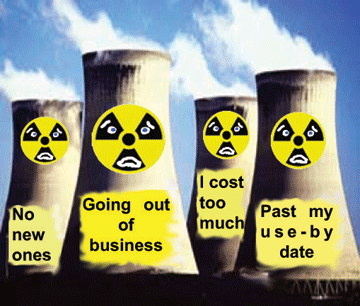
Nuclear plant retirements driven by economic and policy headwinds are likely to continue. Based on announced nuclear retirements, Fitch Ratings expects that the amount of retired and retiring gigawatts (GW) will outpace new nuclear plant additions between 2013 and 2025.
Key factors driving the shutdowns include low natural gas prices due to abundant US supply and actual and anticipated penetration of renewable generation and regulatory constructs that do not adequately compensate for nuclear energy’s non-emitting attributes.
The recent spate of announced nuclear facility retirements is not surprising in light of the depth and duration of the current extended downturn in wholesale power prices and policy challenges faced by nuclear plant operators. Plant closings appear likely to continue unless there are policy changes to address market structures and incentives.
While smaller single-unit merchant nuclear facilities are particularly vulnerable, larger rate-regulated and merchant nuclear facilities are also at risk.
For more information on this topic, see Fitch’s full rating report on “Pacific Gas and Electric Company,” available on our website at www.fitchratings.com.
Additional information is available on www.fitchratings.com.
U.S. Plans to Saturate Globe With Weapons
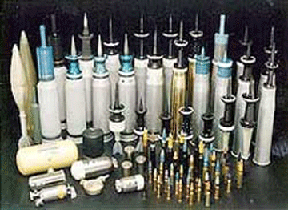 U.S. Plans to Saturate Globe With Weapons http://davidswanson.org/node/5211#.V4enaFLKUhw.linkedin by davidswanson My headline above is a plain English translation of this Pentagonspeak found in a Reuters headline today: “Demand for U.S. arms exports set to keep growing, official says.”
As the United States and NATO antagonize Russia, and pressure NATO members to buy more weapons, and showcase U.S. weapons in numerous wars, and use every carrot and stick in the State Department to market U.S. weapons, an “official” who happens to have been located at a giant weapons trade show predicts that of its own accord “demand” for weaponry is going to grow. Here’s Reuters’ first sentence:
“International demand for U.S. weapons systems is expected to continue growing in coming years, a senior U.S. Air Force official said on Sunday, citing strong interest in unmanned systems, munitions and fighter jets.”
Thus is the proliferation of drones around the world spun as something positive, along with bombs and jets. And thus is it spun as something that simply results from the quality and desirability of the products.
Quick, which five nations do you most want murdering their enemies with missiles from drones over the United States?
Meanwhile, the United States already exports the majority of weapons exported on earth, including the majority of weapons to war-torn regions like the Middle East that don’t manufacture their own weapons but rather suffer from their import as did Native Americans from alcohol or Chinese from opium. U.S. citizens content themselves with fantasizing that the war business is patriotic, while their nations’ killers battle against U.S. weapons sold by profiteers who have only customers, no enemies.
“‘The appetite just keeps getting bigger and bigger,’ U.S. Air Force Deputy Undersecretary Heidi Grant told Reuters in an interview on the eve of the Farnborough International Airshow. U.S. arms sales approved by the Pentagon’s Defense Security Cooperation Agency rose 36 percent to $46.6 billion in the fiscal year ended Sept. 30, 2015, and are likely to remain strong this year, Grant said.”
“There are good-hearted people,” wrote Jan Oberg last week, “who believe that countries have competent experts who along a series of indicators measure and judge which security challenge are waiting in the future – and a series analyses of the threat towards their country on this or that time horizon. The probability of each threat is also evaluated – to help politicians with limited budgets to allocate money to guard against some ‘realistic’ but not all possible/thinkable threats.”
In reality, Oberg explains, the war business generates sales and invents justifications for them. Which came first, the enemy or the bombs? The bombs. Listen to this, from Reuters:
“Grant, the Air Force’s top international arms sales official, said she was working with many countries in eastern Europe and others that wanted to increase their defenses following Russia’s annexation of the Crimea region of Ukraine, but faced tough budget constraints.”
Now there’s not actually any secret around the facts here. The United States, led by Victoria Nuland, who awaits a top appointment in a Hillary Clinton regime, facilitated a coup in Ukraine, installing an anti-Russian government. Then the people of Crimea voted to join Russia. Then the United States began pushing weapons on Eastern European countries as necessary to defend against such “Russian aggression.” Then NATO had a meeting this past weekend to plan for war with Russia.
Each of those events has a date, and their order is not in any dispute. Back in May the Politico newspaper reported on Pentagon testimony in Congress to the effect that Russia had a superior and threatening military, but followed that with this:
“‘This is the “Chicken-Little, sky-is-falling” set in the Army,’ the senior Pentagon officer said. ‘These guys want us to believe the Russians are 10 feet tall. There’s a simpler explanation: The Army is looking for a purpose, and a bigger chunk of the budget. And the best way to get that is to paint the Russians as being able to land in our rear and on both of our flanks at the same time. What a crock.”
Politico then cited a less-than-credible “study” of Russian military superiority and aggression and added:
“While the reporting about the Army study made headlines in the major media, a large number in the military’s influential retired community, including former senior Army officers, rolled their eyes. ‘That’s news to me,’ one of these highly respected officers told me. ‘Swarms of unmanned aerial vehicles? Surprisingly lethal tanks? How come this is the first we’ve heard of it?”
But what better to scare Poland with than swarms of Russian drones, real or otherwise? Go back to the fact that the U.S. Air Force has a “top international arms sales official.” What purpose does that individual serve under the U.S. Constitution?
New York’s Governor Cuomo should invest clean energy funds in actual clean energy, not dirty nuclear
 New York’s Governor Would Rather Prop Up the Nuclear Industry Than Invest in Renewable Energy, By Jessica Azulay / AlterNet July 13, 2016
That may be good politics—and certainly no one wants those people to lose their jobs—but there are substantial drawbacks, including putting millions of New Yorkers at risk. Why doesn’t the governor invest clean energy funds in actual clean energy, such as solar and wind?
To put the 12-year, $7.6 billion plan into perspective, consider that Cuomo’s NY-Sun program, which pays for the state’s solar incentives, is slated to invest only $1 billion into the solar industry over 10 years. That billion dollars has supported the creation of a lot of jobs. Halfway through NY-Sun’s life, New York state has benefitted from the creation of 8,000 solar jobs. Conversely, the $7.6 billion to keep nuclear plants open will save about 2,000 jobs. Based on this math, the money would be better spent invested in solar energy. If the governor wants to give existing nuclear workers a helping hand, he could also provide renewable energy companies incentives to hire them.
Left as it is, the nuclear subsidy policy would turn on its head New York’s promise to lead the nation in renewable energy and instead leave New York and Governor Cuomo leading the nation in nuclear subsidies for old and dangerous reactors. The so-called Clean Energy Standard would spend twice the amount of money on dirty energy as it would on renewables. That is preposterous.
The plants that the state wants to prop up are failures both financially and technologically………
Thousands of New Yorkers and over 100 organizations have criticized these nuclear subsidies, instead calling for the governor to let dangerous and unprofitable nuclear plants close and to invest our money in renewable energy and energy efficiency instead. But on July 8, the governor’s Public Service Commission went the opposite direction, releasing a new, expensive version of the proposed subsidies. The commission is giving the public a paltry 10 days to comment while the governor stated to the press Wednesday he is working to finalize a deal to keep FitzPatrick open to save 600 jobs and use nuclear as a so-called “clean energy bridge” at the cost of billions of dollars.
Governor Cuomo should protect the safety of millions of New Yorkers. He should say no to subsidizing the nuclear industry and yes to New York’s clean and green energy economy. Call him today at (518) 474-8390. http://www.alternet.org/environment/new-yorks-governor-andrew-cuomo-would-rather-prop-nuclear-industry-invest-renewable
President Obama ready to make policy changes to reduce role of nuclear weapons
 Obama plans major nuclear policy changes in his final months, WP By Josh Rogin July 10 The Obama administration is determined to use its final six months in office to take a series of executive actions to advance the nuclear [disarmament] agenda the president has advocated since his college days. It’s part of Obama’s late push to polish a foreign policy legacy that is plagued by challenges on several other fronts.
President Obama announced his drive to reduce the role of nuclear weapons and eventually rid the world of them in his first major foreign policy speech, in Prague in 2009. In his first years, he achieved some successes, such as the New START treaty with Russia, the Nuclear Security Summits and the controversial Iran deal. But progress waned in the past year as more pressing crises commanded the White House’s attention. Now, the president is considering using the freedom afforded a departing administration to cross off several remaining items on his nuclear wish list.
In recent weeks, the national security Cabinet members known as the Principals Committee held two meetings to review options for executive actions on nuclear policy. Many of the options on the table are controversial, but by design none of them require formal congressional approval. No final decisions have been made, but Obama is expected to weigh in personally soon.
“As we enter the homestretch of the Obama presidency, it’s worth remembering that he came into office with a personal commitment to pursuing diplomacy and arms control,” deputy national security adviserBen Rhodes told the Arms Control Association on June 6. “I can promise you today that President Obama is continuing to review a number of ways he can advance the Prague agenda over the course of the next seven months. Put simply, our work is not finished on these issues.”
Several U.S. officials briefed on the options told me they include declaring a “no first use” policy for the United States’ nuclear arsenal, which would be a landmark change in the country’s nuclear posture. Another option under consideration is seeking a U.N. Security Council resolution affirming a ban on the testing of nuclear weapons. This would be a way to enshrine the United States’ pledge not to test without having to seek unlikely Senate ratification of the Comprehensive Test Ban Treaty.
The administration is also considering offering Russia a five-year extension of the New START treaty’s limits on deployed nuclear weapons, even though those limits don’t expire until 2021. This way, Obama could ensure that the next administration doesn’t let the treaty lapse. Some administration officials want to cancel or delay development of a new nuclear cruise missile, called the Long-Range Stand-Off weapon, because it is designed for a limited nuclear strike, a capability Obama doesn’t believe the United States needs. Some officials want to take most deployed nukes off of “hair trigger” alert.
The administration also wants to cut back long-term plans for modernizing the nation’s nuclear arsenal, which the Congressional Budget Office reports will cost about $350 billion over the next decade. Obama may establish a blue-ribbon panel of experts to examine the long-term budget for these efforts and find ways to scale it back…….. https://www.washingtonpost.com/opinions/global-opinions/obama-plans-major-nuclear-policy-changes-in-his-final-months/2016/07/10/fef3d5ca-4521-11e6-88d0-6adee48be8bc_story.html
Connecticut lawmaker seeks justice over “stranded nuclear waste”
 Connecticut lawmaker pushes nuclear waste bill http://wtnh.com/2016/07/12/connecticut-lawmaker-pushes-nuclear-waste-bill/ By Keith Kountz July 12, 2016 New Haven, Conn. (WTNH)– Connecticut congressman Joe Courtney is part of a bi-partisan group of house lawmakers to introduce a bill to help communities that are struggling with the cost of storing what’s known as ‘stranded nuclear waste’.
The legislation is important to people in Courtney’s district, which includes the former home of the Connecticut Yankee nuclear power plant.
The Stranded Nuclear Waste Accountability act of 2016 would help communities cover any losses they’ve racked up associated with the storage of nuclear waste.
In a statement, Courtney says in part that ‘we cannot allow small communities and municipalities across this country to fall into financial distress because of the congressional gridlock which is holding up the establishment of a federal nuclear waste storage facility’.
Democratic Senators naming and blaming the funders of climate science denial
 US Senators detail a climate science “web of denial” but the impacts go well beyond their borders
Australians have been both helpers and victims of the fossil fuelled web of climate science denial being detailed in the U.S Senate, Guardian, Graham Readfearn, 12 July 16, By the middle of this week, about 20 Democratic Senators in the US will have stood up before their congress to talk about the fossil fuelled machinery of climate science denial.
The Senators are naming the fossil fuel funders, describing the machinery and calling out the characters that make up a “web of denial”.
“The web is so big, because it has so much to protect,” said the Rhode Island Senator Sheldon Whitehouse, who bookended the first evening of speeches.
The senate heard how fossil fuel companies such as ExxonMobil, Peabody Energy and the billionaire oil brothers Charles and David Koch had funnelled millions into groups that had spread doubt about the causes of climate change.
In a resolution also being tabled, the upper house will be asked to acknowledge that the fossil fuel industry had done just what the tobacco industry had done – “developed a sophisticated and deceitful campaign that funded think tanks and front groups, and paid public relations firms to deny, counter, and obfuscate peer-reviewed research” and “used that misinformation campaign to mislead the public and cast doubt in order to protect their financial interest.”
Groups like the Competitive Enterprise Institute (CEI), the Heartland Institute, the Committee for a Constructive Tomorrow and many, many others are under scrutiny for the way they have attacked the science linking fossil fuel burning to climate change while accepting cash from fossil fuel interests.
Whitehouse also took time to describe the large body of work in peer-reviewed journals that have examined the funding, the networks and the tactics of organised climate science denial. Climate science denial is itself a live area of academic research.
But the impact of climate science denial – the decades of policy delays, the confusion among the general public and the deliberate politicization of the science – does not stop at the US border. Continue reading
-
Archives
- October 2026 (120)
- September 2026 (339)
- August 2026 (330)
- July 2026 (355)
- June 2026 (287)
- May 2026 (306)
- April 2026 (356)
- March 2026 (251)
- February 2026 (267)
- January 2026 (308)
- December 2025 (358)
- November 2025 (359)
-
Categories
- 1
- 1 NUCLEAR ISSUES
- business and costs
- climate change
- culture and arts
- ENERGY
- environment
- health
- history
- indigenous issues
- Legal
- marketing of nuclear
- media
- opposition to nuclear
- PERSONAL STORIES
- politics
- politics international
- Religion and ethics
- safety
- secrets,lies and civil liberties
- spinbuster
- technology
- Uranium
- wastes
- weapons and war
- Women
- 2 WORLD
- ACTION
- AFRICA
- Atrocities
- AUSTRALIA
- Christina's notes
- Christina's themes
- culture and arts
- Events
- Fuk 2022
- Fuk 2023
- Fukushima 2017
- Fukushima 2018
- fukushima 2019
- Fukushima 2020
- Fukushima 2021
- general
- global warming
- Humour (God we need it)
- Nuclear
- RARE EARTHS
- Reference
- resources – print
- Resources -audiovicual
- Weekly Newsletter
- World
- World Nuclear
- YouTube
-
RSS
Entries RSS
Comments RSS

