President Obama pushes for UN call to end nuclear weapons testing, by-passes Congress
 Obama will bypass Congress, seek U.N. resolution on nuclear
  testing, WP, By Josh Rogin August 4 President Obama has decided to seek a new United Nations Security Council resolution that would call for an end to nuclear testing, a move that leading lawmakers are calling an end run around Congress.
Top administration officials, including Energy Secretary Ernest Moniz, briefed lawmakers and congressional staffers this week about President Obama’s decision to push for the U.N. action this September, to coincide with the 20th anniversary of the Comprehensive Test Ban Treaty, which was adopted in September 1996 but was never ratified by the Senate.
National Security Council spokesperson Ned Price told me that the administration still would like to see the Senate ratify the test ban treaty but is “looking at possible action in the UN Security Council that would call on states not to test and support the CTBT’s objectives. We will continue to explore ways to achieve this goal, being careful to protect the Senate’s constitutional role.”
The administration did not consult Congress before making the decision, and leading Republicans, including those who opposed Obama’s nuclear deal with Iran, are irate that the White House plans another major national security move without their advice or consent……..
The Obama administration has tried for years without success to build Senate support for ratifying the Comprehensive Test Ban Treaty, which has been ratified by 164 countries. The Clinton administration signed the treaty, but the Senate refused to ratify it in 1999. There’s no chance that the current Republican-led Senate would ratify it before Obama leaves office…….
Several lawmakers and staffers acknowledged that another congressional effort to stop Obama’s new U.N. plan would have little chance of success, especially because of the distractions of the election season and the shortage of days lawmakers are in session this fall………
The president’s push for U.N. action on nuclear testing came after months of debate inside his administration over how to advance his nuclear non-proliferation agenda. The president decided to move forward with this item after meeting with his entire National Security Council at the White House. Other nuclear policy changes could be decided and announced in the coming months. https://www.washingtonpost.com/news/josh-rogin/wp/2016/08/04/obama-will-bypass-congress-seek-u-n-resolution-on-nuclear-testing/
Paradox of USA’s nuclear weapons policy shown by Donald Trump
 Donald Trump, Perhaps Unwittingly, Exposes Paradox of Nuclear Arms, NYT, The Interpreter, By MAX FISHER AUG. 3, 2016 WASHINGTON — Donald J. Trump’s remarks on nuclear weapons have brought him, at times, to a question: Why should he be constrained from ever using them?
The controversy has highlighted a paradox that presidents have grappled with throughout the nuclear age: Nuclear weapons are deployed in great numbers, and at tremendous risk, for the purpose of never being used.
Yet the United States and other nuclear powers have maintained and expanded their arsenals, enhancing their ability to launch nuclear strikes even as they have concluded that the logic of such a conflict makes using the weapons unthinkable.
This leads to an odd dynamic: The more willing leaders are to use nuclear weapons, the less likely they will need to do so. Leaders heighten the risk — making the weapons faster, more powerful and harder to stop — so as to minimize it. They make the weapons more usable precisely because they are not.
There is little in Mr. Trump’s comments to suggest that he intended to highlight this contradiction, but that is what he did in asking why the United States bothers to develop extravagantly expensive weapons it never intends to set off………
In every case since 1945, at least so far, the terrible risks of nuclear conflict have helped avert its initiation. But, paradoxically, this has only deepened nuclear powers’ belief in the necessity of possessing such warheads, and in developing detailed plans for using them.
Tellingly, though Mr. Trump drew outrage when he said in the March interview that he would not rule out using nuclear weapons in Europe, his comments reflected current nuclear doctrine. The United States reserves the right to use nuclear weapons under certain conditions, such as retaliation for a nuclear attack, anywhere it deems necessary……..http://www.nytimes.com/2016/08/04/world/donald-trump-nuclear-weapons.html?smid=li-share&_r=0
Climate change: wildfires threaten nuclear disaster at Hanford site
“Very Serious”: Wildfires burn close to US nuclear site — ‘Red Flag Warning’ issued —
 FEMA: “Fire threatened such destruction as would constitute a major disaster” — Largest wildfire in country (VIDEO) http://enenews.com/very-serious-wildfires-burn-close-nuclear-site-red-flag-warning-issued-fema-fire-threatened-destruction-constitute-major-disaster-largest-wildfire-country-video?utm_source=feedburner&utm_medium=email&utm_campaign=Feed%3A+ENENews+%28Energy+News%29
NPR, Aug 3, 2016 (emphasis added): Washington Fire Crews Fight To Keep Buffer Between Wildfire, Nuclear Reactor — Officials from the Hanford nuclear reservation and Energy Northwest have been meeting with fire managers in southeast Washington state Tuesday. The nearby Range 12 Fire has grown to more than 177,000 acres and high winds are predicted this evening. Fire managers are very serious about keeping the Range 12 Fire off the central portion of the Hanford nuclear site and away from the Northwest’s only nuclear reactor… Energy Northwest spokesman John Dobken called the fire’s distance from the reactor a “non-issue,”… However, fire crews were still active on Rattlesnake Tuesday. Helicopters won’t be able to fly if gusts reach 20-30 miles per hour as predicted.
KEPR, Aug 2, 2016: The fire that began on the Yakima Training Center Saturday night and burned into Benton and Grant Counties over the weekend has ballooned to over 175,000 acres according to fire crews… The Range 12 fire [is] burning close to Hanford… The Northwest Incident Command team managing the firefighting efforts said [the blaze] is getting dangerously close to West Richland… A red flag warning is in place until 8 p.m. Tuesday night… Fire officials said the Red Flag Warning is causing concern for controlling containment lines around the blaze… As of Tuesday the Range 12 blaze stretched… from the Yakima Training Center toward the Hanford Reservation… Randall Rishe with BLM [Bureau of Land Management] said at this time they do not have a clear estimate of when the fire will be fully contained.
NPR, Aug 2, 2016: The Country’s Largest Wildfire Is Burning In Washington State… About 400 firefighters, three helicopters and 34 engines are fighting it. Some firefighters and land managers say they’re on edge because of predicted gusty winds and a red flag warning. The breeze is already kicking up, and firefighters worry that burned areas could pop up and jump the established fire lines. Crews set a backfire Sunday night on Rattlesnake Mountain to keep the Range 12 fire from burning contaminated areas of the Hanford Nuclear Reservation… [This] is the largest wildfire on a list of fires managed by government agencies.
KIRO, Aug 1, 2016: FEMA funds to help fight Benton County wildfire — A wildfire burning toward the Hanford nuclear reservation scorched about 110 square miles of brush and grass Monday as it spread… [FEMA] has authorized the use of federal funds to help with firefighting costs for the South Ward Gap Fire burning in Benton County, Washington. FEMA Region X Regional Administrator Kenneth D. Murphy determined that the fire threatened such destruction as would constitute a major disaster…
Seattle Times, Aug 2, 2016: Winds whip up wildfires; one blaze bearing down on Hanford site… winds pushed the Range 12 fire toward the Hanford Nuclear Reservation… Rishe said the fire Sunday ripped through grass, sagebrush and cheatgrass with ferocity… Crews are racing to put the fire down before winds make the situation more dangerous.
Seattle Times, Aug 2, 2016: Wildfire near Hanford site larger than first thought; high winds a concern — The Range 12 fire, near the Hanford nuclear site, is now 175,000 acres — much bigger than crews first realized… More than 400 firefighters are working the Range 12 fire, which is west of the Hanford nuclear site. Rishe said “there’s very low concern along Highway 240,” the barrier to the nuclear site. But, “it’s all contingent on this wind event.”
Tri-City Herald, Aug 2, 2016: Fire near Hanford much larger than thought… The estimated size of the fire that burned… toward the Hanford nuclear reservation has more than doubled to 273 square miles… A red flag fire warning was issued for the Mid-Columbia on Tuesday… The incident command team was concerned that established fire perimeter lines could be threatened… Crews have come from as far away as Medford, Ore., to help fight the fire.
New York State Public Service Commission’s $7.6 billion bailout of uneconomic nuclear power plants
New York Approves $7.6 Billion Bailout Of Nuclear Power Plants, Huffington Post 08/03/2016 Karl Grossman Investigative reporter
The New York State Public Service Commission—in the face of strong opposition—this week approved a $7.6 billion bailout of aging nuclear power plants in upstate New York which their owners have said are uneconomic to run without government support.
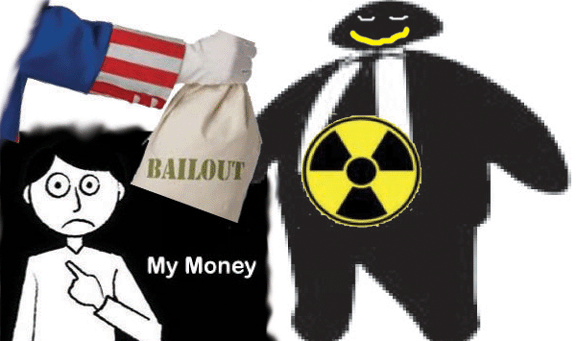
New York Governor Andrew Cuomo—who appoints the members of the PSC—has called for the continued operation of the nuclear plants in order to, he says, save jobs at them. The bailout would be part of a “Clean Energy Standard” advanced by Cuomo. Under it, 50 percent of electricity used in New York by 2030 would come from “clean and renewable energy sources”—with nuclear power considered clean and renewable.
“Nuclear energy is neither clean nor renewable,” testified Pauline Salotti, vice chair of the Green Party of Suffolk County, Long Island at a recent hearing on the plan.
“Without these subsidies, nuclear plants cannot compete with renewable energy and will close. But under the guise of ‘clean energy,’ the nuclear industry is about to get its hands on our money in order to save its own profits, at the expense of public health and safety,” declared a statement by Jessica Azulay, program director of Alliance for a Green Economy, based in upstate Syracuse with a chapter in New York City. Moreover, she emphasized, “Every dollar spent on nuclear subsidies is a dollar out of the pocket of New York’s electricity consumers—residents, businesses and municipalities” that should “instead” go towards backing “energy efficiency, renewable energy and a transition to a clean energy economy.”
The “Clean Energy Standard” earmarks twice as much money for the nuclear power subsidy than it does for renewable energy sources such as solar and wind…….
In opposing the New York nuclear subsidy, Dr. Mark Z. Jacobson, professor of civil and environmental engineering and director of the Atmosphere/Energy Program at Stanford University, wrote in an op-ed in Albany Times Union, the newspaper in the state’s capitol, that he was “shocked” by the PSC’s “proposal that the lion’s share of the Clean Energy Standard funding would be a nuclear bailout.” He said “allowing the upstate nuclear plants to close now and replace them with equal energy output” from offshore wind and solar power “would be cheaper and would create more jobs.” The closure of the upstate plants “would jeopardize fewer than 2,000 jobs” while a “peer-reviewed study” he has done “about converting New York State to 100 percent clean, renewable energy -which is entirely possible now—would create a net of approximately 82,000 good, long-term jobs.”
The upstate nuclear power plants to be bailed out under the plan would be FitzPatrick, Nine Mile Point 1 and 2 and Ginna. The money would come over a 12-year period through a surcharge on electric bills paid by residential and industrial customers in New York State…….
Reuters has reported that the nuclear “industry hopes that if New York succeeds, it could pressure other states to adopt similar subsides” for nuclear plants. The headline of the Reuters story: “New York could show the way to rescue U.S. nuclear plants.”
The two Indian Point nuclear power plants 26 miles north of New York City are not now included in the plan but it “leaves the door open to subsidies” for them, says Azulay of Alliance for a Green Economy. This would mean “the costs [of the bailout] will rise to over $10 billion.” ………http://www.huffingtonpost.com/karl-grossman/76-billion-bailout-of-ny-_b_11302708.html
Most outgoing NRC Commissioners move into plum nuclear industry jobs
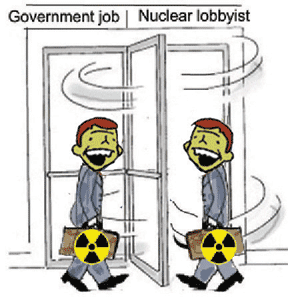
 US Nuclear Regulatory Commission’s ‘enforcement’ is as fierce as the comfy chair, Ecologist Linda Pentz Gunter 2nd August 2016 “…….
- The first NRC commissioner, William A. Anders (1975-76), went on to General Dynamics, where he earned $40 million in two years.
- Thomas M. Roberts (1981-1990) was asked to resign from the commission by critics in Congress due to conflicts of interest.
- Nils Diaz (1996-2006), exited the commission to become Chief Strategic Officer forBlue Castle Project, described as “leading the West in New Nuclear Power.”
- Jeffrey S. Merrifield (1998-2007), was investigated by the Project On Government Oversight while still a commissioner for getting contracts for the Shaw Group for whom he subsequently went to work, as well as having his travel tab paid by GE while job seeking there during his NRC tenure.
- Richard Meserve (1999-2003), who resigned during the Davis-Besse scandal, received a2012 Nuclear Energy Industry Leadership Award from the industry’s lobbying arm, the Nuclear Energy Institute, as testament to his industry loyalty.
- Former NRC Chairman, Dale Klein, (2006-10), now works for Japanese utility Tokyo Electric Power Company, at the center of the Fukushima nuclear disaster, where he oversees the corporation’s ongoing reactor restart effort.
- William D. Magwood, IV (2010-2014), resigned his commission seat to join the Nuclear Energy Association (NEA) in Paris, replacing Stephen Burns who took a new position as … Chairman of the NRC Commission!…….. http://www.theecologist.org/News/news_analysis/2987972/us_nuclear_regulatory_commissions_enforcement_is_as_fierce_as_the_comfy_chair.html
Firefighters work to Keep Buffer Between Wildfire and Hanford nuclear site
Washington Fire Crews Fight To Keep Buffer Between Wildfire, Nuclear Reactor, nw News Network, By ANNA KING • AUG 2, 2016 Officials from the Hanford nuclear reservation and Energy Northwest have been meeting with fire managers in southeast Washington state Tuesday. The nearby Range 12 Fire has grown to more than 177,000 acres and high winds are predicted this evening.
Fire managers are very serious about keeping the Range 12 Fire off the central portion of the Hanford nuclear site and away from the Northwest’s only nuclear reactor.
“We have firefighters and engines stationed around the entire perimeter of the fire and the entire flank of the eastern side where the Hanford site is,” Bureau of Land Management spokesman Randall Rishe said Tuesday. “So if there is a slop over, if there is a spot, they can get it immediately.”…….
The Range 12 Fire is currently the largest wildfire on a list of active wildfires across the U.S. being managed by government agencies. http://nwnewsnetwork.org/post/washington-fire-crews-fight-keep-buffer-between-wildfire-nuclear-reactor
USA’s Nuclear Regulatory Commission – wholly owned subsidiary of the nuclear power industry
 US Nuclear Regulatory Commission’s ‘enforcement’ is as fierce as the comfy chair, Ecologist Linda Pentz Gunter 2nd August 2016
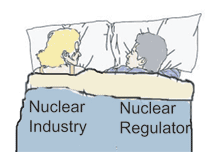
The NRC routinely fails to enforce its own safety codes at nuclear power plants, writes Linda Pentz Gunter – putting all of us at risk from accidents. It’s the US’s most extreme example of regulatory capture, rivalling Japan’s ‘nuclear village’ of crony agencies and feeble regulation that led to the Fukushima disaster. How long can it be before the US experiences another nuclear catastrophe?
Fetch the comfy chair! The US Nuclear Regulatory Commission (NRC) is in town to enforce its own safety regulations at your local nuclear power plant. Reactor owners have been duly warned. Comply or else …
Or else what? Three more last chances? No, unlike Monty Python’s Spanish Inquisition, the NRC isn’t bothering to read the charges. It’s handing out immunity.
The US still has 30 operating reactors of the same General Electric design that exploded at Fukushima. Yet the NRC has decided not to require a significant safety retrofit that it had ordered in 2013, and that would have reduced the radioactive consequences of a major accident at one of these dangerously flawed reactors.
Or rather, the NRC will require it, but only after the reactor closes. The Oyster Creek nuclear generating station in New Jersey, which happens also to be the world’s prototype for the Fukushima reactors, is scheduled to close on December 31, 2019.
The NRC agreed to owner Exelon’s request for an extension to comply with the installation of a reliable severe accident-capable hardened vent. Exelon’s new deadline? January 2020, just after the reactor will be permanently shuttered.
Similarly, the Entergy-owned Pilgrim nuclear plant near Plymouth, MA, also a GE Fukushima design, and which has announced a June 1, 2019 shutdown date, hasrequested and extension to comply with the vent order until December 31, 2019.
It’s tempting be cynical and assume that by agreeing to extend such deadlines, the NRC is hoping owners will change their minds and keep their reactors open. After all, shutdowns are bad for business, and the NRC is very much in league with the interests of its industry friends.
Nothing illustrated this better than the NRC’s decision to provide a 20-year license extension to the Vermont Yankee nuclear power plant – another Fukushima clone – ten days into the 11th March 2011 Japan nuclear disaster. Luckily, the owners closed the financially hemorrhaging plant at the end of 2014.
The consistent pattern: industry cost cuts before public safety
Beleaguered by an economic nosedive, the nuclear industry has consistently challenged the NRC’s safety compliance orders to avoid the expense, putting profit well ahead of safety. The NRC has consistently and obligingly capitulated, even when the risk itself is identified as a top priority……..
Genius – let the nuclear industry self-report its own violations!
The list goes on. At the Exelon-owned Braidwood, IL nuclear power plant, starting in 1996, millions of gallons of water contaminated with tritium (radioactive hydrogen) leaked from the plant for 10 years while Exelon covered it up.
The tritiated water spilled onto roadways and into ditches, contaminating nearby agricultural fields, ponds and the drinking water wells of surrounding homeowners. Two on-site NRC inspectors supposedly failed to notice the lake of radioactive water flooding on and off the site.
The NRC’s solution was to allow the industry to self-report future leaks through an unenforceable voluntary honor system; a guarantee for further cover-ups. This despite revelations including in a report by my organization Beyond Nuclear – Leak First, Fix Later, and by the Associated Press that radioactive leaks were likely occurring at almost every nuclear plant in the country……….
Who is watching? Certainly not Congress, to whom the NRC is supposed to answer but which has rarely asked the agency to explain its negligence. Instead, there have been scores of close calls at US nuclear plants -166 in the last decade alone according to Greenpeace. The NRC has issued dozens of license extensions to old, decrepit reactors and denied none.
‘The agency is a wholly owned subsidiary of the nuclear power industry’
All this should have changed in 1974 when the Energy Reorganization Act divided the then Atomic Energy Commission into two new agencies – the NRC and what would become the Department of Energy. This was done to create a dividing line between nuclear regulation and promotion, with the NRC assuming the former role.
But the umbilical cord never got cut. The NRC didn’t just climb straight back into bed with the nuclear industry. It crawled back into the womb, as former NRC commissioner and now critic, Peter Bradford, told the New York Times: “The NRC inherited the regulatory staff and adopted the rules and regulations of the AEC intact.”
Meanwhile, since the agency’s inception, many outgoing NRC Commissioners have sailed away in golden parachutes straight into plum nuclear industry jobs…….
A few former commissioners, including Bradford (1977-82) and Victor Gilinsky (1974-84) became stern critics of the agency after their tenures. “The agency is a wholly owned subsidiary of the nuclear power industry”, Gilinsky said.
“It’s common knowledge in Washington that anyone nominated to be a commissioner to the NRC has to be pre-approved by the nuclear industry”, Union of Concerned Scientists senior scientist, Edwin Lyman told Forbes. “In order to get a more independent mindset, you’ve got to break that stranglehold.”
Just like Japan’s ‘nuclear village’
The Japanese parliament found that out after it commissioned a causal study on the Fukushima disaster in 2012. When the independent investigators delivered their verdict, they described the calamity as “man-made” and attributed it to collusion between government, regulator and TEPCO.
The NRC seems bent on repeating those mistakes while Members of Congress continue to do the bidding of the nuclear industry lobby and little to represent the safety and wellbeing of their real employers: all of us.
Do those nice fat checks from lobbyists buy their silence? Do they just not care? Or are they in fact worse than the NRC itself? The industry is once again pitching for a reduction in what it sees as burdensome regulatory oversight. Will Congress agree and slash the NRC budget to streamline what is already a rubber stamp system on safety?
Meanwhile, the NRC continues to look the other way on violations of its own safety regulations. It is happy to ignore potentially deadly defects and age-related degradation at the country’s nuclear plants in order to save the beleaguered industry any additional expense.
It will choose to risk potentially tens of thousands of lives to keep that revolving door spinning and the pathway clear to cushy jobs in the nuclear industry. That’s worse than collusion and negligence. It’s criminal. Are we outraged yet? http://www.theecologist.org/News/news_analysis/2987972/us_nuclear_regulatory_commissions_enforcement_is_as_fierce_as_the_comfy_chair.html
California abandons nuclear power, New York does the opposite
These two huge states are both going green. But only one is sticking with nuclear, WP
On Monday, though, New York — also a leader when it comes to greening power supplies — announced a very different route. The state’s Public Service Commission approved a Clean Energy Standard backed by Gov. Andrew Cuomo’s backed Clean Energy Standard. It seeks to get New York to 50 percent renewable electricity by the year 2030 — while also retaining the six nuclear reactors that currently provide more 30 percent of the state’s electricity. (These reactors would not count as part of the renewable 50 percent.)……….
many critics of nuclear energy persist, in the environmental community and elsewhere, and not all observers think New York necessarily made the right move.
“By not making them compete for a place in the low carbon portfolio, the state is almost assuring that the customers are going to pay more than they have to, and that some desirable alternative sources won’t get developed, because nuclear’s place in the picture is locked in,” said Peter Bradford, a former chair of the New York Public Service Commission and an adjunct professor at the Vermont Law School………
All sides will now watch how these two experiments — in New York, and California — play out. Nuclear provides a major stream of what is often termed “baseload” electricity, which is continuous and thus very different from wind and solar, which are much stronger at key times (solar, for instance, in the afternoon) and less available at others. Thus, integrating more wind and solar with less baseload, as California aims to do, presumably puts a greater emphasis on the use of energy efficiency measures (less electricity use over all), or energy storage (using electricity at a different time from when it is generated), to deal with these sources’ intermittency………https://www.washingtonpost.com/news/energy-environment/wp/2016/08/01/why-new-york-state-just-delivered-extremely-good-news-to-the-nuclear-industry/?utm_term=.20097475af56
Non-profit World Business Academy sues Lands Commission over Diablo Canyon Nuclear Station
 Santa Barbara nonprofit sues Lands Commission over Diablo Canyon, Cal Coast News, August 3, 2016
By JOSH FRIEDMAN
A Santa Barbara-based nonprofit has filed a lawsuit against the California State Lands Commission, alleging the agency wrongfully approved a new lease for the cooling system at Diablo Canyon power plant. The lawsuit claims state law mandates than Diablo Canyon undergo an environmental review.
On June 28, the three-member State Lands Commission voted unanimously to approve a new tidelands lease for the Diablo Canyon cooling system. The decision will allow PG&E to continue operating the nuclear plant until 2025, when the utility plans to shut it down. If PG&E did not obtain the new lease, it faced the possibility of closing Diablo Canyon as early as 2018.
The World Business Academy, a think tank that opposes nuclear power and promotes renewable energy, filed its lawsuit in Los Angeles County Superior Court. The suit demands that state officials review potential environmental and public health dangers that could occur due to continued operation of Diablo Canyon.
California law mandates a project undergo an environmental review when any unusual circumstances exist, the lawsuit states. The World Business Academy claims there are numerous unusual circumstances surrounding Diablo Canyon. They include: high seismic risk; adverse health impacts from continuing emissions of radioactive isotopes; devastating impacts on marine life; potential adverse impacts from a terror attack; leakage and buildup of radioactive waste; and Diablo Canyon’s status as the sole remaining nuclear plant in California.
Rinaldo Brutoco, the president of the nonprofit, said any of the unusual circumstances should have triggered an environmental review…….http://calcoastnews.com/2016/08/santa-barbara-nonprofit-sues-lands-commission-diablo-canyon/
Exelon nuclear snubbed by Illinois legislature, embraced by New York’s governor-appointed state regulators
Exelon finds a nuclear ally in New York after Illinois snub , Chicago Tribune, Mark Chediak and Jim Polson, Bloomberg, 4 Aug 16, In the end, the fate of Exelon Corp.’s money-losing reactors in Illinois and New York may have come down to one governor who desperately wanted to rescue them and another who wasn’t so sure.
New York Gov. Andrew Cuomo laid down his marker in December when he told the chairman of the state’s utility regulator that losing two upstate nuclear plants would gut a plan to cut global warming pollution and cost jobs. On Monday, the state agreed to a bailout and within hours, Exelon said it would invest $200 million in the two plants.
While Illinois Gov. Bruce Rauner also worried about job losses, he said any rescue plan must protect ratepayers and taxpayers and that corporate bailouts raise red flags. In June, Chicago-based Exelon said it would close two Illinois plants after the state legislature balked at a measure to stem their financial losses.
“In New York, it was the governor’s support that did it,” Bloomberg Intelligence analyst Kit Konolige said by phone Wednesday. “In Illinois, from what the governor said in public, it appeared he wasn’t all in.”
Debates over nuclear policy come at a critical time for the industry as U.S. reactors face tough competition from power generators that burn cheap natural gas flooding out of shale formations and rising solar and wind production. As of the end of July, 11 nuclear power plants have closed or are slated to be shut, according to data compiled by Bloomberg Intelligence.
In New York, Exelon benefited from Cuomo’s support and his determination to help upstate reactors as part of a clean energy plan even as he calls for the retirement of Entergy Corp.’s Indian Point nuclear plant near New York City. The state Public Service Commission vote Monday may also save Entergy’s James A. FitzPatrick nuclear plant near Oswego. Exelon said it would consider buying FitzPatrick if subsidies were approved.
Cuomo had the advantage of being able to tap governor-appointed state regulators to weigh the nuclear bailout instead of the legislature, according to Christine Tezak, an analyst at ClearView Energy Partners in Washington……..http://www.chicagotribune.com/business/ct-exelon-nuclear-plant-new-york-20160803-story.html
Potential for legal challenges to New York’s new Clean Energy Standard
With Clean Energy Standard, New York looks to save nukes, skirt legal challenges Regulators say three nuclear plants are essential to meeting state climate goals, but is their plan to save them legal? Utility Dive, By Robert Walton | August 4, 2016 New York regulators approved an aggressive Clean Energy Standard this week that calls for 50% renewable energy and includes income supports to keep three upstate nuclear plants online. ……the order has been carefully crafted to pass federal or legal scrutiny, though a challenge is all but inevitable……
In the days after its announcement, much of the legal speculation has centered on Hughes v. Talen Energy Marketing.
In a unanimous decision in April, the U.S. Supreme Court rejected a controversial Maryland program to incentivize new in-state generation, finding that it intruded on federal authorities’ jurisdiction over wholesale energy markets.
That case is also being talked about in the context of Ohio’s struggles with uneconomic generation. A previous subsidy passed by that state was blocked by FERC, forcing the utilities to revise and reduce their subsidy proposals……http://www.utilitydive.com/news/with-clean-energy-standard-new-york-looks-to-save-nukes-skirt-legal-chall/423673/
America to upgrade its B61 nuclear missile
New deterrence: US plans to upgrade its nuclear bomb Rt.com 2 Aug, 2016 The National Nuclear Security Administration has given the go-ahead for work on upgrading the B61 airborne nuclear bomb, as the Pentagon is eager to embark on a multi-billion-dollar scheme to improve the US nuclear arsenal.
The decision taken by the National Nuclear Security Administration (NNSA) authorized the program to enter a post-engineering phase, which comes after four years of work. This now means that the first upgraded bombs are set to roll out by 2020.
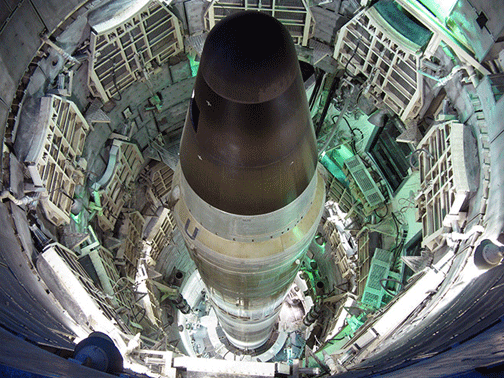
The B61 has been the principal US airborne nuclear bomb since 1968, when the first version was commissioned. With some of the modifications being canceled over the years and others withdrawn from use, only models 3,4,7,11 and 12 are currently in active service……
The Kremlin has been cautious about the announcement that the US intends to modernize the B61 nuclear bomb.
“The experts need to give their opinion about this,” said Dmitry Peskov, President Vladimir Putin’s press secretary.
Meanwhile Senator Viktor Ozerov told RIA that Russia’s nuclear scientists would be assessing the US plans and would take steps to tackle the proposed threat if it is deemed necessary. “No doubt, our nuclear weapons specialists will carefully study the level of threat and will take measures to minimize it, if needed,” Ozerov said.
However, Rob van Riet, the coordinator for disarmament program at the World Future Council foundation, told Sputnik that the decision is harmful to nuclear security and could lead to the weapons being used by accident, while it also “sends the wrong signal.”
“The decision to extend the life span of [or] modernize the system is an unnecessary one that comes at a sizeable price tag and does the opposite of advancing nuclear security and disarmament. These weapons are a remnant of the Cold War,” van Riet said.
The decision taken by the NNSA to prolong the life of the B61-12 also comes as the US Air Force announced that it is planning to move ahead with proposals to replace its current intercontinental ballistic missile and nuclear cruise missile with new programs. …….https://www.rt.com/usa/354364-bomb-nuclear-upgrade-pentagon/
Can America afford the Pentagon’s grandiose nuclear weapons plans?
 The new forecasts are likely to add to the debate over whether coming administrations will be able to afford what defence analysts call a “bow wave” of costs converging in the next decade for the new nuclear systems
A trillion dollar program: Pentagon poised to approve work on modernizing nuclear-armed ICBMs, National Post Tony Capaccio, Bloomberg News | August 2, 2016 The Pentagon is preparing to approve development and production of a new intercontinental ballistic missile, opening competition between three top defence contractors and rekindling debate over whether the U.S. can afford to modernize its triad of nuclear weapons.
Frank Kendall, the Defense Department’s top weapons buyer, has convened a closed session of the Defense Acquisition Board for Wednesday to review the Air Force’s acquisition strategy and updated cost estimates for replacing Minuteman III nuclear-armed missiles that have sat in silos for almost 50 years.
The Air Force last year estimated the program would cost $62.3 billion for research and development and production of as many as 400 missiles as well as command and control systems and infrastructure. Lockheed Martin, Boeing and Northrop Grumman are all competing to build the new ICBMs.
The other arms of the nation’s land-air-sea nuclear triad also are scheduled to be modernized: Northrop defeated a Lockheed-Boeing team in October for the right to build a new bomber that can carry nuclear weapons, a project valued at as much as $80 billion. The Navy is planning to replace its Ohio-class nuclear-armed submarines through a production program now estimated at $122 billion.
Updated estimates for the cost of the missiles have been prepared by the Air Force and and the Pentagon’s independent cost assessment office but haven’t yet been released. The Navy is also updating its submarine estimate for a review later this year.
The new forecasts are likely to add to the debate over whether coming administrations will be able to afford what defence analysts call a “bow wave” of costs converging in the next decade for the new nuclear systems as well as nine Air Force conventional systems and plans for increased construction of naval vessels such as a second Ford-class aircraft carrier.
The ICBM “milestone marks the official beginning of the technology development stage where contracts will be awarded and spending” will “begin to ramp up,” from about $75 million this year to $1.6 billion in 2021, Todd Harrison, a defence budget analyst with the Center for Strategic and International Studies, said in an email.
Arms control organizations and some Pentagon officials say the nuclear triad’s modernization could cost as much as $1 trillion over 30 years if research, procurement, operations and support are included.
By way of comparison, Pentagon analysts estimate that Lockheed’s F-35 jet, the military’s most expensive program, may cost as much as $1.12 trillion over 60 years to support.
“It’s also important to put these costs in context,” Harrison said. “The U.S. will likely spend more than $20 trillion over the next 30 years on defence, so $1 trillion is only a small fraction of that,” Harrison said…….http://news.nationalpost.com/news/world/a-trillion-dollar-program-pentagon-poised-to-approve-work-on-modernizing-nuclear-armed-icbms
New York’s subsidy gift to the nuclear industry – the prelude for other States?
 “Nuclear power is not carbon-free,” wrote Michel Lee, head of the Council on Intelligent Energy & Conservation Policy based in Scarsdale. “If one stage,” reactors operation itself, “produces minimal carbon…every other stage produces prodigious amounts.” Thus the nuclear “industry is a big climate change polluter…Nuclear power is actually a chain of highly energy-intensive industrial processes whichcombinedconsume large amounts of fossil fuels and generate potent warming gasses. These include: uranium mining, milling enrichment, fuel fabrication, transport” and her list went on.
Reuters has reported that the nuclear “industry hopes that if New York succeeds, it could pressure other states to adopt similar subsides” for nuclear plants.
New York’s Woeful $7.6 Billion Nuclear Bailout Package http://www.commondreams.org/views/2016/08/02/new-yorks-woeful-76-billion-nuclear-bailout-package by Karl Grossman
New York Governor Andrew Cuomo—who appoints the members of the PSC—has called for the continued operation of the nuclear plants in order to, he says, save jobs at them. The bail-out would be part of a “Clean Energy Standard” advanced by Cuomo. Under it, 50 percent of electricity used in New York by 2030 would come from “clean and renewable energy sources”with nuclear power considered clean and renewable.
“Nuclear energy is neither clean nor renewable,” testified Pauline Salotti, vice chair of the Green Party of Suffolk County, Long Island at a recent hearing on the plan.
The “Clean Energy Standard” earmarks twice as much money for the nuclear power subsidy than it does for renewable energy sources such as solar and wind.
Biggest Nuclear Weapons Stockpile in the World- Puget Sound

Puget Sound Is Home to the Biggest Nuclear Stockpile in the World, Truth Out, , 01 August 2016 By Martha Baskin, Crosscut The ad pierces your consciousness and catches you by surprise. Plastered on the side of Seattle’s King County Metro it hurls you momentarily back in time, to a time when nuclear weapons were an imminent threat to our survival. Or did the era never end?
The ad — sponsored by activists from the Poulsbo-based Ground Zero Center for Nonviolent Action — reads: “20 miles west of Seattle is the largest concentration of deployed nuclear weapons in the US.”
Behind this text is a map, depicting the proximity of Seattle to Naval Base Kitsap, located on the eastern shore of Hood Canal, one of the four main basins in Washington state’s Puget Sound. The base is home port for eight of the US Navy’s 14 Trident ballistic missile submarines as well as an underground nuclear weapons storage complex. Together, they’re believed to store more than 1,300 nuclear warheads, according to Hans Kristensen, director of the Nuclear Information Project at the Federation of American Scientists.
This is arguably the biggest single concentration of nuclear warheads not only in the US, but in the world.
King County Metro was initially hesitant to run the ad, until Kristensen confirmed its accuracy. The combined explosive power contained in the base is equivalent to more than 14,000 Hiroshima bombs, he says.
But the most surprising thing to him about the underground nuclear weapons storage complex — known as the Strategic Weapons Facility Pacific (SWF-PAC), and completed in 2012 — is the extent to which a $294 million bunker has largely escaped public debate, except for a few industry-related articles.
The small non-profit behind the ad shares a land border with the naval base. It launched when Robert Aldridge, an engineer for Lockheed Martin in California — the arms manufacturer has a facility at the base but only to ensure that Trident ballistic D5 missiles are ready for deployment on the subs — quit his job directing their development when he saw they could be used in a preemptive first strike against the Soviet Union.
According to Glen Milner, an active member of the Center, Aldridge then contacted two peace activists in the area — Catholic theologian Jim Douglas and his wife Shelley — and the Ground Zero Center for Nonviolent Action was formed……..
The US Navy has presented a plan to spend over a trillion dollars during the next 30 years upgrading and maintaining the entire triad of US based nuclear weapons, according to Martin Fleck of Physicians for Social Responsibility, a group that advocates for nuclear disarmament. This includes over $100 billion to replace the base’s nuclear submarines.
The plan was approved by Obama in 2010.
“We and our allies,” says Fleck, “are arguing for sanity with nuclear weapons given that we have enough already to end the world several times over. Why on earth would we invest another trillion dollars in them at this late date?”……http://www.truth-out.org/news/item/37052-puget-sound-is-home-to-the-biggest-nuclear-stockpile-in-the-world
-
Archives
- October 2026 (120)
- September 2026 (339)
- August 2026 (330)
- July 2026 (355)
- June 2026 (287)
- May 2026 (306)
- April 2026 (356)
- March 2026 (251)
- February 2026 (267)
- January 2026 (308)
- December 2025 (358)
- November 2025 (359)
-
Categories
- 1
- 1 NUCLEAR ISSUES
- business and costs
- climate change
- culture and arts
- ENERGY
- environment
- health
- history
- indigenous issues
- Legal
- marketing of nuclear
- media
- opposition to nuclear
- PERSONAL STORIES
- politics
- politics international
- Religion and ethics
- safety
- secrets,lies and civil liberties
- spinbuster
- technology
- Uranium
- wastes
- weapons and war
- Women
- 2 WORLD
- ACTION
- AFRICA
- Atrocities
- AUSTRALIA
- Christina's notes
- Christina's themes
- culture and arts
- Events
- Fuk 2022
- Fuk 2023
- Fukushima 2017
- Fukushima 2018
- fukushima 2019
- Fukushima 2020
- Fukushima 2021
- general
- global warming
- Humour (God we need it)
- Nuclear
- RARE EARTHS
- Reference
- resources – print
- Resources -audiovicual
- Weekly Newsletter
- World
- World Nuclear
- YouTube
-
RSS
Entries RSS
Comments RSS

