Is this because USA wants nuclear disarmament, or because USA wants to sell nuclear materials to the sub continent?
US urges India and Pakistan to sign and ratify nuclear test ban treaty Washington has welcomed Pakistan’s recent proposal to India for a bilateral agreement on nuclear weapons test ban, IBT By Nandini Krishnamoorthy August 24, 2016 The US has asked arch-rivals India and Pakistan to set aside their differences and sign and ratify the Comprehensive Nuclear-Test-Ban Treaty (CTBT). Welcoming Pakistan’s recent proposal to India for a bilateral agreement on nuclear weapons test ban, Washington has urged the two countries to hold talks.
Mark Toner, the State Department deputy spokesperson, said: “We welcome this high-level dialogue between India and Pakistan, encourage both countries to engage in the dialogue and exercise restraint aimed at improving strategic stability.”……..
On Tuesday (23 August), Pakistan announced a fresh move to seek support for its NSGmembership bid. Syed Tariq Fatemi, special assistant to the prime minister on foreign affairs, embarked on a visit to Belarus and Kazakhstan to win their backing, The Hindu reported.
U.S. mulls long-term, bomb-grade uranium exports to Belgium Reuters By Timothy Gardner and Robert-Jan Bartunek | WASHINGTON/BRUSSELS, 25 Aug 16
The U.S. nuclear regulator is considering long-term shipments of weapons-grade uranium to a medical research reactor in security-challenged Belgium, something critics say would set back global anti-proliferation efforts.
With a final decision still months away, the Belgian Nuclear Research Center is seeking permission from the U.S. Nuclear Regulatory Commission to receive 317 pounds (144 kilos) of highly enriched uranium, or HEU, fuel in a series of shipments over 10 years.
The United States has supplied the reactor, which produces radioisotopes for fighting cancer, with HEU for decades. But the long-term nature of the latest request is unprecedented; previous agreements have been for periods of one to three years.
The Belgian research center has told U.S. officials since at least 2005 that it is on the verge of converting to low-enriched uranium, or LEU, not suitable for bombs. But there is no definitive date set for that change.
“Now more than a decade has passed and they are asking for another 10 years – that seems to be a bit preposterous,” said Armando Travelli, who until 2005 headed the U.S. Energy Department’s program to convert research reactors to safer uranium and bring bomb-grade uranium back to the United States.
Annual wind report confirms tech advancements, improved performance, and low energy prices, Eureka Alert, DOE/LAWRENCE BERKELEY NATIONAL LABORATORY, 17 Aug 16 Wind energy pricing remains attractive to utility and commercial purchasers, according to an annual report released by the U.S. Department of Energy and prepared by the Electricity Markets & Policy Group at Lawrence Berkeley National Laboratory (Berkeley Lab). Prices offered by newly built wind projects are averaging around 2¢/kWh, driven lower by technology advancements and cost reductions.“Wind energy prices–particularly in the central United States–are at rock-bottom levels, with utilities and corporate buyers selecting wind as the low-cost option,” said Berkeley Lab Senior Scientist Ryan Wiser. “Moreover, enabled by technology advancements, wind projects are economically viable in a growing number of locations throughout the United States.”
Wind power represented the largest source of U.S. electric-generating capacity additions in 2015. Wind power capacity additions in the United States surged in 2015, with $14.5 billion invested in 8.6 gigawatts (GW) of new capacity. Wind power constituted 41% of all U.S. generation capacity additions in 2015, up sharply from its 24% market share the year before and close to its all-time high. Wind power currently meets about 5% of the nation’s electricity demand, and represents more than 10% of total electricity generation in twelve states, and more than 20% in three of those states.
Bigger turbines are enhancing wind project performance……
Low wind turbine pricing continues to push down installed project costs. Wind turbine prices have fallen 20% to 40% from their temporary highs in 2008, and these declines are pushing project-level costs down. …..
Wind energy prices remain very low. Lower installed project costs, along with improvements in capacity factors, are enabling aggressive wind power pricing. ….
As sea levels rise, nearly 1.9 million U.S. homes could be underwater by 2100, WP By Brady Dennis August 24 The real estate data firm Zillow recently published a research analysis that estimated rising sea levels could leave nearly 2 million U.S. homes inundated by 2100, a fate that would displace millions of people and result in property losses in the hundreds of billions of dollars.
More than 100,000 of those homes would be in Maryland and Virginia, according to the analysis. Another 140,000 would be submerged in the Carolinas. And Florida would face the gravest scenario of any state, with one in eight properties in danger of being underwater……
there’s near-unanimous agreement among scientists that the seas will rise. Insurance companies are anticipating it. Some cities are already planning for it.
“This is going to be a massive issue worldwide,” Michael Gerrard of Columbia University, who directs the Sabin Center for Climate Change Law, told The Post in a recent interview. “We don’t know yet the exact pace, but we know it’s coming. A certain amount is unavoidable.”….
Nuclear Renaissance–Nuclear Requiem, Union of Concerned Scientists DAVE LOCHBAUM, DIRECTOR, NUCLEAR SAFETY PROJECT | AUGUST 25, 2016There was considerable discussion a decade or so ago about the purported Nuclear Renaissance. New reactors were proposed almost everywhere but Delaware: Florida, Georgia, Alabama, North Carolina, South Carolina, Virginia, Louisiana, Texas, New Jersey, Pennsylvania, and Michigan.
Time turned renaissance into requiem. Owners permanently shut down five reactors since 2013 and have informed the Nuclear Regulatory Commission (NRC) of plans to close several other reactors over the next three years.
Whether you celebrated or mourned the five reactor closures, it’s worth reflecting on what each accomplished during its lifetime.
Crystal River Unit 3 (Florida) first achieved criticality of the reactor core on January 15, 1977. It shut down in September 2009 for a refueling outage during which the steam generators were to be replaced. The containment structure was severely damaged by the hole cut through it to allow replacement of the steam generators. Attempts to repair the damage failed, leading the owner to announce in February 2013 that the reactor would not be restarted……..
Kewaunee (Wisconsin) first achieved criticality of the reactor core on March 7, 1974. It shut down permanently on May 7, 2013, due largely to economic pressure from natural gas generators……..
San Onofre Unit 2 (California) first achieved criticality of the reactor core on July 26, 1982. It shut down on January 9, 2012, for a refueling outage. Workers identified abnormally high wear and tear of the tubes in the recently replaced steam generators. Plans to remedy the damage proved futile, leading the owner to announce in June 2013 that the reactor would not be restarted…….
Vermont Yankee (Vermont) first achieved criticality of the reactor core on March 24 1972. It shut down permanently on December 29, 2014, due largely to economic pressure from natural gas generators……
5 Reactors, 0 Meltdowns, 1 Near Miss (nearly)
According to the NRC’s Accident Sequence Precursor program, Kewaunee experienced the most serious safety event among these five reactors. Resin beads leaking from a mixed-bed demineralizer unit in the makeup water system collected in the condensate storage tank. The three auxiliary feedwater pumps transfer water from the condensate storage tank to the steam generators to assist in removing decay heat generated by the reactor core. On November 5, 1975, the motor-driven auxiliary feedwater pumps 1A and 1B failed when resin beds clogged the strainers installed in the piping before the pumps. Turbine-driven auxiliary feedwater pump 1C also failed when resin beads clogged its suction strainer. Fortunately, the feedwater pumps that normally transfer water from the condenser hotwell to the steam generators were unaffected by this problem and remained operable throughout this event.
Those who grew up in the era of the “Doomsday Clock” and “duck and cover” might assume that the days of mutual assured destruction andlaunch under attack were swept away with the Soviet Union. They would be wrong. America’s nuclear weapons remain on hair-trigger alert, and the commander in chief has not ruled out being the first to use them.
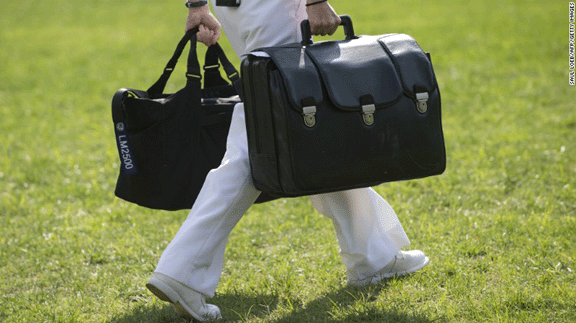
For all his talk about a “nuclear free world,” President Obama has proposed a $1 trillionmodernization of the nuclear arsenal. Republicans, having engineered the demise of the Anti-Ballistic Missile Treaty, are intent on ramping up U.S. nuclear defenses. The nuclear “football” still follows the president everywhere, enabling a cataclysmic strike to be launched on a moment’s notice.
Twenty-five years after the end of the Cold War, U.S. policy remains stuck on the same horrifying premise: that U.S. national security depends on its willingness to use nuclear weapons.
The problem is, who but a madman would ever do so?
First, the danger of escalation is simply too great. Whether the United States used nuclear weapons preemptively, or simply responded in kind, could it count on a nuclear power such as Russia or China to stand down and give in? There is no scenario more unimaginable than the United States taking the chance of setting off a chain reaction that ends in total annihilation.
Second, the humanitarian and environmental risks are unacceptable. Seventy-one years after the United States dropped atomic bombs on Hiroshima and Nagasaki, Japan,, residents are still developing cancerous tumors that can be linked to radiation exposure. New evidence suggests that a nuclear exchange would produce far more serious harm to public health than previously imagined. The United States has made drones its “weapon of choice” in the war on terror in large part because of its obligation under international law to take “all feasible precautions” to avoid and minimize incidental loss of civilian life, injury to civilians and damage to civilian infrastructure.
Third, the world is in a different place than it was when U.S. nuclear doctrine was conceived. Globalization — for better or worse — has interlocked America’s economic fate with that of its former adversaries. Over the past quarter-century, ideological differences have receded, U.S. trade relations with Russia and China have become normalized, and profound cultural, educational, scientific and human ties have been forged. Climate change, mass migration and pandemic disease have brought wide recognition of the interdependence of the planet. And disastrous U.S. interventions in Afghanistan, Iraq and Libya have plainly demonstrated the limits of what can be achieved with military power, no matter how shocking or awesome it may be.
Envisioning Donald Trump’s finger on the nuclear button helps us to understand how poorly the country is served by its absurd nuclear procedures, which allow a single individual, acting alone and instantaneously, without the benefit of full information or consultation, to order a nuclear attack that could end life as we know it. President Obama has a moral obligation to his country, and the world, to dismantle the “use it or lose it” system designed for a bygone era, and to declare that the United States will never be the first to use nuclear weapons. Ohlbaum is an independent consultant and a board member of the Center for International Policy.
The ‘nuclear football’ – the deadly briefcase that never leaves the president’s side
Donald Trump’s views on nukes may be the scariest thing about his candidacy. But how does Potus launch an attack at a moment’s notice? And what happens when you send the codes to the dry cleaners by mistake…Guardian, Stuart Jeffries , 22 Aug 16 “……..As for the nuclear football, it comes into active service when the president leaves the White House. It is the nickname for a large leather, aluminium-framed briefcase weighing 20kg which is hefted by a military aide who shadows the US commander in chief.
It is, as former Washington Post reporter Michael Dobbs calls it, “the ultimate power accessory, a doomsday machine that could destroy the entire world”. The late Bill Gulley, a former director of the White House Military Office, described what’s inside the nuclear football in his 1980 memoir Breaking Cover. “There are four things in the football. The Black Book containing the retaliatory options, a book listing classified site locations, a manila folder with eight or 10 pages stapled together giving a description of procedures for the Emergency Broadcast System, and a three-by-five inch card with authentication codes.”
The nuclear football has an antenna protruding from it, likely indicating that inside there is a communication system with which the president can maintain contact the Pentagon’s National Military Command Centre which monitors worldwide nuclear threats and can order an instant nuclear response. “The football,” says Dobbs, “also provides the commander-in-chief with a simplified menu of nuclear strike options – allowing him to decide, for example, whether to destroy all of America’s enemies in one fell swoop or to limit himself to obliterating only Moscow or Pyongyang or Beijing.”…….
Why is the briefcase nicknamed the nuclear football? According to former US secretary of defence Robert McNamara, it was so-named because it was part of an early nuclear war plan code-named Operation Drop Kick.
In Stanley Kubrick’s 1964 nuclear black comedy Dr Strangelove, there is also an Operation Drop Kick. It denoted a nuclear exercise that goes wrong when the unhinged US general played by Sterling Hayden orders a first strike on the Soviet Union. All the president’s men strive to recall the bombers to prevent nuclear politics……..
Aides who carry the nuclear football have extensive psychological evaluations to assess whether they’re up to the task. Metzger discloses that he underwent extensive vetting by the Defense Department, the secret service and the FBI before he was given the job. The incoming president, whether it is Trump or Clinton, will undergo no such checks as to their mental stability. There is, though, one consoling thought. Even if Trump did nuke Europe, he’d probably spare part of Aberdeenshire – he wouldn’t want to destroy his golf resort. https://www.theguardian.com/world/2016/aug/22/nuclear-football-donald-trump
Yucca Mountain Documents Now Publicly Available – In a New Online Library, USA Nuclear Regulatory Commission August 19, 2016 David McIntyre Public Affairs Officer
The NRC is flipping the switch today on its new LSN Library — making nearly 3.7 million documents related to the adjudicatory hearing on the proposed Yucca Mountain repository available to the public…….The library is significant for three reasons. First, it meets federal records requirements. Second, the library again provides public access to the previously-disclosed discovery materials should the Yucca Mountain adjudicatory hearing resume. Third, should the Yucca Mountain hearing not resume, the library will provide an important source of technical information for any future high-level waste repository licensing proceeding. https://public-blog.nrc-gateway.gov/2016/08/19/yucca-mountain-documents-now-publicly-available-in-a-new-online-library/
“There is no question the Energy Department has downplayed the significance of the accident,” said Don Hancock, who monitors the dump for the watchdog group Southwest Research and Information Center.
a federal investigation found more than two dozen safety lapses at the dump.
Nuclear Accident In New Mexico Is Still Being Censored, $2 Billion Cleanup
Nuclear accident in New Mexico ranks among the costliest in U.S. history, http://www.latimes.com/nation/la-na-new-mexico-nuclear-dump-20160819-snap-story.htmlRalph Vartabedian, 23 Aug 16 When a drum containing radioactive waste blew up in an underground nuclear dump in New Mexico two years ago, the Energy Department rushed to quell concerns in the Carlsbad desert community and quickly reported progress on resuming operations.
The early federal statements gave no hint that the blast had caused massive long-term damage to the dump, a facility crucial to the nuclear weapons cleanup program that spans the nation, or that it would jeopardize the Energy Department’s credibility in dealing with the tricky problem of radioactive waste.
But the explosion ranks among the costliest nuclear accidents in U.S. history, according to a Times analysis. The long-term cost of the mishap could top $2 billion, an amount roughly in the range of the cleanup after the 1979 partial meltdown at the Three Mile Island nuclear power plant in Pennsylvania.
The Feb. 14, 2014, accident is also complicating cleanup programs at about a dozen current and former nuclear weapons sites across the U.S. Thousands of tons of radioactive waste that were headed for the dump are backed up in Idaho, Washington, New Mexico and elsewhere, state officials said in interviews.
Washington state officials were recently forced to accept delays in moving the equivalent of 24,000 drums of nuclear waste from Hanford site to the New Mexico dump. The deal has further antagonized the relationship between the state and federal regulators.
“The federal government has an obligation to clean up the nuclear waste at Hanford,” Democratic Gov. Jay Inslee said in a statement. “I will continue to press them to honor their commitments to protect Washingtonians’ public health and our natural resources.”
Other states are no less insistent. The Energy Department has agreed to move the equivalent of nearly 200,000 drums from Idaho National Laboratory by 2018.
“Our expectation is that they will continue to meet the settlement agreement,” said Susan Burke, an oversight coordinator at the state’s Department of Environmental Quality.
The dump, officially known as the Waste Isolation Pilot Plant, was designed to place waste from nuclear weapons production since World War II into ancient salt beds, which engineers say will collapse around the waste and permanently seal it. The equivalent of 277,000 drums of radioactive waste is headed to the dump, according to federal documents.
The dump was dug much like a conventional mine, with vertical shafts and a maze of horizontal drifts. It had operated problem-free for 15 years and was touted by the Energy Department as a major success until the explosion, which involved a drum of of plutonium and americium waste that had been packaged at the Los Alamos National Laboratory.
The problem was traced to material — actual kitty litter — used to blot up liquids in sealed drums. Lab officials had decided to substitute an organic material for a mineral one. But the new material caused a complex chemical reaction that blew the lid off a drum, sending mounds of white, radioactive foam into the air and contaminating 35% of the underground area.
“There is no question the Energy Department has downplayed the significance of the accident,” said Don Hancock, who monitors the dump for the watchdog group Southwest Research and Information Center.
Though the error at the Los Alamos lab caused the accident, a federal investigation found more than two dozen safety lapses at the dump. The dump’s filtration system was supposed to prevent any radioactive releases, but it malfunctioned.
Twenty-one workers on the surface received low doses of radiation that federal officials said were well within safety limits. No workers were in the mine when the drum blew.
Energy Department officials declined to be interviewed about the incident but agreed to respond to written questions. The dump is operated by Nuclear Waste Partnership, which is led by the Los Angeles-based engineering firm AECOM. The company declined to comment.
Federal officials have set an ambitious goal to reopen the site for at least limited waste processing by the end of this year, but full operations can not resume until a new ventilation system is completed in about 2021.
The direct cost of the cleanup is now $640 million, based on a contract modification made last month with Nuclear Waste Partnership that increased the cost from $1.3 billion to nearly $2 billion. The cost-plus contract leaves open the possibility of even higher costs as repairs continue. And it does not include the complete replacement of the contaminated ventilation system or any future costs of operating the mine longer than originally planned.
An Energy Department spokesperson declined to address the cost issue but acknowledged that the dump would either have to stay open longer or find a way to handle more waste each year to make up for the shutdown. She said the contract modification gave the government the option to cut short the agreement with Nuclear Waste Partnership.
It costs about $200 million a year to operate the dump, so keeping it open an additional seven years could cost $1.4 billion. A top scientific expert on the dump concurred with that assessment.
In addition, the federal government faces expenses — known as “hotel costs” — to temporarily store the waste before it is shipped to New Mexico, said Ellis Eberlein of Washington’s Department of Ecology.
The Hanford site stores the equivalent of 24,000 drums of waste that must be inspected every week. “You have to make sure nothing leaks,” he said.
The cleanup of the Three Mile Island plant took 12 years and was estimated to cost $1 billion by 1993, or $1.7 billion adjusted for inflation today. The estimate did not include the cost of replacing the power the shut-down plant was no longer generating.
Other radioactive contamination at nuclear weapons sites is costing tens of billions of dollars to clean up, but it is generally the result of deliberate practices such as dumping radioactive waste into the ground.
For now, workers entering contaminated areas must wear protective gear, including respirators, the Energy Department spokesperson said. She noted that the size of the restricted area had been significantly reduced earlier this year.
Hancock suggested that the dump might never resume full operations.
“The facility was never designed to operate in a contaminated state,” he said. “It was supposed to open clean and stay clean, but now it will have to operate dirty. Nobody at the Energy Department wants to consider the potential that it isn’t fixable.”
Giving up on the New Mexico dump would have huge environmental, legal and political ramifications. This year the Energy Department decided to dilute 6 metric tons of surplus plutonium in South Carolina and send it to the dump, potentially setting a precedent for disposing of bomb-grade materials. The U.S. has agreements with Russia on mutual reductions of plutonium.
The decision means operations at the dump must resume, said Edwin Lyman, a physicist and nuclear expert at the Union of Concerned Scientists.
“They have no choice,” he said. “No matter what it costs.”
A View from Allison Macfarlane, Nuclear’s Glacial Pace There’s a reason it takes so long to approve a new reactor design.MIT Technology Review ,August 23, 2016 “……. a number of startups are promising cheap, safe, proliferation-resistant nuclear energy in the next decade … Can these startups fulfill their promises? Outside of China, nuclear power is expanding nowhere. China has 21 new reactors under construction; Russia has nine, India six. The U.S. is bringing five new plants online, but since 2012, five other reactors have been retired, with seven more to be shuttered by 2019. California’s Diablo Canyon plant recently announced it will close by 2025. With other plants closing in Japan, Germany, and the U.K., more reactors may be decommissioned than built in the near future.
So why is this happening? Because it’s expensive and time-consuming to design and build a new nuclear plant, and there are cheaper, easier alternatives.
The U.S. Nuclear Regulatory Commission has been waiting since 2014 for applications for design certification licenses for small modular reactors—smaller versions of the large and extra-large operating light-water reactors, with additional safety features. …….. Other designs are on the horizon, including molten-salt reactors, which are promising but won’t be ready for decades.
In 2015, the General Accountability Office reported that it takes 20 to 25 years to develop a new reactor in the United States—10 years for the design phase, 3.5 years for a design certification license from the NRC, four years for a combined operating license, and another four years for construction. And that’s only in an ideal world where no unexpected problems occur.
The GAO also found that it’s not cheap to bring a design to fruition: just to reach the design certification point costs somewhere between $1 billion and $2 billion, and only about $75 million of that is NRC fees. There’s a reason it takes so long and costs so much: manufacturers need to confirm that the design is safe and secure.
Some people blame the regulators for holding up the plants. Yet the NRC hasn’t been presented with any applications for new reactors and probably won’t be for years. Data from prototype plants would be helpful, but then many of the “new” designs are not so new at all. Sodium-cooled fast reactors have been built by countries including the U.S., Japan, Russia, Germany, France, and India since the 1950s, but no country has been able to make a plant cheap and reliable enough to even come close to being a viable energy source…….Allison Macfarlane was the chairman of the Nuclear Regulatory Commission from 2012 to 2014. https://www.technologyreview.com/s/602155/nuclears-glacial-pace/
The agency announced on Aug. 1 that the B61-12 – the nation’s first guided, or “smart,” nuclear bomb – had completed a four-year development and testing phase and is now in production engineering, the final phase before full-scale production slated for 2020.
This announcement comes in the face of repeated warnings from civilian experts and some former high-ranking military officers that the bomb, which will be carried by fighter jets, could tempt use during a conflict because of its precision. The bomb pairs high accuracy with explosive force that can be regulated.
President Barack Obama has consistently pledged to reduce nuclear weapons and forgo weapons with new military capabilities. Yet the B61-12 program has thrived on the political and economic clout of defense contractors such as Lockheed Martin Corp., as documented in a Reveal investigation last year.
The B61-12 – at $11 billion for about 400 bombs the most expensive U.S. nuclear bomb ever – illustrates the extraordinary power of the atomic wing of what President Dwight D. Eisenhower called the “military industrial complex,” which has now rebranded itself the“nuclear enterprise.” The bomb lies at the heart of an ongoing modernization of America’s nuclear arms, projected to cost $1 trillion over the next 30 years.
Virtually everyone agrees that as long as nuclear weapons exist, some modernization of U.S. forces is needed to deter other countries from escalating to nuclear weapons during a conflict. But critics challenge the extravagance and scope of current modernization plans.
In late July, 10 senators wrote Obama a letter urging that he use his remaining months in office to “restrain U.S. nuclear weapons spending and reduce the risk of nuclear war” by, among other things, “scaling back excessive nuclear modernization plans.” They specifically urged the president to cancel a new nuclear air-launched cruise missile, for which the Air Force is now soliciting proposals from defense contractors.
While some new weapons programs are farther down the road, the B61-12 bomb is particularly imminent and worrisome given recent events such as the attempted coup in Turkey. That’s because this guided nuclear bomb is likely to replace 180 older B61 bombs stockpiled in five European countries, including Turkey, which has an estimated 50 B61s stored at Incirlik Air Base. The potential vulnerability of the site has raised questions about U.S. policy regarding storing nuclear weapons abroad.
But more questions focus on the increased accuracy of the B61-12. Unlike the free-fall gravity bombs it will replace, the B61-12 will be a guided nuclear bomb. Its new Boeing Co. tail kit assembly enables the bomb to hit targets precisely. Using dial-a-yield technology, the bomb’s explosive force can be adjusted before flight from an estimated high of 50,000 tons of TNT equivalent force to a low of 300 tons. The bomb can be carried on stealth fighter jets.
“If the Russians put out a guided nuclear bomb on a stealthy fighter that could sneak through air defenses, would that add to the perception here that they were lowering the threshold for the use of nuclear weapons? Absolutely,” Hans Kristensen of the Federation of American Scientists said in the earlier Reveal coverage.
And General James Cartwright, the retired commander of the U.S. Strategic Command told PBS NewsHour last November that the new capabilities of the B61-12 could tempt its use.
“If I can drive down the yield, drive down, therefore, the likelihood of fallout, etc., does that make it more usable in the eyes of some – some president or national security decision-making process? And the answer is, it likely could be more usable.”
__
Ackland can be reached at lenackland@gmail.com. He wrote this story for Reveal, from the Center for Investigative Reporting.
CROW AGENCY, Mont.—The Crow are not alone in their struggle with uranium. The toxic metal is irrefutably intertwined with Native Americans, long a notorious national environmental injustice. Some 15,000 abandoned uranium mines with uranium contamination pocket 14 Western states. Of those, 75 percent are on federal and tribal lands, according to the U.S. Environmental Protection Agency (EPA). Contamination is especially concentrated across the Colorado Plateau near the Four Corners region of Arizona, Utah, Colorado and New Mexico, leaving a lasting impact on tribes such as Navajos, Utes, Hopi and Zuni.
The area became saturated with the dangerous metal from the heavy mining fueled by Cold War-era anxieties in the 1940s and ’60s, and the lax cleanup of the 1980s.
Most of the mines were on federal land—managed by the Forest Service or Bureau of Land Management. But tribes, namely the Navajo, were swept into the uranium-mining boom for both their labor and land and are still dealing with the mess it left.
More than 521 abandoned uranium mines pocket Navajo land alone. Some 90 percent of uranium milling in the United States took place on or just outside the boundaries of Native American reservations, according to a 2015 study. This left a legacy of dirty water, leftover toxic waste and health problems such as lung cancer and developmental delays for children in many Western tribes.
Such pollution becomes a force multiplier for Native Americans—on the Crow reservation it adds to economic, health and historical burdens, and further complicates the ability to cultivate and sustain their culture.
In the body, most—but not all—uranium is excreted. What remains settles mostly in the kidneys and bones. Excess uranium has been linked to increased cancer risk, liver damage, weakened bone growth, developmental and reproductive problems.
Even at low levels uranium may play a role in some cancers and fertility problems. Studies have shown it acts as an endocrine disruptor, mimicking the hormone estrogen. Hormones are crucial for proper development, and such altering can lead to some cancers and fertility and reproductive problems.
For the Navajo Nation, many men worked in mining or milling, unaware of the risks, and later dealt with various cancers and failing kidneys. In 2000 researchers reported that from 1969 to 1993 Navajo uranium miners had a lung-cancer rate about 29 times that of non-mining Navajos, according to the study published in the Journal of Occupational and Environmental Medicine.
Most of the mining tunnels, pits and waste piles remain on the reservation today near Navajo families. Water, already scarce, remains tainted with uranium and other metals. In one report, researchers found elevated uranium levels in the urine of 27 percent of almost 600 Navajo tribal members tested. The U.S. population as a whole is closer to 5 percent.
The uranium-mining legacy also left contaminated groundwater on the Wind River Reservation in Wyoming, home to the Eastern Shoshone and Northern Arapaho Indians. In Washington state, two mines were shuttered in the 1980s, but more than 30 million tons of radioactive rock and ore remain at the site. Today it is a federal Superfund site. Researchers are now tracking cancer rates on the Spokane Indian Reservation.
“We see a high percentage of wells contaminated with trace elements like uranium in the double digits all over the U.S, but they are certainly more prevalent in Western, more arid areas.” – Joe Ayotte, USGSThis toxic trail spreads throughout the West. Some uranium mining took place near the Crow Reservation, but naturally occurring levels can infiltrate drinking water wells too. And private wells don’t have the same safeguards of testing and treatment that public water does.
“We see a high percentage of wells contaminated with trace elements like uranium in the double digits all over the U.S, but they are certainly more prevalent in Western, more arid areas,” says Joe Ayotte, chief of groundwater quality studies section for the U.S. Geological Survey.
The USGS reported 20 percent of untreated water samples from public, private and monitoring wells nationwide contained concentrations of at least one trace element, such as uranium, arsenic and manganese. Manganese and uranium were found at levels at or above human health standards in 12 percent and 4 percent of wells nationwide, respectively, according to the study.
Like the rest of the country, Montana home wells have historically not been tested for elements such as uranium and manganese, so it’s unclear if Crow is an outlier or the norm for the state.
The Montana Department of Environmental Quality does not have regulatory authority over private wells on tribal lands, says Lisa Peterson, an agency spokesperson, adding that they haven’t received any information about contamination on the Crow Reservation. For questions or feedback about this piece, contact Brian Bienkowski at bbienkowski@ehn.org.
Obama’s science legacy: climate (policy) hots upPresident sidesteps Congress to curb US greenhouse-gas emissions. http://www.nature.com/news/obama-s-science-legacy-climate-policy-hots-up-1.20468Jeff Tollefson23 August 2016 Global warming was one of Barack Obama’s top priorities — and one of the most difficult to address, given strong opposition from Republicans in Congress. Yet he managed to help broker a global climate accord and push through regulations to curb greenhouse-gas emissions from cars, trucks and power plants.
“Obama has established a terrific climate legacy,” says David Doniger, who directs the climate and clean-air programme at the Natural Resources Defense Council, an advocacy group in New York.
The president’s earliest actions capitalized on the global financial crisis. In February 2009, Obama signed economic-stimulus legislation that included nearly $37 billion for clean-energy research and development (R&D) at the Department of Energy. Four months later, with failing car companies seeking a federal bailout, the Obama administration proposed higher fuel-efficiency requirements and the first greenhouse-gas standards for passenger vehicles. Theregulations, which took effect in 2012, will nearly double the average fuel efficiency of vehicles by 2025, to around 23 kilometres per litre.
But the president’s big push on climate came in advance of the United Nations climate summit in Paris in 2015. He committed the United States to reduce emissions by at least 26% below 2005 levels by 2025, and negotiated directly with countries such as China to build support for a global climate agreement. The final version, adopted on 12 December, aims to hold average global temperatures to 1.5–2 °C above pre-industrial levels.
“Paris is a major achievement for the world,” says Robert Socolow, a climate scientist at Princeton University in New Jersey. “I don’t think it would have happened without Obama.”
Yet Obama’s domestic achievements could be undone by legal challenges. In February, the US Supreme Court temporarily blocked a federal regulation to reduce emissions from existing power plants. The fate of that rule— the cornerstone of Obama’s plan to reduce emissions — could depend on the election in November. The Supreme Court is down one member and the next president will choose a replacement, who could decide whether the climate rule stands.
Some environmental experts say that Obama should have pushed harder for a comprehensive climate bill, rather than settling for piecemeal regulations. “All of these things are actually small bites at the apple that won’t achieve meaningful emissions reductions over time,” says Catrina Rorke, director of energy policy at the R Street Institute, a conservative think tank in Washington DC.
Others criticize Obama for encouraging a vast expansion of domestic oil and gas development, even as he sought to wean the country off coal and curb its greenhouse-gas emissions. “The administration is still trying to have it both ways,” says Stephen Kretzmann, executive director of Oil Change International, an advocacy group in Washington DC.
Obama rejected the Keystone XL pipeline, which would have carried oil from the Canadian tar sands to US refineries, and has said that some fossil fuels should be kept “in the ground”. But his administration continues to push an ‘all-of-the-above’ energy strategy that leads to higher production of domestic fossil fuels, Kretzmann says.
Nonetheless, Obama has helped to change the conversation about global warming at home and abroad, says Doniger. “The next president needs to do more,” he says, “but did the Obama administration move the ball forward? They sure did.”
Companies ask regulators to approve sale of FitzPatrick nuclear plant , syracuse.com, 23 Aug 16 By Tim Knauss | tknauss@syracuse.com Email the author | Follow on Twitter SYRACUSE, N.Y. – The companies involved in the $110 million sale of FitzPatrick nuclear plant have asked New York regulators to approve the transaction by Nov. 18, saying the deal could fall apart without prompt regulatory approval.
Entergy Corp., the current owner, and Exelon Corp., the buyer, filed a petition Monday asking the state Public Service Commission to approve the sale. They also will seek approvals soon from the U.S. Nuclear Regulatory Commission, the Federal Energy Regulatory Commission, the IRS and other agencies.
The sale will be automatically canceled, unless Entergy and Exelon mutually agree to move ahead, if PSC approval and other conditions are not met by Nov. 18, according to a copy of the sales agreement provided to state regulators.
Exelon wants state regulators to approve the sale before investing “tens of millions of dollars” in a planned refueling outage in January that would extend FitzPatrick’s operating life, according to the petition…..
Exelon and Entergy could face other obstacles to completing the deal, including court challenges.
Several parties, including the owners of non-nuclear power plants, warned the PSC that nuclear subsidy payments might violate federal rules over wholesale energy markets……..
ETHAN BARTONA Department of Energy contractor still has problems with a nuclear weapons safety program eight years after a federal watchdog pointed out issues, the agency’s inspector general (IG) reported Monday.
Sandia National Laboratories’ system designed to track how problems with the nuclear weapons safety program were addressed was never completed, according to the IG report. The watchdog warned the contractor that such a system was necessary in 2008.
“[T]he project that Sandia established in 2011 to improve the formal tracking system has languished for several years without a defined scope or firm completion date,” the IG wrote. “Sandia officials postponed any updates to the tracking system.”
The contractor started a tracking system in 2008, but stopped updating it in 2011 when it launched an improvement project.
“As a result, the information that is needed to make informed decisions about safety improvements in future weapon refurbishment programs may not be readily accessible,” the watchdog continued. “[F]uture engineers may have difficulty finding the latest information on soft spots if Sandia does not maintain its tracking system.”
Employee turnover could also decrease the amount of knowledge surrounding the gaps in the nuclear weapons safety program, the IG noted. A system that tracks problems with nuclear weapons safety would reduce the knowledge lost from such turnover.
Sandia “identified 23 high priority nuclear weapons safety issues” in 2008, “for which there were either no plans to resolve the issues or plans were incomplete,” but wasn’t tracking how the contractor tracked corrections for those problems, the IG wrote.