The national security case against Trans Pacific Partnership
 The national security case against TPP, By John Adams, BG USA (Ret), The Hill, 17 Aug 16 “……..Our military is now shockingly vulnerable to major disruptions in the supply chain, including from substandard manufacturing practices, natural disasters, and price gouging by foreign nations. Poor manufacturing practices in offshore factories lead to problem-plagued products, and foreign producers—acting on the basis of their own military or economic interests—can sharply raise prices or reduce or stop sales to the United States.
The case for ending the policy of Pre-emptive Nuclear Strike
 End the First-Use Policy for Nuclear Weapons http://www.nytimes.com/2016/08/15/opinion/end-the-
 first-use-policy-for-nuclear-weapons.html By JAMES E. CARTWRIGHT and BRUCE G. BLAIRAUG. 14, 2016 Throughout the nuclear age, presidents have allowed their senior commanders to plan for the first use of nuclear weapons. Contingency plans were drawn to initiate first strikes to repel an invasion of Europe by the Soviet Union, defeat China and North Korea, take out chemical and biological weapons and conduct other missions.
After the end of the Cold War, which coincided with revolutionary advances in our nonnuclear military capacities, the range of these missions steadily narrowed to the point where nuclear weapons today no longer serve any purpose beyond deterring the first use of such weapons by our adversaries. Our nonnuclear strength, including economic and diplomatic power, our alliances, our conventional and cyber weaponry and our technological advantages, constitute a global military juggernaut unmatched in history. The United States simply does not need nuclear weapons to defend its own and its allies’ vital interests, as long as our adversaries refrain from their use.
Using nuclear weapons first against Russia and China would endanger our and our allies’ very survival by encouraging full-scale retaliation. Any first use against lesser threats, such as countries or terrorist groups with chemical and biological weapons, would be gratuitous; there are alternative means of countering those threats. Such use against North Korea would be likely to result in the blanketing of Japan and possibly South Korea with deadly radioactive fallout.
But beyond reducing those dangers, ruling out first use would also bring myriad benefits. To start, it would reduce the risk of a first strike against us during global crises. Leaders of other countries would be calmed by the knowledge that the United States viewed its own weapons as deterrents to nuclear warfare, not as tools of aggression.
The policy would also reduce costs by gutting the rationale for retaining the large arsenal of land-based strategic missiles in silos across the Midwest and the tactical nuclear weapons deployed in Europe. Those missiles are mainly for first-use; they are a risky option for second-use because they are highly vulnerable to enemy attack. Eliminating these weapons entirely would be the best option.
Phasing out land-based missiles and shifting to a reliance on submarines and bombers would save about $100 billion over the next three decades. The elimination of smaller, tactical nuclear weapons would save billions more. President Obama could begin the phaseout of land-based missiles before he left office by instructing the Department of Defense to remove 550 weapons from the operationally deployed category and transfer them to long-term storage, thereby reducing the operationally deployed inventory to about 1,000 strategic warheads. These missiles are surplus weapons no longer needed for deterrence.A no-first-use policy would also reduce the risks of accidental or unauthorized use of nuclear weapons. By scrapping the vulnerable land-based missile force, any need for launching on warning disappears. Strategic bombers can be sent aloft on warning of an apparent incoming attack, which may or may not be a false alarm, and stay up until the situation clarifies. Strategic submarines are extremely survivable and exert no pressure on decision-makers to fire them quickly. They can patrol for months waiting for instructions. Both bombers and submarines are also less vulnerable to cyberwarfare than the strategic missiles on land.
Although a no-first-use policy would limit the president’s discretion by imposing procedural and physical constraints on his or her ability to initiate the use of nuclear weapons, we believe such checks on the commander in chief would serve the national interest.
President Obama has an opportunity to further delegitimize nuclear weapons by adopting no-first-use as a core principle of United States security policy on the grounds that first-use is unnecessary and a threat to national survival and humanity itself. We could still maintain a robust nuclear umbrella to protect ourselves and our allies.
China and India adopted this policy long ago, and the American people overwhelmingly support it, according to a recent survey. In that poll, two-thirds say the United States should use nuclear weapons only in response to a nuclear attack or not at all, while just 18 percent think that first-use may be justified sometimes.
President Obama would be wise to follow China’s example. As commander in chief, he can adopt no-first-use overnight and lead the way in establishing it as a global norm among all of the nine countries with nuclear weapons. The next president ought to stay that course. Our nation, our allies and indeed the world will be better and safer for it.
James E. Cartwright, the chairman of the Global Zero Commission on Nuclear Risk Reduction, is a former vice chairman of the Joint Chiefs of Staff and former commander of the United States Strategic Command. Bruce G. Blair is a research scholar at Princeton, a founder of Global Zero and a former Minuteman launch officer.
Exelon readies for legal fight to keep New York nuclear subsidies
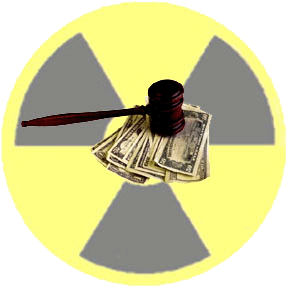 Exelon girds for challenges to Cuomo’s N.Y. nuclear subsidy, Jeffrey Tomich and Saqib Rahim, E&E reporters EnergyWire: Friday, August 19, 2016 Even before the first counterpunch to New York’s plan to subsidize a trio of upstate nuclear power plants in the name of fighting climate change, the beneficiary of almost $500 million in annual payments is airing its legal defenses.
Chicago-based Exelon Corp., owner of the R.E. Ginna and Nine Mile Point plants and the soon-to-be-owner of a third plant, James A. FitzPatrick, said it has vetted all of the potential arguments its opponents could raise and its defense is airtight.
“Given the importance to the company, we’ve gone through these legal theories in great detail and each of the potential challenges,” William Von Hoene, Exelon’s senior executive vice president and chief strategy officer, said in a recent presentation. “And we will have the challenges.”
Exelon is on the same page as New York’s Public Service Commission, which designed the policy to avoid specific legal tripwires. Experts say there’s likely to be a court challenge anyway, if only because of the money at stake and the precedent it could establish. If it survives, the plan could be a blueprint for other states to achieve the same policy goals, even after similar efforts have been blocked by judges and regulators.
This year, the U.S. Supreme Court overturned a Maryland incentive program for new gas-fired generation because it strayed too far into federal jurisdiction over wholesale electricity markets (Greenwire, April 19). And the Federal Energy Regulatory Commission blocked a plan approved by Ohio regulators to subsidize utility-owned coal and nuclear plants because it clashed with affiliate transaction rules (EnergyWire, April 28).
The New York PSC approved its clean energy standard (CES) on Aug. 1, formalizing the state’s goal of getting half its power from renewable energy by 2030. Toward that end, the CES will subsidize three nuclear power plants, giving more time for wind and solar power to develop in New York…..
Opponents said the process moved too fast given the high stakes. They’ve said it’s dubious to peg the subsidy to the social cost of carbon, and that it will lead to burdensome costs for large energy users, like manufacturers. And some environmentalists have objected to any support for nuclear power in a policy meant to advance renewable energy…….
Regulators moved quickly to finalize the clean energy standard. Entergy Corp., the owner of FitzPatrick, planned to shut the plant in January. Exelon was willing to buy it and add to its nuclear fleet, but it wanted clarity about what their economics would be……
On July 8, the state Department of Public Service proposed its plan to rescue the nuclear plants with ZECs. The plan contemplated nearly $1 billion in subsidies for the first two years. It said the $4 billion net benefit, largely from cutting carbon, was worth it.
Regulators took public comments for two weeks and issued a final order on Aug. 1.
Opponents said the process moved too fast given the high stakes. They’ve said it’s dubious to peg the subsidy to the social cost of carbon, and that it will lead to burdensome costs for large energy users, like manufacturers. And some environmentalists have objected to any support for nuclear power in a policy meant to advance renewable energy.
Legal fight on the horizon?
What remains unclear: Will any of the objections lead to a formal legal challenge?…….
Parties have 30 days to petition the PSC for a rehearing, said Jon Sorensen, a spokesman for the Department of Public Service. They have four months to challenge a decision at the New York Supreme Court.
At FERC, parties could lodge a complaint at any time, asserted Tyson Slocum, energy program director at Public Citizen, a consumer watchdog.
What might be the substance of such a challenge? “We do expect opponents to challenge the order both on administrative process as well as the merits,” said Fox of ClearView.
That opens many angles of attack, though not all of them are equally likely. Some parties question how regulators set the amount of the nuclear subsidy. At first, it was based on the cost of running the reactors. They ultimately decided to use the social cost of carbon.
Whether the recent appellate court ruling validates the social cost of carbon metric, some critics say the PSC staff didn’t allow enough time for parties to vet the formula.
“Two business weeks is a wholly inadequate amount of time for parties to review, evaluate and comment on a proposal that is projected to result in billions of dollars in costs and with a newly-created methodology for calculating ZEC prices,” the National Energy Marketers Association said in a filing last month.
The PSC’s timetable violated the state’s Administrative Procedure Act, NEMA said. It declined to comment on a possible challenge to the CES.
Exelon is also bracing for challenges that claim the PSC strayed too far into FERC’s jurisdiction……http://www.eenews.net/stories/1060041817
While Louisiana drowns, sociopaths sabotage action on climate change
 The Path of the Sociopath They did it while Louisiana drowned. http://washingtonmonthly.com/2016/08/20/the-path-of-the-sociopath/#.V7jF_CUlnoY.twitter by D.R. Tucker August 20, 2016
They didn’t give a damn about how many people had lost their lives, or how many people will lose their lives if we don’t transition as quickly as possible away from fossil fuels. They couldn’t care less about the health impacts of carbon pollution, and the fact that it is inherently unfair to deprive innocent people of a stable climate and clean air. Their arrogance has reached new heights–in fact, the level of their arrogance is as high as the sea levels will be in a few decades.
As DeSmogBlog’s Sharon Kelly reports:
A long-awaited campaign to rebrand fossil fuels called Fueling U.S. Forward made its public debut at the Red State Gathering 2016 [in Denver, Colorado last] Saturday, where the organization’s President and CEO Charles Drevna gave attendees the inside scoop on the effort, and confirmed that the campaign is backed financially by Koch Industries.
Back in February, Peter Stone first reported in the Huffington Post that a $10 million-a-year effort was proposed by a Koch Industries board member, James Mahoney, and Mr. Drevna, aiming “to boost petroleum-based transportation fuels and attack government subsidies for electric vehicles.” In early August, the Fueling U.S. Forward website launched, and on Saturday, the first public comments were made about the campaign by Mr. Drevna, and they revealed a lot about how the Koch-backed initiative is working to re-frame fossil fuels…
The top line takeaway from Mr. Drevna’s comments is that the Koch-funded Fueling U.S. Forward is an effort to rebrand fossil fuels, focusing on the “positive” sides of oil, gas and coal.
The new initiative comes at a time when the impacts of climate change are becoming more difficult to ignore. 2016 is already on track to be the hottest year ever recorded, a mid-year climate analysis from NASA reported, and unusual storms, like the torrential rainfall that struck the Gulf Coast over the past few days causing historic flooding, have become more frequent.
Charles and David Koch built this, this monument to malevolence. We always knew they were ruthless…but to do this while Louisiana drowned as a clear result of fossil-fueled climate change is beyond heartless. This is Trumpian in its treachery.
Spare me the nonsense that the Koch family doesn’t like Trump. Yes, Charles and David may scorn Trump in public, but if the bigoted billionaire manages to turn things around and win the White House, both men will be wholly satisfied with Trump’s dirty-energy agenda. (In addition, let’s not forget that another Koch Brother, William “Death to Cape Wind” Koch, has officially boarded the Trump train.)
When Bill McKibben calls for a “war” on climate change, he’s calling for a war on Koch ideology. It’s a war that progressives, moderates and whatever remains of the rational right must be prepared to fight and win. This is an enemy that must be conquered before it conquers us.
The sociopathy of the Kochs shocks the conscience. Looking at a world on fire, they call for the use of more fossil fuels to further increase their profits as they further inflame the planet. If Joseph Welch were alive today, he wouldn’t ask the Kochs if they had any sense of decency; he’d tell them he already knew they had none.
I’ve yet to read Daniel Schulman’s 2014 Koch biography Sons of Wichita, though I imagine that Schulman was thoroughly disgusted by their disregard for their fellow human beings. (Considering their latest actions, I have to say Schulman’s title is incomplete, since obviously Wichita is not the only thing these fossil-fuel fiends are sons of.)
I give Wisconsin talk radio star Charlie Sykes credit for admitting, at long last, that the right-wing media noise machine has created a “monster” comprised of millions of Americans who are resistant to facts and logic. Of course, Janeane Garofalo basically said the same thing seven years ago, and received nothing but scorn from the right for saying so:
Fox News loves to foment this anti-intellectualism because that is their bread and butter. If you have a cerebral electorate, Fox News goes down the toilet, you know, very, very fast…They‘re been doing this for years. That‘s why Roger Ailes and Rupert Murdoch started this venture; it is to disinform and to coarsen and dumb-down a certain segment of the electorate.
Thanks to right-wing radio, Fox and the wingnut blogosphere, we have far too many Americans who scorn science and reject reason…far too many Americans who think the lies of Charles, David and William Koch are the truth…far too many Americans who will suffer as a result of the actions of the fossil fuel industry and its media allies.
They did it while Louisiana drowned.
While Louisiana drowned.
Damn them.
Get used to extreme floods: climate change is becoming urgent
 Extreme Floods May Be the New Normal Communities should plan defenses and emergency responses based on the climate of the future, not the past, Scientific American By Erika Bolstad, ClimateWire on August 18, 2016
Over the past year alone, catastrophic rain events characterized as once-in-500-year or even once-in-1,000-year events have flooded West Virginia, Texas, Oklahoma, South Carolina and now Louisiana, sweeping in billions of dollars of property damage and deaths along with the high waters.
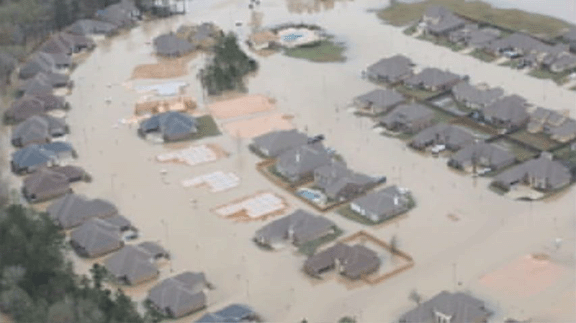
These extreme weather events are forcing many communities to confront what could signal a new climate change normal. Now many are asking themselves: Are they doing enough to plan for and to adapt to large rain events that climate scientists predict will become more frequent and more intense as global temperatures continue to rise?
The answer in many communities is no, it’s not enough.
They could be doing much, much more to adapt—not just people and how they respond to climate change, but homes, buildings, roads, and levees and other infrastructure, said Gavin Smith, director of the Department of Homeland Security’s Coastal Resilience Center of Excellence and a research professor at the University of North Carolina’s Department of City and Regional Planning.
One of the first shifts that must happen, many experts in hazard mitigation say, is to stop using the climate of the past to plan for the future.
“One of the great challenges is to recognize that a lot of communities, a lot of cities, a lot of human settlements in general were designed to reflect the climate of the past,” said Smith, who also served as the director of the Mississippi Office of Recovery and Renewal after Hurricane Katrina.
“These issues, they are happening and they’re going to become worse, and the changes are occurring within a context where we’ve designed cities to reflect a previous climate,” he said…….
What climate scientists do know is that the intensity of extreme precipitation events is on the rise. With rising global temperatures, the 2014 National Climate Assessment predicts that many communities will see such extreme precipitation events more frequently.
More frequent events could defy traditional methods of planning for floods, like using 100- and 500-year floodplain maps to plan communities and develop flood insurance rates and who has to have it. It could also radically shift how engineers and architects design buildings. Coupled with sea-level rise in some places, such rain events could also affect how emergency response teams issue storm warnings or prepare people for weather events…….
Climate change could expose vast swaths of U.S. infrastructure to additional natural hazards that are likely to intensify as sea levels rise, temperatures increase and precipitation patterns shift, the report found. Power transmission lines, ports, refineries and wastewater treatment facilities across the country are vulnerable to climate change……http://www.scientificamerican.com/article/extreme-floods-may-be-the-new-normal/
Rocky Flats’ dangerous radioactive legacy
The concerns are not limited to the refuge itself. There is plenty of plutonium offsite, thanks to a combination of sloppy practices onsite and the high winds for which the area is notorious. In 2010, one researcher discovered high concentrations of plutonium in dust in the crawl space under a local home. Researchers have concluded that smoke from a series of fires and plutonium blown from waste holding areas were probably the main sources. Peer-reviewed studies have found high rates of lung and brain cancers, leukemia, and other diseases among workers at the plant.
We are left with a conundrum: Is Rocky Flats a brilliant urban wildlife resource, or a dangerous radioactive legacy? The weird but inescapable truth is that it is both.
Rocky Flats: A Wildlife Refuge Confronts Its Radioactive Past, Environment 36016 AUG 2016: REPORT
The Rocky Flats Plant outside Denver was a key U.S. nuclear facility during the Cold War. Now, following a $7 billion cleanup, the government is preparing to open a wildlife refuge on the site to the public, amid warnings from some scientists that residual plutonium may still pose serious health risks.by fred pearce “…….In a previous life, Rocky Flats was a secret place, where over almost four decades Dow Chemical and Rockwell International, as contractors working for the U.S. government, turned plutonium from military reactors into an estimated 70,000 grapefruit-sized triggers at the heart of hydrogen bombs. Few installations were as important during the Cold War as the Rocky Flats Plant, which operated from 1952 to 1989. And by all accounts, preventing plutonium pollution of the surrounding environment, including that of the people of Denver, was low on the list of priorities…… Continue reading
Report: U.S. Transfers Nukes From Turkish Airbase to Romania
We can’t solve the problem of a nuclear-armed North Korea without talking to them

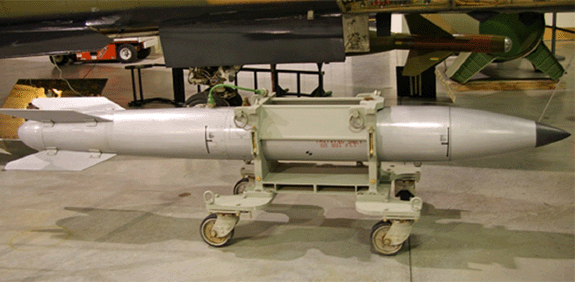
 To Address Nuclear Threat, We Must Talk To North Korea http://www.huffingtonpost.com/lee-h-hamilton/to-address-nuclear-threat_b_11572840.html Isolated and secretive, North Korea presents the United States with a unique challenge we cannot ignore. The North Korean nuclear arsenal is becoming steadily more alarming, and it is past time for the United States to get serious about the threat.
The Obama administration has pursued a policy of “strategic patience,” which includes applying international sanctions and waiting for North Korea to move away from its nuclear program or for the government to collapse. It hasn’t been enough.
The good news is that the region has been relatively stable. But our policy has not changed North Korea’s behavior. Economic sanctions imposed in response to nuclear tests and missile launches are hurting, but they have not threatened the regime’s survival.
Meanwhile, North Korea’s nuclear arsenal continues to grow in defiance of United Nations resolutions; and so does its capacity to threaten its neighbors and even the U.S. It is time to revise our strategy.
For North Korea, its nuclear program is essential to its identity as a nation. It has an estimated 10 to 20 nuclear devices and is developing a new nuclear weapon every six weeks or so. It has both short- and long-range missiles and is constantly trying to improve their effectiveness. It hopes to be able to target the U.S. mainland. An underground nuclear test and unsuccessful satellite launch early this year suggest it is seriously pursuing that goal.
North Korea is the weakest power in Northeast Asia, but it has played its limited hand fairly well. With no real allies, it may well be the most isolated nation on Earth. Life for most of its citizens is unrelentingly harsh. Poverty is widespread, and the country’s per-capita GDP is among the lowest outside of Africa, according to the CIA.
Little is known about its young ruler, 32-year-old Kim Jong Un. He is mysterious, unpredictable and dangerous. He has consolidated power, purging many government officials and promoting others. He obviously wants to keep control and has continued to maintain a rigidly nationalistic and repressive state.
China has more influence with North Korea than any other country, in part because up to 90 percent of North Korea’s international trade is with China. In the U.S., we are continually urging China to get tougher with North Korea.
But while China is no fan of North Korea’s nuclear program, it does not see the country as an imminent threat. China benefits from its neighbor’s stability, fearing a collapse there would create chaos and violence on the Korean peninsula and send refugees surging across the border into China.
For the United States, North Korea’s nuclear program should be cause for alarm but not panic. We can’t do much to influence such an isolated country, but we should not ignore the options we do have. We urgently need to pursue a political process aimed at freezing North Korea’s nuclear weapons program.
And like it or not, we can’t solve the problem of a nuclear-armed North Korea without talking to them. Talking with North Korea will not be popular, but it has become necessary.
Previous multi-party talks addressing North Korea’s nuclear program fell apart in the face of North Korean intransigence. Since then, the U.S. has said we will return to the negotiating table only if North Korea moves away from its nuclear weapons program, a precondition that has ensured no talks.
To continue that stance would be a mistake. We should be prepared to resume talks without preconditions. It may be that the Obama administration is moving away from such preconditions. But we have not yet sat down to talk.
None of this is to suggest that talks with North Korea would be easy or would yield prompt results. We should continue using sanctions and attempting to hold government leaders responsible for their decisions. But along with pressure, we need to add a strong political and diplomatic component to our efforts.
At the same time, the U.S. and its partners must be prepared in the event North Korea collapses. The immediate challenge for the international community would be to seize or destroy North Korea’s nuclear arsenal to prevent it from falling into the wrong hands.
In all of these efforts, we need to work closely with other Asian nations – especially China. We must find a way to persuade North Korea that the path to security and stability lies in moving away from isolation and secrecy, not in pursuing nuclear strength.
Lee H. Hamilton is a Distinguished Scholar, Indiana University School of Global and International Studies; Professor of Practice, IU School of Public and Environmental Affairs; and Senior Advisor, IU Center on Representative Government. He served as U.S. Representative from Indiana’s 9th Congressional District from 1965-1999.
Nuclear reactors, old or new designs, doomed without hefty tax-payer subsidies
 under the 1957 Price-Anderson Act, each plant owner’s accident liability is limited to some $300 million per year, even though the Fukushima disaster showed that nuclear accident costs can exceed $100 billion. If private companies that own U.S. nuclear power plants had been responsible for accident liability, they would not have built reactors. The same is almost certainly true of responsibility for spent fuel disposal.
 free or low-carbon-emitting –What they discovered is that each nuclear power plant releases huge amounts of Radioactive Carbon14 which converts to CO2 in the atmosphere.
 Bradford, The Conversation, August 18, 2016 “…….The nuclear industry, led by the forlornly named lobbying group Nuclear Matters, still obtains large subsidies for new reactor designs that cannot possibly
compete at today’s prices. But its main function now is to save operating reactors from closure brought on by their own rising costs, by the absence of a U.S. policy on greenhouse gas emissions and by competition from less expensive natural gas, carbon-free renewables and more efficient energy use.
President Reagan worked with Russia to defuse the nuclear arms race; time that President Obama did that, too

 An Urgent History Lesson in Diplomacy with Russia, CounterPunch, 12 Aug 16 by RENEE PARSONS As prospects for peace appear dim in places like the Ukraine, Syria, Yemen, Iraq and Afghanistan and now with a renewed bombing of Libya, the President of the United States (and his heiress apparent) continue to display an alarming lack of understanding of the responsibilities as the nation’s highest elected officer. As has been unsuccessfully litigated, Article II of the Constitution does not give the President right to start war; only Congress is granted that authority (See Article I, Section 8).
So for the nation’s Chief Executive Officer to willy-nilly arbitrarily decide to bomb here and bomb there and bomb everywhere in violation of the Constitution might be sufficient standard for that CEO to be regarded as a war criminal. Surely, consistently upping the stakes with a strong US/NATO military presence in the Baltics with the US Navy regularly cruising the Black and Baltic Seas, accompanied by a steady stream of confrontational language and picking a fight with a nuclear-armed Russia may not be the best way to achieve peace……
 Reagan, who was ready to engage in extensive personal diplomacy, was an unlikely peacemaker yet he achieved an historic accomplishment in the nuclear arms race that is especially relevant today as NATO/US are reintroducing nuclear weapons into eastern Europe……
According to Jack Matlock who served as Reagan’s senior policy coordinator for Russia and later US Ambassador to Russia in his book, “Reagan and Gorbachev: How the Cold War Ended,” one of Reagan’s pre-meeting [with Russia’s Mikhail Gorbachev] notes to himself read “avoid any demand for regime change.” From the beginning, one of Reagan’s goals was to establish a relationship that would be able to overcome whatever obstacles or conflicts may arise with the goal of preventing a thermonuclear war. …
After a lengthy personal, private conversation, it became obvious that the two men had struck a cord of mutual respect…. At the conclusion of Geneva, a shared trust necessary to begin sober negotiations to ban nuclear weapons had been established. Both were well aware that the consequences of nuclear war would be a devastation to mankind, the world’s greatest environmental disaster. At the end of their Geneva meeting, Reagan and Gorbachev agreed that “nuclear war can never be won and must never be fought.”……
In December of 1987, Soviet General Secretary Mikhail Gorbachev arrived in Washington DC to sign the bilateral Intermediate-Range Nuclear Forces (including Short Range Missiles) known as the INF Treaty. The Treaty eliminated 2,611 ground launched ballistic and cruise missile systems with a range of between 500 and 5500 kilometers (310 -3,400 miles). Paris is 2,837 (1,762 miles) kilometers from Moscow.
In May 1988, the INF Treaty was ratified by the US Senate in a surprising vote of 93 – 5 (four Republicans and one Democrat opposed) and by May, 1991, all Pershing I missiles in Europe had been dismantled. Verification of Compliance of the INF Treaty, delayed because of the USSR breakup, was completed in December, 2001.
At an outdoor press briefing during their last meeting together and after the INF was implemented, Reagan put his arm around Gorbachev. A reporter asked if he still believed in the ‘evil empire’ and Reagan answered ‘no.” When asked why, he replied “I was talking about another time, another era.”……..
As the current US President and Nobel Peace Prize winner prepares to leave office with a record of a Tuesday morning kill list, unconscionable drone attacks on civilians, initiating bombing campaigns where there were none prior to his election and, of course, taunting Russian President Vladimir Putin with unsubstantiated allegations, the US-backed NATO has scheduled AEGIS anti ballistic missile shields to be constructed in Romania and Poland, challenging the integrity of INF Treaty for the first time in almost thirty years.
In what may shed new light on NATO/US build-up in eastern Europe, Russian Foreign Secretary Sergei Lavrov denied US charges in June, 2015 that Russia had violated the Treaty and that the US had “failed to provide evidence of Russian breaches.” Commenting on US plans to deploy land-based missiles in Europe as a possible response to the alleged “Russian aggression” in the Ukraine, Lavrov warned that ‘‘building up militarist rhetoric is absolutely counterproductive and harmful.’ Russian Deputy Defense Minister Anatoly Antonov suggested the United States was leveling accusations against Russia in order to justify its own military plans.
In early August, the US Department of Energy’s National Nuclear Security Administration authorized the final development phase (prior to actual production in 2020) of the B61-21 nuclear bomb at a cost of $350 – $450 billion. A thermonuclear weapon with the capability of reaching Europe and Moscow, the B61-21 is part of President Obama’s $1 trillion request for modernizing the US aging and outdated nuclear weapon arsenal.
Isn’t it about time for the President to do something to earn that Peace Prize? http://www.counterpunch.org/2016/08/12/an-urgent-history-lesson-in-diplomacy-with-russia/

Secretive manouvres involve tax-payer funds for Bill Gates’ small nuclear reactors
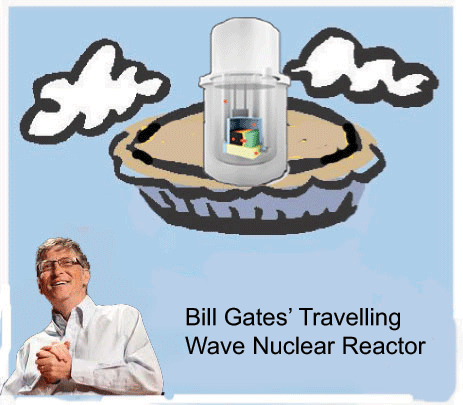
months have elapsed since the Microsoft Corp. co-founder and 27 other billionaires rolled out their Breakthrough Energy Coalition (BEC) — a promise to invest billions of dollars with a very long payback horizon on groundbreaking new carbon-neutral technologies. And the group has barely been heard from since.
Jonah Goldman, a spokesman for the coalition, said much of the work is happening behind the scenes.
Gates brought his message to Capitol Hill, where he met twice with Sen. Lamar Alexander (R-Tenn.) in the past year to press the Energy and Water Appropriations Subcommittee chairman for federal support for research and development.
The two men discussed small modular nuclear reactors and carbon capture and storage technology at the meetings, an Alexander aide said.
Nineteen countries joined the United States in backing Mission Innovation in Paris, and the European Union signed on in June. Since then, the Obama administration has followed up with a fiscal 2017 funding request of $7.7 billion for clean energy R&D across the federal government, with $5.9 billion of that going to DOE programs
What’s happening with Bill Gates’ multibillion-dollar energy fund? EENews, Jean Chemnick, E&E reporter, ClimateWire: Monday, August 15, 2016 Bill Gates believes the key to addressing climate change is an “energy miracle,” and in November, he set about trying to conjure one.
Flanked by President Obama and more than a dozen other world leaders in Paris for the first day of a landmark climate summit, Gates claimed a role for the private sector in delivering new solutions.
“We must … add the skills and resources of leading investors with experience in driving innovation from the lab to the marketplace,” Gates said that morning. “The private sector knows how to build companies, evaluate the potential for  success, and take the risks that lead to taking innovative ideas and bringing them to the world.”
But months have elapsed since the Microsoft Corp. co-founder and 27 other billionaires rolled out their Breakthrough Energy Coalition (BEC) — a promise to invest billions of dollars with a very long payback horizon on groundbreaking new carbon-neutral technologies. And the group has barely been heard from since.
Jonah Goldman, a spokesman for the coalition, said much of the work is happening behind the scenes. The fund, he said, will make announcements about the kinds of investments that will be made when it is up and running, likely toward the end of this year.
“But the focus is definitely more on doing the work we’ve committed to than making public pronouncements,” he said.
A few things are clear. Some of the group’s contributions will flow through a fund that will concentrate on certain kinds of investments. The group is currently hiring scientists and investment professionals who will direct those decisions. Goldman declined to say how many people are working to stand up the fund or how many employees it will eventually have.
Other things remain a mystery, including the coalition’s eventual capitalization target. Gates promised to invest an additional $1 billion of his own dollars when he launched BEC, and predicted the other members would contribute a collective “couple” billion more toward the venture. But it is unclear how much of that $3 billion — if it is $3 billion — will flow through the fund, versus members investing it independently. Goldman said the total size of the fund and targets for investment will be based on this year’s fundraising.
He said the goal would be to raise a level of capital that the fund could deploy effectively, with the understanding that some of the group’s members will continue to invest in projects outside the fund.
“We feel tremendously confident that we will get significant participation in the ultimate funding vehicle, but each of the potential investors will have to make that decision based on the terms presented, and we’re not quite there yet,” he said…..
Gates brought his message to Capitol Hill, where he met twice with Sen. Lamar Alexander (R-Tenn.) in the past year to press the Energy and Water Appropriations Subcommittee chairman for federal support for research and development.
The two men discussed small modular nuclear reactors and carbon capture and storage technology at the meetings, an Alexander aide said.
Then, in the three months before Paris, Gates bore down. He joined Energy and State department officials and White House personnel on calls with foreign governments to urge them to sign on to Mission Innovation, a commitment by countries to double their individual R&D budgets by 2020. Energy Secretary Ernest Moniz spearheaded the initiative, which was unveiled in Paris alongside BEC (EnergyWire, Dec. 17, 2015).
On those calls, former officials say Gates offered the private investors fund as a kind of carrot, promising to help carry technologies produced in national laboratories across the “valley of death” — where ideas often perish for lack of investment — toward greater development that leads to commercialization.
But first governments had to put up the money…….
DOE vague on BEC relationship
Nineteen countries joined the United States in backing Mission Innovation in Paris, and the European Union signed on in June. Since then, the Obama administration has followed up with a fiscal 2017 funding request of $7.7 billion for clean energy R&D across the federal government, with $5.9 billion of that going to DOE programs…….
DOE was less forthcoming about its work with BEC post-Paris. A department spokesman said in response to an inquiry only that the agency “is in communication with thousands of researchers, entrepreneurs, inventors, small businesses and large corporations.”
While the spokesman asserted that the investors’ group and Mission Innovation are “separate” and “complementary,” the private-sector group has popped up in DOE communications with interested members of civil society. It figured, for example, in a slideshow presentation that Office of International Science and Technology Collaboration Director Robert Marlay prepared for the U.S. Energy Information Administration earlier this year.
The presentation states that the fund would provide “seed, angel and series A” investments. Seed capital is offered in exchange for a stake in a company, while angel investments help startup companies. “Series A” investments are typically the first round of venture capital investments that are made in a new company….
Some of the Gates group’s radio silence appears to be strategic.
Bodnar said Gates and his partners opted not to put forward a concrete pledge of dollars in Paris because it wasn’t a venue where the contribution would appear in its best light. Even a funding target that would be enough to fulfill the group’s goal of readying promising technologies for the market would pale in comparison to the hundreds of billions or even trillions of dollars that are routinely discussed in the multilateral climate process…..
what the 28 billionaires managed to do was to signal there will now be “truly patient, flexible” capital available for promising technologies that make it through the basic research phase. Patient capital is seen to be key, because the high risk and very long time horizons for payback have generally made these technologies unattractive to conventional investors.
Bodnar said Gates and his colleagues were confident that the money they put up would be sufficient to ensure the gap is bridged between federally funded basic research and ready-to-deploy commercial technologies……http://www.eenews.net/stories/1060041571
The health impacts of wildfires in America’s West
 Mapping the health threat of wildfires under climate change in US West Tens of millions will experience longer, more intense ‘smoke waves’ YALE SCHOOL OF FORESTRY & ENVIRONMENTAL STUDIES, Eureka Alert, 15 Aug 16 A surge in major wildfire events in the U.S. West as a consequence of climate change will expose tens of millions of Americans to high levels of air pollution in the coming decades, according to a new Yale-led study conducted with collaborators from Harvard.
The researchers estimated air pollution from past and projected future wildfires in 561 western counties, and found that by mid-century more than 82 million people will experience “smoke waves,” or consecutive days with high air pollution related to fires.
The regions likely to receive the highest exposure to wildfire smoke in the future include northern California, western Oregon, and the Great Plains.
Their results, published in the journal Climatic Change, point to the need for new or modified wildfire management and evacuation programs in the nation’s high-risk regions, said Jia Coco Liu, a recent Ph.D. graduate at the Yale School of Forestry & Environmental Studies (F&ES) and lead author of the study.
“Our study illustrates that smoke waves are likely to be longer, more intense, and more frequent under climate change,” Liu said. “This raises critical health, ecological, and economic concerns. Identifying communities that will be most affected in the future will inform development of fire management strategies and disaster preparedness programs.”…..http://www.eurekalert.org/pub_releases/2016-08/ysof-mt081516.php
US Congress weighs problem of nuclear warheads stored in volatile Turkey
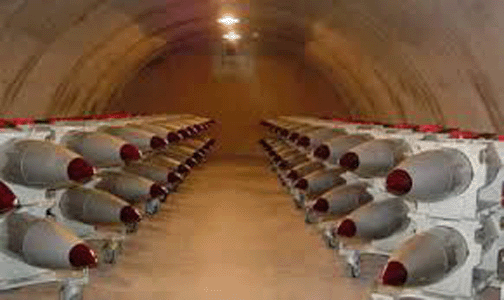 Congress was briefed on possibly moving the US’s nuclear weapons from Turkey’s Incirlik Air Base, Business Insider ALEX LOCKIE AUG 16, 2016, Business Insider previously reported on power being cut to Turkey’s Incirlik Air Base during thefailed July 15 coup and the situation of some 50 B61 nuclear bombs there, but a new report from the Congressional Research Service shows that Congress was also briefed on the matter.
The brief may be the most official confirmation of the location of the bombs on record, and it goes into detail on why and how the bombs are stored.
Essentially, the presence of nuclear weapons at Incirlik owes to Cold War tensions and postures between the US and the former Soviet Union. The report asserts that nuclear weapons were stored in Europe, Japan, South Korea, and elsewhere, with a total of about 200 nuclear bombs in Europe.
The weapons at Incirlik are the shorter-range variety, and they are mainly valuable to deter potential aggression and demonstrate the US’s commitment to NATO. However, Incirlik is unusual in that Turkey does not own or maintain nuclear-capable aircraft, and Ankara does not allow the US to fly nuclear-capable bombers to that airbase.
So the bombs that sit in Incirlik can’t actually be used, or they would have to be hauled to another base first.
Are the bombs secure? The report finds the security situation of the bombs adequate, as they are stored in facilities last updated in 2015, are heavily guarded by US troops, and are stored securely underground……
Should the US move the nukes? In its conclusion, the report weighs the alternatives to stationing nuclear weapons at Incirlik. Moving the warheads could possibly encourage Russia to cooperate more and possibly reduce their nuclear stockpile, though nothing guarantees that.A move could be seen as prudent in light of the evolving and uncertain relationship of the US to Turkey, and the weapon’s current proximity to ISIS territory and the Syrian quagmire….http://www.businessinsider.com.au/congress-briefing-nuclear-weapons-at-incirlik-air-base-2016-8?r=US&IR=T
Environmental groups in America take legal action against transport of nuclear wastes
 Greens Sue to Stop Nuclear Waste Transport http://www.courthousenews.com/2016/08/15/greens-sue-to-stop-
 nuclear-waste-transport.htm By BRITAIN EAKIN WASHINGTON (CN)– The U.S. Energy Department’s unprecedented proposed transfer of “a toxic liquid stew” containing nuclear waste between Canada and the U.S violates federal law, seven environmental groups claim in court.
Terry J. Lodge, attorney for the environmental groups, did not respond Monday to an emailed request for comment.
4 Year nuclear leak not fixed at FitzPatrick nuclear plant
The U.S. Nuclear Regulatory Commission said the accumulation of spilled radioactive waste in the basement of a building at FitzPatrick is of “very low safety significance” because it occurred in a locked, highly shielded area that is already highly radioactive.
“The bottom line is, we have been aware of this issue for some time, but it poses no immediate risks to any residents or the environment,” said Neil Sheehan, speaking for the NRC.
Nevertheless, plant owner Entergy Corp.’s failure to address the leak is of “more than minor significance” because the company knew about the problem for at least four years, the NRC reported.
Nuclear plant owners are required to minimize the accumulation of residual radioactive waste in their plants, which can “greatly increase the cost and complexity of future decommissioning” after a reactor shuts down, according to the NRC……..
Anti-nuclear activists said the NRC report should raise concerns about the aging FitzPatrick plant, which started operation in 1975.
“These violations highlight the ongoing dangers posed by the upstate nuclear reactors and the lax enforcement by the Nuclear Regulatory Commission,” said Tim Judson, of the Nuclear Information and Resource Service. “Entergy has known that this highly radioactive waste spill is a problem for four years, but the NRC has not imposed any fines or other penalties.” http://www.syracuse.com/news/index.ssf/2016/08/minor_radiation_leak_at_fitzpatrick_nuclear_plant_has_gone_unfixed_for_4_years.html
-
Archives
- October 2026 (120)
- September 2026 (339)
- August 2026 (330)
- July 2026 (355)
- June 2026 (287)
- May 2026 (306)
- April 2026 (356)
- March 2026 (251)
- February 2026 (267)
- January 2026 (308)
- December 2025 (358)
- November 2025 (359)
-
Categories
- 1
- 1 NUCLEAR ISSUES
- business and costs
- climate change
- culture and arts
- ENERGY
- environment
- health
- history
- indigenous issues
- Legal
- marketing of nuclear
- media
- opposition to nuclear
- PERSONAL STORIES
- politics
- politics international
- Religion and ethics
- safety
- secrets,lies and civil liberties
- spinbuster
- technology
- Uranium
- wastes
- weapons and war
- Women
- 2 WORLD
- ACTION
- AFRICA
- Atrocities
- AUSTRALIA
- Christina's notes
- Christina's themes
- culture and arts
- Events
- Fuk 2022
- Fuk 2023
- Fukushima 2017
- Fukushima 2018
- fukushima 2019
- Fukushima 2020
- Fukushima 2021
- general
- global warming
- Humour (God we need it)
- Nuclear
- RARE EARTHS
- Reference
- resources – print
- Resources -audiovicual
- Weekly Newsletter
- World
- World Nuclear
- YouTube
-
RSS
Entries RSS
Comments RSS

