India, US set the ball rolling for Westinghouse’s nuclear plants By Dipanjan Roy Chaudhury, ET Bureau | Sep 01, 2016, NEW DELHI: India and the US moved closer to the planned construction of six reactors by American company Westinghouse at a proposed nuclear plant in Andhra Pradesh, with the two sides deciding to immediately commence the work on engineering and site design, and make an early conclusion of a competitive financing package.
September 2, 2016
Posted by Christina Macpherson |
India, marketing, USA |
Leave a comment
 Decommissioning costs: A blind spot in the nuclear power debate In nuclear policy, too little thought is given to the considerable costs of storing radioactive waste on site, Utility Dive By Christina Simeone | August 30, 2016 With over 10 GW of nuclear capacity at risk for premature retirement – defined as retirement before license expiration – many states are considering subsidy policies to keep these economically struggling reactors operating.
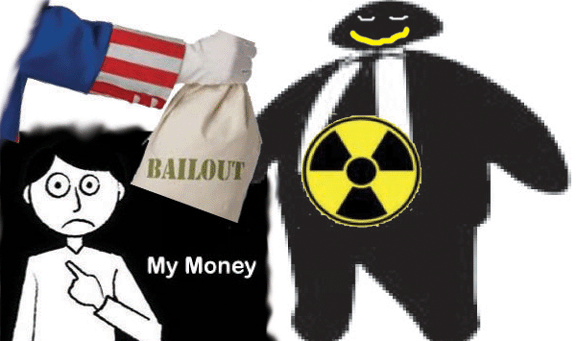
Arguments for subsidies focus on protecting local jobs, keeping low-cost baseload power, maintaining reliability, and preserving the zero-carbon resources needed to address climate change. Opponents argue that out-of-market subsidies distort competitive markets and amount to ratepayer bailouts of uneconomic generation.
Absent from the debate, however, is a focus on what happens to nuclear power plants when they retire and decommission. Specifically, how Americans like you and I will continue to pay more and be subjected to greater risks as nuclear power plants are converted to interim waste storage facilities.
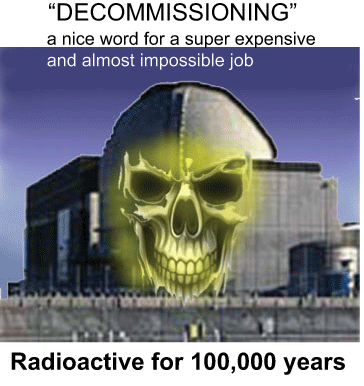
This is the focus of a new report from the University of Pennsylvania’s Kleinman Center for Energy Policy, entitled “Nuclear Decommissioning: Paying More for Greater, Uncompensated Risks.”
Let me explain.
When most nuclear power plants were built, the expectation was spent fuel waste would either be reprocessed (for most plants built before 1977) or the government would take custody of the waste for permanent disposal, per the 1982 Nuclear Waste Policy Act. Licensees that built the reactors were also required to establish financial mechanisms – such as trust funds – to ensure availability of funds to decontaminate equipment and decommission the plant site.
The Nuclear Waste Policy Act established a per-kilowatt-hour fee on nuclear power production that Licensees would pay in exchange for a contractual agreement committing the federal government to take custody of the waste – beginning in 1998 – for permanent geologic disposal. Licensees would recover these fees from electricity ratepayers that enjoyed low cost, baseload nuclear power.
In 1998, the federal government was not prepared to accept the waste. To date, the government has spent more than $7.5 billion to study the Yucca Mountain site in Nevada for geologic disposal, but political opposition from within that state killed the project. There are currently no plans underway to build a geologic disposal repository.
Meanwhile, there are over $34 billion in ratepayer funds sitting in a restricted government account that by law can only be spent on activities related to the geologic disposal site. (The ratepayer fee was suspended in 2014, a few years after the Yucca Mountain project was terminated.)
In the interim, nuclear reactor Licensees have been forced to make significant capital investments to expand their ability to store spent fuel on site at power plants. Licensees sued the federal government for financial damages caused by the government’s failure to accept nuclear waste for disposal, and the Licensees won.
The federal government is therefore using taxpayer money to pay back the Licensee’s costs of interim waste storage. As of 2015, more than $5 billion of taxpayer dollars were paid to reactor Licensees. The total cost of damages is estimated to range from $29 billion to $50 billion if the government begins to accept waste in 10 years. If this date slides, government liabilities increase by $500 million per year.
So today, all 100 operating nuclear power reactors are storing waste on site in wet and/or dry storage. When a full plant retires, the entire site cannot be decommissioned, because a portion of the site must continue to store waste.
With this background in mind, it is important that policymakers consider the following facts when contemplating the fate of struggling nuclear power facilities:
- Distributed, interim (if not perpetual) storage of spent fuel and high level radioactive waste is less safe and less secure than permanent geologic disposal, according to the IAEA.
- Costs of interim storage have been and will continue to be paid by taxpayers, and these costs will accumulate indefinitely. Meanwhile, there is no refund provided to the ratepayers who paid to have nuclear waste removed from their neighborhoods and into a permanent geologic disposal facility. Many Americans are paying twice for nuclear waste management.
- Communities hosting nuclear power facilities – that include ratepayers and taxpayers – are not being compensated for the increased risks of perpetually storing high level radioactive waste. And, when a plant or reactor retires, these communities are also losing the benefits of nuclear power.
An additional concern is the Nuclear Regulatory Commission’s formula for establishing upfront decontamination costs for reactor specific funds has widely been criticized to understate costs. When a reactor retires prematurely, these funds have less time to appreciate and may require additional financial guarantees from the Licensee. More research is needed to understand the ability of owners of at-risk generation to provide such guarantees, if needed……http://www.utilitydive.com/news/decommissioning-costs-a-blind-spot-in-the-nuclear-power-debate/425415/
August 31, 2016
Posted by Christina Macpherson |
decommission reactor, USA |
1 Comment
 The nuclear option After New York props up nuclear power generation sector, is Pennsylvania next?,
The towers of the Beaver Valley nuclear plant in Shippingport loom over the region in this view from nearby Midland.
By Anya Litvak / Pittsburgh Post-Gazette August 30, 2016 Early in August, nuclear operators in New York got the breather they’ve been wishing for in other states: a way to keep struggling nuclear reactors afloat in a tough market by paying subsidies to the plants for not emitting carbon dioxide.
As part of that state’s Clean Energy Standard, utilities will be required to buy “zero emission credits,” providing what is estimated to be a $500 million annual subsidy to keep the nuclear plants open. Nuclear power comprises nearly 30 percent of New York’s electricity supply.
The move came after nuclear operators warned they might be forced to shut down reactors early if they didn’t receive financial support for the zero-carbon fuel. Already, more than half a dozen nuclear plants across the country have been pegged for early retirement because they are losing money.
With victory in New York, it’s only natural for nuclear operators to use the momentum to go after subsidies in other states, wrote Kit Konolige, a senior utility industry analyst at Bloomberg Intelligence, in a recent note.
“Companies probably will end up seeking billions of dollars from Pennsylvania, New Jersey, Ohio and Connecticut,” he wrote. “Closing nuclear plants could lead to higher carbon emissions and thousands of layoffs. Subsidizing them would boost electric bills and hurt rival generators’ margins.”
He speculated that the three operators of Pennsylvania’s five nuclear plants — Akron-based FirstEnergy, Illinois-based Exelon, and Talen Energy, based in Allentown — “could unite in Pennsylvania aid push” on the heels of the New York decision.
It’s not yet clear what the ask will look like and if it will rely on regulations or laws to prop up struggling nuclear plants.
Mr. Konolige noted that while Exelon, which operates two plants in New York, was successful in getting support through that state’s public utility commission, efforts to push nuclear subsidies through the legislature in its home state of Illinois did not pan out.
“It’s too early to tell which route will be taken in Pennsylvania,” Mr. Konolige wrote.
Nuclear plants, for decades a source of baseload generation and 20 percent of the electricity in the U.S., are falling victim to the same market dynamics pushing out coal plants: the low price of natural gas, which tends to set the electricity price paid to all sources on the grid.
Natural gas power plants also can ramp up and down fairly quickly, while nuclear plants must run continuously. That means when the grid price is lower than the operating costs, nuclear reactors have no choice but to run and lose money…..
During a company earnings call last month, FirstEnergy’s CEO Chuck Jones said the company is considering selling off its nonregulated generation plants, such as Beaver Valley, because the market dynamics don’t reward their reliability. He also said FirstEnergy is delaying by two years replacing the steam generator at one of the Beaver Valley reactors……http://powersource.post-gazette.com/powersource/policy-powersource/2016/08/30/After-New-York-props-up-nuclear-power-generation-sector-is-Pennsylvania-next/stories/201608300009
August 31, 2016
Posted by Christina Macpherson |
business and costs, USA |
Leave a comment
 India US to advance talks on building six nuclear reactors Under the Indo-US nuclear cooperation agreement signed in October 2008, two US companies would build 12 atomic reactors, each with a capacity of 1000 MWs. Indian Express By: PTI | New Delhi :August 30, 2016 India and the US on Tuesday agreed to move forward on building six nuclear reactors and discussed ways to enhance cooperation in the field of atomic power and space.
John Kerry, US Secretary of State, who is here for the 2nd Indo-US Strategic and Commercial Dialogue (S&CD), said his country would want its civil nuclear cooperation with India to take shape in setting up of reactors.
“We have agreed now to move forward on six Westing House nuclear reactors which will provide energy for six million Indians, not to mention the enormous number of jobs (it will create)……
Under the Indo-US nuclear cooperation agreement signed in October 2008, two US companies would build 12 atomic reactors, each with a capacity of 1000 MWs. However, the US has often raised concern about hurdles faced by American companies over a series of issues.
Its major concerns like the liability clause in the Civil Liability for Nuclear Damage Act, 2010 has already been addressed and talks between the WestingHouse Co, which will build six reactors, and the Indian side are on, sources said. The two sides are also cooperating in the field of space. http://indianexpress.com/article/india/india-news-india/india-us-to-advance-talks-on-building-six-nuclear-reactors-3004675/
August 31, 2016
Posted by Christina Macpherson |
India, marketing, USA |
Leave a comment
 US government sent over 1.4 million guns to Iraq and Afghanistan | 24 Aug 2016 | Since the start of the so-called War on Terror, the US government has sent at least 1.4 million guns to arm Iraq and Afghan government forces, AOAV’s research into US Department of Defence contracts can reveal. AOAV’s analysis of a wide range of open source data reports showed that the US government had sent at least 1,452,910 small arms to Iraq and Afghanistan (949,582 for Iraq; 503,328 for Afghanistan) since 9/11. In August 2016 the Department of Defense (DoD) sent AOAV two charts that they believed accounted for the small arms sent to Iraq and Afghanistan between 2004 and June 2016 for Afghanistan, and 2005 and June 2016 for Iraq.
August 31, 2016
Posted by Christina Macpherson |
USA, weapons and war |
Leave a comment
California has urged President Obama and Congress to tax carbon pollution Skeptical Science 29 August 2016 by dana1981 Last week, the California state senate passed Assembly Joint Resolution 43, urging the federal government to pass a revenue-neutral carbon tax:
WHEREAS, A national carbon tax would make the United States a leader in mitigating climate change and the advancing clean energy technologies of the 21st Century, and would incentivize other countries to enact similar carbon taxes, thereby reducing global carbon dioxide emissions without the need for complex international agreements; now, therefore, be it Resolved by the Assembly and the Senate of the State of California, jointly, That the Legislature hereby urges the United States Congress to enact, without delay, a tax on carbon-based fossil fuels; and be it further Resolved … That all tax revenue should be returned to middle- and low-income Americans to protect them from the impact of rising prices due to the tax
Copies of the Resolution were sent to President Obama, Vice President Biden, House Speaker Ryan, Senate Majority Leader McConnell, and to all members of Congress representing California. The document specifically calls for the type of revenue-neutral carbon tax advocated by the grassroots organization Citizens’ Climate Lobby. Studies have shown that a rising carbon tax with all revenue returned to taxpayers would have a modestly beneficial impact on the economy, while cutting carbon pollution at faster rates than current policies.
California exerts its climate leadership
California has become the US leader in tackling global warming. 10 years ago, the state passed the Global Warming Solutions Act, requiring that its greenhouse gas emissions in 2020 be no higher than 1990 levels. California achieved that goal in 2010, 10 years early, and is among the lowest per-capita carbon polluting states.
On the same day last week, the state legislature also passed a bill expanding the Global Warming Solutions Act, requiring a 40% cut in California’s carbon pollution from 1990 levels by 2030. In other words, California isn’t just calling on the federal government to take action on climate change; the state is leading the way…….http://www.skepticalscience.com/ca-urged-federal-carbon-tax.html
August 31, 2016
Posted by Christina Macpherson |
climate change, politics, USA |
Leave a comment
Nuclear power plants prepare for old age Materials research is at the heart of efforts to keep the world’s reactors running well past 2050. Nature , Jeff Tollefson, 30 August 2016 Sophisticated inspections are helping to pick up defects in ageing nuclear power plants before they cause trouble. In March, ultrasonic tests identified signs of wear and tear in some of the stainless-steel bolts in the reactor core of the Indian Point power plant just north of New York City. Researchers at the Electric Power Research Institute (EPRI) in Palo Alto, California, are now analysing more than a dozen of the 5-centimetre-long bolts — which secure plates that help direct water through the radioactive core — to determine why they failed the inspection.
The analysis comes as the US Nuclear Regulatory Commission (NRC) considers whether to extend the life of Indian Point’s two 40-year-old reactors for 20 more years. Opponents of the plant, including the state of New York, cite the defective bolts, a transformer fire last year and environmental and safety concerns as evidence that the facility should close.
The plant’s damaged bolts are just one example of the maintenance issues facing ageing nuclear reactors around the world. The International Atomic Energy Agency and the NRC are developing management guidelines for these facilities, but the problem may be most acute for the United States, whose fleet of 99 reactors is the oldest and largest.
The NRC has renewed the licences of 81 US reactors still in operation for another 20 years. And it presented safety guidelines in December for utilities considering renewing their licences for another 20 years. But concerns remain about the effects of time on facilities that could be in operation for 80 years (see ‘Going, going, gone’).
Former NRC chair Allison Macfarlane says that the industry has been struggling economically in the face of cheap natural gas, and that many nuclear power companies are investing the bare minimum when it comes to maintenance and upgrades…..
Of particular concern are the concrete containment structures and steel pressure vessels at the heart of reactors, as well as the kilometres of wires that snake through the plants. Researchers are now analysing the long-term effects of intense heat and neutron bombardment on a plant’s crucial materials down to the atomic level……….
August 31, 2016
Posted by Christina Macpherson |
safety, USA |
Leave a comment
At San Onofre, spent nuclear fuel is getting special tomb Orange County Register, Aug. 28, 2016 ,By TERI SFORZA “……..Once, San Onofre was a marvel of modern engineering – splitting atoms to create heat, boiling water to spin turbines and creating electricity that fulfilled 18 percent of Southern California’s demand. Now, it’s a demolition project of mind-boggling proportions, overseen by a dozen government agencies.
It’s expected to cost $4.4 billion, take 20 years and leave millions of pounds of spent nuclear fuel on the scenic bluff beside the blue Pacific until 2049 or so, because the federal government has dithered for generations on finding a permanent repository.
In this vacuum, contractors from Holtec International – one of only a handful of companies licensed by the Nuclear Regulatory Commission to do dry-cask radiation storage in the U.S. – are at work. Construction of the controversial “concrete monolith” to protect San Onofre’s stranded waste has begun, over the protests of critics who decry a “beachfront nuclear waste dump.”

THE MONOLITH
The reinforced concrete pad that will support the monolith is finished.
Last week, Holtec workers used cranes and trucks to maneuver the first of 75 giant tubes into place atop it. When those tubes are bolted in, concrete will be poured up to their necks, and they’ll be topped off with a 24,000-pound steel-and-concrete lid. Earth will be piled around it so that it looks something like an underground bunker.
Southern California Edison, which operates the plant, would not share the Holtec contract or reveal its price tag, but San Onofre’s owners have recovered more than $300 million from the federal government for its failure to dispose of nuclear waste, which is why dry-cask storage must be built in the first place. San Onofre’s decommissioning plan sets aside $1.27 billion for future spent fuel management.
This is one of the first newly licensed Hi-Storm Umax dry-cask storage systems Holtec is building in the United States. Once it’s complete – expected to be late next year – workers will begin the deliberate and delicate dance of removing all spent fuel from cooling pools beside each reactor.
The iconic twin domes you see from the highway and the beach don’t reveal their enormity. They stand as tall as a 13-story building, and the adjacent pools holding their spent fuel are 25 feet wide, 60 feet long, about 40 to 50 feet deep and hold a half-million gallons of water.
When Southern California Edison begins removing the 2,668 fuel assemblies chilling there, bays to those enormous pools will open. Holtec storage canisters will be lowered in. Underwater, 37 spent fuel assemblies will be loaded into each canister and capped. The canister will be slipped into a “transfer cask,” lifted from the pool and drained.
Then it will be loaded onto a truck, driven a few hundred yards to the Umax and lowered into one of those 75 tubes. The waste-filled canister will remain inside. The transfer cask will be removed. The tube will be capped.
This will be repeated more than 70 times, until all the fuel in the more vulnerable pools is entombed in more stable dry-cask storage. That’s slated to be done by mid-2019.
TECHNOLOGY
The system will become something of a real-time experiment: Edison is partnering with the Electric Power Research Institute to develop inspection techniques to monitor the casks as they age. The casks’ integrity over time, while holding hotter “high burn-up” fuel, is a major concern of critics.
“Burn-up” – i.e., the amount of uranium that undergoes fission – has increased over time, allowing utilities to suck more power out of nuclear fuel before replacing it, federal regulators say. It first came into wide use in America in the latter part of the last century, and how it will behave in short-term storage containers (which, pending changes in U.S. policy on nuclear cleanup, must be used for longer-term storage) remains a topic of debate……..
ry-cask technology is not new, he said. Nuclear power plants in the U.S. have used it since 1986, and an analysis by the Electric Power Research Institute found that it would take at least 80 years before a severe crack could form in a dry storage canister.
The Umax uses the most corrosion-resistant grade of stainless steel; its design exceeds California earthquake requirements, and it protects against hazards such as water, fire or tsunamis.
Critics cast skeptical eyes on those claims.
They don’t disagree that dry storage is safer than the spent fuel pools, but activist Donna Gilmore says officials gloss over the potential for serious cracking – a bigger risk in a moist, salty, oceanfront environment such as San Onofre.
Once a crack starts, it would continue to grow through the wall of the canister, undetected, until it leaked radiation, Gilmore said.
Other countries use thicker-walled casks than those licensed in America, and she believes we should, too.
EYES FORWARD
What everyone wants is to remove the ensconced “stranded waste” from San Onofre as soon as possible, and the only way that can happen is if the federal government takes action.
Palmisano said energy is best expended pushing that forward, not arguing over canisters.
On that front, he is cautiously optimistic.
In January, the U.S. Department of Energy launched a new push to create temporary nuclear waste storage sites in regions eager for the business, currently in West Texas and New Mexico. Several of those could be up and running while the prickly question of coming up with a permanent site is hashed out.
There could be a plan, and a place, for this waste within the next 10 years, Palmisano said – but that would require congressional action, which in turn would likely require much prodding from the public.
“We are frustrated and, frankly, outraged by the federal government’s failure to perform,” he said. “I have fuel I can ship today, and throughout the next 15 years. Give me a ZIP code and I’ll get it there.”…..http://www.ocregister.com/articles/nuclear-727227-fuel-storage.html
August 29, 2016
Posted by Christina Macpherson |
Reference, USA, wastes |
Leave a comment

Solar-powered Pipe desalinizes 1.5 billion gallons of drinking water for
California, http://inhabitat.com/solar-powered-pipe-desalinizes-1-5-billion-gallons-of-clean-drinking-water-for-california/ Inhabitat, by Tafline Laylin, 29 aug 16 The infrastructure California needs to generate energy for electricity and clean water, which will be significant, need not blight the landscape. Designs like The Pipe demonstrate how the provision of public services like these can be knitted into every day life in a healthy, aesthetically-pleasing way. A finalist of the 2016 Land Art Generator Initiative design competition for Santa Monica Pier, the solar-powered plant deploys electromagnetic desalination to provide clean drinking water for the city and filters the resulting brine through on-board thermal baths before it is reintroduced to the Pacific Ocean.
“LAGI 2016 comes to Southern California at an important time,” write Rob Ferry and Elizabeth Monoian,
co-founders of the Land Art Generator Initiative. “The sustainable infrastructure that is required to meet California’s development goals and growing population will have a profound influence on the landscape. The
Paris Climate Accord from COP 21 has united the world around a goal of 1.5–2° C, which will require a massive investment in clean energy infrastructure.”
For this particular competition, LAGI asked designers to submit proposals that incorporate either an energy or drinking water component, since they are inextricably intertwined, or both.
Khalili Engineersfrom Canada chose to power an electromagnetic desalination device using
solar power. And – in keeping with the public art and educational aspect of LAGI’s overall environmental and social crusade – The Pipe is a beautiful design that allows people to seamlessly interact with their source of drinking water without any of the unpleasant side effects typically associated with energy generation.
“Above, solar panels provide power to pump seawater through an electromagnetic filtration process below the pool deck, quietly providing the salt bath with its healing water and the city with clean drinking water,” the design team writes in their brief. “The Pipe represents a change in the future of water.”
According to Khalili Engineers, their design, a long gleaming thing visible from Santa Monica Pier, is capable of generating 10,000 MWh each year, which will in turn produce 4.5 billion liters (or 1.5 billion gallons) of drinking water. Given the current drought throughout California, and the dearth of water in general, a variety of urban micro generators such as this can complement utility-scale energy generation.
“What results are two products: pure drinkable water that is directed into the city’s primary water piping grid, and clear water with twelve percent salinity. The drinking water is piped to shore, while the salt water supplies the thermal baths before it is redirected back to the ocean through a smart release system, mitigating most of the usual problems associated with returning brine water to the sea.”
The winners of LAGI 2016 will be announced on October 6, 2016 at Greenbuild 2016. + LAGI 2016: Santa Monica + Khalili Engineers
August 29, 2016
Posted by Christina Macpherson |
renewable, USA, water |
1 Comment
 Renewable Energy Generation Breaks Records Every Month in 2016 http://www.ecowatch.com/renewable-energy-breaks-records-1987755555.html DeSmogBlog By Mike Gaworecki, 29 Aug 16
Electricity generation from wind, solar and other renewable energy technologies have set monthly records every month so far in 2016, based on data through June released by the U.S. Energy Information Administration (EIA) Wednesday.
“Both hydroelectric and nonhydroelectric renewables have contributed to this trend, but in different ways. After a lengthy West Coast drought, hydro generation has increased and is now closer to historical levels. Nonhydro renewable generation continues to increase year-over-year and has exceeded hydro generation in each month since February 2016,” the EIA said.
According to EIA’s data, net U.S. electricity generation from non-hydroelectric, utility-scale renewables—biomass, geothermal, solar and wind—through June 2016 was 17 percent higher than in the first half of 2015. Electricity generation from conventional hydropower also rose, by nearly 12 percent. Combined, production from all utility-scale renewable sources was up 14.5 percent compared to the same period in 2015.
Not only has electricity generated by renewables exceeded previous levels in every month so far in 2016—in other words, more renewable energy was produced in January 2016 than any other January on record, more renewable energy was produced in February 2016 than any other February and so on—but renewable utility-scale electricity generation hit an all-time high of 16.55 percent of total domestic generation.
Those weren’t the only records broken, either. Utility-scale wind rose 23.5 percent in the first half of 2016, setting a new six-month record of 5.96 percent of total generation.
Meanwhile, generation from utility-scale solar thermal and photovoltaics grew by 30.3 percent and accounted for 0.87 percent of total utility-scale electrical output. The EIA also estimates that distributed solar photovoltaics or rooftop solar systems, expanded by 34.3 percent. Combined, utility-scale and distributed solar comprised 1.26 percent of total generation. A year ago, solar was responsible for just 0.94 percent of electricity generation.
Together, wind and solar grew by nearly 25 percent over the first half of 2015 and now provide almost as much electricity as conventional hydropower. Biomass and geothermal were the only renewable sources tracked by the EIA that have experienced declines so far in 2016.
Of course, renewables aren’t the only record-breakers out there. July 2016 was the 15th record-breaking month in a row in terms of global temperatures, data from the U.S. National Oceanic and Atmospheric Association showed. And Gavin Schmidt, director of NASA’s Goddard Institute for Space Studies, reported that July 2016 was also “absolutely the hottest month since the instrumental records began.”
Electricity generated from coal plummeted by more than 20 percent and nuclear power stagnated, growing just one percent, per the EIA data. Generation fueled by natural gas, on the other hand, was up by 7.7 percent.
Still, Ken Bossong, executive director of the SUN DAY Campaign, noted that renewable energy has continued to defy projections.
“Renewable energy’s share of net electrical generation for the balance of 2016 may dip a little because electrical output from wind and hydropower sources tends to be highest during the first six months of each year,” Bossong said. “Nonetheless, the data thus far is swamping EIA’s earlier forecast of just 9.5 percent growth by renewables in 2016.”
August 29, 2016
Posted by Christina Macpherson |
renewable, USA |
Leave a comment
 The Unlimited Power of Ocean Winds, NYT By THE EDITORIAL BOARD, AUG. 27, 2016 The first offshore wind farm in American waters, near Block Island, R.I., was completed this month. With just five turbines, the farm won’t make much of a dent in the nation’s reliance on fossil fuels, but it shows the promise this renewable energy source could have. When the turbines start spinning in November, they will power the island, which currently relies on diesel generators, and will also send electricity to the rest of Rhode Island.
Putting windmills offshore, where the wind is stronger and more reliable than on land, could theoretically provide about four times the amount of electricity as is generated on the American grid today from all sources. This resource could be readily accessible to areas on the coasts, where 53 percent of Americans live.This technology is already used extensively in Britain, Denmark, Germany and other European countries, which have in the last 15 years invested billions of dollars in offshore wind farms in the North, Baltic and Irish Seas. In 2013, offshore wind accounted for 1.5 percent of all electricity used in the European Union, with all wind sources contributing 9.9 percent of electricity. By contrast, wind power made up only 4.7 percent of electricity in the United States last year.While electricity generated by offshore wind farms is more expensive than land-based turbines, costs have fallen with larger offshore turbines that can generate more electricity. Construction firms have also become more efficient in installing offshore farms……
http://www.nytimes.com/2016/08/28/opinion/the-unlimited-power-of-ocean-winds.html?ref=opinion&mtrref=www.nytimes.com&assetType=opinion&_r=0
August 29, 2016
Posted by Christina Macpherson |
renewable, USA |
Leave a comment
It is time to turn nuclear common sense into national policy. A declaration that the United States would never use nuclear weapons when conventional weapons could destroy the target could reduce the number of nuclear weapons we need for legitimate deterrence purposes.
 The common-sense fix that American nuclear policy needs, WP, By Jeffrey G.
Lewis and Scott D. Sagan August 24
Jeffrey G. Lewis is director of the East Asian Nonproliferation Program at the Middlebury Institute of International Studies at Monterey. Scott D. Sagan is the Caroline S.G. Munro professor of political science and senior fellow at the Center for International Security and Cooperation at Stanford University. This op-ed was adapted from an article that will appear in the fall issue of Daedalus.
President Obama, in his final months in office, is considering major nuclear policy changes to move toward his oft-stated goal of a world without nuclear weapons. One option reportedly under consideration is a “no first use” pledge, a declaration that the United States would not be the first state to use nuclear weapons in any conflict. While we think that such a pledge would ultimately strengthen U.S. security, we believe it should be adopted only after detailed military planning and after close consultation with key allies, tasks that will fall to the next administration.
There is, however, a simpler change that Obama could make now that could have as important, or even greater, benefits for U.S. security. The president could declare, as a matter of law and policy, that the United States will not use nuclear weapons against any target that could be reliably destroyed by conventional means.
This might seem like common sense, but current U.S. doctrine allows the use of nuclear weapons against any “object” deemed to be a legitimate military target. In 2013, the Obama administration did issue a guidance directing the U.S. military to “apply the principles of distinction and proportionality and seek to minimize collateral damage to civilian populations and civilian objects” and pledged that “the United States will not intentionally target civilian populations or civilian objects.”
This was a good step forward. But Obama’s guidance omitted an important legal concept derived from just-war doctrine — the “principle of necessity,” which suggests that war planners must use only the minimum amount of military force necessary to destroy a target. Ignoring the necessity principle leaves a loophole large enough to fly a nuclear-armed bomber through. To give one egregious example, although the U.S. military does not target civilian populations directly, following the principle of noncombatant immunity, it insists that it can legally target civilian airports in an adversary’s cities because they could be converted to military airports during a war — and there is no restriction in place against using nuclear weapons against such a civilian airport………
It is time to turn nuclear common sense into national policy. A declaration that the United States would never use nuclear weapons when conventional weapons could destroy the target could reduce the number of nuclear weapons we need for legitimate deterrence purposes. Placing conventional weapons at the center of debates about the future of deterrence would also help focus the policy discussion on plausible scenarios with realistic plans for the use of U.S. military power. And it would more faithfully honor the just-war principles of distinction, necessity and proportionality, by placing them at the heart of our deterrence and security policies, where our highest ideals belong. https://www.washingtonpost.com/opinions/the-common-sense-fix-that-american-nuclear-policy-needs/2016/08/24/b9692dd0-6596-11e6-96c0-37533479f3f5_story.html?utm_term=.a6cc17bf50cf
August 27, 2016
Posted by Christina Macpherson |
politics international, Reference, USA, weapons and war |
Leave a comment
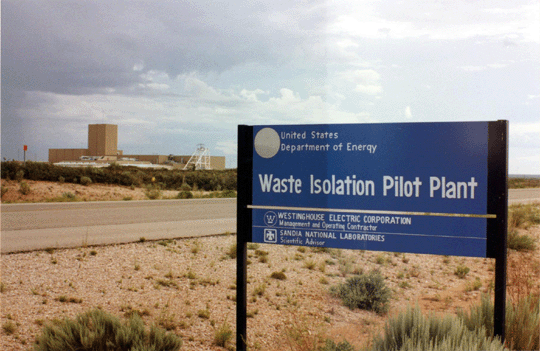
A typo and a bag of kitty litter might cost US taxpayers billions in nuclear waste cleanup, Business Insider, DAVE MOSHER AUG 27, 2016, A typo and a bag of organic kitty litter may end up costing United States taxpayers more than $2 billion in nuclear waste cleanup, according to a new report by Ralph Vartabedian at the Los Angeles Times.
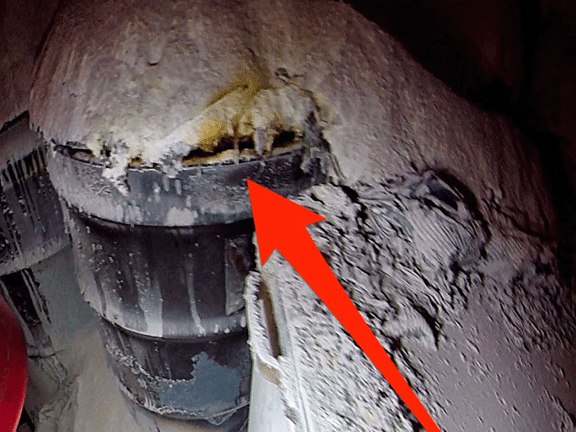
Back in February 2014, a drum of nuclear waste burst open inside the cavernous Waste Isolation Pilot Project (WIPP),  which is drilled out of a salt deposit nearly half a mile below the deserts of Carlsbad, New Mexico.
The US Department of Energy (DOE), which funds the company that runs the nuclear waste dump, quickly suspended operations and launched an investigation to figure out the cause.
In their 277-page report, investigators determined the blast vaporized nearly 7.5 lbs of the material inside a single barrel, labelled “Drum 68660.” That material included some radioactive isotopes of americium, plutonium, and uranium — byproducts of Cold War-era nuclear weapons production.
Although no one was inside WIPP when the drum burst, the facility’s air ventilation system spread some of the gases outside, exposing 21 workers to low doses of radiation.
Investigators also discovered the trigger of the “thermal runaway event,” also known as an “explosion”: a dangerous combination of nitric acid and salts, triethanolamine, and“sWheat Scoop” organic kitty litter. (The DOE mentions the brand almost 400 times in its report.)
The cleanup itself will cost hundreds of millions, but that’s not where the mishap’s ledger ends.
The “organic” part of the kitty litter in question is crucial.
That’s because wheat, which makes up the pee-absorbing bulk of organic kitty litter, contains plant cellulose that can burn. Standard kitty litter, meanwhile, is inorganic, since it’s primarily made of clay.
So when drum-packing workers at Los Alamos National Laboratory (LANL) followed instructions to add an organic variety to soak up radioactive fluids, they were unknowingly packing up what Sarah Zhang at Gizmodo called “the ingredients of a bomb.”………
Whatever the case, WIPP isn’t entombing any nuclear waste while cleanup work continues — which means the US government’s grand scheme to seal it all up has a major wrench in its gears.
The Times reports the facility may need 7 years of additional operation to handle the backup of waste. At $200 million per year, according to the Times’ analysis, that could add up to $1.4 billion in extra costs triggered by the mishap……
In the meantime, the DOE might also have to pay temporary storage and inspection costs for all of the waste that WIPP can’t entomb until the cleanup work is finished. The DOE couldn’t confirm or deny this, nor the cost.
“The Waste Isolation Pilot Plant (WIPP) is critical to the Department of Energy’s mission to cleanup nuclear waste generated by atomic energy activities,” a DOE spokesperson told Business Insider in an email. “WIPP is the nation’s only repository for the disposal of nuclear waste known as transuranic (TRU) waste. The Department is committed to the recovery, and resumption of TRU disposal operations at WIPP when it is safe to do so.”…..http://www.businessinsider.com.au/kitty-litter-nuclear-waste-accident-2016-8?r=US&IR=T
August 27, 2016
Posted by Christina Macpherson |
USA, wastes |
Leave a comment
Entergy Nuclear tells The Rutland Herald 700 gallons of groundwater a day infiltrated the Vermont Yankee turbine building this month. Between 3,000 and 2,500 gallons had been infiltrating the building each day in January. The plant closed in 2014.
The company says ongoing drought conditions likely contributed to the drop and allowed for foundation cracks and a sump-pump drain to be sealed.
The company says it has paid about $1.2 million to ship and treat water from the plant.
Entergy says it has effectively suspended its request to discharge slightly radioactive water from the building into the Connecticut River.
Federal nuclear regulators plan to inspect the plant next week.
August 27, 2016
Posted by Christina Macpherson |
incidents, USA |
Leave a comment
 Turkey Point workers prepare nuclear power plant for possible rough weather http://www.local10.com/weather/hurricane/turkey-point-workers-prepare-nuclear-power-plant-for-possible-rough-weather Tropical wave weakening, but still could impact South Florida By Ben Kennedy – Reporter, August 26, 2016 “Should a storm come like the one that is approaching now, we make sure the site is ready,” emergency preparedness manager Kevin O’Hare said. In the event of a power outage, the twin reactor nuclear power station has a backup system called the Flex Building — a 60-by 150-foot-long structure.
“As a result of Fukushima, (we) needed another level of protection,” Sergio Chaviano, project manager of the Flex Building, said.
Inside a box are backup systems that can deliver power to the entire plant. We have a pump here to the right, a smaller pump to the left. We have trailers that can carry hoses throughout the plant,” Chaviano said.
The hoses can carry water to cool reactors in the event of an emergency, but crews said they’ve been preparing for hurricane season since March.
“Our philosophy is to prevent problems so that by June 1 we are ready for hurricane season and whatever might come our way,” O’Hare said.
August 27, 2016
Posted by Christina Macpherson |
safety, USA |
Leave a comment