Wildfire danger to stranded radioactive wastes
 Feds Leave Radioactive Waste Stranded In Wildfire Danger
Zone http://www.mintpressnews.com/feds-leave-radioactive-waste-stranded-wildfire-danger-zone/191781/ DOE announces it will not meet deadline for removal of radioactive containers held above-ground at northern New Mexico nuclear weapons lab, By The Department of Energy admitted Friday it will not meet a deadline to remove dangerous radioactive waste, currently stranded above-ground in unsafe conditions at a New Mexico nuclear weapons laboratory, before wildfire season hits.
At least 3,706 cubic meters of radioactive waste are being stored at the Los Alamos National Laboratory complex after the Waste Isolation Pilot Plant, an underground nuclear waste dump in southeastern New Mexico, was shut down indefinitely in February due to an airborne radiation leak.
Officials in New Mexico have warned that the waste at Los Alamos could be within the reach of wildfires and must be transferred elsewhere by the end of June. According to the Associated Press, “The agreement for removal of the waste by June 30 was reached after a massive wildfire lapped at the edge of lab property three years ago, raising concerns about the thousands of barrels of waste that were being stored outside.”
“The waste at Los Alamos is trapped with no place to go,” Arnie Gundersen, chief engineer and nuclear safety advocate at Fairewinds Associates, told Common Dreams.
The Los Alamos radioactive materials are “transuranic waste” that is described by the DOE as “clothing, tools, rags, debris, soil and other items contaminated with radioactive material generated during decades of nuclear research and weapons development.”
Concerns have been raised about the safety of these barrels after it was posited that changes in methods of packaging at Los Alamos, from use of inorganic to organic cat litter to absorb moisture, may be responsible for a chemical reaction with nitrate salts and set off the “heat event” behind the WIPP leak. Officials are still trying to determine the cause of the accident and are investigating the potential danger of the more than 500 nuclear waste containers originating from Los Alamos that were packed with organic cat litter.
The DOE had been sending some Los Alamos radioactive waste to a Texas facility for temporary storage until WIPP is functional. Upon discovering that Los Alamos shipments may be dangerous, the DOE halted all shipments, citing public safety.
But Gundersen warns that these barrels of waste could pose a threat in Texas and Los Alamos, where they are being stored above-ground. “It is worse in the summer, because it is hotter in the summer, and the reactions become less stable,” he said.
In a statement (pdf) released Friday, the New Mexico Environment Department said it is “disappointed, but not surprised” that the DOE will not meet its deadline to remove the waste.
Meanwhile, it is still not clear when WIPP will reopen. The facility, which was never supposed to leak, is the bedrock of the U.S. government’s current approach to dispose of military-generated plutonium-contaminated transuranic waste from decades of nuclear bomb production and testing.
Critics have warned that WIPP’s failure raises serious questions about the overall federal strategy for disposing of nuclear waste.
The need to support a community when a nuclear power station closes
Regional and national conversations about nuclear power center on electricity supply and cost, environmental goals and radiological safety. But we focus on how closure looks from the host community’s standpoint. There are substantial financial and social losses that pose major, long-term risks to local and regional economies.
The foreseeable losses from plant closures are substantial enough to merit major planning efforts. Economic impact studies forecast the nature and scale of losses, but it’s not clear what to do next to prepare, beyond bracing for the worst and slashing budgets.
Unfortunately, no targeted programs or funding exist to support nuclear host communities doing this kind of planning. The accelerating pace of nuclear power plant closures has exposed a problem that will affect quality of life for hundreds of towns, many in rural or economically depressed areas. There are no model practices or policies, and no federal entity that assumes responsibility beyond radiological safety, environmental cleanup and monitoring of spent fuel.
A decade ago, community leaders in Southern Vermont asked what might happen to the regional economy if their plant shut down. They conducted a study to understand the problem, and produced the first-ever Comprehensive Economic Development Strategyincorporating nuclear plant closure impacts into economic planning. They had realized it was up to the region to take action because no help would be offered. By the time Vermont Yankee announced closure, work was already underway to replace Vermont Yankee losses with new jobs and businesses.
Today, the community around the Diablo Canyon Power Plant is at the start of a long journey. As home to many of the earliest plant closures, New England offers a network of people with experience, many of whom are also working to improve federal policies that will frame your future experience. This includes engaging with two current initiatives; NRC rulemaking on decommissioning and the Department of Energy consent-based approach to the spent fuel siting process.
Hundreds of billions of dollars will be spent to decommission the nuclear power plants that supply one-fifth of our nation’s energy. Additional billions are going into spent fuel handling and related litigation.
Currently, the best-case closure scenario is simply restoring nuclear sites to a natural state, erasing the past with no attempt to generate new economic activity.
We can do more. Only a few decades ago, America lacked a coherent approach to polluted sites. Now brownfield programs commonly transform polluted sites into new assets that attract investment.
Military base closures have been devastating, but over time Base Realignment and Closurepractices are evolving to help create new economic activity and redevelopment.
The local, county, regional and state agencies responsible for each community need enough funding and authority to implement timely and sufficient mitigation of all risks — to economic, environmental and human health. Decommissioning creates unfunded mandates precisely at the point when revenues are dropping. Ultimately, we need a national solution that makes the long-term economic health of host communities a policy goal. We need a federal agency that assumes responsibility for achieving that goal.
We urge California’s policymakers to join a growing body of state and federal legislators and regulators who believe we can do better when it comes to caring for the communities providing our nation’s energy.
John Mullin is professor emeritus of regional planning at the University of Massachusetts Amherst and former dean of the graduate school. He is co-founder of the Institute for Nuclear Host Communities and teaches a course on nuclear plant closures in the UMass Honors College.
Laura Sibilia is economic development director at the Brattleboro Development Credit Corp. in Vermont and a member of Vermont’s House of Representatives. She worked on development of a Comprehensive Economic Development Strategy to address impacts of Vermont Yankee’s closure.
Jennifer Stromsten is program director for the Institute for Nuclear Host Communities. She has 20 years of nonprofit development experience, and a master’s degree in regional planning, focused on sustainable land use and economic development. http://www.sanluisobispo.com/opinion/letters-to-the-editor/article105472331.html
#ExxonKnew lawsuit could open floodgates for more cases

 New type of #ExxonKnew lawsuit could open floodgates for more cases, Mashable, Andrew Freedman, 2 Oct 16, Exxon’s climate change-related legal problems are growing by the day.
The suit, filed by the Conservation Law Foundation (CLF), is significant because it is the first to allege that a private company is violating the Clean Water Act and hazardous waste laws by failing to adequately prepare for climate change impacts such as sea level rise and stormwater runoff from increased instances of heavy rainfall events.
According to the suit — filed with the U.S. District Court for the District of Massachusetts — the Exxon facility in Everett, Massachusetts, just to the northwest of Boston, has a stormwater drainage system that is easily overrun during extreme precipitation events, which are becoming more frequent due to climate change.
The suit contends that climate change-fed heavy rainfall is flooding the facility, which emits harmful contaminants into a tributary of the Mystic River in violation of the facility’s permit.
The reporting revealed that instead of incorporating the risks into its planning and being transparent about them, the company chose to fund climate denial groups and withhold its research from shareholders.
The reporting has sparked a public campaign against Exxon, known together with the reporting by the hashtag #ExxonKnew………
The lawsuit could pave the way for many more similar legal actions, and not just against Exxon, but other oil and gas companies too.
“America’s coastlines are dotted with oil and chemical tanks and other facilities that are at risk from rising seas.” http://mashable.com/2016/09/29/exxon-knew-lawsuit-massachusetts/#rjmvgqrODuq7
Looming Trade Deals Threaten Efforts to Keep Fossil Fuels in the Ground
 Is Toxic Trade in Your Backyard? https://www.sierraclub.org/trade/mapping-isds [excellent interactive map]
Looming Trade Deals Threaten Efforts to Keep Fossil Fuels in the Ground
If passed by Congress, two pending U.S. trade deals – the Trans-Pacific Partnership (TPP) and the Transatlantic Trade and Investment Partnership (TTIP) – would give some of the world’s largest fossil fuel corporations broad new rights to challenge our climate protections in private tribunals. For the first time, these corporations could ask unaccountable panels of corporate lawyers to order U.S. government compensation if such protections interfered with their widespread fossil fuel projects.
This interactive map shows more than 400 of these polluting projects across 48 states, each of which would get extraordinary protections under the TPP or TTIP. This includes:
- More than 300 polluting facilities, including over 70 coal mines, 30 oil refineries, and more than 100 gas power plants;
- Tens of thousands of miles of fossil fuel pipelines and oil trains;
- More than 10.8 million acres of oil and gas drilling leases; and
- Fracking operations from California to Pennsylvania.
Click on a fossil fuel project for more information on the corporations that could use these trade deals to try to prevent, or gain compensation for, U.S. efforts to keep fossil fuels in the ground. Using satellite view, zoom in to see pictures of the polluting projects in your backyard. For a full explanation of this new climate threat, click here for Sierra Club’s “Climate Roadblocks” report.
San Onofre’s nuclear wastes a great danger to public safety
Critics Question Plans For Nuclear Waste Storage At San Onofre Nuclear expert says it’s a “witches brew of radioactivity” 7 San Deiego By JW August , 30 Sept 16 The threat of a nuclear meltdown is no longer a concern at the San Onofre Nuclear Generating Station because it’s shut down.
A shuttered nuclear plant does present another potential threat to public safety, according to an editorial in the April 2016 edition of Scientific American Magazine. The article warns of a greater danger, and says “more threatening than a meltdown, it’s the steady accumulation of radioactive waste.”

The San Onofre Nuclear Generating Station was permanently retired by its owners, Southern California Edison, SCE, and SDG&E in 2013. The plant’s operations left 3.6 million pounds of radioactive waste behind.
If all goes as planned that radioactive waste is headed to bluffs just north of the dead reactors above San Onofre State Beach. It will sit near Interstate 5 in Southern California between two major metropolitan areas, San Diego and Los Angeles, where 17 million people call home.
Fifty canisters of radioactive leftovers, from fuel burned before the plant closed, are already in storage on the plant’s property. It accounts for about 30 percent of the radioactive waste on site. In the spring of 2017, the remaining radioactive waste will begin to be moved out of the pools of cooling water where it is currently stored and into 100 stainless steel dry casks which will also be encased in a cement pad.
Daniel Hirsch, the Director of the Program on Environmental and Nuclear Policy at UC Santa Cruz, said it is imperative the fuel rods be moved out of the pools and into dry casks as soon as possible.
“It is the most dangerous stuff on earth; a witches brew of radioactive material,” he said.
A fuel rod is a long zirconium metal tube containing pellets of fissionable material, which provide fuel for nuclear reactors.
“Those pools are so densely packed, that if you lose the coolant you could have a fire in them,” Hirsch said.
According to a report from Robert Alvarez, a former policy advisor to the U.S. Department of Energy, a pool fire would release more radioactivity than a reactor meltdown. Hirsch, a long-time critic of the industry told NBC 7 Investigates the clock is ticking, something the plant’s owners agree with.
The location of the waste storage is something the plant’s owners and nuclear waste critics do not agree with.
“They’re going to be stored on the beach in the worst possible location you can imagine,” Charles Langley, who opposes the storage plans at San Onofre, said. Langley tracks all things related to San Onofre and the nuclear waste storage plans for Public Watchdogs, a San Diego based non-profit website.
The proposed storage site is northwest of the plant’s units one and two; the two reactor domes that can be seen from the freeway.
Currently, the San Onofre Nuclear Generating Station is the largest privately-owned coastal nuclear storage site in the country. When compared to government owned sites, it’s the second largest in the country, behind the Hanford Site in Washington where the first plutonium reactor was built and the bomb dropped on Nagasaki, Japan was created.
Langley said the location selected is all about money. “It’s the cheapest alternative,” he said. “It’s what’s best for the stockholders. It’s not what’s best for the people of Orange and San Diego County.”
SCE does not agree. Neither does the Nuclear Regulatory Commission, NRC, and the California Coastal Commission, which both approved the Pacific coastline location.
It’s not a case of no risk, the utilities argue, but low risk.
In January, due to El Nino weather conditions, there was considerable erosion of the beaches and bluffs around the San Onofre plant, the same area where the canisters will be stored.
Nina Babiarz, a transportation consultant and former journalist, said the location for the nuclear waste storage is a poor one. “It’s on an earthquake fault in a tsunami zone,” she said. NBC 7 Investigates reviewed weather reports and found rising sea levels at and around the nuclear waste storage location could continue.
A Pacific Institute report on sea level rise, with contributions by the Scripps Institution of Oceanography, found “flooding and erosion” risks will increase. According to the report, “in areas where the coast erodes easily, sea level rise will likely accelerate shoreline recession” and “may expose previously protected areas to flooding.” The United States Geological Service found the same dynamics: extreme bluff, cliff and beach erosion, accelerating over time.
The City of Del Mar, located 33 miles from San Onofre and with a similar coastline, did its own risk assessment of projected impact from sea level rise, storm surges and coastal flooding. In its assessment it describes the potential for extensive flooding and cliff collapses. …………http://www.nbcsandiego.com/news/local/Critics-Question-Plans-For-Nuclear-Waste-Storage-At-San-Onofre-395305981.html
Obama’s opportunity to reduce America’s nuclear arsenal, and reduce international tensions
 It’s time to cut America’s nuclear arsenal http://thebulletin.org/it%E2%80%99s-time-cut-america%E2%80%99s-nuclear-arsenal9942 Daryl G. KimballKingston Reif, 30 Sep 16, As he enters his final months in office, President Obama is still evaluating options to reduce the role and number of nuclear weapons in US strategy. His final decisions are expected before the end of October.
In a recent article in the Bulletin, we argued that the president should declare that the United States would not be the first to use nuclear weapons. In addition, he should direct a reduction in the size of the US nuclear arsenal. Not only could America make significant cuts to its nuclear forces without harming its security, but doing so would get the president closer to a major unmet goal while simultaneously freeing up federal money that could be much better used on other military priorities.
The United States could cut the size of its strategic nuclear forces on the basis of its own defense requirements alone. In 2013, a Pentagon reviewdetermined that America’s deployed strategic nuclear force is one-third larger than necessary to deter a nuclear attack. The president could direct the Pentagon to reduce the number of deployed strategic warheads from roughly 1,500 today to 1,000 within five years. He could also—and should—order the retirement and dismantling of a significant portion of our non-deployed “hedge” arsenal, estimated to be about 2,600 warheads. A thousand deployed warheads would still provide more than enough nuclear firepower to deter any current or potential nuclear adversary. Just one of our nuclear-armed submarines could devastate an entire country and kill millions. And if an enemy isn’t deterred by 1,000 deployed nuclear weapons, what logic presumes 1,500 would make a difference?
By cutting America’s excessive nuclear firepower, the president would also advance one of his key nuclear policy objectives. In his 2010 “Nuclear Posture Review Report,” Obama pledged that his administration would reduce the number, role, and salience of nuclear weapons in US defense strategy. He also called for maintaining and modernizing America’s remaining nuclear forces on a smaller triad of delivery systems.
Things have not gone as planned. In fact, not only has the reduction process stalled but the cost of sustaining our nuclear forces has skyrocketed.
The president’s posture review set the stage for the 2010 New Strategic Arms Reduction Treaty (New START), which established modestly lower limits for US and Russian deployed strategic arsenals (1,550 deployed strategic warheads each) and mandated a far-reaching verification regime. A follow-on study conducted by the US government in 2013 determined that future deterrence requirements could be met with one-third fewer deployed strategic nuclear forces.
Yet Obama did not immediately reduce the size of America’s nuclear force, despite the follow-on study’s conclusion that deterrence could be achieved by even a unilateral reduction. Instead, in a June 2013 speech in Berlin, he invited Russia to negotiate a further one-third reduction of each country’s strategic nuclear arms.
Russian leaders have rebuffed the offer for more than three years now, saying that they want to address other issues as well, such as the nuclear forces of other nations, America’s increasingly accurate conventional weapons, and missile defenses deployed in Europe, which Moscow believes could undercut its own nuclear retaliatory potential and disrupt strategic stability between itself and its old Cold War adversary.
As a result, US and Russian forces still far exceed deterrence requirements and many weapons deployed by both sides remain in “launch-under-attack” mode—ready to be fired within minutes of an order to do so. If used even in a “limited” way, the result would be a global humanitarian catastrophe.
Leading from ahead. Obama should not give Russian President Putin a veto over cuts of unnecessary and expensive US strategic nuclear weapons. Nor should he give Putin an easy excuse to maintain a similarly bloated arsenal of deployed strategic warheads aimed at the United States.
Now is the time to announce that the United States will reduce its strategic nuclear force to 1,000 (or fewer) strategic deployed warheads, invite Russia to do the same, and propose that the two sides agree to resume formal talks to regulate all types of strategic offensive and defensive weapons systems (nuclear and nonnuclear) that could affect strategic stability. Such a strategy could prompt Russia to rethink its expensive nuclear weapons modernization projects and possibly build-down its strategic nuclear arsenal.
In addition, more-rapid reductions of US and Russian nuclear forces, which comprise 95 percent of global stockpiles, would increase pressure on China and other nuclear-armed states to join the nuclear disarmament enterprise, an objective that leaders in Russia and the United States say they support.
Even if Russia is reluctant to immediately join the United States in reducing to 1,000 warheads, an American reduction would put Russia on the defensive and force Moscow to explain to a critical international community why it needs to maintain a larger deployed nuclear arsenal than the United States.
Such a move would not be unprecedented. Twenty-five years ago this week, George H.W. Bush announced a bold “Presidential Nuclear Initiative” as the Soviet Union began to break apart. It would unilaterally eliminate the US arsenal of land-based tactical nuclear weapons, withdraw tactical nukes from ships and submarines, and terminate certain nuclear weapons programs, including the development of the mobile Peacekeeper intercontinental ballistic missile.
A decade later, George W. Bush decided to unilaterally slash the size of the total US nuclear warhead stockpile (including those already deployed) in order to align American nuclear posture with changing national security needs. The cuts to the deployed force were later codified in a short bilateral treaty with Moscow known as the Strategic Offensive Reductions Treaty. But as Secretary of Defense Donald Rumsfeldtold the Senate Armed Services Committee in 2002: “We would have made these cuts regardless of what Russia did with its arsenal.”
Indeed, reductions to the US nuclear arsenal—which since the end of the Cold War has declined from about 22,000 warheads to roughly 4,600 as of September 30, 2015—have largely been the result of independent presidential discretion. While there isrough parity in the total size of each country’s total nuclear stockpile, the United States currently possesses hundreds more strategic nuclear delivery systems and warheads than does Russia, while Moscow maintains hundreds more non-strategic (or tactical) nuclear warheads than Washington.
Value for money. It is certainly true that Russia’s recent actions in Ukraine and irresponsible saber-rattling pose a challenge to European security. But every dollar Washington spends to maintain a bloated nuclear arsenal is a dollar that can’t be spent on military capabilities more relevant to countering Russia and assuring allies. It is not in the American interest to engage in a tit-for-tat race with the Russians to rebuild an excessively large nuclear force, especially if it comes at the expense of needed conventional improvements, such as programs to maintain America’s military technological edge.
By scaling back its nuclear force to 1,000 deployed strategic warheads and making associated reductions to the hedge stockpile, the United States could remove a big obstacle to trimming tens of billions of dollars from the Defense Department’s costly and excessive plan for new strategic submarines, missiles, and bombers over the next decade, which is premised on maintaining New START force levels in perpetuity.
The Pentagon estimates that the cost to replace nuclear delivery systems and their associated supporting infrastructure alone could cost half-a-trillion dollars over the next 20 years, a spending level that both the White House and Defense Department warn may not be sustainable and could force difficult trade-offs with other programs. This amounts to a multi-decade nuclear spending binge that promises to perpetuate excessive force levels and Cold War–era fighting capabilities for generations to come.
A more realistic, affordable, and sustainable course could include:
- reshaping or canceling the plan to spend at least $85 billion or more on roughly 650 new land-based missiles to support a deployed force of 400 missiles;
- halting the plan for roughly 1,000 new air-launched, nuclear-capable cruise missiles at a cost of some $20 billion to $25 billion;
- trimming back the plan for 12 new nuclear-armed ballistic missile submarines, which are estimated to cost $140 billion to develop.
Obama has it within his power to trim excess nuclear weapons and avoid spending tens of billions of defense dollars on redundant and unnecessary nuclear weapons systems. By doing so, he would open the way for further reductions in the role and size of not only America’s nuclear forces but Russia’s as well—and help build a future that’s a little more safe and secure.
US tells Pakistan that its nuclear threats to India are not acceptable
Nuclear threat not acceptable, US tells Pakistan, http://www.thehindu.com/news/international/nuclear-threat-not-acceptable-us-tells-pakistan/article9170042.ece VARGHESE K. GEORGE, 1 Oct 16 The United States has conveyed to Pakistan that nuclear threats are not acceptable, a senior State Department official who did not want to be named, said. The message was conveyed to Pakistan after its defence minister said twice in the span of a week that his country could use tactical nuclear weapons against India.
“We made that clear to them. Repeatedly,” the official said when asked whether the U.S has conveyed to Pakistan that no nuclear capable country is expected to threaten anyone with the use of nukes. “We haven’t kept the devices that we have just as showpieces. But if our safety is threatened, we will annihilate them (India),” the defence minister of Pakistan had said.
The U.S is concerned about the safety of Pakistani nuclear weapons otherwise also, the official said. “The safety of these weapons is always a concern for us. So we are always monitoring it, regardless of what they said on this particular occasion,” he said.
Shadow Courts – The Secret Tribunals That Corporations Use to Sue Countries
 US trade negotiators are now working to include Investor-State Dispute Settlement (ISDS) in as many new treaties as possible, including both of the massive new free trade deals coming down the pike. The Trans-Pacific Partnership, which President Obama signed in February 2016 and which Congress will likely ratify before he leaves office, already includes ISDS.
The Secret Tribunals That Corporations Use to Sue Countries, Moyers and company
These ad hoc courts are a main reason why so many politicians and activists are against trade agreements like the TPP. BY HALEY EDWARDS | SEPTEMBER 19, 2016 THIS IS AN EXCERPT FROM THE NEWLY PUBLISHED BOOK SHADOW COURTS: THE TRIBUNALS THAT RULE GLOBAL TRADE BY HALEY EDWARDS.
The environmental activist Jane Kleeb was driving down Highway 281 near Lincoln, Nebraska, on a gray day in January 2016, when she got a call from a reporter.
At the time, Kleeb was still riding high off of her success organizing local farmers, ranchers and environmentalists in opposition to the Keystone XL Pipeline, which would have carried petroleum products from Canada’s tar sands across the Nebraska plains to the Gulf of Mexico. Thanks to her and other activists’ efforts, President Barack Obama had announced in November 2015 that his administration would deny the Canadian company TransCanada permission to move forward with the project, ending an eight-year-long effort to get the pipeline built.
The reporter was calling to ask Kleeb about a new twist in the saga. Earlier that day, TransCanada had announced it was suing the US government for $15 billion on the grounds that Obama’s decision to block the project violated the North American Free Trade Agreement. It was the first Kleeb had heard of the suit. “I’m an organizer, so my reaction was, ‘When are the hearings? Where is this happening? Who’s the judge?’” she said recently. If TransCanada was challenging the decision in court, she wanted to be there. Could she protest on the courthouse steps? Arrange for a rally in a nearby town?
But that, Kleeb learned, was not how this case would go down. TransCanada wasn’t suing the US in a US court, or in a Canadian court for that matter. Its argument would not be heard by a judge, and the merits of the case would not be considered under the auspices of either country’s legal system. There would be no protest on any courthouse steps. Instead, the case would be heard by a tribunal, manned by three private arbitrators, operating under a supranational legal system that Kleeb had never heard of. “It was totally strange,” she told me. “A foreign company can sue us in some secret tribunal? How is that even possible?”
Investor-state dispute settlement, or ISDS, first appeared in treaties in 1969. The idea behind the mechanism was straightforward: If a foreign investor believed that his host country — the nation where his company was operating had violated an international treaty by seizing or destroying his factories, oil fields or other assets, he could file an ISDS claim directly against that country. He could do that without involving his own government and without having to wait endlessly for a developing country’s corrupt or biased court system to dispense judgment……..
ISDS was supposed to be a cool, efficient and apolitical dispute resolution system that kept powerful nations from interfering in the affairs of weaker countries, and that offered an extra layer of protection for foreign investors operating in countries with unreliable courts. But in the last 20 years, the mechanism has quietly changed, evolving into something much more powerful — and very political indeed……..
That modern interpretation has only cropped up in the last 20 years, but it has opened up a vast new gray area. Where ISDS claims were once about seized oil fields and bulldozed factories, now they are about tax increases and environmental regulations. Where is the line between a government’s right to regulate in the public interest and a foreign corporation’s claim to its own property?
US trade negotiators are now working to include ISDS in as many new treaties as possible, including both of the massive new free trade deals coming down the pike. The Trans-Pacific Partnership, which President Obama signed in February 2016 and which Congress will likely ratify before he leaves office, already includes ISDS. Whether the mechanism will be inserted into the Transatlantic Trade and Investment Partnership, linking the US and Europe, is a subject of controversy…….http://billmoyers.com/story/shadow-courts-secret-tribunals-trade/
From nuclear to solar power in Sacramento County
 From nuclear to solar power http://www.abc10.com/news/local/from-nuclear-to-solar-power/327657069 The two cooling towers of the decommissioned Rancho Seco Nuclear Power Plant continue to stand tall across the eastern Sacramento County skyline.
A symbol of the past, the two towers got some new neighbors yesterday, that look to energize the future, and power some of Sacramento’s most iconic buildings.
With the flip of a switch, the Rancho Seco Solar plant is officially on line.
“This project will serve the two most iconic buildings in Sacramento, the new Golden One Center and the state Capitol, and it’s being done here out at Rancho Seco, one of the most iconic sites in Sacramento, so you’ve got a great juxtaposition of the old and the new here,” SMUD CEO and GM Arlen Orchard said.
The United States Nuclear Regulatory Commission decommissioned Rancho Seco in 2009. The process to remove and contain all the radiation from the site took 20 years at a cost of $500 million. In all that time, thankfully no one was injured and that the infrastructure to produce and deliver energy remained intact.
“We have all the infrastructure in place to distribute the energy down into Sacramento, so it really made sense from a space, sun, and infrastructure level,” Orchard said. Over 50 percent of the energy SMUD will create this year is carbon free. The sun shining down on this facility here will generate 11 megawatts, enough electricity to power every state building in Sacramento.
“Having a state capitol that is fully powered by clean renewable energy really fits with Governor Brown’s vision,” Brian Ferguson, California general services, said.
“The Rancho Seco project created more than 200 jobs at peak construction and will provide power not just to the Golden One Center but to all of California’s department of General Services,” Michael Argentine, Lead Project Developer, said.
The solar site around Rancho Seco is currently 62 acres with over 100,000 solar cells. SMUD hopes to double the site in the next couple years as it hopes to reach its energy production goal of 75 percent carbon free sources within the next decade.
Opposition to South Carolina becoming a nuclear waste dumping ground
Environmentalists say there is no need to move spent nuclear fuel off of atomic power plant sites. They contend it can be stored safely. Transporting it to a disposal area near Barnwell would increase risks to the public, they said
Plan surfaces for new nuclear disposal ground in SC Casks of spent nuclear fuel are stored above ground at many atomic energy plants because there is no national disposal site for the material U.S. Nuclear Regulatory Commission BY SAMMY FRETWELL AND JEFF WILKINSON\ sfretwell@thestate.com,jwilkinson@thestate.com, COLUMBIA, SC
A plan has surfaced to establish another nuclear waste disposal ground in South Carolina, a state with a history of taking atomic refuse from across the country.
An organization called the Spent Fuel Reprocessing Group wants federal approval to open a disposal area near Barnwell and the Savannah River Site nuclear weapons complex. Spent fuel, a type of highly radioactive waste, would be moved from the state’s four nuclear power plant sites and stored indefinitely at the new facility, records show.
The U.S. Nuclear Regulatory Commission in July received notice of the plan. The proposal is a long way from becoming reality, but if eventually approved by the federal government, it would create a place for nuclear waste disposal that is likely to draw opposition.
Several environmental groups said this week they are preparing to fight any effort to create what they called an atomic waste dumping ground. Politicians, including Gov. Nikki Haley, also expressed reservations Monday. The subject of nuclear waste disposal is a touchy one in South Carolina because many people say the state has shouldered more than its share of the nuclear waste burden.
South Carolina already stores highly radioactive material from around the country and world at the Savannah River Site. It also has a low-level waste dump in Barnwell County that was used for decades to bury nuclear garbage from power plants across the country. That site has leaked radioactive tritium into groundwater.
Now, the government is being asked to allow an interim disposal site for high-level nuclear waste from power plants in South Carolina. The site would be near the Barnwell low-level waste dump, environmentalists said Monday. The site would be considered an interim disposal ground that would hold the nuclear waste while the government figures out what to do with it in the long run…….
Environmentalists say there is no need to move spent nuclear fuel off of atomic power plant sites. They contend it can be stored safely. Transporting it to a disposal area near Barnwell would increase risks to the public, they said. If a permanent disposal site were eventually developed nationally, the material would have to be transported again from the interim South Carolina site, according to Savannah River Site Watch, the S.C. League of Women Voters and the state Sierra Club.
“Packaging of the spent fuel for transport, unloading it at the consolidated storage site and eventually repackaging it to transport to a federal facility would unnecessarily pose a high economic cost and a logistical nightmare, both of which can be avoided if the spent fuel is left where it is now stored until such time as a geologic facility is available,’’ according to the groups…….
Climate change will expose top-secret US nuclear project in Greenland
Greenland’s receding icecap to expose top-secret US nuclear project Camp Century – part of Project Iceworm – is underground cold war network that had been thought buried forever, until climate change made that highly unlikely, Guardian, Jon Henley, 28 Sept, A top-secret US military project from the cold war and the toxic waste it conceals, thought to have been buried forever beneath the Greenland icecap, are likely to be uncovered by rising temperatures within decades, scientists have said.

The US army engineering corps excavated Camp Century in 1959 around 200km (124 miles) from the coast of Greenland, which was then a county of Denmark.
Powered, remarkably, by the world’s first mobile nuclear generator and known as “the city under the ice”, the camp’s three-kilometre network of tunnels, eight metres beneath the ice, housed laboratories, a shop, a hospital, a cinema, a chapel and accommodation for as many as 200 soldiers………
Project Iceworm, presented to the US chiefs of staff in 1960, aimed to use Camp Century’s frozen tunnels to test the feasibility of a huge launch site under the ice, close enough to fire nuclear missiles directly at the Soviet Union.
At the height of the cold war, as the US and the USSR were engaged in a terrifying standoff over the deployment of Soviet missiles in Cuba, the US army was considering the construction of a vast subterranean extension of Camp Century.
A system of about 4,000 kilometres of icy underground tunnels and chambers extending over an area around three times the size of Denmark were to have housed 600 ballistic missiles in clusters six kilometres apart, trained on Moscow and its satellites.
Eventually the engineers realised Iceworm would not work. The constantly moving ice was too unstable and would have deformed and perhaps even collapsed the tunnels.
From 1964 Camp Century was used only intermittently, and three years later it was abandoned altogether, the departing soldiers taking the reaction chamber of the nuclear generator with them.
They left the rest of the camp’s infrastructure – and its biological, chemical and radioactive waste – where it was, on the assumption it would be “preserved for eternity” by the perpetually accumulating snow and ice……..
Greenland’s temperatures broke new records this spring and summer, hitting 24C (75F) in the capital, Nuuk, in June – a figure that shocked meteorologists so much they had to recheck their measurements.
Between 2003 and 2010, the ice that covers much of the island melted twice as fast as during the whole of the 20th century. This year it began melting a month earlier than usual.
The researchers studied US army documents and drawings to work out how deep the camp and its waste – estimated to include 200,000 litres of diesel fuel, similar quantities of waste water and unknown amounts of radioactive coolant and toxic organic pollutants such as PCBs – were buried………
The Pentagon has said it “acknowledges the reality of climate change and the risk it poses” for Greenland, adding that the US government has pledged to “work with the Danish government and the Greenland authorities to settle questions of mutual security”. https://www.theguardian.com/world/2016/sep/27/receding-icecap-top-secret-us-nuclear-project-greenland-camp-century-project-iceworm
Both Russia and America Prepare for Nuclear War? (and this is ‘good for business’)
Dangerous Crossroads: Both Russia and America Prepare for Nuclear War? http://www.globalresearch.ca/dangerous-crossroads-both-russia-and-america-prepare-for-nuclear-war/5548074 By Prof Michel Chossudovsky Global Research, September 27, 2016 Barely acknowledged by the Western media. both Russia and America are “rearming” their nuclear weapons systems. While the US is committed to a multibillion dollar modernization project, Russia is largely involved in a “cost-effective” restructuring process which consists in decommissioning parts of its land-based ICBM arsenal (Topol) and replacing it with the more advanced Yars RS-24 system, developed in 2007.
Rest assured, the B61-12 is a “mini-nuke” with an explosive capacity of up to four Hiroshima bombs. It is categorized as a “defensive” (peace-making) weapon for use in the conventional war theater. According to scientists on contract to the Pentagon, the B61-11 and 12 (bunker buster bombs with nuclear warheads) are “harmless to civilians because the explosion is underground”.
The nuclear triad modernization project is at the expense of US tax payers. It requires the redirection of federal revenues from the financing of “civilian” expenditure categories (including health, education, infrastructure etc) to the “war economy”. It’s all for a good cause: “peace and security”.
 War is “Good for Business”
The multibillion dollar project is a financial bonanza for America’s major defense contractors including Boeing, Lockheed Martin and Northrop Grumman, which are also firm supporters of Hillary Clinton’s stance regarding a possible first strike nuclear attack against Russia, China, Iran and North Korea.
Reported by Defense News, US Secretary of Defense Ash Carter on September 26 called for the “need to modernize all three legs of the nuclear triad.” The project would require a major boost in defense expenditure.
Underscoring today’s “volatile security environment”, the multibillion dollar project is required, according to Carter, in view of threats largely emanating from Russia, China as well as North Korea:
Carter’s comments came during a visit to Minot Air Force Base in North Dakota, … Under the fiscal year 2017 budget request, Carter said, the department pledged $19 billion to the nuclear enterprise, part of $108 billion planned over the next five years. The department has also spent around $10 billion over the last two years, the secretary said in prepared comments. The “nuclear triad” references the three arms of the US strategic posture — land-based ICBMs, airborne weapons carried by bombers, and submarine-launched atomic missiles. All of those programs are entering an age where they need to be modernized.
Pentagon estimates have pegged the cost of modernizing the triad and all its accompanying requirements at the range of $350 to $450 billion over the next 10 years, with a large chunk of costs hitting in the mid-2020s, just as competing major modernization projects for both the Air Force and Navy come due.
Critics of both America’s nuclear strategy and Pentagon spending have attempted to find ways to change the modernization plan, perhaps by cancelling one leg of the triad entirely.But Carter made it clear in his speech that he feels such plans would put America at risk at a time when Russia, China and North Korea, among others, are looking to modernize their arsenals. (Defense News, September 26, 2016)
Carter casually dismissed the dangers of a no-win global war, which could evolve towards a “nuclear holocaust”, Ironically ”… He also hit at critics of the nuclear program — which include former Secretary of Defense William Perry, [who ironically is] widely seen as a mentor for Carter — who argue that investing further into nuclear weapons will increase the risk of atomic catastrophe in the future. (Defense News, September 26, 2016)
Carter expressed his concern regarding Russia’s alleged “nuclear saber-rattling”.
Russia’s ICBM System
Were Carter’s timely statements in response to Russia redeployment and restructuring of its ICBM system on its Western frontier, which were announced on September 20?
Last week, the Russian news agency Tass confirmed that “The westernmost strategic missile force division in the Tver region will soon begin to be rearmed with the missile system Yars.”
It will be a sixth strategic missile division where the newest mobile ground-based missile complexes will replace the intercontinental ballistic missile Topol,” the press-service of the Strategic Missile Force quotes its commander Sergey Karakayev as saying.
According to the official, this year regiments in the Irktusk and Yoshkar-Ola divisions began to be rearmed. The re-armament of the Novosibirsk and Tagil divisions is nearing completion. Earlier, the Teikovo division was fully rearmed.
The final decision to rearm the strategic missile division in the Tver Region will be made after a command staff exercise there. The press-service said the exercises will be devoted to maneuvering along combat patrol routes.
In the near future the ICBM RS-24 Yars, alongside the previously commissioned monoblock warhead ballistic missile RS-12M2 Topol-M, will constitute the backbone of Russia’s strategic missile force.
The Yars ICBM RS-24 was developed in 2007 in response to the US Missile Shield. It is nothing new in Russia’s military arsenal. It is a high performance system equipped with thermonuclear capabilities.
What this report suggests is the restructuring of Russia’s strategic missile force and the replacement of the Topol system (which Moscow considers obsolete) with the Yars ICBM RS-24.
New US Bill Would Ban President From Launching ‘First Use’ Nuclear Strike
 US Congress Bill Bans President From Launching ‘First Use’ Nuclear Strike, https://sputniknews.com/us/20160927/1045761657/bill-ban-us-nuclear-strike.html, Newly-introduced legislation would ban the US commander-in-chief from authorizing a nuclear attack without approval from the legislative branch, Congressman Ted Lieu and Senator Ed Markey said in a press release on Tuesday. WASHINGTON — The release claimed that the issue of “nuclear first use” is even more critical in light of the fact that a majority of Americans do not trust Republican presidential nominee Donald Trump with the US nuclear arsenal.
“This legislation would prohibit the [US] President from launching a nuclear first strike without a declaration of war by Congress,” the release stated. On Monday, US Democratic presidential nominee Hillary Clinton during the campaign’s first debate argued that Trump’s position on nuclear weapons runs contrary to longstanding US policy given he has repeatedly said he did not care if other countries possessed them.
Community protest has stopped development of deep borehole waste disposal method in USA
Protests spur rethink on deep borehole test for nuclear waste http://www.sciencemag.org/news/2016/09/protests-spur-rethink-deep-borehole-test-nuclear-waste By Paul VoosenSep. 27, 2016 DENVER—Along the way to testing an old-but-new concept in nuclear waste storage—burying spent fuel in a hole drilled kilometers below the surface—the U.S. Department of Energy (DOE) and its contractors relearned a lesson that seems frequently forgotten: Get the locals on board first.
Failure to gain the trust and approval of residents in rural North and South Dakota doomed the start of a $35 million project that would have drilled a borehole 5 kilometers beneath the prairie into crystalline basement rock. Early this year, the agency tapped Battelle Memorial Institute, a large research nonprofit based in Columbus, to lead the effort. The hole would not have been used for radioactive material, but was rather intended to garner insight to the geology and technical challenges of such drilling.
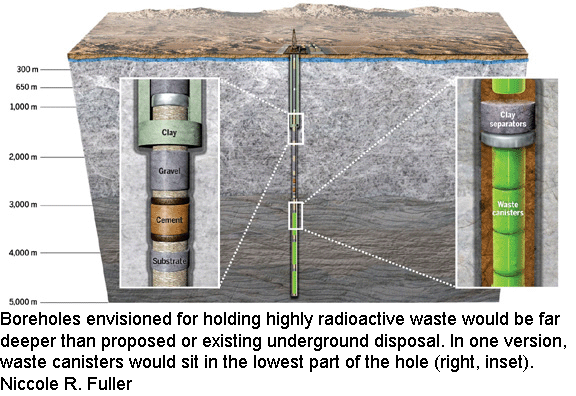
That message would not be heard by residents of Pierce County in North Dakota or Spink County in South Dakota said Mark Kelley, the Battelle project manager who had the “dubious honor” of leading the effort for only half a year, at a presentation yesterday at the annual meeting of the Geological Society of America. “They were not to be convinced,” he said. “They were quite opposed to it.”
This summer, DOE and Battelle agreed to scrap the 5-year effort, which had moved to South Dakota after failing in North Dakota. In August, the agency solicited new bids for the project, due next month, that explicitly require public engagement from the outset, including staff that will remain on site day to day to hear local concerns. Bidders are also expected to find a way of showing how the project could benefit locals through science education or additional research. The agency will likely select multiple contractors for the project’s first phase, keeping its options open on new potential sites.
Battelle had thought its South Dakota site, to be drilled on private land into Precambrian basement rock, might succeed where North Dakota failed. They promised to engage locals earlier, and not repeat the same mistakes, such as when local officials first learned of the project from local newspaper articles. But similar fears that the project would open the county up to a future as a disposal site, or that drilling could go awry and pollute aquifers, led the Spink County’s board of commissioners in June to reject the zoning approval the project needed. It didn’t help, Kelley added, that some of the North Dakota protesters traveled south to keep their opposition going.
Though the concept of borehole disposal, which would see radioactive waste entombed far deeper than traditional repositories, has existed for decades, the idea has been revived in recent years, spurred by troubles in finding a long-term home for the country’s spent fuel. Such boreholes could not house most of the country’s waste, like fuel rods from nuclear power plants, but could have potential for smaller, long-lived radioactive materials. Energy Secretary Ernest Moniz has frequently touted borehole disposal as one alternative to Yucca Mountain, the stalled repository in Nevada.
Many of the scientists working on the borehole project continue to believe in it—if they can only find a community willing to take it on.
“We want to test the things that would be difficult to do,” said Kristopher Kuhlman, a hydrogeophysicist at Sandia National Laboratory in Albuquerque, New Mexico, during the meeting. “If we want to put waste where we’ll never see it again,” he added, it should go at the bottom of a deep borehole.
Cheap, Portable Solar Panel could transform the solar power industry
 This Cheap, Portable Solar Panel Will Be the iPad of Renewables by Good News Network – Sep 24, 2016 A California-based startup unveiled a product this week that aims to disrupt solar power production, much like the iPhone changed communications.
SunCulture Solar Inc. is calling its wire-free SolPad, which resembles a large iPad, the “world’s first integrated solar energy solution.”
It combines batteries, software, inverters and solar panels into one device. Typically, a solar system involves installation of separate parts, increasing costs. SolPad can be used off grid or tied to the grid, and uses batteries that the company says are safer than traditional lithium-ion ones.
”If the grid goes down, SolPad can keep delivering electricity,” the company said in a video unveiling the device in California this week.
“We’ve transformed solar — much like the smartphone revolutionized the personal computer sector, combining numerous components into a single device that’s significantly less expensive, more powerful and easier to use than conventional systems,” said CEO Christopher Estes.
The company plans to bring the product to market in the second half of next year……..http://www.goodnewsnetwork.org/cheap-portable-solar-device-will-ipad-renewables/
-
Archives
- October 2026 (112)
- September 2026 (339)
- August 2026 (330)
- July 2026 (355)
- June 2026 (287)
- May 2026 (306)
- April 2026 (356)
- March 2026 (251)
- February 2026 (267)
- January 2026 (308)
- December 2025 (358)
- November 2025 (359)
-
Categories
- 1
- 1 NUCLEAR ISSUES
- business and costs
- climate change
- culture and arts
- ENERGY
- environment
- health
- history
- indigenous issues
- Legal
- marketing of nuclear
- media
- opposition to nuclear
- PERSONAL STORIES
- politics
- politics international
- Religion and ethics
- safety
- secrets,lies and civil liberties
- spinbuster
- technology
- Uranium
- wastes
- weapons and war
- Women
- 2 WORLD
- ACTION
- AFRICA
- Atrocities
- AUSTRALIA
- Christina's notes
- Christina's themes
- culture and arts
- Events
- Fuk 2022
- Fuk 2023
- Fukushima 2017
- Fukushima 2018
- fukushima 2019
- Fukushima 2020
- Fukushima 2021
- general
- global warming
- Humour (God we need it)
- Nuclear
- RARE EARTHS
- Reference
- resources – print
- Resources -audiovicual
- Weekly Newsletter
- World
- World Nuclear
- YouTube
-
RSS
Entries RSS
Comments RSS

