Preparing the country for nuclear terrorism http://thebulletin.org/preparing-country-nuclear-terrorism9985 JEROME M. HAUER Jerome M. Hauer has served in cabinet-level positions at the local and state level and as an acting assistant secretary for the Office of Public Health Emergency Preparedness at the US Department…
The candidates for president of the United States continue to discuss preventing nuclear proliferation and the threat of nuclear terrorism, yet we hear little about how well prepared the nation is to manage the aftermath of terrorist use of an improvised nuclear device. Some may think the notion of such an attack is apocryphal. So allow me to explain just how likely such a possibility is, how devastating the result of such a detonation would be, and—in particular—just how poorly prepared the United States is to respond.
In 2005, Kofi Annan, former secretary general of the United Nations, said, “Nuclear terrorism is still often treated as science fiction. I wish it were. But unfortunately we live in a world of excess hazardous materials and abundant technological know-how, in which some terrorists clearly state their intention to inflict catastrophic casualties. Were such an attack to occur, it would not only cause widespread death and destruction, but would stagger the world economy … [creating] a second death toll throughout the developing world.
In 2007, US Sen. John McCain was quoted as saying, “My greatest fear is the Iranians acquire a nuclear weapon or North Korea and pass enough highly enriched uranium (HEU) to a terrorist organization. And there is a real threat of them doing that. Just 55 kilograms, roughly 122 pounds of HEU, can be used to make a 10 kiloton IND, similar to the bomb dropped over Hiroshima.”
In 2005, Graham Allison, director of Harvard University’s Belfer Center for Science and International Affairs at Harvard University’s John F. Kennedy School of Government, asked, “Is nuclear mega-terrorism inevitable? Harvard professors are not known for being subtle or ambiguous, but I’ll try to the clear. Is the worst yet to come? My answer: Bet on it. Yes.
Matthew Bunn, also at the Belfer Center, argued in 2007, “Theft of the essential ingredients of nuclear weapons is not just a hypothetical worry, it is an ongoing reality.”
Nuclear physicist Frank Barnaby has been quoted as saying “The really frightening thing about HEU is that it is so easy to make an atom bomb out of it. You only need a couple of PhD students and a small amount of material. I think we should be very frightened about the possibility of nuclear terrorism; I’m surprised it hasn’t happened yet.”
The aftermath of a detonation of a relatively small improvised nuclear device—one that is roughly the yield of the bomb dropped on Hiroshima—in a US city would be almost unimaginably gruesome. In New York City, for example, most buildings within one quarter of a mile would be destroyed. Some 300,000 to 400,000 people would be killed instantly, with several hundred thousand more requiring various levels of medical care. Electrical and communications systems would be severely damaged, at best. And medical and other responders would face radiation dangers and a host of other problems.
In a search of both media and scholarly literature, however, I was able to find only one mention of US preparedness for nuclear terror. “The United States is unprepared to mitigate the consequences of a nuclear attack,” Pentagon analyst John Brinkerhoff wrote in a July 2005 confidential memo to the Joint Chiefs of Staff. “We were unable to find any group or office with a coherent approach to this very important aspect of homeland security.”
Several federal agencies have been aggressively working to address this deficit. The Department of Health and Human Services’ Office of the Assistant Secretary for Preparedness and Response has made significant strides in medical and public health preparedness. But much more work needs to be done across the federal behemoth.
After spending untold millions of dollars since its establishment, the Department of Homeland Security—the umbrella agency in which the Federal Emergency Management Agency resides—still does not have adequate radiation detection technology for use in the aftermath of a nuclear detonation and confuses local responders with inconsistent units of measure for radiation emitted by various nuclear isotopes. In Homeland Security advisories to first responders, the terms REM, rad, Sieverts and Gray are thrown about as if interchangeable. They’re not, and knowing the difference is important if responders are to feel and be safe in the aftermath of a nuclear blast.
Because there is such a clear history of concern about the threat of nuclear terrorism, the presidential candidates must cross the bridge from merely accepting the possibility of an attack with an improvised nuclear device, to planning an effective response that reduces the mass morbidity and mortality such an attack inevitably will cause—and then leads beyond the attack, toward recovery.
The road to preparedness. The detonation of a Hiroshima-yield improvised nuclear device in New York would level or significantly damage a significant portion of the city and instantaneously kill and maim hundreds of thousands of people. Trauma, burns, and radiation damage to organ systems are just some of the injuries that would place extraordinary demands on health care systems. In most multi-casualty incidents, there are one or two triage points where victims are taken for assessment and routing to treatment. Following a nuclear detonation in a major city, there could be need of 25 to 75 such triage points—or more—because of the vast geographical footprint of the detonation and the number of victims involved. Coordination will be difficult; much of the communication infrastructure will be demolished or rendered unusable. Moving patients to definitive care will be a monumental task and deciding which patients are triaged for medical care and which are triaged to receive end-of-life services will vary by triage point.
C. Norman Coleman and colleagues at the Department of Health and Human Services have developed criteria for establishing a triage network in the event of a nuclear explosion, but training for emergency physicians and pre-hospital care providers has not been integrated into the fabric of primary or continuing education for those responders.
Finally, studies—including research I conducted in 2012— have shown that between 30 and 50 percent of critical personnel will not be present at or be unable to travel to work in the aftermath of a nuclear detonation. Many of those non-responding responders will want to be with their families; others will fear the personal health threat of radiation.
This dismal picture of US preparation for an incident of nuclear terrorism could be improved with strong leadership at the White House, particularly from the homeland security advisor to the president. The following areas need support, both in terms of funding and in developing uniform plans for managing a nuclear incident in a major city:
- Threat-based funding is important. We no longer have the luxury of giving money to buy toys—aka equipment that is unlikely to be used—to smaller cities and rural counties. Walla Walla, Washington is a lot less likely to be attacked with an improvised nuclear device than Washington, DC. But hundreds of millions of dollars have been wasted on inappropriate terrorism-response “toys” for small governments that will likely never use them. A robust, mobile medical infrastructure needs to be created—one that is capable of handling tens of thousands of patients at once. The Department of Defense will be central to any response plan developed by Health and Human Services; the White House should make certain they are cooperating on that plan—starting yesterday.
- The president should request and Congress should approve additional funding for communication systems that don’t rely on the local infrastructure likely to be destroyed or heavily damaged in a nuclear terror attack. Satellite-based operability would meet the need, making a seamless transition to undamaged communication channels available in high-threat cities. Competition as to which cities are included in such a system needs to be transparent, and political gamesmanship must be discouraged. The communications issue is too central to any effective response to delay it through influence peddling.
- HHS funding should be increased to accelerate research on medical countermeasures for acute radiation sickness. Such research is being conducted, but at an insufficient scale, given to potential for mass death that an improvised nuclear device poses. This research program should be the new Manhattan Project.
- A commission that includes the best minds in radiation, emergency medicine, emergency medical services, the fire service, law enforcement, the Defense Department, HHS, radiation medicine, and high target states and cities should be formed to address the gaps in response plans for a nuclear detonation. That commission should finalize a report to the new president in 180 days. There is no room for delay.The report should suggest the funding required to close each gap.
- A federal government structure for responding to an improvised nuclear device detonation in a major city should be completed within one year in the new administration.
I realize that the program I’ve suggested is daunting. But it’s absolutely not an insurmountable goal. Millions of lives depend on it. What is more important to an incoming administration than saving millions of lives?
October 8, 2016
Posted by Christina Macpherson |
safety, USA |
Leave a comment
Safety fears as Hurricane Matthew hits TWO nuclear reactors: Storm also sweeps past heads Cape Canaveral and Trump’s Mar-a-Lago resort Hurricane Matthew started hitting Florida early this morning with heavy rain and strong winds
Experts say there is very little risk of a repeat of the Fukushima accident in Japan in 2011 Daily Mail. By CHRIS SUMMERS FOR MAILONLINE 7 October 2016 The storm arrived on shore on Friday north of Palm Beach County, which has a population of 1.4 million people, and the National Hurricane Center predicted it would push along the Interstate 95 corridor towards Jacksonville.
The St Lucie nuclear reactor was right in the storm’s path while Turkey Point in southern Florida was also affected by high winds.
The Department of Energy said: ‘Some reactors were shut as a precaution to protect equipment from the storm; others were forced to shut down or reduce power output due to damage to plant facilities or transmission infrastructure serving the plant.’………
The strongest winds of 120 mph were just offshore, but Matthew’s wrath still menaced more than 500 miles of coastline and 26 million Americans.
Government officials declared a state of emergency in several states in an effort to plan ahead since the deadly Category Three storm is expected to wreak havoc with its 120mph winds.
Two million people across the Southeast have been warned to flee inland as tens of millions along 500 miles of coastline battened down the hatches. ……..http://www.dailymail.co.uk/news/article-3826653/Safety-fears-Hurricane-Matthew-heads-TWO-nuclear-reactors-Storm-set-hit-Cape-Canaveral-Trump-s-Mar-Lago-resort.html
October 8, 2016
Posted by Christina Macpherson |
climate change, USA |
Leave a comment
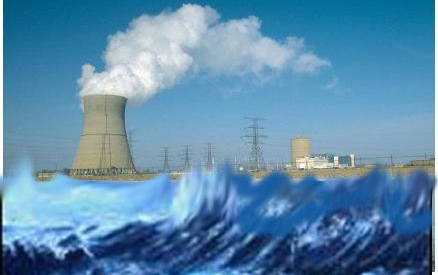
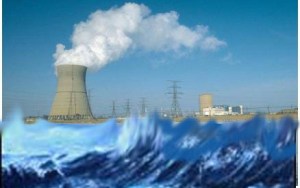 What if Hurricane Matthew Hits Florida’s Nuclear Reactors?, Clean Energy Footprints, October 5th, 2016 Hurricane Matthew has already caused devastation in Haiti and elsewhere in the Caribbean. Tracking this dangerous storm’s path, which Bloomberg reported as a “$15 billion threat,” as it moves towards Florida, Georgia, the Carolinas and potentially up the Eastern seaboard is proving difficult. But despite unclear predictions, communities are wisely mobilizing and calling for evacuations (or are already in the process of doing so) and/or declaring states of emergency.
Extreme weather events have widespread ramifications on our electricity systems. A Department of Energy review of responses to Hurricanes Irene and Sandy from nuclear reactors in the Northeast highlighted a number of strategies to protect the reactors. According to the Department of Energy, “Some reactors were shut as a precaution to protect equipment from the storm; others were forced to shut down or reduce power output due to damage to plant facilities or transmission infrastructure serving the plant; and still others were forced to reduce power output due to reduced power demand caused by widespread utility customer outages.”
Two nuclear power plants exist on Florida’s eastern coast: the St. Lucie and Turkey Point facilities. Based on the current National Hurricane Center projections, it appears that Hurricane Matthew will come closest to the St. Lucie nuclear facility early Friday morning. Storm surge near the St. Lucie nuclear reactors may reach 2-5 feet, and with hurricane force winds of 130 miles per hour. Meanwhile, a significant water quality problem in the Southeast is the ongoing pollution at Florida Power and Light’s (FPL) Turkey Point cooling canal system. It’s unclear what effects high winds and storm surge could have on Turkey Point’s open air industrial sewer.
After flooding caused a nuclear meltdown at the Fukushima Daiichi nuclear reactor in Japan, the Miami News Times published an article, “Five reasons Turkey Point could be the next nuclear disaster.” The article noted: “Just like in Japan, Turkey Point is susceptible to a meltdown caused by a natural disaster. A hurricane-spurred tidal surge from Turkey Point’s neighboring Biscayne Bay could create catastrophic conditions identical to those in Japan. With power down, the plant would be forced to rely on emergency diesel generators to pump water to cool the reactors….those generators would ‘certainly’ become inundated with water from the tidal surge, causing them to drown and fail.” (Southern Alliance for Clean Energy and Tropical Audubon with Friends of the Everglades filed a lawsuit this summer to resolve the pollution problem caused by Turkey Point.)……….http://blog.cleanenergy.org/2016/10/05/nuclearhurricanematthew/
October 7, 2016
Posted by Christina Macpherson |
climate change, safety, USA |
Leave a comment
Looming megadroughts in western US would make current drought look minor. Warming temperatures and uncertain rainfall mean if more isn’t done to slow climate change, droughts lasting 35 years could blight western states, study says, Guardian, Oliver Milman, 8 Oct 16, The harsh drought currently gripping California may appear trivial in the future as new research shows that the south-west US faces the looming threat of “megadroughts” that last for decades.
California is in its sixth year of drought, which was barely dented by rains brought by the El Niño climate event and sparked a range of water restrictions in the state. But warming temperatures and uncertain rainfall mean that if more isn’t done to slow climate change, droughts lasting 35 years are likely to blight western states by the end of the century, according to the study, published in Science Advances.
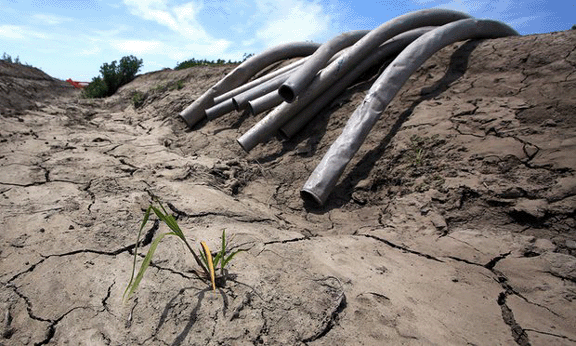
Such a megadrought would impose “unprecedented stress on the limited water resources” of the parched US south-west, researchers found, bringing conditions similar to the 1930s dustbowl to California, Nevada, New Mexico, Colorado and Utah – but over a lengthier period.
Using a combination of temperature and precipitation models, the study predicts a 70% chance of a megadrought by the end of the century, should rainfall levels remain the same, with a 90% chance of an elongated drought should rainfall decrease, as most climate models forecast.
“We can’t rule out there could be a 99.9% chance of a megadrought, which makes it virtually certain,” said Toby Ault, a scientist at Cornell University and lead author of the study………
The new report does proffer a crumb of hope – if greenhouse gas emissions are radically cut then the risk of megadrought will reduce by half, giving a roughly 50:50 chance that a multi-decade stretch of below-average rainfall would occur this century.
But the research found that the emissions cuts would have to be far steeper than those agreed to by nations in Paris last year, where a 2C limit on warming was pledged……..https://www.theguardian.com/environment/2016/oct/05/climate-change-megadrought-california-global-warming
October 7, 2016
Posted by Christina Macpherson |
climate change, USA |
Leave a comment
Anti-nuclear activists mark Fermi 1 incident It was a half-century ago that plant had a partial meltdown By Tom Henry | BLADE STAFF WRITER Oct. 6, 2016 MONROE — Anti-nuclear activists marked the 50th anniversary of Fermi 1’s partial meltdown Wednesday with a peaceful rally at downtown Monroe’s Loranger Square Pavilion, during which they called for America to embrace more renewable energy and support efforts to safeguard the public from radiation exposure…….
“The striking thing to me is — 50 years later — there are still lessons unlearned,” Terry Lodge, Toledo Coalition for Safe Energy spokesman, said.
Mr. Keegan, Mr. Lochbaum, and Mr. Lodge were among seven speakers who addressed about two dozen people Wednesday at a news conference which began at the exact moment the meltdown was reported to authorities 50 years earlier.
Although eclipsed by Three Mile Island and more significant events in other parts of the world, such as the Fukushima Daiichi meltdown of 2011 in Japan and the Chernobyl disaster of 1986 near Kiev, Russia, the Fermi 1 incident inspired the 1975 John G. Fuller book We Almost Lost Detroit, as well as a protest song by the late singer Gil Scott-Heron……http://www.toledoblade.com/local/2016/10/06/Anti-nuclear-activists-mark-Fermi-1-incident.html
October 6, 2016
Posted by Christina Macpherson |
opposition to nuclear, USA |
1 Comment
 Green groups call on state to scrap upstate nuclear subsidies,Times Union
A coalition of environmental groups including Food & Water Watch and the New York Public Interest Research Group have united to oppose what they estimate as an almost $8 billion effort to subsidize three upstate nuclear power plants: the James A. Fitzpatrick Nuclear Power Plant and Nine Mile Point Nuclear Generating Station outside Oswego and the R.E. Ginna plant east of Rochester.
The state Public Service Commission voted in early August to approve a rate increase for the power generated by the plants to pay for the subsidies. Since then, a group of downstate lawmakers have called for the PSC to reconsider that action and be more transparent in its analysis, noting that the majority of the cost of keeping the plants on line will be borne by downstate rate-payers.
On Wednesday, the environmental coalition made the same economic argument, estimating that residential consumers will be on the hook for an estimated $2.3 billion over the 12-year life of the deal. Con Ed ($705.8 million) and Long Island Power Authority ($501.4 million) would bear the largest proportionate share of the cost based on their number of customers.
Blair Horner of NYPIRG said that keeping the plants in operation was like “subsidizing the horse-and-buggy industry while Henry Ford is rolling cars off the Assembly line.”
The coalition plans to mount a grassroots effort to kill the subsidies in much the same way that the natural gas drilling technique known as hydrofracking was blocked…….http://blog.timesunion.com/capitol/archives/268142/green-groups-call-on-state-to-scrap-upstate-nuclear-subsidies/
October 6, 2016
Posted by Christina Macpherson |
opposition to nuclear, USA |
Leave a comment
 Nuclear Power Rapidly Losing Race With Renewable Energy, http://www.ecowatch.com/nuclear-power-renewable-energy-2031607650.html, by Sun Day Campaign, Oct. 05, 2016
 Two new reports from the Federal Energy Regulatory Commission (FERC) and the U.S. Energy Information Administration (EIA) confirm that
nuclear power is rapidly losing the race with
renewable energy sources.
EIA’s latest “Monthly Energy Review” notes that during the first six months of this year, renewable sources—i.e.,
biofuels,
biomass,
geothermal,
hydropower,
solar and
wind—accounted for 5.242 quadrillion Btus (quads) of domestic energy production. This includes thermal, liquid and electrical forms of energy. By comparison, nuclear power provided only 4.188 quads. That is, renewables
outpaced nuclear by more than 25 percent.
Meanwhile, FERC’s latest “Energy Infrastructure Update” states that the total available installed generating capacity in the U.S. from the combination of utility-scale (i.e., greater than 1-MW) hydropower, wind, solar, biomass, and geothermal has grown to 215.82 gigawatts (GW) or 18.39 percent of total generating capacity. Nuclear power’s installed capacity is only107.06 GW or 9.12 percent of the total. Thus, renewable energy generating capacity is now more than double that of nuclear.
However, actual electrical generation by nuclear plants for the first seven months of 2016 is 19.9 percent of total generation. That is still higher than that provided by renewable sources whichcontributed 15.8 percent—a figure which does not include electricity produced by distributed renewables such as rooftop solar.
But while nuclear power’s share of net electrical generation has remained essentially flat over the past decade—e.g., it was 19.4 percent in 2006, renewable energy’s share is growing rapidly, increasing from 9.5 percent 10 years ago to 15.8 percent today with EIA forecasting continuedstrong growth in the years ahead.
“If renewable sources maintain their current growth rates, they could fully eclipse nuclear in the trifecta of not only energy supply and generating capacity but also electricity production within the next five or six years … or less,” Ken Bossong, executive director of the SUN DAY Campaign, concluded.
October 6, 2016
Posted by Christina Macpherson |
renewable, USA |
Leave a comment
Russia suspends its nuclear agreement with the United States http://www.smh.com.au/world/russia-suspends-its-nuclear-agreement-with-the-united-states-20161005-grvw7t.html Lidia Kelly
Moscow: Russia has suspended its nuclear and energy research agreement with the United States as a countermeasure against Washington for imposing sanctions on Russia over Ukraine.
The Russian government also said on Wednesday it was terminating an agreement between its nuclear corporation Rosatom and the US Department of Energy on feasibility studies into conversion of Russian research reactors to low enriched uranium.
On Monday, President Vladimir Putin suspended a treaty with Washington on cleaning up weapons-grade plutonium, signalling he was willing to use nuclear disarmament as a new bargaining chip in disputes with the United States over Ukraine and Syria.
“The regular renewal of sanctions against Russia, which include the suspension of Russian-American cooperation in the field of nuclear energy demands the adoption of countermeasures against the US side,” the Russian government said on its website.
The agreement on co-operation in nuclear- and energy-related scientific research, signed in 2013, provided the legal framework necessary to expand work between US and Russian nuclear research laboratories and institutes in nuclear technology and nonproliferation, among others.
The uranium agreement, signed in 2010, provided for feasibility studies into the conversion of six Russian research reactors from dangerous highly enriched uranium to more secure low enriched uranium.
The West imposed economic sanctions on Russia over its annexation of Ukraine’s Crimea peninsula in 2014, followed by a pro-Russian insurrection in the east of the country. The breakdown of a ceasefire in Syria, where Russia backs government forces and the West supports rebel groups, has added to tensions.
October 6, 2016
Posted by Christina Macpherson |
politics international, Russia, USA |
Leave a comment
Pew survey: Republicans are rejecting reality on climate change
Only 48% of Americans – and 15% of conservative Republicans – realize that humans are causing global warming, Guardian, Dana Nuccitelli, 6 Oct 16, Climate scientists have 95% confidence that humans are the main cause of global warming over the past six decades. Their best estimate attributes 100% of global warming since 1950 to human activities. 90 to 100% of climate scientists and their research agree on this. Human-caused global warming is as settled as science gets.
Yet most Americans don’t realize it. Moreover, the more conservative a person’s ideology, the less likely they are to accept this scientific reality or to trust the scientific experts.
According to a new Pew Research Center poll, just 48% of Americans realize that the Earth is warming mostly due to human activity. Highlighting a vast partisan reality gap, 79% of liberal Democrats and just 15% of conservative Republicans answer the question correctly………https://www.theguardian.com/environment/climate-consensus-97-per-cent/2016/oct/06/pew-survey-republicans-are-rejecting-reality-on-climate-change
October 6, 2016
Posted by Christina Macpherson |
climate change, USA |
Leave a comment
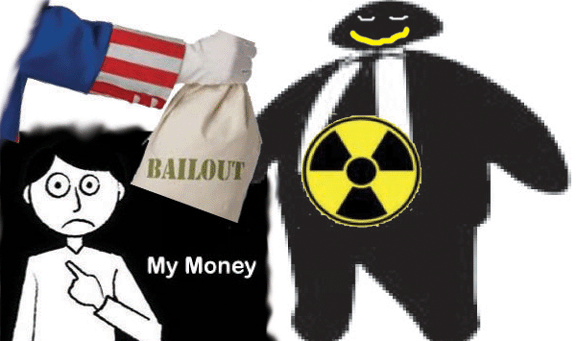
 Nuclear plan gets backlash from left, right, Daily Star, By Joe Mahoney CNHI State Reporter, 5 Oct 16 ALBANY — A coalition of environmental and consumer activists warned Wednesday that New York electricity customers will be jolted by a “huge tax” stemming from Gov. Andrew Cuomo’s plan to subsidize aging nuclear power plants.
Customers of National Grid, NYSEG and other state-regulated utilities will see bills climb by more than $2 per month beginning next year — and even more in subsequent years — if the plan stays on track, the critics said…….
representatives of more than 70 groups — consumer, environmental and conservative — announced they are working in unison to derail the “bailout” of reactors near Rochester and Syracuse.
The subsidy’s cost is expected to top $7 billion, according to a projection by the Public Utility Law Project, which is fighting the plan. Household customers will shoulder about $2.3 billion of that, it said, with the rest passed to industry, institutions and school systems.
“This is one of the biggest transfers of wealth in New York state history,” said Blair Horner, legislative director of the New York Public Interest Research Group………
Under the subsidy, New York utility companies will buy power at inflated rates over two years from the operators of two reactors at Nine Mile Point on the shore of Lake Ontario; the James FitzPatrick Nuclear Power Plant in Oswego County; and the R.E. Ginna Nuclear Plant in Wayne County……….
The arrangement is also opposed by a conservative think tank, the Empire Center for Public Policy, which notes that New York’s electricity rates are already among the highest in the country.
Exelon has signaled it will invest $200 million in its New York reactors if the subsidy is approved. If the deal fails to take shape, the plant’s fate is uncertain.
Entergy and Exelon are asking regulators for “prompt approval” of the FitzPatrick sale, noting that a decision needs to be made soon on refueling the plant. Entergy said last year that it planned to close the reactor in early 2017…….
Plans to have 7 million electric ratepayers in New York pick up the cost of the subsidy could also be challenged by operators of small, municipally owned utilities that do not use nuclear power……..http://www.thedailystar.com/news/local_news/nuclear-plan-gets-backlash-from-left-right/article_928006bc-b987-595a-ae5c-c11871ccd29d.html
October 6, 2016
Posted by Christina Macpherson |
opposition to nuclear, USA |
Leave a comment
Rowe Board of Selectmen chair Marilyn Wilson said the town over the summer heard from Illinois Republican Rep. Robert J. Dold concerning a bill that would help towns that host a “stranded spent nuclear fuel storage site.”
A plainclothes guard with an assault-style rifle stood at the front gate. Reporters were told to point their cameras away from the facility.
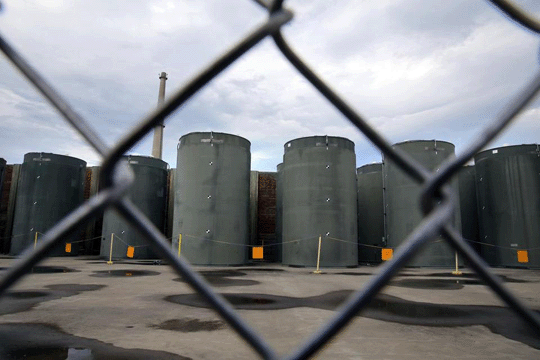
 Rowe seeks federal compensation for hosting nuclear waste at former atomic power plant http://www.masslive.com/news/index.ssf/2016/10/rowe_seeks_federal_compensatio.html ROWE — Yankee Rowe Nuclear Power Station shut down in 1992, and was demolished and decommissioned by 2007, but the fenced and isolated site on the upper Deerfield River still hosts 127 tons of spent fuel and high-level radioactive waste in 16 concrete casks under 24-hour security.
The tiny town of Rowe is one of about a dozen communities nationwide affected by the presence of nuclear waste, but no longer benefiting economically from the presence of a functioning reactor.

On Monday, U.S. Rep. Richard Neal and state Sen. Paul Mark (D-Peru) toured the site as guests of the Rowe Board of Selectmen. Mark is a member of the Yankee Rowe Spent Fuel Storage & Removal Citizens Advisory Committee. Neal, who represents the state’s 1st Congressional District, assured local officials that he supports bipartisan legislation in Washington that would compensate communities that are forced to store nuclear waste.
The “Interim Spent Nuclear Fuel Storage Compensation Act” would seek up to $100 million for 13 towns ranging from Zion, Illinois to Wiscasset, Maine.
“The federal government is obligated to provide mitigation costs to communities such as Rowe, considering that the Department of Energy failed to remove the waste as promised,” said Neal, a Democrat.
It was never the intention of the federal government for small towns such as Rowe to host spent fuel rods forever.
The Nuclear Waste Policy Act of 1982 directed the U.S. Department of Energy to take ownership of the nation’s nuclear waste. The plan was to build a repository at Yucca Mountain in Nevada, but the facility was never built. Capping decades of gridlock, the Obama administration withdrew support for the plan in 2011.
Various nuclear plant owners, who over the years paid into a Department of Energy Fund to handle their waste, repeatedly sued the government over the broken promise, and dozens of settlements to date have cost taxpayers a combined $4 billion.
Rowe Board of Selectmen chair Marilyn Wilson said the town over the summer heard from Illinois Republican Rep. Robert J. Dold concerning a bill that would help towns that host a “stranded spent nuclear fuel storage site.” She said the proposed bill recognizes that such communities have become de facto interim nuclear waste sites.
Wilson said when Yankee Rowe was fully operational, the company paid for the town’s police, fire, and emergency response budgets, on top of paying substantial property taxes. Now taxes are diminished and public safety expenses are borne by local taxpayers. The town continues to bear other plant-related costs, she said.
Event without the nuke, Rowe enjoys a solid tax base thanks to several hydro-electric facilities on the Deerfield River. With a population of 358, its own elementary school, and hundreds of acres of conservation land, the residential tax rate remains at $6.03 per thousand valuation. The commercial and industrial tax rate stands at $13.31. The tax history of the Yankee Rowe plant was not immediately available. The company owns more than 1,700 acres.
Members of the press, initially invited by Neal’s office to attend Monday’s tour, were blocked from attending by plant officials, who cited security reasons. A plainclothes guard with an assault-style rifle stood at the front gate. Reporters were told to point their cameras away from the facility.
Robert Capstick, a spokesman for Yankee Rowe, said he is as eager as town officials to see a solution. The company spends millions every year to host the waste that the government failed to remove, he said. In New England, other plants with stranded waste are Maine Yankee, Vermont Yankee, and Connecticut Yankee.
Meanwhile, the Department of Energy is considering privately-owned interim storage to overcome the impasse in Congress over authorizing a permanent site. Waste Control Specialists proposes an interim facility for 40,000 tons of nuclear waste in West Texas. Energy Secretary Ernest Moniz has said siting of interim facilities would be done under a “consent-based” model.
Moniz still acknowledges the need for an permanent, underground geological repository. About 2,000 metric tons of spent nuclear fuel is created every year.
October 5, 2016
Posted by Christina Macpherson |
USA, wastes |
Leave a comment
Scientists Sound Alarm on Climate but US Still Toys With Skepticism Monday, 03 October 2016 By Dahr Jamail, Truthout Every month, after I finish writing this climate dispatch, I think that this is the most dire, intense, mind-bending, heartbreaking dispatch I have written to date. And every month, for the more than two years that I’ve been writing them, I am correct.
During the morning I was finishing this dispatch, I conducted an interview with Mike Loso, a physical scientist with the National Park Service (NPS), about ice loss in several US national parks. “We as park rangers are tasked with managing and protecting what is in our National Parks, to protect it so it will be there for future generations,” he told me. “But the glaciers are going away, and we can’t stop climate change. So if the Park Service can’t stop the change, we at least have to bear witness to it.”
The information he provided, which will be used in future writings, caused my heart to feel 50 pounds heavier.
To see more stories like this, visit “Planet or Profit?”
When we finished the interview, all I could do was go outside, stand still, and gaze at the trees. I called a friend and shared some of it with him, and he listened. “Thank you for bearing witness with your dispatches, and for holding all of this information,” he told me.
The news about how rapidly the planet is changing only continues to accelerate in both frequency and intensity, and it’s all for the negative……….
Things have become dire enough that 375 National Academy of Sciences members, (including 30 Nobel Prize winners), frustrated with the ongoing political inaction towards anthropogenic climate disruption (ACD), signed an open letter warning of the “real, serious, immediate” climate threat.
Richard Betts, the head of climate impacts research at the UK meteorological office’s (Met Office) Hadley Centre recently stated that the planet is already two-thirds of the way to the 1.5C benchmark, [the politically agreed upon goal of the upper limit of global temperature increase that is allowable before extreme climate disruption impacts ensue] and could begin to pass it in about a decade.
And the alarm bells continue to ring………..
Meanwhile, the tangible signs of warming abound, all around the planet.
Although the Southern Hemisphere is still technically in its winter season, in early September, temperatures across the Antarctic Peninsula and areas of Western Antarctica reached levels of 15 to 23 degrees Celsius (27-40 degrees Fahrenheit) above normal, with the Larsen C ice shelf experiencing thawing temperatures during winter.
Yes, you read that correctly. Parts of Antarctica are melting during the winter.
Scientists are also now closely monitoring a key ocean current in the North Atlantic to find out if rising seawater temperatures and increasing freshwater from melting ice are combining to alter the “ocean conveyor belt,” which they describe as “a vast oceanic stream that plays a major role in the global climate system.” In their own words, they are studying “how climate change could jam the world’s ocean circulation.”……
Is this how life in our ACD-driven world will be, going forward? How much unpredictability can our planet and its inhabitants take?
Earth Soils around the planet are soaking up far less carbon than we previously believed……..
Water As usual, much is happening in the water realm, when it comes to ACD……..
……..rising oceans are not simply a thing of the future: Noticeable sea level rise has already begun.
In the US, one only need look towards Virginia, Florida and Louisiana, among other places, to see that warnings about sea level rise are not theoretical; it is already causing flooding on a daily basis.
Looking west, sea level rise is now causing increasing numbers of people to move off of the Marshall Islands.
The same can be said for most of the population of the atoll of Takuu, which is in the Bougainville region of Papua New Guinea. Ten years ago, 600 people lived on the atoll. Now there are only 50, and sea level rise is a large part of the reason why.
Lastly, a disconcerting report from Australian Geographic cites two recent studies showing that life in the oceans is diminishing so rapidly that they are literally going quiet, since diminishing nutrients and increasing ocean acidification (driven largely by ACD) are killing off sea life.
Air In addition to the global temperature records mentioned above, another interesting study was published last month about ACD-related atmospheric changes……….
Fire In addition to wildfires burning more often, hotter, and with greater frequency around the planet as ACD advances, a recent report showed that there is an alarming increase of fires across the Brazilian Amazon………
Denial and Reality As usual, there is plenty of material from the ACD-denial camp for this dispatch………
Thankfully, the number of people and organizations recognizing ACD’s reality far outweighs the deniers.
Joining a growing handful of other states, Washington State recently adopted a new rule to limit greenhouse gas emissions from large carbon polluters. The change covers fuel distributors, power plants, oil refineries, pulp and paper mills, and other industries.
A recent report from the US military has called ACD a “significant and direct” threat. More than a dozen retired military and national security officials signed a statementsaying that “climate change presents a strategically significant risk to US national security, and inaction is not a viable option.”
Similarly, a recently released US government report stated that ACD is going to get worse. “The impacts of climate change on national security are only going to grow,” Dr. John Holdren, director of the White House Office of Science and Technology Policy, said of the report. The report noted that over the next 20 years, ACD will pose an increasing security challenge, due to the heightening of social and political tensions which will threaten the stability of some countries and cause increasing risks to human health. The report also said that extreme weather events already have dire implications for humanity, which “suggest that climate-change related disruptions are well underway.”………
it is more important than ever that we see it clearly, so as to make more informed decisions about how we live our lives during this key time. http://www.truth-out.org/news/item/37833-scientists-sound-alarm-on-climate-but-us-still-toys-with-skepticism
October 5, 2016
Posted by Christina Macpherson |
climate change, USA |
Leave a comment
DOE charts show why climate doom and gloom isn’t needed Clean tech costs have fallen 41–94% over the past 7 years. Wind and solar accounted for two-thirds of new energy installations in the US in 2015, [Excellent graphs] Guardian, Dana Nuccitelli, 3 Oct 16 , A new report from the US Department of Energy paints a bright picture for our prospects to cut carbon pollution and prevent the most dangerous levels of climate change. The report looked at recent changes in costs and deployment of five key clean energy technologies: wind, residential solar, utility-scale solar, batteries, and LED bulbs. For each technology, costs fell between 41% and 94% from 2008 to 2015
However, it’s important to acknowledge the progress that’s being made, and retain a sense of hope and optimism that we can still avoid the worst climate consequences. This new DOE report highlights the fact that clean energy technology is quickly moving in the right direction, toward lower costs and higher deployment.
Wind energy is blowing away expectations
The report finds that due to its low cost, US wind energy capacity has nearly tripled since 2008. Wind now supplies nearly 5% of total US electricity generation.
As a result, there are now nearly 90,000 U.S. manufacturing, construction, and wind operations jobs. Research has resulted in bigger turbines that can generate more electricity:
a wind turbine installed today on average has 108% longer blades and is 48%taller than one installed in 1999. The longer blades allow each turbine to capture more energy, and taller towers allow access to the stronger and more consistent wind speeds that occur at higher altitudes in many parts of thecountry. Combined, these innovations allow each turbine to produce more electricity, reducing both the number of turbines needed to produce a given amount of electricity and the land area needed for their installation.
Offshore wind also presents tremendous untapped potential, with the first such project set to begin generating power off the cost of Rhode Island this month. The DOE envisions wind generating 20% of the nation’s electricity by 2030 and 35% by 2050, with costs falling a further 35% by 2050.
Solar energy’s bright future
Utility-scale solar farm costs have fallen 64% since 2008, and distributed (mostly residential) solar costs by 54%. While solar still accounts for a relatively small percentage of overall US electricity generation, its deployment has been increasing rapidly as costs have dropped. Even the military is getting on board:
For example in 2015 the Department of the Navy procured 210 MW of a utility-scale PV project to support fourteen Navy installations in California.
In 2015, the solar sector employed about 220,000 Americans. The DOE envisions that solar power could supply 27% of US electricity generation by 2050. Solar deployment is surging in 2016, with around 10 gigawatts (GW) set to be installed this year – equal to all the solar capacity installed in the US through 2014.
Solar panel leasing from companies like Solar City and Sungevity has revolutionized the distributed solar market, accounting for the majority of domestic residential system installed in leading state markets in 2015. This approach makes solar panels obtainable for households that can’t afford to purchase them. Distributed solar costs are expected to fall a further 16–33% by 2020.
Stunning drop in LED costs
The best available LED bulbs use 85% less energy than incandescent bulbs. ………
Electric cars are the future of transportation
Electric vehicle (EV) sales in the US reached 115,000 in 2015, more than double the number sold in 2012. Overall US EV sales will surpass a half-million by the end of this year. As shown by a new paper and app from MIT, EVs reduce greenhouse gas emissions 58% compared to gasoline-powered cars, and often cost less on a per-mile basis. As low-carbon energy deployment increases, EVs will only become cleaner………. https://www.theguardian.com/environment/climate-consensus-97-per-cent/2016/oct/03/doe-charts-show-why-climate-doom-and-gloom-isnt-needed
October 5, 2016
Posted by Christina Macpherson |
renewable, USA |
Leave a comment
 Nuclear power lobby names new CEO, The Hill, By Timothy Cama – 10/04/16 The Nuclear Energy Institute (NEI) has tapped Maria Korsnick, a veteran of the nuclear industry, to be its new CEO.
Korsnick, currently the chief operating officer at NEI, will start her new role Jan. 1, when Marv Fertel, the current CEO, retires.
She has previously held executive positions at Constellation Energy Nuclear Group and Exelon Corp……..
The changes come at a crucial moment for the nuclear sector. Numerous plants are expected to close in the coming years amid competition from cheap natural gas and renewables, and increasing safety and security requirements.
A small handful of new plants or reactors are under construction domestically as well.
NEI is working on various major policy priorities, like getting a tax credit renewed for newly built plants, trying to get the Yucca Mountain nuclear waste site built and reforming the Nuclear Regulatory Commission. http://thehill.com/policy/energy-environment/299158-nuclear-lobby-names-new-ceo
October 4, 2016
Posted by Christina Macpherson |
politics, USA |
Leave a comment
IN YOUR PHONE, IN THEIR AIR A TRACE OF GRAPHITE IS IN CONSUMER TECH. IN THESE CHINESE VILLAGES, IT’S EVERYWHERE. WASHINGTON POST, STORY BY PETER WHORISKEY PHOTOS BY MICHAEL ROBINSON CHAVEZ VIDEOS BY JORGE RIBAS OCTOBER 2, 2016 “……DEMAND RAMPS UP
While U.S. consumers may seem uninvolved in — and untouched by — the Chinese pollution, the truth is more complicated.
The U.S. demand for cheap goods helps keep the Chinese factories going. More than a quarter of the emissions of two key pollutants in China — sulfur dioxide and nitrogen oxides — arose from the production of goods for export, according to research published in 2014 in the Proceedings of the National Academy of Sciences. The largest share of exports goes to the United States.
Moreover, the same researchers found that some of the pollution in China reaches the United States — the air pollution drifts across the ocean and raises ozone levels in the western part of the country, according to the study.
“Outsourcing production to China does not always relieve consumers in the United States . . . from the environmental impacts of air pollution,” according to the authors of the study, which was conducted by a consortium of scientists from China and the United States.
Now the rise of the electric-car industry promises a huge surge in the lithium-ion battery business.
Making batteries big enough to power cars will cause a daunting leap in demand. A laptop requires just a handful of the familiar, thin, cylindrical lithium-ion batteries known as “18650s.” A smartphone requires even less. But a typical electric car requires thousands of times the battery power.
Today, the best known “gigafactory” for electric-car batteries is the one being built by Tesla in the Nevada desert — a plant the company says will produce 500,000 electric-car batteries annually. But it’s just one of many. About a dozen other battery gigafactories are being planned around the world.
This is “not just a Tesla story,” said Simon Moores, managing director of Benchmark Mineral Intelligence, a firm that tracks demand and assesses prices for raw materials in the industry. “The demand is rising everywhere, especially in China.” Todd C. Frankel and Yanan Wang in Washington and Xu Jing contributed to this report.
October 4, 2016
Posted by Christina Macpherson |
China, environment, RARE EARTHS, Reference, USA |
Leave a comment