USA House committee voted to remove a 2020 deadline for a nuclear power plant tax credit
 House committee votes to lift 2020 deadline on nuclear power tax credit http://www.utilitydive.com/news/house-committee-votes-to-lift-2020-deadline-on-nuclear-power-tax-credit/426850/ By Peter Maloney | September 23, 2016
Dive Brief:
- The House Ways and Means Committee has voted 23-9 on a bill to remove a 2020 deadline for a nuclear power plant tax credit, The Hill reports.
- The credit, enacted in 2005, will likely benefit the Vogtle nuclear reactors being built by Southern Co. in Georgia and the Summer reactors being built by SCANA in South Carolina.
- The bill would not change the 6,000-MW cap on the tax credit. Nuclear opponents called the bill a bailout for plant owners who have failed to deliver new reactor projects on time.
Dive Insight:
Nuclear plants are expensive to build — so expensive that until recently a nuclear plant had not entered construction for nearly 30 years. Notably the nuclear plants now under construction are all being done by regulated utilities, and they benefit from federal loans and tax credits.
That federal support is a key component for the financing of the projects, even if they are otherwise supported, ultimately, by ratepayers.
Both the Vogtle and Summer projects have been plagued by delays and cost overruns. The Vogtle units were originally due online in 2016 and 2017 and are now looking at a 2020 online date. The Summer reactors were originally due online in 2017 and are now slated for operation in 2019 and 2020.
If the revised timelines slip and the 2020 deadline on the tax credits remains, it could prove costly for the plant owners. The bill lifting the tax credit deadline would remove that risk.
“When Congress passed the 2005 act, it could not have contemplated the effort it would take to get a nuclear plant designed and licensed,” Rep. Tom Rice (R-SC) told The Hill.
USA and South Korea to conduct mock attack on nuclear facility, (with North Korea in mind)


 South Korea, US to simulate attack on nuclear facility By Jungeun Kim, Paula Hancocks and Joshua Berlinger, CNN September 21, 2016
Story highlights
- The two countries will simulate attacks on nuclear facilities and sudden missile strikes
- The announcement comes after North Korea conducted a nuclear test this month
Another secret and dangerous trade deal – the Trade In Services Agreement
 The new TTIP? Meet TISA, the ‘secret privatisation pact that poses a threat to democracy’ http://www.independent.co.uk/news/business/news/ttip-trade-deal-new-what-is-tisa-privatisation-pact-secret-threat-to-democracy-a7216296.html
Government insists ‘public services are under no threat whatsoever from this deal’
- Ian Johnston
- Wednesday 31 August 2016An international trade deal being negotiated in secret is a “turbo-charged privatisation pact” that poses a threat to democratic sovereignty and “the very concept of public services”, campaigners have warned.But this is not TTIP – the international agreement it appears campaigners in the European Union have managed to scupper over similar concerns – this is TISA, a deal backed by some of the world’s biggest corporations, such as Microsoft, Google, IBM, Walt Disney, Walmart, Citigroup and JP Morgan Chase.
Few people may have heard of the Trade In Services Agreement, but campaign group Global Justice Now warns in a new report: “Defeating TTIP may amount to a pyrrhic victory if we allow TISA to pass without challenge.”
Like the Transatlantic Trade and Investment Partnership, TISA is being negotiated in secret, even though it could have a major impact on countries which sign up.
- While TTIP is only between the EU and US, those behind TISA have global ambitions as it involves most of the world’s major economies – with the notable exceptions of China and Russia – in a group they call the “Really Good Friends of Services”.
The Department for International Trade dismissed the idea that public services were at risk from TISA, adding that the UK was committed to securing an “ambitious” deal.
But according to Global Justice Now’s report, the deal could “lock in privatisation of public services”; allow “casino capitalism” by undermining financial regulations designed to prevent a recurrence of the 2008 recession; threaten online privacy; damage efforts to fight climate change; and prevent developing countries from improving public services.
- Nick Dearden, director of group, said: “This deal is a threat to the very concept of public services. It is a turbo-charged privatisation pact, based on the idea that rather than serving the public interest, governments must step out of the way and allow corporations to ‘get on with it’.
“Of particular concern, we fear TISA will include clauses that will prevent governments taking public control of strategic services, and inhibit regulation of the very banks that created the financial crash.”
He suggested pro-Brexit voters should be concerned at the potential loss of sovereignty.
“Many people were persuaded to leave the EU on the grounds they would be ‘taking back control’ of our economic policy,” Mr Dearden said.
“But if we sign up to TISA, our ability to control our economy – to regulate, to protect public services, to fight climate change – is massively reduced. In effect, we would be handing large swathes of policy-making to big business. “
- The report says the widespread opposition to TTIP, a deal between only the EU and US, had not yet been repeated over TISA.
“It is vital for elected representatives, campaigners and ordinary citizens to unite against this threat,” it adds.
“TISA threatens public services. From postal services to the NHS, TISA could lock in privatisation and ensure that big multinationals increasingly call the shots on areas like health, education and basic utilities.”
A so-called “ratchet” clause in the deal means that after a service – like trains or water or energy – is privatised, this is almost impossible to reverse even if it fails.
- According to the report, a “standstill” clause also means “no new regulation can be passed that gives foreign companies worse treatment” than when TISA is passed.
“Taken together, the standstill and ratchet clauses could make it much harder for a future government to renationalise the railways, a move backed by a majority of the British public,” it says.
“Similarly, it could mean that the creeping privatisation of the NHS becomes more and more irreversible with greater involvement of companies from countries like the US. And forget taking control of the electricity system back from the big six energy firms.”
- Migrant workers could be classified as “independent service suppliers”, the report says, meaning they would not be eligible for the minimum wage or be allowed to join a union.
People going to another country may find their visa is tied to their job, so if they were sacked, they would be deported.
“This sort of system of modern indentured labour is wide open to abuse by unscrupulous employers who may get away with illegal practices safe in the knowledge that they can threaten any employee with deportation if they complain,” the report says.
“This sort of system is used in countries like Saudi Arabia, the UAE and Qatar and has resulted in working conditions that have been described as being close to slavery.”
The global economic crash of 2008 was precipitated by the sale of complex financial products linked to unsafe “sub-prime” mortgages. The report says there is a danger the final TISA deal would “undermine efforts to regulate risky financial products” with a proposal that firms should be allowed to offer “any new financial service”.
- “The danger is that TISA will deter governments from limiting the use of such ‘innovative’ financial products and leave us powerless to stop the next financial crisis,” it says.
TISA could also potentially prevent governments from favouring renewable energy over fossil fuels – despite the need to reduce greenhouse gas emissions and the health effects of air pollution.
Private firms would also be allowed to move online data from one country to another under one proposal being considered. While the original country’s privacy laws would have to be respected, the report said it was “not clear how this will be … enforced”.
While developed countries in Europe have established public services that would not be threatened unless a state’s government decided to open them up to private firms, the same is not true of many developing countries. If they signed up to the deal, it could effectively prevent them from setting up public institutions taken for granted in the West.
- The TISA negotiations were held behind closed doors for about 18 months until they were publicly revealed by the global trade union group Public Services International (PSI). Information about some of the proposals has been also disclosed through Wikileaks and similar sites.
Daniel Bertossa, PSI’s director of policy, said: “Anybody who’s interested in maintaining democratic control of national institutions should be very concerned about the Trade in Services Agreement that is being negotiated in secret.
“It will remove large sections of national sovereignty and the ability of any government, including the UK Government, to regulate important service sectors [on issues] such as energy, such as transport, such as privacy. The Trade in Services Agreement is part of a radical project to limit governments’ sovereign right to regulate and freeze it almost in permanence in the interests of foreign corporations.”
According to the European Commission, TISA is about “facilitating trade in services”.
“The EU is the world’s largest exporter of services with tens of millions of jobs throughout Europe in the services sector. Opening up markets for services will mean more growth and jobs,” its website says.
- The Independent has contacted “Team TISA”, a group of mainly American companies in favour of the deal, asking for a comment. On its website, it says: “Services are the fastest growing sector of the global economy and account for two thirds of global output, one third of global employment and nearly 20 per cent of global trade.
“The TISA provides an opportunity to expand services trade among over 50 countries, covering nearly 70 per cent of global trade in services.
“The potential expansion TISA provides will benefit not only global growth, but also US domestic growth.
“As the world’s largest services exporter, with over $1.3 trillion (about £1 trillion) in annual cross-border and foreign-affiliate sales, the US will benefit tremendously from elimination of services barriers.”
A Department for International Trade spokesperson said: “Public services are under no threat whatsoever from this deal or any other trade agreement. The UK remains committed to an ambitious Trade in Services Agreement.”
Factor climate into national security policy – executive direction by President Obama
For the first time, Obama requires U.S. government to factor climate into national security policy,WP By Juliet Eilperin September 21 President Obama signed a presidential memorandum Wednesday establishing that climate-change impacts must be factored into the development of all national security-related doctrine, policies and plans.
The move signals Obama’s determination to exercise his executive authority during his final months in office to elevate the issue of climate in federal decision-making, even though it remains unclear whether his successor will embrace this approach.
Under the directive, 20 federal agencies and offices that work on climate science, intelligence and national security must “collaborate to ensure the best information on climate impacts is available to strengthen our national security” through the new Federal Climate and National Security Working Group. That group must release a climate change and national security action plan in 90 days. All the relevant agencies must then identify steps to implement it.
Speaking to reporters on a conference call, White House officials said this would spur a more specific and focused strategy when it comes to both identifying how different regions of the world would be affected by climate change and how to respond……..https://www.washingtonpost.com/news/energy-environment/wp/2016/09/21/for-the-first-time-obama-requires-u-s-government-to-factor-climate-into-national-security-policy/?utm_term=.a5aae6b8a2bf
Wind energy getting popular with USA Republicans
Why Republicans support wind energy Tom Kiernan, Roberta Combs, Michele Combs, Desmoines Register September 20, 2016 Did you know that American wind turbines can now produce as much electricity as 17 typical nuclear power plants or 65 coal plants? That’s how much wind power has grown across the U.S.
A cleaner energy economy built by growing wind energy benefits both our economy and our health.
Wind energy greatly reduces a variety of health-harming air pollutants, including smog-causing sulfur dioxide and nitrogen oxides. Cutting these helps reduce asthma rates and other respiratory illnesses, creating $7.3 billion in avoided health costs last year alone.
Conventional wisdom says Democrats are typically consistent supporters of clean energy, while Republicans aren’t. That notion actually doesn’t match up with reality.
Sen. Chuck Grassley has shown visionary leadership in creating and advocating for the Production Tax Credit, a fundamental part of why we have a modern U.S. wind industry today. This performance-based tax incentive is a big reason why Iowa already generates nearly a third of its electricity using wind, with the 40 percent milestone looming in the near-future. It’s also why wind power’s technology has advanced enough to drop costs by two-thirds over just six years, saving American consumers billions of dollars.
It’s also not widely known that wind power supports well-paying jobs and invests in 75 percent of all Republican districts in the U.S.
Republican-represented districts host 86 percent of the total wind farm fleet in America. That means the majority of wind’s economic benefits — including jobs, billions of dollars in private investment, and added tax revenue for improving local infrastructure — go to rural communities with a strong presence of typically Republican voters……..http://www.desmoinesregister.com/story/opinion/columnists/iowa-view/2016/09/20/why-republicans-support-wind-energy/90743862/
USA could lend $billions to India – anything to sell nuclear reactors!
 India Could Get Billions from the U.S. To Build a Nuclear Reactor, Fortune, by Reuters SEPTEMBER 22, 2016 If a lending freeze doesn’t get in the way.
India is negotiating with U.S. Export-Import Bank for an $8-9 billion loan to finance six Westinghouse Electric nuclear reactors, two sources familiar with the talks said, although a lending freeze at the trade agency threatens progress.
The mega-project, the result of warming U.S.-India ties in recent years, could open up billions of dollars of further investment in India’s nuclear power sector, ……..
The Westinghouse deal, however, is contingent on financing and Ex-Im cannot approve loans of more than $10 million, owing to a row in the U.S. Congress over board appointments stemming from a campaign by conservatives to close the government lender……..
“Financing of the reactors is the critical piece; everything is down to this,” said one source involved in protracted negotiations to build the reactors in the south-eastern Indian state of Andhra Pradesh.
The source, requesting anonymity because of the sensitivity of the talks, said Indian negotiators and Ex-Im officials were trying to set the terms of the financial package in the hope that the freeze on the bank, affecting potential sales of several major U.S. companies, would lift soon.
Westinghouse is owned by Japan’s Toshiba Corp but is based in the United States……..
In addition to U.S. Ex-Im, India is also seeking funding from Japan and South Korea for the reactors to be built in Kovvada, two sources familiar with the talks said……..
While negotiators are unlikely to nail down a contract under Obama, who steps down in January, their challenge will be to come up with concessional financing terms that will make Westinghouse’s AP1000 reactors affordable.
Westinghouse did not respond to a request for comment, while a U.S. Ex-Im Bank spokeswoman declined to comment. An NPCIL official said the firm had nothing to say at this stage…….
ndia is also in talks with Russia to build four more reactors on top of the two already completed in Kudankulam in southern Tamil Nadu state, as well as with France’s EDF for the construction of six reactors of 1650 MW each in western India, which would be the world’s biggest nuclear power complex.
But talks with Westinghouse are more advanced than those with the French, with the two sides aiming to sign an early works agreement next month, sources familiar with their progress said.
A delegation from the U.S.-based firm visited New Delhi earlier this month to finalize the pact that would include the timeline and up-front costs such as land acquisition and site preparation, said a source familiar with the matter. http://fortune.com/2016/09/22/india-nuclear-power/
Recurring problems cited at Westinghouse nuclear plant
The State, BY SAMMY FRETWELL sfretwell@thestate.com COLUMBIA, SC
The report, compiled by plant operator Westinghouse, says the company wasn’t always tough-minded enough about safety and it didn’t ensure employees knew enough about nuclear safety while operating some of the factory’s equipment.
Westinghouse’s report cited “long standing deficiencies’’ that led to a buildup of uranium in excess of federal nuclear safety standards in part of the Bluff Road plant……….
Buildups of atomic material are of concern because they can lead to nuclear accidents, although that did not occur in this case. Nuclear safety advocates say Westinghouse needs to redouble its efforts to make sure other, more serious problems don’t arise……..http://www.thestate.com/news/local/article103589917.html
US taxpayers up for huge costs for accident at Waste Isolation Pilot Project (WIPP)
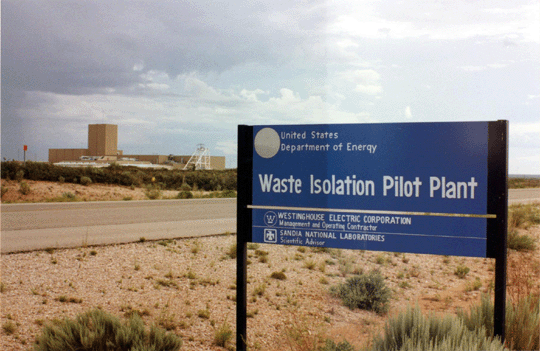 WIPP nuclear waste accident will cost US taxpayers $2 billion. Ecologist, Dr Jim Green 20th September 2016 The clean-up after the February 2014 explosion at the world’s only deep underground repository for nuclear waste in New Mexico, USA, is massively over budget, writes Jim Green – and full operations won’t resume until at least 2021. The fundamental cause of the problems: high level radioactive waste, poor regulation, rigid deadlines and corporate profit make a dangerous mix.
An analysis by theLos Angeles Timesfinds that costs associated with the February 2014 explosion at the Waste Isolation Pilot Plant (WIPP) could total US$2 billion.
The direct cost of the clean-up is now estimated at US$640 million, based on a contract modification made in July with contractor Nuclear Waste Partnership.
The cost-plus contract leaves open the possibility of even higher costs as the clean-up continues and, as the LA Times notes, it does not include the complete replacement of the contaminated ventilation system (which failed after the 2014 explosion) or any future costs of operating the repository longer than originally planned.
The lengthy closure following the explosion could result in waste disposal operations extending for an additional seven years, at an additional cost of US$200 million per year or US$1.4 billion (€1.25b) in total. Thus direct (clean-up) costs and indirect costs could exceed US$2 billion.
And further costs are being incurred storing waste at other nuclear sites pending the re-opening of WIPP. Federal officials hope to resume limited operations at WIPP by the end of this year, but full operations cannot resume until a new ventilation system is completed in about 2021……….
GAO identifies a host of problems
An August 2016 report by the Government Accountability Office (GAO) found that the federal Department of Energy (DOE) did not meet its initial cost and schedule estimates for restarting nuclear waste disposal operations at WIPP, resulting in a cost increase of about US$64 million (€57m) and a delay of nine months.
Worse still, mismanagement of the clean-up has involved poor safety practices. Last year, the DOE’s Independent Office of Enterprise Assessments released a report that found that WIPP clean-up operations were being rushed to meet the scheduled reopening date and that this pressure was contributing to poor safety practices.
The report states: “The EA analysis considered operational events and reviews conducted during May 2014 through May 2015 and identified a significant negative trend in performance of work. During this period, strong and unrealistic schedule pressures on the workforce contributed to poor safety performance and incidents during that time are indicators of the potential for a future serious safety incident.”
The report points to “serious issues in conduct of operations, job hazard analysis, and safety basis.” Specific problems identified in the report include:……….
the National Nuclear Safety Administration (NNSA) – a semi-autonomous agency within the DOE – is itself a big part of the problem of systemic mismanagement of nuclear sites. A June 2015 Government Accountability Office report strongly criticised NNSA oversight of contractors who manage the nation’s nuclear weapons facilities.
The report points to a litany of ongoing failures to properly oversee private contractors at eight nuclear sites, including those managing LANL. The report found that the NNSA lacked enough qualified staff members to oversee contractors, and it lacked guidelines for evaluating its contractors.
Greg Mello from the Los Alamos Study Group was blunt in his criticism of the NNSA: “An agency that is more than 90 percent privatized, with barely enough federal employees to sign the checks and answer the phones, is never going to be able to properly oversee billion-dollar nuclear facilities of vast complexity and danger.” http://www.theecologist.org/News/news_analysis/2988145/wipp_nuclear_waste_accident_will_cost_us_taxpayers_us2_billion.html
Wisconsin nuclear plant: licensee wants license to be terminated
Decommissioning Debate Continues At Former Nuclear Power Plant Near La Crosse
New License-Holder Wants Some Land Released From License Requirements Wisconsin Public Radio, September 20, 2016, By Chuck Quirmbach. The next step in decommissioning the former nuclear power plant in Genoa, Wisconsin, will be the subject of a public meeting Tuesday night.
The session will focus on the La Crosse Boiling Water Reactor, which was shut down in 1987.
La Crosse Solutions, the decommissioning firm that took over the license from Dairyland Power Cooperative this year, is seeking federal approval of its plan to officially close the books on the nuclear facility. Known as a license termination plan, it includes radiological information, decommissioning steps that need to be taken and plans for future radiation surveys of the site……..http://www.wpr.org/decommissioning-debate-continues-former-nuclear-power-plant-near-la-crosse
New York congressman questions impact of climate change on nuclear facilities
 NY congressman questions impact of climate change on nuclear facilities https://www.snl.com/Interactivex/article.aspx?CdId=A-33809939-10283 By Matthew Bandyk, 9 Sept 16
Citing a recent incident at Entergy Corp.‘s Pilgrim plant in Massachusetts, Tonko questioned the four members of the U.S. Nuclear Regulatory Commission about what should be done about this potential problem as they testified at a Sept. 9 hearing held by the committee’s Energy and Power and Environment and the Economy subcommittees.Rising water temperatures caused by climate change could force more nuclear plants to shut down, Rep. Paul Tonko, D-N.Y., said during a hearing by two subcommittees of the House Energy and Commerce Committee.
 On one day this August, the Pilgrim plant had to cut power by 10% as the water the facility pulls in from Cape Cod Bay for cooling hit 75.09 degrees, only the fourth time in the plant’s history that intake water exceeded the NRC’s 75-degree limit, The Boston Globe reported Aug. 11. The other three times all occurred in the summer of 2013.
A scientist at the Gulf of Maine Research Institute told the newspaper that Cape Cod Bay has been getting demonstrably warmer over time and that nuclear plants should consider modifying their intake pipes in response. But Entergy said the hot temperatures that day were an unusual, specific incident caused by winds and tides.
Tonko pointed to National Oceanic and Atmospheric Administration data that found that 2014 was the hottest year on record, and noted that the August Pilgrim incident was not the first time a plant had to be curtailed due to excessive water temperature.
“What is the NRC doing to ensure plants will have sufficient water to operate?” he asked the NRC commissioners.
Commissioner Jeff Baran said that while there have been several instances of cooling water getting too hot, the NRC evaluates those on a case-by-case basis.
As for whether or not there is a recurring issue caused by climate change, “I don’t know if we have looked at any particular trend,” NRC Chairman Stephen Burns told Tonko.
“The NRC doesn’t have any studies or rulemaking processes under way that would look explicitly at the effect of climate change on plant operations,” NRC spokesman Neil Sheehan said in an email after the hearing.
In 2014, the NRC signed off on a request from Dominion Resources Inc.‘s Millstone nuclear plant in Connecticut to allow it to draw water up to 80 degrees instead of 75. Entergy, however, has not yet asked the NRC for a license amendment request to change its temperature limit.
The NRC recently stepped up its oversight of the Pilgrim plant in response to several unplanned shutdowns at the facility. The shutdown that most grabbed the agency’s attention, however, had nothing to do with high temperatures. After a winter storm in January triggered a shutdown, the NRC found that some backup functions required to depressurize the reactor in case of an unplanned shutdown were not operational at the time of the storm, and that Entergy failed to fix a safety relief valve needed for depressurization.
The NRC regulates the water intake temperature at nuclear plants because high temperatures can hurt the efficiency of a plant’s condenser, which uses water to cool down steam produced by the reactor to turn the plant’s turbine, according to Sheehan. Cooling water is also used for heat exchangers that help key plant systems like emergency diesel generators and the spent fuel pool operate, so there is also a safety element, he said.
Alarm, and lawsuit, over dangers of trucking nuclear waste interstate in America
Plans to truck nuclear waste on the interstate sounding alarms, Tribune Democrat, By John Finnerty, jfinnerty@cnhi.com 19 Sep 16 HARRISBURG – Government plans to truck nuclear waste along the interstate in western Pennsylvania and five other states is akin to allowing a series of potential “mobile Chernobyls on steroids,” said Kevin Kamps, radioactive waste watchdog for the group Beyond Nuclear.

Environmentalists are sounding alarms about the possible consequences, especially if a truck crashes, catches fire and causes the waste to escape its container.
Kamps likened the possibility to the 1986 disaster in the Ukraine that killed 30 people, injured hundreds more and contaminated huge swaths of land.
In 2013, the department said a study isn’t needed because earlier reports have already been done. But those studies focused on solid waste – not liquid – and environmentalists say this would be the first time liquid nuclear waste has been moved in North America.
“Transporting even solid, high-level radioactive waste – such as irradiated nuclear fuel from commercial atomic reactors – is already, itself, very high risk,” Kamps said………
environmental groups say the Energy Department doesn’t need to move the waste in the first place.
In at least one similar situation, nuclear waste in Indonesia was diluted so that it no longer contained weapons-grade uranium, said Mary Olson, director of the southeast office of the Nuclear Information and Resource Service, another group involved in the lawsuit.
That waste was solidified and placed in storage, rather than moved back to the United States, she said.“The same plan could be applied to the Chalk River waste,” she said.
An Energy Department public affairs office didn’t respond to a request for comment……
The Nuclear Energy Institute estimates that Pennsylvania’s nuclear power plants have 7,100 metric tons of used fuel in storage. Only Illinois has more used nuclear waste warehoused at its power plants.
“The barriers to moving waste from U.S. reactor sites are many, but when that waste moves, it will take tens of thousands of containers on trucks and rail cars to do it,” Olson said.
Some estimates suggest 50,000 truckloads will be needed to haul all of the waste now stored at power plants. “So, the 150 trucks from Canada are significant. Any time this material is moved, it is significant,” Olson said. “But the Chalk River shipments are still like Little League compared to moving the 40 years of waste accumulated at reactor sites.
“When those gates open,” she said, “it will be a flood.”
Climate change action can be stopped by Trans Pacific Partnership
 How TPP threatens our progress on climate change http://www.sfchronicle.com/opinion/openforum/article/How-TPP-threatens-our-progress-on-climate-change-9223661.php By Van Jones September 14, 2016
In the past month, wildfires forced tens of thousands of people across California to evacuate their homes. Over the same period, historic floods in Louisiana destroyed or damaged more than 60,000 homes, uprooting families and ruining lives.
This fall, Congress is likely to vote on the Trans-Pacific Partnership — an agreement among 12 nations along the Pacific Rim. While billed as a “free trade” deal, most of the TPP is actually about creating new rights for multinational corporations, including the big polluters most responsible for the climate emergency.
Under the TPP, the biggest global firms — including many responsible for offshore drilling and fracking — would be able to sue American taxpayers over laws and regulations that are meant to protect public health and the environment. Rather than suing in regular courts, these corporations would, through the TPP, be able to sue before unaccountable arbitration panels — each panel made up of three corporate lawyers — who could award unlimited cash compensation. Similar rules in other trade deals have already made possible nearly 700 such lawsuits — including efforts to challenge the U.S. rejection of the Keystone XL pipeline and a moratorium on fracking in Quebec.
What does this mean for California?
TPP would allow multinational corporations that own gas-fired power plants from Alameda County to San Diego County to threaten state restrictions on carbon emissions — including some of the new world-leading standards recently passed in Sacramento. The deal would also vastly increase the number of fracking firms and offshore drilling companies that could challenge our protections.
But it’s not about just dirtier air and water or more susceptibility to climate risks. It’s also about jobs.
Because TPP would threaten a successful California rebate program for green technologies that are made in-state, the deal could result in the elimination of good-paying green jobs in fields like solar and wind manufacturing and energy efficiency. Green jobs employ all kinds of people — truck drivers, welders, secretaries, scientists — all across the state. These jobs can pull people out of poverty while protecting the planet.
Given that California has lost an estimated 413,000 manufacturing jobs since America entered NAFTA and the World Trade Organization, we can’t afford to pass a new trade deal and again undermine people’s livelihoods.
But there’s good news. Labor, environmental and social justice leaders now oppose the TPP, as do both major presidential nominees, House Democratic Leader Nancy Pelosi, and Senate Democratic Leader Harry Reid.
Still, some in Washington are scheming to pass the TPP during Congress’s “lame duck” session after the election. While most members of California’s Congressional delegation firmly oppose the deal, some remain on the fence.
As the consequences of climate change get clearer, the case against the TPP gets stronger.
Van Jones is president and founder of the Dream Corps, and is a regular CNN contributor.
Weigh in
You can reach Congress directly by calling (888) 701-6507 and let your representative know that you oppose TPP.
America giving up on the Mixed Oxide Nuclear Fuel (MOX) boondoggle
“The first question I asked was why if she mistakenly skipped over MOX. This is the largest federal construction project in the nation right now,” Jameson said. “The answer was no. She [National Nuclear Administration Principal Deputy Administrator Madelyn Creedon ]said they left it out on purpose, that they’re trying to get rid of it so they weren’t going to talk about it.”
to box up the project and move to another method of plutonium disposal known as dilute and dispose.
The NNSA has said the alternative is cheaper, citing life-cycle costs of MOX in the $50 billion to $60 billion range.
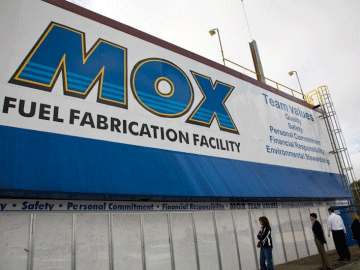 Aiken official: Savannah River Site’s MOX purposefully left out of NNSA discussion http://www.aikenstandard.com/article/20160914/AIK0101/160919745 Thomas Gardiner Email @TGardiner_AS The speaker from the National Nuclear Security Administration at the Energy Communities Alliance meeting in Arlington, Virginia, this week intentionally snubbed the Mixed Oxide Fuel Fabrication Facility, or MOX, under construction at the Savannah River Site, one Aiken official said.
Due to its relation to the Site, Aiken has delegate members that make up the ECA, an organization of local governments adjacent to or affected by Department of Energy activities that meet to discuss issues, establish policy positions and promote community interests.
On Tuesday, Greater Aiken Chamber of Commerce President and CEO David Jameson and Aiken County Councilman Chuck Smith were both in attendance, where National Nuclear Administration Principal Deputy Administrator Madelyn Creedon addressed NNSA projects nationwide.
But Jameson said even with Smith, who is the current ECA chairman, seated just down the table from her, Creedon deliberately passed over the MOX project.
“The first question I asked was why if she mistakenly skipped over MOX. This is the largest federal construction project in the nation right now,” Jameson said. “The answer was no. She said they left it out on purpose, that they’re trying to get rid of it so they weren’t going to talk about it.”
Nearly $5 billion has been poured into the monolithic building thus far, setting the stage for ripe political debate.
Legislators that include U.S. Sens. Tim Scott, R-S.C., and Lindsey Graham, R-S.C., along with U.S. Rep. Joe Wilson, R-S.C., have battled the NNSA and the Obama administration, who have driven for months to box up the project and move to another method of plutonium disposal known as dilute and dispose.
The NNSA has said the alternative is cheaper, citing life-cycle costs of MOX in the $50 billion to $60 billion range.
U.S. Secretary of Energy Ernest Moniz mirrored Creedon’s presentation this week with his own comments at the Carnegie Endowment for International Peace.
Moniz said, “We are in no man’s land, where we spend enough money to not get anywhere. There is no way that Congress is going to commit to spending a billion dollars a year for half a century to dispose of 34 metric tons of plutonium.”
MOX is part of a plutonium disposal agreement with Russia inked in 2000. In the interest of non-proliferation, the two nations bilaterally agreed to destroy or disposition plutonium that would never again be usable in nuclear weapons.
According to Congressional testimony by Under Secretary for Nuclear Security and NNSA Administrator Retired Lt. Gen. Frank G. Klotz, USAF in May, the Obama administration wants to move away from MOX to the dilute and dispose method, which doesn’t change the physical properties or chemical makeup of the plutonium, without getting approval of the Russians
Reports in Russian media said President Vladimir Putin sees the move to dilute and dispose as being outside of the agreement.
Moniz responded to Russian complications at the Carnegie Endowment.
“We do have a few other issues to deal with Russia at this time, and it’s maybe not the most (favorable) time for that question, as President Putin has pointed out,” he said.
Meanwhile, Congress is currently funding MOX at about $350 million a year, which, according to the NNSA, is enough to keep the construction going, even if it is at a trickle. Funding for 2017 is not yet official but is included in all versions of the National Defense Authorization Act bill for the year. That bill is in inter-chamber conference, and legislators are hopeful it will be brought to the floor next week.
Nearly $5 billion has been poured into the monolithic building thus far, setting the stage for ripe political debate.
Legislators that include U.S. Sens. Tim Scott, R-S.C., and Lindsey Graham, R-S.C., along with U.S. Rep. Joe Wilson, R-S.C., have battled the NNSA and the Obama administration, who have driven for months to box up the project and move to another method of plutonium disposal known as dilute and dispose.
Life-cycle costs, however, are estimates from the time ground is broken until the mission is completed and the building’s purpose has been fulfilled entirely. Those costs can change drastically over time, especially considering what Jameson called the “slow-build” approach.
“I like to look at it this way,” Jameson said. “My wife and I were married 39 years ago. I know about how much our bills are, like mortgage payments, electricity, car payments and so on. Our wedding cost about $4,000 then, but would you ever say that the life-cycle cost of our wedding was $1.2 million?”
U.S. Secretary of Energy Ernest Moniz mirrored Creedon’s presentation this week with his own comments at the Carnegie Endowment for International Peace.
Moniz said, “We are in no man’s land, where we spend enough money to not get anywhere. There is no way that Congress is going to commit to spending a billion dollars a year for half a century to dispose of 34 metric tons of plutonium.”
MOX is part of a plutonium disposal agreement with Russia inked in 2000. In the interest of non-proliferation, the two nations bilaterally agreed to destroy or disposition plutonium that would never again be usable in nuclear weapons.
According to Congressional testimony by Under Secretary for Nuclear Security and NNSA Administrator Retired Lt. Gen. Frank G. Klotz, USAF in May, the Obama administration wants to move away from MOX to the dilute and dispose method, which doesn’t change the physical properties or chemical makeup of the plutonium, without getting approval of the Russians.
Reports in Russian media said President Vladimir Putin sees the move to dilute and dispose as being outside of the agreement.
Moniz responded to Russian complications at the Carnegie Endowment.
“We do have a few other issues to deal with Russia at this time, and it’s maybe not the most (favorable) time for that question, as President Putin has pointed out,” he said.
Meanwhile, Congress is currently funding MOX at about $350 million a year, which, according to the NNSA, is enough to keep the construction going, even if it is at a trickle. Funding for 2017 is not yet official but is included in all versions of the National Defense Authorization Act bill for the year. That bill is in inter-chamber conference, and legislators are hopeful it will be brought to the floor next week.
Thomas Gardiner covers energy, science and health topics for the Aiken Standard.
Nuclear industry will grind to a halt, if no waste disposal solution
 Progress on waste issue key to support for nuclear: US senator Washington (Platts)–15 Sep 2016 US Senator Dianne Feinstein of California said at an appropriations subcommittee hearing Wednesday that she cannot continue to support nuclear power if there is “no strategy for the long-term storage of the waste.”

Feinstein, the senior Democrat on the Appropriations Subcommittee on Energy and Water Development, criticized the nuclear power industry in her opening statement on what she called its failure to speak with “one voice” on the need for interim storage of utility spent fuel. The country, she said, “should be working to establish interim [spent fuel] storage far away from reactors and population centers.” The hearing was scheduled to look at the future of nuclear power.
The lesson of the Yucca Mountain repository project is “any solution to nuclear waste needs to be voluntary,” Feinstein said. She and subcommittee chairman Lamar Alexander, a Tennessee Republican, and Senators Lisa Murkowski, an Alaska Republican and chairman of the Senate Energy and Natural Resources Committee, and Maria Cantwell of Washington, the ranking Democrat on the energy committee, have introduced legislation that would, among other things, establish a consent-based siting process. The bill has not moved out of committee, however.
Secretary of Energy Ernest Moniz told the subcommittee that a voluntary siting process is needed and that DOE will discuss during at a public meeting Thursday in Washington input the department received during eight public meetings held across the US on what a consent-based siting process should involve this year.
Support for a nuclear waste facility has to be aligned on the community, state and federal levels to avoid “bad surprises later on,” Moniz said.
In response to a question from Feinstein, Moniz said DOE’s general counsel has said the department has the authority, although not specifically stated, to use a private-sector facility to store utility spent fuel. He said DOE could move forward on setting up contracts with such facilities.
Currently, private-sector efforts are underway in Texas and New Mexico to site consolidated interim storage facilities that would have DOE as its only customer. http://www.platts.com/latest-news/electric-power/washington/progress-on-waste-issue-key-to-support-for-nuclear-21519625
Hillary Clinton’s role in the Fukushima nuclear disaster cover-up. Illegal hiding of emails
I am dumping these screen captures of all the Fukushima emails that I reviewed. I have all the PDFs downloaded and stored and backed up.
But I want to get this out there now, so you can view. Of this $400B dollar a year industry (nuclear), how much do you think they funneled to Hillary or some Super-Pac?
First off, she knew of the dangers of Fukushima, and the precautions that should have been taken, the next 3 graphics are from 1 email, March 12, 2011
 Hillary Clinton — Very Sick Person, Very Dangerous Person, Proof That She Is Willing to Kill Americans For Her Power http://nukeprofessional.blogspot.com.au/2016/09/hillary-clinton-very-sick-person-very.html?utm_source=feedburner&utm_medium=email&utm_campaign=Feed:+NukeProfessional+(Nuke+Professional)
Read below, this really spells it out very clearly. Hillary Clinton Threw American’s Under The Bus, Doubtless Costing Many Lives and Painful Diseases
Her emails, and lack of emails proves this clearly.
Here is the breakdown:
- Clinton was Secretary of State at the Time
- She was clearly briefed on the dangers of Fukushima
- She was getting several emails a day on Fukushima updates
- People in government were pushing her hard to make a trip to Japan even though she was very tired and overworked
- These same people were imploring her to “Go talk to Kissinger” about strategies for the Japan/Fukushima deal
- Hillary went and got a strategy from Kissinger, and decided to make the trip to Japan to meet one on one with top officials.
Now, with a big trip to a world super power and close allie, after the worst industrial accident in history, you know that there would be a lot of emails to coordinate the trip.
But after that meeting with Kissinger there was not a single Japan or Fukushima related email in what she turned over. Not one. They were all disappeared. Under penalty of contempt of court, a jailable offense, or worse, she had all those emails purged.
Why would anyone take a risk this large just to coverup a trip and discussion with one of our closest allies? 60 other top secret emails were released to the FBI (not disappeared), BUT the coverup of the Fukushima story was so important that Clinton and her group committed a felony by removing these from the record.
What is known and what is the most likely story that makes sense.
-
Archives
- October 2026 (112)
- September 2026 (339)
- August 2026 (330)
- July 2026 (355)
- June 2026 (287)
- May 2026 (306)
- April 2026 (356)
- March 2026 (251)
- February 2026 (267)
- January 2026 (308)
- December 2025 (358)
- November 2025 (359)
-
Categories
- 1
- 1 NUCLEAR ISSUES
- business and costs
- climate change
- culture and arts
- ENERGY
- environment
- health
- history
- indigenous issues
- Legal
- marketing of nuclear
- media
- opposition to nuclear
- PERSONAL STORIES
- politics
- politics international
- Religion and ethics
- safety
- secrets,lies and civil liberties
- spinbuster
- technology
- Uranium
- wastes
- weapons and war
- Women
- 2 WORLD
- ACTION
- AFRICA
- Atrocities
- AUSTRALIA
- Christina's notes
- Christina's themes
- culture and arts
- Events
- Fuk 2022
- Fuk 2023
- Fukushima 2017
- Fukushima 2018
- fukushima 2019
- Fukushima 2020
- Fukushima 2021
- general
- global warming
- Humour (God we need it)
- Nuclear
- RARE EARTHS
- Reference
- resources – print
- Resources -audiovicual
- Weekly Newsletter
- World
- World Nuclear
- YouTube
-
RSS
Entries RSS
Comments RSS

