Meet the Fossil Fuel Superfans Tipped to Run Energy and Climate Under Trump Truthout, Friday, 11 November 2016 By Zachary Davies Boren, Joe Sandler Clarke and Emma Howard, Energydesk | Report “…….Trump, an avowed climate change denier and fossil fuel champion, looks set to stack his key energy and environment positions with oil and gas men and free market zealots.
Hamm, whose firm runs the bulk of the Bakken shale formation in North Dakota, has already called for Trump to scrap “overreaching regulations” in order to ramp up oil production — despite record-breaking output under Obama.
Myron Ebell is a highly active climate change denier.
Reports emerged in September that Trump would appoint him to lead the transition at the Environmental Protection Agency.
Ebell is currently head of libertarian think-tank the Competitive Enterprise Institute (CEI), which says of itself: “The CEI’s largest program takes on all the hard energy and climate issues.
“CEI questions global warming alarmism, makes the case for access to affordable energy, and opposes energy-rationing policies, including the Kyoto Protocol, cap-and-trade legislation, and EPA regulation of greenhouse gas emissions. CEI also opposes all government mandates and subsidies for conventional and alternative energy technologies.”
The CEI also leads SafeChemicalPolicy.org, a coalition that lobbies against regulation of the chemicals industry. It promotes the “life enhancing value of chemicals” — even those that scientists claim “significantly increase our risks of cancer, developmental defects, and even obesity”.
If that wasn’t enough, Ebell also runs the Cooler Heads Coalition, a grassroots group that works to “dispel the myths of global warming.” It names the neoconservative American Legislative Exchange Council (ALEC) and the Heartland Institute among its members.
ALEC, which has repeatedly blocked legislation to tackle climate change, has become so divisive that even oil giants Shell and BP have quit the group.
Sarah Palin (Possible Secretary of Interior) “I would love to have the strength of Sarah Palin in my administration.” That’s what Trump said back in September 2015.
The former Vice Presidential candidate and Alaska Governor is on the shortlist for the next Secretary of the Interior, running the government department responsible for the management of federal land and, crucially, the country’s natural resources.
“Energy is my baby,” she said. “Oil, gas, minerals, those things God has dumped on this part of the earth for mankind’s use instead of us relying on unfriendly foreign nations for us to import their resources. If I were head of that, I’d get rid of it.”
The Interior Department has broad ranging responsibilities, from managing America’s national parks to dealing with the land rights of Native Americans, to making decisions about fracking and offshore drilling
The thought of the woman responsible for the “drill baby drill” campaign overseeing who can drill off the coast of Alaska certainly is something.
Forrest Lucas (Possible Secretary of Interior) One of Palin’s rivals for the Interior job is oil industry executive Forrest Lucas.
Lucas, 74, is the co-founder of Lucas Oil and is wealthy enough to have given new Vice President Mike Pence $50,000 while he was running to be Indiana’s governor and spend more than $100million putting his name on an American Football stadium 10 years ago. The Indianapolis Colts now play their home games at the Lucas Oil Stadium.
The oil and gas industry has been fighting furiously against the Obama administration for eight years, on everything from Arctic drilling to the Keystone XL pipeline, so having one of their own heading up the department of interior would be a boon.
As Khalid Pitts, from the Sierra Club, told Politico it would be “open season” on America’s environment if someone like Lucas was given a job.
That said, current secretary Sally Jewell is a former Mobil Oil executive, but she is also known for her conservation work.
Mike McKenna (Energy Department)
Energy lobbyist Mike McKenna is in line to to lead the transition at the Energy Department.
According to the Washington Post, he has lobbied on behalf of the firm owned by the billionaire Koch Brothers, which was listed by Forbes as one of the largest private companies in the US. They are a major funder of climate sceptic think-tanks and scientists as well as efforts to water down environmental regulation at the EU level.
Trump Announces Big Gift To Banks Despite His Campaign Rhetoric Against Wall Streethttp://news.groopspeak.com/breaking-trump-announces-big-gift-to-banks-despite-his-campaign-rhetoric-against-wall-street/, 11 Nov 16
President-elect Trump is announcing on his website that he will immediately dismantle the Dodd-Frank financial regulations put into place shortly after the 2008 crash and signed into law by President Obama. With a Republican Congress backing him up, it’s fair to say that he will get his wish.
Banks are hailing the move as a godsend and see it as less oversight and more profit.
If such a move is implemented, its effects will be far-reaching. It will get rid of legislation that has up until now protected consumers from abusive lending and mortgage practices by banks that caused the financial crisis in the first place – and which it sought to prevent from happening again.
In total, there are 16 major areas of oversight reform that the law put into place that will go away.
“Following the financial crisis, Congress enacted the Dodd-Frank Act, a sprawling and complex piece of legislation that has unleashed hundreds of new rules and several new bureaucratic agencies,” reads the statement. “The proponents of Dodd-Frank promised that it would lift our economy. Yet now, six years later, the American people remain stuck in the slowest, weakest, most tepid recovery since the Great Depression.”
It’s no secret that Republicans have been wanting to undo the massive legislation since the very moment it was implemented. They will now get their chance.
The law took years to write and while it will be almost impossible for them to get rid of it entirely in their first 100 days, there are some things they can do to reverse some of its major provisions from the very get go, padding banks profits almost as soon as the new year begins.
Once Republicans get rid of the “Volcker-rule,” banks will once again be able to make speculative investments that led to the industry’s downfall almost a decade ago.
Another major target – the Consumer Financial Protection Bureau, will almost assuredly go away.
They made news just a few months ago in September when they fined Wells Fargo more than $100 million for the widespread illegal practice of secretly opening unauthorized accounts without the permission of account holders. This protection will no longer exist under a Trump administration.
Elizabeth Warren, known for her tough stance on the big banks, vowed to fight Trump and Republicans on this if they attempted to follow through with it.
“If Trump and the Republican Party try to turn loose the big banks and financial institutions so they can once again gamble with our economy and bring it all crashing down, then we will fight them every step of the way,” she said.
Given that Trump just recently added this to his site, it must mean that he is making this a priority in his administration. He has already stated publicly that repealing Obamacare would be one of the first things he does, so it remains to be seen where this will rank on his to-do list.
WW3 News: Trump Win to Send World to Even Greater Danger of Conflict http://www.techplz.com/alec-baldwin-leave-us-promised-trump-wins-else-leaving/174389/ 12 Nov 16, – Trump is the new president of the United States. The question in everybody’s mind is, will the new leader of the most powerful country in the world bring peace? Or is a new age of political tension upon us?
The whole world awoke to the shocking (for some) news that Donald J. Trump has won the US presidential elections. The Republican candidate shocked the whole world with his victory. Trump is a vocal supporter of Russian President Vladimir Putin; the new president has proclaimed his admiration for the Russian president many times. Trump is by no means a skilful diplomat. He recently criticized his country’s own wars in Iraq and Afghanistan and demanded that US’s own allies share in the defense expense accrued by the US military. Recently, Trump called the issue on climate change a “chinese hoax.”
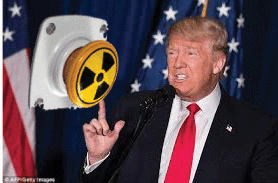
Will Trump bring about war and destruction to the world? Questions are now asked on when Trump will get the Nuclear launch codes of the US military.
WW3 NEWS WHEN WILL TRUMP GET THE NUCLEAR CODES?
With Trump’s obvious tendency to make enemies in every turn, the obvious question is: How easy is it for President Trump to push the button to launch Nuclear Missiles and jumpstart World War 3? The answer is: pretty simple actually.
According to Bruce Blair, who is a research scholar at Princeton, the US president has the sole authority to authorize the use of nuclear weapons. “The commander-in-chief’s power is pretty clear.” He told Bloomberg. Blair continued to explain that the US president always has a continuous line with his military officials. The US president has the power to authorize a nuclear counterstrike as well.
Kingston Reif of the Arms Control Association recently said that the US president has the “supreme authority” to decide what to do with America’s nuclear weapons.
America currently has 900 nuclear missiles, all of them 30 times more powerful than the bombs dropped in Nagasaki and Hiroshima.
WW3 NEWS: MORE TENSE RELATIONSHIP WITH BEIJING
According to a report by The New York Time, Beijing is exceedingly worried about Trump’s unpredictability. Territorial issues in the South China Sea has made tensions between US and China very tense in the past few years. With a Trump presidency now at hand, will the US – China relationship decline further? And how will the new US president handle his country’s powerful nuclear arsenal? The times are very frightening indeed.
Will Donald Hoffman Be President Trump’s Secretary Of Energy? Forbes, Rod Adams, 11 Nov 16, President-elect Trump announced a major emphasis on infrastructure building and manufacturing growth that is going to require a large increase in our energy consumption.
Though many observers keep referring to a four-year-old tweet to characterize Trump’s view on climate change as a hoax, he has at least two close advisors — Senator Jeff Sessions and Donald Hoffman — that are strong supporters of nuclear energy development.
My reasonably well-founded guess is that Don Hoffman is near the top of a short list of potential candidates to become the Secretary of Energy.
Don mentioned his opportunities to talk with Candidate Trump about nuclear energy’s capacity for abundant, reliable power production without pollution or CO2 emissions in an October article published by EENews…….
Who Is Donald Hoffman?
Hoffman joined Trump’s Leadership Council in March. He is the founder, President and CEO of Excel Services Corporation, a nuclear engineering and consulting firm that Don founded in 1985 …….EXCEL has done business with virtually every U.S. nuclear utility and every nuclear plant and enrichment facility in the United States. The company is also currently working on projects in 21 countries, as well as with the International Atomic Energy Agency and the World Nuclear Association, among other organization. http://www.forbes.com/sites/rodadams/2016/11/10/will-donald-hoffman-be-president-trumps-secretary-of-energy/#60c6dc4a3115
Trump said he will rescind any regulations that unduly burden energy development, including the Clean Power Plan, which, if it survives legal challenges, was to have been the cornerstone of Obama’s climate action legacy and the main policy for realizing the nation’s Paris goals. He also said he would abolish the Waters of the U.S. rule, which the fracking industry in North Dakota has opposed. Trump said he would urge TransCanada to renew its permit application for the Keystone XL pipeline. Within his first 100 days, Trump said he would lift moratoriums on fossil fuel production in federal areas, which could clear the way to new coal leasing in the West as well as coastal oil drilling, not only in the Arctic but also the Atlantic and potentially, the Pacific………
For his energy and environmental policy team, Trump has selected one of the nation’s most prominent climate contrarians, Myron Ebell of the Competitive Enterprise Institute, to head his EPA transition. Ebell worked on policy for the tobacco industry before his years of work opposing environmental regulations and sowing doubt on climate science. Trump is also reported to be considering Harold Hamm, chief executive of fracking industry leader Continental Resources, for energy secretary, and Forrest Lucas, co-founder of oil products company Lucas Oil, for interior secretary……..
the early battle lines will be Trump’s regulatory proposals.
In Trump, U.S. Puts a Climate Denier in Its Highest Office and All Climate Change Action in Limbo
His anti-regulatory stances, support of unfettered fossil fuel production, and his threat to pull the U.S. out of the Paris agreement, send ripple effects worldwide.BY MARIANNE LAVELLE, INSIDECLIMATE NEWSNOV 9, 2016 Donald Trump’s astonishing victory has turned the world of climate action upside down, setting back U.S. environmental policy and threatening the international drive to cut carbon pollution and slow global warming. Continue reading →
There’s no way around it: Donald Trump looks like a disaster for the planet Vox by Brad Plumer@bradplumerbrad@vox.com Nov 9, 2016 “…….So is there any hope things won’t actually be this bad? Okay, now time for a deep breath.
Even under Trump, there will still be reason for hope. Political change unfolds in unexpected ways, and not everything on Earth revolves around the machinations of the US federal government. So here are a few reasons to think the fight against climate change is not yet lost:
States like California and New York are still pursuing their own ambitious climate policies, and it’s possible those efforts could be so successful that other states decide to follow suit.
Likewise, wind power, solar power, and electric cars will keep getting cheaper — it’s possible they’ll acquire a self-sustaining momentum, even without support from the US government. Or maybe some other new low-carbon technologies will emerge to shake up climate politics. (Small modular reactors, anyone?)
Climate activists will continue to push for action at local levels — much as they did during the George W. Bush years, when the Sierra Club began blocking a major planned expansion of coal power. It’s possible that opposition to Trump will galvanize a new generation of climate activists who find creative ways to address global warming.
Other countries still have their own reasons for tackling climate change, even China and India (which, note, is choking on deadly levels of air pollution in Delhi right now). It’s possible that Trump’s recalcitrance on climate change could motivate the rest of the world to redouble their efforts at curtailing emissions without us.
Heck, it’s even possible that Trump and the GOP could have a change of heart and decide that global warming is a real issue that needs to be taken seriously. It’s possible that Republicans could balk at repealing all these pollution regulations, realizing that they’re actually quite popular. Stranger things have happened.
So lots of stuff is possible. Climate change will continue to be a defining issue for generations, long after Donald Trump is gone — and there’s never reason to give up. But the landscape has undeniably shifted. The prospect of staying below 2°C looks increasingly bleak. Right now Trump has given every indication that he wants to gamble with the future of the only planet around that’s known to support life. And it’s a wildly irresponsible bet.
“A man you can bait with a tweet is not a man we can trust with nuclear weapons.” The words of his vanquished opponent, Hillary Clinton, are perhaps the biggest anxiety hanging over the shock election of Donald Trump to the US presidency: can he be trusted with the power to launch Armageddon?
Every US president has constant access to a nuclear launch device only he can activate. Born in the Cold War, it is designed for when Russian nuclear missiles are detected making their 30-minute flight to the US, allowing 10-15 minutes to decide to order a counter-strike which would not be countermanded. But it could be used in other scenarios. “There is nothing to prevent a launch for very little reason,” says Paul Ingram of the British American Security Information Council, an arms control think-tank in London.
Would Trump hit the button? He has said he would be “very, very slow on the draw” but has refused to rule out using nukes, asking several times during the campaign, if they are never used, “why do we make them?”
The answer is deterrence: so fear of retaliation will deter any nuclear attack. Trump’s refusal to rule out their use is in fact close to existing US policy, but he has also suggested using them against ISIS, even though conventional weapons would have similar tactical effects.
“The very fact that one person, whoever it is, can decide to launch a nuclear strike is very worrying,” says Ingram.
Hair-trigger alert The president’s ability to respond rapidly is to allow the launch of 450 US land-based missiles before they are destroyed in an attack – for which reason they are kept on hair-trigger alert.
One way to reduce the risk of a rash launch would be for President Obama to take US missiles off hair-trigger alert before he leaves, which would be politically delicate to reverse. Or Trump, who wants better relations with Russia, might do it himself.
The use of existing nukes is one thing; proliferation is another. Trump has said he will “renegotiate” last year’s agreement with Iran to limit its uranium enrichment. Arms control experts say we are never likely to get a better deal, so Trump’s plan could see Iran resume its efforts.
And as North Korea approaches nuclear capability, Trump has suggested its neighbours might develop their own nuclear weapons. In April he said that US allies should pay more for the nuclear protection offered by the US umbrella – or defend themselves, “including with nukes”.
Japan and South Korea, under threat from North Korea, are already under pressure to do that. But both are non-nuclear states in the Non-Proliferation Treaty, and have sworn never to develop their own weapons. Their abandonment of that pledge could well be the death-knell of the treaty. While it has failed to disarm the major nuclear powers, it has kept other countries, such as Egypt and Saudi Arabia, from trying to develop the bomb.
Anti-nuclear norms Its failures in disarmament led a large majority of UN members to vote in October to start work on a new treaty that simply bans nuclear weapons for everyone. Existing nuclear nations rejected the idea (apart from North Korea, which voted for it), as, ominously, did Japan and South Korea. Non-nuclear NATO members backed it in the hope of strengthening global anti-nuclear norms.
Those may not last long in the Trump era. He has long called NATO “obsolete” and questions US commitments to Europe. The threat of losing reliable US defence could lead to military build-up in Europe, handing nuclear deterrence to the small UK and French nuclear arsenals, which would then be more likely to go ahead with expensive upgrades.
Thomas Homer-Dixon at the Balsillie School of International Affairs in Waterloo, Canada, sees a more insidious threat. He believes Trump could pick fights abroad and incite attacks on alleged enemies at home to generate a constant “emergency” to bolster his support. Russia’s Vladimir Putin, whom Trump has long admired, uses such tactics.
“The risk of a slide into war which ultimately involves nuclear weapons is very real,” he says. “Trump has an insatiable need to dominate, and he seems incapable of ignoring a slight.” The deadly nuclear winter predicted to follow even a limited nuclear exchange could one day answer the president-elect’s question: if we have these weapons, why don’t we use them?
Donald Trump and the nuclear codes Mr Trump will soon control America’s nuclear codes http://www.economist.com/news/briefing/21709999-mr-trump-will-soon-control-americas-nuclear-codes-donald-trump-and-nuclear-codesNov 12th 2016 IN A ritual out of sight of the cameras on Inauguration Day in January, America’s “nuclear briefcase” will change hands and President Donald Trump will receive a card, sometimes known as the “biscuit”. The card, which identifies him as commander-in-chief, has on it the nuclear codes that are used to authenticate an order to launch a nuclear attack. At that point, should he wish, Mr Trump can launch any or all of America’s 2,000 strategic nuclear missiles.
There are no constitutional restraints on his power to do so. Even if all his advisers have counselled against it, as long it is clearly the president giving the command, the order must be carried out. There are no checks and balances in the system. Moreover, once the order is given there is likely to be only a matter of minutes in which it could be rescinded. Once the missiles are flying, they cannot be called back or disarmed. Mr Trump, from what he has said, does not take this responsibility lightly. Indeed, he has often stated that he believes nuclear weapons to represent the greatest threat to humanity and that he will not be trigger-happy, “like some people might think”. But in common with his predecessors, he does not rule out their use. With little more than ten minutes to take a decision that could kill hundreds of millions of people, even the calmest individual would be under intolerable stress if informed that America was under imminent attack. It is not Mr Trump’s fault that the system, in which the vulnerable land-based missile force is kept on hair-trigger alert, is widely held to be inherently dangerous. Yet no former president, including Barack Obama, has done anything to change it.
Of greater concern would be how Mr Trump might behave in an escalating confrontation if Russia were to rattle its nuclear sabre even more loudly. It is possible that his apparent desire to be buddies with Vladimir Putin might help defuse a dangerous situation. He is, however, notoriously thin-skinned and unable to stop himself responding to any perceived slight with vicious (verbal) attacks of his own. He also revels in braggadocio and is known to be reluctant to take advice. Marco Rubio, a rival for the Republican nomination, questioned whether he had the temperament to be put in charge of the nuclear codes. So did Hillary Clinton. They were right to do so. But it is now Mr Trump, not them, who takes the biscuit.
There’s no way around it: Donald Trump looks like a disaster for the planet Vox by Brad Plumer@bradplumerbrad@vox.com Nov 9, 2016 This is happening. Donald Trump is going to be president of the United States.
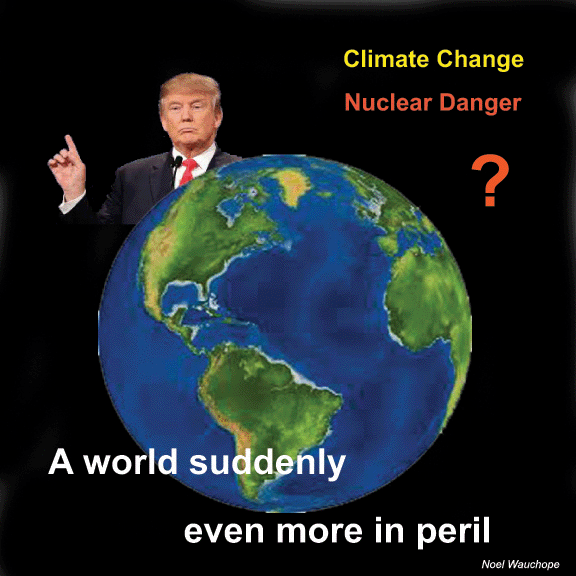
And there’s no way around it: What he’s planning to do looks like an absolute disaster for the planet (and the people on it). Specifically, all the fragile but important progress the world has made on global warming over the past eight years is now in danger of being blown up.
Trump has been crystal clear about his environmental plans. Much of the media never wanted to bring it up, never wanted to ask about it in debates, never wanted to turn their addled attention away from Hillary Clinton’s email servers to discuss what a Trump presidency might mean for climate change. But the warning signs were there:
Trump called global warming a Chinese hoax. He couldn’t have been blunter about this. He also tapped Myron Ebell, an avowed climate denier, to head his EPA transition team.
Trump has said, straight up, he wants to scrap all the major regulations that President Obama painstakingly put in place to reduce US carbon dioxide emissions, including the Clean Power Plan. If Trump wants to rewrite these rules through executive action, he can. Or Republicans in Congress could try to pass a law forbidding the EPA from ever regulating CO2 again.
Trump has also hinted he wants to downsize the EPA. “What they do is a disgrace,” he has said. He now has the power to rewrite or scale back other regulations on mercury pollution, on ground-level ozone, on coal ash, and more.
Trump has said he wants to repeal all federal spending on clean energy, including R&D for wind, solar, nuclear power, and electric vehicles. This would require Congress, but it’s not impossible.
Trump has said he wants to pull the United States out of the Paris climate deal. There’s nothing stopping him here. Technically, the US can’t officially withdraw for four years, but for all practical purposes, the Trump administration could ignore it.
So what happens if Trump gets his way? More air pollution, more carbon emissions. Exactly how much more remains to be seen. There are, after all, plenty of other factors pushing down US emissions that Trump has no control over. Natural gas from fracking would continue to kill coal power. Wind and solar would continue to grow. But it’s nearly impossible to imagine emissions under Trump dropping at the sharp pace necessary to slow global warming. And emissions could even rise, as this analysis from Lux Research suggests.
Even more importantly, the impact of Trump’s moves on the rest of the world could be seismic.
The world is making cautious progress on global warming. Trump wants to blow that all up.
For the last eight years, the Obama administration has been using every regulatory lever at its disposal to push down US greenhouse gases — aiming for a 28 percent cut below 2005 levels by 2025. Obama has also been trying to coax countries like China to participate in a global climate deal, in which every country would voluntarily pledge to restrain its emissions and meet regularly at the UN to ratchet up ambitions over time.
That plan finally came to fruition last December, when the world agreed to a sweeping climate agreement in Paris. The Paris deal was always delicate, and the current pledges weren’t nearly enough to avoid dangerous global warming, defined as 2°C or more. But the deal was a start. And the hope was that by cooperating and exerting diplomatic pressure on each other, all countries would steadily increase action over time.
This plan, which Clinton wanted to build upon, was far from a sure bet to halt global warming. But it was arguably the most plausible and promising accord yet proposed in the history of international climate talks.
Now it’s in peril. If Trump yanks the United States out of the Paris agreement, the deal won’t die, but momentum could wane. One can imagine China and India deciding they don’t need to push nearly as hard on clean energy if the world’s richest and most powerful country doesn’t care. At best, progress would slow. At worst, the entire arrangement could falter, and we set out on a path for 4°C warming or more.
These are decisions that will reverberate for thousands of years and affect hundreds of millions of people. We can’t easily undo the effects of all that extra carbon dioxide we keep putting into the air. Without drastic reductions in emissions (or possibly risky geoengineering), global temperatures will keep rising. The ice caps in Greenland and Antarctica will keep melting. Once that process gets underway, we can’t reverse it. The seas will rise. South Florida will eventually vanish beneath the oceans. Megadroughts will become more likely in the Southwest. For generations and generations.
Next U.S. president has said climate change is a hoax
Focus on talks in Morocco aimed at implementing Paris deal
The global fight against climate change will suffer a blow from Donald Trump’s victory in the U.S. presidential election, threatening the industries working to clean up pollution from fossil fuel.
The next president has questioned the science of climate change, vowed to withdraw from the Paris agreement on global warming and pledged to stimulate production of coal, the dirtiest fossil fuel. Green campaigners and policymakers, some of whom are gathered this week in Morocco for talks on implementing the Paris deal, sounded the alarm over the upheaval they expect when Trump takes office in January.
“The presidency of Donald Trump relegates the West as we knew it to the realm of the past,” Reinhard Butikofer and Monica Frassoni, co-chairs of the European Green Party, said in a statement. “If Donald Trump pursues the foreign policies that he announced during his campaign, this will severely undermine trans-Atlantic relations, the international rule of law and world peace.”
Under President Barack Obama, the U.S. rescued a two-decade-old process the United Nations promoted to rein in pollution damaging the climate, forging the Paris deal last year. Along with China and more than 190 other countries, the accord set out a framework for all nations to cut emissions. Trump has said he will cancel that work.“This is a very bad outcome,” Tom Steyer, founder of San Francisco-based advocacy group NextGen Climate Action, said in a phone interview Wednesday. “The Paris accord was a historic attempt to move forward as a globe to deal with a global problem, with American leadership. If he follows through on his campaign statements, that would be a devastating mistake.”
Delegates at COP22 react to Trump win
May Boeve, executive director of the anti-fossil-fuel campaign group 350.org, said in a statement that “Trump will try and slam the brakes on climate action. Our work becomes much harder now, but it’s not impossible, and we refuse to give up.”
Envoys drawn from environment and energy ministries gathered on Monday for two weeks of talks on climate organized by the UN, aiming to make progress implementing the Paris deal. They are due to finish their work on Nov. 18 with a set of rules on how Paris will be implemented.
It would be difficult for Trump to pull out of the Paris accord, which is part of the 1992 UN Framework Convention on Climate Change, which the U.S. ratified under Republican President George H.W. Bush. Trump would have to renounce the 1992 treaty or risk bringing down the entire UN process to scrap Paris. He’d have to give three years of notice to withdraw legally.
“If the U.S. pulls out of this process and is seen as going as a rogue nation on climate change, that will have implications for everything else on President Trump’s agenda when he wants to deal with foreign leaders,” Alden Meyer, who has been following the UN talks for more than two decades, said at the organization’s annual gathering in Marrakech on Wednesday. “I think he will soon come to understand that.”Doubts about U.S. support for the accord may stall progress in talks in Morocco this week and next, since other nations wouldn’t trust that any commitments the U.S. made will stick after Trump takes office. The U.S. is the richest among the top six polluting nations, and its support for the deal is essential to keep China and other developing economies working for cleaner industry.French Environment Minister Segolene Royal expressed concern about Trump’s stance in a posting on Twitter, noting that Obama “ratified and committed” the U.S. to the Paris agreement and there should be “no withdrawal,” adding, “Let’s stay vigilant for climate.”
November 9, 2016 According to his campaign aides, president-elect, Donald Trump is considering making a decision that would be completely devastating to, not only America, but the entire planet.Sarah Palin is reportedly being considered to take a position as one of Trump’s top cabinet leaders, specifically, the Interior Secretary of the Department of the Interior. In that role, Palin would be in charge of the country’s natural energy resources and America’s climate change policies.
Yes, a woman who doesn’t believe in global warming, or evolution for that matter, will be running the department in control of our energy resources. Palin is a big supporter of the oil industry and all the money it brings in, regardless of the price the planet will pay, so you can imagine what her agenda will be.
Trump himself said that he would “love to” put Palin to work in one way or another. Knowing Trump now, that could mean sexual favors, but he certainly wants her to do some real work as well. Trump said this about adding Palin to his cabinet:
“I’d love that. Because she really is somebody who knows what’s happening and she’s a special person.”Special. Of all the words Donald Trump could have used to describe the most dimwitted person to ever be involved in politics, aside from Michele Bachmann, special is definitely an accurate one to describe Sarah Palin.
Palin told CNN’s Jake Tapper that she would absolutely love to be relevant again:
“I think a lot about the Department of Energy, because energy is my baby: oil and gas and minerals, those things that God has dumped on this part of the Earth for mankind’s use instead of us relying on unfriendly foreign nations.”In case you were wondering, “The Department of the Interior manages one-fifth of the land in the country. That’s 35,000 miles of coastline and 1.76 billion acres of the Outer Continental Shelf. We also are entrusted to honor our agreements with 562 Indian tribes and to conserve fish, wildlife, and their habitats, responsibilities that affect millions of people.”
Watts Bar Unit 2, last old reactor of the 20th century: a cautionary tale, Bulletin of the Atomic Scientists Don SaferSara Barczak, 8 Nov 16More than four decades after construction began in 1973, the Tennessee Valley Authority (TVA) is finally getting close to starting up the Watts Bar Unit 2 nuclear reactor. Only final tests stand in the way of it receiving an operating license from the Nuclear Regulatory Commission (NRC). While the TVA and the nuclear industry describe Watts Bar 2 as “the first new nuclear generation of the 21st Century,” in fact the TVA resuscitated a demonstrably unsafe 1960s-era ice condenser design that was abandoned decades ago by the rest of the nuclear industry. Mismanagement and construction problems have driven the project’s price tag up with billions of dollars in cost overruns. Safety continues to be compromised as the NRC is allowing the TVA to delay post-Fukushima seismic design upgrades indefinitely. Rather than exemplifying a fine technological achievement, the history of Watts Bar Units 1 and 2 is a cautionary tale of the worst pitfalls of nuclear power and the federal regulatory system.
This pair of nuclear reactors has a unique distinction. Back in 1996, Watts Bar Unit 1 was the last reactor completed in the United States, at a hefty $6.8 billion. No other reactors have come online since. In fact, according to the NRC, eight US reactors have permanently shut down since Watts Bar 1 was licensed…….
Watts Bar 2 comes from a federally owned utility that has a history of delays, problems, and fiscal irresponsibility when it comes to nuclear power. This history raises the question of why Watts Bar 2 has survived such a long time and whether it should ever be allowed to open. It is a saga of delays and cost overruns, antiquated designs, inadequate quality control and oversight, failure to implement post-Fukushima upgrades, and a deficient safety culture, among other problems—all at a time when there is still no place for long-term storage of the nuclear waste that will be generated. And because the TVA manufactures tritium for use in America’s nuclear weapons, there will inevitably be greater releases of tritium into the air and water of the region—natural resources which already receive four times as much tritium as originally expected.
Ironically, Watts Bar 2 comes when the large-scale development of new, truly clean energy sources is a burgeoning reality. Created as an innovative model for the nation in the 1930s, the Tennessee Valley Authority has become an entrenched, top-down bureaucracy wedded to the past by its continuing embrace of nuclear and other polluting energy sources in the 21st century.
Let us look at some of the reasons for the delays and overruns in turn.
Problematic, antiquated design. …….
Quality control concerns at Watts Bar……..
Post-Fukushima design upgrades postponed…….
Watts Bar and nuclear weapons. …….
A safer, less risky future is possible. Ratepayers, utilities, and regulators should heed this cautionary tale, whose lessons are only reinforced by recent efforts to build ever more costly and delayed new reactors here in the United States, including SCANA’s V.C. Summer reactor in South Carolina, and the Southern Company’s Plant Vogtle reactors in Georgia. (And abroad at Flamanville, France; Olkiluoto, Finland; and Hinkley Point, Great Britain.) New nuclear power generation is turning out to be the failed technology of the 21st century…….. http://thebulletin.org/watts-bar-unit-2-last-old-reactor-20th-century-cautionary-tale8783
Donald Trump will be the only climate-denying world leader Mashable, BY ANDREW FREEDMAN, 10 Nov 16 If a Donald J. Trump administration acts on the president-elect’s view that global warming’s a “hoax,” the consequences of the presidential election may echo for generations. When he’s sworn into office in January, Trump becomes the only leader of a major industrialized country to deny the existence of human-caused global warming.
This is a first for the U.S., considering that even former president George H.W. Bush signed a climate change agreement in 1992, when the issue was just emerging. Presidents Clinton, George W. Bush and Barack Obama have all pursued reductions to emissions of planet-warming greenhouse gases, such as carbon dioxide.
In the lead-up to the election, environmental leaders and climate scientists issued apocalyptic warnings of what a Trump presidency would do to efforts to rein in global warming, given that the Paris Climate Agreement only just went into effect on Nov. 4, and is still fragile. Now, some of these same people are shellshocked, but remain resolved to opposing attempts to slow the pace of emissions cuts, which climate science says is a crucial factor in determining how much the world will warm in the next several decades.
No time to waste
The U.S. and the world can’t afford to stall or slide backwards on climate progress, according to scientific research. Studies show climate change proceeding faster than anticipated, with a narrowing window to act in order to forestall the worst impacts of global warming, such as a catastrophic increase in sea levels.
In fact, a recent U.N. report showed that if we are to have any hope of meeting the Paris Agreement’s goal of limiting global warming to under 2 degrees Celsius, or 3.6 degrees Fahrenheit, below preindustrial levels, emissions cuts need to become more ambitious.
The Obama administration committed to reducing U.S. greenhouse gas emissions by 25 to 28 percent below 2005 levels by 2025, and it’s expected to lay out a decarbonization plan by midcentury during the ongoing U.N. climate talks in Marrakech, Morocco.
However, to achieve these cuts, the Environmental Protection Agency’s (EPA) regulations on coal-fired power plants, known as the Clean Power Plan, would need to survive court challenges and be implemented by a supportive White House.
During the campaign, Trump made clear he would dismantle those regulations and others.
A Trump White House will have few checks on its power given that Republicans hold both houses of Congress, meaning that there could be significant rollbacks of EPA regulations and climate-related executive orders that could have ramifications beyond a single presidential term.
A slowdown or halt in U.S. emissions cuts would shift the climate math in favor of more severe global warming impacts. Leading environmental activist and journalist Bill McKibben emphasized that issue when reached on Wednesday, telling Mashable that “… The results of this election may eventually be measured in inches or feet of sea level rise.”
“Our job is to limit the damage, a harder job today than yesterday, but it wasn’t easy then either. Since physics is indefatigable I guess we better be too,” McKibben, a founder of the environmental group 350.org, said. Prominent climate scientist Hans Joachim Schellnhuber, who leads the Potsdam Institute for Climate Impact Research in Germany, said the ramifications for global climate action are dire.
The climate system doesn’t forget, and it doesn’t forgive
“The U.S. de-elected expertise and will likely show a blockade mentality now, so Europe and Asia have to pioneer and save the world,” Schellnhuber said in a statement. “Formally leaving the Paris Agreement would take longer than one Presidential term, yet of course the U.S. could simply refuse reducing national emissions which would mean a de facto exit out of international climate policy.”
He went on to say that the U.S. is “one of the world’s biggest economies, and even just four years of unbridled emission staying in the atmosphere for many hundreds years would make a substantial difference. The climate system doesn’t forget, and it doesn’t forgive.”
Environmental groups unite
Trump’s election may help unify the environmental movement in opposition to the White House, making opposition to new fossil fuel projects, anti-regulatory moves and other potential actions more intense and effective.
“This is an undeniable tragedy, but of course as organizers, our job is try and forge some sort of way ahead,” said Jamie Henn, a spokesman for 350.org, in an email on Wednesday morning.
Electrical fault, fire triggers low-level emergency notice at Indian Point http://westfaironline.com/82994/electrical-fault-fire-triggers-low-level-emergency-notice-at-indian-point/ By Ryan Deffenbaugh November 8, 2016An electrical fault and small fire in Indian Point Energy Center’s Unit 2 nuclear reactor Tuesday morning caused the plant’s owners, Entergy Corp. to declare and subsequently terminate a Notice of Unusual Event emergency notification.
The unusual event notice is the lowest of the Nuclear Regulatory Commission’s four emergency classification levels. The fire was self-extinguished moments after it started and there were no injuries or impact on plant operations, Entergy said.
The cable that experienced the electrical faulty carries electricity between both operating units at the Buchanan plant.
The company is investigating the cause of the fault, according to Entergy.
Robert Dodge: A ‘jobs program’ to end humanity Ventura County Star November 5, 2016 Nuclear weapons present the greatest public health and existential threat to our survival every moment of every day. Yet the United States and other nuclear nations stand in breach of the 1968 Nuclear Non-Proliferation Treaty, which commits them to work in good faith to end the arms race and achieve nuclear disarmament.
Now, 48 years later, the efforts of the nuclear nations toward this goal are not evident, and the world is as dangerous as it was during the height of the Cold War and arguably more dangerous with current scientific evidence on the catastrophic effects of even limited regional nuclear war.
This year’s presidential campaign has once again done little to focus on the dangers of nuclear weapons, focusing more on who has the temperament to have their finger on the button with absolutely no indication of any understanding of the consequences to all of humanity by the use of these weapons, even on a very small scale. In addition to tensions between Russia and the U.S. in Ukraine and Syria, there is a real danger of nuclear war in South Asia, which could kill more than 2 billion people from the use of just 100 Hiroshima-size weapons.
The rest of the world is finally standing up to this threat to survival. They are taking matters into their own hands and refusing to be held hostage by the nuclear nations. They will no longer be bullied into sitting back and waiting for the nuclear states to make good on empty promises.
At the United Nations this past month, 123 nations voted to commence negotiations next year on a new treaty to prohibit the possession of nuclear weapons. Despite President Obama’s 2009 pledge to seek the security of a world free of nuclear weapons, the U.S. voted no and led the opposition to this treaty.
Rather than meet our obligations under international law, the U.S has proposed to begin a new nuclear arms race, spending $1 trillion over the next 30 years to modernize and rebuild every aspect of our nuclear weapons programs — a “jobs program” to end humanity. Each of the nuclear nations is expected to do the same, continuing the arms race for generations to come………
From a medical and public health stance, based on our current evidence-based understanding of what nuclear weapons can actually do, any argument for continued possession of these weapons by anyone is untenable and defies logic. There is absolutely no reasonable or adequate medical response to nuclear war.
With any public health threat — from Zika and Ebola to polio and HIV — prevention is the goal. The global threat from nuclear weapons is no different. The only way to prevent the use of nuclear weapons is to ban and eliminate them. Our future depends upon this.
President Kennedy, speaking on nuclear weapons before the U.N. Security Council in September 1961, said, “The weapons of war must be abolished before they abolish us.” Our children’s children will look back and rightly ask why we — the only nation to ever use nuclear weapons — remained on the wrong side of history when it came to abolishing them.