Nuclear plant operators find that money talks in turbulent times. Omaha.com By Cole Epley / World-Herald staff writer , 6 Nov 16
Even though a shuttered nuclear plant is no longer producing electricity, it remains highly regulated to maintain safety for employees and nearby communities. When employees start heading for the exits, plant owners risk seeing institutional knowledge leave with them.
That’s what happened earlier this year at the financially squeezed James A. FitzPatrick Nuclear Power Plant in central New York, after Louisiana-based Entergy Corp. announced plans in November 2015 to shut down the plant for good.
By the time jockeying by New York lawmakers and deal-making with nuclear juggernaut Exelon Corp. removed the plant from a list of doomed facilities in early August, more than 10 percent of FitzPatrick’s 615 workers had jumped ship.
A similar portion of Fort Calhoun’s workforce has followed suit, according to Mart Sedky, Omaha Public Power District’s division manager of human resources. Employees there began leaving as soon as word got out in May that the plant, the nation’s smallest, was on the chopping block, she said.
David Lochbaum, director of the Nuclear Safety Project for the Union of Concerned Scientists, a nonprofit group, said retention bonuses are a “guard against” such rushes for the exits.
“If people start bailing out because they see the writing on the wall and they want to protect themselves and their families, that poses a challenge to the plant owner,” he said.
Early estimates call for about $45 million worth of retention bonuses and separation packages to Fort Calhoun employees. That number doesn’t include salaries at the plant, which had a $71.2 million payroll in 2015.
A spokeswoman at Entergy would not comment on retention agreements at the FitzPatrick plant in New York. But the company committed approximately $55 million to $60 million in severance and employee retention payments to employees at its now-closed Vermont Yankee Nuclear Power Station in southern Vermont, according to a statement from Entergy announcing the plant’s closing in August 2013.
Nuclear operators elsewhere have also found that money talks in turbulent times. Retention agreements kept nuclear professionals in place at the Kewaunee Power Station in Wisconsin when that plant’s owner announced its closing in late 2012. A spokesman for Dominion Resources, which closed Kewaunee for good in May 2013, said financial details around retention agreements with the plant’s employees were proprietary.
Today there are fewer than 200 employees on-site, down from more than 600 when the plant was running at full-power status.
In testimony supporting a rate hike to the North Dakota Public Service Commission in August 2013, Xcel Energy’s Timothy O’Connor said the Minnesota company was thwarted in its attempts to attract employees from Kewaunee to its own struggling nuclear plant because of retention incentives.
“Employees without retention agreements are extremely vulnerable to other nuclear competitors and this is one reason why (Xcel) has lost a large experience base,” O’Connor, Xcel’s chief nuclear officer, said at the time.
Closer to home, such incentives helped Nebraska Public Power District’s Cooper Nuclear Station in Brownville turn the corner when that plant’s fate was uncertain……http://www.omaha.com/money/nuclear-plant-operators-find-that-money-talks-in-turbulent-times/article_13e3e48f-e955-5a0b-a6a3-ada5741accab.html
November 6, 2016
Posted by Christina Macpherson |
business and costs, USA |
Leave a comment
October 1964 Nuclear testing in Mississippi http://mashable.com/2016/11/06/mississippi-nuclear-test/#QAtiwfQCDiqT [many photographs] Waiting on the big bang
by Alex Q. Arbuckle, 6 Nov 16 At 10 a.m. on Oct. 22, 1964, a five-kiloton nuclear device was detonated in Lamar County, Mississippi.
The previous year, as a response to rising public anxiety over the potential fallout of bigger and bigger test explosions, the United States, Great Britain and the Soviet Union had signed the Partial Test Ban Treaty, which prohibited all nuclear testing in the atmosphere, underwater and in outer space. Underground detonations were not banned in the treaty because it was still technically unclear how they could be detected to ensure compliance.
After signing the treaty, the United States government created Project Dribble, an effort to study how underground nuclear tests could be detected — or hidden.
The site of Project Dribble’s first detonation was 28 miles southwest of Hattiesburg in the Tatum Salt Dome, a massive Mesozoic salt deposit 1,000 feet below the ground.
The plan called for two detonations. The first, code-named Project Salmon, would be an explosion 2,700 feet down in solid salt. The second detonation, Project Sterling, would use a smaller bomb in the cavity left behind by the first blast.
Scientists hypothesized that the shockwaves of the second detonation would be muffled by the cavity, effectively concealing it from seismographic detection. The first blast was scheduled for Sept. 22, but was postponed repeatedly because the wind direction was not ideal.
Finally, on Oct. 22, the conditions were right.
Four-hundred residents were evacuated from the area around and downwind of the blast site. For their trouble, adults were paid $10 and children $5.
At 10 a.m., the Project Salmon device detonated with approximately one-third of the power of the bomb that destroyed Hiroshima.
The earth rose and roiled in waves, pecans fell from trees, dogs howled in fear, creeks ran black with disturbed sediment, and buildings thirty miles away swayed for minutes on end.
Within a week, hundreds of residents had filed damage claims with the government, citing burst pipes, cracked masonry and suddenly dry wells. The test was a success, however. The blast vaporized a spherical void in the salt 110 feet in diameter. When sensors were lowered into the cavity more than three months later, temperatures still measured over 400 degrees Fahrenheit.
Two years after Project Salmon, the second part of the test, Project Sterling, was carried out. A much smaller bomb — equal to 350 tons of TNT versus the first bomb’s 5,000 tons — was detonated in the cavity.
As the scientists hypothesized, the cavity absorbed nearly all of the blast’s seismic force. People on the surface barely felt a bump.
The blasts, which gave the government plenty of data on how underground nuclear tests could be hidden and detected, were declared a success — the only nuclear detonations to ever occur in the eastern United States.
November 6, 2016
Posted by Christina Macpherson |
history, USA, weapons and war |
Leave a comment
Advocates Protest In their letter, the plan’s opponents argue that the Nuclear Waste Policy Act of 1982 bars the federal government from taking responsibility for interim waste in the absence of a federal repository.
the concept of interim storage came out of the Obama Administration’s Blue Ribbon Commission on nuclear waste.
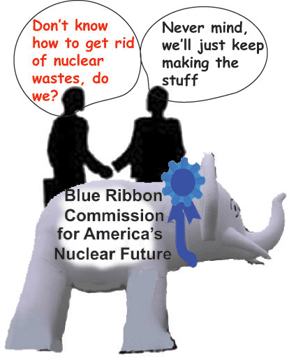
Meanwhile, the Energy Department remains decades away from developing a permanent repository.
 .At nearly every meeting of the San Onofre Community Engagement Panel, residents line up to ask whether sea air might cause corrosion in the casks, what the chance of leakage is, and who’s responsible if the casks degrade
As the amount of waste grows, so does the government’s liability……….The government’s estimated total liability is $29 billion.”That’s probably low, because it’s getting more expensive to store this stuff,”
Nuclear Plants Closing Early Leave Decades of Toxic Waste Stranded http://www.bloomberg.com/news/articles/2016-11-03/decades-of-toxic-waste-stranded-as-nuclear-plants-close-early Catherine Traywick Mark Chediak November 4, 2016 —
-
U.S. government has no permanent repository for spent fuel
-
76,000 metric tons of waste stored at commercial sites
Continue reading →
November 5, 2016
Posted by Christina Macpherson |
USA, wastes |
Leave a comment
 $2 Billion Needed Annually for Advanced Nuclear, Group Says
  http://www.bna.com/billion-needed-annually-n57982082293/ Bloomberg BNA By Rebecca Kern Nov. 3 — Advanced nuclear reactor technologies would be speeded up if the federal government increased spending to $2 billion annually on research and development test beds and demonstration projects, nuclear experts advised.
In order to move advanced nuclear reactors from the conceptual stage where they are today to the testing stages and eventual deployment, the government needs to increase its funding from its approximately $500 million per year to $2 billion per year over a 10-year period, Armond Cohen, executive director of the Clean Air Task Force, said during a Nov. 3 event releasing the Global Nexus Initiative’s policy memo outlining a framework for advanced reactors.
The Global Nexus Initiative is a group formed two years ago by the Nuclear Energy Institute, which represents the nuclear industry, and the Partnership for Global Security, a nonpartisan, non-profit focusing nuclear security policy.
The report is based on discussions during the group’s February workshop on the challenges to deploying advanced reactors, which are non-light water nuclear reactors that rely on other substances, such as sodium, to cool the reactor that have the potential to be cheaper to build and safer than existing reactor technologies.

Todd Allen, a senior visiting fellow at Third Way, a policy research group, said that government funding should be focused on early innovation for startup companies, of which some fraction will move up to commercial deployment….. http://www.bna.com/billion-needed-annually-n57982082293/
November 5, 2016
Posted by Christina Macpherson |
politics, USA |
Leave a comment
 Federal judge rejects dismissing Hanford nuclear lawsuit http://www.pennenergy.com/articles/pennenergy/2016/11/nuclear-power-federal-judge-rejects-dismissing-hanford-nuclear-lawsuit.html November 4, 2016 By Nicholas K. Geranios, Associated Press SPOKANE, Wash. (AP) — A federal judge on Thursday rejected the U.S. Department of Energy’s motion to dismiss a lawsuit filed by Washington state over worker safety issues at the Hanford Nuclear Reservation.
U.S. District Court Judge Thomas Rice rejected an Energy Department argument that the federal agency was not endangering enough Washington residents to allow the state to sue.
“The state has an inherent and fundamental sovereign interest in ensuring that all Washington workers are safe,” Rice wrote in his opinion.
Washington Attorney General Bob Ferguson filed the lawsuit last fall against the Energy Department and its contractor, Washington River Protection Solutions. The lawsuit contends that hazardous tank vapors pose a serious risk to Hanford workers.
‘This motion was just another example of the federal government’s culture of indifference to worker safety at Hanford,” Ferguson said Thursday.
Ferguson’s office contends that hundreds of workers have been exposed to vapors escaping from nuclear waste storage tanks since the early 1980s and that those breathing the vapors developed nosebleeds, chest and lung pain, headaches, coughing, sore throats, irritated eyes, and difficulty breathing.
Hanford for decades made plutonium for nuclear weapons, and now is engaged in cleaning up a massive inventory of radioactive and chemical wastes left over from that work.
Much of the waste is stored in 177 giant underground storage tanks at Hanford, which is located near Richland.
After more than 50 workers were exposed to tank vapors earlier this year, Ferguson asked a federal court to immediately order the government to implement enhanced safety measures. That motion is still pending before the court.
Officials for the Energy Department in Richland did not immediately return a telephone call seeking comment on Thursday.
Lawyers for the Energy Department had argued that the state lacked legal standing to file the lawsuit, in part because it involved about 2,000 workers out of a population of millions of residents. The agency also contended that no evidence has been provided showing that Hanford workers have been harmed by vapors. Symptoms like headaches are common, they have said.
The trial is set for May 22, 2017.
November 5, 2016
Posted by Christina Macpherson |
health, Legal, USA |
Leave a comment
 I-Team: Nuclear reactor test in Nevada could make a Mars trip reality, Las Vegas Now, By George Knapp , Matt Adams | madams@8newsnow.com 11/04 2016 “….Next year, a team of top scientists will hunker down inside a classified facility in the Nevada desert so they can experiment with a piece of advanced technology.
The test will focus on a small nuclear reactor and if it works as planned, it could be a huge step toward putting humans on Mars……
Los Alamos nuclear reactor scientist Patrick McClure is bubbling with enthusiasm about the end uses for the small nuclear reactor his team will test in the Nevada Desert in 2017. The reactor is named Kilopower. The experiment is dubbed KRUSTY, and yes, it’s an acronym named for the character in “The Simpsons” television show, but the goals are all too serious…….
“It could have happened. You could have nuclear powered rockets taking people to Mars, by now. That would be the reality of this,” said Darwin Morgan, Department of Energy.
“Definitely, in the 2030s, we will have the technology and the capability to go to Mars,” Houts said.
“This is exciting stuff,” McClure said. “We like it.” http://www.lasvegasnow.com/news/i-team-nuclear-reactor-test-in-nevada-could-make-a-mars-trip-reality
November 5, 2016
Posted by Christina Macpherson |
technology, USA |
1 Comment
Barack Obama is the first climate president http://www.skepticalscience.com/obama-first-climate-president.html 2 November 2016 by John Abraham
My how far we’ve come in less than eight years. We have seen happen what those of us in the climate and energy fields knew could happen. The US has become a world leader on climate change, dramatically increased our production of clean and renewable fuels, reduced our emissions of greenhouse gases, signed major international agreements to continue progress into the future, and have done so without cost increases or power disruptions that the denial community proclaimed would occur.
As we in the United States get ready to elect a new president, it is helpful to think about the impact a president can have. Particularly since we transitioned from the worst climate president ever (Bush) to the best (Obama). I am going to detail what I think are Obama’s signature accomplishments.

In my mind, the most important part of President Obama’s legacy on climate is that he changed the conversation. He showed that not only should the US play a role in reducing emissions, but we can do just that. He showed that this problem isn’t too big to solve. In fact, most of the solutions are subtle enough that we don’t even notice them. He showed that we can change our future for the better.
With respect to specific actions, the Clean Power Plan is one of his biggest accomplishments. By working with the EPA, he created the first ever carbon pollution standards for the largest source of pollution – power plants. He did this in the midst of a do-nothing congress that fought him every step of the way.
Under his presidency, we made huge investments in clean energy, which are paying off already. Jump starts to the wind and solar industry have led to enormous cost decreases – dirty energy isn’t cheaper anymore. It is really astonishing – wind power has tripled and solar power has increased by 30 times since he took office.
Under his presidency, we improved standards for fuel economy of our vehicles, which not only reduces pollution but also saves money. Furthermore, Obama set targets to reduce the federal government’s emissions by nearly 20% by 2025. He has worked to reduce other types of greenhouse gases such as methane and hydrofluorocarbons, not only within the US but through international agreements.
And those aren’t the only international efforts. Obama made a joint plan with China that is almost unbelievably ambitious. It will reduce our emissions by approximately 27% by 2025 and puts major limits on Chinese emissions as well. He also forged an agreement with India to help low-income countries transition to modern economies that are not as polluting as current developed nations.
There are many more items which would be too numerous to mention but I wanted to know how his presidency is viewed within Washington DC. I mean, among climatescientists, he is the president we’ve been waiting for, but what do legislators think? I asked representative Betty McCollum from Minnesota for her view. Ms. McCollum has a long history of focusing on the environment in general and climate change in particular – long before it was popular. She told me: Click here to read the rest
November 4, 2016
Posted by Christina Macpherson |
climate change, politics, USA |
Leave a comment
 The UN makes history on a nuclear weapons ban. Does the US care?, Bulletin of the Atomic Scientists, JOE CIRINCIONE
 2 NOVEMBER 2016 Joe Cirincione is president of Ploughshares Fund, a global security foundation.
If a treaty rises in the United Nations and US media don’t notice, does the treaty make a difference? This is the situation confronting proponents of the process begun October 27, when—by a vote of 123 for, 38 against, and 16 abstaining—the First Committee of the UN agreed “to convene in 2017 a United Nations conference to negotiate a legally binding instrument to prohibit nuclear weapons.”
It was a historic moment. Despite dozens of nuclear crises and war scares, UN members have never in the 71-year history of the body voted for such a sweeping measure. Yet no major US paper covered the vote. Why not?……
The United States, however, adamantly opposed the resolution and, according to some observers, fiercely lobbied its allies, particularly those enclosed in the US “nuclear umbrella,” to vote against the new process. ….
There is hope for a more optimistic and safer view of nuclear threats to re-emerge. The treaty vote is one sign that many nations have lost patience with the barely discernable, “step-by-step” process that nuclear-armed nations have followed in regard to arms control and eventual nuclear disarmament. The alternative process the countries voting for the ban treaty have begun–encouraged and aided by civil society groups–is having an impact, and may spur the nuclear-armed states to move faster……..http://thebulletin.org/un-makes-history-nuclear-weapons-ban-does-us-care10123
November 4, 2016
Posted by Christina Macpherson |
media, USA |
Leave a comment
 US strike on North Korea would spark world war with China, think-tank warns https://www.thesun.co.uk/news/2090813/crushing-crazy-kims-nuke-bid-will-spark-war-with-china/
U.S. warned against nuking nutty North Korea because it risked war with neighbouring China BY PATRICK KNOX 1st November 2016,
AMERICAN is doomed to fighting an apocalyptic war with China if it dares to hit North Korea with surgical nuclear strikes, experts are warning.
Washington is becoming increasingly alarmed at the pace of crackpot Kim Jong-un’s bid to build-up his nuclear firepower which he vows will be used against the U.S. As revealed by Sun Online, the Pentagon is operating a bizarre looking “floating golf ball” which turns out to a sophisticated anti-missile shield to shoot down Kim’s rockets.
But as well as beefing up its defences, U.S. forces could be forced to carry out a preemptive “surgical strike” against North Korea before its nukes transform California into a radiated hell-hole.
China expert John Delury warns this option would be on the table.
But he said it could end up spectacularly backfiring because nuclear armed Beijing would then feel compelled to defend its neighbour.
He said: “How might Beijing react to a US preemptive or surgical strike on the North?
“North Korea is, after all, China’s only defence treaty ally in the world, and is obligated to ‘immediately render military and other assistance by all means at its disposal’ to defend Pyongyang if attacked.
“A strike of this nature could likely drive Beijing to side with the North in accordance with their 1961 treaty.
Writing for the think tank 38 North, Dr Delury added: “‘Surgery’ would rapidly descend into a bloodbath. “Preemption” would start a war.”
As reported, leaked emails show U.S. Presidential wannabe Hillary Clinton is threatening to “ring China with missile defence” if it doesn’t agree to Washington’s requests and use its influence over the one-party state to stop developing the weapons.
Meanwhile, Major General William Hix, of the US Army, confessed World War 3 is “almost guaranteed” and will be “extremely lethal and fast.” He said that China and Russia are both developing huge militaries which are driven by new technologies.
And he warned that the US is preparing for “violence on the scale that the U.S. Army has not seen since Korea” when over 30,000 American troops were slaughtered.
November 4, 2016
Posted by Christina Macpherson |
China, North Korea, USA, weapons and war |
1 Comment
‘A Dangerous Situation’ As U.S.-Russia Tensions Spill Over To Nuclear Pacts October 31, 2016 Heard on Morning Edition DAVID WELNA The U.S. and Russia are the world’s two mightiest nuclear powers, and yet over the years, they’ve made deals to reduce their respective arsenals.
Just like a marriage gone bad, though, things have soured between Washington and Moscow. Bickering over nuclear issues has increased markedly in recent months, with each side accusing the other of cheating.
And that war of words is being matched by actions:
Russia, in early October, moved a battery of nuclear-capable missile launchers within range of three Baltic states.
In September, three U.S. long-range bombers — the kind used to drop nuclear weapons — flew over Eastern Europe in NATO military exercises.
Russia, in late October, unveiled images of a new intercontinental ballistic missile dubbed the Satan 2, whose warhead, it claims, can destroy an area the size of Texas.
“I would have to say that, without question, this is the low point in U.S.-Russian relations since the end of the Cold War,” says Steven Pifer, an arms control expert at the Brookings Institution………http://www.npr.org/sections/parallels/2016/10/28/499754655/a-dangerous-situation-as-u-s-russia-tensions-spill-over-to-nuclear-pacts
November 4, 2016
Posted by Christina Macpherson |
politics international, Russia, USA |
Leave a comment
 The Navy’s Use of Depleted Uranium in Our Coastal Waters Threatens Humans, Wildlife Monday, 31 October 2016 By Dahr Jamail, Truthout | Report
Sheila Murray with the Navy Region Northwest’s public affairs office, when asked what the Navy was doing to mitigate environmental contamination from the large numbers of Depleted Uranium (DU) rounds it left on the seabed off the Pacific Northwest Coast claimed current research “does not suggest short- or long-term effects” from the release of DU to the environment that could result in its uptake by marine organisms.”
She also said that DU rounds “are extremely stable in sea water and pose no greater threat than any other metal.”
In response to this, Mozhgan Savabieasfahani, an environmental toxicologist and winner of the 2015 Rachel Carson Prize environmental award for her work on DU and heavy metal contamination, told Truthout, “The US Navy representative’s views exhibit an alarming level of amnesia.”
She said this because Murray’s statement has been one that has been recycled by the Navy for years. Reuters reported in January 2003 that the Navy confirmed its use of DU shells in arms tests off the Washington State coast, at which time the Navy claimed, “The DU rounds dissolve so slowly that they would not contribute to naturally occurring (radiation) levels … and do not pose a significant risk.”
Meanwhile, ample scientific reports — including Savabieasfahani’s own research — demonstrate the deleterious health impacts caused by DU.
“When those bullets and bombs explode, dangerous nanoparticles of metals, including uranium nanoparticles, are released into the environment,” she explained to Truthout. “Laboratory research has already established that exposure to environmentally relevant concentrations of uranium has negative impacts on fish embryogenesis, and on the reproductive success of fish.”
Naval documents show that as much as 34 tons of DU could be present on the seabed just 12 miles from the outer coast of Washington State.
Even more distressing, the Navy’s own documents reveal that the extent of its use of DU off the coast of the US is far more pervasive than it admits to the public.
And results of a Freedom of Information Act filing provided to Truthout show that the Navy, which claims in its environmental impact statements it has not used DU since 2008, has actually shipped it from a Puget Sound munitions area as recently as 2011.
A Bogus Study
The Navy’s public affairs officer, Murray, also told Truthout that a “recent study” of an area off the south coast of England that was used for test firing DU rounds “did not show presence of DU in sample of intertidal and ocean bottom sediments, seaweed, mussels, and locally caught lobster and scallops. (Toque, 2006).”
However, the study Murray cites — and which the Navy consistently cites when arguing that DU is not harmful — is heavily disputed.
Carol Van Strum, an Oregon-based environmental advocate who has researched DU for years, told Truthout that Murray’s statement is “an out-and-out lie.”
Van Strum, who has read the Toque study closely and knows it well, pointed out that, for starters, the study’s author works for a British military contractor. She went on to point out two very serious flaws in the study.
“While the study relied on ‘locally caught’ lobster and scallops as samples for testing for depleted uranium, the samples were never ‘caught’ but rather bought in a local market, and thus could have come from anywhere,” Van Strum explained. “Second, and most worrisome … the actual study reports depleted uranium contamination in nearly all of the samples.”
The Navy’s Environmental Impact Statement (EIS) on the matter claims “the survey results show no evidence of DU being present in any marine environmental sample collected in the year 2004.”
But Van Strum called their claim “incontrovertibly false” because the study itself stated it had found DU contamination in the soil in many areas where the military was operating cannons, in the soil where ordnance had been fired, and in the soil, sea water and marine life where the ordnance they had fired had landed.
“The study’s methodology would not pass muster for even a high school science project,” Van Strum said. Karen Sullivan, a retired endangered species biologist who co-founded the website West Coast Action Alliance that acts as a watchdog of Naval activities in the Pacific Northwest, questioned why the Navy would open itself up to accusations of bias by relying on only a single study done by someone who works for a group affiliated with the British military.
“Why would the Navy rely on such a flawed and obviously biased study to ‘prove’ that DU in seawater poses no threat greater than any other metal?” Sullivan, who worked at the US Fish and Wildlife Service for more than 15 years and who is an expert in the bureaucratic procedures the Navy is supposed to be following, asked in an interview with Truthout. “Probably because the enormous body of properly conducted and unbiased science completely refutes it.”
Van Strum went on to point out additional significant problems with the study, including the almost laughable procurement and use of the samples……..
Human Health Impacts of DU “Quite Relevant” to Naval Exercises
“Navy exercises in the waters of the Pacific Northwest will release contaminants into the marine environment, with an undeniable potential to harm human health,” Savabieasfahani said, noting that this would apply even to low-level amounts of DU being introduced into the oceans. “It is long established that explosives can contaminate soil, sediment and water and thereby impact environmental and human health.”
She explained that the human and environmental impacts of the Navy’s use of DU in past exercises is “quite relevant,” and cited a report that showed how DU exposure has been linked to lower cognitive ability in adults.
“This leads us to expect much worse impacts on growing children, newborns and infants — to say nothing of unborn babies,” Savabieasfahani added. “Furthermore, epidemiological evidence is also consistent with an increased risk of birth defects in the children of people exposed to DU.”
She also heavily emphasized the fact that the internalization of uranium in any form will result in both chemical and radiation exposure. “Once inside a living body, DU and uranium’s effects are virtually the same,” Savabieasfahani explained. “This is a point worth repeating.”
Moreover, Savabieasfahani emphasized that it’s dangerous to guesstimate “safe” levels of DU, whether or not it reaches levels determined to be “toxic.”
“Our knowledge of the human health impacts of DU is consistent with laboratory studies of other mammals,” she said. “DU exposure affects neurogenesis during prenatal and postnatal brain development by disrupting patterns of cell proliferation and cell death. Even sub-toxic levels of DU have been shown to alter brain function.”
She also took issue with Murray’s argument, which Savabieasfahani described as, essentially, “the solution to pollution is dilution.” This is the nuclear industry’s default argument about radiation and other forms of pollution, and has been for decades, despite the fact that this logic was “decisively rejected” more than 40 years ago. Savabieasfahani pointed out that even Richard Nixon’s EPA administrator, William Ruckelshaus, rejected the dilution argument in a 1972 Congressional testimony regarding the Clean Water Act.
Savabieasfahani noted that any upcoming Naval exercises that introduce heavy metals and other pollutants, regardless of whether they use DU, will increase the environmental “background burden” of DU and other pollutants.
“Increasing that burden is simply irresponsible,” Savabieasfahani said. “Seabed pollutants have already found their way into our bodies. Those pollutants will continue to impact the most vulnerable populations — infants, newborns and growing children — most profoundly, and their imprint will be found in the baby teeth of our children.”
Other Instances of DU
Problems with DU in the Pacific Northwest are not limited to the Navy……. http://www.truth-out.org/news/item/38185-the-navy-s-use-of-depleted-uranium-in-our-coastal-waters-threatens-humans-wildlife
November 4, 2016
Posted by Christina Macpherson |
depleted uranium, Reference, USA |
Leave a comment
No One Saw Tesla’s Solar Roof Coming Elon Musk just showed us the grand unification of Tesla: Fast cars, big batteries, and a stunning solar rooftop. Bloomberg, Tom Randall October 31, 2016 “…….. This is the future of solar, Musk proclaimed. “You’ll want to call your neighbors over and say ‘check out the sweet roof.’ It’s not a phrase you hear often.”
The roof tiles are actually made of textured glass. From most viewing angles, they look just like ordinary shingles, but they allow light to pass through from above onto a standard flat solar cell. The plan is for Panasonic to produce the solar cells and for Tesla to put together the glass tiles and everything that goes along with them. That’s all predicated on shareholders approving the $2.2 billion acquisition of SolarCity, the biggest U.S. rooftop installer, on Nov. 17.

Tesla says the tempered glass is “tough as steel,” and can weather a lifetime of abuse from the elements. It can also be fitted with heating elements to melt snow in colder climates. “It’s never going to wear out,” Musk said, “It’s made of quartz. It has a quasi-infinite lifetime.”
In a Q&A with reporters after the presentation, Musk said the tiles are comparable to competing high-efficiency solar panels. The current prototypes that Tesla engineers are working with reduce the efficiency of the underlying solar cell by just 2 percent. With further refinement, Musk said he hopes the microscopic louvers responsible for making the tiles appear opaque can be used to actually boost the efficiency of standard photovoltaic cells.
Putting the pieces together
The vision presented at Universal Studios in Los Angeles is the grand unification of Musk’s clean-energy ambitions. The audience was able to step into a future powered entirely by Tesla: a house topped with sculpted Tuscan solar tiles, where night-time electricity is stored in two sleek wall-hung Powerwall batteries, and where a Model 3 prototype electric car sits parked out front within reach of the home’s car charger.
Attracting less attention on Wisteria Lane was Tesla’s Powerwall 2, a major upgrade of its home battery for electricity storage. …Version 2 is a much different product. It packs more than twice the capacity—14 kilowatt hours versus 6.4 kilowatt hours—for a cheaper price after installation. It includes a built-in Tesla-brand inverter and comes with a ten year, infinite-cycle warranty. ……https://www.bloomberg.com/news/articles/2016-10-31/no-one-saw-tesla-s-solar-roof-coming?cmpid=google
November 4, 2016
Posted by Christina Macpherson |
decentralised, USA |
Leave a comment
 To Adapt to Climate Change, Retreat Is Necessary Four years after Hurricane Sandy, many coastal communities recognize that rising oceans mean relocating their residents. But there is no consensus on how to do so. The Nation By Alexandra Tempus OCTOBER 31, 2016 “……
 After Sandy made landfall in 2012, it destroyed or damaged roughly 305,000 homes in New York, killing 53 people and leaving the state with $42 billion in damages. Since then, more than 700 home-owning New York families alone have relocated as a result of the storm. Renters or public-housing tenants who have relocated are harder to track, but at least 2,000 were displaced to hotel rooms after Sandy and almost as many registered for affordable housing within six months of Sandy. Across the globe, growing numbers of people are being permanently displaced by climate-change impacts—the 1,000-year floods and megadroughts and superstorms generated by rising temperatures. By now experts have established
that the damage Sandy wrought was made worse by rising sea levels, linking it indisputably to climate change.
New York state has predicted that by 2100, rising seas could swallow
up to six feet of its shore, the same year real-estate firm Zillow says nearly 2 million US homes could be underwater. A 2016 study in the
Proceedings of the National Academy of Sciences predicts a Sandy-level flood will be more than
four times as likely by that time. As this plays out, academia and government officials increasingly agree that large numbers of Americans will need to move, even as some experts warn that we don’t really know how to effectively pull it off……..
Relocation programs are a historically sensitive topic for local governments, which don’t like to see decreases in population or in their tax base. But with climate change increasingly threatening the lives and homes of people on the coasts, that reluctance is starting to shift. Post-Sandy, the city and the state of New York both established programs to purchase homes damaged by the storm in certain risky areas, theoretically allowing for homeowners to pick up and move somewhere safer. As of now, there is no requirement as to where state-buyout recipients must move, but the state offers a 5 percent bonus for relocating within the city to those in the special buyout areas of Staten Island. So far the state has officially purchased 613 of the 750 houses it made offers on in Staten Island and Long Island, totaling $240 million. For its part, New York City just proposed adding a $50,000 bonus to its acquisition offers for homeowners willing to relocate within the five boroughs. The city plans to make 600 such offers, and has already purchased 31 homes. According to NYC Housing Recovery Operations, “The vast majority of Sandy affected applicants whose homes were substantially damaged would have been consulted about the possibility of selling their home.”
But the buyouts and acquisitions are dwarfed by the money spent on rebuilding and stormproofing housing where it stands. New York State has paid $1 billion to 11,000 residents to repair and rebuild their homes, and $76 million to repair rental properties. The city projects it will serve 19,500 households through its Build It Back program—of which acquisition is just a small part—with nearly 4,000 construction starts to date. Earlier this year, The Wall Street Journal reported that program’s total cost would be $2.46 billion.
That the bulk of money is being spent on rebuilding belies the fact that experts and government officials acknowledge that relocation from the riskiest areas will be necessary. “Managed retreat is the strategy that most effectively mitigates the risk of catastrophic flooding,” a spokesperson for the Governor’s Office of Storm Recovery told The Nation. “By removing man-made impediments and restoring the wetlands, we are recreating the best coastal buffer that nature can offer. This is all the more important in the face of imminent sea level rise and the new reality of increasingly frequent storms.”
This acceptance of relocation reaches up to the federal level, says Brian Sullivan, a spokesman for the US Department of Housing and Urban Development.
We have a lot of our built communities increasingly in harm’s way,” says Sullivan. “With the frequency and the severity of these events, with storm surge and sea-level rise, we can’t afford to rebuild in the way that we’ve always intended to rebuild. The model a generation ago was to rebuild to what things were. And we can’t do that.”
Yet there is no consensus on how this retreat should be managed. …….. https://www.thenation.com/article/to-adapt-to-climate-change-retreat-is-necessary/
November 4, 2016
Posted by Christina Macpherson |
climate change, USA |
Leave a comment
http://www.lohud.com/story/opinion/readers/2016/11/01/energy-rights-group-blasts-cuomo-plan-bail-out-nuke-plants/93007830/ Re “Nuclear plant bailout burdens New Yorkers, NYPIRG writes,” Oct. 24 Community View: Nancy S. Vann, president of Safe Energy Rights Group.
It’s not surprising that the Cuomo administration’s decision to burden New Yorkers with a nuclear bailout was shrouded in secrecy. Behind closed doors, it was decided that our electric bills would be raised by $7.6 billion to bail out old, failing nuclear power plants in upstate New York.
Here in Westchester, our ConEdison rates could go up by $705.8 million to sustain these unprofitable, dangerous plants. These plants are losing money and were slated to be shut down until this administration partnered with the owner of the plants, Exelon, to make them profitable on the taxpayers’ dime. If the state is forced to add the failing Indian Point plant to the list, the costs could be even higher.
Gov. Andrew Cuomo should scrap this huge rate hike and instead develop a new plan — one that focuses on keeping rates low and invests in affordable 21st century clean energy technology that creates jobs, improves our communities and protects the environment. New Yorkers deserve investments that work for them, not irresponsible bailouts for dying industries.
November 4, 2016
Posted by Christina Macpherson |
politics, USA |
Leave a comment
Nuclear CSI: Noninvasive procedure could identify criminal nuclear activity, http://phys.org/news/2016-11-nuclear-csi-noninvasive-procedure-criminal.html November 1, 2016 by Molly Peterson Determining if an individual has handled nuclear materials, such as uranium or plutonium, is a challenge national defense agencies currently face. The standard protocol to detect uranium exposure is through a urine sample; however, urine is able to only identify those who have been exposed recently. Now, scientists at the University of Missouri have developed procedures that will better identify individuals exposed to uranium within one year. Scientists and homeland security experts believe this noninvasive procedure could identify individuals who may be smuggling nuclear materials for criminal purposes.
“We are working to develop a tool that
law enforcement agencies in nuclear proliferation or smuggling investigations can use to identify individuals who have handled special nuclear material,” said John Brockman, associate professor of research in the MU Research Reactor Center. “The goal of our research was to determine if hair, fingernail clippings and
toenail clippings could be used to better detect uranium exposure.”
Brockman collected hair, fingernail and toenail clippings from workers in nuclear research facilities from around the country. Testing procedures developed by Brockman and his team were able to identify exposure to both natural and manmade sources of uranium.
According to the World Nuclear Association, naturally occurring uranium is a mixture of three isotopes, including uranium-238 (U-238), U-235 and traces of U-234. U-238 accounts for over 99 percent of the isotopes found in nature; U-235 is the isotope necessary to create nuclear weapons or power a nuclear reactor. U-235 is considered a fissile isotope, meaning the atom has the ability to split, yielding a large amount of energy. Uranium that has been used as fuel in a nuclear power plant also contains the manmade isotope, U-236.
“Our technique was not only able to determine uranium exposure, but also the specific isotopes the individual has handled within the last year,” Brockman said. “We were able to identify exposure to enriched uranium, which is used to make both nuclear fuel and weapons, and U-236 which is suggestive of nuclear fuel reprocessing.”
With this discovery, law enforcement official could use specialized equipment and identify individuals who have been exposed to special nuclear material within 48 hours. Brockman is looking to expand his analysis with the national human radiobiological tissue repository (NHRTR) to further provide insight on how hair and nail samples could be used to monitor exposure to special nuclear material.
The MU Research Reactor has been a crucial component to research at the university for more than 40 years. Operating 6.5 days a week, 52 weeks a year, scientists from across the campus use the 10-megawatt facility to not only provide crucial radioisotopes for clinical settings globally, but also to carbon date artifacts, improve medical diagnostic tools and prevent illness.
November 4, 2016
Posted by Christina Macpherson |
secrets,lies and civil liberties, USA |
Leave a comment