Exelon’s Illinois energy bill greeted by vociferous opposition, Utility Dive, Peter Maloney@TopFloorPower Nov. 17, 2016
Dive Brief:
Illinois lawmakers have introduced a massive energy bill backed by Exelon that would implement a sweeping restructuring of utility bills in the state to pay for a variety of incentives and programs, including subsidies to keep two nuclear power plants scheduled for closure operating, media sources report.
The bill also includes capacity charges for coal plants in the south of the state, as well as provisions for utility energy efficiency programs, utility microgrids and community solar projects. It would also institute mandatory residential demand charges while replacing net metering with a one-time rebate.
The bill was introduced into the General Assembly’s shortened “veto session,” which runs for three days this week and three days the week after Thanksgiving, and has attracted vocal criticism from a variety of constituencies.
Dive Insight: The day it was introduced, opponents of the Future Energy Jobs Bill spoke out in opposition to the proposed legislation.
“This is going to be the largest rate hike in U.S. history,” Dave Lundy, head of the BEST Coalition, a business group opposed to the bill, said at a press conference shortly after the bill was introduced.
Lundy was objecting to the subsidies the bill would provide to not only Exelon nuclear plants, but to southern Illinois coal plants as well. He said that Illinois generates 41% more electricity than the state needs, so payments to the coal and nuclear plants would be subsidizing rates for customers in other states.
Abe Scarr, director of Illinois Public Interest Research Group, called the mandatory demand charges in the bill “an end run around the Illinois Commerce Commission.”
Sheila Garland, with National Nurses United, said the charges would who would harm low-income and minority residents.
Solar advocates spoke out as well, decrying the demand charge and net metering reform they said would kill rooftop solar in the state.
Exelon’s nuclear plant posturing includes massive rate hike http://rockrivertimes.com/2016/11/15/exelons-nuclear-plant-posturing-includes-massive-rate-hike/The latest opposition to Exelon’s proposal to save its power plants in Clinton and the Quad Cities has little to do with the two nuclear plants. Instead, a number of consumer and business groups are fighting what they call the largest utility rate hike ever proposed.
Exelon’s latest request from Illinois lawmakers is a 450-page proposal the company says will that’d save its the two endangered nuclear plants by classifying nuclear power as “carbon-friendly.” They would then qualify for government funds that they would use to modernize the two stations.
Without it, Exelon says the Clinton Power Station in Clinton, Ill., will close on June 1, 2017, and the Quad Cities Generating Station in Cordova, Ill., will close on June 1, 2018. The two plants have lost $800 million in the last seven years, according to the company.
The proposal would also offer credits for coal-fired power plants as a peace offering to Texas-based Dynegy, which owns coal-fired plants in southern Illinois and opposes the bill, and allow Exelon to increase rates.
Dave Lundy with the BEST Coalition, which represents a number of business and consumer groups, said Exelon’s proposal will cost around a billion dollars a year until 2044. “This is going to be the largest rate hike in U.S. history,” Lundy said. “This legislation is going to cost $24 billion.”
The legislation would allow Exelon to move to “demand rate” pricing.
Demand rates would charge customers based on the peak price of their usage the month before. Julie Volin with AARP said that means if customers use their washing machine in the middle of the day, it could spike their power bill.
“The demand rate structure is going to limit people’s ability to actually live in their homes from 9 a.m. til 9 p.m.,” Volin said.
Volin says the Illinois Commerce Commission, which approves utility rate hikes should decide how much people pay for power, not lawmakers.
Exelon says the legislation is a way to guarantee about 1,500 jobs at the plants in Clinton and the Quad Cities and ensure their own viability into the future.
Illinois needs to invest in energy efficiency programs, State Journal Register, Jason Vogelbaugh, Nov 16, 2016 . Concluding a yearlong debate, lawmakers appear ready to consider legislation addressing Illinois energy policy as they return to Springfield this month. To create jobs, save energy and improve air quality, members of the General Assembly must act now to create a stronger energy future for Illinois.
Back in 2007, Illinois leapt ahead of many other states, pioneering energy efficiency legislation that plays a key role to this day in providing Illinois consumers and industrial users with the lowest electricity rates in the Midwest.
But after a decade of inaction, other states have moved ahead of Illinois, seizing private investment and creating jobs that should have come here instead. Last year alone, Illinois lost more than 500 jobs in wind and solar combined, while dozens of other states registered significant gains in these sectors. At the same time, Exelon says that nuclear plants in two communities, the Quad Cities and Clinton, are at risk of closure barring quick action by the Legislature.
To maximize economic and environmental goals, this legislation should not simply address questions about the type of energy we use, it should also address the amount of energy we use by reducing demand through energy efficiency.
Energy efficiency has a proven track record in Illinois, saving money and putting people to work. Since Illinois energy efficiency standards were passed in 2007, customers have saved more than $1 billion on their electric bills. Today 86,000 people statewide work in this field, weatherizing or insulating buildings, designing efficiency measures and upgrading appliances…….
Proponents of the Illinois Clean Jobs Bill (HB 2607/SB 1485) have called for boosting energy efficiency standards statewide and fixing limits that artificially cap investments that utilities can make to save customers money. A bill from ComEd and its parent company Exelon (SB 1585) would expand these programs to save customers in ComEd’s Northern Illinois service area up to $4 billion over the next decade and create thousands of new jobs.
A bill that melds these ideas to expand energy efficiency would be a boon to Illinois customers.
Now that that these parties have put forward a strong energy efficiency initiative, we strongly encourage Ameren Illinois to join them. Central and Southern Illinois customers should not left behind while those in Northern Illinois reap the benefits of lower costs and thousands of new jobs created by expanding energy efficiency.
Programs ensuring that energy efficiency programs are targeted at low-income communities are also under consideration, helping unlock savings for customers who need them most, while accelerating employment opportunities in these areas of Illinois.
Iran deal critics to Trump: Please don’t rip it up, They hated the nuclear agreement. But now they’re urging Trump not to kill it. Politico, By NAHAL TOOSI, 11/16/16
President-elect Donald Trump spent much of his campaign railing against the Iran nuclear deal, even raising the possibility of scrapping the agreement immediately upon taking office.
But many of the deal’s most ardent critics are now saying: “Slow down.”
As the reality of Donald Trump’s White House win sinks in among nuclear deal opponents, some are insisting that pulling out of the agreement is unwise. Instead, they say, Trump should step up enforcement of the deal, look for ways to renegotiate it, and pursue measures to punish Iran for its non-nuclear misbehavior. Such a multi-pronged, get-tough approach may even give Trump cover to fend off any criticism he may get for keeping the deal.
It’s a remarkable moment for the anti-deal crowd, which includes Israel’s prime minister, Saudi princes and Republican lawmakers. Many tried to keep the deal from ever being reached, accused outgoing President Barack Obama of appeasing an enemy and used the agreement to knock Democrats during the 2016 campaign. Now that they have a shot at scuttling the deal they hate so much, they are urging caution.
GOP Sen. Bob Corker, who opposed the deal as chairman of the Senate Foreign Relations Committee, spoke out against immediately discarding the deal in interviews with cable channels on both Wednesday and Tuesday. The problem is that, as part of the agreement, Iran already has accessed billions of dollars in once-frozen assets, Corker said. Plus, the U.S. is just one of seven countries involved in the deal, in which the United Nations and the European Union also play a role.
“We gave up … all of our leverage on the front end when we gave away the moneys that were stashed in various countries around the world and so now the leverage is with them,” Corker told MSNBC on Tuesday. “I think the beginning point is for us to cause them to strictly adhere [to the deal]. And I think that what we have to remember is, we have to keep the Europeans and others with us in this process.”
The July 2015 nuclear deal is not a treaty. It is a political arrangement put into force largely through presidential executive orders that suspended nuclear-related sanctions on Iran. In exchange for the lifting of such sanctions by the U.S., the EU and the U.N., Iran has dismantled its nuclear infrastructure………
“You don’t want all the blame for the deal falling apart to land on the U.S.,” argued David Ibsen, president of United Against Nuclear Iran, a group that has spent months trying to persuade companies around the world not to invest in Iran despite the lifting of sanctions.
EPA to test areas in Bridgeton for radioactive contamination St Louis Public Radio, 17 Nov 16The Environmental Protection Agency is planning to test areas in Bridgeton for radioactive contamination.
Federal officials are responding to allegations made by residents near the West Lake Landfill. In a lawsuit filed Tuesday against against landfill owner Republic Services, Michael and Robbin Dailey claimed contamination from the Superfund site was found in their home.
According to a letter from an EPA lawyer, the agency plans to sample dust and soils at the home and other areas in Bridgeton.
EPA officials have previously said there is no evidence that radioactive material has migrated away from the site.
Original story from Nov. 15 —Residents in Bridgeton have filed a lawsuit Tuesday afternoon in the St. Louis County Circuit Court, alleging that radioactive waste was found at a home near the West Lake Landfill.
The lawsuit names nine companies, including landfill owner Republic Services, the Cotter Corporation and Mallinckrodt Inc. as defendants. The plaintiffs are Michael and Robbin Dailey, who live in the Spanish Village subdivision. According to the lawsuit, sampling conducted at their property last summer found “high levels of uranium decay products, including thorium, lead, radon” in the kitchen, basement and yard. Exposure to such substances can increase the risk to cancer, according to the Environmental Protection Agency.
It also claims that dust inside their home contained levels of the radioactive element Thorium-230 that were at least 200 times higher than background levels.
The Daileys have lived in Spanish Village since 1999. Robbin Dailey has long been concerned that exposure to nuclear waste from the Superfund site has adversely affected their health. ……
The West Lake Landfill, a federally listed Superfund site, contains World War II-era nuclear waste that was illegally dumped there in the 1970s. It sits approximately 600 feet from an underground smoldering fire under the Bridgeton Landfill……
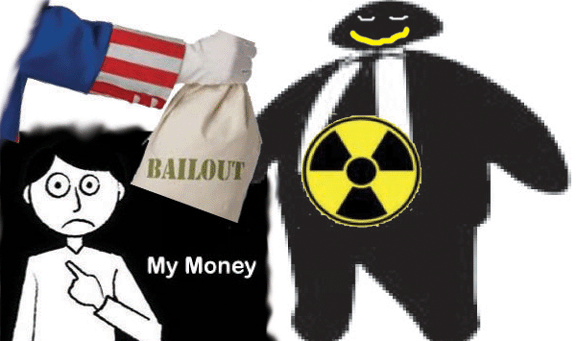
Should electric customers pay for NYS nuclear plants? WBFO88.7, ByDAVE LUCAS , 15 Nov 16, The battle is heating up over a statewide electric rate increase to subsidize upstate nuclear power plants that pits Governor Andrew Cuomo against a coalition of “good-government groups.”
Members and leaders of the statewide campaign to “Stop the Cuomo Tax” and end the bailout of nuclear power in New York have made their intentions clear: they are calling on the governor to release alleged “secretive agreements with nuclear companies.”
Blair Horner with the New York Public Interest Research Group said the governor is proposing to keep three upstate nuclear power plants near Rochester and Oswego open for the next dozen years, using $7.6 billion of ratepayer money to make it happen.
The issue is part of the Public Service Commission’s broader Clean Energy Standard. The final installment on putting that deal together occurs in a vote before the Public Service Commission scheduled for Thursday.
“There is certainly an irony in the fact that the governor is hell-bent on closing the Indian Point nuclear power plant outside of the city of New York and yet providing billions and billions of dollars in subsidies for aging upstate ones,” said Horner. “The plants that he’s bailing out are ones that were ready for the scrap heap. They’d already outlasted their anticipated lifespan as power plants.”
He continued that this could be the single biggest transfer of wealth from ratepayers to companies in New York state history.
“The decision on this was conducted largely outside of public view. The public had, at best, only dim awareness that this was happening,” Horner said. “The governor’s ramming through a basically secretive decision that’s going to cost New Yorkers billions and billions of dollars and, for the 800,000 poorest New Yorkers, they’re gonna take a big, big hit.”
Horner said most of those 800,000 are in arrears and 20,000 have already had their service cut off.
“The governor’s proposed bailout of these nuke power plants will just jack up the price even harder for these struggling New Yorkers and it’s not even that it’s a great investment,” Horner said. “This is just to keep old Vietnam War-era nuke power plants running.”
NEI requests DOE minimize US supplier burden for liability risk pool https://dailyenergyinsider.com/featured/2253-nei-requests-doe-minimize-us-supplier-burden-liability-risk-pool/November 15, 2016 Daily Energy Insider Reports The Nuclear Energy Institute (NEI) recently requested that the U.S. Department of Energy (DOE) provide U.S. nuclear energy suppliers with more certainty regarding their liabilities in a nuclear incident to allow them to better develop a contingency plan. The department is collecting data in developing a liability risk pool for an international treaty on compensating those affected by a nuclear incident.
The Convention of Supplementary Compensation for Nuclear Damage (CSC) was adopted in 1997 and entered into force last year. The CSC establishes a two-tiered approach for compensating victims in the event of a nuclear incident. The first tier is paid by the country in which the incident takes place and is set at a minimum of 300 million “special drawing rights,” a unique form of international money developed by the International Monetary Fund (IMF) based on a weighted average of convertible currencies.
If the first tier is insufficient, the second tier is funded by the CSC signatories.
NEI calculated that the United States would contribute approximately $64.5 million per covered incident if the current parties to the CSC are Argentina, India, Japan, Montenegro, Morocco, Romania, United Arab Emirates and the United States.
NEI said that since the Energy Independence and Security Act of 2007 mandates that U.S. nuclear suppliers reimburse the federal government for any costs it incurs in contributing to the second tier of liability, the CSC would create an undue burden on U.S.-based nuclear suppliers.
The institute also requested that the DOE ensure that the final rule is not overly burdensome from an administrative, record keeping or implementation standpoint.
US Military Plans to Dump 20,000 Tons of Heavy Metals and Explosives Into the Oceans Tuesday, 15 November 2016 By Dahr Jamail, Truthout | Report The US Navy has been conducting war-game exercises in US waters for decades, and in the process, it has left behind tons of bombs, heavy metals, missiles, sonar buoys, high explosives and depleted uranium munitions that are extremely harmful to both humans and marine life.
Truthout recently reported that the Navy has admitted to releasing chemicals into the oceans that are known to injure infants’ brains, as well as having left large amounts of depleted uranium in US coastal waters. Now, the Navy’s own documents reveal that it also plans to use 20,000 tons of heavy metals, plastics and other highly toxic compounds over the next two decades in the oceans where it conducts its war games.
According to the Navy’s 2015 Northwest Training and Testing environmental impact statement (EIS), in the thousands of warfare “testing and training events” it conducts each year, 200,000 “stressors” from the use of missiles, torpedoes, guns and other explosive firings in US waters happen biennially. These “stressors,” along with drones, vessels, aircraft, shells, batteries, electronic components and anti-corrosion compounds that coat external metal surfaces are the vehicles by which the Navy will be introducing heavy metals and highly toxic compounds into the environment.
Just some of the dangerous compounds the Navy will be injecting into the environment during their exercises are: ammonium perchlorate, picric acid, nitrobenzene, lithium from sonobuoy batteries, lead, manganese, phosphorus, sulfur, copper, nickel, tungsten, chromium, molybdenum, vanadium, trinitrotoluene (TNT), RDX [Royal Demolition eXplosive] and HMX [High Melting eXplosive], among many others.
“None of these belong in the ocean’s food web, upon which we all depend,” Karen Sullivan, a retired endangered species biologist who cofounded West Coast Action Alliance, which acts as a watchdog of Naval activities in the Pacific Northwest, told Truthout. “Nor will the Navy be willing to clean it up, or even contribute to medical tests for people whose health may suffer.”……http://www.truth-out.org/news/item/38374-us-military-plans-to-dump-20-000-tons-of-heavy-metals-and-explosives-into-the-oceans
Trump seeking quickest way to quit Paris climate agreement, says report, Guardian, 13 Nov 16
The president-elect wants to bypass the theoretical four-year procedure to exit the accord, according to a Reuters source, Donald Trump is looking at quick ways of withdrawing from the Paris climate agreement in defiance of widening international backing for the plan to cut greenhouse gas emissions, Reuters has reported.
But, according to Reuters, a source in the Trump transition team said the victorious Republican, who has called global warming a hoax, was considering ways to bypass a theoretical four-year procedure for leaving the accord.
“It was reckless for the Paris agreement to enter into force before the election,” said the source, who works on Trump’s transition team for international energy and climate policy, speaking on condition of anonymity. The Paris agreement went into force on 4 November, four days before last Tuesday’s election.
Alternatives were to send a letter withdrawing from a 1992 convention that is the parent treaty of the Paris agreement, voiding US involvement in both in a year’s time, or to issue a presidential order simply deleting the US signature from the Paris accord, the source told Reuters.
Many nations have expressed hopes the United States will stay. Morocco, the host for the talks, said the agreement that seeks to phase out greenhouse gases in the second half of the century was strong enough to survive a pullout.
“If one party decides to withdraw that it doesn’t call the agreement into question,” foreign minister Salaheddine Mezouar told a news conference.
Despite the threat of a US withdrawal, US secretary of state John Kerry said on Sunday that he would continue his efforts to implement the Paris agreement until Barack Obama leaves office on 20 January.
Speaking in New Zealand following a trip to Antarctica, Kerry appeared to take a swipe at Trump when he listed some of the ways in which global warming could already be seen. He said that there were more fires, floods and damaging storms around the world, and sea levels were rising.
Todd Allen, senior visiting fellow for a Washington think tank called Third Way, said the industry
needs to remake itself because “nuclear energy stands at a crossroads.”
In a separate event last week, Tim Judson, Nuclear Information and Resource Service executive director, discussed findings of a report he authored called “Too Big to Bail Out,” in which he argued that subsidizing the nuclear industry will have deep consequences.
Peter Bradford, a former U.S. Nuclear Regulatory Commission board member and a former state utility regulator in Maine and New York, said New York’s bailout is “the clearest example of a state capitulating” to the industry.
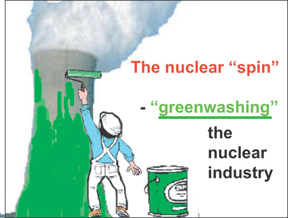
Nuclear industry looks to reshape image The Blade ByTom Henry | BLADE STAFF WRITER,Nov. 13, 2016 the U.S. nuclear industry is trying harder than ever to market itself as an irreplaceable ally in the war against climate change.
It is eager to get going on a new generation of plants that are smaller, leaner, faster, easier to manage,
and more attractive to private investors.
At stake could be the degree to which electricity ratepayers in Ohio and other states end up subsidizing the nuclear industry.
“There’s an important and continuing role for nuclear power in achieving these goals,” Kenneth N. Luongo, president of the Washington-based Partnership for Global Security, said at the start of a recent discussion between his group and the nuclear industry’s chief lobbying group on Capitol Hill, the Nuclear Energy Institute.
The Partnership for Global Security, originally incorporated in 1997 as the Russian-American Nuclear Security Advisory Council, is a think tank that promotes the convergence of 21st-century security, technology, and economic issues that affect the global nuclear industry. It has been working with the NEI on an effort called the Global Nexus Initiative, which promotes stronger public-private collaboration on nuclear issues.
“This is not a one-country issue,” Mr. Luongo said.
The NEI wants the public to reconsider how it views nuclear power ……
The NEI’s marketing campaign, though, took another hit in late October when Omaha Public Power announced it is giving up on its Fort Calhoun nuclear plant.
It is the seventh site in three years where a utility said it can no longer justify high operation costs.
Chicago-based Exelon, which owns the most nuclear plants, announced in June it will shut its single-unit Clinton and its twin-unit Quad Cities plants in Illinois in 2017 and 2018, respectively, because of poor economics.
Although Akron-based FirstEnergy Corp. has said repeatedly that its Davis-Besse and Perry plants in Ohio are safe from early closure, Davis-Besse appeared on another list of at-risk plants in a Nov. 3 report issued by the Nuclear Information and Resource Service, an anti-nuclear group in Takoma Park, Md.
Three years ago, Davis-Besse was one of several plants cited at-risk for early closure in a Vermont Law School study. FirstEnergy’s chief executive officer, Charles “Chuck” Jones, said in a conference call with analysts earlier this month that the utility giant is undertaking a 12 to 18-month “strategic review” of its competitive generation business that could lead to selling off as many as 13 power plants, including Davis-Besse and plants at its other two nuclear complexes. The latter are the Perry nuclear plant east of Cleveland, and the twin-reactor Beaver Valley nuclear complex west of Pittsburgh.
“The fact is, competitive generation is weighing down the rest of the company,” Mr. Jones said. “We do not think competitive generation is a good fit.”
Though showing a profit for its third quarter, FirstEnergy lost millions of dollars during the first nine months of 2016 and expects to end the year with a loss as well.
“We are at a crossroads,” Mr. Jones said. “We have to make some tough decisions.”
Rate request
In a highly contentious rate request argued for months before the Public Utilities Commission of Ohio, FirstEnergy originally sought a guaranteed cash flow of up to 15 years to ensure the viability of Davis-Besse and the utility’s massive coal-fired Sammis plant in southern Ohio.
Last month, after the Federal Energy Regulatory Commission struck down a modified plan, state regulators unanimously agreed to let FirstEnergy impose $132.5 million a year in new surcharges on its 1.9 million customers over the next three years. That comes to about $3 more a month for a typical residential customer. The deal is substantially less than FirstEnergy’s attempted compromise for an eight-year deal at $558 million per year for a total of $4.5 billion.
Critics have decried each proposal as a bailout, while the utility argued the money is necessary to help stabilize it.
But Ohio’s handling of FirstEnergy requests has been watched closely by other states which are undecided about the degree to which they should support nuclear power.
California, Mr. Luongo noted, has taken the position of gradually phasing out its nuclear plants, while New York decided late this summer to spend $7.6 billion over 12 years to ensure continued operation of three upstate nuclear plants……
There isn’t any uniformity regarding this issue at the moment,” Mr. Luongo said. “The market seems to be distorted, in that it is disincentivizing nuclear power.”
The discussion focused on the mix of old and new: How an investment in advanced nuclear reactors that are smaller but more efficient than today’s existing fleet could bring back the nuclear industry …..
The hope is to achieve better economies of scale with advanced nuclear reactors, standardized designs, greater involvement from private investors, and global partners.
“They’re unlikely to be wholly government financed,” Everett Redmond, NEI fuel cycle and technology policy senior director, said. “It’s key to be able to export this technology.”
Todd Allen, senior visiting fellow for a Washington think tank called Third Way, said the industry needs to remake itself because “nuclear energy stands at a crossroads.”
“Nuclear energy must evolve to keep up with changes in the energy sector,” he said……
In a separate event last week, Tim Judson, Nuclear Information and Resource Service executive director, discussed findings of a report he authored called “Too Big to Bail Out,” in which he argued that subsidizing the nuclear industry will have deep consequences.
He said his research shows half of the current fleet of nuclear plants could be uneconomical as early as 2020.
The nation should invest in other technologies instead of “obsolete infrastructure,” Mr. Judson said.
“Renewable energy and efficiency can be done for less,” he said.
Peter Bradford, a former U.S. Nuclear Regulatory Commission board member and a former state utility regulator in Maine and New York, said New York’s bailout is “the clearest example of a state capitulating” to the industry.
Nuclear weapons: how foreign hotspots could test Trump’s finger on the trigger, Guardian, Julian Borger, 13 Nov 16, “……….Trump has claimed he could improve relations with Russia, and in particular with Vladimir Putin personally, that would defuse the high tensions over Ukraine and Syria. Such deals could well be at the expense of the people of those countries, but could conceivably lessen the chances of a complete end to arms control and the return to an expensive and dangerous nuclear arms race. Hans Kristensen, a nuclear expert at the Federation of American Scientists (FAS), points out that the deepest cuts in nuclear arsenals have been achieved by Republican administrations.
“Republicans love nuclear weapons reductions, as long as they’re not proposed by a Democratic president,” Kristensen wrote on an FAS blog
“That is the lesson from decades of US nuclear weapons and arms control management. If that trend continues, then we can expect the new Donald Trump administration to reduce the US nuclear weapons arsenal more than the Obama administration did.”
The current arms treaty limiting the strategic arsenals of both countries, New Start, expires in 2021. A decision will have to be made whether to replace it or let arms control wither. Both Putin and Trump could save tens of billions of dollars by cutting arsenals. As part of any deal, however, Putin would ask for the scrapping of the US missile defence system currently being erected in eastern Europe. Any concessions on the US trillion-dollar nuclear weapon modernisation programme, which Trump endorses in his transition website, would bring him in direct conflict with the Republican establishment.
Controversial in Australia because it would allow US-headquartered corporations to sue Australian governments in extraterritorial tribunals and entrench pharmaceutical monopolies and copyright rules, the TPP was the subject of a last-minute plea by Prime Minister Malcolm Turnbull to president-elect Donald Trump in their 15-minute phone conversation on Thursday.
It has been signed by each of the member countries – Australia, the US, Japan, Canada, New Zealand, Malaysia, Brunei, Singapore, Chile, Mexico, Peru and Vietnam – but ratified by none.
Over the weekend the Senate’s top Democrat Charles Schumer told union leaders the deal would not be ratified. House of Representatives Republican speaker Paul Ryan, who has in the past supported the TPP, said the “votes aren’t there” to pass it.
Mr Trump made opposing the TPP a key part of his campaign, saying America did “not need to enter into another massive international agreement that ties us up and binds us down”. Democrats members of Congress were never keen, opposing by a wide margin President Barack Obama’s negotiating mandate which only passed into law with the support of Republicans.
On Sunday Australia’s trade minister Steven Ciobo questioned whether it would be worthwhile concluding the agreement without the US, even if it was possible.
“In theory, yes,” he told the ABC’s Insiders. “but is there enough merit to look at a trade deal among the 11 of us? It changes the metrics substantially.”
Mr Ciobo will hold discussions about the future of the agreement at the APEC leaders summit in Lima, Peru on Thursday which will be attended by Mr Turnbull on Sunday.
The US decision leaves two Australian parliamentary inquiries in limbo. The joint standing committee on treaties finished hearing evidence just before Mr Trump’s election and has not yet produced a report. The Senate inquiry has yet to call witnesses.
Nuclear weapons: how foreign hotspots could test Trump’s finger on the trigger
From North Korea to Iran to Russia, a president-elect with civilisation-ending weaponry at his fingertips will face an in-tray of potential international crises, Guardian, Julian Borger , 13 Nov 16 On Donald Trump’s first day in office he will be handed the “nuclear biscuit” – a small card with the codes he would need to talk to the Pentagon war room to verify his identity in the event of a national security crisis.
Some presidents have chosen to keep the “biscuit” on them, though that is not foolproof. Jimmy Carter left his in his clothes when he sent them to the dry-cleaners. Bill Clinton had it in his wallet with his credit cards, but then lost the wallet.
Others have chosen to give the card to an aide to keep in a briefcase, known as the “nuclear football”, together with a manual containing US war plans for different contingencies and one on “continuity of government”, where to go to ensure executive authority survives a first nuclear strike.
The “biscuit” and “football” are the embodiment of the awesome, civilisation-ending power that will be put in Trump’s hands on 20 January. They only become relevant in very rare moments of extreme crisis, but a US president’s ability to manage crises around the world will help determine whether they become extreme. There is one such situation already in the in-tray Trump will find on his desk, on the Korean peninsula, where the North Korean regime is rapidly developing a long-range nuclear missile. Another could blow up at any time with Russia, whose warplanes are flying increasingly close to Nato planes and ships in a high-stakes game of chicken. And Trump could trigger a third crisis, with Iran, if he follows through with his threat to tear up last year’s agreement curbing its nuclear programme in return for sanctions relief.
Trump’s election has added a new layer of uncertainty to all these potential flashpoints.
“I have no idea what he would do, and neither I suspect, does he,” said James Acton, the co-director of the nuclear policy programme at the Carnegie Endowment for International Peace. “Let’s not kid ourselves he has policies for these issues. He doesn’t have a team that has done deep dives into these questions.”
The temperament question
During the campaign, 10 former US nuclear launch officers, who once manned missile silos and held the keys necessary to execute a launch order, signed a lettersaying Trump should not have his “finger on the button” because of his temperament.
One of those former officers, Bruce Blair, said that if US early warning radar showed the country was under attack by nuclear missiles, there would be time for a president to receive a briefing that could be as short as 30 seconds and the commander-in-chief would then have between three and 12 minutes to make up his mind. He would have to take into account that the early warning system had been wrong before and could be vulnerable to ever more sophisticated hacking.
Donald Trump presidency a ‘disaster for the planet’, warn climate scientists
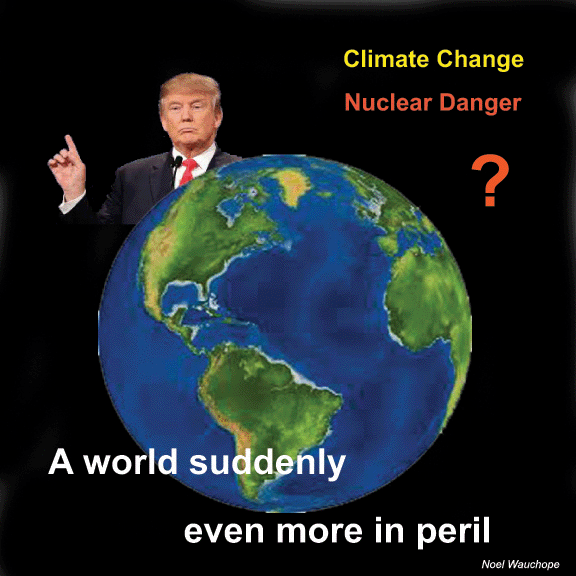
Leading scientists say the climate denier’s victory could mean ‘game over for the climate’ and any hope of warding off dangerous global warming, Guardian, Oliver Milman, 13 Nov 16 The ripples from a new American president are far-reaching, but never before has the arrival of a White House administration placed the livability of Earth at stake. Beyond his bluster and crude taunts, Donald Trump’s climate denialism could prove to be the lasting imprint of his unexpected presidency.
“A Trump presidency might be game over for the climate,” said Michael Mann, a prominent climate researcher. “It might make it impossible to stabilize planetary warming below dangerous levels.”
Kevin Trenberth, senior scientist at the US National Center for Atmospheric Research, added: “This is an unmitigated disaster for the planet.”
Trump has vowed to sweep away the climate framework painstakingly built over Barack Obama’s two terms. At risk is the Paris climate accord, which only came into force last week, and Obama’s linchpin emissions reduction policy, the Clean Power Plan.
At a pivotal moment when the planet’s nations have belatedly banded together to confront an existential threat, a political novice who calls global warming a “bullshit” Chinese-invented hoax is taking the helm at the world’s foremost superpower.
“Millions of Americans voted for a coal-loving climate denier willing to condemn people around the globe to poverty, famine and death from climate change,” said Benjamin Schreiber, climate director at Friends of the Earth US. “It seems undeniable that the United States will become a rogue state on climate change.”
US conservatives are already rubbing their hands in glee at the prospect of a bonfire of regulation. Trump wants the US to exit the Paris deal, which commits nations to keeping the global temperature rise below a 2C threshold, potentially setting off a cataclysmic domino effect where other countries also drop out or ease off efforts to decarbonize. The 2C limit, which was already a stern challenge, now appears perilous.
The Clean Power Plan, the main tool to cut American emissions, is also targeted for elimination, along with billions of dollars in clean energy funding. Republicans will also turn off the tap of aid flowing to developing nations already struggling with climate change-driven sea level rise, heatwaves and drought.
Bitterly contested fossil fuel projects such as the Keystone development and the Dakota Access pipeline, which has caused unprecedented uproar among native American tribes, would likely be waved through, with Trump promising to “lift the Obama-Clinton roadblocks to allow these vital energy infrastructure projects to go ahead”.
Environmentalists are already aghast at Trump’s presidential preparations. He has appointed Myron Ebell, director at a conservative thinktank, to oversee transition plans for the Environmental Protection Agency, which Trump has casually earmarked for abolition. Ebell has said global warming is “nothing to worry about” and that the Clean Power Plan is “illegal”.
Shortlists drawn up for key Trump administration posts have also raised alarm. Oil billionaire Harold Hamm is being touted as energy secretary, while former vice presidential candidate Sarah Palin could make a stunning comeback as interior secretary, putting her in charge of US public lands, including treasures such as Yellowstone and Yosemite national parks. Palin is an enthusiastic proponent of oil and gas drilling, describing the fossil fuels as “things that God has dumped on this part of the Earth for mankind’s use”.
Republicans have already used Congressional committees to hound climate scientists and green groups and this badgering may escalate once climate denial is official White House doctrine. It’s understood that scientists at Nasa are already bracing themselves for cuts to climate research programs.
Predicting Trump’s plans, however, largely relies upon reading the runes from his discursive policy speeches, which regularly dissolved into vituperative diatribes while on the campaign trail.
At the heart of his energy and climate thinking is an “America first” policy where “draconian climate rules” are repealed and the US escalates its production of coal, oil and natural gas. In May, Trump sported a coal miner’s helmet at a rally in West Virginia, a state with a long history of mining, to underscore his message that the “war on coal” is over and that jobs will flow back to the stricken industry.
“Under my administration,” Trump said, “we’ll accomplish complete American energy independence. Complete. Imagine a world in which our foes, and the oil cartels, can no longer use energy as a weapon. It will happen. We’re going to win.”
These bromides to American industrial strength helped propel Trump to the White House but aren’t tethered to reality. US coal production slumped 10% last year, with mining jobs shrinking by 12%. Over the same 12-month period, the US oil industry lost $67bn. These woes have been caused by market forces, rather than onerous regulation, and even Trump’s authoritarianism doesn’t extend far enough to change that.
“As president, Donald Trump will pretend climate change does not exist,” said Prof Tom Lyon of the University of Michigan’s business school. “This is an increasingly untenable position, even for committed climate skeptics.
“His energy policy will encourage investment in high-carbon energy sources that will look foolish in retrospect. And he will anger much of the rest of the world by reneging on policies designed to address global challenges.”
US greenhouse gas emissions have started to taper off in recent years but a Trump presidency would see a resurgence, with an analysis by Lux Research finding that carbon dioxide output would be 16% higherthan the current trajectory should the real estate magnate complete a second term.
This would give the world a hefty shove towards climate disaster and fatally wound the US’s reputation as a global leader. Should other major emitters such as China, India and the European Union fail to make compensatory emissions cuts the planet will likely spiral into runaway climate change where tens of millions of people are displaced by rising seas, food insecurity and conflict, leading to an unprecedented international humanitarian disaster.
Michael Moore Predicts Donald Trump Won’t Last The Full 4 Years“He will break laws because he’s only thinking about what’s best for him.” Huffington Post 11/11/2016Documentary filmmaker Michael Moore, who in July correctly predictedDonald Trump would win the White House, now says the president-elect’s first term will end in either his resignation or impeachment.
“Here’s what’s going to happen, this is why we’re not going to have to suffer through four years of Donald J. Trump, because he has no ideology except the ideology of Donald J. Trump,” Moore said Friday on MSNBC’s “Morning Joe.” “And when you have a narcissist like that, who’s so narcissistic where it’s all about him, he will, maybe unintentionally, break laws. He will break laws because he’s only thinking about what’s best for him.”
When host Mika Brzezinski asked Moore if he were now wishing ill on Trump, Moore replied, “He is ill.”
“He is racist,” Moore said. “He is a misogynist. He is an authoritarian.” ……
Moore participated in a massive anti-Trump protest in Manhattan on Wednesday and has urged relentless resistance.
“We are going to resist, we are going to oppose,” he told MSNBC. “This is going to continue, tonight and the next night and the next night. And all he has to do is start nominating Rudy Giuliani as attorney general, and things like that ― or his Supreme Court. This is going to be a massive resistance. Women are calling for a million woman march on the Inauguration Day, and there is going to be the largest demonstration ever on Inauguration Day.”