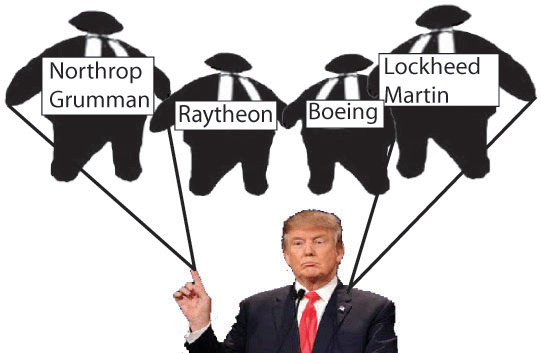
Trump Goes Nuclear, But This Time Lockheed, Northrop, Raytheon Rise http://www.investors.com/news/trump-tweets-about-nukes-after-blasting-pentagon-spending/GILLIAN RICH President-elect Donald Trump tweeted about the importance of the U.S. nuclear arsenal, which will cost hundreds of billions of dollars to recapitalize, potentially giving defense giants like Lockheed Martin (LMT), Northrop Grumman (NOC), Raytheon (RTN) and Boeing (BA) some hope that he won’t cost-shame them on that piece of the Pentagon budget America’s nuclear triad of air-, land- and sea-based delivery systems is nearing the end of its life span and needs to be replaced. But that won’t come cheaply.
Over the summer, the Air Force released its requests for proposals for intercontinental ballistic missiles to replace Boeing’s aging Minuteman system. The Ground-Based Strategic Deterrent’s estimated cost is $62 billion over 30 years, but a report from the Pentagon’s office of independent cost assessment said the Air Force’s estimate is too low by “billions of dollars,” sources told Bloomberg.
The Air Force is also seeking Long-Range Standoff nuclear cruise missiles to replace Boeing AGM-86B Air-Launched Cruise Missiles. That program’s cost has been estimated at $20 billion-$30 billion.
Boeing, Raytheon, Northrop and Lockheed are expected to bid on the two contracts, and initial contracts could be awarded next year.
Last year, Northrop was awarded a contract to build the B-21 bomber that replaces the Cold War-era Boeing B-52s. The Air Force has put the development-phase cost for the B-21 at $23.5 billion, but analysts have estimated the total acquisition cost at up to $80 billion. The Navy’s program to replace its Ohio-class submarines, which can launch nuclear missiles, will cost the service $100 billion.
Shares of defense contractors reversed higher after early, narrow losses. Lockheed shares edged up 0.1% on the stock market today, Northrop added 0.3%, and Raytheon rose 0.5%. Boeing gained 0.1%. General Dynamics (GD) and Huntington Ingalls (HII), which build submarines, were up 0.3% and 2.1%, respectively.
Congress scrapped this one word from the law, opening the door to a space arms race, L.A. Times, David Willman, 22 Dec 16, By removing a single word from legislation governing the military, Congress has laid the groundwork for both a major shift in U.S. nuclear defense doctrine and a costly effort to field space-based weaponry.
Experts say the changes, approved by overwhelming majorities in both the House and Senate, could aggravate tensions with Russia and China and prompt a renewed nuclear arms race. The bill awaits action by President Obama. The White House has not said what he will do.
For decades, America’s defense against nuclear attack has rested on twin pillars: The nation’s homeland missile defense system is designed to thwart a small-scale, or “limited,” attack by the likes of North Korea or Iran. As for the threat of a large-scale strike by China or Russia, the prospect of massive U.S. retaliation is supposed to deter both from ever launching missiles.
Central to this strategy was a one-word qualifier – “limited” — used to define the mission of the homeland defense system. The language was carefully crafted to avoid reigniting an arms race among the superpowers.
Now, with virtually no public debate, bipartisan majorities in Congress have removed the word “limited” from the nation’s missile defense policy. They did so in giving final approval over the last month to the year-end defense bill, the National Defense Authorization Act.
A related provision of the law calls for the Pentagon to start “research, development, test and evaluation” of space-based systems for missile defense.
A space-based defense program would hinge on annual congressional appropriations and decisions by the incoming Trump administration.
Yet both proponents and opponents say the policy changes have momentous implications.
“These amendments were historic in nature — given the paradigm shift forward that they represent,” said Rep. Trent Franks (R-Ariz.), who introduced and shepherded the amendments in the House.
Leading defense scientists said the idea that a space-based system could provide security against nuclear attack is a fantasy.
“It defies the laws of physics and is not based on science of any kind,” said L. David Montague, a retired president of missile systems for Lockheed Corp. and co-chair of a National Academy of Sciences panel that studied missile defense technologies at the request of Congress.
“Even if we darken the sky with hundreds or thousands of satellites and interceptors, there’s no way to ensure against a dedicated attack,” Montague said in an interview. “So it’s an opportunity to waste a prodigious amount of money.”
He called the provisions passed by Congress “insanity, pure and simple.”
The National Academy study, released in 2012, concluded that even a bare-bones space-based missile defense system would cost about $200 billion to put in place, and hundreds of billions to operate in subsequent years.
Franks, asked whether the country could afford it, replied: “What is national security worth? It’s priceless.”
Philip E. Coyle III, a former assistant secretary of Defense who headed the Pentagon office responsible for testing and evaluating weapon systems, described the notion of a space-based nuclear shield as “a sham.”
“To do this would cost just gazillions and gazillions,” Coyle said. “The technology isn’t at hand — nor is the money. It’s unfortunate from my point of view that the Congress doesn’t see that.”
He added: “Both Russia and China will use it as an excuse to do something that they want to do.”
The word “limited” has guided U.S. policy since the National Missile Defense Act of 1999. The qualifier reflects, in part, the reality that intercepting and destroying incoming warheads is supremely difficult, and that it would be impractical to field enough interceptors to counter a large-scale attack. Any such system, by its very nature, would be limited.
The first of his amendments — to eliminate “limited” from U.S. policy — was approved in April by the House Armed Services Committee with no debate and without a recorded roll-call vote.
At a committee hearing May 17, a senior Democrat on the panel, Rep. Jim Cooper of Tennessee, offered mild protest.
“I think it was a mistake to mandate a poorly thought out, unaffordable and unrealistic missile defense policy, including plans for a space-based missile deterrent,” Cooper said.
But neither Cooper nor any other House Democrat sought to overturn the provisions, and he was among those who voted to pass the overall bill the next day……..
In June, Sen. Ed Markey (D-Mass.) sought to restore “limited,” saying that the change in U.S. policy would create “the impetus for a new arms race” with Russia and China. Markey offered an amendment on the Senate floor but could not muster enough support to bring it to vote.
The same month, the Obama administration criticized the changes in the Senate bill, saying it “strongly objects” to removing “limited” and to placing anti-missile weaponry in space. The statement stopped short of threatening a veto.
The policy changes were greeted with opposition from another quarter as well. At a congressional hearing in April, Franks pressed Vice Adm. James D. Syring, director of the Missile Defense Agency, for his stance on expanding U.S. capability into space.
I’m a scientist who has gotten death threats. I fear what may happen under Trump. Michael E. Mann, The Washington Post, December 18, 2016 Michael E. Mann is a professor of atmospheric science and director of the Earth System Science Center at Penn State University.
My Penn State colleagues looked with horror at the police tape across my office door.
I had been opening mail at my desk that afternoon in August 2010 when a dusting of white powder fell from the folds of a letter. I dropped the letter, held my breath and slipped out the door as swiftly as I could, shutting it behind me. First I went to the bathroom to scrub my hands. Then I called the police.
It turned out to be only cornstarch. And it was just one in a long series of threats I’ve received since the late 1990s, when my research illustrated the unprecedented nature of global warming, producing an upward-trending temperature curve whose shape has been likened to a hockey stick.
I’ve faced hostile investigations by politicians, demands for me to be fired from my job, threats against my life and even threats against my family. Those threats have diminished in recent years, as man-made climate change has become recognized as the overwhelming scientific consensus and as climate science has received the support of the federal government. But with the coming Trump administration, my colleagues and I are bracing for a renewed onslaught of intimidation, from inside and outside government. It would be bad for our work and bad for our planet.
Donald Trump, of course, famously dismissed global warming as a Chinese hoax and “a big scam for a lot of people to make a lot of money.” This month he framed his position on climate change as “nobody really knows – it’s not something that’s so hard and fast.” He has vowed to cancel U.S. participation in the Paris climate agreement and threatened to block the Clean Power Plan, a measure to reduce carbon emissions in the power sector.
The strong anti-science bent of his advisers is similarly ominous. Among the members of his Environmental Protection Agency transition team are some of the most notorious climate change deniers. One adviser has threatened to cut NASA’s entire climate research program, disparaging it, with no apparent sense of irony, as “heavily politicized.”………
We are afraid that four (possibly eight) years of denial and delay might commit the planet to not just feet, but yards, of sea level rise, massive coastal flooding (made worse by more frequent Katrina and Sandy-like storms), historic deluges, and summer after summer of devastating heat and drought across the country.
We also fear an era of McCarthyist attacks on our work and our integrity. It’s easy to envision, because we’ve seen it all before. We know we could be hauled into Congress to face hostile questioning from climate change deniers. We know we could be publicly vilified by politicians. We know we could be at the receiving end of federal subpoenas demanding our personal emails. We know we could see our research grants audited or revoked.
I faced all of those things a decade ago, the last time Republicans had full control of our government………
I’ve also come under pressure at the state level. In Pennsylvania, an organization funded by conservative Richard Mellon Scaife persuaded Republican state senators to threaten to hold my university’s funding hostage until “appropriate action” was taken against me. In Virginia, then-Attorney General Ken Cuccinelli, a tea party Republican, accused me of fraud and sued the University of Virginia for all my personal emails from when I was teaching there. When Cuccinelli was unsuccessful, a Koch brothers-funded front group attempted to sue for the same emails. That effort, too, was ultimately blocked by the Virginia Supreme Court, which ruled that unpublished research should be protected in the interest of academic freedom.
In all, I’ve been through roughly a dozen investigations prompted by climate change deniers. Each time, I’ve been exonerated: Investigators find my methods are sound, my data is replicable and my lab is run responsibly. But by then, much time has been lost, expense has been incurred, and abuse and vilification has been endured on my part.
And then there have been the threats of violence. I’ve received email warnings that “the public will come after you,” suggesting that I’ll find myself “six feet under” and hoping to read that I had “committed suicide.”
Such threats could spike again under a president and Congress hostile to climate science. As we’ve seen recently, a segment of Americans is receptive to fake news, and some are eager to act on it. Wild conspiracy theories have propelled a woman to make death threats against the parent of a child killed at Sandy Hook Elementary and motivated a man to discharge an assault rifle in a family pizza restaurant in Washington.
I fear the chill that could descend. I worry especially that younger scientists might be deterred from going into climate research (or any topic where scientific findings can prove inconvenient to powerful vested interests). As someone who has weathered many attacks, I would urge these scientists to have courage.
The fate of the planet hangs in the balance.
Michael E. Mann is a professor of atmospheric science and director of the Earth System Science Center at Penn State University. He co-authored, with Washington Post cartoonist Tom Toles, “The Madhouse Effect: How Climate Change Denial Is Threatening Our Planet, Destroying Our Politics, and Driving Us Crazy.” http://www.sfgate.com/opinion/article/I-m-a-scientist-who-has-gotten-death-threats-I-10804229.php
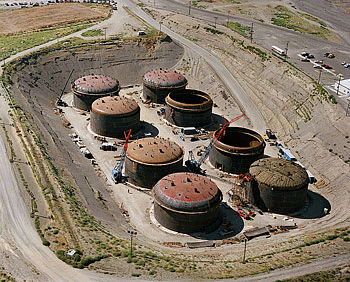
The price tag for cleaning up nuclear waste at Hanford site just went up another $4.5 billion LA Times, 16 Dec 16 Ralph VartabedianContact ReporterThe U.S. Energy Department said Friday that its long-troubled attempt to build a plant to process highly radioactive sludge at a former nuclear weapons site in central Washington state will cost an additional $4.5 billion, raising the project’s price tag to $16.8 billion.
The Hanford treatment plant, a small industrial city with some two dozen facilities on a desert plateau along the Columbia River, is more than a decade behind schedule and will cost nearly four times the original estimate made in 2000.
The government aims to transform 56 million gallons of deadly sludge stored in leaky underground tanks into solid glass, which theoretically could then be stored safely for thousands of years.
But the effort has involved an extended history of errors, miscalculations and wrongdoing. The result has been a massive, partially built concrete facility that has been under a stop-work order for three years because of serious technical doubts.
The biggest technical problems involve two giant facilities, a melter building for high-level radioactive waste and a pretreatment building to prepare the sludge for chemical processing.
After an exhaustive technical review, the Energy Department at the beginning of this year ordered fixes for more than 500 problems, some of them fundamental design deficiencies at the melter. Construction of the building and equipment was 78% complete at the time of the review.
And in November, the Justice Department settled a False Claims Act suit against two major contractors at the plant, San Francisco-based Bechtel Corp. and AECOM, an engineering, design and construction management company based in Los Angeles. The allegations originally were brought by three engineers at the plant, who had long raised concerns that the fundamental design of the plant was flawed. The two companies agreed to pay $125 million in damages, a portion of which will be awarded to the three whistle-blowers……..
outside watchdogs say the giant cost increase could jeopardize the cleanup at a time when the incoming president, Donald Trump, has already sharply criticized high-cost government projects and contracts.
Tom Carpenter, executive director of the Hanford Challenge, which has helped whistle-blowers disclose problems at the site, said the new cost estimate puts a target on the plant that could lead the Energy Department to begin searching for lower-cost and less safe solutions to the waste problem.
One potential lower-cost remedy at Hanford, which has been used at other former nuclear waste sites, would be to pour concrete into the tanks to solidify the waste and then simply leave it in place. The risk is that the concrete might eventually break down, leak radioactivity into the groundwater and contaminate the Columbia River about seven miles away, Carpenter said.
“There are a lot of question marks about the fate of this facility,” Carpenter said.
The revised plan disclosed Friday is part of an effort to get the waste treatment plant started up sooner, though the estimated delay for full operational status seems to be growing.
In 2013, then-Energy Secretary Steven Chu stopped most construction on the project after a whistle-blower warned about a potential for explosion from accumulated hydrogen gas in the melter tanks. In an effort to get the cleanup moving again, Chu’s successor, Ernest J. Moniz, ordered that some of the lower-level waste be solidified without any pretreatment — a so-called direct feed system — and on a faster schedule at the low-level melter.
The early processing could begin in 10 years or less, but the full capability for the most highly radioactive sludge that requires the high-level melter is now scheduled for a 2036 start-up, some 20 years past the original schedule, Carpenter said.
Duke Energy may take handguns from security at nuclear plants,wsoctv.com by: Paul Boyd Dec 18, 2016 CHARLOTTE, N.C. – Two Duke Energy insiders said they’re risking their jobs to speak out about a proposal aimed at taking handguns away from nuclear security officers.
Duke Energy operates six nuclear power plants in the Carolinas. They’re among the most highly secured and fortified facilities in the country.
Terrorist groups consider nuclear power plants high-value targets.
“We’re only there for one reason. To stop a breach into that plant,” one of the nuclear security officers said.We’ve hidden the faces and altered the voices of the security officers in our report.
They agreed to speak to Whistleblower 9 because of what they feel is an imminent safety threat — a Duke Energy proposal to take away their handguns.”If they take these weapons away, they’re not providing what we need to protect these plants,” one officer said.
“Taking away the handgun would provide us with zero backup. It’s a safety issue. It’s an officer safety issue,” the other officer said. Rifles are the nuclear security officer’s primary weapon but they say their handguns are a crucial backup weapon if a rifle jams or fails.”In this day and time with the terrorist activity escalating, taking away half of our weapons platform — that is ludicrous,” one officer said.
Channel 9 confirmed a proposal is in place to take away the security guard’s handguns. We obtained an internal document from Duke Energy that reads “efficiency bulletin” and “handgun elimination” for nuclear security officers.
Karen Gay Silkwood (February 19, 1946 – November 13, 1974) was an American chemical technician and labor unionactivist known for raising concerns about corporate practices related to health and safety of workers in a nuclear facility. Following her mysterious death, which received extensive coverage, her estate filed a lawsuit against chemical company Kerr-McGee, which was eventually settled for $1.38 million. Silkwood was portrayed by Meryl Streep in Mike Nichols‘ 1983 Academy Award-nominated film Silkwood.
She worked at the Kerr-McGeeCimarron Fuel Fabrication Site plant near Crescent, Oklahoma, United States. Silkwood’s job was making plutoniumpellets for nuclear reactor fuel rods. This plant experienced theft of plutonium by workers during this era. She joined the union and became an activist on behalf of issues of health and safety at the plant as a member of the union’s negotiating team, the first woman to have that position at Kerr-McGee. In the summer of 1974, she testified to the Atomic Energy Commission about her concerns.
For three days in November, she was found to have plutonium contamination on her person and in her home. That month, while driving to meet with David Burnham, a New York Times journalist, and Steve Wodka, an official of her union’s national office, she died in a car crash under unclear circumstances.
Her family sued Kerr-McGee on behalf of her estate. In what was the longest trial up until then in Oklahoma history, the jury found Kerr-McGee liable for the plutonium contamination of Silkwood, and awarded substantial damages. These were reduced on appeal, but the case reached the United States Supreme Court in 1979, which upheld the damages verdict. Before another trial took place, Kerr-McGee settled with the estate out of court for US $1.38 million, while not admitting liability. https://en.wikipedia.org/wiki/Karen_Silkwood
Questions Still Remain In Suspicious Death Of Karen Silkwood
Scientists backing up climate data over fears it could be erased under Donald Trump, ABC News 14 Dec 16Scientists in the United States are making copies of federal climate and environmental data over fears it could be erased under Donald Trump’s administration.
The mass action — being coordinated by the University of Pennsylvania’s Program in the Environmental Humanities (PPEH Lab) — has been dubbed a “data rescue” and has brought together academics from across the country and in neighbouring Canada.
It aims to safeguard data “vulnerable under an administration which denies the fact of ongoing climate change” by storing it on an independent server. Researchers are also collating a spreadsheet of the research they deem to be at risk once the President-elect takes office on January 20.
In a statement, Mr Pruitt was described as “a national leader against the EPA’s job-killing war on coal”.
In a piece for The Washington Post, Holthaus yesterday wrote that archiving climate data was “an extraordinary step to have to take, but we live in an extraordinary moment”.
In 1968, a B-52 Bomber Crashed (With 4 Super Lethal Nuclear Weapons Onboard That ‘Exploded’) The National Interest, Matthew GaultDecember 15, 2016 Throughout the 1950s and ’60s American bombers carrying nuclear weapons crisscrossed the globe, ready at a moment’s notice to fly into the heart of Russia and bomb it back to the stone age. Strategic Air Command — a now defunct branch of the U.S. Air Force — commanded this airborne alert force.
It was once the pride of the American military. For more than a decade, SAC bombers were no more than 15 minutes from nuking Russia. But the shifts on the bombers were long — sometimes more than 24 hours — and keeping such an alert force ready was taxing on pilots and crew.
There were many accidents.
In 1958, a B-47 carrying a nuke collided with an F-86 Sabre in the skies above Savannah, Georgia. The B-47 jettisoned its nuclear payload into the Atlantic Ocean. Authorities never recovered the bomb.
Months later, another B-47 dropped its nuke over South Carolina when a bomb technician aboard accidentally activated the emergency release. The bomb’s conventional explosives detonated and destroyed a nearby house.
In 1966, a B-52 crashed in Spain, spilling the nuclear guts of two bombs onto nearby farms. After the accident, Spain halted nuclear-armed American planes from passing through its air space.
Those were bad, but SAC and its airborne alert survived them. Then, in 1968, a B-52 crashed near Thule Monitoring Station in Greenland and spilled its payload all over the ice. It was one disaster too many, and it signaled the end of America’s airborne alert program … and Strategic Air Command’s prestige……..
The Arctic’s climate is harsh and the radar station was fragile. Outages were frequent, and SAC needed redundancy to ensure that it didn’t attack Moscow just because it lost contact with Thule.
So SAC did what it always did. It strapped some nukes on a bomber. The air command sent one of its airborne alert bombers — complete with live nukes — to fly above the Thule monitoring station 24 hours a day … forever.
It seemed silly to keep live nukes in the air above the world’s head all day, every day. It was a sword of Damocles and it dropped in 1968.
On Jan. 21, 1968, fire swept through the cabin of the airborne B-52 watching Thule station. Smoke and flames consumed the plane and the seven crew members ejected. Six survived. The bomber crashed into an ice cap in the bay near the base.
The conventional explosives in the plane’s four hydrogen bombs exploded and cracked their nuclear payloads. Radioactive elements slid out of the bombs and onto the ice.
SAC’s Operation Chrome Dome was already on its last legs. The Thule accident just confirmed what many politicians and military leader already thought — keeping a fleet of nuclear-armed bombers in the air at all times was dangerous and insane……….
Only one of the B-52’s crew died during the Thule disaster, but his death wasn’t the end of the tragedy. The hydrogen bombs spread jet fuel and radioactive materials across the ice cap. It busted up the flow of the sea, blackened the ice and spread plutonium, uranium, americium and tritium into the ice and water……..
the Danish workers who helped clean up the site are dying of cancer. Crested Ice was a rush job done under pressure from the international community, and its leadership cut corners. American and Danish workers didn’t have the protective gear they needed to work with the radioactive materials.
The Danes tried to sue the United States for compensation and 1987, but failed. In 1995, Copenhagen paid a settlement to 1,700 members of the crew. Crested Ice, the plight of its workers and the possibility that America left contaminated material behind is a recurring story in the Danish press to this day……..This first appeared in WarIsBoring here. http://nationalinterest.org/blog/the-buzz/1968-b-52-bomber-crashed-4-super-lethal-nuclear-weapons-18746
The Nuclear Regulatory Commission says Friday that the renewal is through March 20, 2045.
Fermi 2 is in Frenchtown Township, southwest of Detroit. The power plant’s license was issued in 1985 and was valid through March 20, 2025.
DTE Energy submitted the renewal application in 2014.
The extension approval was put on hold late last month after an activist group encouraged the Nuclear Regulatory Commission to look more closely into how potassium iodide pills would be given to area residents if the plant ever has a major release of radioactive steam.
On December 20, the Georgia Public Service Commissioners will decide whether to put utility customers on the hook for cost increases while rewarding Georgia Power and its partners for the bungled expansion of nuclear Plant Vogtle. The Commissioners are considering a settlement that approves all costs spent-to-date ($3.68 billion) on the two reactors and pre-approval of an additional $2 billion in yet-to-be-spent capital costs. Watch a new TV INTERVIEW with SACE staff here.
The PSC Commissioners need to hear from Georgia Power customers about this out-of-control nuclear boondoggle!
Despite having only 36 percent of construction complete more than seven years into the project, the water-intensive Vogtle reactors along the Savannah River are likely 45-months delayed and Georgia Power’s estimated costs have increased by over $2 billion.
Once-projected “benefits” have completely disappeared. Since 2011, over $1.8 billion has been collected from Georgia Power customers for financing costs charged in advance due to anti-consumer state legislation.
Now a proposed settlement offers Georgia Power a sweetheart deal – Vogtle’s costs will increase significantly and the majority of the burden will fall on the Company’s customers, not shareholders.
The PSC Commissioners need to hear from you TODAY! Find more information here. Help spread this action on social media by sharing on Facebook or Twitter.
Contact the Commissioners before December 20, 2016 and reference “Docket#29849 – Vogtle Supplemental Information Report.”
U.S. looks for potential issues linked to falsified French nuclear documents Reuters, 14 Dec 16U.S. nuclear regulators are investigating whether the suspected falsification of documents at French nuclear power company Areva SA, which supplies components for reactors globally, poses any problems at U.S. nuclear plants……..
France’s Nuclear Safety Authority, or ASN, requested a probe of Le Creusot in early May after a flaw was discovered in the vessel of a reactor under construction in Flamanville in France.
Areva checked the records of Le Creusot and found anomalies associated with about 400 parts manufactured there since the plant opened in 1965. Areva purchased the forge in 2006.
One U.S. plant with parts from Le Creusot is Dominion Resource Inc’s Millstone station in Connecticut, which has had a pressurizer from the French forge in service in Unit 2 since 2006.
Dominion spokesman Ken Holt said that when Areva manufactured the pressurizer for Millstone they performed some additional heat treatment, but did not tell Dominion……
Another plant that may be affected is FirstEnergy Corp’s Beaver Valley station in Pennsylvania. Beaver Valley has steam generators and reactor vessel heads manufactured by Spain’s Equipos Nucleares SA, or ENSA, which FirstEnergy said may contain some subcomponents from Le Creusot.
“The audit is still underway but at this point in time there have not been any identified issues with quality or safety of any components at our plants,” FirstEnergy spokeswoman Jennifer Young said.
DISEASES ACKNOWLEDGED BY THE UNITED STATES GOVERNMENT TO BE CAUSED BY PARTICIPATION IN ATMOSPHERIC TESTING OF NUCLEAR WEAPONS, Paul Langley’s Nuclear History Blog, 2 Jan 2012
Leukaemia (other than chronic Iymphocytic leukaemia)
Cancer of the Thyroid
Cancer of the Breast
Cancer of the Pharynx
Cancer of the Oesophagus
Cancer of the Stomach
Cancer of the small intestine
Cancer of the Pancreas
Multiple Myeloma
Lymphomas (except Hodgkinís disease)
Cancer of the Bile Ducts
Cancer of the Gall Bladder
Cancer of the liver (except if cirrhosis or hepatitis indicated)
Cancer of the urinary tract, which also translates to the bladder and kidneys
Cancer of the salivary glands
Incorporated into public law 100-321, 20.5.88.
“This law gives US atomic exservicemen due recognition for the unusual service they rendered, and is an expression of gratitude of the American people toward their atomic veterans The law enables Veteran Affairs benefits to flow to US atomic veterans who are afflicted. The US government m relation to nuclear veterans considers the nature of service plus the development of any of the above diseases sufficient cause to quality for Veteran Benefits regardless of recorded dose rates received. All US nuclear test service personnel are officially Veterans.” http://nuclearhistory.wordpress.com/2011/12/31/diseases-acknowledged-by-the-united-states-government-to-be-caused-by-participation-in-atmospheric-testing-of-nuclear-weapons/
Utility regulator wants nuclear energy to count as renewable, The Daily Progress, PHOENIX (AP) 13 Dec 16 — Arizona’s utility regulator has suggested that nuclear energy should count as a renewable power source, allowing it to compete with solar and wind.
Environmental advocates don’t generally consider nuclear power plants renewable because the uranium that fuels them must be mined, reported The Arizona Republic (http://bit.ly/2hitoC0 ). Utility regulator Andy Tobin proposed the change in a letter that implies he never supported the Renewable Energy Standard the state passed in 2006, which didn’t include nuclear energy as a renewable source.
Trump says ‘nobody really knows’ if climate change is real, WP, By Juliet EilperinDecember 11 President-elect Donald Trump said Sunday that “nobody really knows” whether climate change is real and that he is “studying” whether the United States should withdraw from the global warming agreement struck in Paris a year ago.
There is a broad scientific consensus that human activity — including the burning of fossil fuels for transportation, heating and industrial manufacturing — is driving recent climate change. In its most recent report, the Intergovernmental Panel on Climate Change concluded that it is “extremely likely” that, since the 1950s, humans and their greenhouse gas emissions have been the “dominant cause” of the planet’s warming trend. The top 10 hottest years on record have all been since 1998, and 2016 is expected to be the hottest year since formal record-keeping began in 1880.
But it’s not the first time that Trump has disregarded that established scientific view.
Sen. Martin Heinrich called former Texas Governor Rick Perry “utterly unqualified” to lead the Department of Energy, while Sen. Tom Udall said he was “disappointed” by the selection.
Heinrich noted that those who work at the national labs in New Mexico are affected by the Department of Energy, and called the department “New Mexico’s economic lifeblood.”
Udall also mentioned that most of the DOE budget is earmarked for “its solemn and critical responsibilities regarding our nation’s nuclear security.”
Udall brought up Los Alamos National Lab and Sandia National Labs as the “crown jewels of our nuclear security complex,” as well as the Waste Isolation Pilot Plant in southeast New Mexico.
“New Mexico is also home to the Waste Isolation Pilot Plant, the nation’s only deep geologic facility that disposes of weapons-related nuclear waste, which is closed due to a radiological accident and still faces a difficult road to recovery,” Udall said. “To win the confidence of the American people and the Senate, Gov. Perry will need to demonstrate a strong understanding of these complex challenges and lay out a management vision to execute the difficult tasks before the department.”
Heinrich had a similar message.
President-elect Trump has signaled his blatant hostility to the Department and the workforce at our National Labs by nominating someone who has proposed eliminating this entire agency,” Heinrich said. “I’m not confident that Rick Perry is fully cognizant of the role that DOE plays in keeping our nuclear deterrent safe, secure and reliable.”
During his own failed presidential campaign in 2011, Perry famously said he wanted to eliminate three agencies. When naming them during a debate, he forgot the third, the Department of Energy—the very same agency that the president-elect is choosing him to lead.