Could Donald Trump help unleash nuclear catastrophe with a single tweet?, Canberra Times, Greg Sargent , 27 Dec 16, Donald Trump’s alarming tweet about his desire to “greatly strengthen and expand” the “nuclear capability” of the US unleashed a frenzy of media efforts to try to divine his actual policy intentions. It forced some of his advisers into tortured claims that Trump didn’t say what he actually said, even as others simultaneously insisted that Trump did meaningfully put other countries on notice that if he deems them to be challenging our supremacy, they will face an arms race.
But perhaps the most worrisome thing about Trump’s nuclear tweet is not the intention to break with decades of international disarmament efforts that it may have signalled, though that’s frightening enough on its own. Rather, it’s that he saw fit to tweet about nuclear weapons at all.
As we prepare for President Trump to take near-unchecked control of our nuclear machinery, his nuclear tweet is best seen as a window into his temperament. Trump still does not appreciate that every word he utters carries tremendous weight and could have dramatic, untold, far-reaching, unpredictable consequences – something that is especially true in the nuclear arena. Or, perhaps worse, Trump may be entirely indifferent to this fact.
Arms control experts I spoke with suggested that Trump’s willingness to tweet about nuclear weapons raises the possibility of Trump doing the same as president – and more to the point, the possibility of him doing so amid some species of international crisis or escalation………
As we prepare for President Trump to take near-unchecked control of our nuclear machinery, his nuclear tweet is best seen as a window into his temperament. Trump still does not appreciate that every word he utters carries tremendous weight and could have dramatic, untold, far-reaching, unpredictable consequences – something that is especially true in the nuclear arena. Or, perhaps worse, Trump may be entirely indifferent to this fact.
Arms control experts I spoke with suggested that Trump’s willingness to tweet about nuclear weapons raises the possibility of Trump doing the same as president – and more to the point, the possibility of him doing so amid some species of international crisis or escalation……
Bernie Sanders urges Congress to stop Donald Trump launching nuclear arms raceDemocrat speaks out after President-elect appears to reverse decade’s-old policy of disarmament, The Independent, Charlotte England@charlottenglandSaturday 24 December 2016Bernie Sanders has urged Congress to stop Donald Trump launching a Cold War-style nuclear arms race.
“It’s a miracle a nuclear weapon hasn’t been used in war since 1945,” the VermontSenator said in a post on Twitter. “Congress can’t allow the Tweeter in Chief to start a nuclear arms race.”
Earlier on Friday, the US President-elect was asked to clarify the meaning behind an ambiguous tweet in an interview with MSNBC. “Let it be an arms race,” he is reported to have told co-host Mika Brzezinski,in a telephone call……..
Laicie Heeley, a nuclear expert at the Stimson Center, a nonpartisan anti-nuclear proliferation think-tank in Washington, told AFP news agency it was “reckless” for Mr Trump to tweet on the topic without offering details.
“To make such a loaded statement without context or follow-up is irresponsible at best,” she said.
“We could be talking about a return to the Cold War here, when the threat of a nuclear catastrophe was very real,“ she said. ”Russian rhetoric is already moving in that direction. It wouldn’t take a lot to bring us back there.”
Minutes after Mr Trump’s follow up remarks were reported on MSNBC, his secretary Sean Spicer said in several television interviews that there would be no arms race because the President-elect would make sure that other countries trying to step up their nuclear capabilities, such as Russia and China, would decide not to participate.
Alex Smith, Radio Ecoshock, 22 Dec 16 The fossil fuel industry, and their paid climate deniers, have taken control of the government of the United States. Russia, another major world supplier of oil and gas, played it’s part, raiding the servers of the Democratic Party, the Democratic Candidate, and their campaign Chair.
As a result, scientists at the recent meeting of the American Geophysical Union are gathering to protect their data, and likely many of their jobs. Our first guest Joerg Schaefer came from his training in Germany and Switzerland for the brightest minds and best technology to analyze and predict climate change. Now all that is in doubt.
There are several movements in science to make copies of key climate databases and models, to get them out of the country before the climate killers take control.
But even this misses another threat. Climate science depends on long strings of dependable records. Weather comes and goes, but climate is understood decade by decade, through centuries, and even millions of years. The United States, through it’s network of satellites, ocean buoys, and research ships provides a great deal for scientists in many countries. If there is a break in those critical records, even for four years, or heaven forbid, eight – then we’ll know less, and be less prepared. Less prepared for the biggest shift in human affairs in the whole time we have been on this planet.
The great but slow movement to get off fossil fuels will continue. Citizens will continue to install solar panels, the price will continue to drop. While Donald Trump may subsidize the coal industry, and get a mine or two going, nobody wants to go back to coal. It cost more than renewable energy, or gas, even without a price on carbon. America might as well go back to making horse carriages, or the original Apple computers. Trying to rebuild a coal industry is just going to waste money and time.
We don’t have that time. Each and every scientist you’ve heard on Radio Ecoshock this fall has brought out another feed-back, a greater climate sensitivity, more reasons why we have to cut carbon emission drastically, ideally starting 20 years ago. As our guest Kevin Anderson from the Tyndall Center told us, the next four years are critical.
Can we stop Greenland from reverting to the bare rock it knows best? Can we save the remaining Arctic sea ice, to stabilize the weather further south, where most of you live? Can we prevent methane geysers from the sea floor? Can we slow deglaciation in Antarctica until we find a way to remove greenhouse gases from the atmosphere?
All this may be up to the rest of the world, while America enters bizarro world, the place where foxes guard the hen-house. Or the responsibility may go back where it really belongs: into our own homes, lives and lifestyles. If we can’t count on the big father of national governments, the future returns to us. Prepare to organize. Prepare to act, to save ourselves and Nature…… http://www.ecoshock.org/2016/12/greenland-melt-japanese-meltdown-conspiracy.html
Trump claims NBC ‘purposely’ misquoted nuclear comments, Politico, By CRISTIANO LIMA, 12/24/16
President-elect Donald Trump claimed Saturday that NBC News “purposely” misquoted his call for an expansion of the U.S. nuclear program earlier this week, despite reports to the contrary.
Trump on Thursday said the United States “must greatly strengthen and expand its nuclear capability until such time as the world comes to its senses regarding nukes.” Saturday he accused NBC of intentionally leaving out the latter, more measure portion of his statements……..
NBC News’ initial report covering Trump’s comments on nuclear expansion, however, cited his comments in full. And the Thursday broadcast of NBC’s “Nightly News with Lester Holt” displayed his comments in their entirety.
Trump’s claim of dishonesty in media coverage has been a calling card of his ascendance to the White House. Since winning the presidency, Trump has repeatedly attacked the media, broadly accusing them of inciting violence against him, singling out individual reporters and blasting the press as “crooked.”……http://www.politico.com/story/2016/12/donald-trump-nbc-nuclear-232960
A tense new battle over nuclear arms erupts between Donald Trump and his staff, WP By Philip BumpDecember 23It began, it seems, with a speech from Vladimir Putin on Thursday, during which the Russian president argued that his country’s nuclear arsenal needed to be upgraded. In short order a tense two-day stand-off began — between Donald Trump and the communications staffers on his transition team.
Trump weighs in.
Trump’s initial comment about nuclear proliferation was clear in its intent if vague in its boundaries.
“The United States must greatly strengthen and expand its nuclear capability” is not subtle, implying that as president Trump aims to match whatever it is that Russia does. That, as we pointed out on Thursday, means a new nuclear arms race, contravening decades of American foreign policy.
His team pushes back.
Not so fast, though. On Thursday afternoon, transition spokesman Jason Miller sent out a statement about Trump’s declaration.
“President-elect Trump was referring to the threat of nuclear proliferation and the critical need to prevent it—particularly to and among terrorist organizations and unstable and rogue regimes,” Miller wrote in an email to The Post. “He has also emphasized the need to improve and modernize our deterrent capability as a vital way to pursue peace through strength.”
“[T]he threat of nuclear proliferation and the critical need to prevent it” is language that comports with existing policy — but it does not comport with what Trump himself said. The word “expand” is hard to avoid, but in the spirit of generosity one might allow that the president-elect misspoke on Twitter.
Trump suggests he meant what he said.
On MSNBC’s “Morning Joe” on Friday, co-host Mika Brzezinski reported on a conversation she’d had directly with Trump.
CO-HOST JOE SCARBOROUGH: The president-elect told you what?
BRZEZINSKI: “Let it be an arms race. We will outmatch them at every pass.”
SCARBOROUGH: “And outlast them all.”
BRZEZINSKI: “And outlast them all.”
SCARBOROUGH: OK. You can put that down as breaking news.
The conversation continued with the question of whether Trump was simply posturing in order to seem unpredictable. The Post’s David Ignatius, who was part of that discussion, noted that it was more likely that Trump was reverting to his old pattern: Being criticized for something he’d said and then doubling down on it in response.
The transition team assures us he didn’t mean what he said.
The conversation moved to NBC proper, where “Today” show host Matt Lauer spoke with Sean Spicer, recently identified as the incoming White House press secretary………
Trump questionnaire recalls dark history of ideology-driven science, Skeptical Science 21 December 2016 by By Paul N. Edwards, Professor of Information and History, University of Michigan,
President-elect Trump has called global warming “bullshit” and a “Chinese hoax.” He has promised to withdraw from the 2015 Paris climate treaty and to “bring back coal,” the world’s dirtiest, most carbon-intensive fuel. The incoming administration has paraded a roster of climate change deniers for top jobs. On Dec. 13, Trump named former Texas Governor Rick Perry, another climate change denier, to lead the Department of Energy (DoE), an agency Perry said he would eliminate altogether during his 2011 presidential campaign.
Just days earlier, the Trump transition team presented the DoE with a 74-point questionnaire that has raised alarm among employees because the questions appear to target people whose work is related to climate change.
For me, as a historian of science and technology, the questionnaire – bluntly characterized by one DoE official as a “hit list” – is starkly reminiscent of the worst excesses of ideology-driven science, seen everywhere from the U.S. Red Scare of the 1950s to the Soviet and Nazi regimes of the 1930s.
The questionnaire asks for a list of “all DoE employees or contractors” who attended the annual Conferences of Parties to the United Nations Framework Convention on Climate Change – a binding treaty commitment of the U.S., signed by George H. W. Bush in 1992. Another question seeks the names of all employees involved in meetings of the Interagency Working Group on the Social Cost of Carbon, responsible for technical guidance quantifying the economic benefits of avoided climate change.
It also targets the scientific staff of DoE’s national laboratories. Continue reading →
Women are breaking the climate taboo and questioning whether to have kids in such a world, Fusion, By Renee Lewis, 20 Dec 16, Climate change has caused a reproductive justice crisis, activists say, as its projected impacts lead some to question how they could have a baby with such an uncertain future.
Nearly 200 nations came together to sign a climate treaty in Paris last year, but even their collective efforts to reduce emissions will not be enough to keep the planet at a safe level of temperature rise.
All of these things point to a precarious future for our species—a business-as-usual scenario will mean some six feet of sea level rise and some regions of the world becoming uninhabitable or disappearing under rising seas by the end of the century.
With little time to spare, many are trying to take matters into their own hands and consider their options. A group of 21 youth recently sued the federal government for its role in creating the climate crisis and for leaving them to inherit a polluted planet—calling it generational injustice.
Others worry more about future generations.
“Decision makers have repeatedly put big business and fossil fuels over a future for our children,” said Meghan Kallman, co-founder of Conceivable Future. The women-led network hopes to bring awareness to the threat climate change poses to reproductive justice, and to end U.S. subsidies for the fossil fuel industry.
Kallman and co-founder Josephine Ferorelli brought up a taboo question—how this affects a person’s decision on whether or not to have kids.
“How does this affect people of childbearing age?” Kallman asked.
The response they’ve received has been overwhelming, with many people commenting on articles written about the group: ‘That’s my reason!’
Women as well as men are consciously deciding not to have children, knowing that their kids could inherit a future that is unlivable.
“People are still shocked when they ask why I don’t have children, and I tell them ‘for environmental reasons,’” Shannon O., 38 years old,said in a testimonial for Conceivable Future. Having a child, especially in America where consumption levels are so high, adds another carbon footprint. For example, an American woman who makes lifestyle changes such as recycling and driving a fuel-efficient car saves almost 500 tons of CO2 emissions in her lifetime. But choosing to not have a child would dwarf that, preventing almost 10,000 tons of CO2 from being emitted into the atmosphere………
The testimonies are part of Conceivable Future’s strategy to build a conversation—and a movement—around this question. Ferorelli said they hope the movement will become powerful enough to enact change at the local level—especially with Trump’s statements on expanding the fossil fuel industry.
“Now more than ever, we need to organize at the grassroots level, because the possibility of federal action is pretty severely limited,” Ferorelli said.
The group encourages anyone who’s interested in talking about these issues to host a house party. There, they can discuss these often taboo topics openly in a comfortable environment.
By Patrick M. Malone, Center for Public Integrity December 21, 2016
Altogether, the three companies making these settlement payments since 2013 are involved in the operation of six of the eight active sites in the Energy Department’s nuclear weapons program. Actions by the Energy Department’s contractors – including any misspending – have substantial impact there, since contract work consumes roughly 90 percent of its total spending.
Although work on energy generation and consumption garners more public attention and President-elect Donald Trump has nominated an oil-state politician – former Texas governor Rick Perry – to become the department’s new top manager, nuclear weapons-related work accounts for nearly two-thirds of all the Energy Department’s activities.
The latest case emerged from a civil lawsuit that accused two companies of both performing substandard work at a nuclear weapons-related waste site and said one of them had improperly spent government funds to lobby for more. The companies declared on Nov. 23 they would settle the allegations by making the payment, mostly to the federal government, for a total of $125 million, a massive amount for alleged Energy Department-related malfeasance.
The settlement involves work by Bechtel National Inc. and its parent Bechtel Corp., and URS Corp. and its subsidiary URS Energy and Construction Inc., which together have been trying to clean up the Hanford Nuclear Reservation near Richland, Washington. That’s where raw uranium was enriched into fuel for nuclear bombs during the Manhattan Project and the Cold War.
The firms have denied doing anything improper. But the settlement is part of an emerging pattern.
Lockheed Martin Corp., which operates one of three U.S. nuclear weapons laboratories – Sandia, agreed in August 2015 to pay $4.7 million to settle a complaint by the Justice Department that it used federal funds to lobby for a no-bid contract extension, while Fluor Corp. paid $1.1 million in April 2013 to settle accusations that it used federal funds to lobby government agencies for more business at its Hanford training facility.
Worries about the mission being underminedBesides overseeing the Hanford cleanup, Bechtel and URS (now owned by a company called AECOM) help operate the other two U.S. nuclear weapons labs — Los Alamos and Lawrence Livermore, which perform the bulk of U.S. nuclear weapons design work. Altogether, the firms that have reached the settlements since 2013 are involved with operations at Los Alamos and Sandia in New Mexico, Livermore in California, the Pantex Plant in Texas, the Savannah River Site in South Carolina, and the Y-12 National Security Complex in Tennessee.
The recent settlement “demonstrates that the Justice Department will work to ensure that public funds are used for the important purposes for which they are intended,” Benjamin C. Mizer, principal deputy assistant attorney general in charge of the Justice Department’s civil division, said in a written statement released on Nov. 23.
Money allocated by Congress for Hanford “is intended to fund the Department of Energy’s important mission to clean up the contaminated Hanford nuclear site, and this mission is undermined if funds are wasted on goods or services that are not nuclear compliant or to further lobbying activities,” Mizer said.
Both Bechtel and AECOM in written statements said the settlements were made to avoid messy litigation and keep the waste plant project moving. “We have performed our work…ethically and professionally,” Bechtel National Inc. spokesman Fred deSousa said in a written statement, without going into details.
In its own written statement, AECOM — which acquired URS in 2014 — complained that the Department of Justice joined the whistleblowers’ “unwarranted lawsuit against URS” based on events that preceded AECOM’s acquisition of the company. “We take our responsibilities as a government contractor very seriously and have a demonstrated track record of serving our customers with honesty and integrity,” the company’s statement said.
The Justice Department’s involvement in the case originated in civil allegations of mismanagement and wrongdoing in Hanford’s Waste Treatment and Isolation Plant project, commonly called “WTP.” Under its contract with the Energy Department, Bechtel designed and is constructing machinery to convert nuclear-tainted wastes there into a stable, glassy substance suitable for safe disposal.
Three whistleblowers — Walt Tamosaitis, Donna Busche and Gary Brunson — filed a lawsuit on Feb. 4, 2013, accusing Bechtel and URS bosses of mismanagement and misappropriation of funds over a dozen years that together cost the government more than $1 billion. They also said safety lapses at the site, motivated by a desire to meet Energy Department deadlines and collect financial bonuses, were serious enough to risk a nuclear accident.
The whistleblowers’ complaint triggered an investigation by the Energy Department’s Office of Inspector General, which collected emails sent between Bechtel’s project leaders, the company’s top congressional lobbyist for nuclear projects, and Energy Department employees. The whistleblowers’ attorneys subsequently obtained the emails through the civil discovery process and incorporated them into an amended complaint. The Justice Department, in turn, used the complaint as the basis for its own investigation of Bechtel and URS.
Getting $45 million in new work
In the complaint, the whistleblowers said that when they originally lodged accusations of mismanagement – several years earlier — Bechtel project leaders launched a coordinated lobbying campaign to defend itself and also to collect new revenues for additional work on the waste treatment plant project. It then billed the department for the costs of this lobbying, the complaint said.
In an email sent by one Bechtel manager to another — along with a chart detailing the work that the company could say the additional revenue would finance — the manager said “in reality if we did not receive the additional $50m … most of these activities would still likely happen,” according to the whistleblowers’ complaint. The company subsequently got $45 million added to its contract.
The full emails detailing these actions have not been publicly released, by either the government or the plaintiffs, because the messages are part of an investigation that remains “open and ongoing,” according to Felicia Jones, spokeswoman for the Energy Department Office of Inspector General. She declined to say whether her colleagues consider the whistleblowers’ description of the emails accurate.
The Justice Department’s statement affirmed that it had “alleged that Bechtel National Inc. and Bechtel Corp. improperly claimed and received government funding for lobbying activities.” But Justice Department spokeswoman Nicole Nava declined to comment about the whistleblower’s account of specific emails.
Lobbying Congress for new work isn’t against the law. But billing the government for lobbying is, according to the federal Byrd Amendment, approved by Congress in 1989. Court records state that Bechtel will pay $67.5 million of the settlement, and AECOM will pay $57.5 million; the amount of money that will go to the whistleblowers – who are entitled to a portion of any funds they help the government recover — has not been determined yet.
Charles Curtis, who oversaw the Energy Department’s nuclear weapons work from 1994 to 1997 while serving as undersecretary and then deputy secretary, said he was not aware of any improperly-funded lobbying during his tenure. But he expressed surprise that multiple contractors within the past three years have been caught doing it. “These are for-profit enterprises. They can use their shareholders’ money for lobbying, but to use congressionally appropriated money [is] a diversion of funds,” Curtis said. “It’s not only unethical … it’s illegal.”
Three years ago, it was the Fluor Corporation and its subsidiary Fluor Hanford Inc., which at the time held the contract to manage the Hanford site, that agreed to pay $1.1 million to settle a separate complaint that its officials lobbied with government money from 2005 to 2010 to drum up business for a federally funded training facility there. Loydene Rambo, a Fluor employee, triggered the settlement by filing her own whistleblower suit, based on what she described as records of the lobbyists being paid with federal funds. She received a $200,000 reward, and Fluor denied any wrongdoing.
The Justice Department’s August 2015 settlement with Lockheed Martin Corporation, which runs Sandia, similarly followed improper billing of the government for a more complex and elaborate lobbying effort to extend its management contract, according to a special investigation report released by the Energy Department Office of Inspector General. Lockheed agreed to pay $4.7 million in 2015 to settle the Justice Department’s complaint about the billing. Like Fluor before it and Bechtel and URS since, Lockheed Martin in a written statement denied it had done anything wrong.
Asked by the Center about how the lobbying settlements have affected the department’s relationship with its nuclear weapons contractors, Energy Department spokeswoman Bridget Bartol said in an email that “the Department has taken and will continue to take vigorous action against any contractor who spends federal funds on improper lobbying activities.”
Bechtel remains the primary contractor on the WTP project, and Lockheed Martin still holds the contract to operate Sandia National Laboratories.
Cleanup of the Hanford site was authorized 25 years ago, and as of 2000 it was expected to cost $4.3 billion and be completed in 2011. The Department now estimates it may not be fully operational until 2037, according to pleadings filed in federal court by government lawyers defending the Energy Department in a lawsuit brought by the state of Washington to force an acceleration of the cleanup. If the job is funded at its current level of about $690 million a year until 2037, the cost would exceed $15 billion.
President-elect Donald Trump’s transition team is mindful of the project’s problems and growing price tag. A recent memo to top Energy Department officials from the transition team he appointed asked them to describe “your alternatives to the ever increasing WTP cost and schedule, whether technical or programmatic.”
The Center for Public Integrity is a nonprofit, investigative newsroom in Washington, D.C. More of its national security reporting can be found here.
Donald Trump Is the Stock Market’s Most Interesting Man, Bloomberg, by Joseph Ciolli and
Lily Katz 23 Dec 16,
Uranium ETF surges right after post as underlying shares soar
Icahn pick moves stocks the investor has previously rebuked
Donald Trump’s still the most interesting man in the world for U.S. stock investors.
A Twitter post from the President-elect signaling support for beefing up America’s nuclear arsenal sent shares in uranium miners surging……..
Trump’s call for expanded nuclear capability erased a loss of 2 percent in an exchange-traded fund tracking a basket of uranium miners. Uranium Energy Corp. climbed as much as 14 percent intraday to lead gains in the fund, while Mega Uranium Ltd. and Laramide Resources Ltd. are on pace to gain more than 3.7 percent…….
Goldman Sachs Group Inc. shares have surged 32 percent, touching the highest since 2007 this week, to lead financial shares higher on speculation Trump will roll back industry regulations. Goldman alumni dot the billionaire’s inner circle, with his picks for Treasury secretary, economic adviser and chief strategist all having ties to the investment bank………https://www.bloomberg.com/news/articles/2016-12-22/trump-stock-market-s-most-interesting-man-as-tweet-roils-nuclear
What Lies Beneath In the 1960s, hundreds of pounds of uranium went missing in Pennsylvania. Is it buried in the ground, poisoning locals—or did Israel steal it to build the bomb?
BY SCOTT C. JOHNSON FOREIGN POLICY, 20 DEC 16 As a kid in the 1960s, Jeff Held thought that having a nuclear company in his backyard made life more exciting in Apollo, Pennsylvania. About 2,400 people lived alongside the Nuclear Materials and Equipment Corporation (NUMEC), the town’s main employer. Held’s neighborhood subsisted on atomic lore: Just 33 miles down the road in Pittsburgh, the Westinghouse Corporation had helped construct the world’s first nuclear submarine, and in Apollo, NUMEC consequently manufactured the requisite nuclear fuel, a source of stirring pride minted by the Cold War
To Held, the plant, its lights flickering over the western edge of town on the banks of the Kiskiminetas River, was “kind of neat.” When one of the town’s radiation monitors went off, children would dash through neighbors’ backyards to reach the facility—it was housed inside a refurbished steel mill with dirt floors, big windows, and dozens of smokestacks—to see what had happened.
As Held grew older, the plant that inspired his boyish thrill evolved into something more puzzling, and more sinister. NUMEC closed its doors in 1983, and in the mid-1990s, the federal government swooped in and declared several city blocks contaminated. Various agencies rolled in with bulldozers, razed the plant, and carted off the radioactive pieces, barrel by barrel, for disposal. Ever since, Apollo’s residents have been grappling with fears that NUMEC poisoned their town.
One bitterly cold day this January, Held—now 53 and Apollo’s mayor—drove me north on State Route 66, which cuts along one side of the old NUMEC site. A green chain-link fence outlines the desolate acreage where the factory once stood. Held, a stout man with a graying beard, gestured up a hill toward several decaying Victorian houses. The residents, he said, have suffered from various cancers: lung, thyroid, prostate, brain. They have argued that years of radiation soaking into their soil, air, water, clothes, and homes had led to their afflictions. To date, owners of the NUMEC property have shelled out tens of millions of dollars in compensation to locals who’ve filed suit.
Apollo’s woes didn’t end with those payouts, however. Held told me that events shifted, alarmingly, one day in September 2011, two years before he was elected mayor. That’s when he saw several white SUVs, with blue U.S. Homeland Security decals emblazoned on their sides, stationed on the road just five miles north, in Parks Township. As he drove up the road, Held said, men with high-caliber military assault rifles milled around. It looked like a Hollywood blockbuster about a terrorist attack.
In Parks, a second NUMEC facility had produced plutonium starting in 1960, but it also had served another purpose: nuclear disposal. From 1961 to 1970, the corporation dug at least 10 shallow trenches, spread across about 44 acres, into which it dumped radioactive waste; some locals speculate that other companies around the country shipped their waste to Parks to be buried too. Although the U.S. Army Corps of Engineers (USACE) had been put in charge of cleaning up the site in 2002, under congressional authorization, the process didn’t begin until almost a decade later—right before Held encountered the madness on the road.
In October 2011, the USACE announced that excavation activities at the site were suspended. The work was halted after Cabrera Services, a Connecticut-based contractor hired to clean up Parks, mishandled materials, which the company acknowledged. The following year, the USACE uncovered an unexpected variety of “complex” radioactive contaminants in the ground, but it didn’t say all of what it had found or how much of it. In a December 2014 report, the USACE noted that among the contaminants it expects to find are several “radionuclides of concern,” including americium-241, radium-228, uranium-235, and various types of plutonium, which, under the right conditions, could be used as ingredients for a dirty bomb. It seems the material buried at Parks is more dangerous than anyone had previously imagined.
The USACE immediately ceased the excavation and established a 24-hour patrolled security perimeter that’s still in effect today. Bidding for a new cleanup contractor starts this summer, and the work, now forecast to begin in 2017, is expected to cost roughly half a billion dollars—10 times the original estimate in 2002.
The nuclear mess in Parks could hold clues to yet another mystery in this Pennsylvania community, one that has bedeviled nuclear analysts for decades. Beginning in the early 1960s, investigators from the Atomic Energy Commission (AEC), the agency that regulated U.S. nuclear facilities at the time, began to question how large amounts of highly enriched, weapons-grade uranium had gone missing from NUMEC. Any nuclear site had a certain amount of loss, from seepage into walls and floors, for instance. In fact, between 1952 and 1968, lax standards at 20 of the country’s commercial nuclear sites resulted in an apparent loss of 995 kilograms (2,194 pounds) of uranium-235. But investigators found that at NUMEC, hundreds of pounds went missing, more than at any other plant.
NUMEC’s founder, Zalman Shapiro, an accomplished American chemist, addressed the concern in 1978, telling Arizona Congressman Morris Udall that the uranium simply escaped through the facility’s air ducts, cement, and wastewater. Others, such as the late Glenn Seaborg, the AEC’s chairman in the 1960s—who had previously helped discover plutonium and made key contributions to the Manhattan Project—have suggested that the sloppy accounting and government regulations of the mid-20th century meant that keeping track of losses in America’s newborn nuclear industry was well near impossible. Today, some people in Apollo think that at least a portion of the uranium might be buried in Parks, contaminating the earth and, ultimately, human beings.
But a number of nuclear experts and intelligence officials propose another theory straight out of an espionage thriller: that the uranium was diverted—stolen by spies working for the Mossad, Israel’s intelligence agency. In the 1960s, to secure nuclear technology and materials, Israel mounted covert operations around the world, including at least one alleged open-ocean transfer of hundreds of pounds of uranium. Some experts have also raised questions about Shapiro himself. He had contacts deep within Israel’s defense and intelligence establishments when he ran NUMEC; several of them even turned up at his facility over time and concealed their professional identities while there.
Fifty years after investigations began—they have involved, at various times, the AEC and its successors, Congress, the FBI, the CIA, and other government agencies—NUMEC remains one of the most confounding puzzles of the nuclear era. ……….
Today, many people in the nuclear and intelligence communities are still convinced that a diversion occurred. “I tend to think it happened,” Stockton told me. “In fact, I’m damn sure it happened.” But the believers also concede that the evidence against Shapiro remains largely circumstantial; the nail in the coffin, they say, would be a confession from the aging founder of NUMEC or the release of a yet-to-be-identified document that would show definitive proof…….http://foreignpolicy.com/2015/03/23/what-lies-beneath-numec-apollo-zalman-shapiro/
Donald Trump and Vladimir Putin agree: Let’s revive the nuclear arms race, WP By Philip BumpDecember 22Russian President Vladimir Putin gave a speech Thursday in which he praised his country’s military operations on behalf of the government of Syria and made a case for how Russia could be stronger moving forward.
“We need to strengthen the military potential of strategic nuclear forces,” …… You can’t have a new nuclear arms race, of course, without someone to run against. Enter President-elect Donald Trump……..
The trend since the late 1980s has been in the opposite direction, winding down the stockpiles of weapons held by the United States and Russia…….
As always, it’s fraught to take one Trump tweet as a descriptor of where his presidency might be headed. (He has, for example, also tweeted that he never argued for other countries to get nuclear weapons, which is false.) It’s also not clear that “strengthen and expand” means more actual nuclear warheads. (The United States will spend an estimated $1 trillionover 30 years to modernize its weapons stockpile, in part because aging nuclear warheads require significant maintenance.) But Trump’s tweet stands in stark contrast to what President Obama said in May, at the site of the first atomic detonation in world history. In Hiroshima, Japan, Obama called for “a world without nuclear weapons.”…….
Nuclear arms expert: There’s a huge contradiction in Trump’s thinking on nuclear arms, Business Insider ALEX LOCKIE DEC 24, 2016 On Thursday, President-elect Donald Trump tweeted that “The United States must greatly strengthen and expand its nuclear capability until such time as the world comes to its senses regarding nukes.”
But as Kingston Reif, director for disarmament and threat reduction policy at the Arms Control Association, told Business Insider, there’s a huge contradiction in Trump’s recent thinking on defence projects.
“Trump may be open to expanding the number of nuclear weapons in the arsenal, building new weapons, increasing the role of nuclear weapons in US policy,” Reif told Business Insider in an interview, despite the fact that the US’s nuclear arms are already “second to none.”
However, the US’s current path towards modernising US nuclear weapons will already cost a whopping $1 trillion dollars. Though it’s not yet clear whether Trump means actually building more or different types of nuclear weapons, he also recently seemed to shun another potentially trillion-dollar US defence project that’s already well underway.
“One of the interesting contradictions here is that his tweet suggests that he is going to move full steam ahead with the current nuclear modernisation plan, but we’ve also heard him express concerns about the F-35 program, saying maybe we need to stop it,” said Reif.
But, as Reif points out, the F-35 is part of the US’s overall nuclear modernisation program.
“Later versions of the F-35 will be nuclear capable and replace other fighters and bombers,’ said Reif.
Donald Trump: US must greatly expand nuclear weapons Donald Trump has called for the US to “greatly strengthen and expand” its nuclear arsenal. BBC News 22 Dec 16 The president-elect, who takes office next month, said the US must take such action “until such time as the world comes to its senses regarding nukes”.
He spoke hours after President Vladimir Putin said Russia needs to bolster its military nuclear potential.
The US has 7,100 nuclear weapons and Russia has 7,300, according to the US nonpartisan Arms Control Association. Mr Trump’s announcement, which came via Twitter, was published in a string of several tweets on Thursday morning.
Mr Trump also wrote to criticise a resolution being considered at the UN and to reiterate his vow to “drain the swamp” – a reference to corruption in Washington DC.
His tweet came only hours after President Putin met with his military advisers to recap Russian military activities in 2016………
This is a radical departure from President Obama’s current policy.
Mr Trump has offered no further details on his plans but he has hinted in the past that he favoured an expansion of the nuclear programme.
He was asked in interviews whether he would use weapons of mass destruction against an enemy and he said that it would be an absolute last stance, but he added that he would want to be unpredictable.
In contrast, President Obama has talked of the US commitment to seek peace and security without nuclear weapons.
He has sought to reduce the nation’s arsenal of nearly 5,000 warheads in favour of more special operations forces and precise tactical strikes……. http://www.bbc.com/news/world-us-canada-38410027
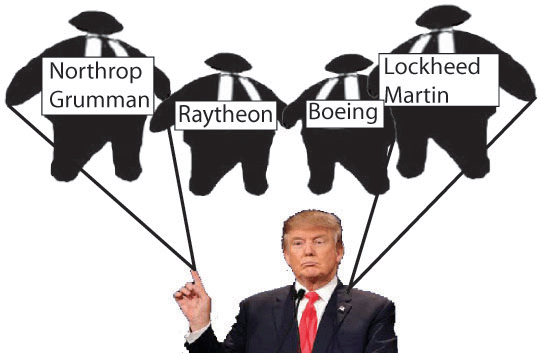
Trump Goes Nuclear, But This Time Lockheed, Northrop, Raytheon Rise http://www.investors.com/news/trump-tweets-about-nukes-after-blasting-pentagon-spending/GILLIAN RICH President-elect Donald Trump tweeted about the importance of the U.S. nuclear arsenal, which will cost hundreds of billions of dollars to recapitalize, potentially giving defense giants like Lockheed Martin (LMT), Northrop Grumman (NOC), Raytheon (RTN) and Boeing (BA) some hope that he won’t cost-shame them on that piece of the Pentagon budget America’s nuclear triad of air-, land- and sea-based delivery systems is nearing the end of its life span and needs to be replaced. But that won’t come cheaply.
Over the summer, the Air Force released its requests for proposals for intercontinental ballistic missiles to replace Boeing’s aging Minuteman system. The Ground-Based Strategic Deterrent’s estimated cost is $62 billion over 30 years, but a report from the Pentagon’s office of independent cost assessment said the Air Force’s estimate is too low by “billions of dollars,” sources told Bloomberg.
The Air Force is also seeking Long-Range Standoff nuclear cruise missiles to replace Boeing AGM-86B Air-Launched Cruise Missiles. That program’s cost has been estimated at $20 billion-$30 billion.
Boeing, Raytheon, Northrop and Lockheed are expected to bid on the two contracts, and initial contracts could be awarded next year.
Last year, Northrop was awarded a contract to build the B-21 bomber that replaces the Cold War-era Boeing B-52s. The Air Force has put the development-phase cost for the B-21 at $23.5 billion, but analysts have estimated the total acquisition cost at up to $80 billion. The Navy’s program to replace its Ohio-class submarines, which can launch nuclear missiles, will cost the service $100 billion.
Shares of defense contractors reversed higher after early, narrow losses. Lockheed shares edged up 0.1% on the stock market today, Northrop added 0.3%, and Raytheon rose 0.5%. Boeing gained 0.1%. General Dynamics (GD) and Huntington Ingalls (HII), which build submarines, were up 0.3% and 2.1%, respectively.
Congress scrapped this one word from the law, opening the door to a space arms race, L.A. Times, David Willman, 22 Dec 16, By removing a single word from legislation governing the military, Congress has laid the groundwork for both a major shift in U.S. nuclear defense doctrine and a costly effort to field space-based weaponry.
Experts say the changes, approved by overwhelming majorities in both the House and Senate, could aggravate tensions with Russia and China and prompt a renewed nuclear arms race. The bill awaits action by President Obama. The White House has not said what he will do.
For decades, America’s defense against nuclear attack has rested on twin pillars: The nation’s homeland missile defense system is designed to thwart a small-scale, or “limited,” attack by the likes of North Korea or Iran. As for the threat of a large-scale strike by China or Russia, the prospect of massive U.S. retaliation is supposed to deter both from ever launching missiles.
Central to this strategy was a one-word qualifier – “limited” — used to define the mission of the homeland defense system. The language was carefully crafted to avoid reigniting an arms race among the superpowers.
Now, with virtually no public debate, bipartisan majorities in Congress have removed the word “limited” from the nation’s missile defense policy. They did so in giving final approval over the last month to the year-end defense bill, the National Defense Authorization Act.
A related provision of the law calls for the Pentagon to start “research, development, test and evaluation” of space-based systems for missile defense.
A space-based defense program would hinge on annual congressional appropriations and decisions by the incoming Trump administration.
Yet both proponents and opponents say the policy changes have momentous implications.
“These amendments were historic in nature — given the paradigm shift forward that they represent,” said Rep. Trent Franks (R-Ariz.), who introduced and shepherded the amendments in the House.
Leading defense scientists said the idea that a space-based system could provide security against nuclear attack is a fantasy.
“It defies the laws of physics and is not based on science of any kind,” said L. David Montague, a retired president of missile systems for Lockheed Corp. and co-chair of a National Academy of Sciences panel that studied missile defense technologies at the request of Congress.
“Even if we darken the sky with hundreds or thousands of satellites and interceptors, there’s no way to ensure against a dedicated attack,” Montague said in an interview. “So it’s an opportunity to waste a prodigious amount of money.”
He called the provisions passed by Congress “insanity, pure and simple.”
The National Academy study, released in 2012, concluded that even a bare-bones space-based missile defense system would cost about $200 billion to put in place, and hundreds of billions to operate in subsequent years.
Franks, asked whether the country could afford it, replied: “What is national security worth? It’s priceless.”
Philip E. Coyle III, a former assistant secretary of Defense who headed the Pentagon office responsible for testing and evaluating weapon systems, described the notion of a space-based nuclear shield as “a sham.”
“To do this would cost just gazillions and gazillions,” Coyle said. “The technology isn’t at hand — nor is the money. It’s unfortunate from my point of view that the Congress doesn’t see that.”
He added: “Both Russia and China will use it as an excuse to do something that they want to do.”
The word “limited” has guided U.S. policy since the National Missile Defense Act of 1999. The qualifier reflects, in part, the reality that intercepting and destroying incoming warheads is supremely difficult, and that it would be impractical to field enough interceptors to counter a large-scale attack. Any such system, by its very nature, would be limited.
The first of his amendments — to eliminate “limited” from U.S. policy — was approved in April by the House Armed Services Committee with no debate and without a recorded roll-call vote.
At a committee hearing May 17, a senior Democrat on the panel, Rep. Jim Cooper of Tennessee, offered mild protest.
“I think it was a mistake to mandate a poorly thought out, unaffordable and unrealistic missile defense policy, including plans for a space-based missile deterrent,” Cooper said.
But neither Cooper nor any other House Democrat sought to overturn the provisions, and he was among those who voted to pass the overall bill the next day……..
In June, Sen. Ed Markey (D-Mass.) sought to restore “limited,” saying that the change in U.S. policy would create “the impetus for a new arms race” with Russia and China. Markey offered an amendment on the Senate floor but could not muster enough support to bring it to vote.
The same month, the Obama administration criticized the changes in the Senate bill, saying it “strongly objects” to removing “limited” and to placing anti-missile weaponry in space. The statement stopped short of threatening a veto.
The policy changes were greeted with opposition from another quarter as well. At a congressional hearing in April, Franks pressed Vice Adm. James D. Syring, director of the Missile Defense Agency, for his stance on expanding U.S. capability into space.