OOPS: RICK PERRY TAPPED TO LEAD DEPARTMENT HE WANTED TO ELIMINATE
The brain-frozen Texas governor gets the last laugh. Vanity Fair, BY TINA NGUYEN , 13 Dec 16, Continuing his trend of appointing people to lead the same departments they want to destroy, Donald Trump will reportedly announce that he will appoint Rick Perry, who famously forgot during a 2011 debate that he wanted to eliminate the Department of Energy, to lead the Department of Energy.
Perry, the former governor of Texas, was previously briefly a frontrunner in the 2012 presidential race, until his fortunes cratered when he struggled to list the three departments he would eliminate as president. “Oops”, he offered sheepishly. Having forgotten that he wanted to eliminate the Department of Energy (in addition to the Commerce and Education departments) is hardly the most troublesome aspect of Perry’s nomination.
While Perry spent more than a decade as the executive of a state that is a major energy producer—promoting the expansion of fossil fuel extraction even as Texas itself became a leader in wind power, with over 10 percent of the state’s energy being drawn from wind farms—the D.O.E. is mostly concerned with nuclear energy, including the safe handling of nuclear materials, oversight of nuclear weapons and nuclear reactor production, energy-related research, and developing new energy technologies…..
……Judging from his 2012 platform and his position on the board of a natural gas company, Perry, a climate-change skeptic, would tout energy independence above all and push for an increase in North American drilling and “clean coal” technologies. Trump, too, has promised to increase America’s energy production by lifting regulations limiting the extraction and production of domestic oil, coal, and gas. But neither Trump nor Perry have said much about nuclear energy, which remains the central mission of the D.O.E. http://www.vanityfair.com/news/2016/12/donald-trump-rick-perry-energy-department
The nomination of Oklahoma Attorney General Scott Pruitt to head the U.S. Environmental Protection Agency (EPA) is unprecedented. Whether you are a Republican or a Democrat, it is a travesty—because Pruitt has vigorously used his office to derail and obstruct clean air safeguards that are broadly supported by Americans in red and blue states alike. This nomination is a danger to our children and families.
Moms are outraged about this most cynical choice. We do not want an Environmental Destruction Agency.
Pruitt has used his office to attack vital safeguards for our children’s health.
Pruitt, Oklahoma’s top legal officer, has been against every single clean air protection we have gained. He has sued to stop vital safeguards that protect us from mercury, arsenic, acid gases and other emissions. These protections are supported by the American Academy of Pediatrics, the American Lung Association and the American Public Health Association.
Pruitt has used his office to attack protections against soot and smog pollution, and to attack EPA’s science documenting oil and gas air pollution levels.
Pruitt is against standards for reducing soot and smog that crosses state lines and pollutes neighbors’ air. Pruitt is against standards that improve air quality in our national parks. In 2014, Pruitt led an “unprecedented, secretive alliance” with large energy companies to attack clean air rules. This included using a letter written by an energy company as his own to challenge EPA’s science-based analysis of the oil and gas pollution levels in our communities.
Pruitt lies about science.
Pruitt has also professed profound ignorance—willful ignorance—about global warming. He is against any and all plans to cut the carbon and methane pollution that is dangerously altering our atmosphere. He perpetuates lies in an all-out assault on science.
He says the science on climate change is not settled. This is a lie. He claims that human activity has not changed the atmosphere. This is a lie. He claims we can do nothing about a natural phenomenon that has always occurred. This is a lie.
Pruitt accepts money from corporate polluters—to protect them.
He has sued to protect corporate polluters—and his campaigns have been funded by polluters. He has received hundreds of thousands of dollars from fossil fuel companies—to protect their ability to pollute.
Pruitt destroys solutions, rather than solves problems.
He has led lawsuits to undo clean air protections. But he has never, not once, advanced a single solution to any of the problems that the Clean Air Act must, by law, address. Pruitt does not offer solutions to mercury coming from coal-fired power plants, mercury that damages fetal and infant brains.
Pruitt does not offer solutions to soot and smog pollution. Pruitt does not offer solutions to the wasted methane that escapes from fracking operations. Pruitt does not offer plans to cut the emissions that are dangerously throwing our climate off balance.
Pruitt is not a leader for the new economy.
He is operating with an outdated understanding of science, economics, markets and job growth. He will not help position America globally as an innovative energy leader.
The Clean Air Act was signed into law by a Republican president and it was strengthened twenty years later by a Republican president. It is a vital demonstration that some things must transcend partisan politics: the protection of clean air and clean water chief among them.
President-elect Donald Trump was not given a mandate by the American people to stop protecting us from air pollution.
Pruitt’s entire career has demonstrated that his priority is obstructing clean air safeguards for our children.
What’s standing between Donald Trump and nuclear war?The main barriers to using nuclear weapons are psychological, not legal, The Verge by Rachel Becker Dec 11, 2016 When President-elect Donald Trump officially becomes the president of the United States in January, he will take complete control of America’s nuclear arsenal. Should he decide to start a nuclear war, there are no legal safeguards to stop him. Instead, a much less tangible web of norms, taboos, and fears has reined in US presidents since World War II. But as North Koreaescalates its nuclear weapons tests and the president-elect of the United States openly contemplates using nukes, experts worry that this fragile web could start to tear.
Tale of Two Cities (1946) – Hiroshima & Nagasaki Japan after The Atomic Bombs of World War II
During his campaign, Trump called nuclear proliferation the “biggest problem” in the world. But he also said that Japan and South Koreamight want to get nukes of their own. He wouldn’t take nuking ISIS, or even Europe, off the table. But he’s also characterized himself as “highly, highly, highly, highly unlikely” to ever use nuclear weapons. This calculated ambiguity isn’t unusual for America’s presidents. Presidents Bill Clinton and George W. Bush left nuclear first strikes on the table, too.
But for a US president to talk so openly and frequently about using nuclear force is a clear break with history, says Frank Sauer, an international security researcher at the Bundeswehr University Munich and author of the book Atomic Anxiety: Deterrence, Taboo and the Non-Use of U.S. Nuclear Weapons. And it could be potently destabilizing in a world where nations’ nuclear doctrines are shaped more by posture than by policy.
Despite a few close calls, nuclear warheads haven’t been used in armed conflict for more than 70 years. But there’s controversy over the reason why. Robert McNamara, the US secretary of defense during the Cuban Missile Crisis, put it down to pure luck.
But Nina Tannenwald, director of international relations at Brown University, argues that a taboo gradually emerged from the nuclear devastation of Hiroshima and Nagasaki. This taboo created the shared expectation that using nuclear weapons again would be deeply, morally wrong. International relations professor and author of The Tradition of Non-Use of Nuclear Weapons,T.V. Paul disagrees, arguing that it’s not a taboo but a tradition that’s driven by social and political pressures. And underlying both of these explanations is humankind’s deep-seated fear of going extinct, Sauer says.
While mutually assured destruction — the notion that any country launching nukes would likely also be destroyed by nukes — gets the most ink in terms of deterrence, these cultural and psychological deterrents play powerful roles.
Let’s be very clear: the president alone controls the nukes. There aren’t more checks and balances because our nuclear chain of command was built to speedily deliver mutually assured destruction. In fact, the only real check on the president’s nuclear authority is the election, writes nuclear history professor Alex Wellerstein in a recent blog post. “[D]on’t elect people you don’t trust with the unilateral authority to use nuclear weapons.”
That’s because if the US is attacked, time is precious: early warning teams only have three minutes to determine whether warnings of a missile attack are real. If it looks legitimate enough to take to the president, the president then has less than 12 minutes to open the nuclear briefcase (or “football”), review his tactical options, and authorize a nuclear strike. Or at least, 12 minutes is how long the White House has if a submarine deployed in the Western Atlantic were to fire on DC; if Russia were to launch a nuke from within its borders, there’s maybe 18 additional minutes to react. If the president hesitates, a nuke could hit the White House before the US has a chance to launch a counterstrike.
Still, many experts agree that mutually assured destruction can’t fully explain why no one is using their nukes. After all, the US didn’t use nuclear weapons against Iraq in the 1991 Gulf War, even though Iraq didn’t have any nuclear weapons to retaliate with.
Other nations do a better job at checking their leaders’ nuclear strength. China and India both pledged to not use nuclear weapons in a first strike. (India changed their policy in 2003 to let them retaliate with nukes against a chemical or biological weapons attack.) Russia walked back their own no-first-use policy in the 1990s, and the US doesn’t have one.
MUTUALLY ASSURED DESTRUCTION CAN’T FULLY EXPLAIN WHY NO ONE IS USING THEIR NUKES
That’s where the nuclear taboo comes in. It lumps nuclear, chemical, and biological weapons into a category of weapons of mass destruction that are unusable precisely because they’re so powerful and hard to control, says Tannenwald, author of TheNuclear Taboo: The United States and the Non-Use of Nuclear Weapons Since 1945.
The taboo stems from the wreckage of the atomic bombs the US dropped on Japan during World War II. We still don’t know how many people were killed by the first blasts, probably between 150,000 and 250,000 in total. The death toll continued to rise over the next five years to nearly 350,000 people, with many dying of cancers from the radioactive fallout.
During his recent visit to Japan, President Obama called Hiroshima “the start of our own moral awakening.” That moral awakening has kept nations like the US from using nukes even as they stockpiled them, Tannenwald argues. The taboo casts nuclear weapons as untouchable, stigmatized tools that only a barbarian would use — shaping public opinion as well as world leaders’ personal conviction. After the bombing of Nagasaki, President Harry Truman reportedly called off any more nuclear attacks, saying, “The thought of wiping out another 100,000 people was too horrible.”………
Trump Team’s Asking for Ways to Keep Nuclear Power Alive by Mark Chediak and Catherine Traywick, Bloomberg, December 9, 2016
Nuclear facing increasing competition from gas, renewables
Trump team asked Energy Department for ways to help nuclear
President-elect Donald Trump’s advisers are looking at ways in which the U.S. government could help nuclear power generators being forced out of the electricity market by cheaper natural gas and renewable resources.
In a document obtained by Bloomberg, Trump’s transition team asked the Energy Department how it can help keep nuclear reactors “operating as part of the nation’s infrastructure” and what it could do to prevent the shutdown of plants. Advisers also asked the agency whether there were any statutory restrictions in resuming work on Yucca Mountain, a proposed federal depository for nuclear waste in Nevada that was abandoned by the Obama administration.
The list of questions to the Energy Department offers one of the clearest indications yet of Trump’s potential plans for aiding America’s battered nuclear power generators. Five of the country’s nuclear plants have closed in the past five years, based on Energy Department data, and more are set to shut as cheaper supplies from gas-fired plants, wind and solar squeeze their profits.
Anti-nuclear group applauds closing of Palisades nuclear plant Entergy Corp., has announced in a news release Thursday, Dec. 8, that the Palisades nuclear power plant in Covert Township will close in 2018. (Mark Bugnaski / MLive.com) By Mark Tower | mtower@mlive.com December 08, 2016 COVERT, MI — Kevin Kamps, a representative of the anti-nuclear group Beyond Nuclear, has long called for the closure of the Palisades nuclear power plant near South Haven.
It appears that Kamps will soon have his wish.
Entergy Corp., the plant’s owner, announced the facility’s impending closure in a news release Thursday, Dec. 8. The plant will receive its final load of fuel in 2017 and close permanently on Oct. 1, 2018, according to the company.
Kamps praised the announcement in a news release issued Thursday.
“Entergy’s announcement today that it will permanently shut down the Palisades atomic reactor by Oct. 1, 2018 is most welcome to the large number of Michiganders, and beyond, who have fought so hard, for so long, to get it shut down,” he said……
Kamps pointed to the fact that the plant’s reactor is one of the most “embrittled” nationwide, arguing that keeping it open until 2018 poses serious risks.
“Nearly two more years of operation is a frightening prospect for a catastrophic release of hazardous radioactivity due to pressurized thermal shock fracture of the vessel,” he said. “The good news is that, after permanent shutdown and removal of irradiated nuclear fuel from the reactor core, no more meltdown can happen, and no more high-level radioactive waste will be made.”
The “embrittled” reactor puts it at risk of cracking, prompting the NRC in 2014 to begin a three-year review of results of tests on the reactor.
The Nuclear Regulatory Commission determined that the plant operated safely in 2015, but it was under increased NRC oversight for the first three quarters of 2015 due to its failure to accurately calculate radiation doses to workers during an activity in 2014. ……..
U.S. Rep. Fred Upton, R-St. Joseph, urged the community to not turn its back on those employees in the coming years.
Entergy Corp., owner of the Palisades nuclear plant in Covert Township near South Haven, had set aside $384.16 million in 2014, according to the most recent report submitted to the Nuclear Regulatory Commission in 2015. (The next report, due in 2017, will show the numbers for 2016.).
Entergy Corp announced Thursday that it plans to close the Palisade plant in October 2018.
Viktoria Mitlyng, spokesperson for the NRC Midwestern Region near Chicago, said Entergy has 30 days from Thursday’s announcement to formally notify the NRC of its intentions.
Closing nuclear plants is a complicated process with “lots of moving parts,” she said. “Our role as a nuclear safety regulator, is to oversee that process, including the removal of all fuel from the reactor to a “spent fuel pool” withing the facility, to its eventual placement, for an indefinite period, in dry cask storage.”
The dry cask storage is within the plant’s protected perimeter but not within the building itself, she said.
Throughout the process, Mitlyng said, the NRC requires that security is maintained and that detailed safety protocols are The very last phase of decommissioning requires that radiation levels in the area meet NRC requirements for decommissioning.
There is not yet a site, nationally, for long-term storage of spent fuel, an ongoing policy issue in which the NRC is not involved, Mitlyng said.
Until such a facility is planned – “and there is nothing on the drawing board at this point as far as we know,” she said — spent fuel remains in dry cask storage on site.
The storage is monitored by the NRC.
During final decommissioning, plant is taken apart — all radioactive systems are removed — and the plant has 60 years to get to final phase where the decommissioning is complete and meets NRC requirements.
After the plant is totally decommissioned, only the dry cask storage remains.
Some companies perform decommissioning activities themselves, others hire another company to take down the plant. If that is done, though, the license must be transferred, with NRC approval, Mitlyng said. The NRC also monitors the status of the decommissioning fund, which cannot be used for any other operations, she said.
“I want to emphasize that our responsibility as the Nuclear Regulatory Commission is to ensure that a plant is safe, whether in operation or during decommissioning,” she said. “We have inspections for all stages of that process to assure that it is done in a way to protect people.”
Safety requirements do not change, whether a plant is operational or closing, Mitlyng said. “There is no change in the NRCs posture, none at all.”
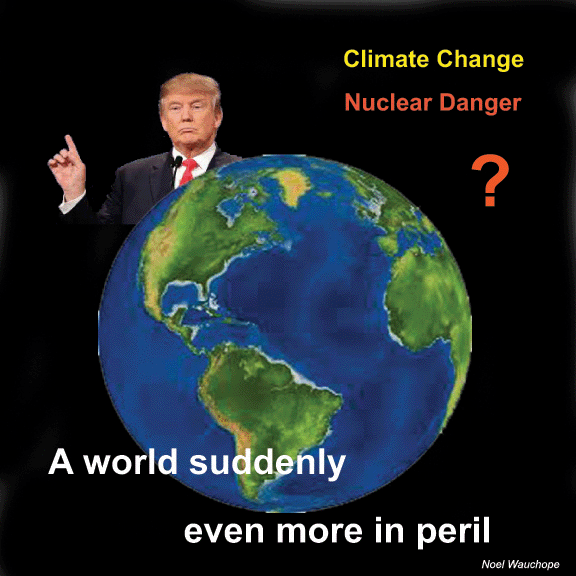
Does Donald Trump Believe Nuclear War Is Inevitable? The man about to take control of US nukes has a very fatalistic view, Mother Jones, DAVID CORNDEC. 8, 2016n just seven weeks, a man known for being ill-tempered, thin-skinned, narcissistic, and erratic will take control of the US nuclear arsenal. Donald Trump will have the authority and power to launch any combination of the country’s4,500 nuclear weapons. At any time and for any reason he deems fit, Trump could destroy a nation and, through miscalculation, the world.
During the presidential campaign, he uttered several troubling statements about nuclear arms. At a Republican primary debate, he botched a question about the nuclear triad—America’s system of sea-, air-, and land-based nuclear weapons—suggesting he did not understand the most basic information about the structure of the US nuclear command. (He babbled, “For me, nuclear is just the power, the devastation is very important to me.”) At other points in the campaign, Trump noted he would support allowing Japan, South Korea, and Saudi Arabia to obtain nuclear weapons and indicated he would be open to using such weapons against ISIS and in other conflicts.
What makes Trump’s loose talk—and ignorance—about nuclear weapons particularly worrisome is that in the past, he has taken a fatalistic approach toward the notion of nuclear war. He has spoken as if he believed such a conflagration was almost inevitable. And now he is about to become one of the few humans on the planet who can decide the fate of the Earth……. http://www.motherjones.com/politics/2016/12/donald-trump-nuclear-war-weapons-inevitable
A deal with Michigan’s largest utility will result in Entergy Corp. permanently shutting down the troubled Palisades nuclear power plant in 2018, four years earlier than the New Orleans-based company could have under an earlier contract.
Entergy bought the plant from Consumers Energy in 2007. The original agreement required Consumers Energy to purchase nearly all of the power the plant generated through April 2022. But market conditions have changed substantially since the purchase, with much cheaper power alternatives now available.
Consumers Energy will pay Entergy $172 million, half the $344 million the Michigan utility expects to save by buying power elsewhere over four years, for an early end to the original deal.
Consumers Energy customers’ costs will drop by as much as $172 million over four years, according to Entergy. Assuming regulators approve, Entergy intends to shut down the Palisades plant on Oct. 1, 2018.
The plant closure will affect around 600 workers. Entergy will also provide $8 million and Consumers Energy Foundation $2 million over several years to fund economic development efforts for the Southwest Michigan region.
Palisades was shut down eight times between 2012 and 2014, according to Michigan Radio. The plant shut down again in September after part of the turbine generation system, just days ahead of a scheduled maintenance shut down.
All indications so far point to a bleak future for addressing climate change, or even recognizing it as one of the world’s largest challenges. A number of his cabinet nominees, political appointees and closest advisors are outright climate deniers while others have funded the denial of climate change or are lukewarm on accepting the science.
At best, climate action will likely take a backseat to other issues. At worst, there could be an all-out assault on the science, and as important, the funding that makes it possible.
To glean a clearer picture of where Trump’s administration stands and where it may be headed, we’ve created a list of his major cabinet and agency appointees as well as his senior advisors. We’ll continue to update this as appointments are made.
Steve Bannon, Senior Advisor
His views:Since 2012, Bannon has been in charge of Breitbart News, a site that espouses extremist right-wing views on a number of issues, including climate change. Under Bannon’s leadership, Breitbart News has repeatedly referred to climate change as a hoax and denigrated everyone from scientists (“dishonest” and mostly “abject liars”) to the Pope (“a 16-year old trotting out the formulaic bilge”) who has spoken out about the need to rein in carbon pollution.
According to James Delingpole, a writer for Breitbart, “one of his pet peeves is the great climate-change con . . . it’s going to be a core part of his administration’s political program.”
Bannon has also framed dealing with climate change and terrorism as an either/or choice (a similar theme has emerged with Trump’s national security picks as well. It’s also a false dichotomy).
What he could do:As senior advisor, Bannon will be in position to influence Trump’s thinking on a wide range of issues, including climate change.
Reince Priebus, Chief of Staff
His views:As chair of the Republican National Committee, Priebus oversaw the creation of the 2016 party platformthat called the widely respected Intergovernmental Panel on Climate Change “a political mechanism, not an unbiased scientific institution.”
During the primaries, Priebus criticized Democratic candidate Martin O’Malley for saying that “the cascading effects” of climate change contributed to the rise of ISIS despite the research directly linking the climate-change fueled Syrian drought to instability in the region.
More recently, Priebus reiterated that Trump “has his default position, which most of it is a bunch of bunk” when it comes to climate science.
What he could do:As chief of staff, Priebus will also have Trump’s ear and advise him on all fronts, including climate change. Traditionally, the chief of staff also acts as a gatekeeper to the president and works with Congress to communicate and enact the president’s agenda.
Senator Jeff Sessions, nominee for Attorney General
His views:Sessions (R-Ala.) has repeatedly questioned climate change and voted against climate action. In a 2003 floor speech in opposition to the McCain-Lieberman Climate Stewardship Act, Sessions said, “I believe there are legitimate disputes about the validity and extent of global warming . . . Carbon dioxide does not hurt you. We have to have it in the atmosphere. It is what plants breathe. In fact, the more carbon dioxide that exists, the faster plants grow.”
Sessions repeated an oft-debunked claim that there’s been “almost no increase” in temperatures over the past 19 years during a December 2015 episode of Washington Watch, a podcast put out by the conservative think tank Family Research Council.
Sessions also signed a letter to cut U.S. contributions to the United Nations Green Climate Fund, which is designed to help poor countries adapt to climate change. He is also on the Senate Committee on Environment and Public Works where Republicans have attacked the U.S. commitments to the Paris Agreement and the EPA’s implementation of the Clean Power Plan.
What he could do:As attorney general, Sessions would be advising Trump on the legality of various climate rules and treaties, including the Clean Power Plan and the Paris Agreement. Sessions would also be head of the Justice Department, which is currently defending the Clean Power Plan in court. As Attorney General, Sessions could tell federal government to stop arguing the case, though how that would work and what would come after is unclear according to Michael Burger, executive director of Columbia’s Sabin Center for Climate Change Law. Burger said there are a number of states, cities and environmental organizations that could continue the defense.
Rep. Mike Pompeo, nominee for Director of the CIA
His views: Pompeo (R-Kan.) has been an outspoken critic of factoring climate change into national security issues during his tenure in the House of Representatives. In a December 2015 statement, Pompeo said, “For President Obama to suggest that climate change is a bigger threat to the world than terrorism is ignorant, dangerous, and absolutely unbelievable.” The Pentagon doesn’t necessarily support that view nor the idea that climate and terrorism is an either/or issue (more on that below).
Pompeo has referred to the Paris Agreement — a pact forged between nearly 200 countries to voluntarily take steps to reduce their impacts on the climate beginning in 2020 — as a “radical climate change deal” and even used last year’s mass shooting in San Bernardino to claim that President Obama “continues his pursuit of misguided policies, including his radical climate change agenda.”
On C-SPAN in December 2013, Pompeo responded to a question on if he agrees that global warming is a problem by saying “Look, I think the science needs to continue to develop. I’m happy to continue to look at it. There are scientists who think lots of different things about climate change. There’s some who think we’re warming, there’s some who think we’re cooling, there’s some who think that the last 16 years have shown a pretty stable climate environment.”
That statement belies the fact that the world has warmed dramatically, with temperatures increasing about 1°C since the start of the Industrial Revolution. This year will be the hottest on record, marking the third year in a row that’s happened. The 2000s were the warmest decade on record and the 2010s are easily on the path to surpass that mark.
What he could do:As the CIA’s director, Pompeo would be responsible for how the U.S. approaches national intelligence and security. The CIA shut down its climate program last year, but an agency spokesperson said “it continues to evaluate the national security implications of climate change.” Under Pompeo, it’s likely that resources focused on climate change would be further scaled back or scrapped altogether.
Gov. Nikki Haley, nominee for United Nations ambassador
Her views:South Carolina, where Haley is governor, is one of the states suing the EPA over the Clean Power Plan. She has criticized that plan, saying in a meeting with electric utilities that it “raises the cost of power. That’s what’s going to keep jobs away.”
During her tenure as governor, the state Department of Natural Resources came under fire for burying a report on the impacts of climate change throughout South Carolina for what appear to be political reasons.
What she could do:As the U.S. ambassador to the United Nations, Haley would set the tone for how the U.S. approaches international climate negotiations. Trump has threatened to “cancel” the Paris Agreement. While he can’t cancel it, he can pull the U.S. out of it and Haley would likely play a major role in doing that if Trump decides to move forward.
Lt. General Michael Flynn, National Security Advisor
His views:Similar to Pompeo, Flynn has railed against the idea that climate change should be a national security priority, a stance that would fly in the face of the Pentagon’s risk assessment and planning.
Dealing with climate change and terrorism is not a simple one-or-the-other decision. The two are linked, withnumerousstudiesshowingclimatechange is tied to conflict and that climate change will only further destabilize the world. The Pentagon itself has described climate change as an “immediate” risk and major threat multiplier, one that could cause crops to fail, spark mass migrations and increase conflict for dwindling water resources (to say nothing of the threat sea level rise poses to U.S. naval bases around the world).
What he could do: As national security advisor, Flynn will be Trump’s main sounding board and trusted source on security issues. If he downplays the threat of climate change, Flynn could create a huge blind spot for the administration’s security plans.
Betsy DeVos, nominee for Education Secretary
Her views:Of all Trump’s appointees so far, DeVos, an heiress to the Amway fortune and philanthropist, has the most moderate views on climate change (though she’ll likely have little influence in that realm as head of the Department of Education). WindQuest Group, the investment management firm she operates with her husband Dick DeVos, has overseen investments in clean technology.
But that moderation is somewhat tempered. DeVos has donated to the political campaigns of a number of Republican senators and representatives who deny climate change and have voted on an array of bills that would increase offshore oil drilling, end fuel efficiency standards and bar the EPA from regulating greenhouse gases. Of course, that’s a bit of guilt by association as over the past eight years Republicans have been steadfast in their opposition to Obama’s climate and energy policies and any donation to her party would have resulted in votes against meaningful climate action. But given Republicans will soon control the White House, Senate and House, the legislators she’s backed will likely play a role in further gridlocking climate action or actively dismantling it.
What she could do:As education secretary, DeVos would have little direct sway on climate policy as there are no national education standards. But Ann Reid, head of the National Center for Science Education, said DeVos’ interest in providing vouchers and school choice could have an indirect effect on climate education.
“It’s not at all clear these charter schools are held to the same standards as public schools with curricula,” Reid said. “Part of their point is to be creative and teach in new ways. That sounds grand but what if they don’t accept climate change? Are they going to be held to the standards of the state? That’s a big, big change.”
K.T. McFarland, Deputy National Security Advisor
Her views:Like Bannon, Pompeo and Flynn, McFarland views climate change and terrorism as mutually exclusive. McFarland worked in the Nixon, Ford and Reagan administrations on national security and is currently a commentator on Fox News. It’s in the latter position where she’s espoused views that terrorism is a greater threat than climate change. Speaking about President Obama attending the 2015 climate conference in Paris in the wake of the terrorist attacks that killed 130, she told Fox host Neil Cavuto:
“Well, because President Obama thinks that climate change is the greatest strategic and geological and existential threat to our future. You know, here we are — and the irony, if it were not so tragic it would be funny — here we have ISIS, which is attacking with suicide vests and Kalashnikovs and potentially chemical weapons in the French water supply. What are we doing? We’re going to fight ISIS. We’re going to have windmills. We’re going to have solar panels. We’re going to show them. It’s just really — all it does is it gives encouragement to the terrorists who feel that they have been selected and chosen by Allah to establish the caliphate and kill everybody who disagrees with them. They now look at this and they are laughing.
“This is a threat and an assault against all western civilization. We will not defeat it with windmills and solar panels.”
What she could do:As deputy national security advisor, McFarland will occupy a similar role to Flynn, and her views on climate change appear to line up with his.
Rep. Tom Price, nominee for Health and Human Services Secretary
His views:The voting pattern of Price (R-Ga.) in the House lines up with his fellow cabinet nominees Pompeo and Sessions. He has voted against having the EPA regulate greenhouse gases and voted no on subsidies for renewable energy as well voting to continue giving subsidies for oil and gas exploration.
Price also signed a pledge created by Americans for Prosperity, a conservative advocacy group funded by the Koch brothers, vowing to oppose climate legislation.
What he could do: As Health and Human Services Secretary, Price would have sway over a number of agencies and centers that do research on climate-related diseases and health issues, including the Centers for Disease Control and National Institutes of Health.
Elaine Chao, nominee for Transportation Secretary
Her views: In a 2009 blog post for the conservative think tank Heritage Foundation, where she was a fellow at the time, Chao derided a proposed cap-and-trade system as a policy that “would drain trillions of dollars out of the private economy and into federal coffers.” While the economics of any cap-and-trade system are worthy of debate, it’s clear something has to be done about climate change and Chao has shown no interest in any alternative. Letting global warming continue unabate could cause trillions in economic losses from drowned coastal cities to decreased agricultural productivity.
Chao was on the board of Bloomberg Philanthropies’ board until January 2015. She chose to step down after the foundation decided to ramp up its “Beyond Coal” campaign. The move came shortly after her husband, Senator Mitch McConnell’s (R-Ky.), won re-election during a campaign where he was attacked for accepting money from “enemies of coal,” a veiled reference to Chao’s board membership at Bloomberg.
What she could do: As Transportation Secretary, Chao would be tasked with overseeing a large chunk of Trump’s proposal to spend $1 trillion on infrastructure over the next 10 years. She would also be tasked with building out the electric vehicle charging corridors proposed by the Obama administration earlier this month, a project that is unlikely to fit with Trump’s plans that focus on the private sector.
Steven Mnuchin, nominee for Treasury Secretary
His views: It’s a mystery. Mnuchin has worked at Goldman Sachs, hedge funds and as a financier in Hollywood. Through all that, he’s said nary a word about climate change or energy-related issues.
His political donations also don’t say much about his views. He and his wife donated $5,400 to Trump, the maximum amount allowed under campaign finance law, and $309,600 to the Republican National Committee. That’s not surprising since he was Trump’s campaign finance chair. He also donated $2,000 to Kamala Harris, California’s new Senator who has been outspoken about the need to address climate change (in sharp contrast to Trump).
What he could do:As Treasury Secretary, Mnuchin would essentially help Trump set economic policies for the country. Climate change is expected to cost the U.S. — and the world — trillions if actions aren’t taken. Speaking at the Brookings Institute in 2014, current Treasury Secretary Jack Lew said, “if the fiscal burden from climate change continues to rise, it will create budgetary pressures that will force hard tradeoffs, larger deficits or higher taxes.”
The Treasury has also had to loan $24 billion to the National Flood Insurance Program to cover hurricane damages from Katrina, Rita, Wilma and Sandy, underscoring that planning for a fiscal response to near- and longer-term climate shocks will be a part Mnuchin’s job.
Wilbur Ross, nominee for Commerce Secretary
His views: Ross is a billionaire who made his fortune in buying distressed companies, cutting costs and selling them for a profit. In the past, he’s invested in coal companies and has recently moved into the oil and gas industry.
Beyond those investments, Ross hasn’t said anything about his interest or understanding of climate science.
What he could do:As Commerce Secretary, he would oversee the National Oceanic and Atmospheric Administration’s $189 million climate research budget. One of Trump’s advisors has suggested shifting some of NASA’s climate science responsibilities to NOAA, further expanding the amount of climate work Ross would be in charge of.
Gen. James Mattis, nominee for Defense Secretary
His views: Mattis served in a number of roles in the Marines prior to retiring in 2013. He hasn’t espoused anything publicly, but according to Stephen Cheney, a retired Marine brigadier general, Mattis “gets climate change.”
In 2003, Mattis led the 1st Marine Division during the Iraq invasion. Following the invasion, he told Navy researchersto “unleash us from the tether of fuel.” That indicates an understanding that renewable energy and alternative fuels have an important role to play in military preparedness and operations. The statement lines up with recent Department of Defense goals to reduce the use of petroleum products, increase renewable energy and cut non-combat greenhouse gases 34 percent by 2020.
What he could do: As Defense Secretary, Mattis would be in charge of implementing military strategy around the world (in comparison to Trump’s National Security Advisor, who can only offer advice). Under the Obama administration, climate change has been on the Department of Defense’s radar from how it affects national security to how military installations around the world should prepare for climate impacts, like sea level rise at naval bases, melting permafrost in the Arctic and more extreme rainfall events around the world.
Editor’s note: This story has been updated to correctly note that Kamala Harris is California’s newest Senator, not governor.
Critics blast Cuomo’s $7.6B subsidy for nuclear plants, WBFO.org, By KAREN DEWITT, 8 Dec 16,A long-term energy plan by the Cuomo administration that includes a nearly $8 billion subsidy to two upstate nuclear power plants is being challenged from both ends of the political spectrum, and a lawsuit has been filed to try to stop the deal.
Gov. Andrew Cuomo’s Public Service Commission plans to convert 50 percent of the state’s power sources to renewable energy over the next decade and a half. A controversial part of that program includes a $7.6 billion state-financed subsidy to a company that now runs two New York nuclear power plants – Nine Mile Point in Oswego and Ginna near Rochester – and is taking over a third plant, FitzPatrick, also in Oswego.
That has angered environmental groups, who filed a lawsuit, saying the PSC “acted improperly when it mandated a massive subsidy to prop up New York’s aging, failing nuclear power plants as part of the State’s Clean Energy Standard.”
Other progressive-leaning groups, including the New York Public Interest Research Group, also object to the deal.
“In some ways, it’s a straight-up ratepayer issue,” said Blair Horner, NYPIRG’s legislative director.
He said the deal will result in $2.3 billion in increased payments for residential utility customers, and even more for businesses. That’s in a state that already has among the highest utility rates in the nation.
“Roughly 800,000 New Yorkers are already having a hard time paying their existing electric bills,” Horner said. “This isn’t going to make it any better.”
Not only left-leaning groups oppose the deal. Fossil fuel companies like Shell and BP have objected, filing complaints with the PSC. Oil and gas companies would have to essentially help subsidize the deal through the price of zero emission tax credits bought and sold in New York…..http://news.wbfo.org/post/critics-blast-cuomos-76b-subsidy-nuclear-plants
Trump could face the ‘biggest trial of the century’ — over climate change, WP By Chelsea HarveyDecember 1A few weeks ago, a federal judge in Oregon made headlines when she ruled that a groundbreaking climate lawsuit will proceed to trial. And some experts say its outcome could rewrite the future of climate policy in the United States.
The case, brought by 21 youths aged 9 to 20, claims that the federal government isn’t doing enough to address the problem of climate change to protect their planet’s future — and that, they charge, is a violation of their constitutional rights on the most basic level. The case has already received widespread attention, even garnering the support of well-known climate scientist James Hansen, who has also joined as a plaintiff on behalf of his granddaughter and as a guardian for “future generations.”
The U.S. government under President Obama, along with several others representing members of the fossil fuel industry, filed to have the lawsuit dismissed. But on Nov. 10, federal judge Ann Aiken denied the motion, clearing the case to proceed to trial. According to Our Children’s Trust, the nonprofit representing the youth plaintiffs, a recent case management conference indicated that the case would likely go to trial by summer or early fall of 2017.
“It’s been called the biggest trial of the century, and it is,” said Mary Wood, a law professor at the University of Oregon and expert in natural resources and public trust law. “Literally, when I say the planet is on the docket, it would be hard to imagine a more consequential trial, because the fossil fuel policies of the entire United States of America are going to confront the climate science put forth by the world’s best scientists. And never before has that happened.”
The odds of success
Theoretically, the trial’s outcome could have major implications for the incoming Trump administration, which aims to dismantle many of the climate and energy priorities established under President Obama.
Officials set to repackage radioactive waste in New Mexico, Huron daily Tribune, Susan Montoya Bryan, Associated Press, December 1, 2016 ALBUQUERQUE, N.M. (AP) — Isolated in a temperature-controlled storage area at one of the nation’s premiere nuclear weapons laboratories, dozens of containers of radioactive waste similar to one that ruptured in 2014 remain under 24-hour surveillance, awaiting treatment so they can be stabilized and disposed of.
The U.S. Department of Energy announced this week that treatment of the 60 containers is expected to begin next spring following a series of safety assessments and upgrades to the building where the work will be performed…….
The work is one step in a yearslong effort to get the federal government’s multibillion-dollar cleanup program back on track at Los Alamos and other installations around the country where decades of Cold War-era waste — from gloves and tools to clothing and other material —have piled up.
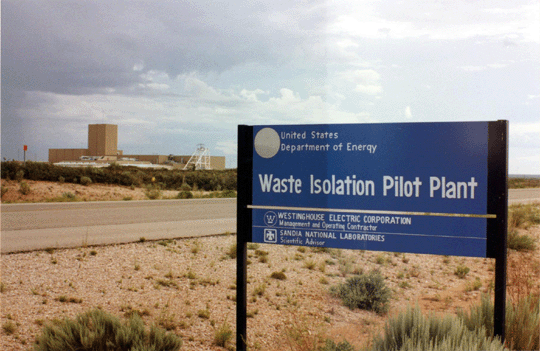
The shipment of that waste to an underground disposal facility in southern New Mexico was put on indefinite hold in February 2014 when a container sent from Los Alamos to the Waste Isolation Pilot Plant breached, contaminating a significant portion of the underground storage area……
The incident resulted in an overhaul of policies, costly work to mitigate the contamination, and a multimillion-dollar settlement with the state of New Mexico for numerous permit violations.
The Energy Department had hoped to resume some work at the Waste Isolation Plant by the end of the year. But the agency still needs to submit a readiness report to state regulators for review and an onsite inspection needs to be done.
Even if the site is cleared to begin moving waste into the underground, state officials say shipments will be sent slowly before they are ramped up………All of the work will be done inside an enclosed box in a specially engineered building with filters. Technicians will handle the waste only through gloved ports. http://www.michigansthumb.com/news/article/Feds-prepare-to-repackage-radioactive-waste-in-10646737.php
An Albuquerque watchdog group is calling for an additional federal review before WIPP can reopen. The Waste Isolation Pilot Plant outside Carlsbad has been working for nearly three years to recover from a radiation accident in February 2014.
Roof collapses at WIPP raise new safety questions,Albuquerque Journal By Lauren Villagran / Journal Staff Writer Tuesday, December 6th, 2016 In a salt mine more than 2,000 feet underground where drums of nuclear waste are embedded in enormous rooms – some radiologically contaminated – workers heard a loud noise and saw a spray of salt dust.
It was just before 2:30 p.m. on Nov. 3 at the Waste Isolation Pilot Plant. Still recovering from a radiation accident nearly three years ago, managers of the nation’s only deep geologic repository for defense nuclear waste had just two weeks prior decided to shut down the far south end of the mine after the salt ceiling collapsed in two places.Suspecting a rock fall, workers reported the incident to the Central Monitoring Room on the surface. Managers called for an evacuation of the underground and, following the latest safety protocol, activated the Emergency Operations Center 26 miles away in Carlsbad as a precaution.
The next day, a team of geotechnical and radiological control experts, members of the mine rescue team and a representative from the Mine Safety and Health Administration descended into WIPP. They found a massive area of the ceiling in Room 4 of Panel 7 had crashed: a rock fall two-thirds the length of a football field, eight feet thick.
WIPP is supposed to reopen this month. The U.S. Department of Energy has not publicly changed its position that WIPP will begin putting waste underground in December, a symbolic “end” to a recovery that still will likely go on for years.
There are regulatory hurdles left to clear. WIPP managers are expected to make public the results of a DOE “operational readiness review” this week, which could include corrective actions and could alter the time frame. New Mexico’s Environment Department must also complete a review of safety equipment, procedures and staff training and sign off that WIPP is ready.
But experts say the recent roof collapses inside WIPP – which have injured no one, thanks to precautionary closures of troubled areas – call into question the facility’s ability to handle ground control in a contaminated mine.
At the least, they say, the latest roof fall reduces available real estate underground, including potentially eliminating Room 4. At worst, the inability to keep up with maintenance could threaten worker safety, although WIPP managers frequently repeat that safety is the “highest priority.”……..
The radiation accident drastically reduced ventilation underground, curbing the number of vehicles that can operate. Workers must wear bulky protective clothing and respirators in contaminated areas and thus work more slowly. These and other constraints mean they can’t bolt back the roof at pre-accident rates, and some areas have been left unattended.
Salt was the chosen burial ground for certain types of legacy Cold War nuclear waste because, once filled and closed, the salt will slowly encapsulate the drums forever. But salt’s dynamic nature means WIPP managers are in a race against time – one they have not been winning.
“People have to understand, for WIPP to work it has to be a successful and a safe mining operation,” said Robert Alvarez, a columnist for the Bulletin of the Atomic Scientists and former senior policy adviser to the Energy Secretary in the 1990s in the lead-up to WIPP’s opening. “They are just not out of the woods. But they are under enormous pressure to get this thing open because of all these sites sitting on this transuranic waste.”
Transuranic waste consists of boots, gloves and other materials contaminated during weapons production. Hundreds of shipments of “TRU” waste are piling up at sites around the country, including at Los Alamos and Idaho national laboratories and the Savannah River Site in South Carolina………
Federal review sought
An Albuquerque watchdog group is calling for an additional federal review before WIPP can reopen.
The Waste Isolation Pilot Plant outside Carlsbad has been working for nearly three years to recover from a radiation accident in February 2014.
In a letter to the U.S. Department of Energy dated Nov. 21, Albuquerque’s Southwest Research and Information Center and the New York-based Natural Resources Defense Council asked DOE to submit WIPP to a review under the National Environmental Policy Act, or NEPA.
The last NEPA review of WIPP came in 1997 – documents that “are now known to be incomplete, and in some cases, erroneous,” according to the letter.
Specifically, the letter requests NEPA analyses of WIPP’s recovery and its waste disposal plans – such as studies outlining the impacts of an underground fire like the one that occurred days before the radiation release in an unrelated accident – as well as a new analysis regarding the probability and impacts of a hot reaction inside a waste drum like the one that contaminated the facility. – Lauren Villagran https://www.abqjournal.com/902842/new-safety-questions-come-up-at-wipp.html
For patients, unnecessary procedures (usually imaging procedures) and radiation dosing errors represent the bulk of risk from medical radiation, whereas incidental, unintended radiation exposure is the primary concern for nurses and other health care workers…
Radiation safety for patients—and nurses Oncology Nurse Advisor, Bryant Furlow, October 26, 2011 Diagnostic and therapeutic radiation have prolonged and improved millions of patients’ lives, and represent indispensable and increasingly sophisticated tools in clinical oncology. But medical radiation’s gifts have come at the potential cost of unintended irradiation of patients and health care workers and increased lifetime risks of secondary cancers. This concern has grown with improving patient survival times, particularly among pediatric cancer patients. Continue reading →