US Doubles Down On Wave Energy, $40 Mil For New Test Bed, Clean Technica December 31st, 2016 by Tina Casey It looks like the US is about to get much, much more serious about developing its vast wave energy potential. Researchers have been working at several relatively modest sites in Hawaii and the Pacific Northwest, and now the Energy Department has announced funding for a new, $40 million utility scale test site in the waters of the continental US, off the coast of Oregon.
Why Wave Energy?
The new wave energy test site will be built and operated under the auspices of Oregon State University’s Northwest National Marine Renewable Energy Center.
In a press release announcing the plan to invest up to $40 million in the nation’s first utility scale wave energy test site, the Energy Department noted that more than half of the population of the US lives within 50 miles of a coastline.
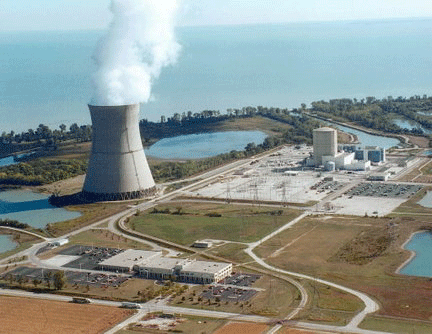
All things being equal, coastal populations are expected to grow, but getting zero emission energy to coastal regions is becoming more complex and difficult. Aging coastal nuclear power plants will most likely not be replaced, and population density limits the potential for utility scale wind farms and solar arrays on land.
Another limitation for land-based renewable energy in coastal areas is the need for new long distance transmission lines. Plans have been in place for years to bring wind power from the wind rich midwest to points east, but the new lines have had to battle against fossil fuel interests as well as local stakeholders.
One solution is to tap the waters of the US coastlines.
That’s beginning to happen in the wind energy sector on the east coast, where the relatively shallow waters of the Continental Shelf are amenable to offshore wind turbine technology.
The nation’s first offshore wind farm just went online off the coast of Rhode Island, and the Obama Administration has mapped out an ambitious plan to harvest wind energy all along the eastern seaboard. It looks like New York State’s Long Island is next in line for development.
The west coast is a different kettle of fish. The Continental Shelf drops off quickly, and the waters are too deep for conventional offshore wind turbines to be set on the ocean floor.
As a solution, the Energy Department has been pumping some significant dollars into R&D to commercialize floating wind turbines.
With the new investment of $40 million the agency appears to be broadening its focus to accelerate wave energy development, too.
The payoff could be huge, so to speak: Recent studies estimate that America’s technically recoverable wave energy resource ranges between approximately 900–1,230 terawatt hours (TWh) per year…For context, approximately 90,000 homes can be powered by 1 TWh per year. This means that even if only a few percent of the potential is recovered, millions of homes could be powered by wave energy as the technology progresses.
The New Wave Energy Test Facility
The new facility will be called the Pacific Marine Energy Center South Energy Test Site. Along with federal dollars, unspecified non-federal funding will go into the construction………
A Wave Energy Explainer……… https://cleantechnica.com/2016/12/31/us-doubles-wave-energy-40-mil-new-test-bed/
January 2, 2017
Posted by Christina Macpherson |
renewable, USA |
Leave a comment
 NEI asks incoming Trump administration to promote nuclear power, http://www.elp.com/articles/2016/12/nei-asks-incoming-trump-administration-to-promote-nuclear-power.html By Wayne Barber Chief Analyst, GenerationHub “….
the Nuclear Energy Institute (NEI), is asking the incoming Donald Trump administration to take steps to both improve the economic prospects of the existing domestic fleet and improve the chances for new nuclear reactors.
The energy sector has always been heavily shaped by government policy, NEI said in its policy memorandum to the Trump administration.
Several key policies are needed in the immediate future and in the longer term to ensure the benefits of nuclear power for the long-term, NEI said.
Government at all levels should rewrite policy to have federal agencies buy nuclear power when they buy other forms of zero carbon energy.
The previous administration’s Executive Order 13693, a clean air strategy which requires the federal government to buy more renewable energy, should be rewritten by the White House to allow nuclear energy to participate, NEI said.
NEI also states should be encouraged to have renewable portfolio standards (RPS) become clean power standards.
NEI said the Federal Energy Regulatory Commission (FERC): Existing reactors must be recognized for all the benefits they bring to the electric system, through the following changes:
· FERC should clarify that its requirement for “just and reasonable” rates that are not “unduly discriminatory or preferential” implies compensation for all of these benefits: high reliability and availability, increased grid resiliency due to operability under all weather conditions and no need for continuous fuel supply, and virtually zero emissions.
· FERC should work with the Independent System Operators and Regional Transmission Organizations to ensure that the competitive markets fully value all the attributes of existing nuclear plants, and the services they provide to the grid.
· FERC should address flaws in the structure of the markets it governs. Among these, the system makes “uplift” payments to generators that are not economic but are needed to assure reliability, but the cost of those payments does not enter into the price paid to other producers, including reactors.
· The agency should make clear that generation sources that by their nature tend to stabilize electricity prices and limit the risks from fuel price volatility should be compensated for protecting consumers by improving the diversity of the system.
December 30, 2016
Posted by Christina Macpherson |
politics, USA |
Leave a comment
 Beyond Nuclear: NRC Must Publish Flawed Reactor List http://www.ladailypost.com/content/beyond-nuclear-nrc-must-publish-flawed-reactor-list by Chris Clark December 27, 2016 TAKOMA PARK, Md. ― Beyond Nuclear (BN), a leading national anti-nuclear advocacy group, last week called on the U.S. Nuclear Regulatory Commission (NRC) to make public the full list of U.S nuclear power plants that are known to be operating with potentially defective parts imported from France.
The flawed components could seriously compromise safety at the nuclear sites, the group warns. Affected reactors should be immediately shut down, BN says.
The NRC has refused to reveal the names of all affected U.S. nuclear power plants. So far only one nuclear plant — Connecticut’s Millstone — has been named in a
Reuters news article. However, a
Greenpeace France report suggests there are at least 19 reactors at 11 sites in the U.S. operating with potentially defective parts that, if not replaced, could lead to a meltdown.
Beyond Nuclear is filing an emergency enforcement 2.206 petition and a Freedom of Information Act Request to demand that the NRC release the full list of reactors with flawed parts; inform the affected reactor communities of the risks; and require the shutdown of reactors with potentially defective reactor components.
The potentially defective parts were manufactured at the Le Creusot-Areva forge in France. The parts include crucial components such as reactor pressure vessels, replacement reactor pressure vessel closure heads (replacement lids), replacement steam generators and replacement pressurizers, according to reports. The defects were first revealed by Areva in May 2016. In addition to uncovering the defective parts, the French safety authorities also suspected falsification of manufacturing reports.
“Every one of those potentially defective parts are safety-significant and could lead to meltdown if they fail,” said Kevin Kamps, Radioactive Waste Watchdog at Beyond Nuclear. “Everyone living around these reactors has a right to know that the NRC has chosen to gamble with their lives rather than enforce safety measures that include replacing these potentially defective parts.”
The affected nuclear plant sites – some with multiple reactors – revealed by Greenpeace include: Prairie Island in Minnesota; North Anna and Surry in Virginia; Three Mile Island in Pennsylvania; Arkansas One in Arkansas; Turkey Point and St Lucie in Florida; DC Cook in Michigan; Salem in New Jersey; Callaway in Missouri; and Millstone in Connecticut. The Crystal River reactor in Florida was also listed but is now permanently closed.
The 2.206 emergency enforcement petition filed by Beyond Nuclear would seek emergency shutdowns at all implicated reactors until the NRC can provide assurances that all potentially defective parts do not pose a major accident or meltdown risk during operations.
“It is unacceptable that the NRC refuses to divulge the names of U.S. reactors with potentially defective parts from the Le Creusot forge,” said Paul Gunter, Director of Reactor Oversight at Beyond Nuclear. “The failure of these parts could have catastrophic and long-lasting consequences with a high price not only in costs but in human health.”
“These revelations point up once again that it is time to close the country’s dangerous nuclear plants, especially since we do not have a regulator that can be relied upon to enforce even the most fundamental safety standards,” Gunter concluded.
Defective parts and safety falsifications have long been rampant in the U.S. nuclear power sector. Most recently, revelations came to light about widespread falsification of fire safety checks which had never been carried out.
In 2002, the Davis-Besse reactor in Ohio narrowly escaped a meltdown when boric acid eroded the reactor’s pressure vessel closure head, the closest near miss since the 1979 Three Mile Island meltdown. The NRC knew of the problem but allowed the reactor to keep operating.
The Palisades reactor in Michigan, which recently announced a 2018 closure date, has never replaced its badly degraded reactor lid in part because the replacement lid was also found to be defective but also because the NRC never enforced replacement.
A
1982 report commissioned by the NRC, calculated that catastrophic reactor failures could result in 3,900 early deaths from acute radiation poisoning at the Cook nuclear plant if both Cook units were involved. There would be 168,000 early injuries and an estimated 26,000 cancer deaths over time. Property damage could be as high as $192 billion ($477 billion in 2015 dollars adjusted for inflation.)
The potentially defective replacement reactor vessel lids at Cook, combined with the plant’s known faulty and age-degraded containment, could initiate the reactor disasters and exacerbate the hazardous radioactivity release studied in the NRC report
Beyond Nuclear is urging all reactor communities to contact their elected officials at all levels of government to pressure the NRC to be forthcoming and to fix the problem.
December 30, 2016
Posted by Christina Macpherson |
safety, USA |
Leave a comment
 Trump’s Madman Gambit
 Hi
story shows his nuclear threats will fail. US News.com By Jeffrey P. Kimball | Dec. 30, 2016, President-elect Donald Trump’s recent Tweet that “the United States must greatly strengthen and expand its nuclear arsenal” and comments to MSNBC welcoming an “arms race” could signal a radical shift away from decades of bipartisan U.S. policy to reduce nuclear tensions and stockpiles. His spokesperson Sean Spicer tried to explain the comments to NBC’s Matt Lauer as a “warning” to other countries “that this president’s going to take action.”
Some pundits have suggested Trump’s unorthodox and erratic comments on nuclear policy are part of a deliberate, Nixonian “madman” strategy designed to strike fear of irrational U.S. behavior into adversaries in order to secure better terms for the United States. But if Trump, his advisers or the neoconservative commentariat believe nuclear threats can be leveraged to the United States’ advantage in the 21st century, they should think again. A look at the historical record reveals that when this strategy was pursued during the Eisenhower and Nixon years, it failed to achieve the desired results………..
Why did Eisenhower’s and Nixon’s nuclear gambits fail to work as intended? Such threats are unlikely to succeed when the side threatened possesses its own nuclear weapons and delivery capabilities, or when a non-nuclear state or a guerrilla or terror group is presumably under the protection of a nuclear state, or when the nuclear threat is disproportionate and therefore not credible because it is aimed at a small country or non-state actor.
For these and other reasons, Trump’s implied or actual nuclear “warnings” are not likely to succeed in their goal of intimidating others, whether it is nuclear-armed Russia, China, North Korea or the undeterrable Islamic State group, to comply with his foreign and military policy goals.
The real danger for the United States and the world, however, is that if Trump tries to operationalize his threat to expand the lethality or size of America’s already costly, formidable and oversized nuclear arsenal, and continues his erratic bluster, he may trigger a new arms race and possibly produce a chain reaction of great-power threats and mobilizations that could potentially escalate into nuclear conflict. http://www.usnews.com/opinion/world-report/articles/2016-12-30/donald-trumps-nuclear-madman-gambit-will-fail
December 30, 2016
Posted by Christina Macpherson |
politics, USA, weapons and war |
Leave a comment
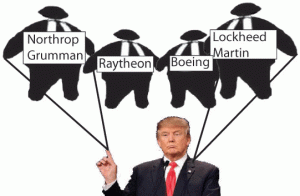 No, the U.S. Doesn’t Need to Expand Its Nuclear Weapons Program, Politico By STEVEN PIFER December 29, 2016
December 23, President-elect Donald Trump tweeted that the United States must “expand its nuclear capability.” Had he written modernize, upgrade, update or renew, no one would have paid much attention. But he seemed to call for a quantitative increase, something Matthew Kroenig endorsed in a December 23 Politico Magazine article.
December 30, 2016
Posted by Christina Macpherson |
politics, USA, weapons and war |
Leave a comment
 Diablo Canyon nuclear plant cited for cooling system problem, Orange County Register Dec. 30, 2016 SAN LUIS OBISPO – Federal regulators have cited the Diablo Canyon nuclear power plant for a problem that may have knocked out a reactor cooling system for a year-and-a-half.
The Tribune of San Luis Obispo says the Nuclear Regulatory Commission issued a “white finding” on Thursday. That color-coding means the problem created a low-to-moderate safety risk at the Central California plant.
During a test in May, workers found that an emergency cooling system for one of the two reactors wasn’t working – and may not have been operating since it was last checked in October 2014….http://www.ocregister.com/articles/problem-739810-plant-nuclear.html
December 30, 2016
Posted by Christina Macpherson |
safety, USA |
Leave a comment
Trump: “I have a problem with wind” https://blog.bulb.co.uk/trump-wind-problem/ by hayden November 2016 In a recent interview with the New York Times, President-elect Trump claimed there are three reasons to oppose wind power. Perhaps unsurprisingly, we disagree with each of them. We thought we’d break them down and add some facts to a discussion that threatens to undermine one of the most important global efforts of our time.
Here are Trump’s three main points:
- Wind turbines kill birds (even the golden eagle)
- Wind turbines are bad for the atmosphere due to their steel construction
- Energy from wind isn’t commercially viable
You can read the full transcript of the NYT interview here but here’s an excerpt:
TRUMP: The wind is a very deceiving thing. First of all, we don’t make the windmills in the United States. They’re made in Germany and Japan. They’re made out of massive amounts of steel, which goes into the atmosphere, whether it’s in our country or not, it goes into the atmosphere.
The windmills kill birds and the windmills need massive subsidies. In other words, we’re subsidizing wind mills all over this country. I mean, for the most part they don’t work. I don’t think they work at all without subsidy, and that bothers me, and they kill all the birds. You go to a windmill, you know in California they have the, what is it? The golden eagle? And they’re like, if you shoot a golden eagle, they go to jail for five years and yet they kill them by, they actually have to get permits that they’re only allowed to kill 30 or something in one year. The windmills are devastating to the bird population, OK.
With that being said, there’s a place for them. But they do need subsidy. So, if I talk negatively. I’ve been saying the same thing for years about you know, the wind industry. I wouldn’t want to subsidize it. Some environmentalists agree with me very much because of all of the things I just said, including the birds, and some don’t. But it’s hard to explain. I don’t care about anything having to do with anything having to do with anything other than the country.
We wouldn’t normally include such a long quote, but we thought you’d enjoy President-elect Trump’s turn of phrase in its full, unfiltered glory.
Bird protection groups are in favour of wind
To quote the Royal Society for the Protection of Birds; “the RSPB supports a significant growth in offshore and onshore wind power generation in the UK”. It couldn’t be put more succinctly than that.
Climate change is set to have a devastating impact on the environment, which is a far greater threat to birds than wind farms. Of course, governments and wind farm investors should do all they can to minimise the danger to birds. However, this is not a significant hurdle. The RSBP scrutinises hundreds of UK wind farm applications each year, and 94% of those are safe enough for the RSPB to give their blessing.
You can read more about the RSPB’s policies here.
Wind has very low carbon intensity
Steel, of course, takes energy to produce. However, the carbon cost of this energy is dwarfed when other factors are taken into consideration. We can do this by considering the lifecycle carbon emissions associated with each type of electricity generation. This is a common method used to compare technologies on an environmental basis and is recommended by bodies such as Defra because it considers the full impact of each technology by calculating the emissions associated with it from cradle to grave, not just the period where it’s generating electricity.
Over the course of its lifetime, a wind turbine will produce 400 times less carbon per kWh than coal. A study conducted by the Intergovernmental Panel on Climate Change (IPCC) in 2014 put the median carbon cost of onshore wind at an equivalent of 11 grammes of CO2 per kWh over its lifetime. Which is similar to nuclear, hydro, solar and a lot lower than the 820 grammes per kWh of Mr Trump’s beloved coal power.
You can read the full IPCC report here. The key figures are on the right-hand side of page seven.
Wind is commercially viable
The cost of wind per unit of electricity is already on par with the likes of new-build coal and nuclear. According to Lazard Investment Bank, coal costs $65-150 per MWh, compared to $32-77 for wind. This cost advantage already gives wind the edge over coal, before the carbon cost is even considered. It’s easy to criticise wind, claiming the supply is unreliable and dependent on the weather, but this is solved through energy storage. When Denmark was generating 140% of its energy needs through wind power, it simply exported it to be stored as potential energy in Germany and Sweden’s hydro dams.
Plus, the efficiency of wind power is improving at a rate of knots. Bloomberg New Energy Finance estimates the cost of wind will decrease by 19% for every doubling of installed capacity. By comparison, the cost reduction for existing technologies, like coal, is a fraction of a percent.
How much can Trump actually change?
Experts aren’t yet in agreement about the extent to which Trump will be able to reverse recent climate change policy. He could repeal President Obama’s executive orders, which he seems set to do. This would likely move US climate policy decisions from national decision makers to individual states. When Reagan starved the EPA of funding in the 1980s, most policies were made at the state level, rather than federal.
Perhaps the biggest concern, though, is Trump’s inconsistency. He has shown a willingness to reverse direction, which makes it difficult to know quite what’s going to happen. He has previously stated he would pull out of the Paris agreement. But in the New York Times interview above he said he would just “take a look at it.” Everyone is closely watching this space. As Trump tells us, he’s a businessman, so it’s possible he may end up seeing the benefits of new and competitive technology.
Here’s hoping.
December 30, 2016
Posted by Christina Macpherson |
politics, renewable, USA |
Leave a comment
 Grayson files ‘Nuclear Sanity Act’ in response to Trump remarks :DEC 29 2016 12:HTTP://WWW.FOX35ORLANDO.COM/NEWS/226096159-STORY WASHINGTON DC (WOFL FOX 35) – Florida Congressman Alan Grayson has filed the Nuclear Sanity Act in response to growing concern over President-elect Trump’s recent series of “Bomb, Baby, Bomb” pro-nuke mad libs.
The bill requires approval by the Secretaries of Defense and State before the U.S. launches nuclear war, unless U.S. territory is under attack by a foreign military. “We need to take the nuclear football out of Trump’s hands, before he fumbles it,” Grayson said.
This bill was filed on the heels of Trump’s bizarre call for U.S. nuclear expansion and statements that the U.S. will “outmatch” and “outlast” any nuclear adversary.
“What part of the phrase ‘mutual assured destruction’ does Trump not get?” Grayson said.
Neither the Constitution nor the U.S. Code currently curbs the President’s ability to launch nuclear weapons.
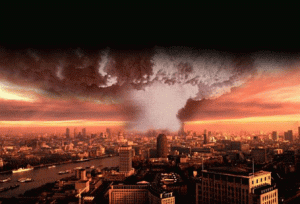
 “We need to place someone or something between Donald Trump’s impulses and Armageddon. When it comes to demonstrating Trump’s recklessness, we don’t want the smoking gun to be a mushroom cloud.” Grayson said.
“If any finger rests on the nuclear button, it shouldn’t be Trump’s extended middle one.”
December 30, 2016
Posted by Christina Macpherson |
politics, USA, weapons and war |
6 Comments
Donald Trump’s New Nuclear Instability, Democracy Now DECEMBER 29, 2016 BY AMY GOODMAN & DENIS MOYNIHAN
President-elect Donald Trump exploded a half-century of U.S. nuclear-arms policy in a single tweet last week: “The United States must greatly strengthen and expand its nuclear capability until such time as the world comes to its senses regarding nukes.” With that one vague message, Donald Trump, who hasn’t even taken office yet, may have started a new arms race.
Trump’s statement set off alarms around the world, necessitating a cadre of his inner circle to flood the airwaves with now-routine attempts to explain what their boss “really meant.”
On MSNBC, Rachel Maddow confronted former Trump campaign manager and newly appointed Trump counselor Kellyanne Conway about the shocking tweet:
Maddow: “He’s saying we’re going to expand our nuclear capability.”
Conway: “He’s not necessarily saying that —”
Maddow: “… He did literally say we need to expand our nuclear capability —”
Conway: “…What he’s saying is…we need to expand our nuclear capability, really our nuclear readiness, our capability to be ready for those who also have nuclear weapons.”
The next morning, during a commercial break on the MSNBC program “Morning Joe,” Trump spoke by phone with Mika Brzezinski, as she and her co-host Joe Scarborough sat in pajamas on the Christmas-themed TV set. The call was not broadcast, but when the show came back from the break, Brzezinski quoted Trump as saying, “Let it be an arms race … we will outmatch them at every pass and outlast them all.”
Minutes after that aired, Annie Leonard, executive director of Greenpeace USA, told us on the “Democracy Now!” news hour: “Every day, Trump says something that makes us worried, but this may be the most terrifying yet. A nuclear-arms race is the last thing that the world needs. I think about climate change. I think about economic inequality. I think about all of these major threats that we’re facing as a country and as a world. Why would we add on top of that a totally manufactured, unnecessary threat?”………
Donald Trump’s finger on the nuclear trigger is a terrifying prospect. It’s the anti-nuclear movement that needs to go on high alert to make sure that trigger never gets pulled.https://www.democracynow.org/2016/12/29/donald_trump_s_new_nuclear_instability
December 30, 2016
Posted by Christina Macpherson |
politics, USA, weapons and war |
Leave a comment
 Facts matter, and on climate change, Trump’s picks get them wrong https://www.skepticalscience.com/facts-matter-climate-change-trumps-picks-wrong.html 27 December 2016 by dana1981
When speaking about climate change, President-elect Trump has flip-flopped between acceptance and denial, which suggests that he hasn’t put much thought into one of humanity’s greatest threats. However, what his administration does is far more important than what he thinks. Unfortunately, Trump has nominated individuals to several critical climate leadership positions who reject inconvenient scientific and economic evidence.
Stage 3 denial: climate dangers and model accuracy
Climate denial often pinballs between five different stages, but the cleverer denialist arguments tend to land on Stage 3: denial that climate change is a problem.
It’s ironic that Secretary of State nominee Rex Tillerson – CEO of ExxonMobil – has the most sophisticated position on climate change among Trump’s key nominees. Tillerson accepts that humans are causing global warming, but he denies that it’s a problem. His key argument focuses on sowing doubt about the accuracy of climate models.
This happens to be the core topic in my book Climatology versus Pseudoscience, whose analysis I updated for a presentation at the American Geophysical Union conference two weeks ago. Climate scientists have been making global temperature predictions for over 40 years, and they’ve turned out to be amazingly accurate, as this video of the key slides from my presentation shows:
Tillerson has long cast doubt on the accuracy of climate models, for example saying at a 2013 ExxonMobil annual shareholder meeting:
our ability to project with any degree of certainty the future is continuing to be very limited … our examination about the models are that they’re not competent.
This line of argument led to the question Tillerson posed at the company’s 2015 annual meeting:
What if everything we do, it turns out our models are lousy, and we don’t get the effects we predict?
The answer to that question is that we get the co-benefits associated with reduced burning of fossil fuels: cleaner air, cleaner water, healthier people, green jobs and economic growth, energy independence, and so on. But the point is that Tillerson tries to cast doubt on scientists’ ability to project what will happen in the future, because the projections show that we need to leave most fossil fuel reserves in the ground. For Exxon, that’s bad for business.
Stage 2 denial: we’re causing the problem
Trump’s appointees will sometimes get stuck in Stage 1 denial – that global warming is even happening – but most frequently they land in Stage 2 denial – that humans are responsible.
This is a question that’s about as settled as science gets. The best estimate in the 2014 IPCC report, representing the consensus of the world’s top climate scientists summarizing the body of climate research, was that humans have caused all the global warming over the past 65 years. The report concluded with 95% confidence that humans have caused most of the global warming since 1950. Climate scientists are as confident in human-caused global warming as medical scientists are that smoking causes cancer. There’s a 97% expert consensus on the subject.
Trump’s nominee to head the EPA, Scott Pruitt is in Stage 2 denial. So is his choice to lead the Department of Energy, Rick Perry. His choice to lead the Department of Interior, Ryan Zinke is an interesting case, who strongly supported climate action in 2010, but now denies that humans are responsible. Even Trump himself has said “nobody knows” what’s causing it.
Somebody does: the world’s scientific experts.
Stage 4 denial: we can solve it
Trump’s nominees will sometimes advance to Stage 4 denial, and argue that solutions to the climate problem are too costly. For example, while environmental regulations actually have a positive net effect on employment, Pruitt and Trump argue that these sorts of regulations kill jobs. Tillerson argues that third world countries need fossil fuels to end ‘energy poverty.’ In reality, while access to electricity certainly helps the poor, distributed renewable energy like solar panels and wind turbines are a better fit for most developing nations, especially since poorer countries are the most vulnerable to climate changeimpacts.
Trump’s transition team also believes the cost of carbon pollution is lower than the estimates used by the Obama Administration. However, the most recent research on the subject indicates the actual cost is in fact much higher than government estimates, and a majority of economists agree that the federal estimate is too low.
Tillerson has claimed to support a revenue-neutral carbon tax – a bipartisan solution that in addition to helping curb climate change and its damages, would have a modestly beneficial direct impact on the economy. However, under Tillerson’s leadership, ExxonMobil hasn’t supported policymakers who have proposed this exact legislation, and has instead continued to fund climate denial organizations that work to obstruct it. And in 2013, Tillerson walked back his carbon tax support:
I would not support putting a carbon tax in place today because I think we still have a lot of gains to be made through technology and other less intrusive policies on the economy which are showing results.
Tillerson has argued that climate change is “an engineering problem and it has engineering solutions.” In other words, that we can keep burning fossil fuels, and solve the problem through adaptation efforts. However, research is quite clear that while we’ll need a combination of mitigation and adaptation, relying primarily on adaptation would be exceptionally costly.
It’s not surprising that the CEO of ExxonMobil advocates for a path that would lead to the burning of lots more fossil fuels. However, the Secretary of State has tremendous influence over America’s role in international climate negotiations. ExxonMobil’s priorities are in sharp conflict with America’s and the world’s on this issue.
December 30, 2016
Posted by Christina Macpherson |
climate change, USA |
Leave a comment
10 Reasons Trump Won’t Lead A Nuclear Renaissance http://oilprice.com/Energy/Energy-General/10-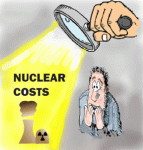 Reasons-Trump-Wont-Lead-A-Nuclear-Renaissance.html By Leonard Hyman & William Tilles – Dec 28, 2016 Donald Trump in the White House and Theresa May in 10 Downing Street. They will open the door to more nuclear spending, no doubt. Prime minister May has already given a green light to Britain’s most expensive energy project, a heavily subsidized nuclear power station at Hinkley Point. Based on the most recent federal budgeting approvals, we expect that no U.S. nuclear weapons programs will want for funds. But, despite all the post-election industry euphoria, should we anticipate a full renaissance for U.S. commercial nuclear power? Is that just a bridge too far, so to speak? Let’s look at the what will go into some of these decisions.
1.Need for the product. With no growth in the market for electricity, the industry needs new power plants only to replace old ones and to decarbonize output in order to mitigate global warming. The Trump administration has declared an end to the so-called war on coal, which makes it less likely that the electric industry will have to close old coal fired generating stations soon and it has categorized global warming as a hoax, which removes an excuse to build non-carbon producing nuclear units. The nuclear industry will need another rationalization for expansion.
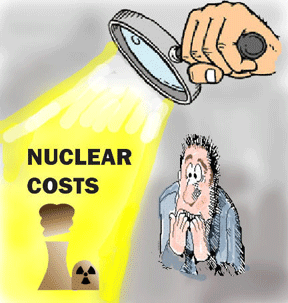
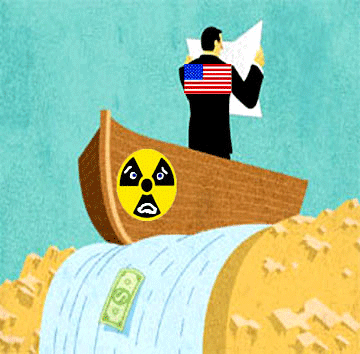
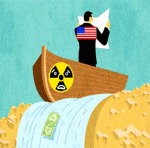 2.Economics. Nuclear power looks like an expensive means of producing base load electricity with significant known risks and ongoing waste storage/disposal issues. A new 1,000 MW nuclear plant ordered today for 2025 in service would cost about $10 billion. New renewables can produce power at no higher a cost per kwh, without the same long construction schedule and need to build so large a unit. A new base load gas fired unit of the same size capacity could be completed in a few years and cost one fifth as much per MW and produce at a lower cost per kwh. Producing a commodity like electricity at a relatively high price in a competitive market is not a winning business strategy. Nuclear has to offer something else.
3. Base load generation. Nuclear plants run as base load units, something renewables cannot do — at least not until economical energy storage comes into the picture– because of the intermittency of their output. Still, renewables, particularly wind in the U.S. midwest and Texas, will temporarily displace more large central station power generation, forcing more units to “cycle”. Nuclear plants are less well suited for this duty. Flexibility and load following may become more highly valued than base load. This also reflects a change in the electric industry itself. The former command and control or paternalistic relationship between utility and consumer is changing. At a minimum consumers are dictating how their energy is produced, agreeing for example to pay premiums for “greener” forms of electricity. In other words, nuclear has something to sell in the base load market, but that market may be in decline.
4. Power markets. Neither U.S. nor UK power markets will support unsubsidized or non-mandated new generation. To the extent that the U.S. wholesale power markets remain both deregulated and regulated in parts, this is also a negative for new nuclear capacity. Deregulated power markets, both here and in the UK, aren’t permitting wholesale prices high enough to finance new gas fired capacity much less new nukes. Regulators will want a cost benefit analysis before approving a new nuclear facility. Basically, this means that a new nuclear project in order to proceed will need a subsidy of one sort or another. A carbon tax would do the job even better. But what GOP politician would vote for that tax, especially if some of their constituents view the issue of global warning as a hoax?
5. Nuclear as infrastructure. As currently built, nuclear projects require a large contingent of well paid labor and massive amounts of steel and concrete. A handful of qualified engineering firms, the usual suspects, also build other infrastructure and one can only think that these politically connected firms can lobby for nuclear projects as hard as they lobby for new bridges or highways. Nuclear construction then could play a role as a component of the as part of the infrastructure program needed to boost the economy. The problem, however, is that nuclear infrastructure has some drawbacks.
6. Resilience needed. Infrastructure should be resilient and anti-fragile. In battle, would we rather attack our enemy in a swarm formation as part of a horde of thousands or ponderously approach the fields of honor as a monolithic “death star”. The former is anti-fragile. The latter, as we all know from the movies (no spoiler intended), is powerful but most definitely fragile. The “enemy” here approaches from two sides: technological obsolescence (which is slowly confronting all central station power generators) and simple obsolescence from a harsher operating environment. In plain terms, stuff just wears out faster. It’s a riskier business that’s for sure.
7. Investor-owned operators needed. The two major U.S. electric utilities with an outsized presence in nuclear power, Entergy and Exelon, could be characterized as the Dogs of the UTY, thanks to their less than stellar stock performances. EDF, the builder of the new British station, almost didn’t get to a positive decision on the new plant due to a revolt on the part of concerned directors. Do investors want more nuclear power? Probably not without subsidies or guarantees.
 8. Coastal locations needed. One problem with commercial nuclear power is not that it produces expensive electricity via fission, but that its voracious need for cooling water requires mostly coastal or riparian sites. Ignore the technology for a moment. Rising seas, hurricanes, storm surges and the like could render an ever broader swath of coastline unsuitable for infrastructure of any sort. Even if the Trump administration sees no issues, property and casualty insurors as well as and bond investors might.
9. Using nuclear subsidies as corporate welfare. New York and Illinois both launched
programs best described as Welfare for the Nuclear Elderly. It’s heart-warming to see such generosity just prior to the holiday season aimed at aging, uneconomic nuclear plants. This sounds to us like a job creation/preservation program for rural areas (where high paying jobs are scarce) masquerading as an environmentally beneficial, carbon mitigating proposal. There is nothing inherently evil about subsidizing private sector jobs in the electric utility industry. We just wish they’d drop the low carbon fig leaf as a rationale or change the market so it pays for the supposed virtues of nuclearinstead of making this a political handout. But note that handouts to old nukes do not encourage the building of new ones.
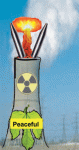 10. Nuclear for defense. Defense spending may crowd out civilian needs.Themilitary already plans to modernize its nuclear warfare capability over comingdecades. In fact, if we think about where nuclear power as an energy source has worked best, it is in military-maritime applications, things like submarines and arctic icebreakers. If a nuclear accident on a naval vessel at sea occurs resulting in all hands lost–that is clearly a tragedy. If Indian Point goes full metal Fukushima, rendering significant parts of Westchester County, NY uninhabitable, we don’t even have the adjectives much less the liability coverage. We also doubt that military applications will take a back seat in the new administration. Beyond that, there are two big nuclear related projects in the U.S.: completion of the Yucca Mountain nuclear waste repository in Nevada and construction of a vitrification facility at the Hanford, WA site now holding significant amounts of highly radioactive materials in less than perfect circumstances. More than likely, the military, Yucca and Hanford will absorb the lion’s share of new nuclear-related infrastructure monies.
Without a rationale rooted in decarbonization or in shortage of alternative fuels or energy sources, the new administration in the U.S. can only make a weak case for commercial nuclear power. If it will not embrace direct subsidies (which the incoming Congress may be reluctant to do as a matter of principle), the administration may have a hard time finding private partners for nuclear projects. But it can, and probably will, make a strong case for completing the huge nuclear tasks already on the government’s plate. That spending could boost the economy just as much as putting up new nuclear power stations,
December 30, 2016
Posted by Christina Macpherson |
business and costs, USA |
Leave a comment

 Climate deniers, conspiracists and one-percenters: Trump’s cabinet of characters
The president-elect plans to surround himself with enemies of the environment, billions of dollars in net worth and people who are against their own agencies, Guardian, Tom McCarthy, 30 Dec 16, Barack Obama’s original cabinet was chockablock with historic firsts. The first African American attorney general. The first Nobel laureate upon appointment. The first female homeland security secretary, and the first African American to head the Environmental Protection Agency (EPA).
Donald Trump’s cabinet, if confirmed, also would advance multiple historic firsts. It would be the first cabinet of multiple billionaires. It would be the first cabinet to give pride of place to climate deniers. It would be the first cabinet whose members want to eliminate their own agencies. And it would raise the bar – a lot – for conspiracy theorists.
Before Trump’s team faces closer scrutiny from Congress in January, here’s your guide to understanding how these four categories define many of Trump’s major nominees and advisers.
Climate deniers and enemies
These nominees would lead the four most important agencies in combatting climate change.
Scott Pruitt, EPA
Oklahoma state attorney general Pruitt wrote in a May 2016 editorial in the National Review that there was a climate change “debate” that was “far from settled. Scientists continue to disagree about the degree and extent of global warming and its connection to the actions of mankind. That debate should be encouraged …” He was part of a “secretive alliance” with fossil fuel companies to fight Obama administration environmental regulations, according to 2014 New York Times reporting.
Ryan Zinke, Department of the Interior
Congressman from Montana
In a 2014 interview, Zinke blamed the buildup of greenhouse gases on volcanoes. “I’m a conservationist, but when there’s a volcano in the Philippines that erupts and produces more CO2 than humans have produced in 200 years – is CO2 really the problem?”
Rick Perry, Department of Energy
Former Texas governor
Perry wrote in a 2010 book that “we have been experiencing a cooling trend”. “I don’t believe that we have the settled science,” he said in a 2014 interview, continuing: “Calling CO2 a pollutant is doing a disservice the country, and I believe a disservice to the world … I’m not a scientist.”
Mike Pompeo, CIA
Congressman from Kansas
Pompeo has used congressional hearings to grandstand against “what you all call climate change today”. He told CSPAN in 2013: “There are scientists who think lots of different things about climate change. There’s some who think we’re warming, there’s some who think we’re cooling, there’s some who think that the last 16 years have shown a pretty stable climate environment.”
Rex Tillerson, secretary of state
CEO of ExxonMobil
Tillerson pays lip service to “risks of climate change” but runs the world’s biggest non-state oil and gas extraction company. Likewise, he has said ExxonMobil favors a climate tax and supports the Paris climate accords but has not backedthose statements with action.
One-percenters
Trump’s billionaire cabinet could be the wealthiest administration ever. At least six appointees have net worths estimated in the nine figures. Collectively, they have more money than a third of American households combined, according to a Quartz calculation………
Divided loyalties
A noticeable Trump innovation in picking a cabinet: appointing leaders who have said they would like to destroy the agencies they’re supposed to lead. A variation is appointing leaders whose careers have undercut the agencies they’re supposed to lead.
Rick Perry
Perry famously suffered a memory lapse during a presidential debate in trying to name the Department of Energy as one of three federal agencies he would eliminate if elected. “Oops,” he said. Perry’s background in nuclear issues, which is the energy department’s main charge, appears to be limited to an effort to privatize the disposal of radioactive waste in Texas. Perry’s two immediate predecessors in the job were both nuclear physicists.
Scott Pruitt
Pruitt has been involved in multiple lawsuits against the EPA. He is currently part of a legal action waged by 28 states against the EPA to halt the Clean Power Plan, an effort by Obama’s administration to curb greenhouse gas emissions from coal-fired power plants. Pruitt has said the American people “are tired of seeing billions of dollars drained from our economy due to unnecessary EPA regulations”, and he boasted on his LinkedIn page that he was “a leading advocate against the EPA’s activist agenda”………
Conspiracists
Trump traffics in conspiracy theories and fake news – Barack Obama was born outside the US and sympathizes with terrorists, the election was rigged, Hillary Clinton is a criminal – so it’s only proper that his cabinet should too. Here are the three Trump nominees in competition for the tinfoil hat trophy.
Ben Carson, Department of Housing and Urban Development
Retired neurosurgeon
Carson believes pyramids were built by the biblical Joseph to store grain, thatVladimir Putin, Ayatollah Ali Khamenei and Mahmoud Abbas attended school together in Moscow in 1968, that Jews with firearms might have been able to stop the Holocaust, that he personally could stop a mass shooting and that Osama bin Laden enjoyed Saudi protection after 9/11……… https://www.theguardian.com/us-news/2016/dec/28/donald-trump-cabinet-climate-deniers-conspiracy-wealth?CMP=oth_b-aplnews_d-1&utm_content=buffer36606&utm_medium=social&utm_source=twitter.com&utm_campaign=buffer
December 30, 2016
Posted by Christina Macpherson |
politics, USA |
Leave a comment
 Davis-Besse Nuclear Power Station Could Soon be Closed or Sold by FirstEnergy , CleverScene, Sam Allard on Thu, Dec 29, 2016 USA Today reports that the Davis-Besse Nuclear Power Station might soon be shuttered or sold by FirstEnergy Corp.
FirstEnergy CEO Chuck Jones said in an industry conference that due to cheap energy sources like natural gas, and the state of Ohio’s unwillingness to set energy prices above market rate, operating some power plants is no longer profitable. Davis-Besse is one of several plant in Ohio and Pennsylvania potentially on the chopping block…….
December 30, 2016
Posted by Christina Macpherson |
business and costs, USA |
Leave a comment
General Atomics has some explaining to do http://www.sandiegoreader.com/news/2016/dec/28/radar-general-atomics-hot-potato/# GA’s hot potato By Matt Potter, Dec. 28, 2016 La Jolla–based military contractor General Atomics, maker of the Predator drone and other lucrative pieces of battle-ready hardware, also provides radiation monitoring systems for atomic reactors. The company’s latest installation came in July of this year at Watts Bar Unit 2 in Tennessee, “the first new U.S. nuclear power plant scheduled to be put into operation since 1996,” says a news release by the firm. “Since 1965, we’ve maintained a solid reputation for designing and manufacturing the highest quality, most reliable safety-related products, and for continually supporting our products and our customers throughout a plant’s lifecycle,” executive Scott Forney was quoted as saying.
But the story is different in a November 29 Notice of Nonconformance, sent to the company’s Electromagnetic Systems Group here by the U.S. Nuclear Regulatory Commission. That document says the quality of the detection devices is questionable, leading to potentially mistaken radiation readings. Among other omissions listed in the 38-page document, General Atomics “did not perform periodic testing of the chemical composition of the [detectors’] coating material…nor did [General Atomics] verify the shelf life of the coating material.” In addition, the company failed to “verify the adequacy of the calibration services…which could adversely affect the accuracy of [radiation monitoring system’s] detectors.” On top of that, inspectors witnessed “staff adding and removing lead shields from the stack of lead bricks below the platform without documenting the change in configuration.”
Per the report, “staff were unaware of the amount of scattered radiation in the area, and the effect of adding and removing lead from the cart on the amount of scattered radiation.” Said the notice, “verification of the material-critical characteristics specified [for use] in safety-related applications was not performed and the connector was not adequately dedicated for operation in harsh environments.”
Concludes the document, “Please provide a written statement or explanation within 30 days from the date of this letter in accordance with the instructions specified in the enclosed Notice of Nonconformance. The NRC will consider extending the response time if you show good cause for the agency to do so.”
December 30, 2016
Posted by Christina Macpherson |
safety, USA |
Leave a comment
 The Commission has entirely ignored the immense evidence that DOE’s plans for disposal of
  several types of defense waste pose much greater threats to water resources, most especially at Hanford
“I am dismayed that the Commission saw fit to recommend that the Department of Energy (DOE) have a large upfront role in both the next steps for repository program, … DOE was in large part responsible for the mess the program is in now,
 Radioactive Wastes From Nuclear Bomb Program Given Short Shrift In Blue Ribbon Commission Report EnEws Park Forest, TAKOMA PARK, MD–(ENEWSPF)–January 27, 2012. Arjun Makhijani, Ph.D., President of the Institute for Energy and Environmental Research, today commented on some of the recommendations of the final report of the Presidential Blue Ribbon Commission (BRC) on America’s Nuclear Future.
The commission was created to address U.S. nuclear waste issues after the Obama administration cancelled the Yucca Mountain program….
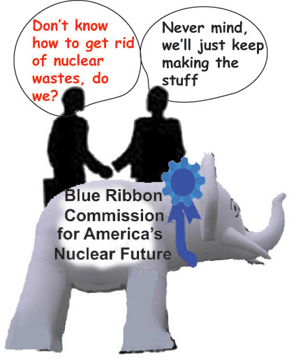
….On wastes from the nuclear bomb program:
Makhijani: “It is tragic that the Commission did not substantively address the most pressing radioactive waste contamination threats to precious water resources – for instance hundreds of times the drinking water limit at Hanford, Washington on the banks of the Columbia River.
The Commission had a charter to conduct a ‘comprehensive’ review of the nuclear waste problem, including defense wastes from the nuclear bomb program. Yet, it simply said it did not have the resources to deal with all the problems and punted the nuclear weapons waste issue to Congress while focusing on commercial spent fuel at nuclear reactor sites.” Continue reading →
December 28, 2016
Posted by Christina Macpherson |
Reference, USA, wastes |
1 Comment




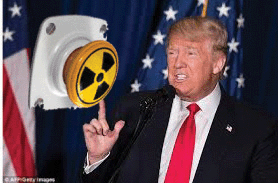 “We need to place someone or something between Donald Trump’s impulses and Armageddon. When it comes to demonstrating Trump’s recklessness, we don’t want the smoking gun to be a mushroom cloud.” Grayson said.