Indian Point Nuclear Power Plant to Close by 2021 NYT, By VIVIAN YEE and PATRICK McGEEHANJAN. 6, 2017The Indian Point nuclear plant will shut down by April 2021 under an agreement New York State reached this week with Entergy, the utility company that owns the facility in Westchester County, according to a person with direct knowledge of the deal.
The Indian Point nuclear plant will shut down by April 2021 under an agreement New York State reached this week with Entergy, the utility company that owns the facility in Westchester County, according to a person with direct knowledge of the deal.
Under the terms of the agreement, one of the two nuclear reactors at Indian Point will permanently cease operations by April 2020, while the other must be closed by April 2021. The shutdown has long been a priority for Gov. Andrew M. Cuomo, who — though supportive of upstate nuclear plants — has repeatedly called for shutting down Indian Point, which he says poses too great a risk to New York City, less than 30 miles to the south.
“Why you would allow Indian Point to continue to operate defies common sense, planning and basic sanity,” Mr. Cuomo told reporters in June……..
In exchange, the state and Riverkeeper will drop safety and environmental claims against Indian Point they had previously filed with federal regulatory agencies.
Entergy, which is based in New Orleans, has been seeking a 20-year renewal of its license from the federal Nuclear Regulatory Commission since 2007. But New York State officials have challenged that renewal on several fronts and have refused to grant permits that they say the plant needs to continue operating.
Eden Keeper, (USA) 6 Jan 17Faith members considering solar power for churches, temples, mosques, and other houses of worship are discovering that installations are getting both easier and cheaper. Since 2009, according to the Solar Energy Industries Association (SEIA), costs for non-residential solar installations have dropped around 73%, from around $7.50 per kilowatt to today’s cost of about $2 per kilowatt.In Minnesota, for example, approximately 400 congregations are working with Minnesota Interfaith Power and Light (MNIPL), a faith-based nationwide nonprofit concerned with climate change and environmental stewardship. MNIPL Executive Director Julia Nerbonne notes that conversations on solar power for churches are trending all across the state.
Among the 20 Minnesota houses of worship that completed their transition to solar power in 2016 are Unity Church-Unitarian and Woodbury Peaceful Grove United Methodist Church in St. Paul. In Roseville, St. Christopher’s Episcopal Church also completed it’s solar rooftop installation last year……..
Community Solar Farms Offer Additional Solutions……..
Just Community Solar: A Story of Faith in Action
Many States Offer Solar IncentivesCurrent political fearmongering aside, many states are working hard to increase the transition to renewable energy in the US. Minnesota is an inspiring example…
“Tons and Tons of Faith Communities Doing Solar” An additional bill credit especially relating to solar power for churches, faith-based organizations, and other nonprofits may be approved in March 2017, by the Public Utilities Commission………
Learn More about Community Solar Power For ChurchesMNIPL’s project, “Just Community Solar: A Story of Faith in Action” is “connecting the dots between climate, racial, and economic justice.”
US delays cleanup rule at uranium mines amid GOP criticism
Federal GOP legislators from Wyoming have said a rule was an unnecessary burden for the uranium industry NBC5 Jan 5, 2017 CHEYENNE, Wyo. —
Federal officials withdrew a requirement for companies to clean up groundwater at uranium mines across the U.S. and will reconsider a rule that congressional Republicans criticized as too harsh on industry.
The plan that the U.S. Environmental Protection Agency put on hold Wednesday involves in-situ mining, in which water containing chemicals is used to dissolve uranium out of underground sandstone deposits. Water laden with uranium, a toxic element used for nuclear power and weapons, is then pumped to the surface. No digging or tunneling takes place.
The metal occurs in the rock naturally but the process contaminates groundwater with uranium in concentrations much higher than natural levels. Mining companies take several measures to prevent tainted water from seeping out of the immediate mining area…….
Along with setting new cleanup standards, the rule would have required companies to monitor their former in-situ mines potentially for decades. The requirement was set for implementation but now will be opened up for a six-month public comment period.
EPA officials didn’t immediately respond to a request for comment Thursday.
Environmentalists and others say uranium-mining companies have yet to show they can fully clean up groundwater at a former in-situ mine. Clean groundwater should not be taken for granted, they say, especially in the arid and increasingly populated U.S. West.
“We are, of course, disappointed that this final rule didn’t make it to a final stage,” said Shannon Anderson with the Powder River Basin Resource Council. “It was designed to address a very real and pressing problem regarding water protection at uranium mines.”
The EPA rule is scheduled for further consideration in President-elect Donald Trump’s administration.
NRC plans to name U.S. nuclear reactors using potentially flawed Areva parts, Japan Times, 6 Jan 17,
WASHINGTON – The U.S. Nuclear Regulatory Commission told French nuclear power company Areva SA it will publish as early as next week the names of U.S. reactors that contain components from its Le Creusot forge that the firm is suspected of falsifying documents despite the company’s claim that the information is proprietary.
The written notice, dated Dec. 30 and seen by Reuters on Thursday, underscores rising tension between the U.S. nuclear regulatory body and Areva after French authorities opened an investigation last month into decades of alleged forgery relating to the quality of parts produced at the forge and used in power plants around the world.
The NRC has investigated whether the suspected falsification of documents poses any risks for U.S. nuclear plants, but has said it has found that the plants are safe.
“At this time, there are no indications of any specific safety concerns for U.S. reactors,” NRC spokesman David McIntyre said on Thursday.
Still, anti-nuclear power advocates, including Greenpeace, have pushed NRC to reveal which U.S. reactors have the components, saying that there could be risks to the public.
GM Commits to 100 Percent Renewable Energy by 2050 15.09.2016 GM pledges to source global electricity from wind, sun and landfill gas, joins RE100
DETROIT – General Motors plans to generate or source all electrical power for its 350 operations in 59 countries with 100 percent renewable energy — such as wind, sun and landfill gas — by 2050.
“Establishing a 100 percent renewable energy goal helps us better serve society by reducing environmental impact,” said GM Chairman and CEO Mary Barra. “This pursuit of renewable energy benefits our customers and communities through cleaner air while strengthening our business through lower and more stable energy costs.”
This new renewable energy goal, along with the pursuit of electrified vehicles and efficient manufacturing, is part of the company’s overall approach to strengthening its business, improving communities and addressing climate change. GM is also joining RE100, a global collaborative initiative of businesses committed to 100 percent renewable electricity, working to increase demand for clean power.
In 2015, GM required 9 terawatt hours of electricity to build its vehicles and power its offices, technical centers and warehouses around the world. To meet its new renewable energy goal, GM will continue to improve the energy efficiency of its operations while transitioning to clean sources for its power needs.
Today GM saves $5 million annually from using renewable energy, a number it anticipates will increase as more projects come online and the supply of renewable energy increases. In addition, the company anticipates costs to install and produce renewable energy will continue to decrease, resulting in more bottom-line returns.
State, federal leaders push for transparency after shutdown and safety concerns. State officials are pushing for more transparency from federal regulators about safety concerns at the Pilgrim Nuclear Power Plant in Plymouth.
In a letter dated Jan. 4 to the Nuclear Regulatory Commission, Gov. Charlie Baker, Attorney General Maura Healey, Sen. Edward Markey and several other lawmakers called for a public meeting in Massachusetts to allow the agency to answer questions and communicate directly with the public about the safety of the nuclear power plant and provide details about recent shutdowns.
The letter comes after the inadvertent disclosure of an email last month from the leader of the NRC special inspection team noting continued concerns about operations at the plant, including poor engineering expertise and a “safety culture problem.”
In the letter, the team leader commented that plant staff “seems overwhelmed by just trying to run the” nuclear plant.
“The NRC has an obligation to address the operation of the Pilgrim Nuclear Power Plant and the increased public concerns that continue to plague the plant at a time when it should be showing significant improvements,” Healey said. “The public’s serious questions about the safety of this plant and risks it poses to the environment, workers and residents need to be answered immediately.”
The letter states that a public meeting also would provide an opportunity for the NRC to discuss the cause of the plant’s most recent shutdown, including how the leaks in three of the plant’s eight main steam isolation valves were discovered, why they were not discovered earlier, and what steps have been taken to inspect the integrity of the remaining steam isolation valves. These valves are used to prevent a leak of radioactivity into the environment during a nuclear accident.
In light of the documented ongoing safety issues at the plant, the letter also calls on the NRC to deny a request from the plant’s owner, Entergy, for an exemption from NRC’s post-Fukushima Dai-ichi plant safety upgrades.
The NRC downgraded Pilgrim safety’s status to the least safe category in September 2015 based on recurring safety issues at the plant. In October 2015, Entergy announced that it will shut down the plant by June 2019, citing low energy prices, reduced revenues, and increased operational costs.
— In the last days of the Obama Administration, the U.S. Environmental Protection Agency is about to dramatically increase allowable public exposure to radioactivity to levels thousands of times above the maximum limits of the Safe Drinking Water Act, according to documents the agency surrendered in a federal lawsuit brought by Public Employees for Environmental Responsibility (PEER). These radical rollbacks cover the “intermediate period” following a radiation release and could last for up to several years. This plan is in its final stage of approval.
The documents indicate that the plan’s rationale is rooted in public relations, not public health. Following Japan’s Fukushima meltdown in 2011, EPA’s claims that no radioactivity could reach the U.S. at levels of concern were contradicted by its own rainwater measurements showing contamination from Fukushima throughout the U.S. well above Safe Drinking Water Act limits. In reaction, EPA prepared new limits 1000s of times higher than even the Fukushima rainwater because “EPA experienced major difficulties conveying to the public that the detected levels…were not of immediate concern for public health.”
When EPA published for public comment the proposed “Protective Action Guides,” it hid proposed new concentrations for all but four of the 110 radionuclides covered, and refused to reveal how much they were above Safe Drinking Water Act limits. It took a lawsuit to get EPA to release documents showing that –
The proposed PAGs for two radionuclides (Cobalt-60 and Calcium-45) are more than 10,000 times Safe Drinking Water Act limits. Others are hundreds or thousands of times higher;
According to EPA’s own internal analysis, some concentrations are high enough to deliver a lifetime permissible dose in a single day. Scores of other radionuclides would be allowed at levels that would produce a lifetime dose in a week or a month;
The levels proposed by the Obama EPA are higher than what the Bush EPA tried to adopt–also in its final days. That plan was ultimately withdrawn; and
EPA hid the proposed increases from the public so as to “avoid confusion,” intending to release the higher concentrations only after the proposal was adopted. The documents also reveal that EPA’s radiation division even hid the new concentrations from other divisions of EPA that were critical of the proposal, requiring repeated efforts to get them to even be disclosed internally.
“To cover its embarrassment after being caught dissembling about Fukushima fallout on American soil, EPA is pursuing a justification for assuming a radioactive fetal position even in cases of ultra-high contamination,” stated PEER Executive Director Jeff Ruch, noting that New York Attorney General Eric Schneiderman has called for the PAGs to be withdrawn on both public health and legal grounds. “The Safe Drinking Water Act is a federal law; it cannot be nullified or neutered by regulatory ‘guidance.’”
Despite claims of transparency, EPA solicited public comment on its plan even as it hid the bulk of the plan’s effects. Nonetheless, more than 60,000 people filed comments in opposition.
“The Dr. Strangelove wing of EPA does not want this information shared with many of its own experts, let alone the public,” added Ruch, noting that PEER had to file a Freedom of Information Act lawsuit to force release of exposure limits. “This is a matter of public health that should be promulgated in broad daylight rather than slimed through in the witching hours of a departing administration.”
Tesla Flips the Switch on the Gigafactory Musk meets a deadline: Battery-cell production begins at what will soon be the world’s biggest factory—with thousands of additional jobs. Bloomberg, by Tom Randall January 5, 2017 The Gigafactory has been activated.
Tesla’s solar roofs could revolutionize the industry
Hidden in the scrubland east of Reno, Nev., where cowboys gamble and wild horses still roam—a diamond-shaped factory of outlandish proportions is emerging from the sweat and promises of Tesla CEO Elon Musk. It’s known as the Gigafactory, and today its first battery cells are rolling off production lines to power the company’s energy storage products and, before long, the Model 3 electric car. 1
The start of mass production 2 is a huge milestone in Tesla’s quest to electrify transportation, and it brings to America a manufacturing industry—battery cells—that’s long been dominated by China, Japan, and South Korea. More than 2,900 people are already working at the 4.9 million square-foot facility, 3 and more than 4,000 jobs (including temporary construction work) will be added this year through the partnership between Tesla and Panasonic. 4
By 2018, the Gigafactory, which is less than a third complete, will double the world’s production capacity for lithium-ion batteries and employ 6,500 full-time Reno-based workers, according to a new hiring forecast from Tesla. The company’s shares, having touched their highest point since August, closed up $10 at $226.99 in New York trading.
The full activation of the Gigafactory carries existential significance for Tesla, representing a new sense of urgency at a company known for its unreachable deadlines. After missing almost every aggressive product milestone it set for itself over the last decade, Tesla must prove to investors and customers that it can stay on schedule for its first mass-produced car.
There are promising signs. ………
The storage products fit into Musk’s long-term vision of transforming Tesla from an an electric car company to a clean-energy company. That’s the same motivation behind his recently concluded deal to acquire SolarCity Corp., the largest U.S. rooftop solar installer. Last week, Tesla reached a deal with Panasonic to expand its relationship to produce solar cells in Buffalo, N.Y., bringing some 1,400 jobs to the region.
At a time when President-elect Donald Trump has taken to Twitter to skewer manufacturers for moving jobs to Mexico or China, Tesla stands apart as an all-American carmaker, battery maker, and solar producer. About 95 percent of the Model 3’s components will be made in the U.S., and 25,000 of the company’s 30,000 employees are based there. Musk, who visited Trump recently in New York City, was named to a strategy group to advise the new Republican president. ……. https://www.bloomberg.com/news/articles/2017-01-04/tesla-flips-the-switch-on-the-gigafactory
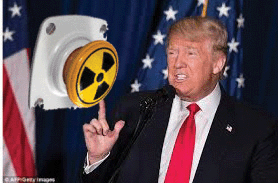
The “madman theory” of nuclear war has existed for decades. Now, Trump is playing the madman.VOX, by Nicole Hemmer Jan 4, 2017, Is Donald Trump a madman? Or, at least, would he like foreign leaders to think he might be just a little unstable? Such questions are being batted around in papers like the Boston Globe and the Washington Post in response to the president-elect’s foreign policy moves: his provocations toward China, his attacks on NATO and the UN, his warm overtures toward Rodrigo Duterte and Vladimir Putin.
Across the pundit-sphere, analysts are asking, is he crazy, or crazy like a fox?
In no context is the question more pertinent than Trump’s position on nuclear weapons. His comments both as candidate and president-elect show a more cavalier attitude toward their proliferation and use than any president in the past 30 years. “You want to be unpredictable,” Trump said last January on Face the Nation when asked about nuclear weapons. More recently, he tweeted that it was time for the US to start stockpiling nukes again. The comments prompted instant parallels to Richard Nixon’s “madman theory” of foreign relations: the idea that the president couldn’t be controlled — including where America’s nuclear arsenal was concerned — so foreign leaders should do everything in their power to appease him.
The madman question is so important here because madness has been a mainstay of nuclear culture since the atomic age flashed into being in the Jornada del Muerto desert in 1945. The bomb, carefully engineered by some of the 20th century’s most brilliant scientists, able to raze cities and civilizations, has always spanned rationality and irrationality, logic and madness.
The brightest minds created the most destructive force, and then leaders spent years working out rationales for its world-ending use. It was a madness begot by logic. But that madness doesn’t always present in the same way, which is why the history of nuclear madness has to precede our understanding of the Trump-as-madman debate…….
A brief, terrifying history of America’s nuclear mishaps
four years after Hiroshima and Nagasaki, the Soviets tested their own nuclear bomb, and the race was on for more powerful bombs, for better strike capability, for the ability to annihilate the other side before it could return fire. By the mid-1950s, the arms race had reached its illogically logical endpoint: If one side struck, everyone would be wiped out. Mutual assured destruction. MAD.
The acronym stuck, perhaps because of the horrific absurdity of it all. The logical conclusion, the position to which the world had been brought by the combined education and expertise of scientists and strategists, was the verge of obliteration………
As time passed, Mutually Assured Destruction came to seem — MAD……….
Maybe it was the exhaustion of the arms race, or the terror of the missile crisis, or the apocalyptic consequences of MAD, but by 1964 the idea of ever using nuclear weapons was considered insane. If the outcome truly was mutual assured destruction, then it would take an act of self-destructive madness to press the button………
World leaders understand that nations with nuclear weapons are treated differently than those without, and so there is a rational reason for pursuing nuclear technology. At the same time, the use of nuclear weapons against an enemy would make a nation-state into a global pariah. It would be insane.
Enter Donald Trump. The president-in-waiting is schooled in none of these particulars, claiming to believe only in strength and the desire to use it. His loose talk about nukes has re-raised the long-dormant question: Is he crazy enough to actually press the button?
Here, the history of nuclear madness may be as much a trap as a guide. Because the questions now shouldn’t be about Trump’s madness but his impulsivity and ignorance. Whatever one thinks of Nixon and Kissinger’s madman theory, it was a calculation. Kissinger was steeped in game theory and Nixon had a deep knowledge of international affairs. Reagan was a foreign policy autodidact with experienced ideological advisors. Their administrations could tell a hawk from a handsaw. (Admittedly, some of these comforting thoughts were only fully evident in hindsight.)
Trump doesn’t share his predecessors’ considered strategic thinking and mastery of geopolitics, but that doesn’t make him a madman. The madness is in the weapons themselves, powerful enough to obliterate entire countries, entire peoples, and in the logics that grew up around them to govern their disuse. The only hope is that, as with Nixon and Reagan before him, Trump’s time in office makes clear how badly things can go in an atomic age, and how important it is to continue the push to contain, if not eliminate, the madness in our midst.
Toshiba admits to a ruinous overpayment for an American nuclear firm Its share price plunged by 40% in three days as investors worried about its financial viability, The Economist, Jan 7th 2017 | TOKYO THE probe in 2015 into one of Japan’s largest-ever accounting scandals, at Toshiba, an electronics and nuclear-power conglomerate that has been the epitome of the country’s engineering prowess, concluded that number-fiddling at the firm was “systemic”. It was found to have padded profits by ¥152bn ($1.3bn) between 2008 and 2014. Its boss, and half of the board’s 16 members, resigned; regulators imposed upon it a record fine of $60m.
Now its deal-making nous is in doubt too. In December 2015—the very same month that it forecast hundreds of billions of yen in losses for the financial year then under way, as it struggled to recover from the scandal—Toshiba’s American arm, Westinghouse Electric, bought a nuclear-construction firm, CB&I Stone & Webster. One year on, on December 27th, Toshiba announced that cost overruns at that new unit could lead to several billions of dollars in charges against profits.
Its shares fell by 42% in a three-day stretch as investors dumped them, fearing a write-down that could wipe out its shareholders’ equity, which in late September stood at $3.1bn. Moody’s and S&P, two ratings agencies, announced credit downgrades and threatened more. Toshiba’s explanation for how it got the numbers so wrong on a smallish purchase is woolly. But it is clear that missing construction deadlines on nuclear-power plants can send costs skyrocketing. Its projects in America, and in China, are years behind schedule. Mycle Schneider, a nuclear expert, says that in America, as elsewhere, engineering problems are compounded by a shortage of skilled manpower. Few plants have been built there recently.
Part of the $229m that Westinghouse paid for CB&I Stone & Webster included $87m of goodwill (a premium over the firm’s book value based on its physical assets). It is that initial estimate that is now being recalculated.
Toshiba had looked to be bouncing back from its accounting nightmare………
Toshiba’s central part in a plan by the government of Shinzo Abe, the prime minister, to pep up growth by exporting nuclear-power technology to emerging countries may help. In June Westinghouse clinched a deal in India to build six new-generation AP1000 reactors, Toshiba’s first order since the triple meltdown at the Fukushima Dai-ichi nuclear plant in 2011. Toshiba is also involved in that site’s costly and complex clean-up. Some think that Japanese banks, known for keeping zombie firms on life support, will stand behind it, come what may. Shares in Toshiba’s two main lenders, Sumitomo and Mizuho, slid last week after the profit warning. Investors expect more big bank loans or a debt-for-equity swap, which allows a bank to turn bad loans into shares.
The Salem County complex operated by Public Service Gas and Electric, where three nuclear reactors are located, also was identified by French Greenpeace as one of nine nuclear plants nationwide that may have imported defective safety components manufactured at the Le-Cruseot-Areva forge in France.
The cancer study, released by the Radiation Public Health Project (RPHP) and written by epidemiologist Joseph Mangano at the request of Unplug Salem, a citizen’s group, indicates rising cancer rates in communities around the facility. Mangano has published 34 medical journal articles on the effects of radiation on public health, including areas around the Oyster Creek nuclear reactor in Lacey that showed elevated pediatric cancer rates and the presence of radioactive strontium 90 in baby teeth. Strontium 90 is a radioactive isotope that can be found only in a nuclear bomb or nuclear plant.
The report states that Salem County had the highest cancer rates of any New Jersey county for 2014, the most recent year statistics were gathered. Prior to 1990, the county cancer death rate was below the state rate. Since then, the county rate has steadily risen. The report indicates the 2014 rate was 40 percent higher than the state rate.
The study does not draw a definite link between radiological releases from the plant and cancer rates, but strongly urges state and federal agencies to do more in-depth analysis.
In light of the revelations of potentially flawed components at Salem and the RPHP report, the NRC must step up its oversight and provide the public with hard-core data proving the public is not at risk.
The NRC has refused to confirm or deny whether there are American nuclear plants using defective French parts, saying it is proprietary information between the plant operator and manufacturer, and that there is not a safety concern at this time.
The proprietary information argument is absurd. The NRC should not have to be reminded that its obligation and mandate is the protection of the American public. If this were a defective automobile part, recall notices would be sent to owners and then advertised in nationwide news outlets.
The French Nuclear Safety Authority reported in April 2016 that analysis showed manufacturing flaws, and since then, regulators in France have shut down 18 reactors to test for potentially defective parts. The parts include crucial cooling components.
We need to do exactly what France is doing.
According to Beyond Nuclear, a national nuclear watchdog group, the parts include reactor pressure vessels and replacement steam generators. In addition to uncovering the defective parts, French regulators also suspected falsification of manufacturing reports.
Beyond Nuclear’s Paul Gunter has filed an emergency petition with the NRC to release the list of nuclear plants that could be using defective French parts.
Congress must join that call and demand proof that those potentially defective parts could not cause a catastrophic accident or meltdown. Until that analysis is conducted and made public, any nuclear plant operating with a potentially defective part must be shut down.
The NRC’s long history of putting nuclear industry profits ahead of public safety, and its abrupt cancellation of a cancer study around nuclear plants, including Oyster Creek, does nothing to quell public unease. International cancer studies in France, Germany and the United Kingdom have found increased childhood leukemia rates in neighborhoods around nuclear plants.
The public is exposed to daily emissions of low-level radiation from nuclear plants. These nuclear isotopes are man-made and not naturally occurring. The National Academies of Science has stated in a report referred to as the Bier VII that no amount of continuous exposure to radiation can be considered safe.
The unfolding events at Salem/Hope Creek, which had three safety problem findings in 2015, including the presence of icicles that contained tritium about 500 times the federal standard, demands immediate state and congressional attention.
A new governor will be in Trenton in 2017, and that individual must get New Jersey on track toward a renewable energy future so that we can leave dangerous nuclear energy and dirty fossil fuels in the past. It’s time to embrace 21st century technology and become a shining example for other states. Las Vegas is now entirely powered by renewables. If Las Vegas can do it, so can New Jersey. It just takes political will, determination and a hefty dose of foresight for the well-being of the planet and future generations.
Janet Tauro is New Jersey board chair of Clean Water Action.
The biggest environmental battles facing the Trump administration Some flashpoints for environmental activists relating to climate change that are likely to erupt in the first few months of Donald Trump’s presidency, Guardian, Mazin Sidahmed, Nicole Puglise and Oliver Milman, 6 Jan 17,Donald Trump is likely to face unprecedented opposition from environmental groups during his presidency as activists prepare to battle the new administration on a number of fronts across the US.
While environmentalists clashed with Barack Obama over the Keystone and Dakota Access oil pipelines, these fights could pale in comparison to the array of grievances Trump will face overwater security, fracking and climate change.
The president-elect has vowed to approve the Keystone pipeline, which Obama blocked, and “very quickly” resolve the Dakota Access project, currently held up by the federal government after months of protests by Native Americans. Trump has pledged to remove “roadblocks” to oil, gas and coal developments and threatened to end all climate and clean energy spending.
Opposition to this agenda has already begun in earnest, following a prediction by former vice-president Al Gore that there will be a “huge upsurge” in environmental activism, stoked by the new administration’s plans to cut science funding, remove the US from the Paris climate deal and appoint Scott Pruitt as administrator of the Environmental Protection Agency – an agency he has sued multiple times as Oklahoma attorney general.
What will be the first actions Trump takes as president?
350.org, an international environmental organization, pledged to make January a month of a resistance against Trump’s cabinet picks. On 9 January, the organization will mobilize its chapters in all 50 states to stage protests at senators’ district offices. It will be the beginning of what they say will be a sustained protest throughout the year.
In New York City in December, the Sierra Club protested Pruitt’s nomination by projecting an image of rising seas and the words “Don’t Trump the planet” on to the side of the Trump Building on Wall Street. It’s the opening salvo of what is likely to be a war of attrition waged by America’s largest environmental group, which has drawn in more monthly donors in the weeks since Trump’s election than it has in the past four years.
“If Trump keeps choosing to drag us backwards to the dirty energy of the past, he will find unfettered opposition every step of the way,” said Michael Brune, executive director of the Sierra Club.
Here are some of the flashpoints for environmental activists protesting issues relating to climate change happening around the country now and likely to erupt in the first few months of Trump’s presidency:
Eminent domain in Iowa
South of Standing Rock, the sprawling Dakota Access pipeline faces another dispute. Landowners in Iowa are challenging the government seizure of their land to build the pipeline………
Divestment movement on campus
Campuses across the country have been pushing universities to divest from from the fossil fuel industry over the past few years. Organizers are hoping the environmental threats posed by Trump’s cabinet nominations of energy industry leaders will further galvanize the movement……..
As a U.S. Business, Nuclear Power Stinks http://www.powermag.com/blog/as-a-u-s-business-nuclear-power-stinks/ 01/01/2017 | Kennedy Maize Regardless of one’s views of the social values of nuclear power — compelling cases can be made all around — as a business proposition nuclear stinks.
The latest evidence comes from the giant Japanese conglomerate Toshiba, which saw a third of its market value vanish in two days of trading (20% in one day, a free-fall stopped only by a limit to trading losses imposed by the Japanese stock market). Credit rating agencies promptly downgraded the company’s debt.
Toshiba’s stock crash was a result of billions in reported losses from its Westinghouse Electric subsidiary and Westinghouse’s ruinous investment last year in nuclear engineering and construction behemoth CB&I Stone & Webster, itself the product of an ill-fated merger. Toshiba’s nuclear business has been hemorrhaging money at its U.S. construction projects in Georgia and South Carolina. Westinghouse is years behind schedule and billions of dollars over budget at its two construction projects: Southern’s Vogtle and Scana Corp.’s Summer units, a total of four Westinghouse AP1000 reactors under construction. Toshiba faces the possibility that its nuclear troubles will lead the company to a negative net worth.
My colleague Aaron Larson describes the gory business details well. The bottom line is that Westinghouse threatens to bring Toshiba to its financial knees, although the firm is too large to fail entirely. It may well require a Japanese government bailout.
Then there is France’s Areva, which has been bleeding red ink for more than a decade and would have expired but for its French government owners, and a recent bailout.
The company is far behind schedule and vastly over budget on construction projects in Finland and France. Late last year, discovery of quality control problems in carbon steel forgings from Areva’s Le Creusot Forge shocked the company. The allegations closed 20 of France’s 58 operating reactors, which also could jeopardize regulatory approval for extended operation at the aging plants.
In late December reports surfaced that Areva employees for decades hid problems in reactor parts it manufactured at Le Creusot Forge. Inspectors from the U.S., France,
China, and the U.K. descended on Areva to examine records and investigate the allegations. “I’m concerned that there keep being more and more problems unveiled,” Kerri Kavanagh, who leads the U.S. Nuclear Regulatory Commission’s unit inspecting Le Creusot, told the Wall Street Journal.
The business case for existing nukes in the U.S. is also ominous. Just last week, an Ohio newspaper reported that Akron-based FirstEnergy will close or sell its long-troubled, 900-MW Davis-Besse nuclear unit this year or next, without counting on a state bailout. “We have made our decision that over the next 12 to 18 months we’re going to exit competitive generation and become a fully regulated company,” CEO Chuck Jones said. “We are not going to wait on those states to decide what they are going to do there.” This comes on top of multiple closings of U.S. nukes unable to compete in competitive markets in recent years, state subsidies in Illinois and New York to keep uneconomic plants open, and threats of even more shutdowns.
At the same time as the Davis-Besse warning, Environmental Progress, a pro-nuclear group, released an analysis that concluded that a quarter to two-thirds of operating U.S. nuclear plants could face premature closure. If it weren’t for actions by state governments in Illinois and New York, the picture would look worse.
The Environmental Progress analysis counts 35 GW of nuclear capacity as at “triple risk” because “they are in deregulated markets, uneconomical (according to Bloomberg New Energy Finance) and up for relicensing before the end of 2030.” Facing greatest jeopardy for early closure? D.C. Cook in Michigan, Seabrook in New Hampshire, Millstone in Connecticut, and Davis-Besse in Ohio.
Amanda Oglesby , @OglesbyAPPApp.com Jan. 4, 2017 LACEY – The U.S. Nuclear Regulatory Commission performed special inspections of Oyster Creek Generating Station after personnel found a box of uranium-containing monitors outside the nuclear power plant’s designated nuclear-containing Material Access Area.
The box of eight local power range monitors was found Oct. 6 under a pallet and other material inside the warehouse, where it mostly likely sat for decades, according to a letter from Exelon Generation to the U.S. Nuclear Regulatory Commission. Nothing on the box marked the contents as containing radioactive material, according to the letter.
The monitors, which measure power inside of the nuclear reactor, contained less than a gram of uranium-235, said Neil Sheehan, a spokesman for the Nuclear Regulatory Commission.
Uranium-235 is radioactive. If ingested or inhaled, it can cause cancer or serious damage to major organs in the body, according to the Centers for Disease Control.
It is the same isotope of uranium that is used within the plant’s fuel rods, said Dave Lochbaum, director of the Nuclear Safety Program for the Union of Concerned Scientists. With enough of the material, someone could make a dirty bomb or nuclear weapon, he said.
“You want to control this material so it doesn’t get into places it shouldn’t be,” Lochbaum said.
What a Twitter-Happy Trump Might Mean For Nuclear Diplomacy, The Wire, BYRAMESH THAKURON01/01/2017
Far from making America great again, Trump is more likely to make America grope again in the darkness of the post-nuclear age.Hillary Clinton lost the election, but a question she tweeted during the campaign remains critically important for the world. Can a man so easily baited by Twitter be trusted with the nuclear codes?
Donald Trump’s likely policies after assuming office later in January require triangulation of three known character traits. First, his twitchy thumbs can jump into action to spray his thought bubbles over the Twitter-sphere before his brain is engaged. Second, he possesses a unique capacity to deny outright something he said, even if digitally recorded. Third, he is a professional deal maker.
Trump’s nuclear Twitter spray
During the US election campaign, Trump thrice asked a foreign policy adviser: if we have nuclear weapons, why can’t we use them?. In a New York Times interview, he seemed to suggest Japan and South Korea could obtain their own nuclear arsenals. On December 22, President-elect Trump tweeted: “The United States must greatly strengthen and expand its nuclear capability.” The same day President Vladimir Putin also spoke of the need to do the same with Russia’s deterrent………
The number of times that we have come frighteningly close to nuclear holocaust is simply staggering.
In the 1962 Cuban missile crisis, the US strategy was based on intelligence that no nuclear warheads were present in Cuba. In fact there were 162 warheads already stationed there, the local Soviet commander had taken them out of storage to deployed positions for use and the top three commanders split on whether or not to launch them against US targets.
On October 28, 1962, a missile launch base in Okinawa received an authenticated order to launch missiles. The local commander used rare common sense and further clarifications confirmed the order was a mistake. Other veterans dispute this account.
On June 3, 1980, amidst the tension of the Soviet invasion of Afghanistan, national security adviser Zbigniew Brzezinski was awakened close to the proverbial 3 am by his military aide General William Odom with the news that the Soviets had launched 220 SLBMs at the US. Brzezinski asked for confirmation and Odom called him a second time with a correction: the number of missiles hurtling towards the US was 2,200. Brzezinski decided not to wake his wife, preferring she die in her sleep. As he prepared to call President Jimmy Carter to authorise US retaliatory strikes, Odom phoned for the third time: it was a false alarm triggered by a 46-cent defective computer chip.
In November 1983, in response to NATO war games exercise Able Archer, which Moscow mistook to be real, the Soviets came close to launching a full-scale nuclear attack against the West.
On January 25, 1995, Norway launched a scientific research rocket in its northern latitude whose stage three mimicked a Trident SLBM. Within seconds, the Russian early warning radar system tagged it as a possible US nuclear missile attack. Fortunately the rocket did not stray into Russian airspace owing to system malfunction and the alert subsided.
Following the Ukraine crisis, in the one year period March 2014 to 2015, one study documented 67 specific incidents between Russia and NATO – 13 of which were “serious” and five, “high risk.”
The nuclear equation is biased against peace
For nuclear peace to hold, deterrence and fail-safe mechanisms must work every single time. For nuclear armageddon, deterrence or fail safe mechanisms need to break down only once. This is not a comforting equation. Deterrence stability depends on rational decision-makers being always in office on all sides – a dubious precondition. From later this month, leaders with their fingers on the nuclear buttons will include Trump and Kim Jong-un. It depends equally critically on no rogue launch, human error or system malfunction. The above examples prove conclusively that this is an impossibly high bar.
The more the number of nuclear weapons in existence and the more countries that possess them – the more the risk of a nuclear war multiplying exponentially. If not by design and intent, this could result from an accident, a rogue launch, human error or system malfunction. When we combine this with the proliferation of fake news, the risks of a nuclear launch by mistake are magnified manifold under current conditions. Recently, for example, Pakistan’s defence minister Khawaja Muhammad Asif threatened a nuclear attack on Israel – via a tweet, of course – in response to a fake news story that Israel had threatened Pakistan with nuclear weapons. https://thewire.in/90831/trump-tweets-nuclear-diplomacy/