 Generators call New York nuclear subsidies an ‘existential threat’ to wholesale markets, Utility Dive by Robert Walton @TeamWetDog 12 Jan 17
Dive Brief:
January 13, 2017
Posted by Christina Macpherson |
business and costs, Legal, USA |
Leave a comment
Another Climate Change Push Comes From Exxon Shareholders, Inside Climate News,
Investors have introduced seven more resolutions, asking the company to address climate change and its risks, moving beyond Rex Tillerson’s resistant stance. David Hasemyer, 12 Jan 17
Once again this year, dissident ExxonMobil stockholders have filed several resolutions with the company asking it to be more forthright in addressing the climate crisis.
Submitted months before Exxon’s annual meeting in May, by a twist of fate it also helps set the stage for Wednesday, when Rex Tillerson, Exxon’s former chief executive and Donald Trump’s pick to become secretary of state, appears at a Senate confirmation hearing.
At the hearing, Tillerson’s critics are likely to connect the dots between his stance on climate change as the head of the oil giant and how he would approach the problem as the nation’s top diplomat, in light of the global climate treaty that Trump has opposed.
And that may mean Tillerson finds himself facing questions about the treaty’s goals that shareholders have pressed him about before.
Most of the seven shareholder resolutions filed under Exxon’s deadline in recent days resemble those the company vehemently opposed in recent years under Tillerson’s leadership.
They ask Exxon to add a board member with environmental expertise; disclose funding of lobbyists and organizations dedicated to influencing climate policy; and to explain in detail how the company might align its business with a low-carbon economy.
Exxon is expected to oppose those resolutions, as it has consistently for more than two decades…….. https://insideclimatenews.org/news/11012017/exxon-shareholders-climate-change-rex-tillerson
January 13, 2017
Posted by Christina Macpherson |
climate change, USA |
Leave a comment
 The White House Wants Scientists To Explore Geoengineering, Gizmodo, Maddie Stone Jan 12, 2017, Geoengineering, or hacking the climate system to cool it off, is the latest science fictional idea to make its way into a White House strategic roadmap, following a report last week on how we should be preparing for the apocalypse asteroid. Seeing as the apocalypse asteroid won’t have a chance to annihilate us if the climate spirals out of control first, it would appear the White House is trying to cover all bases.
The fact that geoengineering, a controversial subject the White House avoided mentioning for years, is now getting serious treatment in a policy roadmap is also the latest indication that Obama does not think we are acting to reduce our emissions quickly enough, and that aggressive technological interventions may be required.
The roadmap, which was submitted to Congress this week by the US Global Change Research Program, the governing body of the 13 federal agencies conducting research on global environmental change, lays out future directions of study on familiar topics, such as the rapidly-warming Arctic and humanity’s impact on the global water cycle. It also urges research into two of the most widely discussed planet-hacking concepts: Solar engineering, or injecting particles into the stratosphere to make it more reflective, and carbon capture, or sucking CO2 right out of the sky.
While the report does not suggest scientists conduct a climate experiment any time soon — solar engineering and direct carbon capture from the air are both highly speculative ideas — it recommends we start laying some groundwork, by improving models and observational capabilities that can predict the consequences of geoengineering. “Such research would also define the smallest scale of intervention experiments that would yield meaningful scientific understanding,” the report reads…….
Michael Mann, a climate scientist at Penn State University and an outspoken critic of geonengineering, had a somewhat darker view on the new White House recommendations. “I do believe it is dangerous to consider engaging in massive planetary interventions with a system we understand imperfectly,” he told Gizmodo. “The law of unintended consequences reigns supreme.”
“The one possible exception is direct air capture, a relatively benign form of geoengineering,” Mann continued. “With respect to other schemes, like stratospheric sulphate aerosol injection, the only legitimate reason to study them right now, in my view, is to get a better sense of just what dangers might result from implementing such schemes.”…… more http://www.gizmodo.com.au/2017/01/the-white-house-wants-scientists-to-explore-geoengineering/
January 13, 2017
Posted by Christina Macpherson |
climate change, USA |
Leave a comment
 Toshiba may face still heavier losses in U.S. nuclear business: source http://www.japantimes.co.jp/news/2017/01/12/business/corporate-business/toshiba-may-face-heavier-losses-u-s-nuclear-business-source/#.WHfi9NJ97Gg KYODO Toshiba Corp. anticipates that total losses at its nuclear business in the United States could be larger than earlier stated due to a write-down at its subsidiary Westinghouse Electric Co., a source familiar with the matter said Wednesday.
The development may further taint the financial standing of the company that has been battling to overcome a massive window-dressing scandal.
Toshiba is finalizing the size of an impairment loss at Westinghouse, which could reach tens of billions of yen, ahead of the release of its group earnings report for the April to December period in mid-February, the source said.
Last month Toshiba said it may need to write down the value of assets at CB&I Stone & Webster Inc., a nuclear plant builder Westinghouse obtained in 2015, possibly by several hundred billion yen.
Toshiba believes the devaluation of CB&I Stone & Webster may have seriously undermined the value of Westinghouse, the source said.
The source said Toshiba estimated the final write down in connection with U.S. nuclear plant operations may reach up to ¥500 billion as of the end of last year, but the total amount could change as the company combed through their financial data.
Toshiba has been focusing on nuclear energy operations as its core business but has been struggling to win orders for new power plants both at home and abroad, particularly after the 2011 Fukushima nuclear disaster.
The company booked an impairment loss of about ¥250 billion in its U.S. nuclear business in the last fiscal year through March 2016.
January 13, 2017
Posted by Christina Macpherson |
business and costs, Japan, USA |
Leave a comment
U.S. officials on Tuesday announced the cancellation of the final two oil and gas leases in a wilderness area bordering Glacier National Park that’s sacred to the Blackfoot tribes of Montana and Canada. Christian Science Monitor, Matthew Brown Associated Press JANUARY 10, 2017 BILLINGS, MONT. —U.S. officials on Tuesday announced the cancellation of the final two oil and gas leases in a wilderness area bordering Glacier National Park that’s sacred to the Blackfoot tribes of Montana and Canada, more than three decades after the tribes said the leases were illegally sold…….http://www.csmonitor.com/Environment/2017/0110/Thirty-years-later-Blackfoot-tribes-see-environmental-win-on-sacred-grounds
January 13, 2017
Posted by Christina Macpherson |
Canada, indigenous issues, USA |
Leave a comment

 Renewables Industry ‘More Than Ready’ For N.Y. Nuclear Plant Closure http://solarindustrymag.com/renewables-industry-more-than-ready-for-n-y-nuclear-plant-closure by Joseph Bebon on January 09, 2017 Gov. Andrew M. Cuomo, D-N.Y., has announced the closure of a 2 GW nuclear power plant in New York by April 2021. Renewable energy advocates have applauded the decision and say it provides an opportunity to further bolster solar and wind energy, including offshore wind power, in the state.
According to Cuomo’s announcement, the aging Indian Point Energy Center, located 25 miles north of New York City, has been plagued by numerous safety and operational problems, including faulty bolts and various leaks and fires. After extensive litigation and negotiation, plant operator Entergy Corp. has agreed to end all operations at the facility, with plans to shut down Indian Point Unit 2 as early as April 2020 and Unit 3 in April 2021 – 13 and 14 years earlier than required under the anticipated federal re-licensing terms, respectively.
“For 15 years, I have been deeply concerned by the continuing safety violations at Indian Point, especially given its location in the largest and most densely populated metropolitan region in the country,” says Cuomo in the press release. “I am proud to have secured this agreement with Entergy to responsibly close the facility 14 years ahead of schedule to protect the safety of all New Yorkers. This administration has been aggressively pursuing and incentivizing the development of clean, reliable energy, and the state is fully prepared to replace the power generated by the plant at a negligible cost to ratepayers.”
The release says there will be continued employment at the plant throughout the closure process through 2021, and Entergy has committed to offer plant employees new jobs at other facilities. Furthermore, the state will work with employees to gain access to other job opportunities and worker retraining in the power and utility sectors within New York. Through the New York State Energy Research and Development Authority, the release notes, the state will also offer workers retraining and new skills in renewable technologies, such as solar and wind.
The release says a combination of current and planned resources, including 1 GW of hydropower, will be able to generate more than enough electricity to replace Indian Point’s 2 GW of capacity by 2021. Nonetheless, Anne Reynolds, executive director of the Alliance for Clean Energy New York (ACE NY), emphasizes that the state should avoid relying on more natural gas and instead focus on additional solar and wind power. In a press release, she says the renewables industry is “more than ready” to help fill in the energy gap.
“Governor Cuomo’s 50 percent renewable energy by 2030 mandate has created fertile ground for renewables developers, and they have responded by proposing dozens of projects,” says Reynolds. “There are now 34 wind projects totaling 4,544 MW in the interconnection queue. There are also 27 proposed utility-scale solar projects totaling 583 MW of capacity. This totals to more than twice the current capacity of the two Indian Point reactors.”
“Meanwhile, continuing adoption of rooftop and community solar will also help push New York toward 50 percent, as will development of small hydro and fuel cells,” she says. “These smaller projects add up, providing New Yorkers the opportunity to generate their own power and modernize the grid.”
Reynolds adds, “Offshore wind development is also moving forward. Offshore areas for wind energy development have already been leased by the federal government off Montauk and the Rockaways and off the shores of neighboring states. Development in these areas alone could provide 1,500 to 2,000 MW of capacity to New York. And more offshore areas should be leased in the coming years.”
Liz Gordon, director of the New York Offshore Wind Alliance, comments, “With the Atlantic Ocean off New York featuring some of the best wind resources in the world, offshore wind power is uniquely situated to help meet that downstate demand.”
January 11, 2017
Posted by Christina Macpherson |
renewable, USA |
Leave a comment

 Report: Benefits of state renewable energy policies far outweigh costs http://midwestenergynews.com/2017/01/09/report-benefits-of-state-renewable-energy-policies-far-outweigh-costs/ EnergyWire By David Ferris
A new report from the national laboratories examined states’ renewable energy goals and found that, while renewables add costs, they more than make up for it in avoiding pollution and saving water.
For the first time, researchers from the National Renewable Energy Laboratory and Lawrence Berkeley National Laboratory took a look at state renewable energy portfolios and projected their costs and benefits decades into the future, as far as 2050.
Today, 29 states and Washington, D.C., have a renewable portfolio standard. They have been an important engine for the spread of renewable energy sources like solar panels and wind farms. More than half of all renewable energy installations since 2000 have been created to satisfy an RPS, according to the paper.
The study analyzed two scenarios: one where RPSs remain unchanged from where they stand today, and another where they expand to every state and have higher targets.
It’s unknown how realistic the scenarios are, since RPSs find themselves in powerful crosscurrents, with some states on a path to strengthen their standards while others face movements to weaken them.
Just since the paper’s research was completed last July, Michigan has strengthened its renewable portfolio standard, while a watering-down of Ohio’s standard was prevented only by a veto from the governor (Energywire, Dec. 16, 2016; Greenwire, Dec. 27, 2016).
Under existing RPSs, the country will count on renewables for 26 percent of electricity generation by 2030 and 40 percent by 2050. Under the high-RPS scenario, renewables would reach 35 percent by 2030 and 49 percent by 2050, the report found.
Satisfying existing portfolio standards will cost about $31 billion, or about three-quarters of a cent per kilowatt-hour of renewable energy in terms of levelized costs. If renewable standards multiply and strengthen, the study said, costs could range widely, from $23 billion to $194 billion, or from about one-quarter of a cent to 1.5 cents more per kWh.
Meanwhile, emissions of common pollutants — sulfur dioxide, nitrogen oxides and small particles — would drop by between 4 and 5 percent under existing standards, prompting $97 billion in health and environmental benefits. A stronger RPS regime would trigger these pollutants to drop much more, 29 percent, with benefits of $558 billion, the study said.
Greenhouse gas emissions will drop by 6 percent under the existing portfolio standards, with $161 billion in benefits. In the high-RPS scenario, they would decrease by 23 percent and provide a value of $599 billion in avoided costs.
Water, which is used in copious quantities to cool fossil fuel power plants, would see a drop in use as more renewables come online. One megawatt-hour of renewable energy avoids the withdrawal of 3,400 gallons from waterways and the consumption of 290 gallons, the report said. The United States would save the water consumption equivalent of 420,000 homes under the existing portfolio standards and 1.9 million homes under a high-RPS scenario.
In terms of employment, the existing state RPSs would cause the creation of 4.7 million hours of job time, while the more optimistic scenario would spur 11.5 million job-hours. But the overall number of jobs would remain the same, as a gain in renewable-related employment would be offset by the loss of jobs in other parts of the energy industry, the study said.
January 11, 2017
Posted by Christina Macpherson |
renewable, USA |
Leave a comment
U.S. lists 17 nuclear reactors with parts from forge under probe, Reuters,10 Jan 17 The U.S. Nuclear Regulatory Commission (NRC) on Tuesday unveiled a letter showing that 17 of the country’s nuclear reactors have parts from Areva SA’s Le Creusot forge in France, which is under investigation for allegedly falsifying documents on the quality of its parts.
The number of reactors was more than the nine the NRC had previously disclosed.
Last month authorities in France opened an investigation into decades of alleged forgery of documents relating to the quality of parts produced at Le Creusot and used in power plants around the world.
Areva, a nuclear and renewable energy firm, furnished the information to the U.S. regulator last month but had urged the agency to keep it private, saying it was material to the business of nuclear power generators. The NRC told Areva it did not consider the information to be so and released it 10 days after receiving it.
The parts at reactors include a reactor head at Xcel Energy Inc’s Prairie Island reactor in Minnesota, reactor vessel heads at two of Dominion Resources Inc’s reactors at the North Anna plant in Virginia, and another vessel head at Dominion’s reactor in Surry, Virginia. Some of the components were made by other companies but include parts from the Le Creusot…….
David Lochbaum, an expert on nuclear energy at the Union of Concerned scientists, said the Le Creusot issue was “troubling from both trust and public safety perspectives” because to a large degree both the NRC and U.S. nuclear power plants depended on vendors to certify their work. http://www.reuters.com/article/us-usa-france-nuclearpower-idUSKBN14U2T0
January 11, 2017
Posted by Christina Macpherson |
safety, USA |
Leave a comment
 Puget Sound’s ticking nuclear time bomb, Crosscut by Glen Milner, 10 Jan 17 “……“Command and Control” shows what can happen when the weapons built to protect us threaten to destroy us, and it speaks directly to Puget Sound citizens: Locally, we face a similar threat in Hood Canal with the largest concentration of deployed nuclear weapons in the United States at Naval Base Kitsap-Bangor.
January 11, 2017
Posted by Christina Macpherson |
- plutonium, Reference, safety, USA, weapons and war |
Leave a comment
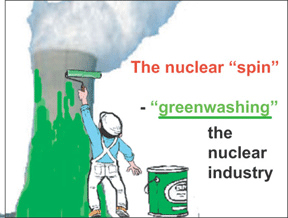
don’t for one second think that nuclear power is green or sustainable in any way. You will hear that, because nukes don’t create CO2 when they’re generating power, they’re a solution to climate change.
What you don’t hear from the proponents of nuclear power/weapons is that the mining and refining of nuclear fuel is extremely energy- and carbon-intensive.
What you don’t hear is that the billions of government subsidy dollars that are going to shore up and bail out unprofitable nuclear power companies could be better spent on developing and bringing to scale truly sustainable forms of energy.
What you don’t hear is that there is no way to safely clean up radioactive waste. “Green” and “nuclear” simply cannot be credibly used together.
My Turn/Darling: No such thing as ‘green’ nuclear power http://www.recorder.com/my-turn-nuclear-facilities-7049505 By ANN DARLING , December 26, 2016 Here in the Pioneer Valley we live within a circle of five operating, decommissioning, or decommissioned nuclear power facilities and a nuclear submarine base. Radioactive materials are extremely dangerous and extremely long lived. For our safety and the safety of future generations, we need to be informed about nuclear power and the waste created from its mining and its use.
Of course, there are nuclear facilities all over the world and nuclear contamination has a way of traveling very long distances in the air, through oceans and rivers, and in our bodies. So it’s not something anyone can totally escape from, no matter where we live. We have fouled our nest with nightmarishly toxic and pernicious stuff and we don’t know what to do with it.
It’s extremely painful, frightening and depressing to face this head on. But we have to. We are now the stewards of all this radioactive waste, whether we like it or not. And more waste is being made all the time.
What can you do? First, accept the responsibility of being a nuclear steward. Then, become knowledgeable. Two good resources are the Nuclear Information and Resource Service, www.nirs.org, or Fairewinds Energy Education, www.fairewinds.org.
Second, question everything you hear about nuclear power. Start with these two basic assumptions and see if they help you make sense of it:
Corporations have a “perverse motivation” (i.e. profit) to reduce costs and neglect safety, so they tend to obfuscate and lie when challenged.
The Nuclear Regulatory Commission is about one quarter regulator (at best) and three quarters nuclear industry cheerleader. It is one of many “captive regulators” in an economy driven by short-term gain and not by long-term investment in the future.
Third, do everything you can to pressure government, utilities, and corporations to stop creating more radioactive waste. A good starting place would be calling Gov. Baker and telling him Pilgrim Nuclear in Plymouth should be shut down.
Fourth, don’t for one second think that nuclear power is green or sustainable in any way. You will hear that, because nukes don’t create CO2 when they’re generating power, they’re a solution to climate change. What you don’t hear from the proponents of nuclear power/weapons is that the mining and refining of nuclear fuel is extremely energy- and carbon-intensive. What you don’t hear is that the billions of government subsidy dollars that are going to shore up and bail out unprofitable nuclear power companies could be better spent on developing and bringing to scale truly sustainable forms of energy. What you don’t hear is that there is no way to safely clean up radioactive waste. “Green” and “nuclear” simply cannot be credibly used together.
Fifth, don’t even imagine that Yucca Mountain is an appropriate place to store radioactive waste. Even if we had technology good enough to contain radioactive waste for generations — which we don’t — Yucca is not the right place from a geological standpoint.
Sixth, if you live near a shutdown reactor (which you do) and just want the radioactive waste gone, yesterday, think about where it will go. Think about the places it would be transported through, at great risk of accident or terror attack. Think about the places where it would be stored, and where it could leak or worse. Right now, radioactive materials from the decommissioning of Vermont Yankee are being shipped to a storage facility near the Texas-New Mexico border that sits on top on a huge aquifer supplying at least seven southwestern states. What will happen if the radioactivity gets into the deep water?
Seventh, recognize that the communities and geographies that are being forced or asked to take on radioactive waste are sacrifice zones inhabited by people with dark skin and/or no money or political clout. That storage facility on the Texas-New Mexico border is in an area that is poor, rural, and largely Mexican-American. Uranium is mined on indigenous people’s land throughout the world and the waste simply left there, making them sick. Yucca Mountain itself, and the contaminated Nevada nuclear testing sites nearby, are actually on Shoshone tribal lands. This is racism at a profound level.
Finally, get involved in anything that will slow down or stop the creation of nuclear waste. Promote sustainable energy and energy conservation efforts. Climate Action Now is a good local resource: www.climateactionnowma.org. Advocate to shut down Pilgrim Nuclear in Plymouth: www.capedownwinders.org or www.pilgrimcoalition.org. Get involved in regional and national discussions about what is the least bad resolution to the problem of nuclear waste. The Citizens’ Awareness Network is a local organization with a solid history and national reach: www.nukebusters.org.
You don’t have to be an expert on nuclear power to make a difference. You just have to show up and be ready to learn and work hard for your children and their children and their children.
Ann Darling currently lives in Easthampton and has worked in Greenfield for over 15 years. She is a 35-year resident of the Brattleboro, Vt., area and a member of the Safe and Green Campaign to responsibly shut down and decommission Vermont Yankee Nuclear Power Plant. She recently attended a national summit on radioactive waste in Chicago.
January 9, 2017
Posted by Christina Macpherson |
spinbuster, USA |
Leave a comment
 Indian Point nuke plant to shut down by 2021: Reports http://www.metro.us/new-york/indian-point-nuclear-power-plant-to-shut-down-by-2021/zsJqag—zxZJftzkicyc6/ KIMBERLY M. AQUILINA
Gov. Cuomo is expected to announce an agreement with the plant operators on Tuesday Indian Point nuclear power plant, less than 30 miles from New York City, will close by April 2021 under an agreement New York State reached this week with the utility company that owns the plant, according to several news reports.
One of the reactors will permanently shut downby April 2020, followed by the rest of the plant, which sits on the east bank of the Hudson River, the following year.
Gov. Andrew Cuomo, who supports nuclear power plants in the upper region of the state, has long requested that the Westchester County plant cease operations.
“Why you would allow Indian Point to continue to operate defies common sense, planning and basic sanity,” Cuomo said in June, The New York Times reported.
New York’s Department of State said the Indian Point plant is in violation of state coastal management regulations and that it poses a risk to the 17 million people who live within 50 miles, The Wall Street Journal reported.
However, Cuomo hasn’t confirmed the win for his administration.
“There is no agreement — Governor Cuomo has been working on a possible agreement for 15 years and until it’s done, it’s not done,” spokesman for the governor, Richard Azzopardi, said. “Close only counts for horseshoes, not for nuclear plants.”
The governor is expected to make the announcement in his home county of Westchester on Tuesday, the New York Daily News reported.
The replacement for the energy the plant provides for New York City and Westchester County isn’t clear; the power plant generates more than 2,000 megawatts — 25 percent of the region’s electricity.
Cuomo previously suggested alternative power options, including power from nearby wind farms and hydropower from Quebec.
In 2015, Cuomo’s administration opposed the 20-year recertification request by the plant’s owner, Entergy, citing ecological concerns. The objection stated that the reactor, located near “two active seismic faults,” kills marine life by using 2.5 billion gallons of water of day for cooling and puts drinking water at risk, according to the advocacy group Riverkeeper.
In his 2004 report “Chernobyl on the Hudson? The Health and Economic Impacts of a Terrorist Attack at the Indian Point Nuclear Plant,” Edwin S. Lyman of the Union of Concerned Scientists “found that a core meltdown and radiological release at one of the two operating Indian Point reactors could cause 50,000 near-term deaths from acute radiation syndrome and 14,000 long-term deaths from cancer.”
When asked if New York City’s safety will be affected by the plant closure, Raul Contreras, a spokesman for Mayor Bill de Blasio, said, “The closing of Indian Point must be coupled with a clear understanding of the risks and impact its replacements will have on air quality, energy affordability and reliability.”
A representative from Entergy told Metro on Saturday that the company has no comment at this time on the closure.
January 9, 2017
Posted by Christina Macpherson |
politics, USA |
Leave a comment
 WATCHDOGS: Zion’s nuclear fallout; still reeling from ’98 closing, Chicago Sun Times, John Carpenter, 1/07/2017, Workers are methodically dismantling the once-mighty Zion nuclear power plant. Just up the road in the far north suburb, a different kind of dismantling is taking place.
The small Lake County city of Zion — founded at the start of the last century as the new “City of God” and once a bustling little blue-collar bedroom community — is staggering. Crushed by the loss of half its property-tax base when the power plant was closed in 1998, it faces the foreseeable future as a nuclear waste dump.
It wasn’t supposed be this way.
“The understanding was that Zion would have a nuclear power plant on the lakefront and that it would be an eyesore but that there could be some economic development down the line,” Zion Mayor Al Hill says. “The understanding also was that, when they closed it, it would be gone. That’s not what happened.”
What happened is that no one can agree on where to put about 1,000 tons of spent nuclear fuel rods. So they will stay, sealed inside stainless steel canisters, encased in concrete and stacked in neat rows of 20-feet-tall cylinders on a concrete pad, all huddled together along some of Illinois’ most beautiful lakefront shoreline.
“We are,” Hill says, “a nuclear waste dump.”
It’s easy to ignore the plight of one small town. But nuclear plants in downstate Clinton and the Quad Cities, threatened with closing earlier this year, narrowly escaped the same fate. There are 11 nuclear reactors in six locations across Illinois and 99 operating across the nation. According to the Nuclear Regulatory Commission, there are 16 nuclear reactor sites nationwide that have been shut down and are being decommissioned — being taken apart, a lengthy process because nearly everything being dismantled is somewhat radioactive and requires special care in handling.
According to the most optimistic estimates, the radioactive waste now being stored in Zion will be there until at least the next decade, perhaps much longer. That’s left the city to try to lure new economic development with a nuclear-waste storage facility occupying its most valuable waterfront land.
If you think this is no big deal, talk to Sharon and Don Bourdeau, who, after running the Zion Antique Mall and Toy Mart for more than 20 years, just closed the store at the end of last month. Until then, it was an easy place to visit, as parking is never a problem these days in the heart of downtown Zion, which has nearly as many empty storefronts as it does working businesses……….
Redmond points out that all U.S. taxpayers, not just electricity rate-payers, are paying for nuclear-waste disposal thanks to the industry’s successful lawsuit against the Energy Department. As of last year, more than $5 billion has been paid out of that judgment fund, he says, with some estimates suggesting that number could climb to almost $30 billion before a storage solution is found.
A spokesman for Commonwealth Edison parent Exelon won’t comment, saying the matter of future waste storage in Zion is in the hands of the federal government. Exelon technically doesn’t own or control the waste, which is now in the hands of Zion Solutions, the company hired to dismantle the plant. Once the dismantling is complete, though, the facility — and the nuclear waste — will return to the control of Exelon until the federal government comes up with a solution…….. http://chicago.suntimes.com/news/zions-nuclear-fallout-town-still-reels-from-1998-plant-closing/
January 9, 2017
Posted by Christina Macpherson |
USA, wastes |
Leave a comment
 Nuclear Energy Dangerous to Your Wallet, Not Only the Environment http://www.counterpunch.org/2016/01/01/nuclear-energy-dangerous-to-your-wallet-not-only-the-environment/ Pete Dolack writes the Systemic Disorder blog and has been an activist with several groups. His book, It’s Not Over: Learning From the Socialist Experiment, is available from Zero Books.
by PETE DOLACK The ongoing environmental disaster at Fukushima is a grim enough reminder of the dangers of nuclear power, but nuclear does not make sense economically, either. The entire industry would not exist without massive government subsidies.
Quite an insult: Subsidies prop up an industry that points a dagger at the heart of the communities where ever it operates. The building of nuclear power plants drastically slowed after the disasters at Three Mile Island and Chernobyl, so it is at a minimum reckless that the latest attempt to resuscitate nuclear power pushes forward heedless of Fukushima’s discharge of radioactive materials into the air, soil and ocean.
There are no definitive statistics on the amount of subsidies enjoyed by nuclear power providers — in part because there so many different types of subsidies — but it amounts to a figure, whether we calculate in dollars, euros or pounds, in the hundreds of billions. Quite a result for an industry whose boosters, at its dawn a half-century ago, declared that it would provide energy “too cheap to meter.”
Taxpayers are not finished footing the bill for the industry, however. There is the matter of disposing radioactive waste (often borne by governments rather than energy companies) and fresh subsidies being granted for new nuclear power plants. None of this is unprecedented — government handouts have the been the industry’s rule from its inception. A paper written by Mark Cooper, a senior economic analyst for the Vermont Law School Institute for Energy and the Environment, notes the lack of economic viability then:
“In the late 1950s the vendors of nuclear reactors knew that their technology was untested and that nuclear safety issues had not been resolved, so they made it clear to policymakers in Washington that they would not build reactors if the Federal government did not shield them from the full liability of accidents.” [page iv]
Nor have the economics of nuclear energy become rational today. A Union of Concerned Scientists paper, Nuclear Power: Still Not Viable Without Subsidies, states:
“Despite the profoundly poor investment experience with taxpayer subsidies to nuclear plants over the past 50 years, the objectives of these new subsidies are precisely the same as the earlier subsidies: to reduce the private cost of capital for new nuclear reactors and to shift the long-term, often multi-generational risks of the nuclear fuel cycle away from investors. And once again, these subsidies to new reactors—whether publicly or privately owned—could end up exceeding the value of the power produced.” [page 3]
The many ways of counting subsidies
Among the goodies routinely given away, according to the Concerned Scientists, are: Continue reading →
January 9, 2017
Posted by Christina Macpherson |
business and costs, politics, Reference, USA |
Leave a comment

 Why solar power poses a very tricky problem for Donald Trump, The Week, Ryan Cooper , 6 Jan 17 The worst imaginable president for climate change might be about to take power, but solar is still a bright spot. The technology and business infrastructure of solar panel manufacturing has been getting better at a blistering pace, and the latest estimates conclude that solar will surpass coal as the cheapest electricity source within a single decade — and in many places, it already has.
This raises the question of what President Trump will do about the solar business. Most Republicans, Trump included, are heavily committed to filth-spewing power sources like coal and natural gas, and deny the science of climate change. But while Republicans will no doubt want to use regulations and subsidies to prop up fossil fuels and keep down renewables, Trump has shown a bizarre fixation with U.S.-based manufacturing jobs that might just redound to solar’s benefit.
The latest estimate of solar panels’ economic viability comes via Bloomberg New Energy Finance. The price of solar power has plummeted by 62 percent merely since 2009. Taking into account current trends and planned technological developments, they estimate solar will be on average the world’s cheapest power source by about 2026, without subsidies of any kind.
That average hides much variability, of course — in some sunny regions, solar is already astoundingly cheap:…….
Republicans will likely respond to the growth of solar by trying to stamp it out by allowing fossil fuels to pollute to their heart’s content (thus granting them a huge implicit subsidy), and passing burdensome new regulations on renewables. On the face of it, this fits well with Donald Trump’s campaign, which was all about valorizing traditionally masculine jobs, particularly in manufacturing and manual labor. In the conservative shorthand, coal is tough and cool, while renewables are for sissy Prius-drivers.
But on the other hand, this stereotype is wildly at odds with the actual reality of the solar business. Solar panels must be manufactured (as of 2015, there were about 30,000 such jobs in the United States) and installed by manual laborers (120,000 jobs as of 2015). That number has no doubt grown substantially in the past year, as solar jobs have been consistently increasing in number by about 20 percent per year……..
Stamping out solar would kill an order of magnitude more jobs than that. If Trump got wind of some policy that would strangle American solar — or worse yet, force the company to pick up and move to Europe or China — there is a genuine chance he’ll go on one of his Twitter rampages and force the Republican Congress to back down.
Conversely, it will be genuinely difficult to revive coal jobs, which have been in long-term decline since the 1970s. Big Coal has been all but killed off by competition with fracked natural gas and, increasingly, renewables. It is smaller than solar and shrinking fast. Stark hypocrisy is basically the Republican motto, but even they might struggle with the large and increasing subsidies necessary to prop up an ever-more-obsolete marketplace loser.
So don’t get me wrong: The Trump presidency will be an absolute disaster for climate change. But with a bit of luck, the American solar industry might not be totally eviscerated. http://theweek.com/articles/670876/why-solar-power-poses-tricky-problem-donald-trump
January 7, 2017
Posted by Christina Macpherson |
politics, renewable, USA |
Leave a comment
 No deal on closing Indian Point, Gov. Cuomo says after shutdown reports http://pix11.com/2017/01/06/no-deal-on-closing-indian-point-gov-cuomos-office-says/ , JANUARY 6, 2017, BY ALIZA CHASAN BUCHANAN, N.Y. — No agreement has been reached to close the Indian Point nuclear plant in Westchester County despite reports the plant would close its two units by 2021, Gov. Andrew Cuomo’s office said Friday.
“There is no agreement,” a spokesman for Cuomo’s office said. “Governor Cuomo has been working on a possible agreement for 15 years and until it’s done, it’s not done. Close only counts for horseshoes, not for nuclear plants.”
The plant has been at the center of potential disasters over recent years and Cuomo has repeatedly called for its shutdown, saying it poses an environmental threat to the Hudson River and a threat to New Yorkers.
“Indian Point is antiquated and does not belong on the Hudson River in close proximity to New York City, where it poses a threat not only to the coastal resources and uses of the river, but to millions of New Yorkers living and working in the surrounding community,” Gov. Cuomo said in November.
Inspectors found hundreds of faulty bolts within the reactor at the Indian Point Unit 2 Plant in March. There was also a 600 gallon oil spill in 2016. Only a small portion of the spill reached the discharge canal.
Entergy, the operator of Indian Point, declined to comment.
The license for Indian Point’s Unit 2 expired in 2013, but can operate as long as the relicensing process continues under the U.S. Nuclear Regulatory Commission. Unit 3’s license expired in 2015, but it remains in operation while the relicensing application is pending. Unit 1 was permanently closed in 1974.
Entergy has applied for a 20-year license renewal for Units 2 and 3.
Indian Point is a key source of energy for the New York area. It has a generating capacity of 2,000 megawatts of clean electricity, according to Entergy. It provides power to about 2 million homes along with businesses and municipal systems.
January 7, 2017
Posted by Christina Macpherson |
politics, USA |
Leave a comment