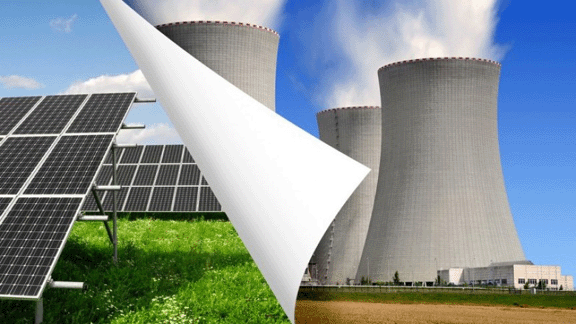
“Our analysis suggests that solar could now infringe on gas’ market share and in some cases challenge its peak margins, and that gas and renewables collectively will continue to gain market share at the expense of coal and nuclear,”
Levelized cost of energy survey shows wind, natural gas cementing economic edge SNL, 06 January 2017 By Lucas Bifera
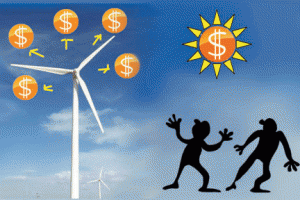
A survey of levelized cost of energy, or LCOE, studies illustrates that onshore wind and combined-cycle gas have secured their place as the lowest-cost energy resources, with utility-scale solar not far behind.
Often used as a barometer for estimating the cost at which certain generation technologies can be deployed on an economic basis, LCOE has become a mainstay for policymakers, analysts and industry groups as a reference when comparing costs and benefits of various technologies on the grid.
Incumbent technologies like combined-cycle gas, onshore wind, utility-scale solar photovoltaic, nuclear and coal are uniformly included in studies…….the emergence of a cluster around onshore wind and combined-cycle gas across the different studies indicates an economic consensus, one that highlights the cost effectiveness of renewables on an unsubsidized basis and role of combined-cycle gas as the preeminent baseload resource.
“The demands of a developed economy will continue to require both traditional and alternative energy sources as the technologies driving renewable energy evolve,” observed George Bilicic, vice chairman and global head of power, energy & infrastructure group at Lazard, an investment bank that releases a widely-cited LCOE study each year.
But on an unsubsidized basis, renewables remain competitive across all studies, and in the case of the Bloomberg New Energy Finance analysis, wind resources in Texas have become the cheapest source of power across North and South America, consistent with Lazard’s finding that wind has a low end range of $32/MWh in the Midwest and $36/MWh in Texas.
“Wind capital costs will go up because they are building higher towers, but LCOE values will fall because they have better capacity factors,” said Josh Rhodes, postdoctoral fellow at the Webber Energy Group and co-author of a study from The University of Texas at Austin’s Energy Institute.
“I think we will see a major deployment of solar and wind to come online by [the end of] 2019 in order to take advantage of the full ITC and PTC,” Rhodes noted, looking outward.
Onshore wind and utility-scale solar additions appear poised to outstrip additions of natural-gas fired ……… the Energy Information Administration’s recent 2017 Annual Energy Outlook, which projects that between 2018 and 2022, as much as 54.2 GW of wind could come online, in addition to 13.4 GW of solar photovoltaic capacity.
Combined, that projected capacity is more than 40 times the amount of projected advanced natural gas-fired capacity projected in the same study, which EIA estimates at 1.6 GW.
“Our analysis suggests that solar could now infringe on gas’ market share and in some cases challenge its peak margins, and that gas and renewables collectively will continue to gain market share at the expense of coal and nuclear,” Guggenheim added. http://www.snl.com/web/client?auth=inherit&mkt_tok=eyJpIjoiWlRsaU0yUXhZMkV3TnpjNCIsInQiOiJGZnRMT045UWllTkRYNzZsSDE1YWFJMXE0M0lQU2F1QnN6Z25jM2hoZlFpNDhwNFFSRzIyTnI1cDdyUW14c2hKXC9keStFV2JvenljcVVFT2Ztc3gxck12WElPXC9WMGVlQWNMbjNJcklpalltM01OTUN2ckRsQktyWlFLTFRcL0VrVyJ9#news/ar
January 14, 2017
Posted by Christina Macpherson |
business and costs, renewable, USA |
Leave a comment

 How Did 2016 Fare For U.S. Energy Employment?
According to the DOE’s second annual report tracking these employment trends, 6.4 million Americans now work in the “traditional energy and energy efficiency industries,” which added over 300,000 net new jobs in 2016 – representing 14% of the nation’s job growth. The report describes “traditional energy” jobs as those in “electric power generation and fuels” and “transmission, distribution and storage,” both of which include include “fossil, nuclear, and renewable energy sources and their value chains,” the report explains. In addition, “energy efficiency” jobs are described as those covering the “production of energy-saving products and the provision of services that reduce end-use energy consumption.” The report notes that energy efficiency jobs increased by 133,000 jobs for a total of 2.2 million.
The agency says its “2017 U.S. Energy and Employment Report (USEER)” uses information from surveys to over 30,000 employees in energy sectors and tracks “dramatic growth” in several key sectors of the U.S. economy in 2016. The report also uses secondary data from the U.S. Department of Labor.
For wind power specifically, the industry employs a total of 101,738 workers, which represents a 32% increase since 2015, the report says. The largest share of wind employment lies in construction, which accounts for 37% of the workforce. Manufacturing and wholesale trade follow at 29% and 14%, respectively.
“Wind means opportunity and job security for over 100,000 Americans,” comments Tom Kiernan, CEO of the American Wind Energy Association. “The Department of Energy’s new jobs data underscore the incredible impact of wind power in creating American jobs. Wind workers directly contribute to our nation’s energy independence and economic success story. We’re especially proud of helping America’s veterans find well paying jobs after their service – employing them at a rate that is 50 percent higher than the national average.”
For solar, the report says U.S. Department of Labor data does not adequately capture the true employment numbers: The data “dramatically underestimates” how many workers are employed in the solar sector, which, the DOE report says, includes 373,807 Americans who “spend some portion of their time working to install, distribute or provide professional services to solar technologies.” Like wind, construction/installation represents the biggest employment share, followed by “wholesale trade, manufacturing and professional services.”
“This report verifies the dynamic role that our energy technologies and infrastructure play in a 21st-century economy,” says David Foster, the DOE’s senior advisor on industrial and economic policy. “Whether producing natural gas or solar power at increasingly lower prices or reducing our consumption of energy through smart grids and fuel-efficient vehicles, energy innovation is proving itself as the important driver of economic growth in America, producing 14 percent of the new jobs in 2016.”
USEER examines four sectors of the economy – electric power generation and fuels; transmission, wholesale distribution and storage; energy efficiency; and motor vehicles – which cumulatively account for almost all of the U.S.’ energy production and distribution system and roughly 70% of U.S. energy consumption, according to the DOE.
By looking at such a wide portion of the energy economy, the agency says, USEER can provide the public and policymakers with a clearer picture of how changes in energy technology, systems and usage are affecting the economy and creating or displacing jobs……… The full report can be found here. http://nawindpower.com/how-did-2016-fare-for-u-s-energy-employment
January 14, 2017
Posted by Christina Macpherson |
employment, renewable, USA |
Leave a comment
 New York Bets On Renewables To Replace Indian Point
  Nuclear Plant https://cleantechnica.com/2017/01/13/new-york-bets-renewables-replace-indian-point-nuclear-plant/ January 13th, 2017 Originally published on Think Progress. By Jeremy Deaton
New York governor Andrew Cuomo announced plans this week to close the Indian Point nuclear power plant, which supplies electricity to New York City and surrounding areas. The plant’s two working reactors — which account for roughly 10 percent of the state’s power generation — are slated to go offline in 2020 and 2021, more than a decade ahead of schedule.
Nuclear power plants represent a range of risks, from hazardous radioactive waste to a full-scale meltdown. They also supply the bulk of America’s zero-carbon electricity. In laying out its carbon-cutting goals, the Environmental Protection Agency assumed that existing nuclear power plants would continue to hum and buzz for decades to come. But cheap natural gas is digging into the profits of America’s aging nuclear power plants, pressuring them to close ahead of schedule.
Some states, like Illinois, have thrown a lifeline to nuclear, subsidizing struggling plants, lest they be replaced by carbon-spewing natural gas. New York, by contrast, is betting that the hole created by Indian Point’s closure will be filled with solar, wind, and hydropower.
In a statement, Cuomo said the plant’s closure won’t drive up emissions “at the regional level.” Given New York’s ambitious climate policies, he might be right.
This week, Cuomo called for states belonging to the Northeast carbon trading program to further limit carbon pollution. He also announced that New York would cut carbon emissions by an additional 30 percent by 2030. As part of its energy plan, New York will require 50 percent of its power to come from renewables by 2030.
To help integrate renewables, New York is remaking its power grid, incentivizing utilities to advance distributed energy — rooftop solar panels, community solar arrays and microgrids. It’s also building power lines to supply New York City with wind and hydroelectric power generated upstate. Cuomo promised that new hydropower and improved transmission would largely fill the gap left by Indian Point. He’s said the shift will come “at a negligible cost to ratepayers.”
You may be wondering why New York isn’t maximizing zero-carbon power, building out wind, solar, and hydropower while maintaining its nuclear reactors. More zero-carbon power means less natural gas. Less natural gas means less climate change.
Advocates and policymakers are trying to perform triage on environmental threats. With climate change, there is a high probability of a global disaster in the future. With nuclear power, there is low probability of a local disaster in the present. How we should balance these risks is the subject of vigorous debate.
In the years following the Three Mile Island disaster, the United States stopped building nuclear power plants, in part because new projects were met with fierce local opposition. This left the door open for carbon-intensive coal and natural gas. Now, New York is trying to wean its way off nuclear without repeating the same mistake.
The Indian Point power plant presents a range of risks. Last year, it was discovered that a leak at the power plant was turning groundwater radioactive, though reportedly not enough to threaten human health. Experts are most concerned about the possibility of nuclear meltdown or a terrorist attack. The people who planned the 9/11 attacks had initially floated targeting nuclear power plants in addition to the World Trade Center and the Pentagon. Indian Point offers a prime target for terrorists. The plant lies less than 40 miles from Midtown Manhattan.
What should replace Indian Point? Unlike wind turbines and solar panels, gas-fired power plants can provide energy on demand. But, gas-fired power plants generate carbon dioxide and other pollutants, putting vulnerable New Yorkers in harm’s way.
“Western Queens already produces a majority of the electricity for the New York metropolitan area and has the high asthma and emphysema rates to prove it,” New York State Sen. Michael Gianaris (D) said in a statementissued in response to the planned closure of Indian Point. “Make no mistake, I will vigorously fight any efforts to build new power plants in already over-saturated communities.”
Cuomo is putting his money on clean, resilient renewable energy, but New York can’t transform its energy grid overnight. It will take decades to run the state on wind, solar, and hydropower alone, and that transition depends on smart public policy.
Renewables thrive where policies nurture their growth. That’s why New Jersey generates more solar power than Texas. And it’s why New York can shutter an important nuclear power plant and realistically expect to curb carbon emissions at the same time.
Its slate of climate policies could serve as a model for other states looking to wean off fossil fuels and nuclear energy both. And it has already begun: Just this week, Cuomo announced a new offshore wind project that will generate enough electricity to power more than 18,000 homes.
January 14, 2017
Posted by Christina Macpherson |
renewable, USA |
Leave a comment
 U.S. Nuclear Power Plants Continue To Close, Oil Price, By Nick Cunningham – Jan 12, 2017, “…….The situation is emblematic of an unfolding drama across the country as the nation’s nuclear power plants near retirement. The bulk of the 100 or so nuclear power plants in the U.S. were constructed in the 1960s and 1970s, all of which were granted a standard 40-year license to operate. Many of those have expired or are nearing expiration, and the bulk of them have been granted 20-year license extensions. With dozens of reactors now a decade or so away from hitting their 60-year birthdays, the U.S. is faced with a dilemma of whether to shut them down or extend their lifespans by yet another 20 years.
While the New York government supported reactors elsewhere in the state, they resisted Indian Point because of its proximity to the city. Entergy ultimately conceded, as the company is in the midst of ridding itself of nuclear reactors in the north and is instead focusing on regulated markets in the south.
In fact, Entergy disputed Gov. Cuomo’s influence, citing cheap natural gas as a significant factor in its decision to shut down the plant. But Gov. Cuomo and the state’s attorney general resisted granting Entergy a 20-year license extension on Indian Point. Entergy spent $200 million over the past decade in legal fees trying to obtain a new license, to no avail……..
Gov. Cuomo is now aggressively pushing offshore wind, and is targeting 2.4 GW of offshore wind capacity by 2030. The first down payment on that target is a 90-megawatt project off the coast of Long Island, which he is supporting. However, those projects will take years to come online even under the most optimistic circumstances, raising fears of a gap in power supply…..
Environmental groups are more confident. “Hats off to the Cuomo Administration and New York leaders for planning to shut down another nuclear plant and replacing it with clean energy,” Anna Aurilio, director of Environment America’s Global Warming Solutions Program, said in a statement. “There’s more than enough renewable energy projects in the pipeline to replace Indian Point.” Offshore wind could be complemented by onshore wind, solar, and energy efficiency. If New York fails to fill the gap left by Indian Point with renewables, the state can still import hydropower from Quebec.
Indeed, New York is unfazed. The state recently implemented a tighter renewable portfolio standard that requires utilities to source 50 percent of their electricity from renewable sources by 2030, one of the most aggressive in the nation. Gov. Cuomo also announced this week that New York will cut greenhouse gas emissions by an additional 30 percent below 2020 levels by 2030, tightening the requirements under the Regional Greenhouse Gas Initiative (RGGI), a regional cap-and-trade program between Mid-Atlantic and Northeastern states. Gov. Cuomo is going all-in on renewables in an effort that has raised questions regarding his presidential aspirations in 2020.
Indian Point is just one power plant, but it is indicative of the eroding position of nuclear power. Only a handful of new nuclear reactors are under construction, and despite the hype of a “nuclear renaissance,” even the newest models are facing lengthy delays and cost overruns, a longstanding problem for the industry. Meanwhile, existing nuclear reactors are getting picked off, one by one.
Whether it will be solar, wind or natural gas, the one thing that is clear is that nuclear power will increasingly give way to alternatives.http://oilprice.com/Alternative-Energy/Nuclear-Power/US-Nuclear-Power-Plants-Continue-To-Close.html
January 14, 2017
Posted by Christina Macpherson |
business and costs, USA |
Leave a comment
Nuclear power producers want government-mandated long-term contracts or other mechanisms that require customers to buy power from their troubled units at prices far higher than they would pay otherwise.
In California and in Nebraska, utilities plan to replace nuclear plants that are closing early for economic reasons almost entirely with electricity from carbon-free sources. Such transitions are achievable in most systems as long as the shutdowns are planned in advance to be carbon-free.
We should not rely further on the unfulfilled prophesies that nuclear lobbyists have deployed so expensively for so long.

 Should troubled nuclear reactors be subsidized? http://bangordailynews.com/2017/01/13/the-point/compete-or-suckle-should-troubled-nuclear-reactors-be-subsidized/ By Peter Bradford, The Conversation
Since the 1950s, U.S. nuclear power has commanded immense taxpayer and consumer subsidy based on promises of economic and environmental benefits. Many of these promises are unfulfilled, but new ones take their place and more subsidies follow.
Today, the nuclear industry claims that keeping all operating reactors running for many years, no matter how uneconomic they become, is essential in order to reach U.S. climate change targets.
Economics have always challenged U.S. reactors. After more than 100 construction cancellations and cost overruns costing up to $5 billion apiece, Forbes magazine in 1985 called nuclear power “the greatest managerial disaster in business history … only the blind, or the biased, can now think that most of the money [$265 billion by 1990] has been well spent.” U.S. Atomic Energy Commission Chair Lewis Strauss’ 1954 promise that electric power would be “ too cheap to meter” is today used to mock nuclear economics, not commend them.
As late as 1972, the Atomic Energy Commission forecast that the U.S. would have 1,000 power reactors by the year 2000. Today, we have 100 operating power reactors, down from a peak of 112 in 1990. Since 2012, power plant owners have retired five units and announced plans to close nine more. Four new reactors are likely to come on line. Without strenuous government intervention, almost all of the rest will close by midcentury. Because these recent closures have been abrupt and unplanned, the replacement power has come in substantial part from natural gas, causing a dismaying uptick in greenhouse gas emissions.
The nuclear industry, led by the forlornly named lobbying group Nuclear Matters, still obtains large subsidies for new reactor designs that cannot possibly compete at today’s prices. But its main function now is to save operating reactors from closure brought on by their own rising costs, by the absence of a U.S. policy on greenhouse gas emissions and by competition from less expensive natural gas, carbon-free renewables and more efficient energy use.
Only billions more dollars in subsidies and the retarding of rapid deployment of cheaper technologies can save these reactors. Only fresh claims of unique social benefit can justify such steps.
When I served on the U.S. Nuclear Regulatory Commission from 1977 through 1982, it issued more licenses than in any comparable period since. Arguments that the U.S. couldn’t avoid dependence on Middle Eastern oil and keep the lights on without a vast increase in nuclear power were standard fare then and throughout my 20 years chairing the New York and Maine utility regulatory commissions. In fact, we attained these goals without the additional reactors, a lesson to remember in the face of claims that all of today’s nuclear plants are needed to ward off climate change.
Nuclear power in competitive electricity markets
During nuclear power’s growth years in the 1960s and 1970s, almost all electric utility rate regulation was based on recovering the money necessary to build and run power plants and the accompanying infrastructure. But in the 1990s, many states broke up the electric utility monopoly model.
Now a majority of U.S. power generation is sold in competitive markets. Companies profit by producing the cheapest electricity or providing services that avoid the need for electricity.
To justify their current subsidy demands, nuclear advocates assert three propositions. First, they contend that power markets undervalue nuclear plants because they do not compensate reactors for avoiding carbon emissions or for other attributes such as diversifying the fuel supply or running more than 90 percent of the time.
Second, they assert that other low-carbon sources cannot fill the gap because the wind doesn’t always blow and the sun doesn’t always shine. So power grids will use fossil-fired generators for more hours if nuclear plants close.
Finally, nuclear power supporters argue that these intermittent sources receive substantial subsidies while nuclear energy does not, thereby enabling renewables to underbid nuclear even if their costs are higher.
Nuclear power producers want government-mandated long-term contracts or other mechanisms that require customers to buy power from their troubled units at prices far higher than they would pay otherwise.
Providing such open-ended support will negate several major energy trends that currently benefit customers and the environment. First, power markets have been working reliably and effectively. A large variety of cheaper, more efficient technologies for producing and saving energy, as well as managing the grid more cheaply and cleanly, have been developed. Energy storage, which can enhance the round-the-clock capability of some renewables is progressing faster than had been expected, and it is now being bid into several power markets — notably the market serving Pennsylvania, New Jersey and Maryland.
Long-term subsidies for uneconomic nuclear plants also will crowd out penetration of these markets by energy efficiency and renewables. This is the path New York has taken by committing at least $7.6 billion in above-market payments to three of its six plants to assure that they operate through 2029.
Nuclear power versus other carbon-free fuels While power markets do indeed undervalue low-carbon fuels, all of the other premises underlying the nuclear industry approach are flawed. In California and in Nebraska, utilities plan to replace nuclear plants that are closing early for economic reasons almost entirely with electricity from carbon-free sources. Such transitions are achievable in most systems as long as the shutdowns are planned in advance to be carbon-free.
In California, these replacement resources, which include renewables, storage, transmission enhancements and energy efficiency measures, will for the most part be procured through competitive processes. Indeed, any state where a utility threatens to close a plant can run an auction to ascertain whether there are sufficient low-carbon resources available to replace the unit within a particular time frame. Only then will regulators know whether, how much and for how long they should support nuclear units.
If New York had taken this approach, each of the struggling nuclear units could have bid to provide power in such an auction. They might well have succeeded for the immediate future, but some or all would probably not have won after that.
Closing the noncompetitive plants would be a clear benefit to the New York economy. This is why a large coalition of big customers, alternative energy providers and environmental groups opposed the long-term subsidy plan.
The industry’s final argument — that renewables are subsidized and nuclear is not — ignores overwhelming history. All carbon-free energy sources together have not received remotely as much government support as has flowed to nuclear power.
Nuclear energy’s essential components — reactors and enriched uranium fuel — were developed at taxpayer expense. Private utilities were paid to build nuclear reactors in the 1950s and early 1960s, and received subsidized fuel. According to a study by the Union of Concerned Scientists, total subsidies paid and offered to nuclear plants between 1960 and 2024 generally exceed the value of the power that they produced.
The U.S. government also has pledged to dispose of nuclear power’s most hazardous wastes — a promise that has never been made to any other industry. By 2020, taxpayers will have paid some $21 billion to store those wastes at power plant sites.
Furthermore, under the 1957 Price-Anderson Act, each plant owner’s accident liability is limited to some $300 million per year, even though the Fukushima disaster showed that nuclear accident costs can exceed $100 billion. If private companies that own U.S. nuclear power plants had been responsible for accident liability, they would not have built reactors. The same is almost certainly true of responsibility for spent fuel disposal.
Finally, as part of the transition to competition in the 1990s, state governments were persuaded to make customers pay off some $70 billion in excessive nuclear costs. Today, the same nuclear power providers are asking to be rescued from the same market forces for a second time.
Christopher Crane, the president and CEO of Exelon, which owns the nation’s largest nuclear fleet, preaches temperance from a bar stool when he disparages renewable energy subsidies by asserting, “I’ve talked for years about the unintended consequences of policies that incentivize technologies versus outcomes.“
But he’s right about unintended and unfortunate consequences. We should not rely further on the unfulfilled prophesies that nuclear lobbyists have deployed so expensively for so long. It’s time to take Crane at his word by using our power markets, adjusted to price greenhouse gas emissions, to prioritize our low carbon outcome over his technology.
Peter Bradford is a the former chair of the Maine’s Public Utilities Commission and former U.S. Nuclear Regulatory commissioner. He also is on the board of the Union of Concerned Scientists. This piece was originally published on TheConversation.com.
January 14, 2017
Posted by Christina Macpherson |
business and costs, politics, Reference, USA |
Leave a comment
 Faith leaders reframe climate change as moral issue Marion Renault The Columbus Dispatch • Friday January 13, 2017
Priests, pastors and ministers nationwide are spreading the gospel of climate change — as are imams and rabbis.
In recent years, faith-based advocacy has emerged as a powerful tool in the environmental movement. By reframing climate change and sustainability as moral issues, religious leaders hope to advance environmentalism by elevating it above the political fray.
“I believe that all religions, all faiths share a common goodness,” said Zerqa Abid, founder of My Project USA, a Muslim youth organization in Columbus. “All of us have to look within our houses, within our cities, in our everyday lives.
“We take care of the Earth, or we destroy it.”
Americans report fairly high levels of spirituality, but most do not view climate change as a moral issue, according to a 2015 survey by the Yale Program on Climate Change Communication.
Presenting climate change as a spiritual issue could be a successful strategy for attracting religious folks to environmental causes, the report suggests.
In Ohio, three-fourths of voters identify as religious, but little more than half say environmental laws are worth the cost, according to 2016 Pew Research Center surveys.
“Hitting people in the head with science doesn’t get them in the heart,” said Deborah Steele, fiscal officer for Clinton Township who previously worked for three years as an Ohio Interfaith Power and Light coordinator. “What gets people is a matter of conscience and not the logic of science.”
As leaders of intimate community spaces, religious officials are beginning to address the human-rights implications of climate change.
For example, exploitation of natural resources severely affects the world’s poorest populations and violates divine dictates on how people should treat the planet, said Rabbi Alex Braver of Tifereth Israel.
“The big-picture view, that’s what religion can offer,” Braver said. “I think (environmentalism) has very deep roots in ancient text and tradition, but it’s been lifted up in a different way now that we’re seeing the immense power we can have over the environment.”……….
At a rally on Monday, people from across several faiths and campaigns called on U.S. Sen. Rob Portman, a Republican from Ohio, to reject nominees for President-elect Donald Trump’s cabinet who deny climate change or come from the fossil-fuel industry.
Among the people who attended was Aline Yamada and her two children. Yamada, a Buddhist from Clintonville, said she feels a parallel between her beliefs and the protest’s message.
“We are all connected,” she said. “I think this is the biggest moral challenge of our time.” mrenault@dispatch.com
@MarionRenault http://www.dispatch.com/content/stories/local/2017/01/13/faith-leaders-reframe-climate-change-as-moral-issue.html#
January 14, 2017
Posted by Christina Macpherson |
climate change, Religion and ethics, USA |
1 Comment
 Conaway Introduces Bill to Add More Types of Nuke Waste at Dump in Andrews http://sanangelolive.com/ By Joe Hyde | Jan. 12, 2017
Washington, D.C. — Thursday, Congressman Mike Conaway (R-TX) and Congressman Darrell Issa (R-CA) introduced a bill that will, as Conway described it, pave a path forward for storage of the nation’s nuclear waste in Andrews.
The Texas Tribune reported in April 2016 that Waste Control Specialist, the company that owns the nuclear waste dump near Andrews and the Texas-New Mexico border, applied for the license to build and maintain a temporary storage site for the spent fuel.
“The Interim Consolidated Storage Act would allow the Department of Energy to use interest from the National Nuclear Fund to contract temporary storage facilities for spent nuclear fuel and could have the federal government begin collecting waste from nuclear facilities across the country in as little as five years,” Conaway stated in a release……..
The Andrews nuclear waste facility received approval to store radioactive waste in 2009. It is the only facility to obtain regulatory approval within the last 30 years to store Class A, B and C low-level radioactive waste.
Conaway’s bill is among many steps in approving the storage of “temporary” radioactive waste at the Andrews site. This type of waste is highly radioactive and originates as spent nuclear reactor fuel, according to reports. The WCS proposal requires the Department of Energy to assume the title and liability for the spent nuclear fuel stored at the site, Texas Tribune reported. Congressional approval is required for the DoE to do so. http://sanangelolive.com/news/business/2017-01-12/conaway-introduces-bill-add-more-types-nuke-waste-dump-andrews
January 14, 2017
Posted by Christina Macpherson |
politics, USA, wastes |
Leave a comment
Washington, D.C. – Today, U.S. Senators Maria Cantwell (D-Wash.) and Patty Murray (D-Wash.) and Representatives Dan Newhouse (Wash.-04), Adam Smith (Wash.-09), Rick Larsen (Wash.-02), Cathy McMorris Rodgers (Wash.-05), Dave Reichert (Wash.-08), Jaime Herrera Beutler (Wash.-03), Suzan DelBene (Wash.-01), Denny Heck (Wash.-10), Derek Kilmer (Wash.-06), and Pramila Jayapal (Wash.-07) wrote President-Elect Donald Trump to urge him to make the ongoing cleanup at the Hanford nuclear waste site a high priority.
The letter provided essential background information on the cleanup and remediation operations at the site and emphasized the importance of worker safety and protecting communities in the Tri-Cities region and beyond. The senators and representatives called for the incoming administration’s full support for and attention to the Hanford cleanup mission.
The delegation noted that fully supporting Hanford means maintaining strong and predictable funding for vital cleanup work already underway at Hanford. This “enables progress and ensures our top priority—worker safety—is achieved while these dangerous cleanup operations take place,” said the members. “It is essential that the safety of the more than 9,000 workers come first as they are doing a remarkable job and their efforts keep surrounding communities safe.”
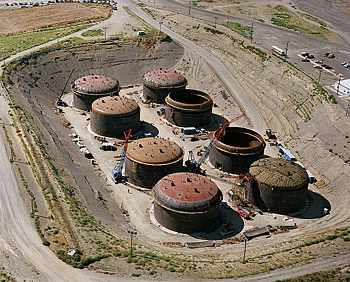
After contributing to the country’s security through nuclear deterrence in World War II and the Cold War, the Tri-Cities region now faces the high costs of a decades-long nuclear waste cleanup program. There are still 54.6 million gallons of nuclear and radioactive waste stored in the Hanford facility, threatening the surrounding area and communities downstream along the Columbia River. Any lapses in funding for the site puts workers and communities at risk.
President-elect Donald J. Trump
Trump-Pence Transition Office
1717 Pennsylvania Avenue NW
Washington, D.C. 20006
Dear President-elect Trump:
We write to share with you the importance of the U.S. Department of Energy’s (DOE) ongoing cleanup mission at the Hanford Nuclear Reservation in the State of Washington, a region that underwent dramatic transformation nearly 75 years ago to help the United States win World War II, and later the Cold War. We believe, with your strong support, we can continue the vital nuclear waste cleanup and environmental remediation work currently underway at Hanford. This work is essential to protecting the health and safety of the Tri-Cities community, the Columbia River, Washington state, and our nation from waste that was created from over 40 years of nuclear weapons production. Continued cleanup progress, along with strong and predictable funding, is crucial to the federal government fulfilling its legal and moral obligation to remediate the 54.6 million gallons of nuclear and radioactive waste currently stored at Hanford. Additionally, this vital cleanup mission is a top priority for the local communities and our constituents in Washington state, as well as to the strength of the local and regional economies. ……..
Previous administrations and Congress have repeatedly supported the legal and moral obligation of the federal government to clean up Hanford, and we urge your Administration to do the same. A critical component to this support is proper funding levels, which enables progress and ensures our top priority—worker safety—is achieved while these dangerous cleanup operations take place. It is essential that the safety of the more than 9,000 workers come first as they are doing a remarkable job and their efforts keep surrounding communities safe.
We look forward to discussing Hanford, ongoing cleanup work, and its importance to the Tri-Cities community and the Pacific Northwest with you and your Administration in more detail in the coming days and months. Together, we can ensure that the federal government fulfills its obligation through continued progress and safe remediation of the Hanford site.
Sincerely,
January 14, 2017
Posted by Christina Macpherson |
politics, USA, wastes |
Leave a comment
Miniaturized Nuclear Power Plant? U.S. Reviewing Proposed Design, npr.org 13 Jan 17
“………”Miniature” in nuclear terms is still pretty big. The modules are small enough to fit on flat-bed trucks, but they would stand nearly nine stories tall. Moreover, a power plant would probably require several modules hooked together like giant batteries. ….
NuScale says its mass-produced reactor modules will be simpler and more affordable to build than a big plant. Placing several modules in a single location will provide the same power output as a commercial reactor, says Mike McGough, the company’s chief commercial officer. NuScale is already partnering with a consortium of Utah utilities to build a 12-module power plant on land in Idaho owned by the
U.S. Department of Energy. (The DOE is a partner in the NuScale project.)…..
not everyone is convinced smaller is better.
Ed Lyman,an analyst with the Union of Concerned Scientists, says the electricity generated by a smaller reactor is more expensive than that generated by a larger one. Companies such as NuScale hope to offset the higher costs by saving on the cost of construction, but Lyman isn’t convinced. He worries savings will come at the cost of safety.
He says NuScale wants to do things like reduce the size and strength of the reactor containment building and the number of personnel needed to operate the plant. “NuScale is proposing major reductions in all of these areas relative to current NRC requirements for large reactors, based on the assertion that the reactor will be safer,” he says.
January 14, 2017
Posted by Christina Macpherson |
technology, USA |
Leave a comment
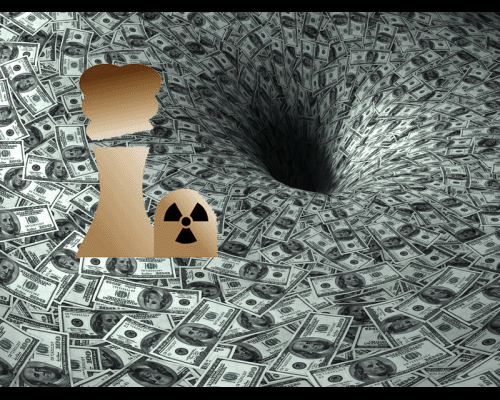
Toshiba Loses Billions On U.S. Nuclear Write-Offs http://oilprice.com/Alternative-Energy/Nuclear-Power/Toshiba-Loses-Billions-On-US-Nuclear-Write-Offs.html By Leonard Hyman & William Tilles – Jan 11, 2017 As a sort of financial casino, Wall Street permits its customers to indulge in all sorts of financial risk. Short selling, for example, betting on a stock’s decline as opposed to its rise. If you short at $10 and it goes to $2? Awesome. If it instead goes the other way, from $2 to $10, you just lost 5 times your principal.
But how can you lose several billion dollars, or ten times your principal investment, on a U.S. asset that you bought for $220 plus million? That’s the question that Toshiba executives are asking themselves.
The goodwill write off triggering this financial commotion relates to cost overruns at two U.S. nuclear construction sites, V.C Sumner and Vogtle in Georgia.
Toshiba, a titan of Japanese industry and owner of Westinghouse Electric dropped a bombshell on the stock market at the end of December and its stock fell by one third. The bond agencies cut Toshiba’s ratings, analysts wondered if the company would have any equity left and sources claimed that Toshiba was thinking of selling its most valuable subsidiary in order to fill the hole in its balance sheet.
This announcement comes in the wake of a previous accounting scandal in which Toshiba was accused of inflating profits. After that, Toshiba seemed ready to raise more equity capital but held off. Now it looks as if the company will have to raise more money on even more dilutive terms for existing shareholders.
What prompted the sudden announcement and what does that announcement mean to the nuclear sector? Let’s go back to 2015. In that year, Toshiba’s Westinghouse subsidiary bought Stone & Webster (S&W), the nuclear construction and services company, from Chicago Bridge & Iron (CBI). It paid $229 million in cash for S&W, and estimated that goodwill, subject to writeoff, was under $87 million, with that number to be determined by December 31, 2016. Near the end of December, Westinghouse informed its corporate parent, Toshiba that “the cost to complete U.S. projects will far surpass the original estimates…leading to a possible recognition of goodwill far exceeding the original…estimate…current estimation shows a level of…several billion U.S. dollars….”
Toshiba is one of a handful of nuclear engineering and manufacturing firms in the world. Its Westinghouse unit produces one of the approved designs (AP 1000) for U.S. construction. Toshiba also owns one of the nuclear construction sites in the UK. If a firm of this size and expertise is surprised by the cost of nuclear construction, that is not a good sign.
But from a financial perspective, if a firm of Toshiba’s size, and one of the premier nuclear engineering firms in the world, is in financial straits due to nuclear overruns, just how big and how accurate in project costing does a firm need to be to take on the risks of nuclear construction? Due to the size of the projects, no small firm can ever take them on. But will the point come when not even large firms execute a nuclear project unless an even larger entity, such as the federal government or the ratepayers over a wide area, guarantees payment of all cost overruns?
Toshiba’s difficulties may reverberate beyond Tokyo’s financial district. They call into question the ability of the most expert of firms to evaluate the risks of what has become bespoke nuclear construction. That will raise costs for new nuclear power since paying a return “of and on” capital is still its biggest cost.
January 13, 2017
Posted by Christina Macpherson |
business and costs, Japan, USA |
Leave a comment
 The F-35 may carry one of the US’s most polarising nuclear weapons sooner than expected http://www.businessinsider.com.au/f-35-b-61-nuclear-bomb-sooner-than-expected-2017-1?r=US&IR=T ALEX LOCKIE JAN 13, 2017 The Air Force designed the F-35A with nuclear capability in mind, and a new report indicates that the Joint Strike Fighter may carry nuclear weapons sooner than expected.
The Air Force originally planned to integrate nuclear weapons in the F-35 between 2020-2022, but Air Force Brig. Gen. Scott Pleus told Defensetech.org that “it would definitely be possible,” to hasten the deployment of B-61 nuclear gravity bombs on the F-35 should the need for it arise.
As it stands, the B-61’s “military utility is practically nil,” wrote General James Cartwright, former vice chairman of the Joint Chiefs of Staff in 2012. The B-61s “do not have assigned missions as part of any war plan and remain deployed today only for political reasons within the NATO alliance,” Cartwright continued.
Currently among fighter jets, only the F-15E and F-16C carry the B-61. Neither of these planes can penetrate contested enemy airspace, so they could only drop the gravity bomb on an area unprotected by air defences.
The F-35, a polarising defence project in its own right, could change that with its stealth capabilities. However, President-elect Trump has voiced concerns about the F-35 project while simultaneously stressing that the US needs to “expand its nuclear capability.”
Immediately this lead to talk of a new nuclear arms race, much to the horror of nuclear experts and non-proliferation advocates. The fact is that Russia and the US already have more nuclear weapons than necessary to meet their strategic needs.
Additionally, nuclear modernisation is due to cost the US hundreds of billions of dollars in the coming decades, and around a trillion dollars in total.
But not only do experts find nuclear expansion costly and unnecessary, they also find it dangerous.
The US has 180 B-61 nuclear bombs stationed in five bases throughout Europe. Russian intelligence services monitor deployments of fighter jets across Europe, and the fact that the F-15E and F-16C regularly deploy to these bases could lead to a catastrophic misinterpretation.
Kingston Reif, the director for Disarmament and Threat Reduction Policy at the Arms Control Association, told Business Insider that the US “should be seeking to strengthen the dividing line between nuclear and conventional weapons, not blur that line” by certifying additional fighter jets to carry nuclear weapons.
F-35s, with their excellent stealth attributes, taking off from European bases that may or may not house the B-61s (it would be extremely difficult for Russia to know) and flying near Russia’s borders could put Moscow on high alert. This could even potentially spook the Kremlin into launching an attack on the US.
Furthermore, the B-61s are low-yield bombs, meaning they don’t pack much of a punch. In the event of an actual nuclear conflict, “the likely hood is that we’re going to use the big bombs, and not the little bombs,” Laicie Heely of the nonpartisan Stimpson Center think tank points out.
So while the F-35 may provide a stealthy, sleek new delivery method for nuclear bombs, they may destabilize already fraught relations between the world’s two greatest nuclear powers — Russia and the US.
“There can be no winners in a nuclear war and that as long as each side has nuclear weapons, strategic stability will remain central to their bilateral relations,” Reif said of US-Russian relations.
January 13, 2017
Posted by Christina Macpherson |
USA, weapons and war |
1 Comment
 Massachusetts judge requires Exxon to hand over climate documents, Reuters 11 Jan 17
 A Massachusetts judge has refused to excuse Exxon Mobil Corp from a request by the state’s attorney general to hand over decades worth of documents on its views on climate change, state officials said on Wednesday.
The decision by Massachusetts Superior Court Judge Heidi Brieger denying Exxon’s request for an order exempting it from handing over the documents represents a legal victory for Attorney General Maura Healey, who is investigating the world’s largest publicly traded oil company’s climate policies.
“This order affirms our longstanding authority to investigate fraud,” Healey said on Twitter following the decision, adding that Exxon “must come clean about what it knew about climate change.”……
The investigations follow separate reports by online news publication Inside Climate News and the Los Angeles Times showing that Exxon worked to play down the risks of climate change despite its own scientists’ having raised concerns about it decades earlier.
The news came on the day former Exxon Chief Executive Rex Tillerson faced a U.S. Senate confirmation hearing on his nomination to serve as President-elect Donald Trump’s secretary of state…….http://www.reuters.com/article/us-exxon-mobil-massachusetts-idUSKBN14W04Z
January 13, 2017
Posted by Christina Macpherson |
climate change, Legal, USA |
Leave a comment
Mattis strikes sharp contrast to Trump on F-35, nuclear weapons 12 JANUARY, 2017: FLIGHTGLOBAL.COM BY: LEIGH GIANGRECO WASHINGTON DC
Donald Trump’s nominee for secretary of defense supports Lockheed Martin’s F-35 Joint Strike Fighter programme, the NATO alliance and restrained use of nuclear weapons during his confirmation hearing, marking a stark departure from the president-elect……..https://www.flightglobal.com/news/articles/mattis-strikes-sharp-contrast-to-trump-on-f-35-nuc-433139/
January 13, 2017
Posted by Christina Macpherson |
politics, USA, weapons and war |
Leave a comment
Tillerson and Trump at odds on nuclear http://www.news.com.au/world/breaking-news/tillerson-and-trump-at-odds-on-nuclear/news-story/20c6219abce5929b3aa29ef8f2095b8d JANUARY 12, 2017
US Secretary of State nominee Rex Tillerson says that he doesn’t agree with President-elect Donald Trump’s comments that it would not be a bad thing if other countries, including Japan, acquired nuclear weapons.
Asked by Democratic Senator Edward Markey about Trump’s comments, Tillerson said during his Senate confirmation hearing that he did not think anyone would advocate for more nuclear weapons on the planet.
Pressed further by Markey on whether he agreed with Trump’s remarks, Tillerson replied: “I do not agree.”
January 13, 2017
Posted by Christina Macpherson |
politics, USA |
Leave a comment
Tillerson Backs Paris Climate Agreement At Confirmation Hearing http://oilprice.com/Latest-Energy-News/World-News/Tillerson-Backs-Paris-Climate-Agreement-At-Confirmation-Hearing.html By Irina Slav Oilprice.com Jan 12, 2017, Secretary of State nominee Rex Tillerson said during his Senate confirmation hearing that the U.S. would be better off sticking with the Paris agreement to tackle climate change. His position stands in contrast to President-elect Donald Trump’s stated opposition to the agreement and his intention to break away from the agreement when he enters office.
Climate change was among the topics on which a 21-senator panel grilled Tillerson yesterday, and was also one of the topics on which his stance differed from that of Trump. Also among these were nuclear proliferation, and to a certain extent, Iran.
Asked to comment on Trump statements that he would not object if U.S. allies such as Japan, South Korea, and Saudi Arabia obtained nuclear weapons, Tillerson said that hardly anyone would advocate the global proliferation of nuclear weapons.
As for the Iran deal that several Western governments closed with Iran last year to deter the country from building its own nuclear weapons, Tillerson was wary in his approach, telling the Foreign Relations Committee he would recommend “a full review” of the deal.
Tillerson was also measured in his responses to questions concerning Russia and bilateral relations. Urged by Republican senator – and former Trump rival for the Republican presidential nomination – Marco Rubio to agree that Russia’s President Putin was a war criminal because of Russia’s involvement in Syria, Tillerson declined, saying these were “serious charges to make,” adding that he needed more information before reaching that determination.
Back to climate change and more specifically Exxon’s role in it and its alleged attempt to hide knowledge about the effect of human activity on climate, Tillerson referred the panel to Exxon itself. Asked whether he was unwilling to answer or rather lacking the knowledge that would allow him to do so, Tillerson responded with “A little of both.”
January 13, 2017
Posted by Christina Macpherson |
climate change, politics, USA |
Leave a comment