Congress Passes Unconventional Nuclear Power Bill ANDREW FOLLETT, Daily Caller, 24 Jan 17 House lawmakers passed legislation Monday to support unconventional nuclear power.
If signed by President Trump, the proposal could change how the government regulates nuclear power and create a boom in the utilization of advanced unconventional reactor technology. The bill was sponsored by two Republicans and three Democrats.
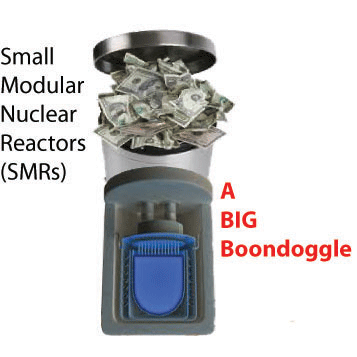
“We believe that trailblazing the advance of nuclear energy technology including Gen 3+, Small Modular Reactors, Non-Light Water Reactor (LWR) Advanced Reactors and Fusion Reactors is one of the key imperatives for U.S. market competitiveness,” David Blee, executive director of the U.S. Nuclear Infrastructure Council (NIC), told The Daily Caller News Foundation.
“It is vital to maintaining the U.S. lead in technology innovation, safety enhancements, energy security and clean energy,” Blee said…….
Energy companies in Idaho and Utah announced plans in June to build twelve small modular reactors to provide electricity to nine western states.
Getting regulators to consider approving an unconventional nuclear design is incredibly expensive. The company NuScale was required to produce a 12,000-page document and spend $500 million dollars just to get the government to consider its designs. The company thinks it won’t be able to commercialize small modular reactors by 2026 at the earliest due to regulatory delays…….
The UK now relies on Trump for our nuclear weapons – we need to spend more than ever before to free ourselves Britain’s Trident missiles are in a common pool shared with the US and maintained at Kings Bay, Georgia. Without the cooperation of the Trump administration, Trident wouldn’t last longer than a couple of months, Independent Benedict SpenceTuesday 24 January 2017 The report that a Trident missile test went awry, veering not toward its intended target on the west coast of Africa, but toward Florida – just weeks before parliament voted for its renewal – has forced the question of Britain’s nuclear deterrent firmly back into the public agenda.
Number 10 has confirmed that the Prime Minister, Theresa May, was aware of this malfunction before the vote, raising questions over whether she should have revealed information at the time. Scottish First Minister Nicola Sturgeon, for one, believed there should have been “full disclosure”, whilst the Campaign for Nuclear Disarmament suggested such information “would have impacted the debate in parliament.”
The Times’ article reporting the incident, however, came at a curious moment, in the immediate aftermath of Trump’s inauguration. The brave new world we find ourselves in calls for Britain to keep her head whilst all around are losing theirs. It may seem strange to use “keep your head” as justification for spending £42bn to renew a weapon capable of rendering the world a barren wasteland, but we have to take into consideration that the man holding the nuclear codes is known for firing off ill-thought out 3am tweets.
Worse still, Britain’s nuclear capabilities are hostage to this shot-gun social media enthusiast’s goodwill. Britain’s Trident missiles are in a common pool shared with the US and maintained at Kings Bay, Georgia. Furthermore, our nuclear warheads are designed and maintained with the help of the US. As Trump beats the isolationist drum, and withdraws from Nato, we may be left militarily out in the cold. It isn’t a stretch for him to withdraw US support for UK nuclear capabilities too. Without the cooperation of the Trump administration, Trident wouldn’t last longer than a couple of months……..http://www.independent.co.uk/voices/donald-trump-trident-theresa-may-nuclear-weapons-special-relationship-russia-a7541541.html
Trump’s Nuclear Defense Plan: Another ‘Star Wars’ Budget Buster? The Fiscal Times, By Eric Pianin January 24, 2017 President Ronald Reagan cowed the Soviet Union and eventually brought its leaders to the bargaining table with the threat of a costly space-based nuclear missile system dubbed “Star Wars.” In March 1983, Reagan formally launched the Strategic Defense Initiative (SDI) to develop and deploy an “impenetrable shield” to protect the U.S. from a Soviet missile attack.
Although the U.S. ultimately spent more than $200 billion on a system that was never successfully developed and deployed, Reagan’s high-stakes defense gambit was credited by many for helping to hasten the end of the Cold War…….
Now a new addition to Trump’s evolving defense posture, the website declared that the United States would develop a “state of the art missile defense system” to guard against attacks from North Korea, Iran, and other rogue states.
The announcement was bereft of details about the technical capabilities or the potential cost to taxpayers for a more sophisticated missile defense system than the land-based and seaborne systems currently deployed in California and Alaska and aboard Navy destroyers in the Pacific.
In addition to the missile shield, the Trump White House said a new military budget would be submitted to Congress outlining a plan to rebuild the military and increase cyber-warfare capabilities. “We will make it a priority to develop defensive and offensive cyber capabilities at our U.S. Cyber Command, and recruit the best and brightest Americans to serve in this crucial area,” the statement declared.
The Climate Action Plan was introduced four years ago as a national strategy for tackling climate changeAndrew Griffin@_andrew_griffin 21 January 2017 Donald Trump’s first post on the White House website suggests destroying the US’s strategy to tackle climate change.
After President Trump took over the site, he posted six “Issues” to its home page. The first of those is an “America First Energy Plan”.
The first proposal in that document suggests getting rid of “burdensome regulations on our energy industry”. Those include getting rid of “harmful and unnecessary policies such as the Climate Action Plan and the Waters of the US rule”.
President Trump doesn’t suggest a replacement for any of those regulations, and goes on to suggest that getting rid of them will save money and keep America secure.The Climate Action Plan was landmark legislation introduced by Barack Obama in June 2013. It served as a “national plan for tackling climate change”, according to the government.
The key parts of the plan were divided into three sections. Those outlined plans to cut carbon pollution in the US, actions to get the country ready for the effects of climate change, and plans for how to lead international efforts to address global warming.No part of the Mr Trump’s environmental document makes any mention of climate change or global warming – something that President Trump has in the past said was just a Chinese hoax. The only mention of the environment calls for “responsible stewardship of the environment”, but that refers only to keeping water and air clean. “Lastly, our need for energy must go hand-in-hand with responsible stewardship of the environment,” the document reads. “Protecting clean air and clean water, conserving our natural habitats, and preserving our natural reserves and resources will remain a high priority.”It also says that Donald Trump will focus the Environmental Protection Agency onto “protecting our air and water”, and presumably away from climate policies.
President Trump says that his environmental policies will join up with his economic ones, by encouraging more spending in the US economy. The document says that he will encourage the burning of coal, and the use of shale oil and gas in the US.By doing so, he will be able to use the revenues to pay for the rebuilding of “roads, schools, bridges and public infrastructure” that he promised to his voters. It will also help stimulate the agriculture industry, he claimed. President Trump says that his environmental policies will join up with his economic ones, by encouraging more spending in the US economy. The document says that he will encourage the burning of coal, and the use of shale oil and gas in the US.That will also allow the US to achieve energy independence from the OPEC alliance of oil producing countries. But President Trump says he will continue to work with countries in the Gulf – many of which are in OPEC – “to develop a positive energy relationship as part of our anti-terrorism strategy”.The document also calls for a new focus on coal and a revival of the country’s coal industry. President Trump has claimed that he will do that by backing “clean coal” – but it’s not clear that such a thing would actually be possible and whether such thing as clean coal could actually exist.
Allegations of illegally spending federal funds to lobby for new funds now encompass contractors working at six of the eight U.S. nuclear weapons sites By Patrick Maloneemail, December 21, 2016 This article has been co-published with USA Today/Gannett.
A $67.5 million payment by a major nuclear weapons contractor to settle claims that it illegally spent federal funds is the latest in a series of settlements stemming from allegations that firms making bombs and cleaning up the resulting debris are using federal money improperly to win support for continued weapons-related work.
Altogether, the three companies that have made such settlement payments since 2013 are involved in the operation of six of the eight active sites in the Energy Department’s nuclear weapons program. Actions by the Energy Department’s contractors — including any misspending — have substantial impact, since contract work consumes roughly 90 percent of the department’s total budget.
The lobbying activities at the heart of the latest settlement helped one of the contractors win a $45 million award for additional cleanup work. Although work on energy generation and consumption garners more public attention and President-elect Donald Trump has nominated an oil-state politician — former Texas governor Rick Perry — to become the department’s new top manager, such nuclear weapons-related work accounts for nearly two-thirds of all the department’s activities.
The latest case emerged from a civil lawsuit that accused two companies of performing substandard work at a nuclear weapons-related waste site and said one of them had improperly spent government funds to lobby for more. The companies declared on Nov. 23 they would settle the allegations by making payments, mostly to the federal government, for a total of $125 million, a massive amount for alleged Energy Department-related malfeasance.
The settlement involves work by Bechtel National Inc. and its parent Bechtel Corp., and URS Corp. and its subsidiary URS Energy and Construction Inc., which together have been trying to clean up the Hanford Nuclear Reservation near Richland, Washington. That’s where raw uranium was enriched into fuel for nuclear bombs during the Manhattan Project and the Cold War.
The firms have denied doing anything improper. But the settlement is part of an emerging pattern.
Lockheed Martin Corp., which operates one of three U.S. nuclear weapons laboratories – Sandia, agreed in August 2015 to pay $4.7 million to settle a complaint by the Justice Department that it used federal funds to lobby for a no-bid contract extension. Last Friday, it lost that effort when the Department of Energy selected a different contractor team, led by Honeywell International, to run Sandia for up to a decade, beginning next year. Meanwhile, Fluor Corp. paid $1.1 million in April 2013 to settle accusations that it used federal funds to lobby government agencies for more business at its Hanford training facility.
Spent nuclear fuel shipment to Idaho lab remains in limbo WT By – Associated Press – Sunday, January 22, 2017 IDAHO FALLS, Idaho (AP) – The director of the Idaho National Laboratory says it’s problematic whether a small quantity of spent nuclear fuel needed for research will be allowed into Idaho this spring.
The lab renegotiated a research agreement to allow the shipment to be received later this year, Mark Peters told the Post Register (http://bit.ly/2j1eP2W).
However, the continued failure of a treatment facility to process 900,000 gallons of high-level nuclear waste stored at the 890-square-mile U.S. Department of Energy site in eastern Idaho has caused the federal agency to violate a 1995 agreement with Idaho.
Idaho Attorney General Lawrence Wasden as a result is refusing to allow research quantities of spent nuclear fuel into Idaho until the facility, called the Integrated Waste Treatment Unit, is operating.
“We still have the need to bring in small quantities,” Peters said. “And the official position of the attorney general is, until IWTU is running hot, he will not allow that to happen. So this is problematic. Very problematic.”
A previous research shipment has instead been sent to Oak Ridge National Laboratory in Tennessee. Peters said his lab could potentially lose the next shipment as well.
“If IWTU goes beyond (spring), then we need to continue to rethink,” Peters said.
The shipment from the Byron Nuclear Generating Station in Illinois was originally scheduled for last June.
Late last month, the Department of Energy said a small-scale version of a key component of the waste treatment facility was being sent to Colorado to better understand why the treatment facility isn’t operating as planned.
The Scramble to Protect Climate Data Under Trump Fearing what might happen to the data that catalogues the details of climate change in an administration with so many climate deniers, researchers rush to save it. Inside Climate News Lisa Song and Zahra Hirji, 22 Jan 17 More than 250 people gathered at the University of Pennsylvania last week for Data Rescue Philly, one of the latest examples of a grassroots effort to save environmental and climate change data that scientists fear could vanish under the Trump administration’s many climate deniers.
Over two days, volunteers from academia, nonprofits and the tech industry were trained and then preserved data from more than 3,000 websites hosted by the National Oceanic and Atmospheric Administration.
Bethany Wiggin, director of the Penn Program in the Environmental Humanities (PPEH), said the idea emerged from conversations recalling how government data became less accessible during the George W. Bush administration. Wiggin said a scan of agency websites showed that some data sets were archived in multiple locations, while others were more vulnerable.
Those concerns prompted PPEH and Penn Libraries to launch DataRefuge, which approaches the problem like a libraries project, placing “multiple copies [of data] in multiple places,” Wiggin said.
“The main goal is to make sure climate change research doesn’t slow down.”
A recent move by the Wisconsin Department of Natural Resources to remove references to climate change from its website adds urgency to scientists’ concerns. In December, researchers and software engineers held a “guerrilla archiving event” in Toronto that focused on preserving Environmental Protection Agency data, and the leader of that effort attended Data Rescue Philly to offer advice.
DataRefuge events took place this week in Chicago and Indianapolis. The project is open to anyone who wants to attend.
The Penn project was in collaboration with the Environmental Data and Governance Initiative(EDGI), an international group of university researchers and nonprofits that formed after Donald Trump’s victory to coordinate data rescue efforts. The amount of climate-related information stored on federal websites is overwhelming, and includes vital satellite imagery, sea-ice records, pollution inventories and decades of scientific studies. Wiggin said it’s impossible to save everything, and the goal is to prioritize the data most at risk of removal.
Trump White House Distorts Wages Figure on First Day, Climate Central By John Upton 22 Jan 17 Shortly after Donald Trump was sworn in as president on Friday, the White House said that eliminating power plant climate rules, a clean water rule and other environmental regulations would “greatly help American workers, increasing wages by more than $30 billion over the next 7 years.”
The statement, included on the White House’s website to justify Trump’s drive to eliminate environmental rules affecting the energy sector, was a distortion. And if it was true, it would represent wage gains equivalent to less than $20 per American every year. The figure was based on a paper produced by a Louisiana State University finance professor in 2015 on behalf of a fossil fuel industry nonprofit. The paper, which was not peer reviewed, investigated potential economic impacts if all protected federal lands were opened to unlimited oil, gas and coal mining.
The paper did not, however, analyze the potential impacts of other potential regulatory changes, such as eliminating Obama-era power plant climate rules, as the White House suggested.
“It seems that the White House mischaracterized the study,” said Ken Gillingham, a Yale economist who worked a year for the Obama White House. He also said the study was “problematic from start to finish.”
The paper assumed that lifting restrictions on fossil fuel extraction in the Arctic National Wildlife Refuge and all other protected American lands would lead to an unfettered boom in production of coal and other fossil fuels. That assumption and others were disputed by Gillingham and other experts.
“The long-term trend in terms of our overall electricity sector is very much away from coal,” said Adele Morris, a researcher at the nonprofit Brookings Institute who reviewed the paper. “So I don’t see why opening up a bunch more land is going to necessarily generate a lot more mining activity.”
The paper examined how the economic benefits from such mining and drilling booms nationwide might spill into other industries. It estimated a $32 billion growth in wages across the American economy every year for the next seven years. The findings were also mischaracterized and cited in more detail by Trump’s campaign in August.
Not only did the new administration and the Trump campaign misrepresent the regulations that were analyzed in the paper, they also understated its findings by claiming the “more than $30 billion” in increased wages would accrue over seven years instead of every year for seven years.
Projecting the true economic impacts of eliminating America’s environmental protections would be exceedingly difficult to calculate……….
estimates by Obama’s EPA and academics have concluded that the overall economy-wide benefits from the rules, called the Clean Power Plan, or CPP, would quickly climb into the tens of billions of dollars a year.
Among other things, those analyses consider savings from reduced future impacts of rising seas, worsening droughts, intensifying storms and other effects of climate change caused by fossil fuel pollution. The past three years have broken global heat records, amplifying disasters.
“To be clear, the air pollution benefits alone justify the CPP,” said Michael Wara, a Stanford Law environment expert who co-authored a Science article in 2014 with Stavins and other academics that examined the economic costs and benefits of the rules.
Trump supporters don’t like his climate policies, Bulletin of The Atomic Scientists, 20 JANUARY 2017 Dana NuccitelliRecent surveys jointly conducted by Yale University and George Mason University found that a majority of Republicans (including a plurality of conservative Republicans) support US participation in international climate agreements like the Paris accords. They support regulating or taxing carbon pollution. And they want the United States to get much more of its energy from renewables, and less from fossil fuels.
Yet they also voted overwhelmingly for Donald Trump, who pledged to “cancel” the Paris climate agreement (though he has since waffled), and to kill the Clean Power Plan and its carbon pollution regulations. And he seems to strongly prefer coal to wind and solar energy, which he has inaccurately described as “not working on large-scale” and “very, very expensive.”………
Republican support for climate-change mitigation policies is broad but shallow. They would prefer that the government take action to curb carbon pollution, but for most, the issue won’t impact their votes.
However, the fossil fuel industry is a major Republican Party donor. Which means that for many Republican politicians, the incentives are thus quite clear—if they obstruct climate policies, they’re rewarded with campaign donations, and they’re not penalized at the ballot box by conservative voters who only mildly disapprove of their actions.
Donald Trump didn’t receive particularly substantial fossil fuel funding during his presidential campaign, which may help explain his wobbly stance on climate change. He simply doesn’t seem to have put much thought into the subject or consider it a high priority, quite like most of his supporters. But many of his nominees to powerful government positions like Scott Pruitt have benefited from oil industry donations, and Trump even nominated the chief executive officer of the world’s largest oil company to be his Secretary of State.
It’s in those key government roles where the rubber meets the road. If Trump’s nominees are approved, the fossil fuel industry will have powerful allies in his administration, and if they do enough damage to America’s efforts to curb carbon pollution, Trump and the GOP may eventually pay the electoral price…….http://thebulletin.org/trump-supporters-don%E2%80%99t-his-climate-policies10411#.WINK_ptkX2s.twitter
Decoding Trump’s White House Energy Plan , Climate Central, By Bobby Magill , 20 Jan 17 Just as President Donald Trump took the oath of office and the White House scrubbed its website of Obama climate change information, it posted Trump’s “America First Energy Plan,” which is replete with misinformation and specious claims about climate and energy policy.
The White House’s new energy plan repackages Trump’s campaign promises to reignite America’s declining coal industry, kill the Obama administration’s Climate Action Plan and exploit all of America’s fossil fuel reserves to achieve energy independence — an idea that ignores that America’s oil and gas is part of a truly global fossil fuels market.
Throughout his campaign, Trump expressed contempt for the Obama administration’s climate policies, which were critical to the success of the Paris Climate Agreement — the international pact aiming to stop global warming from reaching what the world’s scientists agree are dangerous levels.
Obama’s climate and energy policies encouraged the development of low-carbon renewable sources and discouraged the use of coal for electricity as a way to reduce the greenhouse gas emissions driving global warming.
Trump and his transition team called those policies job killers. He falsely claimed that Obama’s policies alone have forced the coal industry into decline. Coal has been on a long, steady decline since 2008 when natural gas was made cheap and abundant because of fracking. Natural gas overtook coal as America’s largest source of electricity for the first time in history in 2016.
The White House’s “America First Energy Plan” reflects those claims and Trump’s disdain for climate science and renewable energy. Here is a paragraph-by-paragraph analysis of the plan:
Energy is an essential part of American life and a staple of the world economy. The Trump Administration is committed to energy policies that lower costs for hardworking Americans and maximize the use of American resources, freeing us from dependence on foreign oil.
Few people question that energy is essential, but Trump’s statement that his administration is committed to low-cost energy and maximizing the use of American resources is seen by many as code for unfettered exploitation of oil, coal and natural gas in the U.S. Trump has called renewables “an expensive way of making the tree-huggers feel good about themselves,” and says a cheaper way to energy independence is through oil, gas and coal.
Fossil fuels are abundant in the U.S. thanks to fracking, which brought about the shale oil and gas boom of the past decade. But oil drilled in the U.S. isn’t necessarily staying in the U.S. and contributing to energy independence. Congress lifted a 40-year ban on oil experts a year ago, and now U.S. oil is being shipped all over the world, even as the U.S. is importing oil from Canada and the Middle East.
At the same time, the costs of renewables has been falling dramatically in recent years, and America’s largest oil refiner and carbon emitter — Texas — has become the nation’s leader in wind power production.
Trump’s skepticism of renewables contrasts starkly with Obama, who said that wind and solar power are a critical a component of energy independence. For too long, we’ve been held back by burdensome regulations on our energy industry. President Trump is committed to eliminating harmful and unnecessary policies such as the Climate Action Plan and the Waters of the U.S. rule. Lifting these restrictions will greatly help American workers, increasing wages by more than $30 billion over the next 7 years.
“Burdensome regulations” has long been Republican messaging for what they consider odious Obama-era climate policies and regulations that encourage the use of renewables and natural gas instead of fossil fuels to address climate change, or restrict the development of oil and gas on federally owned public lands and waters.
For example, one of Obama’s last-minute actions was to close off most of the Arctic Ocean off of Alaska’s North Coast for oil and gas development as a way to protect the seashore from oil spills and prevent more and more of the carbon pollution driving climate change. That followed a moratorium on coal leasing on federal lands and the closure of large swaths of the Atlantic coast to future oil drilling.
Each of those moves angered fossil fuel boosters in the Republican Party and were motivated in part by Obama’s Climate Action Plan, which involved a variety of measures to help slash America’s greenhouse gas emissions.
Trump’s claim that lifting those and other restrictions would increase workers’ wages by more $30 billion wildly mischaracterizes the potential for workers to benefit from killing U.S. climate policy. The figure seems to come from a 2015 report by Louisiana State University banking professor Joseph R. Mason, which was released by the Institute for Energy Research, an oil-industry funded organization run by Trump’s energy transition team chief,Tom Pyle.
The report claims that $32 billion in annual worker wages over seven years would be earned if all of America’s public lands were opened to oil, gas and coal development — even the lands protected by law from energy development, including wilderness areas and national parks.
That means Trump is saying that if Yellowstone, the White House lawn, Yosemite Valley, the Great Smoky Mountains and Mt. Rushmore were opened to fracking, workers would reap billions in benefits.
Sound energy policy begins with the recognition that we have vast untapped domestic energy reserves right here in America. The Trump Administration will embrace the shale oil and gas revolution to bring jobs and prosperity to millions of Americans. We must take advantage of the estimated $50 trillion in untapped shale, oil, and natural gas reserves, especially those on federal lands that the American people own. We will use the revenues from energy production to rebuild our roads, schools, bridges and public infrastructure. Less expensive energy will be a big boost to American agriculture, as well.
“Sound” energy policy is a play on “sound science” in an effort to lend it legitimacy.
It is true that the U.S. has vast untapped domestic energy sources — and that includes renewables. While fracking and the shale oil and gas boom led to discoveries of millions of barrels of oil that were once thought too expensive to reach, renewables are some of America’s largest untapped sources of energy.
For example, America’s offshore wind power potential is so huge that if fully developed, offshore wind farms could produce four times the electricity currently generated in the U.S. today, according to the U.S. Department of Energy. America’s first offshore wind farm was completed in December, with more expected to be built over the next five years.
Trump’s estimated $50 trillion in untapped oil and gas reserves is a huge mischaracterization of the fossil fuels that can be developed in the U.S., said Mark Squillace, a professor of natural resources law at the University of Colorado-Boulder.
“The problem with numbers like this is that they do not tell the whole story,” Squillace said. “The United States certainly has vast oil and gas and coal reserves and if you just add them up and multiply by their market value you get a big number. But most of those reserves cannot be economically developed any time in the foreseeable future.”
He said the figure originates from Kathy Hartnett White, a Trump advisor affiliated with the conservative Texas Public Policy Foundation, who told Fox Business in June that the U.S. is sitting on $50 trillion of oil and gas, “but the government is stopping us from getting it.”…….
President Trump will refocus the EPA on its essential mission of protecting our air and water………….Trump’s energy policy says nothing about climate change, which will be made drasticly worse if the U.S. develops as much oil, gas and coal as Trump suggests.
America’s air and water have been kept clean over the past 40 years because of environmental laws enforced by the Environmental Protection Agency, which Trump previously said he wants to abolish. Trump has appointed one of the EPA’s most ardent foes to head the agency — Oklahoma Attorney General Scott Pruitt, who has sued the EPA 14 times and is involved in a lawsuit aiming to kill one of Obama’s most sweeping climate policies.
During his confirmation hearing, Pruitt said he wants states to have more control over how they are regulated by the EPA, suggesting that the federal laws protecting America’s air and water would be applied unevenly from state to state. Some states are much more vigilant in enforcing environmental regulations and have more resources than others,
It also appeared to remove any reference to combating climate change, a topic that had been featured prominently on the White House site under President Barack Obama. The page that once detailed the potential consequences of climate change and the Obama administration’s efforts to address it vanished on Friday just as President Trump was sworn in. It now redirected to a broken link: “The requested page ‘/energy/climate-change’ could not be found.”
In its place, listed among the top issues of the Trump administration, was a page entitled, “An America First Energy Plan.”
The incoming administration vows to eliminate “harmful and unnecessary policies” such as the Climate Action Plan and the Waters of the United States rule. The first represents a variety of efforts Obama pursued to reduce U.S. greenhouse gas emissions, while the second is a rule issued by the EPA to protect not only the largest waterways but smaller tributaries that others believe should fall under the jurisdiction of states rather than the federal government.
The new White House site says that Trump would “refocus the EPA on its essential mission of protecting our air and water.”
It also says the incoming president will pursue “clean coal technology,” a reference to efforts to remove carbon dioxide emissions from coal-burning plants and bury those emissions in the ground to use them to enhance oil recovery. The Obama Energy Department has already been funding a variety of projects in this area. Though, without nearby enhanced oil recovery projects, the technology is not economic. Trump’s White House site says the new administration would aim at “reviving America’s coal industry.”
Rick Perry asked about nuclear energy policy as energy secretary
Going nuclear: Perry poised to lead renewable energy push
BY MARK PERRY, 01/20/17 “……..This is where the new administration can make a difference. With Perry guiding the DOE, the agency can stimulate development of a new generation of small modular reactors and advanced nuclear plants.
Just last week, NuScale, an Oregon-based nuclear company, applied to the Nuclear Regulatory Commission for safety certification of a small modular reactor (SMR) that it intends to develop for use in the United States and abroad.
This is the first request for certification of a new reactor design in many years and it could mark the start of the next step for advanced nuclear power…….
Perry is a strong supporter of nuclear power. He can play an invaluable role in pushing for action at the state and regional levels to keep existing nuclear plants online…… it takes new leadership and a renewed appreciation for the importance of nuclear power. Hopefully, Perry will soon provide that leadership as the head of the DOE”.
“Responsibly developed wind energy offers a substantial, economically feasible, and wildlife-friendly energy opportunity for America,” according to the National Wildlife Federation.
Here’s why they offer such strong endorsements.
Scientists overwhelmingly agree that excess carbon pollution threatens birds across the globe. This looms particularly large in North America, where the National Audobon Society finds CO2 pollution could cause 314 different bird species to lose up to 50 percent of their habitats in the coming decades.
Fortunately, wind power remains the biggest, fastest, and cheapest way to reduce carbon pollution, cutting 28 million cars’ worth every year. Wind also contributes to a cleaner environment for America’s birds by eliminating pollutants like nitrogen oxides and sulfur dioxide that create smog.
Working proactively to keep impacts low
The U.S. wind industry works closely with conservation organizations and government officials to understand and minimize the impacts it does have to the greatest degree possible. Here’s one example of groundbreaking research on ways to do this:
How else do wind developers ensure conservation happens? Some examples of the different methods they use include:
Thorough site monitoring to notice any unexpected impacts.
Creating wildlife preserves.
Partnering to create the American Wind Wildlife Institute to tackle wind and wildlife issues, identifying areas that need research and then making sure it happens.
Performing extensive pre-construction surveys to minimize impacts, and following best practices to maintain small effects during project operations.
Factors like this contributed to the New York State Energy and Research Development Authority’s finding that wind has the lowest impact on wildlife and their habitats of any way to generate electricity.
It is true that wind does have some impact on bird populations, and the U.S. wind industry takes that very seriously. However, this should also be put into context: wind causes less than 0.01 percent of all human-related bird deaths.
The reality is no human activity is completely impact-free. With decades of siting experience and comprehensive environmental impact assessments done before construction, wind greatly lessens the effects it does have.
And because wind power directly combats the greatest threat to birds, helps create a cleaner environment and preserves habitats through its small footprint, it creates a future where birds of all kinds can continue to flourish.
In Nuclear Poker, Don’t Bet on Trump, Bloomberg JAN 19, 2017 BY James McManus Is North Korea’s belligerent young leader, Kim Jong-un, bluffing when he says the “last stage” is underway for testing a ballistic missile capable of hitting the U.S.? What about President-elect Donald Trump, when he tweets, “It won’t happen“?
As Trump’s administration begins, a showdown with North Korea over ICBMs seems all but inevitable. Just yesterday, South Korean media reported possible signs that the North may be preparing a new missile launch. In managing this conflict, few things will be more crucial than understanding the nature of bluffing. Unfortunately, for all his talk of being a good deal maker, Trump is a terrible bluffer — and his lack of skill is likely to destabilize nuclear politics.
A bluff is an untrue but plausible story. In the mindsport of poker, bluffs work when your opponent believes you have a better hand, so he can’t call your bet or raise, conceding you the pot. The savvier player wants to steadily grind away at the stack of his opponent over a large number of small pots, without risking too many of his own chips in any single hand. The weaker player can counter the “small ball” strategy by raising all-in fairly often, forcing all-or-nothing confrontations.
To understand why these dynamics are so crucial in nuclear negotiation, consider the work of John von Neumann, the prodigiously gifted polymath who immigrated to the U.S. from Hungary in 1933 and later contributed to the Manhattan Project. Von Neumann loved poker because its strategy involves guile, probability, luck and budgetary acumen, but is never transparent; it always depends on the counterstrategies deployed by opponents.
Expert players misrepresent the strength of their hands, simulate irrational behavior, and deploy other mind games to confuse their opponents. In a nutshell, they bluff. It was von Neumann’s efforts to express bluffs in mathematical terms that helped him develop game theory, which has numerous real-world applications, nuclear strategy foremost among them……..
Trump bluffs almost constantly. He has spent his entire adult life overstating the value of his real estate holdings and branding endeavors, while bragging relentlessly about his wealth, sex life, length off the tee, and on and on. His bluffs during the campaign — that he had a replacement for Obamacare, a secret plan to defeat Islamic State and so on — were plainly false to anyone paying attention. To Trump, what was true hardly mattered.
Such tendencies would not serve him well in a poker game. Any player who continually misrepresents the size of his hand would cause sharp opponents to give his bets little credit. They’d simply wait for above-average hands and call him. As Daniel Negreanu, the all-time winningest poker tournament player, put it to me, “Trump’s bluffs are very effective against level-one thinkers. His lies are so outlandish that people think they have to be true or he wouldn’t have said it. The constant barrage makes him tougher to read. But sharper players would pick him apart.”
Kim may not be irrational, but he knows how to seem that he is, which gives him leverage. Kim’s contempt for most North Koreans means that he has less to lose by threatening to nuke an American city. The more we know about his pretensions to deity, his labor camps, the food and electricity shortages his policies have prolonged, the easier it is to believe he might sacrifice millions of Koreans in an absurd attempt to save face. Kim isn’t threatening to defeat the U.S., a bluff no one would credit; he’s trying to prove he could grievously injure it before dying himself, a bluff that must be taken seriously. As Negreanu puts it, Kim is “a scary player. Being unpredictable, capable of any move at any time, makes him hard to prepare for.”
In such circumstances, Trump’s long history of empty boasts is destabilizing. Kim may calculate that he has renewed leverage to push for concessions from the U.S. He might engage in riskier behavior, such as firing more test missiles or launching cyberattacks. Almost certainly, he’ll persist in developing missiles that can reach the U.S., calculating all the while that Trump’s Twitter outbursts are simply talk.
People of color are bracing for climate injustice under Trump, Guardian, Elizabeth C Yeampierre, 20 Jan 17 When things are bad for everyone, they are particularly bad for people of color – which doesn’t bode well as the Trump administration sets up shop. hen things are bad for everyone, they are particularly bad for people of color. The Trump administration is about to legitimize injustice in all of our communities. People of color have endured the extraction of our land and labor – and its legacy – since the creation of these United States. Now, we are bracing ourselves for worse things to come.
The environmental and climate justice movement has had substantial successes on both the local and national fronts. We have cleaned up brownfields, stopped the siting of power plants, facilitated community-based planning for climate adaption and resilience, all while developing a framework known as Just Transitions, which rejects the “dig, burn, dump” economy and wants to push it away from an extractive economy to a regenerative one.
Always frontline-led and solutions–oriented, we have been working diligently to operationalize this transition through such initiatives as community-owned solar, offshore wind and local cooperatives that model another way to live without a carbon footprint. Energized by the momentum created by the People’s Climate March and the breadth of knowledge shared by the Climate Justice Alliance’s Our Power Campaign, the last few years have been all about the possibilities.
And then Trump was elected.
The solutions to unresolved environmental justice crises in low-income communities of color that the environmental and climate justice movement and allies have been diligently working to resolve now suddenly appear unattainable……..
Our communities across the nation have struggled but survived with administrations that moved slowly. We have never faced an administration that on all underlying tenets of climate justice – including the very existence of climate change – is at best indifferent and at worst actively antagonistic.
The appointments of climate denier Scott Pruitt as head of the Environmental Protection Agency, fossil fuel-backed Ryan Zinke as head of Department of Interior, ExxonMobil CEO Rex Tillerson as secretary of state, neo-Confederate Jeff Sessions as attorney general and fast food executive Andrew Puzder as secretary of labor all constitute direct attacks on these tenets and communities of color.