US report sets out policy options for nuclear preservation, World Nuclear News, 27 January 2017
A bipartisan organization supporting US state legislatures has published a new report providing an overview of state action and policy options for legislators who are interested in preserving nuclear assets in their state.
The National Conference of State Legislatures (NCSL) report, State options to keep nuclear in the mix, provides background on the current situation of US nuclear power plants and discusses the policies, trends and market conditions that have led to the current environment……..
The report suggests a number of policy options that states who set themselves the goal of retaining the current nuclear fleet could consider to relieve some of the pressures placed on operating nuclear facilities. It aims to provide legislators with a suite of possible options such as zero-emissions credits, tax incentives, the creation of state-wide nuclear mandates, and clean energy subsidy payments.
While making case studies of recent legislation enacted to preserve nuclear capacity in Illinois and New York, the authors note that individual state needs may differ. Legislatures may therefore want to consider a variety of policies to retain their most at-risk nuclear plants.
Report authors Daniel Shea and Kristy Hartman said the report aims to raise awareness and foster dialogue. “The nation’s nuclear facilities are facing an unprecedented array of challenges as nuclear power looks to compete in a rapidly changing energy market,” they said. “State legislatures play a critical role in determining the future of US nuclear power. At least 21 states are considering measures to support the continued use of nuclear generation in recent legislative sessions. In the final months of 2016, Illinois and New York took action to prevent the premature closure of several nuclear plants, but across the country, challenges remain.”
Christine Csizmadia, director of state governmental affairs and advocacy at the US Nuclear Energy Institute, said state legislatures played a vital role in developing policies affecting the viability of existing nuclear power plants. She said the report presented state policymakers with “an array of solutions” to choose from. “Every state is unique and so will be their approach to energy planning. That is why NCSL’s report is such a comprehensive tool for state legislators”, Csizmadia said. http://www.world-nuclear-news.org/NP-US-report-sets-out-policy-options-for-nuclear-preservation-2701177.html
With every single hearing on every single cabinet appointee put forward by Trump’s administration under a cloud of ethical dubiosity, news is leaking out that nobody in Trump’s administration need worry about “conflicts of interest.” When President Barack Obama came into office he put down some executive orders. An important one required incoming officials to sign a pledge to avoid ethical dilemmas in policy decisions. Fearing that Trump and his appointees’ hands would burst into flames having to sign such a pledge, the International Business Times is reporting that no one seems to be enforcing this pledge.
A review of agreements between Trump’s top appointees and federal ethics regulators shows that none of the compacts mentions the 2009 executive order that requires incoming officials to sign a pledge to avoid participating in policies that “directly and substantially relate to [their] former employer or former clients” for the first two years of government service. Obama-era ethics agreements included standard language obligating political appointees to follow the rule.
If the ethics pledge rule is not enforced, watchdog groups say, Trump officials entering the administration from the private sector could quickly be in a position to use their government positions to enrich their former paymasters. Rather than facing a full two-year restriction as required by the Obama-era executive order, they would encounter only the one-year restriction previously enshrined in federal law.
Don’t you fear, we still may have one year before the most obvious conflict of interest gets a press op.
During their first year in government, presidential appointees face a federal law mandating a “cooling off” period that prohibits them from overseeing policy that affects their former employers. Another federal law creates a special two-year cooling off period if those former employers gave them an “extraordinary payment” upon their acceptance of a government job. While Energy Secretary designate Rick Perry and Commerce Secretary designate Wilbur Ross appear to be following that two-year restriction, Tillerson in his ethics agreement said he would avoid Exxon-related government business for only single year, despite his $180 million payout.
By this standard, Donald Trump himself may just spend the first year of his presidency, unpresidentedly creating a framework from which to insulate himself from the onslaught of transparent conflicts of interest he will embark upon in 2018. The good news is that he may have the new iPhone to tweet about it then!
By John D. Sutter, CNN January 26, 2017 Source: Employees terrified by EPA lockdow John D. Sutter is a columnist for CNN Opinion who focuses on climate change and social justice. Follow him on Snapchat, Twitter and Facebook or subscribe to his email newsletter.
(CNN)Climate change is real — and we’re causing it. That’s a basic fact.
But it’s also a controversial one in the Donald Trump era.
In its first week, the US President’s administration instituted a media blackout at the US Environmental Protection Agency, removed references to climate change on the White House website and posted an energy plan that calls for increasing our use of fossil fuels like coal, oil and natural gas, which are causing the Earth to warm with dangerous consequences.
“We want to push back … with reality,” 350.org climate activist Jamie Henn said in an email.
So activists, scientists, celebrities and journalists took to Twitter on Thursday. They posted under the #ClimateFacts hashtag — in solidarity with the government workers who can’t, Henn said.
Daily KosBy Paul Bland for Public JusticeThursday Jan 26, 2017·”……Today, the new White House team is taking a deeply troubling step to hide the truth by shuttering the EPA’s climate change website and, by extension, deleting volumes of important scientific information. And it is part of a very troubling pattern: President Trump once famously proclaimed that climate change was an idea “created by and for the Chinese.” And, in an all-out assault on science and reality, he has nominated Scott Pruitt – a man so extreme that we broke 35 years of silence on cabinet nominees to oppose his nomination – to head the Environmental Protection Agency.
As a public interest law firm that brings a variety of cutting edge lawsuits that help fight the pollution that contributes to climate change, these issues are central to our mission.
The old saw that “the truth hurts sometimes” will prove especially true if we ignore the truth about the science on this issue. As gigantic chunks of ice larger than several states are headed towards “calving” (i.e., breaking away) from Antarctica, as temperatures at the North Pole are frequently 30 and 40 degrees above normal, the actual world is changing, and pretending it isn’t happening is a recipe for disaster.
So until today, the EPA site has been filled with useful and important information on climate change. But today, the new Administration is suppressing the truth and trying to erase three recent, and important, publications that the oil industry and polluters definitely don’t want the public to see.
The Administration can change the EPA’s website, but it can’t un-write the truth that was up there as of this morning. And we think responsible Americans who care about science and our planet can handle the truth. So here are the 3 recent, comprehensive EPA reports on climate change that the new Administration is trying to make go away:
These reports contain important information on the causes and effects of climate change, along with the scientific data to back them up. We think they’re too valuable to go missing, so we’ve given them a permanent home on the Public Justice website.
Because now is the time – when some insist that big is small, cloudy is sunny and fiction is reality – to step up, speak out and RESIST.
When it comes to supporting renewables, blue and red make green.
Among a dwindling number of politicians at the national level, there’s a pretend debate going on. Using all the scare tactics and rhetorical tricks they can muster, some apologists for the fossil fuel status quo would have you believe that we, as a nation, are divided about whether or not to move forward aggressively with clean, renewable energy like wind and solar.
But the simple truth is that there is no debate: The national verdict on renewables is already in. However they may have voted in the presidential election, Americans—of all political stripes, in red states and blue ones—are overwhelmingly voting yes on clean energy. Whether it’s because it’s good for the economy, the environment, consumers, or all three, citizens and their elected officials at the state level are throwing their full support behind the next energy revolution.
For evidence of clean energy’s bipartisan and cross-cultural appeal, one need look no further than the American heartland—the same part of the country that gave Donald Trump his victory—where governors, legislatures, and voters have come to see investment in renewables as something to be embraced wholeheartedly and unequivocally. In the weeks just after the election, while many of us were nervously wondering what our national energy policy would look like under a President Trump and a Secretary of Energy Rick Perry, three of these states undertook significant measures to protect, or even improve, their efficiency and renewable energy standards.
In Michigan last month, a legislative package that began its life as an attempt by some lawmakers to roll back the state’s clean energy goals ended up being transformed into a set of bills that not only preserves them, but actually makes them stronger. Just before Christmas—and after much bipartisan negotiating—Republican Governor Rick Snyder personally inserted himself into the debate and ultimately sealed the deal by putting his signature on laws that will increase Michigan’s renewable energy portfolio standard from 10 percent to 15 percent while simultaneously fostering greater efficiency.
In Illinois, Republican Governor Bruce Rauner recently signed the Future Energy Jobs Bill, passed by his state’s Democrat-controlled legislature and designed, among other things, to ensure that more than $200 million a year gets channeled into renewable energy investment. Under the new law, the state’s largest electric utility will also increase efficiency to reduce demand from customers by more than 20 percent by the year 2030. Both measures will greatly help Illinois reach its goal of getting a quarter of its energy from renewables by 2025.
Meanwhile, in Ohio, Governor John Kasich has just defied members of his own party by vetoing a bill that would have continued a deplorably cynical freeze on the state’s move toward renewable energy. In defending his veto, the Republican and 2016 presidential candidate cited the economic harm that would befall his state were it to abandon its sizable investments in the clean energy sector, which currently employs nearly 90,000 Ohioans.
Each of these happy developments represents another forceful refutation of all the shopworn clichés about clean energy: that it’s practically unfeasible, for instance, or that it’s somehow inimical to job growth, or that it’s something only tree huggers care about. More and more, these clichés are being revealed for what they are: desperate and outdated political posturing. Republicans in Washington, D.C., who stubbornly cling to them should take a lesson from their counterparts in heartland states—and not just the aforementioned ones, but also states like Texas and Iowa—and get with the program. If they don’t, they’re going to look even more out of touch with public sentiment than they already do.
Sadly, some in the U.S. Congress would rather bury their heads in radioactive quicksand, sinking our money into nuclear energy research at national laboratories that have sought but failed to find illusory atomic answers for decades.
The House and Senate are re-introducing near identical versions of the “Nuclear Energy Innovation Capabilities Act of 2017,” which promises to throw our money down the nuclear rabbit hole rather than direct major funding to renewable energy solutions that are already addressing climate change quickly and effectively but should be supported and accelerated before it’s too late.
The Act states as its purpose “To enable civilian research and development of advanced nuclear energy technologies by private and public institutions, to expand theoretical and practical knowledge of nuclear physics, chemistry, and materials science, and for other purposes.” It passed the House last year but stalled in the Senate.
In reality, it is another futile tilt at the so-called “advanced reactor” windmill, when real windmills would actually do the job far faster, more safely and cheaply and without all the attendant risks of tinkering with radioactive materials and perpetuating a deadly waste problem into eternity.
The bill states it would authorize research, modeling and simulation of “advanced nuclear reactor concepts” that are “inherently safe.” This chimera has been chased for decades and inherent safety won’t be found in the designs the national laboratories are pushing, such as the sodium-cooled reactor, proven to be literally explosive.
So-called new generation “fast reactors” are another old idea from an old research establishment, the Argonne National Laboratory, which would be delighted to be on the receiving end of this latest transfusion. Argonne’s first attempt at a fast neutron reactor was canceled by the U.S. Congress in 1994.
A new documentary, The New Fire, (a singularly odd choice of title given the subject), celebrates the excitement of eager young scientists determined to invent the better nuclear mousetrap. But back in 1996 the National Academy of Sciencesalready acknowledged that the development of a reactor that could recycle its own waste would have very high costs and marginal benefits and would take hundreds of years — time we definitely do not have.
The thrill of theoretical experimentation in the laboratory may be exciting for young engineers. But they shouldn’t get our money. Nor should we hand these aspiring atomic alchemists the mandate to cure climate change. That race is already being won by renewable energy research and implementation. It is in this field where the real “innovation” lies and where Congress should be directing their mandate and funding dollars.
Governor Cuomo Announces Approval of Largest Offshore Wind Project in the Nation BY LONG ISLAND NEWS & PR JANUARY 26 2017 Governor Andrew M. Cuomo announced the Board of Trustees of LIPA voted to approve the nation’s largest offshore wind farm, and the first offshore wind farm in New York. Long Island, NY – January 25, 2017 – Governor Andrew M. Cuomo today announced the Board of Trustees of the Long Island Power Authority voted to approve the nation’s largest offshore wind farm, and the first offshore wind farm in New York. The approval of the South Fork Wind Farm, a 90 megawatt development 30 miles southeast of Montauk, is the first step toward developing an area that can host up to 1,000 megawatts of offshore wind power. The wind farm, which is out of sight from Long Island’s beaches, will provide enough electricity to power 50,000 Long Island homes with clean, renewable energy, and will help meet increasing electricity demand on the South Fork of Long Island.
The vote comes two weeks after Governor Cuomo called on LIPA to approve the wind farm project and announced an unprecedented commitment to develop up to 2.4 gigawatts of offshore wind by 2030 in his regional State of the State address on Long Island. The 2.4 gigawatt target, which is enough power generation for 1.25 million homes, is the largest commitment to offshore wind energy in U.S. history, helping to bring this valuable resource to New Yorkers at a scale unmatched in the United States.“New York leads the nation in pioneering clean energy innovation, and this bold action marks the next step in our unprecedented commitment to offshore wind, as well as our ambitious long term energy goal of supplying half of all electricity from renewable sources by 2030,” Governor Cuomo said. “This project will not only provide a new, reliable source of clean energy, but will also create high-paying jobs, continue our efforts to combat climate change and help preserve our environment for current and future generations of New Yorkers.”
The LIPA Board approved a contract submitted by Deepwater Wind for the South Fork Wind Farm after a year-long process engaging the private sector for the best available clean energy generation ideas and detailed cost modeling. Other elements of LIPA’s South Fork energy portfolio include transmission enhancements and additional clean energy solutions such as battery storage and consumer electricity demand reduction……..
Karl R. Rábago, Pace Energy and Climate Center said, “It is gratifying to see years of advocacy for clean energy development bearing fruit in such a spectacular fashion. And it is inspiring to have the leadership in New York that made it happen.”
Heather Leibowitz, Director, Environment New York said, “Offshore wind needs to be a significant part of the energy mix. It is key to putting the Empire State on a path toward an economy powered entirely by renewable energy. The 90-megawatts of energy produced off east Montauk will get us one step closer to this goal.”
Kevin Law, President and CEO of the Long Island Association said, “The offshore wind farm proposed by Deepwater Wind is an important step forward in building Long Island’s clean energy economy, creating new jobs in this industry and diversifying our fuel sources which is why the LIA has supported this project.”
John R. Durso, President, Long Island Federation of Labor, AFL-CIO said, “LIPA’s decision to enter into an agreement with Deepwater Wind is good news for the Long Island labor movement. It is a first step in realizing the potential for a new American industry with Long Island at the epicenter. We thank New York State for their commitment to our energy future, an opportunity which includes union jobs. We are excited to put our skilled workforce on the job.”
About Reforming the Energy Vision
Reforming the Energy Vision is Governor Andrew M. Cuomo’s strategy to lead on climate change and grow New York’s economy. REV is building a cleaner, more resilient and affordable energy system for all New Yorkers by stimulating investment in clean technologies like solar, wind, and energy efficiency and generating 50 percent of the state’s electricity needs from renewable energy by 2030. Already, REV has driven 730 percent growth in the statewide solar market, enabled over 105,000 low-income households to permanently cut their energy bills with energy efficiency, and created thousands of jobs in manufacturing, engineering, and other clean tech sectors. REV is ensuring New York State reduces statewide greenhouse gas emissions 40 percent by 2030 and achieves the internationally-recognized target of reducing emissions 80 percent by 2050. To learn more about REV, including the Governor’s $5 billion investment in clean energy technology and innovation, please visit www.ny.gov/REV4NY and follow us at @Rev4NY. http://www.longisland.com/news/01-25-17/cuomo-largest-offshore-wind-project-li-approved.html
China ‘deploys missiles’ amid calls for more nuclear weapons to deter Donald Trump Neil Connor, Telegraph UK Beijing 25 JANUARY 2017
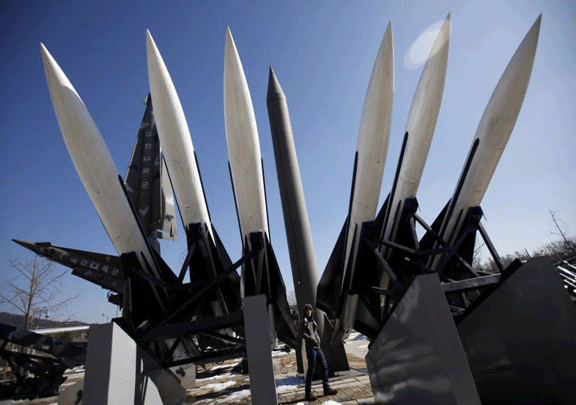
Beijing is moving advanced ballistic missiles which are capable of hitting the US to its north-eastern frontier with Russia, according to media reports, amid suggestions that the weapons were revealed in response to Donald Trump’s “provocative remarks” towards China……..
The state-run Global Times newspaper, which has close links with China’s Communist leaders, said: “Some media claimed that the Chinese military intentionally revealed the Dongfeng-41 and connected it with the inauguration of US President Donald Trump.
“They think this is Beijing’s response to Trump’s provocative remarks on China,” added the outlet, which is known for taking a strongly nationalist tone and making inflammatory comments.
The newspaper also called for a ramping up of China’s nuclear capabilities, saying: “China’s nuclear arsenal must be able to deter the US.”
“Even Washington feels that its naval forces and nuclear strength are lacking,” it added. “So how can China be content with its current nuclear strength when it is viewed by the US as its biggest potential opponent?”
The idea of a scientists’ march on Washington began in earnest on Reddit, with scientific professionals discussing how to best make their voices heard with respect to getting President Trump to heed their warnings on climate change. Scientific redditors then decided to put out a call to action for all scientists and anyone who supports empirical science to come together in Washington, DC after seeing the resounding success of the historic Women’s March on Washington and around the country.
“This isn’t just about jobs to us, if we cared about money we wouldn’t be in this field in the first place. This is about the future of every organism on earth, many that haven’t even been born yet,” wrote Reddit user RetardCharizard. “We have to fight.”
Caroline Weinberg, a public health researcher, told the Washington Post that the Trump administration’s gag orders on government agencies that study climate change and how it affects the U.S. was the last straw.
“We were inspired (well, infuriated) by the current attacks on science from the new administration,” Weinberg wrote in an email to the Post. “Slashing funding and restricting scientists from communicating their findings (from tax-funded research!) with the public is absurd and cannot be allowed to stand as policy.”
A Twitter account for the march has already been launched, and says a date announcement is forthcoming.
and 1 person is to blameMary Bowerman , USA TODAY Network Jan. 26,Scientists moved the hands of the Doomsday Clock closer to midnight on Thursday amid increasing worries over nuclear weapons and climate change.
“This year’s Clock deliberations felt more urgent than usual…as trusted sources of information came under attack, fake news was on the rise, and words were used by a President-elect of the United States in cavalier and often reckless ways to address the twin threats of nuclear weapons and climate change,” Rachel Bronson, the executive director and publisher of Bulletin of the Atomic Scientists, said in a statement.
While many threats played into the decision to move the clock 30 seconds forward from where it was in 2016, one person in particular prompted the scientists to act.
“Never before has the Bulletin decided to advance the clock largely because of the statements of a single person. But when that person is the new president of the United States, his words matter,” David Titley and Lawrence M. Krauss of the Bulletin wrote in an New York Times op-ed.
The Bulletin pointed to President Donald Trump’s careless rhetoric on nuclear weapons and other issues as well as his troubling stance on climate change. “Current political situation in the U.S. is of particular concern,” Titley of the Bulletin Science and Security Board said. “The Trump administration needs to state clearly, unequivocally it accepts climate change caused by human activity…There are no alternative facts here.”
Last year, the clock remained at three minutes from midnight. It was moved to three minutes in 2015 where it was previously at five minutes to midnight.
Gag Order Or Not, Here’s Why Trump Cracking Down On Government Science is So Scary, Modern Farmer By Dan Nosowitzon January 25, 2017You may have seen news about a crackdown on communications between USDA (and the EPA, HHS, and Department of the Interior) and the public. In this latest affront, the administration on Monday directed the USDA to stop all “outward-facing” communications. But by Tuesday night, the gag-order had been “rescinded.” So what’s going on? And what could happen if scientists can’t speak to the public?
It all started yesterday, when BuzzFeed obtained a memo distributed on Monday within the USDA’s Agricultural Research Service (ARS). The memo was written by Sharon Drumm, chief of staff for ARS, and it informed the more than 2,000 ARS scientists—who study everything from methane emissions to the economy of rural America and have a major focus on climate change—to, essentially, keep quiet. Here’s the text, provided to Modern Farmer by the Christopher Bentley, director of the office of communications at ARS:
“Starting immediately and until further notice, ARS will not release any public-facing documents. This includes, but is not limited to, news releases, photos, fact sheets, news feeds, and social media content.”
According to reports today, however, a second email went out to ARS late Tuesday evening stating that Drumm’s note should have never been issued and has been “hereby rescinded.”
Wait, what?
The Play-By-Play
Once BuzzFeed published the memo yesterday, people got loud. News of a gag-order on the USDA was the latest of several similar edicts:
The Department of the Interior, after tweeting images Friday comparing President Trump’s meager inauguration crowds to the throngs at President Obama’s 2009 inauguration, found its Twitter account shut down, only to reappear the next day with an apology.
Tuesday, Badlands National Park’s account tweeted a few facts about climate change—a subject President Trump has repeatedly and falsely claimed to be “controversial”—that were soon deleted.
The Department of Health and Human Services (HHS) was told not to respond to any public questions, but to wait for the new leadership to arrive.
And the Environmental Protection Agency—which Trump pledged to “abolish” during his campaign and whose nominee to head the department, Scott Pruitt, is an avowed enemy who’s currently suing the agency—has issued a complete freeze on all communications (including social media, email, press releases and website updates), as well as a funding freeze on its grants and contracts.
Trump ordering USDA scientists—who conduct a great deal of research on climate change given agriculture is a notable contributor—to cease communicating with the public seemed to follow a pattern……..
Even if the Drumm memo has truly been rescinded, similar policies have been enacted at other governmental organizations. This isn’t a weird aberration; it’s part of a systematic clampdown on the parts of the government that the Trump administration finds problematic. So let’s take a look at how a crackdown on government science could affect the nation……….
US Humanitarian Aid Goes to North Korea Despite Nuclear Tensions, VOA, January 25, 2017 Baik Sung-won WASHINGTON — The United States has provided $1 million in humanitarian aid to impoverished North Korea, the U.S. State Department said Wednesday.
Despite growing tensions between North Korea and Washington, the U.S. sent the assistance last week on the day before President Donald Trump was sworn in and took over the U.S. government.
It marks the first time that the U.S. provided humanitarian assistance to the North since 2011, when it provided relief items including medical supplies to North Korean flood victims. That aid, worth $900,000, was made through Samaritan’s Purse, a U.S.-based humanitarian aid organization.
Aid to help typhoon damageThe current assistance comes in the aftermath of Typhoon Lionrock, which hit North Korea in August with heavy rain that resulted in flooding. At the time, the government reported hundreds were dead and missing, and said thousands had lost their homes. International aid organizations responded immediately.
Pope spurs Republicans to shift climate views, EurekAlert, 24 Jan 17 CORNELL UNIVERSITY After Pope Francis framed climate change as a moral issue in his second encyclical, conservative Republicans shifted and began to see environmental dilemmas in the same way, according to a new study led by Cornell University communication researchers.
“When Pope Francis issued his encyclical paper in June 2015, he emerged as a strong advocate for climate action,” said Jonathon P. Schuldt, assistant professor of communication. “He is in many ways uniquely positioned as a global moral authority – a religious authority – and his position is very visible.”
Schuldt, along with Adam R. Pearson of Pomona College and Rainer Romero-Canyas and Dylan Larson-Konar, both of the Environmental Defense Fund, sought to understand a mechanism for changing public opinion about climate change. Their research, “Brief Exposure to Pope Francis Heightens Moral Beliefs About Climate Change,” was published online in the journal Climatic Change, Dec. 30.
The pontiff addressed waste, culture and modern day ills in the encyclical. Climate change is a global problem with grave environmental, social, economic and political implications, the pope wrote. Many of the world’s poor live in areas particularly affected by phenomena related to global warming, and their subsistence depends on keeping Earth healthy. They have few resources to help them adapt to climate change, the pope said.
Trump Just Ordered Government Scientists to Hide Facts From the Public He also immediately suspended all EPA contracts and grants.Mother Jones, TOM PHILPOTTJAN. 24, 2017 Throughout Donald Trump’s campaign, he and his proxies consistently expressed hostility to government regulation, particularly of the fossil fuel and agriculture industries. Within days of taking over, the Trump administration has already put a squeeze on the two agencies that most directly regulate Big Energy and Big Ag, the Environmental Protection Agency and the US Department of Agriculture.
At the EPA, the administration has ordered that “all contract and grant awards be temporarily suspended, effective immediately,” ProPublica writers Andrew Revkin and Jesse Eisinger report, quoting an internal EPA email they obtained. Myron Ebell, the climate change denier who led the Trump team’s EPA transition and directs the Center for Energy and Environment at the Competitive Enterprise Institute, confirmed the suspension, Revkin and Eisenger report.
That’s potentially a massive blow to the agency’s core functions, says Patty Lovera, assistant director of the environmental watchdog group Food & Water Watch. “The EPA’s not necessarily out there running a bulldozer to clean up a toxic site,” she says. Superfund, an EPA program responsible for cleaning up the nation’s most contaminated land, is executed through contracts, she said. The EPA turns to contractors for “tons of water stuff, too”—from monitoring water quality downstream from polluters to helping municipalities update water infrastructure to avoid toxins.
“It’s one thing to put a pause on new contracts so they can be reviewed, but to reach back and stop existing ones is a whole other can of worms,” Lovera said.
in Flint, Michigan, where lead contamination has led to the nation’s most notorious drinking-water catastrophe in years, the announcement brought uncertainty and confusion. “State officials are seeking more information on a U.S. Environmental Protection Agency freeze on grants and contracts and what it could mean to $100 million in federal funds already appropriated for the Flint water crisis,” the news site MLive.com reported Tuesday. In statement quoted by MLive.com, the press secretary for Michigan Gov. Rick Snyder noted that “we haven’t received any guidance from the federal government” about the EPA’s funding to address the Flint crisis.
Andrew Rosenberg, who directs the Center for Science and Democracy for the Union of Concerned Scientists, adds research to the list. The agency funds crucial environmental science through contracts with outside scientists, and interruptions to their funding can be devastating, he said. He likened the situation to the government shutdown of 2013, which temporarily blacked research funding throughout the federal government, including the EPA. In a blog post at the time, Rosenberg quoted an EPA scientist he interviewed on the effects of such interruptions:
A toxicologist who works for the Environmental Protection Agency expressed great frustration that the crucial work of testing chemicals on the market for toxicity has been interrupted. This work had been slow and complex, and short of manpower. Now, things are worse, the scientist writes. “The next time you reach under the sink to pull out a cleaning product, ask yourself if you’d really like to know if it was causing cancer, or if it was safe.” The shutdown, the toxicologist concludes, will keep toxic chemicals on the shelves “longer than they otherwise should have.”
Of course, it remains unclear exactly how far-ranging the contract suspension is—and that brings us to another move from the White House: a media blackout. . TheHuffington Post‘s Kate Sheppard got hold of an internal EPA email sent to staff Monday blocking all press releases, social-media messages, and blog posts. As for answering queries from journalists, “Incoming media requests will be carefully screened,” the email stated. My own calls and emails to EPA spokespeople on Tuesday went unanswered.
Meanwhile, over at the USDA, a similar media blackout is afoot, reportsBuzzFeed‘s Dino Grandoni:………
f the funding interruptions and media blackouts continue, she said, much of what the USDA and EPA do to study and protect the public from polluting industries will be negated. And that might be the point, she said: If you can prevent public agencies from conducting vital functions, “you can say they don’t do anything and justify cutting their funding.”
On a positive note, all the information that emerged Tuesday on the EPA and the USDA came from internal leaks. Trump may be determined to keep these crucial watchdog and research agencies tightly muzzled, but at least some career bureaucrats and scientists appear unwilling to keep the public in the dark http://www.motherjones.com/environment/2017/01/trump-has-already-cracked-down-epa-and-usda
Under Trump, INL pivots its nuclear message Post Register January 24, 2017 By LUKE RAMSETH lramseth@postregister.comIdaho National Laboratory officials are considering how to shift their message under a Trump administration that has sent mixed signals on energy research and the existence of climate change.