Source: AAP
US President Donald Trump’s defense secretary has warned North Korea of an “effective and overwhelming” response if Pyongyang chooses to use nuclear weapons.
It came as he reassured Seoul of steadfast US support at the end of a two-day visit.
“Any attack on the United States, or our allies, will be defeated, and any use of nuclear weapons would be met with a response that would be effective and overwhelming,” Defense Secretary Jim Mattis said at South Korea’s defense ministry.
Mattis’ remarks come amid concern that North Korea could be readying to test a new ballistic missile, in what could be an early challenge for Trump’s administration.
North Korea, which regularly threatens to destroy South Korea and its main ally, the United States, conducted more than 20 missile tests last year, as well as two nuclear tests, in defiance of UN resolutions and sanctions.
The North also appears to have also restarted operation of a reactor at its main Yongbyon nuclear facility that produces plutonium that can be used for its nuclear weapons program, according to US think tank 38 North.
“North Korea continues to launch missiles, develop its nuclear weapons program and engage in threatening rhetoric and behaviour,” Mattis said.
North Korea’s actions have prompted the United States and South Korea to respond by bolstering defenses, including the expected deployment of a US missile defense system, known as Terminal High Altitude Area Defense (THAAD), in South Korea later this year. The two sides reconfirmed that commitment on Friday.
February 4, 2017
Posted by Christina Macpherson |
North Korea, politics international, USA, weapons and war |
Leave a comment
 US Congress orders review of Russian & Chinese leadership’s nuclear strike ‘survivability’ Rt.com 30 Jan, 2017 The US Congress has directed intelligence agencies and the Pentagon’s Strategic Command to evaluate the ‘survivability’ of Russian and Chinese leaders in the event of a nuclear strike on their aboveground and underground defense facilities.
The comprehensive study will be carried out by the US intelligence agencies as well as the Strategic Command, which is in charge of the American nuclear forces. They will evaluate whether the Russian and Chinese leadership could survive a nuclear attack and continue to operate in a post-strike environment, according to a little-reported section of the 2017 National Defense Authorization Act (NDAA). Read more
If we are in arms race, US started it by pulling out of ABM treaty – Putin
The review will include “an identification of which facilities various senior political and military leaders of each respective country are expected to operate out of during crisis and wartime,” as well as the “location and description of above-ground and underground facilities important to the political and military leadership survivability.
“Key officials and organizations of each respective country involved in managing and operating such facilities, programs, and activities” should also be identified, says the document, which is somewhat reminiscent of an elaborate war plan.
“Our experts are drafting an appropriate response,” Navy Captain Brook DeWalt, spokesman for the Strategic Command, said in an email to Bloomberg on Monday. While “it’s premature to pass along any details at this point, we can update you further at a later date.”
Although the study was ordered before Donald Trump took office, it appears to coincide with his statement that he would unconditionally support strengthening US strategic arsenals. In an incendiary tweet in December, Trump wrote that Washington “must greatly strengthen and expand its nuclear capability until such time as the world comes to its senses regarding nukes.”
Later in the month, Trump stunned arms control experts, reportedly telling Mika Brzezinski, co-host of MSNBC’s ‘Morning Joe’ program: “Let it be an arms race. We will outmatch them at every pass and outlast them all.”
The remarks came despite Trump’s separate statement that he would consider a rapprochement with Moscow in response for a possible new deal on nuclear arms reduction………. https://www.rt.com/news/375604-russia-china-nuclear-survivability/
February 3, 2017
Posted by Christina Macpherson |
USA, weapons and war |
Leave a comment
 Staff ‘Overwhelmed’ at Nuclear Plant, but U.S. Won’t Shut It, NYT, 2 Feb 17 By KATHARINE Q. SEELYE, FEB. 1, 2017PLYMOUTH, Mass. — One by one, ordinary residents confronted the federal regulators, telling them during a three-hour meeting Tuesday night that the Pilgrim Nuclear Power Station here was not safe and should be shut down.
February 3, 2017
Posted by Christina Macpherson |
safety, USA |
Leave a comment


 Europe should act fast to preserve the Iran nuclear deal, Bulletin of the Atomic Scientists, Ellie Geranmayeh, 2 FEBRUARY 2017 US President Donald Trump has stirred all kinds of controversy with European allies during his first fortnight in office. Now, his administration’s evolving policy on Iran is becoming another source of concern across the Atlantic. Europe has a crucial but short window to clearly outline its position on the Iran nuclear deal in ways that could influence policymakers in Washington. In doing so, Europe should focus on preserving the agreement under existing terms as enshrined by the United Nations, and charting a course that minimizes confrontation—whether intentional or accidental—between Iran and the United States in an already turbulent Middle East.
On Wednesday, new National Security Advisor Michael Flynn declared that the United States was “putting Iran on notice.” While it is not clear what exactly he meant, he also criticized Iran’s missiles tests and behavior in the region, calling Tehran’s actions “provocative” and staking out a US position distinctly different from those of Europe and Russia. Although Flynn didn’t directly attack the nuclear deal reached between Iran and six world powers in July 2015, a war of words could easily escalate in ways that threaten it.
The Iran nuclear deal, also known as the Joint Comprehensive Plan of Action (JCPOA), scaled back the country’s nuclear activities in exchange for sanctions relief. As a presidential candidate, Trump suggested he would “dismantle the disastrous deal” or renegotiate it. As president-elect he condemned the deal, but has since said he would “rigorously” enforce it. And during a White House briefing the same day as Flynn’s comments, US officials stressed “that they were not linking Iran’s missile and regional actions to the nuclear deal at this point,” as Al-Monitor reported. On Thursday, though, Trump tweeted that Iran “should have been thankful for the terrible deal the U.S. made with them.” Going forward, it seems likely that Trump’s calculations over the nuclear deal and sanctions will be influenced by developments on non-nuclear issues and also events abroad—among Russia, US allies in Europe, the Gulf Arab states, and Israel.
An early test of the US administration’s stance will come this spring, when the president is required to renew sanctions waivers that enable non-US companies to do business with Iran, in accordance with the terms of the nuclear deal. ……
The Iran nuclear deal steered the United States and its allies away from resorting to yet another futile military encounter in the Middle East. It was never intended to solve every problem between the West and Iran, and the two sides continue to take opposing views on a number of critical issues. However, the agreement has proven that Iran and the West have the capacity to resolve complex security challenges through a transactional relationship if there are mutually beneficial outcomes. Instead of watching Tehran and Washington relapse into the rhetoric of war and conflict, Europe should encourage them to build on this winning formula. http://thebulletin.org/europe-should-act-fast-preserve-iran-nuclear-deal10488
February 3, 2017
Posted by Christina Macpherson |
EUROPE, Iran, politics international, USA |
Leave a comment
 DOOMSDAY DUNGEONS/ (PICTURES) Inside the nuclear bomb shelters being installed throughout Texas as residents prepare for global apocalypse. The bunkers range from £31,000 to £6.6million THE SUN, BY SAM WEBB 2nd February 2017

AMERICANS fearing that society is going to collapse or President Trump will spark a nuclear war have been investing in bunkers to ride out the apocalypse.
Sales of the mini-fortresses have spiked since the divisive billionaire took the reins – and terrified families are taking steps to survive Armageddon……..
Depending on the model, the shelters can offer basic amenities like a bed, kitchen, toilet and shower to an underground mansion with dozens of separate apartments, garden rooms for growing fresh fruit and veg, a games room, sauna, pool, power generator and gym…….
In recent months sales of the most luxurious bunkers have jumped 700 per cent.
A growing phenomenon in the US is ‘prepping’, where people worried about the end of the world prepare for the chaos by undergoing survival and military training, stockpiling weapons and preparing bolt-holes in remote locations.https://www.thesun.co.uk/news/2769421/inside-the-nuclear-bomb-shelters-being-installed-throughout-texas-as-residents-prepare-for-global-apocalypse
February 3, 2017
Posted by Christina Macpherson |
USA, weapons and war |
Leave a comment

 Trump, Russia take a dangerous first step on nuclear arms control, The Hill, BY RICHARD NEPHEW AND ADAM MOUNT, 2 Feb 17 In a recent interview with the the London Times, Donald Trump suggested that he would offer to lift U.S. sanctions over Russia’s invasion of Ukraine as part of a nuclear arms control agreement.
At a time when tensions between the two countries are growing, a verifiable and stabilizing new arms control agreement would be genuinely welcome. But a bad deal would only make matters worse.
The comments about sanctions relief raise real questions about whether the incoming administration is willing to pay any price to improve relations with Russia (and why).
Today, both countries are making investments to replace nuclear systems that were first fielded during the Cold War. An agreement to limit these modernization plans could save money, stabilize the nuclear balance, and be safer to maintain and operate.
Under President Obama, the United States found that it could meet its deterrence requirements after a further one-third reduction in deployed strategic warheads, beyond what was agreed in the New Strategic Arms Reduction Treaty (New START) in 2010, and offered this deal to Russia.
A new arms control agreement would be difficult to achieve today. Putin declined Obama’s one-third offer and has signaled that he is not willing to negotiate over his most dangerous systems, its vast and opaque stocks of low-yield and short-range weapons.
At the same time, Russia has violated the 1987 Intermediate-Range Nuclear Forces (INF) Treaty by developing a new prohibited cruise missile and indicated no real willingness to address the concerns of the United States and other treaty participants. Arms control accords are among the most consequential and the most difficult negotiations in the world, features that will surely attract Trump — but changing Putin’s position will be a very tall order. …….http://thehill.com/blogs/pundits-blog/foreign-policy/317403-trump-russia-take-a-dangerous-first-step-on-nuclear-arms
February 3, 2017
Posted by Christina Macpherson |
Russia, USA, weapons and war |
Leave a comment
the nuclear manufacturers—Westinghouse and General Electric—.. refuse to participate in any project unless they are guaranteed to be free of any liability for any offsite accident consequences. If they believed the NRC risk calculations, they would have no difficulty in accepting the litigation risk—but they obviously don’t. In short, the organizations most highly knowledgeable about nuclear safety don’t trust the NRC’s probabilistic calculations………
A definition of risk that placed greater emphasis on avoiding large-consequence events would be more in line with the common sense of the public whom the NRC is supposed to be protecting. If nuclear power is to have any long-term future, it will have to go beyond even that level of protection….Just as the nuclear manufacturers don’t want to bet their companies on calculations of nuclear safety, neither do people at large want to bet their cities and countrysides.
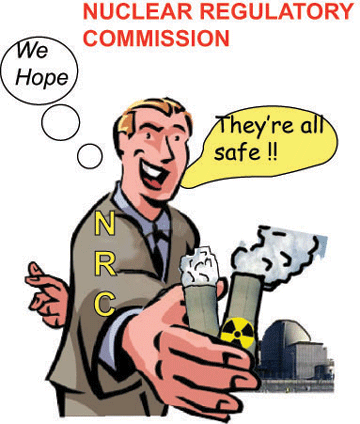
 When 10,000 square miles of contamination is an acceptable risk: The NRC’s faulty concept, Bulletin of the Atomic Scientists, 9 JANUARY 2017 Victor Gilinsky In making safety decisions, the Nuclear Regulatory Commission uses accident probability calculations that are much more optimistic than anything that nuclear manufacturers like General Electric and Westinghouse actually believe. The result is weak public protection. A good example is the NRC commissioners’ rejection in 2014 of a proposal to limit the possible severe consequences of spent fuel pool fires in nuclear power plants because the proposal’s cost, however modest, exceeded the value of the expected reduction in “risk.”
Spent fuel pools are where highly radioactive (and thus thermally hot) used reactor fuel is stored after it is removed from the reactor core. If a pool loses its water supply, the spent fuel can overheat and eventually burn, releasing large quantities of radioactivity. The spent fuel pool issue gained prominence after the 2011 Fukushima accident. For a time during the accident the dominant concern was that spent fuel in Fukushima’s damaged Unit 4 pool might catch fire. It didn’t happen, but it could have multiplied the effects of the catastrophic Fukushima accident manyfold. The NRC staff told the commissioners in 2014 that a worst-case spent fuel pool fire in a US plant like those at Fukushima—of which there are nearly three dozen—could release 25 times more long-lasting radioactivity than escaped from the Fukushima reactor vessels, and perhaps even more. Such a release could render 10,000 square miles uninhabitable and (around the Pennsylvania nuclear plant the staff chose as an example) could require the evacuation of 4 million persons.
The specific proposal before the commissioners was to limit the amount of radioactive spent fuel in a pool and thus to reduce the consequences of a fire by a factor of ten. This would be accomplished by speeding up the transfer of radioactive spent (used) fuel from the pool into “dry cask” storage. The plant owners have to do this eventually, but earlier transfers increase the cost. The commissioners saw their role as deciding whether the safety benefit—the reduction in risk—warranted this cost increase.
In fact, they weren’t deciding anything. The commissioners lent an air of official seriousness to the proceeding, but the decision making was on autopilot. It involved calculating the average risk (R) of an accident by multiplying two numbers, the accident’s probability (P) and its consequence (C). If P is sufficiently small, the average risk (or P times C) will be negligible no matter how large the consequence. And, therefore, the possible reduction in risk will hardly be worth any expenditure. That is how it worked in the 2014 case of a possible spent fuel fire, and that is how it has worked in most cases involving protection against severe accidents.
Actually, most cases don’t get this far. The commission has a threshold for the staff to investigate a safety issue posed by a hypothetical accident. If the estimated probability of “prompt” deaths offsite is below 2 in 1 million per year, the NRC staff need not investigate further. This involves a kind of Catch-22. The NRC assumes effective evacuation of the surrounding area in the event of an accident, so there aren’t people to be irradiated, and even substantial accidents don’t exceed the commission’s threshold……..
Consider the implications of NRC’s risk definition for the risk of long-term land contamination: The NRC staff’s projection of about 10,000 square miles, when multiplied by the staff-estimated accident probability, becomes an annual risk of about one-thousandth of a square mile, or less than an acre per year. Since valuable farmland runs at several thousand dollars per acre, the NRC conclusion is that any safety improvement that costs more than that isn’t worthwhile in terms of saving land. Similarly, the risk of displacing persons, becomes about half a person displaced per year, perhaps at a cost of tens of thousands of dollars, and so, again, per NRC logic, it is not worth spending more than that to avoid long-term evacuations to protect against severe spent fuel pool fires. This isn’t the conclusion most people would arrive at for themselves or their home towns.
There are several things wrong with the NRC’s cost-benefit approach to nuclear safety. To begin with, neither factor in the risk formula—probability times consequence—can be calculated with any accuracy. For example, the consequences of an accident requiring the long-term, possibly permanent, evacuation of 4 million will surely not be limited to the expense of such an evacuation. It would, for example, almost certainly spell the end of nuclear power use in the United States and likely in many countries, with huge economic consequences. …….
Nor is the situation much better when it comes to estimating the accident probability. As there is little data on large accidents, the accident probability is a calculated number. The NRC staff relies increasingly on elaborate calculations that model the various failure modes of a nuclear plant. For outsiders, or for that matter the NRC commissioners themselves, the result essentially comes out of a black box. …..
Which brings us to a deep flaw in NRC’s safety methodology—its reliance on the average risk as the figure of merit. It is by no means the only possible measure of risk. We know that in many statistical situations the average is not the best choice to characterize the data. It works where there are well-established data on both probabilities and consequences as, for example, in considering measures to reduce auto accidents. It doesn’t make sense for high consequence/low probability events, for one thing, because the numbers are so poorly known. Also, using average risk doesn’t reflect what most people—the people the NRC is supposed to be protecting—want to achieve. They don’t want to risk losing a city, no matter what the calculated probabilities. That is how the nuclear manufacturers—Westinghouse and General Electric—see it, too. They refuse to participate in any project unless they are guaranteed to be free of any liability for any offsite accident consequences. If they believed the NRC risk calculations, they would have no difficulty in accepting the litigation risk—but they obviously don’t. In short, the organizations most highly knowledgeable about nuclear safety don’t trust the NRC’s probabilistic calculations………
Any change in the NRC’s approach to nuclear risk must come from the outside; the agency has too much invested in the current approach for internal reform to have a chance. When a witness at the 2014 Commission meeting on spent fuel pool fires, Clark University professor Gordon Thompson, questioned using the average risk as the figure of merit, only one commissioner took notice and that was to ridicule the notion. The commissioners should have paid more attention.
A definition of risk that placed greater emphasis on avoiding large-consequence events would be more in line with the common sense of the public whom the NRC is supposed to be protecting. If nuclear power is to have any long-term future, it will have to go beyond even that level of protection. A 2012 report of the American Society of Mechanical Engineers, a group heavily involved with the nuclear industry, called for a major step-up in nuclear safety and warned that severe accident impacts on people’s lives were “wholly inconsistent with an economically viable and socially acceptable use of nuclear energy.” Just as the nuclear manufacturers don’t want to bet their companies on calculations of nuclear safety, neither do people at large want to bet their cities and countrysides. http://thebulletin.org/when-10000-square-miles-contamination-acceptable-risk-nrc%E2%80%99s-faulty-concept10459
February 3, 2017
Posted by Christina Macpherson |
Reference, safety, USA |
Leave a comment
 Bannon Is Given Security Role Usually Held for Generals By GLENN THRUSH and MAGGIE HABERMANNYT, JAN. 29, 2017 WASHINGTON
 — The whirlwind first week of
Donald J. Trump’s presidency had all the bravura hallmarks of a Stephen K. Bannon production.
February 1, 2017
Posted by Christina Macpherson |
politics, safety, USA |
Leave a comment
 James Knieling no high level international nuclear waste dump in south australia, 30 Jan 17

Funny thing about Radiation debris, once it drops into your house, its like the “Relatives Visiting From Hell!” I watched the biggest ever above ground Nuke go off from 75-miles away, while my dad hoisted it into position at the Mercury’s Nevada Test Site. *It was dark with only the lights of Fremont Street’s Casinos at 0530 and then the brightest light you ever did not look at went on. Then a 50mph wind struck us, and it felt like a hundred little bee stings on my bare arms,
legs, and face
Then it was gone. About 20-years later they found Nuclear Hot Particles in the attics of our street. My dad built and operated 67-above ground nuclear bomb hoists in 1956-7. He died of his exposure, never being warned that his badge had gone red hot, with Small Cell Lung & Bone Cancer.
My field was Radiation Health Technology to work at the Nevada Test Site so when I had the chance to go to Bikini Atoll and see all the on-site data and films I went. I went on the 60-yr post-blast and we took reading for a week. The coconuts were lethal, the coconut crabs were lethal, the ground was, even with 17″ of protection fill, still off gassing lethal hot particles.
We were billeted in structures built several feet off the ground with blowers underneath to vent the radiation. We were told not to walk bare foot, and not sit, or linger on the ground. We were told to “Never, Ever turn off the A/C and Never, Ever to shut the fresh air vent!” Funny thing about being safe to visit. Only a 150+ people had a problem with the “OK to Visit” notice, and they dropped dead. See the sign below from the Bikinian Cemetery? Guess who’s in it? Answer~!The Bikinians the US Govt suckered as “Its safe to come home!” Not, they started dropping like flies! https://www.facebook.com/groups/1314655315214929/
February 1, 2017
Posted by Christina Macpherson |
health, PERSONAL STORIES, USA |
Leave a comment

Would any judge question a medical expert’s evidence in the way that this judge doubts the evidence of the world’s climate scientists? Then again – they do say that “the law is an ass”
Judge in environmental activist’s trial says climate change is matter of debate
Controversial statements angered environmentalists who insist courts have an obligation to recognize the science about manmade climate change, Guardian, Sam Levin 31 Jan 17, A Washington state judge has sparked outrage for remarks questioning the existence of climate change and the role of humans in global warming.
During the high-profile trial of Ken Ward, a climate activist facing 30 years in prison for shutting down an oil pipeline, Judge Michael E Rickert said: “I don’t know what everybody’s beliefs are on [climate change], but I know that there’s tremendous controversy over the fact whether it even exists. And even if people believe that it does or it doesn’t, the extent of what we’re doing to ourselves and our climate and our planet, there’s great controversy over that.”
The Skagit County judge made the comments on 24 January while addressing Ward’s request to present a “necessity defense” in court, meaning he would argue that the grave threat of climate change justified civil disobedience.
Rickert’s controversial statements, along with his decision to block Ward from arguing that his pipeline protest was necessary to prevent harm to the planet, angered environmentalists who insist that American courts have an obligation to recognize the science and consensus among researchers about man-made climate change.
“I thought it was shocking and deeply worrisome for my case,” said Ward, 60, of Corbett, Oregon, who temporarily shut off the safety valve of the TransMountain pipeline in Skagit County. “We are in the late stages of global collapse, and to have someone who is presumably as knowledgeable and aware as a judge should be blithely dismissing the biggest problem facing the world is chilling.”
Ward, whose trial began on Monday, is part of a group of activists that targeted oil sands pipelines in Washington, Oregon, North Dakota, Montana and Minnesota on 11 October 2016. The coordinated #ShutItDown actions – which have led to a dozen criminal cases and threats of hefty prison sentences against activists and journalists – was aimed at stopping 15% of US crude oil imports for a day.
He later added that with climate change, there’s “great controversy” with “over half of our political leaders”. (Critics have slammed the GOP as the “only major party in the advanced world” to deny climate change)……. https://www.theguardian.com/environment/2017/jan/31/environmental-activist-trial-judge-questions-climate-change-ken-ward
February 1, 2017
Posted by Christina Macpherson |
climate change, Legal, USA |
Leave a comment
 What is the Relationship of Nuclear Energy Plants and Nuclear Weapons? Finding the Missing Link January 28, 2017 Scott Jones, Ph.D.
Setting aside the classical tenderness of the phrase, they are Mother and Child. Within the science community and the business of commercial nuclear energy this reality is a given. However, the “Atoms for Peace” commercial slogan may have introduced some ambiguity about this reality. This is quickly cleared up for the lay person by a January 1983 article published in The Bulletin of the Atomic Scientists:
“An even more specific confirmation of the economic advantage
of the commercial-power route to bombs is available in a most
distressing form: the admission by the U.S. government, in late 1981,
 that it is considering turning to commercial-reactor fuel as the
 source of plutonium for a new round of nuclear warheads. Would
the United States even consider paying the political costs of such a
move unless the economic attractiveness were compelling?”
The family relationship is the basic and fundamental link between nuclear energy production and nuclear weapons. However, it leads to other important relationships.
Nuclear weapons are the result of willful national security political decisions. After the development and use of nuclear weapons by the Unites States, every country that followed in the club of nuclear weapon owners made that decision because of an assessment that it gave them security that they otherwise would not have. It was claimed to be a defensive move to deter all potential enemies from use of nuclear weapons against them……
What we can say with certainty is that a nuclear power plant nominates itself as a potential target. What cannot easily be predicted is who or what may be the aggressor. While progress is being made in predicting threats from nature, it will always remain to a significant degree a capricious force.
In the human realm, current and traditional enemies most certainly will be on target and threat lists. But the threat may be from a terrorist group that selects one of the world’s existing 450 operating nuclear power plants in 31 countries, or later, one the 60 new plants under construction in 16 countries. Which plant to attack may be decided because it is assessed to be the most vulnerable target for their capability to attack.
There is no shortage of targets now and the number is increasing. Success will not be measured by the amount of radiation released. That will almost be immaterial.
The global nuclear power plant network shares a nervous system that is highly tuned to every nuclear event. Deserved or not an accident or an attack will be perceived by much of the world through a memory lens of Hiroshima, Nagasaki, Chernobyl, and Fukushima. http://akiomatsumura.com/2017/01/what-is-the-relationship-of-nuclear-energy-plants-and-nuclear-weapons.html
February 1, 2017
Posted by Christina Macpherson |
USA, weapons and war |
1 Comment
U.S. will change course on climate policy, says former EPA transition head Reuters, By Nina Chestney |30 JAN 17 LONDON The United States will switch course on climate change and pull out of a global pact to cut emissions, said Myron Ebell, who headed U.S. President Donald Trump’s Environmental Protection Agency (EPA) transition team until his inauguration.
Ebell is the director of global warming and international environmental policy at the Competitive Enterprise Institute, a U.S. conservative think tank, and helped to guide the EPA’s transition after Trump was elected in November until he was sworn in on Jan. 20.
Trump, a climate skeptic, campaigned on a pledge to boost the U.S. oil and gas drilling and coal mining industries by reducing regulation.
He alarmed nations that backed the 2015 Paris agreement to cut greenhouse gases by pledging to pull the United States out of the global deal agreed by nearly 200 countries. However, Trump told the New York Times in November that he had an “open mind” on the agreement.
Trump’s administration has asked the EPA to halt all contracts, grants and interagency agreements pending a review, sources said.
“The U.S. will clearly change its course on climate policy. Trump has made it clear he will withdraw from the Paris Agreement. He could do it by executive order tomorrow or he could do it as part of a larger package,” Ebell told reporters in London on Monday.
The top energy official for the European Union, meanwhile, said he hoped that Trump would stick to the Paris deal……..http://www.reuters.com/article/us-usa-trump-epa-idUSKBN15E1MM
February 1, 2017
Posted by Christina Macpherson |
climate change, USA |
Leave a comment
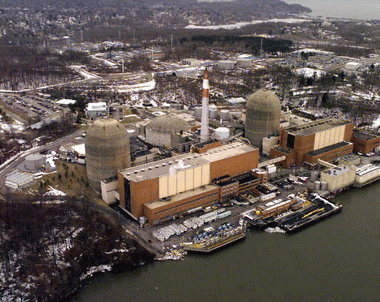
 The battle of Indian Point http://shelterislandreporter.timesreview.com/2017/01/29/column-battle-indian-point/ by Karl Grossman “It is a huge step forward in protecting the health and safety of all New Yorkers.”
So said State Assemblyman Fred W. Thiele Jr. (I-SagHarbor) on the agreement to close the Indian Point nuclear power plants, which sit 30 miles from Times Square, less than 50 miles from western Suffolk and 84 miles from Shelter Island — as the crow flies and radioactivity spreads.
These aged, problem-plagued nuclear plants have constituted a huge danger for the most densely populated area of the United States.
“This closure will put New York State on the fast track to expanding its renewable energy portfolio,” Mr. Thiele said. “By shifting our focus to green, renewable energy, we can grow our economy, create jobs and safeguard the health and safety of residents and state’s natural resources for generations to come.”
Governor Andrew Cuomo has long been calling for the plants to be shut down, and in announcing the agreement on January 9, he called the two-reactor Indian Point facility a “ticking time bomb.” Under the agreement, Indian Point 2 will close by April 2020 and Indian Point 3 by April 2021.
For decades, environmentalists and safe-energy organizations have been active in working to shut down the plants. Riverkeeper, the environmental organization, has been deeply involved. Its president, Paul Gallay, along with top New York State officials led by the governor, signed the agreement with the nuclear plants’ owner, New Orleans-based Entergy.
After the signing, Mr. Gallay described Indian Point as the “biggest existential threat to the region.” These strong words were confirmed years ago by the U.S. Nuclear Regulatory Commission in an analysis of the consequences of a meltdown with breach of containment (a “China Syndrome” accident) at every nuclear power plant in the U.S.
The 1982 report, “Calculation of Reactor Accident Consequences” or CRAC2 (it’s available on-line), considers “peak early fatalities,” “peak early injuries,” “peak cancer deaths” and “scaled cost billions in 1980 dollars.”
For Indian Point 2, the analysis, done at the U.S. Department of Energy’s Sandia National Laboratories, projects peak early fatalities — 46,000; peak early injuries — 141,000; peak cancer deaths — 13,000; and scaled cost in billions — $274 billion, which in today’s dollars would be $1 trillion. For Indian Point 3, it calculates peak early fatalities — 50,000; peak early injuries — 167,000; peak cancer deaths — 14,000; scaled cost in billions — $314 billion. “Scaled cost” includes “lost wages, relocation expenses, decontamination costs, lost property” and a portion of the U.S. rendered uninhabitable for centuries because of radioactivity.
These aren’t just numbers, but represent people’s lives lost, injuries, those left with cancer and part of the planet ruined.
Said Robert F. Kennedy Jr., vice chairman of Riverkeeper: “The agreement marks a milestone in America’s historic transition from a dirty, dangerous energy system to clean, safe, wholesome, local and patriotic power supply.”
New York State and the environmental and safe-energy groups won the battle of Indian Point by using a similar tactic we on Long Island used to prevent the Shoreham nuclear power plant from going into commercial operation, and to prevent the Long Island Lighting Company (LILCO) from building seven to 11 nuclear plants here. The strategy involved getting around federal “pre-emptions” on nuclear power.
The promoters of nuclear power arranged in the 1950s for a supportive federal government to have “pre-emption” over states and localities on most nuclear plant issues. On Long Island, a strategy of grassroots activists with support of elected officials was to use the state’s power of eminent domain. The Long Island Power Act was enacted in 1985 giving the state the authority, if LILCO persisted with Shoreham and its other nuclear plant projects, to seize its assets and eliminate it. There was no federal “pre-emption” preventing that. And LILCO gave up.
On Indian Point, environmental activists and the state zeroed in on denying Entergy the State Pollutant Discharge Elimination System (SPDES) permit that allowed the plants to discharge 2.5 billion gallons of water a day into the Hudson. This “once-through” cooling system released radioactive poisons into the river and has been killing massive amounts of fish. There was no federal “pre-emption” preventing this SPDES strategy. Another important factor causing Entergy to give up is that competitive power systems are now less expensive than nuclear, including renewable energy with safe solar and offshore wind power playing a huge role.
There are post-agreement complaints by some about replacing the electricity Indian Point generated. That’s baloney. There are alternatives. We can easily have energy we can live with.
January 30, 2017
Posted by Christina Macpherson |
environment, USA |
Leave a comment
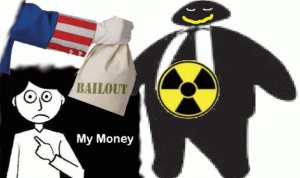 New York readies for nuclear energy from aging power plants, Herald Net, Jan 29th, 2017 By David Klepper Associated Press OSWEGO, N.Y. — When the Nine Mile Point reactor first went online, Richard Nixon was president, the Beatles were still a band and Three Mile Island, Chernobyl and Fukushima weren’t yet bywords for the hazards of nuclear power.
Almost 50 years later, New York state is betting big on the future of Nine Mile Point, one of the nation’s two oldest nuclear plants.
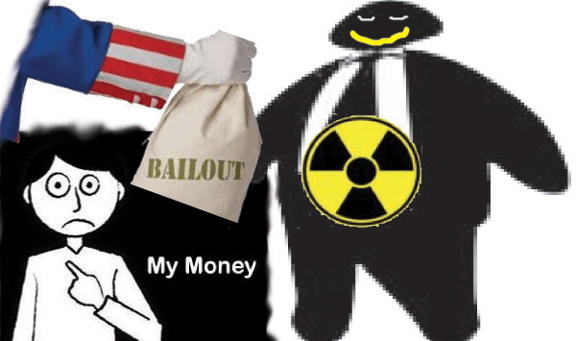
The state is putting up $7.6 billion in subsidies to ensure that the plant and two other upstate nuclear plants stay open, part of New York’s strategy to lean on nuclear energy as it ramps up renewable sources such as wind, solar and hydroelectric.
But even as Democratic Gov. Andrew Cuomo’s administration embraces nuclear power upstate, it’s moving to shutter the Indian Point nuclear plant some 30 miles north of New York City.
To critics, Cuomo is making a political calculation that favors jobs and energy upstate, and safety and the environment downstate.
“These things have an expiration date, and they’re really pushing it,” said Sue Matthews, who worked for contractors building Nine Mile Point’s second reactor in the 1980s. She said her opposition to the plant makes her the “most hated” woman in town. “Everyone here depends on that place — the jobs, the property taxes. They can’t afford to close it.”
Nuclear plants around the nation are at a similar crossroads, with more closures likely as owners become reluctant to spend increasingly large sums operating aging plants.
Located on the shores of Lake Ontario, Nile Mile Point is a wonder of Cold War-era engineering, with miles of colored pipes and wires snaking through long corridors to a cathedral-sized turbine room. Anyone getting close to the reactor is fitted with a small dosimeter to monitor exposure, and must step inside a phone-booth sized radiation scanner before and after.
The plant’s first reactor went online in 1969, sharing the nation’s-oldest honor with the Oyster Creek plant in New Jersey.
Immediately adjacent to Nine Mile Point is a second, 42-year-old nuclear plant, FitzPatrick, which was slated to close before Cuomo’s nuclear bailout package was approved. A third, the 47-year-old Ginna nuclear power plant, is located just east of Rochester……….
Environmental groups critical of nuclear power don’t like Cuomo’s approach.
“The governor should take his own advice,” said Alex Beauchamp, of the group Food & Water Watch. “And close the other nuclear plants upstate instead of propping up a costly and unsafe industry with $7.6 billion in New Yorkers’ money.” http://www.heraldnet.com/news/new-york-readies-for-nuclear-energy-from-aging-power-plants/
January 30, 2017
Posted by Christina Macpherson |
politics, USA |
Leave a comment
 Mikhail Gorbachev: It ‘looks as if the world is preparing for war’ as nuclear threat re-emerges, Telegraph Barney Henderson, new york 27 JANUARY 2017 Mikhail Gorbachev has warned that a new arms race means “the nuclear threat once again seems real” as he stated it “looks as if the world is preparing for war”.
The former Soviet leader called on Donald Trump and Vladimir Putin to work together to take steps to reduce the world’s nuclear arsenal.
“Politicians and military leaders sound increasingly belligerent and defence doctrines more dangerous. Commentators and TV personalities are joining the bellicose chorus. It all looks as if the world is preparing for war,” he wrote in an article for Timemagazine.
Mr Gorbachev said the US and Russian presidents should champion a resolution at the UN Security Council to guard against a nuclear conflict.
“I think the initiative to adopt such a resolution should come from Donald Trump and Vladimir Putin – the presidents of two nations that hold over 90% of the world’s nuclear arsenals and therefore bear a special responsibility,” he wrote……
Mr Gorbachev, who detailed his own efforts at denuclearisation during the dying days of the Cold War in the 1980s, issued a stark warning of a world where weapons of mass destruction were becoming cheaper and more readily available.
“Money is easily found for sophisticated weapons whose destructive power is comparable to that of the weapons of mass destruction; for submarines whose single salvo is capable of devastating half a continent; for missile defence systems that undermine strategic stability,” he wrote.
He said his proposed UN Security Council resolution should state “nuclear war is unacceptable and must never be fought”…….http://www.telegraph.co.uk/news/2017/01/27/mikhail-gorbachev-looks-world-preparing-war-nuclear-threat-re/
January 28, 2017
Posted by Christina Macpherson |
politics international, Russia, USA, weapons and war |
Leave a comment