Trump didn’t know what the New START nuclear treaty was, but wanted to get rid of it
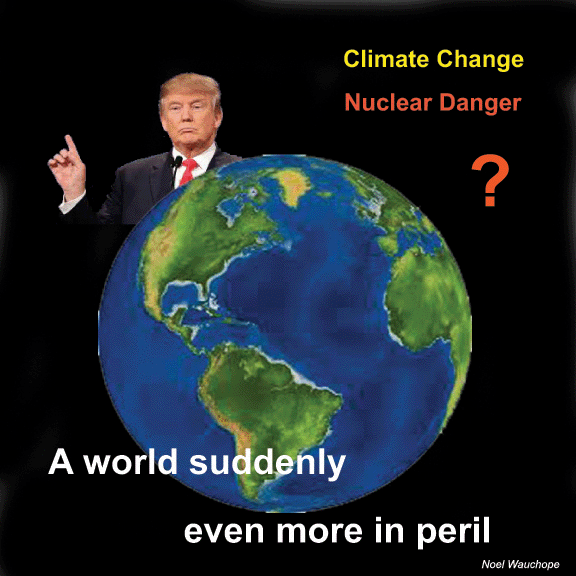 A bad START: Trump tells Putin U.S.-Russia treaty to limit nuclear weapons was a “bad deal”, Salon.com , FEB 10, 2017
The president reportedly didn’t know what the New START treaty was but wanted to get rid of it President Donald Trump has had another embarrassing phone call with a foreign leader — and this time there’s potentially dangerous consequences.
According to the sources who spoke with Reuters, however, Trump seemed unfamiliar with the details of New START when it was brought up by Russian leader Vladimir Putin. After Putin suggested extending New START beyond its original time frame, Trump referred to the treaty as one of many bad deals that Obama had negotiated.
If New START is not mutually extended, neither America nor Russia would be limited in their nuclear production, which could trigger a nuclear arms race.
The sources also say that Trump then turned the conversation toward the subject of his own supposed popularity within the United States. The official White House account of Trump’s Jan. 28 conversation with Putin did not mention a discussion about New START.
Trump’s phone calls with world leaders have not gone well……http://www.salon.com/2017/02/09/a-bad-start-trump-tells-putin-u-s-russia-treaty-to-limit-nuclear-weapons-was-a-bad-deal/
America’s new nuclear missile plan puts China on the defensive
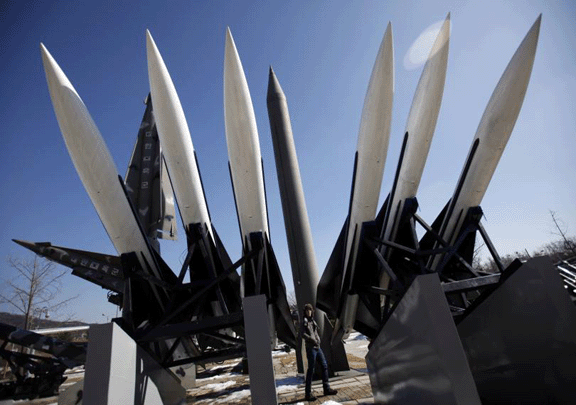

 China’s nuclear missile policy put under strain by US plan CNBC, 10 Feb 17 David Reid | @cnbcdavy
A decision by the United States to pursue a new breed of nuclear weapons could push China to reconsider its decades-long atomic policy, according to experts.
The U.S. Defense Department recently recommended the government develop tactical nuclear weapons with “low yield” results that can be deployed within smaller battlefield areas.
Tong Zhao, an associate in the Carnegie Endowment’s Nuclear Policy Program based in Beijing, told CNBC Wednesday that this more flexible form of weapon would lower the threshold of nuclear use.
U.S. President Donald Trump signed an executive order on January 27, requiring Defense Secretary James Mattis to review America’s nuclear prowess.
Zhao said U.S. plans to pursue a global missile network, initiated by the Obama administration, may be viewed by China as a threat to its own small deterrent and could mean a switch to a “launch-on-warning” policy, whereby China would retaliate before enemy missiles hit land.
“The new U.S. administration seems very much devoted to developing and deploying a massive global and layered missile defense network that protects not only U.S. homeland, U.S. allies, and friends, but also U.S. bases and troops wherever they are located or deployed.
US nuclear industry looks to Trump to change nuclear regulation rules
 Trump and U.S. Nuclear Power Find Common Ground in Jobs Push, Bloomberg by Jonathan Crawford February 8, 2017,
 -
Early signs suggest Trump is eager to keep reactors open
-
Obama gave a higher priority to wind and solar power: NEI
Nuclear power providers, battered by low prices and competition from cheap natural gas, say they can help President Donald Trump fulfill a campaign promise to put more people to work.
Trump will throw more support behind nuclear power than the Obama administration, which gave a higher priority to wind and solar power, Maria Korsnick, president and chief executive officer of the Nuclear Energy Institute, said in an interview Tuesday at Bloomberg headquarters in New York. The industry’s goal of expanding the number of U.S. nuclear reactors dovetails into Trump’s campaign promise to add jobs and boost investment in infrastructure.
Profits for U.S. nuclear operators are falling with the collapse of wholesale power prices amid a boom in gas production and rising supplies of renewables. Five nuclear plants will close by 2025, bringing the total number of retirements to 10 since 2009 when the shale boom was just getting underway. ………
Korsnick said. “The previous administration was a bit more in love with renewables.”
Early indications suggest that Trump may be supportive of nuclear power and receptive to the concerns of the industry. In a document obtained by Bloomberg, Trump’s transition team asked the Energy Department how it can help keep nuclear reactors “operating as part of the nation’s infrastructure” and what it could do to prevent the shutdown of plants.
Regulatory Support
The administration can help at the Federal Energy Regulatory Commission, which oversees wholesale U.S. power markets. …….Korsnick is pushing for more states to follow New York and Illinois, which approved measures to prevent the premature closing of money-losing nuclear plants.
In December, Illinois approved annual payouts of about $235 million for 10 years to keep Exelon Corp.’s Quad Cities and Clinton reactors open. In August, New York regulators approved subsidies totaling about $500 million a year for the R.E. Ginna and Nine Mile Point nuclear plants owned by Exelon, and the James A. FitzPatrick plant it is purchasing from Entergy Corp.
“FERC can value what nuclear brings,” Korsnick said. “They can value it in the same way that some of the states have valued it.”……..https://www.bloomberg.com/news/articles/2017-02-07/trump-and-u-s-nuclear-power-find-common-ground-in-jobs-push
Trump’s attitude to science is like Stalin’s , says Australia’s Chief Scientist
Australia’s chief scientist compares Trump to Stalin over climate censorship
 Alan Finkel warns that forcing EPA data to undergo political review before publication will ‘cause long-term harm’, Guardian, Gareth Hutchens, 7 Feb 17, Australia’s chief scientist has slammed Donald Trump’s attempt to censor environmental data, saying the US president’s behaviour was comparable to the manipulation of science by the Soviet Union.
Speaking at a scientific roundtable in Canberra on Monday, Alan Finkel warned science was “literally under attack” in the United States and urged his colleagues to keep giving “frank and fearless” advice despite the political opposition.
“The Trump administration has mandated that scientific data published by the United States Environmental Protection Agency from last week going forward has to undergo review by political appointees before that data can be published on the EPA website or elsewhere,” he said.
“It defies logic. It will almost certainly cause long-term harm. It’s reminiscent of the censorship exerted by political officers in the old Soviet Union.
“Every military commander there had a political officer second-guessing his decisions.”
Last month Trump’s administration mandated that any studies or data from scientists at the EPA undergo review by political appointeesbefore they can be released to the public.
The communications director for Trump’s transition team at the EPA, Doug Ericksen, said the review also extended to content on the federal agency’s website, including details of scientific evidence showing the Earth’s climate was warming and human-induced carbon emissions were to blame.
Finkel compared the Trump administration’s attempt to censor science to the behaviour of Soviet dictator Josef Stalin.
“Soviet agricultural science was held back for decades because of the ideology of Trofim Lysenko, who was a proponent of Lamarckism,” he said……..https://www.theguardian.com/science/2017/feb/06/australias-chief-scientist-compares-trump-to-stalin-over-climate-censorship
Florida Power and Light, and the costly nuclear mess it is in
 We Pay for FPL’s Mess, Miami’s Community Newspapers | In case you haven’t heard, Japan’s Toshiba is in financial free-fall and is pulling its subsidiary Westinghouse out of the nuclear construction business due to massive losses. According to Forbes, Toshiba’s President Satoshi Tsunakawa said Westinghouse is “unlikely to carry out actual construction work for the future nuclear power plant projects to eliminate risk.”
The two new reactors proposed by FPL for Turkey Point are supposed to be designed and built by Toshiba-Westinghouse. With this news, how can FPL continue to claim they intend to build two new reactors and why do we have to keep paying for them?
Clearly, market trends run counter to FPL’s misguided plans. Power from a natural gas plant is much cheaper than new nuclear, and utility scale solar projects are vastly cheaper than either nuclear or natural gas.
Toshiba is right to tag reactor construction as a loser. Duke Energy Florida cancelled their plans in 2013 to build new reactors due to staggering price increases and long delays. Reactors under construction in Georgia and South Carolina are massively over budget and way behind schedule. So why do we, FPL customers, continue to take a financial hit for a project that will likely never be built while FPL can walk away from it at any time without any impact to its shareholders?
FPL customers have already forked over $280 million dollars for this boondoggle. The project comes before regulators at the Florida Public Service Commission again this year when FPL will be again asking for more money. FPL should not request more money from customers and if they do, the Commission should protect consumers and say no.
If history is our guide, FPL hasn’t even been able to safely manage the existing reactors at Turkey Point. Many decisions FPL has made have been ill advised, starting with building them in the first place.
In the late 1960s, FPL dumped heated cooling water via a pipe directly into Biscayne Bay, killing much of the nearby marine nursery grounds. The damage was well documented. In the early seventies, a federal judge in Miami made FPL stop direct discharges of heated water into the Bay and a holding area for the contaminated water was developed. It grew to a 10 square mile area of connecting “cooling canals” that acts like a radiator……..
FPL’s next “fix” was to dump toxic chemicals into the cooling canals to kill the algae and then add billions of gallons of freshwater into the system. They ultimately flushed all of that toxic and hyper saline water into our National Park and our federally protected Aquifer.
Now FPL wants to suck up over four decades of pollution and pump it down into the boulder zone below our aquifer for “safe” keeping. State and local regulators have rightfully expressed concerns. FPL’s model does not consider simple evaporation, the drawdown from the surrounding canals, and it shows more water than really exists in the system to mask the damage their plan will cause to the surrounding wetlands.
Also, let’s not forget we are spending billions of dollars on Everglades Restoration in south Florida. FPL’s plan to draw down water from the wetlands and concentrate salt in the system is in direct conflict with this important taxpayer project designed to improve our economy and resiliency.
Why should we trust FPL to “fix” the mess they created with decades of bad decisions much less trust them with tens of billions more to add two more new reactors? We’ve already been forced to pay big bucks for FPL’s nuclear sham that has ravaged our local environment, risks our water supply and threatens our future. We must stop this monopoly that continues to spend our money on regretful choices and the wrong technologies.
Floridians must continue to demand changes from state legislators and regulators about how energy is produced in Florida. Much is at stake including our drinking water. It’s time to take a different direction toward a clean and safe energy future. http://communitynewspapers.com/aventura/pay-fpls-mess/
Pilgrim Nuclear facility reduces power because of seawater leak
Seawater leak forces reduced power at Pilgrim nuclear power plant, Wicked Local Pembroke By
A seawater leak at Pilgrim Nuclear Power Station has prompted plant operators to sharply reduce energy output there.
Control room operators reduced power to about 50 percent on Monday afternoon, Feb. 6, after there was an indication of a leakage into the Plymouth plant’s condenser.
A power plant spokesman told the News Service on Tuesday morning that the plant is now operating at 28 percent while repair work is undertaken.
Entergy Pilgrim Station spokesman Patrick O’Brien did not have an estimate of how much seawater leaked into the plant’s condenser……..http://pembroke.wickedlocal.com/news/20170207/seawater-leak-forces-reduced-power-at-pilgrim-nuclear-power-plant
Trump has no skills to negotiate foreign relations, but he can unleash nuclear war
 World War III? Into Uncharted Territory, Trump’s Authority to Use Nuclear Weapons: “Let it be An Arms Race. We will Outmatch Them…and Outlast Them All.”http://www.globalresearch.ca/world-war-iii-trumps-authority-to-use-nuclear-weapons-let-it-be-an-arms-race-we-will-outmatch-themand-outlast-them-all/5572887 By Arms Control Association February 04, 2017
Trump’s chief advisor, Steve Bannon and his obsession with war
Trump Adviser Steve Bannon Tells Press to “Keep Its Mouth Shut”
Former friends of Trump’s chief advisor, Steve Bannon, reveal his longtime obsession with war http://www.dailykos.com/story/2017/2/2/1629296/-Former-friends-of-Steve-Bannon-reveal-his-longtime-obsession-with-testosterone-and-war
Risks in nuclear wastes being transported through Texas cities
“You’ve got this stuff going out in the middle of the desert with temperature extremes,” Hadden said. “You’ve got intense storms and flooding, lightning, wildfires. … I don’t think the casks are at all robust enough.”
Unexpected accidents are not unheard of in the nuclear waste field.
 Nuclear waste could pass through Texas cities en route to Andrews disposal site, Brendan Gibbons, San Antonio Express-News February 4, 2017 In the high, dry plains of West Texas sits a hazardous waste site operated by Waste Control Specialists, a company that wants to begin storing high-level nuclear waste from dozens of nuclear power plants across the country.
For that waste to get to the facility in Andrews County on the Texas-New Mexico border, it would first travel on thousands of miles of railroad tracks, according to a WCS spokesman and a Federal Railroad Administration document. That could include rail lines that pass through Dallas, Houston and San Antonio, though the specifics so far are hard to come by.
WCS site is already one of eight in the U.S. permitted to take low-level radioactive waste, mostly from hospitals and laboratories. High-level waste, which only comes from nuclear reactor fuel or reprocesssed fuel, is radioactive enough to kill a person directly exposed to it so it’s stored in metal canisters inside of concrete casks that can weigh more than 100 tons.
WCS wants to begin accepting high-level waste by 2021. On Jan. 27, the Nuclear Regulatory Commission, an independent agency, declared WCS’ application complete, starting the clock on period for public input that ends March 13. The NRC will hold public hearings in Andrews on Feb. 15 and in Hobbs, New Mexico, on Feb. 13.
Trying to build grassroots opposition to the new permit, husband-and-wife clean energy activists Tom “Smitty” Smith, who recently retired from running Public Citizen, and Karen Hadden of the SEED Coalition have been visiting Texas cities telling local politicians and news media that the waste could travel through their communities on its way to Andrews. Bexar County Commissioner Tommy Calvert added his voice to theirs in a statement last April.
“You’ve got this stuff going out in the middle of the desert with temperature extremes,” Hadden said. “You’ve got intense storms and flooding, lightning, wildfires. … I don’t think the casks are at all robust enough.”
Unexpected accidents are not unheard of in the nuclear waste field. The wrong brand of cat litter caused a two-year shutdown of the DOE’s Waste Isolation Pilot Plant, an underground storage site for defense-related radioactive waste outside of Carlsbad only 43 miles from WCS, in an area sometimes referred to as New Mexico’s nuclear corridor.
In 2014, a barrel of waste at that site burst, releasing radioactive materials, after someone packed it with organic cat litter instead of the inorganic brand they usually use, according to a DOE investigation. The site reopened Jan. 9……..
WCS’ site has now become part of the debate over what to do with spent nuclear material being stored at 67 sites in 34 states, including the South Texas Project in Bay City, the nuclear power plant partly owned by CPS Energy. The fuel is kept in concrete-lined pools of water 40 feet deep or in above-ground casks. Spent fuel only 10 years out of the reactor still emits 20 times the amount of radiation per hour it would take to kill a person all at once, according to the NRC.
So far, the U.S. has no viable permanent disposal site for this waste, which continues to emit unsafe levels of radiation for hundreds of thousands of years after it has grown too thermally cool to efficiently generate electricity.
Hadden thinks the real priority should be on finding a permanent site.
“We don’t think it should be moved until that site is found and developed because it’s a huge risk to transport this, and it should only get transported once,” she said……..
In the coming weeks, the Senate will vote whether to confirm former Texas Gov. Rick Perry, who has supported WCS in the past, to lead the DOE.
From 2000 to 2011, Perry’s campaigns took in at least $1.1 million from Dallas billionaire and WCS owner Harold Simmons, who died in 2013. As governor, Perry wrote a letter in 2014supporting WCS’ permit application for high-level waste storage.
At Perry’s recent confirmation hearing, Sen. Catherine Cortez Masto, D-Nevada, asked him if he supported a requirement that the DOE, if it does decide to use Yucca Mountain, get Nevada’s consent………bgibbons@express-news.net Twitter: @bgibbs http://www.expressnews.com/news/local/article/Waste-Control-Specialists-is-under-review-to-10908883.php
New rule in USA government erodes ethical oversight of politicians
House GOP Quietly Shields Lawmakers Records from Ethics Probes, Fiscal Times, January 9, 2017 The new rule states that records created, generated or received by the congressional office of a House member “are exclusively the personal property of the individual member” and that the member “has control over such records,” according to a report by OpenSecrets.org.
Radioactive contamination persists in former uranium mining site: the reason why
 This cycling in the aquifer may result in the persistent plumes of uranium contamination found in groundwater, something that wasn’t captured by earlier modeling efforts.
Study helps explain why uranium persists in groundwater at former mining sites https://www.sciencedaily.com/releases/2017/02/170202163234.htm
February 2, 2017
- Source:
- SLAC National Accelerator Laboratory
- Summary:
- A recent study helps describe how uranium cycles through the environment at former uranium mining sites and why it can be difficult to remove.
-
Decades after a uranium mine is shuttered, the radioactive element can still persist in groundwater at the site, despite cleanup efforts.
A recent study led by scientists at the Department of Energy’s SLAC National Accelerator Laboratory helps describe how the contaminant cycles through the environment at former uranium mining sites and why it can be difficult to remove. Contrary to assumptions that have been used for modeling uranium behavior, researchers found the contaminant binds to organic matter in sediments. The findings provide more accurate information for monitoring and remediation at the sites.
The results were published in the Proceedings of the National Academy of Sciences.
In 2014, researchers at SLAC’s Stanford Synchrotron Radiation Lightsource (SSRL) began collaborating with the DOE Office of Legacy Management, which handles contaminated sites associated with the legacy of DOE’s nuclear energy and weapons production activities. Through projects associated with the Uranium Mill Tailings Radiation Control Act, the DOE remediated 22 sites in Colorado, Wyoming and New Mexico where uranium had been extracted and processed during the 1940s to 1970s.
Uranium was removed from the sites as part of the cleanup process, and the former mines and waste piles were capped more than two decades ago. Remaining uranium deep in the subsurface under the capped waste piles was expected to leave these sites due to natural groundwater flow. However, uranium has persisted at elevated levels in nearby groundwater much longer than predicted by scientific modeling………
- “For the most part, uranium contamination has only been looked at in very simple model systems in laboratories,” Bone says. “One big advancement is that we are now looking at uranium in its native environmental form in sediments. These dynamics are complicated, and this research will allow us to make field-relevant modeling predictions.”In an earlier study, the SLAC team discovered that uranium accumulates in the low-oxygen sediments near one of the waste sites in the upper Colorado River basin. These deposits contain high levels of organic matter — such as plant debris and bacterial communities.During this latest study, the researchers found the dominant form of uranium in the sediments, known as tetravalent uranium, binds to organic matter and clays in the sediments. This makes it more likely to persist at the sites. The result conflicted with current models used to predict movement and longevity of uranium in sediments, which assumed that it formed an insoluble mineral called uraninite.
Different chemical forms of the element vary widely in how mobile they are — how readily they move around — in water, says Sharon Bone, lead author on the paper and a postdoctoral researcher at SSRL, a DOE Office of Science User Facility.
Since the uranium is bound to organic matter in sediments, it is immobile under certain conditions. Tetravalent uranium may become mobile when the water table drops and oxygen from the air enters spaces in the sediment that were formerly filled with water, particularly if the uranium is bound to organic matter in sediments rather than being stored in insoluble minerals.
“Either you want the uranium to be soluble and completely flushed out by the groundwater, or you just want the uranium to remain in the sediments and stay out of the groundwater,” Bone says. “But under fluctuating seasonal conditions, neither happens completely.”
This cycling in the aquifer may result in the persistent plumes of uranium contamination found in groundwater, something that wasn’t captured by earlier modeling efforts.
Jeremy Scahill on Donald Trump and the Military-Industrial Complex
by Alexander Reed Kelly
Feb 2, 2017 In an interview with acTVism, investigative journalist Jeremy Scahill discussed the connection between President Trump’s Cabinet picks and the military-industrial complex.
Scahill also addressed the history of anti-war movements and Germany’s role in the United States’ “war on terror.” He examined the significance of the Ramstein Air Base in Germany, and questioned the legality of its activities.
Jeremy Scahill on the Military Industrial Complex, Donald Trump, Ramstein & Anti-War Movements
Trump administration not serious about jobs growth: ignores renewable energy
 Trump Is Foolish to Ignore the Flourishing Renewable Energy Sector http://www.truth-out.org/opinion/item/39306-trump-is-foolish-to-ignore-the-flourishing-renewable-energy-sector Sunday, February 05, 2017By Linda Pentz Gunter, Truthout | Op-Ed President Donald Trump claims to be focused on providing “jobs for all Americans,” but — in another example of his reliance on “alternative facts” — he has emphasized the fossil-fuel sector as the likeliest site to create those jobs. He is clearly not paying attention to the recently released figures from the US Department of Energy (DOE) that show soaring jobs growth in the US renewable energy sector.
Indeed, as Tomás Carbonell of Environmental Defense Fund wrote in December 2016, the clean energy sector “currently supports hundreds of thousands of manufacturing and construction jobs around the country, and employs far more people than the coal or oil and gas industries.”
Solar, already far outpacing fossil fuels and nuclear energy, jumped from 300,192 US jobs in 2015 to 373,807 in 2016. The industry anticipates further such growth in 2017. The wind energy sector, while smaller in actual job numbers at 101,738, nevertheless experienced even faster growth than solar, increasing by 32 percent over 2015 numbers.
According to the International Renewable Energy Agency’s 2016 Annual Review of Renewable Energy and Jobs, employment in the US solar industry “grew 12 times as fast as overall job creation in the US economy, and surpassed those in oil and gas extraction (187,200) or coal mining (67,929).”
The United States has been steadily increasing its investment in renewable energy, according to figures in the 2016 World Nuclear Industry Status Report, which compares the nuclear and renewable energy sectors in terms of growth, installed capacity, electricity generation and general trends. However, the US — while second in the world with $44.1 billion invested in renewable energy development in 2015 — still lags far behind China, which invested $102.9 billion that same year.
The US electricity sector is likely to see further shifts in employment as the country’s aging and perpetually more dangerous nuclear fleet continues to close in a declining industry that currently employs around 68,000. However, fears that a nuclear shutdown would boost fossil fuel use have proven unfounded. Nebraska and California have announced they will replace their shuttered or imminently closing nuclear plants with solar power, wind power and energy efficiency.
In New York, after announcing the planned shutdown of the Indian Point nuclear power plant by 2021, Gov. Andrew Cuomo released plans to build the nation’s largest offshore wind energy project off the Long Island coast.
Frustratingly, Cuomo also announced a $7.6 billion state subsidy to prop up three upstate nuclear power plants. One, the James A. FitzPatrick Nuclear Power Plant, is the same design as those that melted down in Japan. Even its owner, Entergy, which is selling the reactor to Exelon, wanted to close it. The state handout will make every nuclear job at the three plants — FitzPatrick, Nine Mile Point and Ginna — worth around $300,000 a year. Re-directing this money into the renewables sector would have created more, longer-term and safer jobs for the economically depressed region.
Globally, wind and solar are on a dramatic upward trajectory, while nuclear energy has been fundamentally flat lining since the start of the 21st century. A reduction, and eventual elimination of fossil fuel use is, of course, essential if the planet is to survive.
Sustainable new US jobs will not be created by building pipelines, sending working people back down collapsing coal mines or sending workers out to incendiary offshore oil rigs. If the Trump administration were serious about job growth, it would focus on renewable energy investment rather than make hollow promises to revive mining in declining communities where coal was once king.
The danger of Steve Bannon and “America First”
 Robert Reich: Why Putting Steve Bannon on the National Security Council Is So Terrifying, In These Times, 30 Jan 17 The dangers of “America First.”
Bannon will join the NSC’s principals committee, the top inter-agency group advising the President on national security.
Meanwhile, the Director of National Intelligence and the Chairman of the Joint Chiefs of Staff will now attend meetings only when “issues pertaining to their responsibilities and expertise are to be discussed,” according to the presidential memorandum issued Saturday.
Political strategists have never before participated in National Security Council principals meetings because the NSC is supposed to give presidents nonpartisan, factual advice.
But forget facts. Forget analysis. This is the Trump administration.
And what does Bannon have to bring to the table?
In case you forgot, before joining Donald Trump’s inner circle Bannon headed Breitbart News, a far-right media outlet that has promoted conspiracy theories and is a platform for the alt-right movement, which espouses white nationalism.
This is truly scary.
Former National Security Adviser Susan Rice calls the move “stone cold crazy.” Former Defense Secretary Robert Gates, who also served under George W. Bush, says the demotions are a “big mistake.”
Republican Sen. John McCain, chairman of the Armed Services Committee, told CBS News, “I am worried about the National Security Council. … The appointment of Mr. Bannon is a radical departure from any National Security Council in history.” McCain added that the “one person who is indispensable would be the chairman of the Joint Chiefs of Staff, in my view.”
Here’s the big worry: Trump is unhinged and ignorant. Bannon is nuts and malicious. If not supervised by the Joint Chiefs of Staff, their decisions could endanger the world…….
Not incidentally, “America First” was the name of the pro-Nazi group led by Charles Lindbergh that bitterly fought FDR before U.S. entry into World War II to keep America neutral between Churchill’s Britain and Hitler’s Reich.
Trump’s and Bannon’s version of “America First” is no less dangerous. It is alienating America from the rest of the world, destroying our nation’s moral authority abroad, and risking everything we love about our country.
Unsupervised by people who know what they’re doing. Trump and Bannon could also bring the world closer to a nuclear holocaust. http://inthesetimes.com/article/19853/reich-trump-bannon-america-first-national-security-council
Pentagon urges Trump to expand nuclear weapons, ready for “limited” atomic war.
Pentagon Panel Urges Trump Team to Expand Nuclear Options Report suggests “tailored nuclear option for limited use”, Roll C all, John M. Donnelly, 1 Feb 17, A blue-ribbon Pentagon panel has urged the Trump administration to make the U.S. arsenal more capable of “limited” atomic war. The Defense Science Board, in an unpublished December report obtained by CQ, urges the president to consider altering existing and planned U.S. armaments to achieve a greater number of lower-yield weapons that could provide a “tailored nuclear option for limited use.”The recommendation is more evolutionary than revolutionary, but it foreshadows a raging debate just over the horizon.
Fully one-third of the nuclear arsenal is already considered low-yield, defense analysts say, and almost all the newest warheads are being built with less destructive options. But experts on the Pentagon panel and elsewhere say the board’s goal is to further increase the number of smaller-scale nuclear weapons — and the ways they can be delivered — in order to deter adversaries, primarily Russia, from using nuclear weapons first.
Critics of such an expansion say that even these less explosive nuclear weapons, which pack only a fraction of the punch of the bombs America dropped on Japan in 1945, can still kill scores of thousands of people and lead to lasting environmental damage. They worry that expanding the inventory of lower-yield warheads — and the means for delivering them — could make atomic war more thinkable and could trigger a cycle of response from adversaries, possibly making nuclear conflict more likely. And, they say, such an expansion would cost a lot of money without necessarily increasing security.
The issue will gain greater prominence in the next several years as an up-to-$1 trillion update of the U.S. nuclear arsenal becomes the biggest Pentagon budget issue. That update, as now planned, mostly involves building new versions of the same submarines, bombers, missiles, bombs and warheads. Support for the modernization effort is bipartisan.
But any effort to create new weapons, or even to modify existing ones, in order to expand the arsenal of potentially usable nuclear weapons is likely to trigger opposition.
“There’s one role — and only one role — for nuclear weapons, and that’s deterrence. We cannot, must not, will not ever countenance their actual use,” said Sen. Dianne Feinstein, D-Calif. “There’s no such thing as limited nuclear war, and for the Pentagon’s advisory board to even suggest such a thing is deeply troubling.”
“I have no doubt the proposal to research low-yield nuclear weapons is just the first step to actually building them,” she added. “I’ve fought against such reckless efforts in the past and will do so again, with every tool at my disposal.”
Conservatives on the congressional defense committees generally support exploring new nuclear options………
Fears of expanded arms race
Those who oppose development or production of more small-scale nuclear weapons argue that U.S. conventional capabilities are unmatched. They also say there’s no reason to believe Russia, for all its bluster, would go nuclear in a conflict, because it would never assume the United States wouldn’t respond either with overwhelming conventional force or nuclear weapons.
Moreover, they say, the United States has or will have plenty of lower-yield nuclear bombs to drop if necessary. And, they add, there are few scenarios in which missiles would be needed to deliver such warheads, because aircraft will suffice, particularly if they can launch atomic-tipped cruise missiles from long distances.
There are potentially serious disadvantages to expanding the lower-yield arsenal, the critics also contend.
First, there’s the cost — expected to be in the billions………http://www.rollcall.com/news/policy/pentagon-panel-urges-trump-team-expand-nuclear-options
1 This Month





PLEASE OPPOSE HR 8255 AND S.3639 – bills would accelerate satellite deployment, with no environmental review or safeguards – https://ncstd5li.quorum.us/campaign/169331/
To see nuclear-related stories in greater depth and intensity – go to https://nuclearinformation.wordpress.com
-
Archives
- October 2026 (91)
- September 2026 (339)
- August 2026 (330)
- July 2026 (355)
- June 2026 (287)
- May 2026 (306)
- April 2026 (356)
- March 2026 (251)
- February 2026 (267)
- January 2026 (308)
- December 2025 (358)
- November 2025 (359)
-
Categories
- 1
- 1 NUCLEAR ISSUES
- business and costs
- climate change
- culture and arts
- ENERGY
- environment
- health
- history
- indigenous issues
- Legal
- marketing of nuclear
- media
- opposition to nuclear
- PERSONAL STORIES
- politics
- politics international
- Religion and ethics
- safety
- secrets,lies and civil liberties
- spinbuster
- technology
- Uranium
- wastes
- weapons and war
- Women
- 2 WORLD
- ACTION
- AFRICA
- Atrocities
- AUSTRALIA
- Christina's notes
- Christina's themes
- culture and arts
- Events
- Fuk 2022
- Fuk 2023
- Fukushima 2017
- Fukushima 2018
- fukushima 2019
- Fukushima 2020
- Fukushima 2021
- general
- global warming
- Humour (God we need it)
- Nuclear
- RARE EARTHS
- Reference
- resources – print
- Resources -audiovicual
- Weekly Newsletter
- World
- World Nuclear
- YouTube
-
RSS
Entries RSS
Comments RSS

