 With Westinghouse Bankruptcy, the Nuclear Energy Story Nearly Over The much touted nuclear renaissance is now over. News Click Prabir Purkayastha 07 Apr 2017
“…………The Westinghouse story is no different. Under the Bush administration, the US government declared certain subsidies for new nuclear plants. This was continued by Obama, It was to kick-start the US nuclear industry’s revival, and help GE and Westinghouse sell their “advanced” reactors. The GE had developed its ESBWR and Westinghouse its AP1000 that they claimed were 3rd generation designs. Utilising the government subsidies, two sets of plants were ordered from Westinghouse, two units in South Carolina, and two units in Georgia, at an estimated cost of $14 billion and $10 billion respectively.
Westinghouse faced enormous problems right from the beginning. A huge number of modifications had to be done, a number of vital pieces of equipment were found to be faulty, all of which led to serious cost and time over runs. This picture is no different from the other two sets of orders that Westinghouse was executing in China. It had secured two orders of two units each for AP1000 reactors for Sanmen and Haiyang plants. While the impact of the rework for the four AP1000 units in China are not known, the time overruns are clear. Instead of 2013 and 2014, these units are now scheduled for commissioning in 2018.
The two US utilities ordering the Westinghouse reactors had observed one caution. Given the nuclear industry’s history of inability to control its prices, they had signed fixed price contracts with Westinghouse. With a fixed price contract, Westinghouse could not pass on the cost of faulty equipment and its rectification to the utilities. Toshiba, which had bought a majority share in Westinghouse, was forced to take huge losses, leading finally to its withdrawal and Westinghouse filing for bankruptcy.
Westinghouse’s bankruptcy means that the utilities have now to see how these projects can be completed. They have already sunk too much money to scrap the plants. If they want to commission the plants, they will have to start absorbing the increase in costs. The utilities are already paying huge amounts for capital that has been locked up during construction and the interest charges for the loans they have taken. With the projects taking almost twice the time that Westinghouse had promised, these add up significantly in what finally the consumers have to pay for the cost of electricity…….http://www.newsclick.in/westinghouse-bankruptcy-nuclear-energy-story-nearly-over
April 8, 2017
Posted by Christina Macpherson |
business and costs, USA |
Leave a comment
While this might mean huge losses for taxpayers, the real tragedy is that financial entanglement with the project could have been avoided altogether. It’s not clear what the Department of Energy can do now to mitigate the potential for losses. In the end, the Vogtle mishap could be a very expensive way to learn what we should have known all along – the federal government cannot ignore risk when taxpayers’ money is on the lin
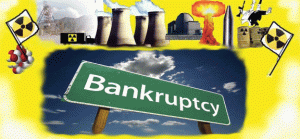 The High Cost of Ignoring Risk https://www.usnews.com/opinion/economic-intelligence/articles/2017-04-06/westinghouse-bankruptcy-shows-cost-of-energy-department-ignoring-risk
The bankruptcy of a company in the midst of building two nuclear reactors could leave taxpayers on the hook. By Ryan Alexander |April 6, 2017, Last week, Westinghouse Electric Co. announced that it will be filing for bankruptcy. Westinghouse, a subdivision of Toshiba Corporation, is in the process of building two AP1000 nuclear reactors for a power plant known as Plant Vogtle in Georgia. In fact, Westinghouse is bankrupt largely because of Vogtle. The project is a mess, and thanks to the $8.3 billion worth of loan-guarantees federal taxpayers have put into the project, courtesy of the Department of Energy, we are the ones who are going to take the hit if the whole things goes belly up.
In 2008, when the project originally applied for a federally backed loan guarantee, it was estimated that the two reactors under construction would begin commercial operation in April 2016 and 2017, respectively, and cost $14.3 billion. Instead of being completed this month, the project is less than halfway done, more than 39 months behind schedule, and at least $3.3 billion over budget. Now this.
The Title XVII program at the Energy Department provides broad authority for it to guarantee loans for early commercial use of advanced technologies if there is a “reasonable” prospect of repayment by the borrower. Loan guarantees are like cosigning a loan. The government (taxpayers) are on the hook for repayment of the loans if the borrower defaults. Building a nuclear reactor – two nuclear reactors – is expensive and risky.
The amount of risk represented by a particular loan guarantee is measured in the project’s “
subsidy cost.” The higher the risk, the higher the cost that gets assigned to the guarantee. You would think a loan guarantee for a nuclear power plant – the riskiest project of all – would be assessed a pretty high price. It should have been. But the Energy Department guaranteed at least $6.5 billion of the $8.3 billion total
at a cost of $0. That is, it recorded
no potential liabilities for its guarantee of more than $6 billion in loans for the construction of two nuclear power plants.
What is even more maddening is that the inexplicable decision to pretend like there was no risk in the Vogtle project was made knowing that for years the project has been beset by problems. From mispoured cement in one of the reactor’s foundation to poorly constructed reactor parts, the project began hitting snag after snag. Deadlines were missed and costs mounted. The three major credit ratings agencies eventually downgraded the creditworthiness of all of the project partners. If taxpayers end up forking over billions of dollars to pay off Westinghouse’s loans, we can’t say we didn’t see it coming.
While this might mean huge losses for taxpayers, the real tragedy is that financial entanglement with the project could have been avoided altogether. It’s not clear what the Department of Energy can do now to mitigate the potential for losses. In the end, the Vogtle mishap could be a very expensive way to learn what we should have known all along – the federal government cannot ignore risk when taxpayers’ money is on the line.
April 8, 2017
Posted by Christina Macpherson |
business and costs, politics, USA |
Leave a comment
 Edison agrees to negotiate new home for San Onofre plant’s nuclear waste. EIN NewsDesk, 7 Apr 17, Jeff McDonald,
Owners of the failed San Onofre nuclear plant agreed Friday to begin negotiations aimed at relocating tons of radioactive waste from the San Diego County coastline.
The announcement came in the form of a brief filed in San Diego County Superior Court, where a showdown hearing was looming next week between majority plant owner Southern California Edison and environmentalists who want the spent fuel shipped off-site.
The change of heart is significant for Edison, which has long said that storing 3.6 million pounds of nuclear waste on the grounds for decades to come is a safe and reasonable option.
Edison and San Diego attorney Michael Aguirre, who filed the lawsuit that led to the settlement negotiations, declined to comment beyond a single-page joint news release.
Advocacy groups opposed to the burial plan were thrilled with the announcement.
“That’s huge,” said Charles Langley of Public Watchdogs when told about the deal. “The fact that they are willing to consider moving it is an amazing situation.”
The mutual notice filed in court Friday requests that the judge postpone next week’s scheduled hearing at least until July to provide lawyers from both sides of the dispute time to work out a settlement……….
There was no word Friday on where the spent fuel may end up.
Possible locations include Palo Verde in Arizona, where Edison is part-owner of another nuclear plant; Nevada, where federal regulators have long planned a national repository; or one of a handful of proposed private dumps.
Edison is in the process of moving the San Onofre waste from climate-controlled pools to so-called dry cask storage — steel-lined canisters scheduled to be buried near the shuttered twin reactors north of Oceanside.
The company plans to complete the transfer by 2019 and return the leased property to the federal government as soon as possible.
The Citizens Oversight lawsuit sought an injunction against the Coastal Commission permit, arguing that the location was unsafe because more than 8 million people live within 50 miles of the site.
The plaintiffs also complained that the canisters are subject to leaks, saltwater intrusion, tsunamis and earthquakes. The storage devices Edison is planning to use have been certified by federal regulators for 20 years of use. Critics of the dry-cask plan note that radioactive waste remains dangerous for thousands of years……more http://world.einnews.com/article/375009931/Ps5PTUKu7YV1uQvl?lcf=QMQeMDaQotZLzLzMmdW3i1dNGT2MdIk5fPNm1KjmkUg%3D
April 8, 2017
Posted by Christina Macpherson |
USA, wastes |
Leave a comment
And yet that appears to be precisely what we’re seeing with New York Gov. Andrew Cuomo, a potential 2020 challenger to Trump who until recently had a strong record advocating for the planet.
Most notably, Cuomo as governor banned fracking statewide, which was a huge win for the movement and also recently closed Indian Point nuclear power plant, a move that may have saved the lives of millions of people.
But the goodwill from those arguably heroic acts has evaporated because of another Cuomo directive that’s causing problems nationwide, but has barely made headlines outside New York.
Last year, Cuomo quietly ordered New York’s Public Service Commission—which regulates energy companies in the state—to slip subsidies into electric bills for all New Yorkers to prop up three aging, unsafe, unprofitable nuclear power plants.
He’s not calling it a tax, but it is and one that will bring in an estimated $7.6 billion over the next 12 years for Exelon, the $34 billion Fortune 100 corporation that operates the plants.
As if handing more than $7.6 billion to a nuclear energy company isn’t outrageous enough, he did it in the name of his otherwise commendable “Clean Energy Standard,” which calls for 50 percent of New York State’s energy to be renewable by 2030, and the reduction of carbon dioxide emissions and other heat-trapping pollutants by 40 percent from 1990 levels.
Unfortunately, the idea to make ratepayers—some of whom have opted into renewable programs for which they’re already paying a premium—subsidize nuclear power plants has spread to other states, with proposals now pending in Ohio, Connecticut, Pennsylvania and New Jersey.
Meanwhile, Illinois, where Exelon is located, had repeatedly fought off a similar program. After Cuomo authorized New York’s bailout, however, they approved ratepayer-funded nuclear subsidies in late 2016 to keep two plants there open.
All total, consumers can be on the hook for $3.9 billion in higher bills as a result of these subsidies, according to a Bloomberg analysis.
Cuomo’s decision, and the resulting ramifications nationwide, is a hard blow and environmentalists won’t soon forget it—especially if, as early signs seem to indicate, he runs for the White House in 2020.
After four years of Trump, what this country will need is a president who is both consistent and creative when it comes to the environment. We’ve seen neither of those qualities from Cuomo.
Cuomo has an environmental record with some serious achievements, but if he’s looking to be the next president, he needs to take such bold action again, not support corporate welfare.
There is still time for Cuomo to make this right. Just as he directed New York’s Public Service Commission to include the surcharge tax in the Clean Energy Standard, he can direct them to remove it and build a better, more ambitious plan that relies on energy efficiency and renewables and moves away from nuclear power.
The people and the planet deserve nothing less.
April 8, 2017
Posted by Christina Macpherson |
politics, USA |
Leave a comment
Déjà vu all over again: Heartland Institute Peddling Misinformation to Teachers about Climate Change http://blog.ucsusa.org/brenda-ekwurzel/deja-vu-all-over-again-heartland-institute-peddling-misinformation-to-teachers-about-climate-change
BRENDA EKWURZEL, SENIOR CLIMATE SCIENTIST | APRIL 7, 2017 I have had the thrill of sharing the latest discoveries in the classroom with students who asked probing questions, when I was a faculty member of a University. That journey of discovery is one that parents and family members delight in hearing about when students come home and share what they have found particularly intriguing.
What if the information the student shared was not based on the best available evidence? Misinformation would begin to spread more widely. If corrected, the student might distrust the teacher who may have not known the source material was compromised.
This scenario is not fiction. It has happened and may still be occurring in some U.S. schools. Anyone concerned about this can learn more with an update forthcoming from those who keep track – the National Center for Science Education (NCSE).
According to the NCSE, during October 2013 educators received a packet chock full of misinformation about climate change. The report includes an abbreviation that looked similar to a highly respected source – the Intergovernmental Panel on Climate Change (IPCC) – for international climate assessments.
It has happened again (starting in March 2017). Many teachers found a packet in their mailbox with a report from the same group that spread the misinformation back in October 2013. This report has a “second edition” gold highlight with a cover image of water flowing over a dam and a misleading title.
The report runs counter to the agreement among scientists who publish on climate change in the peer-reviewed scientific literature. More than 97% of scientists agree that climate change is caused by human activities
The Heartland Institute is infamous for its rejection of climate science and unsavory tactics. According to a reported statement by the CEO of Heartland Institute, they plan to keep sending out copies to educators over the weeks ahead.
If you see any student or teacher with this report or DVD please let NCSE know about it and share what you have learned to help stop the spread.
April 8, 2017
Posted by Christina Macpherson |
climate change, secrets,lies and civil liberties, USA |
Leave a comment
 FirstEnergy Corp. gets introduction of the nuclear bailout bill it sought, Crains Cleveland Business,
 By
DAN SHINGLER, 7 APR 17,
FirstEnergy Corp. got the legislation it apparently sought introduced to the Ohio Senate in the form of
Senate Bill 128.
And the company probably got the reaction it expected from various consumer and industrial groups — mostly a chorus of boos.
The bill, which has been introduced by Republican Sens. John Eklund of Geauga County and Frank LaRose of Hudson, would give so-called zero emissions credits to FirstEnergy’s nuclear plants near Perry and Toledo.
If the plants are sold, however, the legislation would reduce the credits through a formula based on the sales price and the revenues it generates for FirstEnergy, unless the company sold the plants out of bankruptcy.
Of course, those credits won’t be spun from straw. They will result in an extra charge on the bills of FirstEnergy’s electricity customers. It would reportedly give the plants an extra $300 million per year in revenue — mostly to help them compete with wind- and natural gas-generated electricity — and cost consumers an extra 5% on their electric bills, or about $57 per year per household.
What’s at stake, the company insists, is nothing less than the future of Ohio’s Perry Nuclear Power Plant and Davis-Besse Nuclear Power Station, if not the future of Akron-based FirstEnergy itself. The plants are having difficulty competing with low-cost natural gas and subsidized wind energy that can encroach on nuclear’s turf.
Not surprising, the legislation was applauded by FirstEnergy, which has been lobbying for its introduction in Columbus for months……..Likewise, the International Brotherhood of Electrical Workers, with members working at FirstEnergy’s nuclear plants, supported the legislation………
But from others, the response was negative.
“Senate Bill 128 is nothing more than another attempt by utilities to force customers to pay above-market prices for electricity … FirstEnergy should not be allowed to prop up its business on the backs of Ohio consumers. While manufacturers support nuclear power as part of an all-of-the-above energy portfolio, Senate Bill 128 is a wolf in sheep’s clothing. We will actively work to oppose this misguided bill,” wrote the Ohio Manufacturers’ Association on Thursday, April 6.
Then came angry retirees.
“Deregulation of the market in Ohio is working,” said AARP state director Barbara Sykes. “Ohioans have the ability to buy power from whoever they want, forcing competitive pricing. This legislation unfairly props up businesses, such as FirstEnergy, who have failed to remain competitive by passing the costs of doing business on to consumers. We are firmly opposed to this for all Ohioans, but especially for those age 50-plus who are living on fixed incomes.”
And, finally, the Ohio Consumers’ Counsel in Columbus — which pegged the cost of the proposed bill at $57 per year for 2 million FirstEnergy customers — gave one of the sternest rebukes.
“What needs to stop is the electric utilities’ dependence, since 2000, on government subsidies — $14.7 billion to date — that have been charged to Ohio families and businesses,” wrote OCC public affairs coordinator Molly McGuire. “Under the legislature’s 1999 vision for benefits from power plant deregulation, Ohioans should not pay more than the market price of electricity on their electric bills.”
Such reactions might be an indication of how steep a climb FirstEnergy has ahead of it if it’s to get the legislation passed. So far, the legislation has no sponsor in the House, where some observers predict it will face obstacles, including from free-market Republicans.http://www.crainscleveland.com/article/20170407/NEWS/170409853/firstenergy-corp-gets-the-nuclear-bailout-bill-it-sought
April 8, 2017
Posted by Christina Macpherson |
politics, USA |
Leave a comment
Another month in UK’s failing new nuclear programme nuClear News No.94 April 2017 The Trump administration is working to find a new owner for Westinghouse, but doesn’t want the Company to fall under Chinese control. The administration is “keenly aware” of the national security implications attached to the sale of the company, and is trying to pre-empt any possible blocking of a deal by making clear at an early stage that the US government would take a tough stance on any significant Chinese role. A US-led deal for even the profitable operations of Westinghouse could be tricky to arrange though. The only US company with substantial nuclear engineering operations is General Electric, through its joint venture with Hitachi, but its technology is different from Westinghouse’s. Westinghouse has close links to China, where it has four of its AP1000 reactors under construction. As part of the deal for those projects, Westinghouse agreed to transfer intellectual property relating to the plants. More than 75,000 No2NuclearPower nuClear news No.94, April 2017 4 documents were handed over to its Chinese customers in 2010 in the first stage of implementing that agreement. (11) http://www.no2nuclearpower.org.uk/nuclearnews/NuClearNewsNo94.pdf
April 8, 2017
Posted by Christina Macpherson |
business and costs, politics international, USA |
Leave a comment
With Westinghouse Bankruptcy, the Nuclear Energy Story Nearly Over The much touted nuclear renaissance is now over. News Click Prabir Purkayastha 07 Apr 2017 With Westinghouse announcing its bankruptcy, India’s pledge to buy at least 10,000 MW as a part of the India US Nuclear Deal and reiterated by Modi last year, should be given a decent burial. Any agreement with Westinghouse now means that India would be bailing out Westinghouse and the US nuclear industry with Indian peoples’ money.
This also draws to a close all talk about a nuclear renaissance. The three major reactor manufacturers – Toshiba-Westinghouse, GE-Hitachi and Areva, France – are all in major financial difficulties. Only a fool will still believe their promise that the 3rd generation reactors they are developing – none of which have been successfully commissioned as yet – are either safe or cheap.
The Left’s position during the India US 123 Deal was that it neither served India’s strategic interest, nor made sense in energy terms. It also meant abandoning India’s self-reliant nuclear reactor industry for importing costly and unproven US reactors. Though it failed to stop the 123 Agreement in Parliament, the Left successfully led the struggle to modify India’s Nuclear Liability Act, ensuring that nuclear suppliers, like in any other hazardous industry, should be liable for their faulty equipment.
The Fukushima disaster has shown that a nuclear accident can cost up to $200 billion . Even this could be a conservative estimate. The Indian liability law caps operator and suppliers’ liability to just $ 407 million (300 million SDR’s). Though cost of a reactor is in billions of dollars, even this small liability, only a fraction of its cost, was perceived to be too “dangerous” and unacceptable to the US suppliers.
Last year, Modi, announced during one of his US visits that not only would India buy US reactors, a continuation of the assurance given by Shivshankar Menon, the Foreign Secretary under Manmohan Singh (Letter September 10th, 2008 ), but would also assume the liabilities of the US suppliers in case of of a nuclear accident. India offered Mithi Virdi in Gujarat to Westinghouse and Kovvada in Andhra to GE as the two sites. Subsequently on GE’s failure to show any successful contract combined with local resistance in Mithi Virdi, GE’s project was considered cancelled, and its Andhra site offered to Westinghouse.
Fortunately for India, Modi’s assurances have come too late for the US nuclear industry. The much touted nuclear renaissance is now over. In OECD countries, only 7 new reactors are being built with varying degrees of state support. With huge cost and time overruns, the curse of the nuclear industry, all of them are in deep trouble. GE, unsuccessful in selling even one of its so-called advanced design, has virtually pulled out of the nuclear business. After huge and continuing losses, Areva, the French reactor supplier, is being taken over by EdF, the French state-owned energy utility. EdF has already scrapped the new Areva EPR design, with which the Finnish Olkiluoto and French Flamanville plants were being built. This is also the design Areva is trying to sell for the Jaitapur project in Maharashtra.
The major objections of the Left regarding imported reactors have been proven correct. The untried and untested designs have meant numerous changes and difficulties in construction, leading to significant delays and sharp increase in costs. The cost of the two Areva plants of Euro 3 billion each originally, have increased by almost three times .
The Westinghouse story is no different………
In the exchanges between the UPA and the Left during Manmohan Singh’s government, the cost of new nuclear plants from French or US suppliers had come up. The UPA had presented figures for capital cost per KW of $1,500 and the price of power to be Rs. 1.49 paise per unit from imported nuclear plants. The Left had given figures from Olkiluoto and the US, showing that the capital cost would be at least $4,000 per KW and the price of electricity from such plants around Rs. 5 per unit.
The figures from the US and French projects now show that the capital cost per KW for such plants is in the range of $6,000-7,000, and therefore the price per unit of electricity from such plants will not be less than Rs. 8-10 per unit.
Why did the UPA claim such absurdly low figures for nuclear energy? They were either figments of their imagination or took these figures straight from the promotional material of the nuclear suppliers. To claim nuclear energy to be competitive, the nuclear suppliers took a 60-year life of the plant, left out the interest on capital during construction as a component of the cost, and claimed their new designs had much lower capital costs. They then did what are called levellised cost calculations – the cost of electricity over the lifetime of the plant. By this sleight of hand, they reached figures for the cost of nuclear power to be competitive with coal and gas.
Of course, the actual capital costs are much higher than what the nuclear industry was claiming. The regulators and utilities that price the electricity, have also to look at all the cost components including cost of capital, interest on loans, etc., and fix the price that of electricity. What matters to consumers and utilities (distribution companies or state electricity boards) is not the levellised cost of electricity, but the entry cost of nuclear power to the grid. This is what needs to be competitive to other sources. Any such calculations shows that nuclear energy is simply not competitive.
The collapse of Westinghouse, which has either built or licensed its designs to almost half the world’s reactors, shows that the nuclear story is nearly over. The reality is that with the cost of renewables – solar photovoltaics and wind – dropping sharply, the economics are increasingly against nuclear energy. This is apart from danger of catastrophic accidents or danger from long-term storage of radioactive nuclear wastes. It may still sustain itself for some time in countries, where there is a strong indigenous nuclear industry, such as India, China, Korea and Russia. But its days are now clearly numbered. http://www.newsclick.in/westinghouse-bankruptcy-nuclear-energy-story-nearly-over
April 8, 2017
Posted by Christina Macpherson |
business and costs, India, politics, politics international, USA |
Leave a comment
U.S. strikes Syrian military airfield in first direct assault on Bashar al-Assad’s government [following US-backed ‘rebel’ chemical false flag] WP, 06 April 2017 | The U.S. military launched approximately 50 cruise missiles at a Syrian military airfield late on Thursday, in the first direct American assault on the government of President Bashar al-Assad since that country’s civil war began six years ago. The operation, which the Trump administration authorized in retaliation for a chemical attack killing scores of civilians this week, dramatically expands U.S. military involvement in Syria and exposes the United States to heightened risk of direct confrontation with Russia and Iran, both backing Assad in his attempt to crush his opposition.
April 7, 2017
Posted by Christina Macpherson |
Syria, USA, weapons and war |
Leave a comment
What specifically makes this new plan different from the operations of administrations past is the new autonomy it gives the military from civilian control, not only in terms of congressional oversight but also in terms of presidential direction.

Trump’s dangerous expansion of executive war powers For decades, Congress has relinquished its constitutional role in declaring war. But Trump is taking it to new extremes. Politico, By BONNIE KRISTIAN 04/03/17 With Washington distracted by the health care debate, President Donald Trump has quietly overseen an expansion in the administration’s war-making powers, giving the Department of Defense greater autonomy to conduct military operations independent of the White House.
Already, the Pentagon has used this expanded authority in Yemen, where the U.S. has recently conducted significant air operations against AQAP, an Al Qaeda offshoot. And on Friday, Trump extended the authority to parts of Somalia where the U.S. is targeting Shabab, a terrorist group. In military terms, Yemen and Somalia are now “areas of active hostility,” a bureaucratic way of saying that the U.S. is conducting military operations there, with little input or oversight from either the White House or Congress.
This expanded bombing campaign, though, could be just the tip of the iceberg. In early March, The Guardian reported that the White House is considering a secret Pentagon proposal to designate temporary areas of active hostility in which the military could launch what amounts to six-month wars without congressional approval. Under the proposal, once the president signs off on a temporary battlefield, commanders would be given “the same latitude to launch strikes, raids and campaigns” as they now have in active U.S. warzones like Iraq. Protections for civilians would also be scaled back.
These temporary battlefields, as The Guardian dubbed them, are not exactly new; the Obama administration already applied the label to conflicts in Afghanistan, Iraq, and Syria. But the proposal Trump is considering would expand and formalize that decision, stretching the temporary battlefield designation to cover entire countries in which the United States is technically not at war. Despite the bureaucratic language, Trump’s plan, if implemented, is a flagrant perversion of the Constitution, redoubling the worst excesses of the Obama administration and further undercutting the rule of law.
To understand the recklessness of this proposal, a little history is in order. Though it names the president as “Commander in Chief” of the U.S. military, the Constitution explicitly delegates the power to “declare war” to Congress. The choice of the word “declare” was a careful one, as James Madison’s notes from the Constitutional Convention reveal. Originally written as the power to “make war,” it was amended to communicate that while the executive is permitted “the power to repel sudden attacks” on American soil, it is not allowed to “commence war” independent of the legislature.
George Mason, the “father of the Bill of Rights,” was against “giving the power of war to the Executive, because [it was not] safely to be trusted with it,” Madison records, and Mason supported using “declare” as a means of “clogging rather than facilitating war [and instead] facilitating peace.”…….
With this “temporary battlefields” idea, the White House once again strips Congress of what was left of its responsibility for our military, taking unilateral control of foreign policy for the foreseeable future.
What specifically makes this new plan different from the operations of administrations past is the new autonomy it gives the military from civilian control, not only in terms of congressional oversight but also in terms of presidential direction. In Obama’s scheme, which was already far afield from the constitutional war powers framework, the president and his top national security advisers remained intimately involved in the approval process for U.S. strikes outside of active war zones in Afghanistan, Iraq, and Syria. With the new plan, military commanders would be able to make these decisions independently during 180-day periods. This puts major foreign policy decisions one step further away from congressional influence and civilian control………
this proposal is regression, not reform. It demolishes the last remnants of one our Founders’ most necessary constitutional protections, and it opens the gate to a host of dangerous, imprudent military interventions with no demonstrable connection to U.S. national security interests.
After the last 15-plus years of imprudent executive war-making, what we need is not less oversight of our foreign policy, but more—more open debate about our goals and strategy, more realistic risk analysis, and more careful determination of what political outcomes we can achieve through military force.
Bonnie Kristian is a fellow at Defense Priorities. She is a weekend editor at The Week and a columnist at Rare, and her writing has also appeared at Time Magazine, CNN, Politico, Relevant Magazine, The Hill, and The American Conservative, among other outlets. http://www.politico.com/agenda/story/2017/04/trumps-dangerous-expansion-of-executive-war-powers-000387
April 7, 2017
Posted by Christina Macpherson |
politics, USA, weapons and war |
Leave a comment
 Amazing that they can pretend that this thing is “non profit”. Backed by nuclear lobbyists like Rod Adams, and with board members like Lenka Kollar (Director of Business Strategy at NuScale Power where she is working to bring NuScale’s small modular reactor to market through business plan development)
Generation Atomic asks the public for donations, and if you donate, they’ll supply a shirt for you to publicise the nuclear industry, on the March For Science on 22 April.
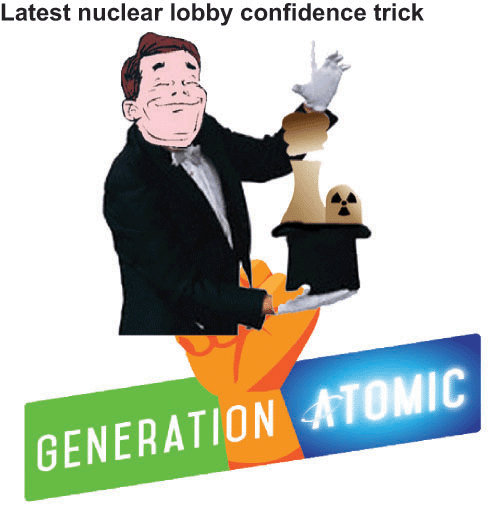
Advocating For Nuclear Energy — There’s An App For That, Forbes, James Conca, 6 Apr 17 There’s a new App that helps you advocate for nuclear energy. Named Atomic Action, it’s from a non-profit grassroots start-up, called Generation Atomic, that specializes in door-to-door canvassing operations and gamifying nuclear advocacy……
The developer, uCampaign, is a pioneer in gamifying advocacy, successfully creating and deploying similar tools for issues and political campaigns in the 2016 elections. Gen A’s team is taking Atomic Action public tomorrow, April 5th. Those interested will be able to download the app beginning tomorrow in Apple’s App Store or the Google Play Store, free of charge…….
When a Gen A volunteer knocks on a door, they present potential supporters with an entirely digital experience on a handheld or mobile device. On the screen are facts about three main benefits of nuclear energy:
– Jobs & Economy
– Affordable Energy
– Environment
Volunteers allow potential supporters to self-select issues through Gen A’s tailored digital platform. Following the conversation, canvassers send the new supporters a text message invitation to download the Atomic Action app.
Supporters even earn points by sharing content, contacting legislators, attending meetings, and recruiting new supporters. The engine for this campaign was rooted at the campuses of the University of Pittsburgh and Pennsylvania State University. Gen A has established two officially-recognized student chapters at each university. Thus far, of the thousands of people Gen A has had a conversation with, 53% sign up to support nuclear…….
The nuclear industry is vilified in the press, scorned by green activists, and ignored by politicians…..But it cannot seem to pierce the unfair image that has been painted by irrational – and baseless – fear……..Above all, the industry must wrest control of the green message.
April 7, 2017
Posted by Christina Macpherson |
spinbuster, USA |
2 Comments

 GOP climate resolution deserves wider support APRIL 5, 2017 PHILLY.COM by John C. Dernbach
It has already been a tough year for those who want bipartisan leadership on climate change.
President Trump’s recent executive order is intended to unwind much of the Obama administration’s work on climate change. Trump wants to cut funding by a third for the Environmental Protection Agency (EPA), which has a major role in reducing greenhouse gas emissions, and he appointed Scott Pruitt, who has openly questioned the reality of climate change, to lead EPA.
But even in the face of hostility for climate action from the Republican leadership in Washington, there are signs of positive change within the party.
Seventeen Republican lawmakers – including Pennsylvania Congressmen Ryan Costello, Brian Fitzpatrick, and Patrick Meehan – just introduced the Republican Climate Resolution. It states that it is “a conservative principle to protect, conserve, and be good stewards of our environment.” It also calls for Congress to commit to economically viable solutions to climate change………
This House resolution on climate change is the latest sign that more Republicans are changing their tune on this and other environmental protection issues. Earlier this year, nine Republicans broke with their party on a vote to repeal an Obama-era rule to protect waterways from coal mining runoff. And 11 Republicans voted against a repeal of a rule to reduce greenhouse gas emissions from the oil and gas industry.
It is little wonder that Republicans are increasingly willing to buck special interests on the issue. Lawmakers are seeing more and more climate change-related impacts in their home districts. The economic opportunities provided by climate action are enormous. And their constituents are calling for solutions.
That is certainly the case in Pennsylvania……….
It was a Republican state senator from Delaware County, Ted Erickson, who sponsored the Climate Change Act of 2008, which calls for state impact assessments and a climate change action plan. A Republican chief justice of the state Supreme Court, Ronald Castille, wrote the 2013 opinion upholding the Environmental Rights Amendment of the Pennsylvania Constitution.
The House resolution does not make specific policy recommendations for preventing future climate disruptions. And more signers are needed before the caucus will have the votes necessary to command the respect it needs. But this is real progress.
Costello, Fitzpatrick, and Meehan recognize that everyone has much to gain if we act on climate change, regardless of political affiliation. Let’s hope they convince more of their GOP colleagues to join them. And those of us who live in other districts represented by Republicans can do our part by asking them to join this resolution.
John C. Dernbach is the commonwealth professor of environmental law and sustainability and the director of the Environmental Law and Sustainability Center at Widener University Commonwealth Law School. jcdernbach@widener.edu http://www.philly.com/philly/opinion/commentary/20170405_Commentary__GOP_climate_resolution_deserves_wider_support.html
April 7, 2017
Posted by Christina Macpherson |
climate change, politics, USA |
1 Comment

 Uranium leaves legacy of contamination for Navajo Nation http://www.heraldextra.com/news/state-and-regional/uranium-leaves-legacy-of-contamination-for-navajo-nation/article_8c4df54f-426c-5647-8779-15049d913308.html Apr 2, 2017 SHIPROCK, N.M. (AP) — For more than a decade, about 20 gallons of uranium-contaminated groundwater have been pumped per minute into a disposal pond from beneath a tailings site on the eastern edge of the Navajo Nation.
April 7, 2017
Posted by Christina Macpherson |
indigenous issues, Uranium, USA, water |
Leave a comment
Careless workers cause flood at Pilgrim nuclear power plant in Plymouth http://www.masslive.com/news/index.ssf/2017/04/operator_error_leads_to_flood.html By Mary Serreze | Special to The Republican on April 04, 2017 Operators at the 45-year-old Pilgrim Nuclear Power Station failed to follow standard procedures last week, causing water to flood into a reservoir at the base of the reactor, reports the Cape Cod Times.
Workers incorrectly opened and shut certain valves, causing water to flood from a massive storage tank to an area of the reactor known as the torus. The torus plays a role in depressurizing and cooling down the reactor in case of a serious accident.
“This was a breakdown in the process that shows lack of adherence to procedure,” according to a spokesman for the Nuclear Regulatory Commission. He said there were no immediate safety concerns.
At noon on Friday, Pilgrim operators were flushing pipes in the reactor’s cooling system in preparation for an upcoming refueling. They opened a valve on the torus without first closing the valve on the water storage tank. Water being drained into the torus, setting off an alarm in the control room.
“This volume of water placed the torus level above the administrative limit for readiness should an unplanned event occur,” a spokesman for plant owner Entergy Corp. told the Cape Cod newspaper. “Station personnel appropriately responded to close the valves and processed and filtered the water from the torus back to the condensate storage tanks.”
Friday’s flood was the second recent serious incident involving operator error. On March 27, workers triggered the wrong switch, causing the temporary shutdown of a coolant injection system that is essential to cool the plant in a severe emergency.
Federal regulators in 2015 labeled Pilgrim as one of the three worst performers in the country and placed under increased oversight for safety violations and unplanned shutdowns.
Soon thereafter, Entergy announced it would close Pilgrim permanently in mid-2019 due to poor market conditions and increased operational costs. The closure will remove 680 megawatts of capacity from the New England power grid.
There have been a number of problems and violations at the aging nuclear power plant in recent years. Pilgrim has reportedly logged $40 million in annual losses.
April 7, 2017
Posted by Christina Macpherson |
incidents, USA |
1 Comment
Since Trump came to power, the American supreme court has now ruled that a government employee does NOT have protection of the first amendment (freedom of speech). Jeff Ruch executive director for Public Employees for Environmental Responsibility (PEER) who describes PEER as a “shelter for battered staff” said government workers have fewer rights with freedom of speech than a incarcerated person in a penitentiary.
If you are wondering what the big picture is in this story, it stifles a whistle blower’s resolve to engender the hidden facts in the safety of nuclear, medicine, air travel or any other industry where the government has their foot in the door. Some people may not give a damn what happens in America but this impacts on every man, woman and child on this planet. https://www.facebook.com/groups/344452605899556/
April 3, 2017
Posted by Christina Macpherson |
civil liberties, USA |
Leave a comment