The Moapa went from suffering at the hands of coal to benefiting from the profits of renewables
Color Lines, Yessenia Funes APR 10, 2017 Tucked between scattered red desert rocks, the Moapa Band of Paiutes dwells on a little over 70,000 acres in southeastern Nevada. It’s a small tribe with a population of no more than 311, but those numbers
haven’t stopped its members from shutting down a giant coal generating station to protect their health and land.
While President Donald Trump is attempting to revive the coal industry, the Moapa Band has proven how dangerous that industry can be to health. Tribal members suffer from high rates of asthma and heart disease, though the tribe’s small size makes it difficult to accurately quantify. The coal-fired Reid Gardner Generating Station sits outside the Moapa River Indian Reservation, just beyond a fence for some tribal members who have had to deal with the repercussions of its air pollution and toxic coal ash waste for 52 years.
“The whole tribe was suffering from it,” says Vernon Lee, a tribal member and former council member who worked at the plant 15 years ago. “It’s just bad stuff. We all knew that.”
Coincidentally, the day after the station last stopped operating (on March 17), the Moapa Band of Paiutes launched the Moapa Southern Paiute Solar Project, the first-ever solar project built on tribal land, in partnership with large-scale solar operator First Solar. Companies started approaching the tribe about leasing its land around the same time their organizing took off, and things essentially fell into place.
Despite all this—and the impending closure of the coal-fired Navajo Generating Station in Arizona, also run by NV Energy and impacting Navajo Nation members who work there or live nearby—President Trump is pushing forth with a coal-first energy agenda……..
the tribe’s prevalence of cardiovascular and respiratory issues are consistent with what is generally caused by air pollution, says C. Arden Pope III, an environmental epidemiologist who currently teaches economics at Brigham Young University but has served on the EPA Science Advisory Board and chairs the EPA Advisory Council on Clean Air Compliance Analysis.
Coal releases heavy carbon dioxide emissions, but it also emits a cocktail of pollutants dangerous to health: sulfur dioxide, nitrogen oxides, mercury, particulates and fly ash that is then placed into nearby ponds. Lee calls them “chemical soup ponds.” These pollutants can lead to respiratory issues, heart problems, as well as neurological and developmental damage.
Pope has examined the health of the Moapa Band. Back in 2012, he attempted to conduct a study on the tribe but was unable to establish conclusive findings because the tribe’s numbers are so small. Then, there was the issue of no valid control group because, as Pope put it, “they all lived so very close to the power plant that…they were all being exposed.”
Still, Pope did collect a lot of data, and the health impacts were enough for him to have a strong opinion about how the generating station was impacting their health: “Do I think that the exposure to air pollution likely had adverse impacts on their health? The answer to that is yes.”
And he says that their high rates of respiratory and cardiovascular issues are in line with greater empirical research on air pollution. Without a conclusive study, however, it was difficult for government officials to take tribal members seriously.
“But we wouldn’t care,” chairwoman Simmons says. “We smelled it and felt it.”
Then, in 2010, they met Vinny Spotleson, who was working with the Sierra Club at that time. That changed everything.
It all started with letters. That’s how tribal members first thought they’d give the EPA and state agencies like the state’s Division of Environmental Protection a piece of their mind. “People wrote [many] letters,” Simmons tells me, adding that they never got a response.
When they met Spotleson in 2010, Simmons realized that they finally had the support needed to be taken seriously by officials. Before then, Simmons says government agencies would shoot back with numbers from air quality reports she and other Moapa people didn’t fully understand. But Spotleson introduced them to lawyers and scientists. From there, all the Moapa had to do was tell their stories. Simmons remembers Spotleson telling her, “Just say how you feel, and they’ll never be able to prove you wrong.”……
with the help of the Sierra Club, the Moapa Band of Paiutes entered into a legal battle against the Bureau of Land Management for approving the expansion project in Moapa Band of Paiutes, et al v. BLM, et al. Part of their campaign involved growing public awareness. The residents in Las Vegas whose homes were powered by the plant had no idea where it was or that it even existed—much less what it was doing to the Moapa.
“We did see a lot of people in the community, in Las Vegas, in southern Nevada, really engaging and making this campaign their own,” says Elspeth DiMarzio, another Sierra Club campaign organizer who worked with the Moapa. “Once they were aware of the issue, they could see that their neighbors in Moapa were suffering because of an energy that they were receiving.”……
the tribe ultimately lost that case in 2013—but they didn’t lose everything.
Legislators introduced Senate Bill 123 in February 2013, which would require certain utilities (like NV Energy, the one behind Reid Gardner) to reduce their coal-based greenhouse gas emissions by eliminating at least 800 megawatts of electricity by 2019 and replacing part of that lost energy with 350 megawatts of renewable energy like solar or wind. This came after these three years of organizing by the Moapa and its allies.
By April, NV Energy gave its support for SB 123. In June 2013, the bill became law—with a stamp of approval from NV Energy and the Moapa.
The plant shuttered for good March 2017…….
The tribe now leases its land to Capital Dyanmics, which owns the Moapa Southern Paiute Solar Project. The plant provided 115 construction jobs for tribal members and employs two permanently as field technicians.
The power goes to Los Angeles, and the tribe receives revenue from leasing their land. But they’ve been discussing and attempting to find bidders for two other solar projects with the thought of launching one that would bring that power into their homes.
They have a new revenue stream and are still deciding on the best way to use it. “We’ve never been in this position before or had these [solar] projects before,” Simmons says. “It’s hard to take off and start spending everything we do have because we want to plan and spend accordingly.”
The Moapa went from suffering at the hands of coal to benefiting from the profits of renewables……http://www.colorlines.com/articles/how-one-small-tribe-beat-coal-and-built-solar-plant
April 12, 2017
Posted by Christina Macpherson |
indigenous issues, renewable, USA |
1 Comment
Why you’ll hear nuclear emergency sirens sounding in N.J., Del. http://www.nj.com/salem/index.ssf/2017/04/why_youll_hear_nuclear_emergency_sirens_sounding_i.html By Bill Gallo Jr. | For NJ.com April 11, 2017 LOWER ALLOWAYS CREEK TWP. — The 70-plus emergency sirens around the Artificial Island nuclear generating complex will be tested Tuesday night, officials say.
The sirens located within the 10-mile radius of the three reactors operated by PSEG Nuclear, are scheduled to sound at 7:20 p.m., according to company spokesman Joe Delmar.
The sirens — 34 in New Jersey and 37 in Delaware –will sound for three minutes. They are part of the alert system that would inform those living near the Artificial Island complex in case of an emergency at one of the nuclear plants.
Parts of Salem and Cumberland counties in New Jersey and in New Castle and Kent counties in Delaware all fall within the 10-mile radius of the plants.
During the siren tests residents are not required to do anything. n an emergency, such as the accidental release of a large amount of radiation, the sirens would alert those living near the generating complex to tune to radio stations WENJ-FM 97.3 or Marine Channel 16 in New Jersey for official information on what steps they should take.
The stations in Delaware include WKNZ-FM 88.7, WDEL-AM 1150, WDDE-FM 91.1, WSUX-AM 1280, WDSD-FM 94.7, WWTX-AM 1290, WSTW-FM 93.7, WDOV-AM 1410, WRDX-FM 92.9, WILM-AM 1450, WJBR-FM 99.5 and Marine Channel 16.
These radio stations are part of the Emergency Alert System.
Depending on the emergency, residents in the 10-mile zone could be directed to shelter in place or evacuate.
Information about what to do in an emergency is also available online. he three reactors operated by PSEG Nuclear at Artificial Island make up the second-largest commercial nuclear complex in the U.S. in terms of power output. Only the Palo Verde complex in Arizona produces more electricity.
Bill Gallo Jr. may be reached at bgallo@njadvancemedia.com.
April 12, 2017
Posted by Christina Macpherson |
safety, USA |
Leave a comment

 Almost Everyone Agrees that the U.S. Strikes Against Syria are Illegal, Except for Most Governments, Opinio Juris, 9 Apr 17, by Julian Ku The blogosphere is now so fast that we can get an enormous sampling of expert opinion in a very short time. So within 24 hours of President Trump’s military strikes on Syria, we have already heard from former Bush State Department Legal Advisor John Bellinger, former Obama State Department Legal Advisors Harold Koh and Brian Egan, former DOJ officials and law profs Jack Goldsmith and Ryan Goodman, as well as numerous law profs and other experts including our very own Deborah Pearlstein and Edward Swaine. The bottom line: Almost everyone (except for Harold Koh) thinks the strikes violate the U.N. Charter and many think it also violates the U.S. Constitution.
Most of what I have to say I said in 2012-13 on this issue, but I am struck by one group of important actors who seem relatively untroubled by the “illegality” of the U.S. strikes under the UN Charter: states. With the notable exception of the Russian government, very few states have come out to criticize the U.S. strikes as a violation of international law. No one is saying it is illegal, but it is striking how few are willing to say it is illegal. I’ve gathered a few statements and links below.
China’s Ministry of Foreign Affairs:……….
France and Germany (President and Chancellor):…….
United Kingdom Defence Minister:…….
European Union, President of European Council:….
Turkey, Deputy Foreign Minister:……
Japan, Prime Minister……
This survey is not comprehensive and some large players, like India, have yet to weigh in. But it seems only Russia and Iran have condemned the strikes vigorously. The general support for the attacks in Europe, the Middle East, along withChina’s acquiescence, seems to show that many states are not very troubled by the violation of Article 2(4) most scholars think has occurred here. Is this because it is a one-off attack? Or does it suggest Article 2(4) has very little pull with many foreign governments these days?
On the domestic US law front, FiveThirtyEight has counted 69 senators have already issued statements supporting the Syria Strikes and while there are critics on constitutional grounds, it doesn’t seem like close to a majority in Congress.
Of course, none of this means that the experts are wrong on the law. But it is at least worth noting the limited impact of the law so far on governmental actors, as the debate on the legality of the Syria Strikes continues. http://opiniojuris.org/2017/04/07/almost-everyone-agrees-that-the-u-s-strikes-against-syria-are-illegal-under-international-law-except-for-most-governments/
April 10, 2017
Posted by Christina Macpherson |
Legal, USA |
Leave a comment
As noted by the Palmer Report, Trump owns stock in Raytheon, which was reported by Business Insider in 2015.
According to Trump’s financial disclosure reports filed with the FEC in 2015, his stock portfolio includes investments in technology firms, financial institutions and defense firms, including Raytheon.
On Thursday, Trump launched an attack on the al-Shayrat military airfield, used by both Syrian and Russian military forces, hitting it with 59 Tomahawk missiles manufactured by Raytheon. Trump’s attack on Syria was reportedly in response to a deadly gas attack launched by Syrian President Bashar al-Assad against his own people earlier in the week.
While the Tomahawk attack did little damage to the airfield — with the Syrian air force continuing to launch assaults from the same base on Friday — investors, sensing an increasing escalation in tensions between two countries and the possibility of war , pushed Raytheon stock up.
Since taking office, Trump has refused to divulge all of his financial information — including his income taxes — and refused to place his business and financial holdings in a blind trust allowing Trump and his family to move money and investments around as they see fit.
April 10, 2017
Posted by Christina Macpherson |
business and costs, politics, secrets,lies and civil liberties, USA |
Leave a comment
 Trump’s Options for North Korea Include Placing Nukes in South Korea, NBC News 7 Apr 17 by WILLIAM M. ARKIN, CYNTHIA MCFADDEN, KEVIN MONAHAN and ROBERT WINDREM
 The National Security Council has presented President Donald Trump with options to respond to
North Korea’s nuclear program — including putting American nukes in South Korea or killing dictator Kim Jong-un, multiple top-ranking intelligence and military officials told NBC News.
Both scenarios are part of an accelerated review of North Korea policy prepared in advance of Trump’s meeting with Chinese President Xi Jinping this week.
The White House hopes the Chinese will do more to influence Pyongyang through diplomacy and enhanced sanctions. But if that fails, and North Korea continues its development of nuclear weapons, there are other options on the table that would significantly alter U.S. policy.
The first and most controversial course of action under consideration is placing U.S. nuclear weapons in South Korea. The U.S. withdrew all nuclear weapons from South Korea 25 years ago. Bringing back bombs — likely to Osan Air Base, less than 50 miles south of the capital of Seoul — would mark the first overseas nuclear deployment since the end of the Cold War, an unquestionably provocative move.
“We have 20 years of diplomacy and sanctions under our belt that has failed to stop the North Korean program,” one senior intelligence official involved in the review told NBC News. “I’m not advocating pre-emptive war, nor do I think that the deployment of nuclear weapons buys more for us than it costs,” but he stressed that the U.S. was dealing with a “war today” situation. He doubted that Chinese and American interests coincided closely enough to find a diplomatic solution………http://www.nbcnews.com/news/us-news/trump-s-options-north-korea-include-placing-nukes-south-korea-n743571
April 10, 2017
Posted by Christina Macpherson |
politics international, South Korea, USA, weapons and war |
Leave a comment
Donald Trump’s decision to launch airstrikes on a Syrian airfield was hailed by many corporate media and foreign policy establishment types, but in addition to the myriad questions surrounding the motivation and constitutionality of Trump’s unilateral action, the ineffectiveness of the strike is becoming the story. According to multiple reports, flights from the airbase resumed on Friday, a day after the strikes.
Trump, true to form, wore that insecurity on his sleeve, and his Twitter feed:….
Democratic Congressman Ted Lieu (D-CA) pointed out that the strikes did “basically nothing” to prevent Assad from launching attacks on civilians. Lieu is part of a growing number of lawmakers on both sides of the aisle who are questioning the efficacy of the Syria strikes, including one of the most vocal boosters of Trump’s decision, Sen. John McCain (R-AZ).
The criticism sparked an absurd response from current Trump National Security Advisor H.R. McMaster, who was pressed by Fox News Sunday host Chris Wallace over the fact that the airbase resumed operations so quickly:……..
Trump has definitely sent a lot of messages with this strike, including to the Russians prior to the strike, to Congress by not seeking their authorization, and to the corporate media by getting them to look away from the Russia collusion investigation. The faintest of these was to Assad, who scarcely has any more incentive to cease his brutality than he did last week. http://shareblue.com/trump-team-on-the-defensive-amid-dem-criticism-of-syria-strikes/
April 10, 2017
Posted by Christina Macpherson |
politics, USA |
Leave a comment
 Nuclear plant owners expand search for financial rescue, http://www.pennlive.com/news/2017/04/nuclear_plant_owners_expand_se.html By Marc Levy | The Associated Press April 09, 2017 HARRISBURG, Pa. (AP) — The natural gas boom that has hammered coal mines and driven down utility bills is hitting nuclear power plants, sending multi-billion-dollar energy companies in search of a financial rescue in states where competitive electricity markets have compounded the effect.
Fresh off victories in Illinois and New York, the nuclear power industry is now pressing lawmakers in Connecticut, New Jersey, Ohio and Pennsylvania for action. Lobbying efforts are bubbling up into proposals, even as court battles in Illinois and New York crank up over the billions of dollars that ratepayers will otherwise foot in the coming decade to keep nuclear plants open longer.
Perhaps nuclear power’s biggest nemesis is the cheap natural gas flooding the market from the northeast’s Marcellus Shale reservoir, the nation’s most prolific gas field. Meanwhile, electricity consumption hit a wall after the recession, while states have emphasized renewable energies and efficiency.
“You put all of this together and it’s a perfect storm,” said John Keeley, a spokesman for the Nuclear Energy Institute, an industry group.
Opposition to a so-called nuclear bailout is uniting rivals and the natural gas exploration industry. The potential for a hit to utility bills is drawing pushback from the AARP and manufacturers.
Subsidizing nuclear power could chill investment in lower-cost energy sources and erode competitive markets, critics say, and, with natural gas prices expected to stay low for some time, shutting down nuclear plants may have no impact on electricity bills.
For steel companies, paper companies, food processors and pharmaceutical makers whose electric bill might be their biggest expense, “a mil of an increase in a kilowatt hour turns into a lot of money,” said David Kleppinger of the Industrial Energy Consumers of Pennsylvania.
In Pennsylvania, the nation’s No. 2 nuclear power state after Illinois, it could mean propping up five nuclear plants to help feed the sprawling mid-Atlantic power grid that stretches from New Jersey to Illinois.
The owners of the 11 nuclear plants in Connecticut, New Jersey, Ohio and Pennsylvania are no small potatoes: Exelon, PSEG, FirstEnergy and Dominion, among them.
The plant owners’ strategy is similar to that in Illinois and New York: give nuclear power megawatts the kind of preferential treatment and premium payments that are given to renewable energies, such as wind and solar.
The industry’s pitch is part economic, part environmental. A plant shutting down would devastate a local economy, they say. And, nuclear waste and water consumption issues aside, zero-carbon nuclear plants are better suited than natural gas or coal to fight climate change, they say.
The claim to environmental credentials has drawn jeers from nuclear power’s traditional critics.
“When did highly carcinogenic toxic waste become green?” said Eric Epstein, a longtime nuclear power watchdog in Pennsylvania.
The most vulnerable nuclear plants are those with just one unit — such as Exelon’s Three Mile Island in Pennsylvania, where a second unit was destroyed in a partial meltdown in 1979 — or those in need of expensive upgrades, analysts say.
FirstEnergy says it could decide next year to sell or close its three nuclear plants — Davis-Besse and Perry in Ohio and Beaver Valley in Pennsylvania — unless states make them more competitive.
Exelon is warning that it could close Three Mile Island and PSEG says it won’t operate nuclear plants — it owns all or parts of all three in New Jersey and part of Peach Bottom station in Pennsylvania — that are long-term money losers.
Should nuclear power disappear, it can be replaced.
“The question is, at what cost and whether or not you can find other resources that have the same emission characteristics,” said Joe Dominguez, an Exelon executive vice president.
In the mid-Atlantic grid, it likely would be natural gas. Some 190 natural gas power projects comprising roughly 59,000 megawatts are being studied or built, according to PJM Interconnection, the grid operator. That dwarfs the grid’s nuclear capacity.
April 10, 2017
Posted by Christina Macpherson |
business and costs, politics, USA |
Leave a comment
 TRUMP’S CONFUSING STRIKE ON SYRIA, If President Trump broadens his aims against Assad, he will enter the very morass that Candidate Trump warned against.New Yorker, By Steve Coll APRIL 17, 2017, “……. despite having previously seen similarly horrifying pictures, Trump had been skeptical of military action in Syria. In 2013, Assad’s forces attacked civilians and rebels near Damascus with sarin, a banned nerve agent, killing more than a thousand people. Trump advised President Obama, via Twitter, “Do not attack Syria. There is no upside and tremendous downside.” (Obama had called Assad’s use of chemical arms crossing a “red line,” which might lead the U.S. to take military action, but he did not strike. Instead, Russia helped broker an agreement by which Assad gave up many—but evidently not all—of his chemical arms.)]
Trump has said, “I’m very capable of changing to anything I want to change to.” In the case of Syria, however, he seems to have acted without a clear plan in place. During the campaign, he promised to “bomb the shit out of” isis, which holds territory in Syria, but he also said that it was foolish to become mired in the civil war, or to target Assad, who has opposed isis—at least, rhetorically.
As recently as March 30th, Secretary of State Rex Tillerson said that Assad’s future would be “decided by the Syrian people,” words that signalled a sharp departure from Obama’s insistence that Assad must leave office. Then, last Thursday, Tillerson seemed to shift direction, saying that “it would seem there would be no role” for Assad in Syria’s political future. But he later said, “I would not in any way attempt to extrapolate that to a change in our policy or our posture relative to our military activities in Syria today.”……..
If President Trump broadens his aims against Assad, to establish civilian safe havens, for example, or to ground Syria’s Air Force, or to bomb Assad to the negotiating table, he will enter the very morass that Candidate Trump warned against. He would have to manage risks—military confrontation with Russia, an intensified refugee crisis, a loss of momentum against isis—that Obama studied at great length and concluded to be unmanageable, at least at a cost consistent with American interests……..
once started, even limited wars upend initial plans and assumptions, violence produces unintended consequences, and conflicts are much easier to begin or escalate than to end.
Canadian, European, and Middle Eastern allies, as well as some sections of the Washington foreign-policy establishment, applauded Trump for his strike, pointing out its narrow scope, and noting that Assad had brought it on himself. Unfortunately, Donald Trump’s continual search for approval seems to contribute to his unpredictability. Perhaps he will soon rediscover his inclination to proceed cautiously in Middle Eastern wars. Given his bombast, his inconsistency, and his preference for gut instinct over policy knowledge, he always seemed likely to be a dangerous wartime President. The worry now is that he will also be an ambitious one. ♦http://www.newyorker.com/magazine/2017/04/17/trumps-confusing-strike-on-syria?mbid=nl_TNY%20Template%20-%20With%20Photo%20(155)&CNDID=46508601&spMailingID=10785187&spUserID=MTcxNTIwODYzMTU2S0&spJobID=1140615112&spReportId=MTE0MDYxNTExMgS2
April 10, 2017
Posted by Christina Macpherson |
politics international, USA, weapons and war |
Leave a comment

 Ohio lawmakers weigh bailout for FirstEnergy nuclear plants, by Associated Press April 9, 2017 TOLEDO, Ohio (AP) – A bailout proposed for Ohio’s two nuclear plants would keep alive a big source of jobs and tax money but end up increasing electricity rates for FirstEnergy Corp.’s customers in the state.
It will be up to the legislature and Republican Gov. John Kasich whether to approve what would amount to a huge subsidy for the plants.
While it’s not known how much FirstEnergy’s rates could go up, the increases would be capped at 5 percent.
Exactly how much the plan would generate for the nuclear plants isn’t clear yet because it’s based on a complex formula that involves plant emissions.
Both New York and Illinois recently approved multibillion-dollar subsidies to stop unprofitable nuclear plants from closing prematurely.
Akron-based FirstEnergy says the subsidies are needed to save the Davis-Besse and Perry plants that sit along Lake Erie and make 14 percent of the state’s electricity. The company has said both might be sold even if the subsidies are approved………http://nbc4i.com/2017/04/09/ohio-lawmakers-weigh-bailout-for-firstenergy-nuclear-plants/
April 10, 2017
Posted by Christina Macpherson |
business and costs, politics, USA |
Leave a comment
 US warns of more Syria attacks during UN Security Council meeting, news.com.au , APRIL 8, 2017 Sarah Blake, in New York, staff writers, wires News Corp Australia Network THE US ambassador to the United Nations has said that the US is prepared to take further action in Syria.
April 8, 2017
Posted by Christina Macpherson |
politics international, USA, weapons and war |
Leave a comment
Experts agree that in limited instances, such as the Syrian missile attack, a president has legal authority provided in the Constitution as commander-in chief.
“Because the air strikes were undertaken by cruise missiles that put virtually no American lives at risk and because the strikes lasted only minutes, the president’s action would seem to be a lawful use of force under the Constitution. Needless to say, if further military actions were to be undertaken, they could rise to the level of requiring congressional authorization.”
 Mark Pocan wrongly claims Donald Trump had no legal authority to launch missile attack on Syria http://www.politifact.com/wisconsin/statements/2017/apr/07/mark-pocan/mark-pocan-wrongly-claims-donald-trump-had-no-lega/ By Tom Kertscher on Friday, April 7th, 2017 The morning after the U.S. cruise missiles assault on a Syrian air base, U.S. Rep. Mark Pocan questioned the legal authority of President Donald Trump to order the attack.
“There is no legal basis for last night’s missile strike against Syrian military assets,” the Madison-area Democrat declared in a statement on April 7, 2017. “Congress must be called back immediately, if President Trump plans to escalate our military involvement. He must send a new Authorization for Use of Military Force (AUMF) to Congress, as I have previously called for.”
The 59-missile assault was launched in retaliation for a chemical weapons attack by the government against Syrian civilians two days earlier. News reports quoted U.S. officials as saying Trump had the right to use force to defend national interests and to protect civilians from atrocities.
Meanwhile, first-term U.S. Rep. Mike Gallagher, R-Green Bay, while praising the “limited strikes,” also said Trump “should seek congressional authorization for any sustained military operation in Syria.”
There’s certainly debate over the extent of a president’s authority to use military force without approval from Congress.
But Pocan went too far in saying there is no legal basis for Trump’s action.
Competing arguments To support Pocan’s claim, his office noted the U.S. Constitution assigns to Congress the power to declare war, and sent us commentary on that provision and the missile attack by the American Civil Liberties Union.
The ACLU reiterated its position that “the decision to use military force requires Congress’ specific, advance authorization.”
Pocan also cited the War Powers Resolution of 1973, which was enacted over a veto by Republican President Richard Nixon. It says “the introduction of United States Armed Forces into hostilities” can be done only “pursuant to a declaration of war, specific statutory authorization, or a national emergency created by attack upon the United States, its territories or possessions, or its armed forces.”
And Harvard law professor Jack Goldsmith, an assistant attorney general under Republican President George W. Bush, argued in 2013 that Democratic President Barack Obama didn’t have unilateral authority to launch attacks against Syria, as was being considered at the time.
Goldsmith said the president’s authority to use force without congressional approval had been extended to protect American persons and property abroad, but that rationale would not have applied to the attacks Obama contemplated (but never carried out).
The Trump administration, meanwhile, also invokes the Constitution (Article 2) in asserting that the president has the power to defend the U.S. national interest.
In this case, that interest is described as “promoting regional stability, which the use of chemical weapons threatens” — which the Trump administration likened to the Obama administration’s justification for using force in Libya in 2011.
Other views
Experts agree that in limited instances, such as the Syrian missile attack, a president has legal authority provided in the Constitution as commander-in chief.
Cameron University history and government professor Lance Janda said he agrees with Pocan’s call for a new congressional authorization for use of force, adding: “We have not declared war on anyone since 1941, and yet we are the most active nation state on the planet when it comes to military action.”
But “having said that,” Janda continued, the Constitution gives the president authority as commander in chief to use force to protect our national interests and War Powers Resolution gives the president “leeway to respond to attacks or other emergencies.”
McGill University professor of international relations Mark Brawley also said the president has authority to use military force in a crisis, but then should notify Congress within 48 hours. The president also should ask Congress for authority to use military force if there will be extended conflict, or for a declaration of war, if the United States will be at war with Syria, he said.
Like the Trump administration, Georgetown University professor Anthony Arend, whose specialties include international relations and constitutional law of U.S. foreign relations, also cited Article 2 of the Constitution and the president’s power as commander-in-chief. He told us:
“While the precise scope of this power is unclear, a strong argument can be made that the president can use force in short military operations — especially where there is minimal risk to American lives — without congressional authorization. Indeed, over the years, Congress has generally acquiesced in such presidential uses of force.
“Because the air strikes were undertaken by cruise missiles that put virtually no American lives at risk and because the strikes lasted only minutes, the president’s action would seem to be a lawful use of force under the Constitution. Needless to say, if further military actions were to be undertaken, they could rise to the level of requiring congressional authorization.”
Added Richard Stoll, an international conflict scholar at Rice University, about the Trump attack: “This is not new.” Stoll said he would advise a president to get congressional approval before taking additional action, but presidents many times have taken a “one-off” action such as the Syrian attack.
Those views correspond to a 2013 fact check of then-U.S. Sen. Joe Lieberman, who said Obama would have had the legal authority to strike Syria without a vote from Congress. PolitiFact National’s rating was True. As our colleagues reported:
- Since the last time Congress declared war, at the beginning of World War II, presidents have generally initiated military activities using their constitutionally granted powers as commander in chief without having an official declaration of war in support of their actions.
- Even under the War Powers Resolution, the president can send in forces without approval from Congress.
- Lower courts have ruled in favor of the White House in the use of force, and the U.S. Supreme Court declined to hear an appeal on that point.
Our rating
Pocan said: “There is no legal basis” for Trump’s “missile strike against Syrian military assets.”
For limited military activities like the missile strike, presidents can send in forces without approval from Congress.
We rate Pocan’s statement False.
April 8, 2017
Posted by Christina Macpherson |
politics, USA |
Leave a comment
Syrian bombing: US and Russia ‘one step away from combat’, Paul McGeoug, The Age, 8 Apr 17, “…..Donald Trump’s response to Tuesday’s sarin gas attack was visceral, heartfelt and entirely understandable. But don’t get carried away – this is the same guy who, when a voter asked about Syrian refugee children coming to the US, during a rally in Mew Hampshire last year, said: “I can look in their faces and say ‘You can’t come.’ I’ll look them in the face.”
But And in contradicting his every tweet on the madness of Washington being drawn into the Syrian civil war, Thursday’s missile barrage raises as many questions as it triggers alarms.
War is theatre – and in this case, audience reaction and the reviews are unsettling. Washington is unbowed. Describing the attack as “a measured step”, US UN ambassador Nikki Haley warned a Security Council meeting on Friday: “We are prepared to do more, but we hope that would not be necessary.” Blasting Syria’s sponsors Russia and Iran, she drew a new red line: “Bashar al-Assad must never use chemical weapons again”.
Moscow is furious. On Facebook, Russian Prime Minister Dimitry Medvedev declared the relationship with Washington to be “completely ruined” and warned that the two countries were just one step away from combat.
And Moscow is doing something about it. Already a dangerous place, the Syrian airspace in which the US and Russian air forces are fighting different wars, became more risky with the Kremlin shutting down a risk-minimising channel, through which both air forces swapped information on their air movements, and “significantly increasing” the risk of confrontation.
Moscow promised too to bolster Syria’s air defences to “protect the most sensitive Syrian infrastructure facilities”. But that prompted analysts to observed that despite a 60 to 90-minute warning of Thursday’s attack, Moscow did not activate its own sophisticated missile defence systems in Syria against the incoming American salvo.
The Chinese are saying little, but no doubt are fuming. Beijing has backed Syria by joining Russia in thwarting action against it in the UN Security Council, and it won’t take lightly how the timing of Trump’s missile strike overshadowed a highly orchestrated Florida meeting between Trump and President Xi Jinping, or the provocative message it sent……..
there’s a danger now that Trump has had this early taste of war – mission creep. There are quibbles in Congress about his failure to seek its authority, but there’s also broad political and media support for his missile strike and given Trump’s desperate need for approval, he’ll be tempted to do more.
“If Mr Assad persists in the use of chemical or biological weapons, it will take extraordinary discipline to avoid falling into an escalation trap that leads from justified punitive strikes to a broader, and riskier, US intervention,” Blinken writes in The New York Times……….
Trump is taking a huge gamble. What was left of his wish for rapprochement with Moscow has been battered; to the extent that there is popular criticism of the attack, much of it is coming from his most ardent fringe-dweller followers; and, despite his endless rhetoric, he might just have delivered the US to the threshold of another Middle East war.
It’s all part of the amazing contradiction of Trump. Skeptics will says that demolition, death and dislocation will continue apace in Syria.
And cynics will wonder about motivation, the President’s historically rotten ratings and a Trump tweet back in October 2012, in which he said: “Now that Obama’s poll numbers are in tailspin – watch for him to launch a strike in Libya or Iran. He is desperate.”
But Trump has sent a signal to the world – he’s got a feel for American military power and he is not afraid to use it. http://www.theage.com.au/world/syrian-bombing-us-and-russia-one-step-away-from-war-20170407-gvgmdw.html
April 8, 2017
Posted by Christina Macpherson |
politics international, USA |
Leave a comment
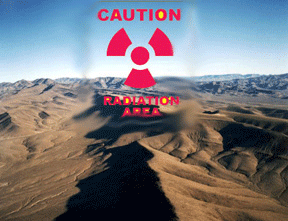 Trump plans to revive nuclear waste plans axed by Obama in 2010 https://www.newscientist.com/article/2127269-trump-plans-to-revive-nuclear-waste-plans-axed-by-obama-in-2010/By Fred Pearce, 7 Apr 17,
The Trump administration last month revived controversial plans to bury the US’s growing stockpile of highly radioactive spent fuel from nuclear power plants and weapons factories in tunnels dug into Yucca mountain in Nevada.
But, with local opposition to the plan axed by President Obama undimmed, scientists at the Department of Energy are already hedging their bets.
They are pursuing an alternative scheme to drop the hot radioactive waste down hundreds of deep shafts across the US, where it can mix with molten granite in the Earth’s crust. Next month, they are expected to announce the site for the first test drilling.
The US currently has some 79,000 tonnes of spent fuel in at least 76 power-station cooling ponds and secure dry stores across the country. Another 2000 tonnes are added each year. The stores contain an estimated 444,000 petabecquerels of radioactivity, which is some 50 times more than released from all atmospheric nuclear weapons tests.
“US spent fuel pools are densely packed and at severe risk of a fuel fire in the event of an earthquake or terrorist attack that drained cooling water from the pools,” says Edwin Lyman of the Union of Concerned Scientists in Washington DC.
Dry air-cooled stores are safer. The Nuclear Regulatory Commission says such stores could act as a stopgap for up to 160 years. But all agree that geological burial is eventually needed for waste that will be dangerous for tens of thousands of years. The question is where?
Desert fuel dump
Yucca Mountain, which is part of the former atomic weapons testing grounds in the Nevada desert near Las Vegas, has for 30 years been earmarked as the sole burial ground for spent fuel, the most dangerous radioactive waste. A tunnel was dug 500 metres into the mountain in the early 1990s.
The plan was to start taking spent fuel in 1998. But local opposition blocked the plan, and some geologists questioned its safety, warning of the risks of local volcanoes erupting magma into the storage tunnels and blasting radioactivity to the surface.
President Obama effectively abandoned the $100-billion project in 2010 by pulling funding for the licensing process. But he failed to find a replacement site, and Washington is already liable for an estimated $30 billion to compensate power companies for its failure to deliver a final burial ground for their waste fuel.
Last month, President Trump asked Congress to approve $120 million to resume licensing for Yucca Mountain. But the state’s governor and senators vowed to continue blocking the plan.
Quietly, since 2010 the Department of Energy (DOE) has established an alternative disposal route. The idea is to bury the spent fuel in hundreds of narrow shafts drilled 5 kilometres down into solid granite.
Up to 40 per cent of the US might have suitable bedrock, but the technique has still to be tested. In December, the DOE selected four companies to find somewhere with the right geology and local support for test drilling.
And last month, at a conference in Phoenix, Arizona, Tim Gunter, the DOE’s head of spent fuel management said he expected to announce a test site in May. One site being discussed is in granite bedrock beneath Haakon County in South Dakota. Others are in Texas and New Mexico.
Fergus Gibb of the University of Sheffield, UK, who first came up with the idea 15 years ago, says the radioactive waste would generate so much heat it would melt the surrounding rock and then slowly solidify into a ”granite coffin”. Yucca may soon be yesterday’s news.
April 8, 2017
Posted by Christina Macpherson |
USA, wastes |
Leave a comment
Hawaii congresswoman says Trump ‘acted recklessly’ with Syria missile strikes https://www.businessinsider.com.au/trump-syria-missile-strikes-reckless-nuclear-tulsi-gabbard-2017-4?r=US&IR=T BRYAN LOGAN APR 7, 2017 Rep. Tulsi Gabbard of Hawaii torched President Donald Trump on Thursday night over his decision to launch a missile strike against airfields in Syria.
Gabbard said Trump “acted recklessly” in authorizing the strikes on Shayrat airfield and nearby military infrastructure controlled by Syrian President Bashar al-Assad. The operation was a response to a chemical weapons attack that killed at least 80 civilians in northwestern Syria earlier this week.
Gabbard said: “It angers and saddens me that President Trump has taken the advice of war hawks and escalated our illegal regime change war to overthrow the Syrian government.” The Democrat congresswoman made similar remarks after returning from a trip to Syria days after Trump’s inauguration.
Gabbard called the strike “short-sighted,” and said it would lead to “more dead civilians, more refugees … and a possible nuclear war between the United States and Russia.”
Her statement represents one of the strongest condemnations of Trump’s strike order, and a departure from a bipartisan group of congressional lawmakers who cautiously applauded the commander-in-chief’s action late Thursday night.
Read Rep. Gabbard’s full statement below:
“It angers and saddens me that President Trump has taken the advice of war hawks and escalated our illegal regime change war to overthrow the Syrian government. This escalation is short-sighted and will lead to more dead civilians, more refugees, the strengthening of al-Qaeda and other terrorists, and a possible nuclear war between the United States and Russia.
This Administration has acted recklessly without care or consideration of the dire consequences of the United States’ attack on Syria without waiting for the collection of evidence from the scene of the chemical poisoning. If President Assad is indeed guilty of this horrible chemical attack on innocent civilians, I will be the first to call for his prosecution and execution by the International Criminal Court. However, because of our attack on Syria, this investigation may now not even be possible. And without such evidence, a successful prosecution will be much harder.”
April 8, 2017
Posted by Christina Macpherson |
politics, USA |
Leave a comment
 Seven Lessons From Trump’s Syria Strike, The Atlantic, DAVID FRUM, 7 APR 17
The attack raises a series of questions about the president’s approach to America’s political processes and institutions. When the Electoral College elevated Donald Trump to the presidency, it conferred on him the awesome life-and-death powers that attend the office. It was inevitable that President Trump would use those powers sooner or later. Now he has. For the effects on the region, I refer you to the powerful piece by The Atlantic’s Andrew Exum. I’m concerned here with the effects on the U.S. political system. Seven seem most immediately relevant.
Trump’s Words Mean Nothing
If there was any one foreign policy position that Donald Trump stressed above all others, it was opposition to the use of force in Syria. Time has helpfully compiled Trump’s tweets on the subject dating back to 2013. For example:
April 8, 2017
Posted by Christina Macpherson |
politics, USA |
Leave a comment