22 MAY 2017 Shortly after news broke that Devon Arthurs, an 18-year-old Muslim convert and former white supremacist, killed two of his friends for attacking his new faith, more details have been revealed surrounding the murders.
According to the Miami Herald, Brandon Russell, Arthurs’ roommate, was in possession of multiple materials meant to build explosives, including a lethal bomb-making chemical named hexamethane triperoxide diamine. FBI and Tampa Police Department officers found the materials in Russell’s garage.
Russell was arrested on May 21 during a traffic stop in Key Largo, and police have not yet revealed why he was pulled over or what he was doing in the Florida Keys.
While in Russell’s bedroom, devices used by police bomb technicians alerted to the presence of radiation sources — thorium and americium.
Russell returned home from National Guard duty on May 19 to find that Arthurs had killed their friends. It’s unclear whether the bomb was intended for Arthurs’ or for another person or group.
Russell is an admitted “national socialist,” the name of the Adolf Hitler’s party that was soon shortened to “Nazi” during the lead-up to World War II.
The Herald also reports that Russell is a member of a group called “Atomwaffen” (meaning “atomic weapon” in German.) The group has been promoted by the white supremacist Daily Stormer website since last year. The racist site praised the group for holding a protest during “a homo vigil for the victims of the Orlando nightclub shooting.”
In January, RadarOnline reported that the group’s leader was a nuclear physics student who was “trying to encourage members to conduct an attack similar to Timothy McVeigh‘s strike in Oklahoma City.”
Police reportedly found a framed photo of Oklahoma City bomber Timothy McVeigh in Russell’s bedroom. It is believed that he learned to manufacture explosives while at the University of South Florida, where he was a member of the engineering club.
According to the Chicago Maroon, the Atomwaffen Division group has described itself as a “very fanatical, ideological band of comrades who do both activism and militant training. Hand to hand, arms training, and various other forms of training. As for activism, we spread awareness in the real world through unconventional means.”
How New York Is Building the Renewable Energy Grid of the Future, This is a story of ripping up old incentives that encouraged selling as much electricity as possible, then unleashing the entrepreneurs. BY LESLIE KAUFMAN, INSIDE CLIMATE NEWS MAY 25, 2017 New York State is making a $5 billion bet that by making its power cleaner, it can become a magnet for the clean energy jobs of the future.
Its efforts stand out among the many states racing to integrate more renewables into their power grids—such as Massachusetts, Hawaii and California—not necessarily for the technology but because of what’s happening behind the scenes: New York has launched a Herculean effort to turn around an antiquated system that has deterred innovation for generations by rewarding utilities for selling more electricity.
To get utilities to embrace a changing electricity system, the state is establishing ways for the companies to be reimbursed for some of the savings from energy efficiency programs that are reducing demand for their services. It also is allowing them to reap more return on their investments in equipment needed to bring more renewable energy into the grid. And it is investing in entrepreneurs who are inventing the technology to make it all work.
The state is so gung-ho that its rules require utilities to come up with demonstration projects that test out a new business model, in partnership with at least one private sector company.
The result, say the state’s regulators, is that New York is already attracting hundreds of innovative companies of all stripes. The plum opportunities are not only in installing wind turbines and solar panels, which are generating new employment opportunities across the country, they are also in emerging technologies related to smart grid management and storage. These jobs are largely invisible to the public and, in some cases, didn’t even exist a few years ago……..
Incubating Clean Energy Innovation
Three years ago, New York announced that it would spend $5.3 billion toward meeting its goal of having 50 percent of its electricity come from renewable sources by 2030. (The state only had 24 percent renewable generation in state this year.) Mandates related to these standards have resulted in significant additions of wind and solar to the grid—but that is just the most readily visible part of the changes New York is undergoing.
According to Richard Kauffman, the state’s chairman of energy and finance, it didn’t take long to figure out that “New York cannot cost effectively make this transition just by bolting wind and solar onto the grid of Westinghouse and Tesla,” referring to two of the original creators of the grid, George Westinghouse and Nicola Tesla. Instead, New York wants a new “hybrid grid” that integrates intermittent and distributed resources like wind or solar or microgrids……… https://insideclimatenews.org/news/24052017/new-york-renewable-energy-electrical-grid-solar-wind-energy-coal-natural-gas
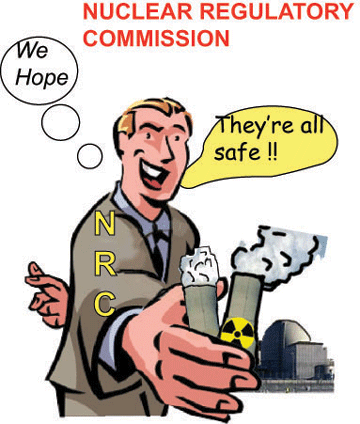
US nuclear regulators greatly underestimate potential for nuclear disaster Nuclear spent fuel fire could force millions of people to relocate https://www.eurekalert.org/pub_releases/2017-05/puww-unr052317.phpPRINCETON UNIVERSITY, WOODROW WILSON SCHOOL OF PUBLIC AND INTERNATIONAL AFFAIRS, 25 May 17, PRINCETON, N.J.–The U.S. Nuclear Regulatory Commission (NRC) relied on faulty analysis to justify its refusal to adopt a critical measure for protecting Americans from the occurrence of a catastrophic nuclear-waste fire at any one of dozens of reactor sites around the country, according to an article in the May 26 issue of Sciencemagazine. Fallout from such a fire could be considerably larger than the radioactive emissions from the 2011 Fukushima accident in Japan.
Published by researchers from Princeton University and the Union of Concerned Scientists, the article argues that NRC inaction leaves the public at high risk from fires in spent-nuclear-fuel cooling pools at reactor sites. The pools — water-filled basins that store and cool used radioactive fuel rods — are so densely packed with nuclear waste that a fire could release enough radioactive material to contaminate an area twice the size of New Jersey. On average, radioactivity from such an accident could force approximately 8 million people to relocate and result in $2 trillion in damages.
These catastrophic consequences, which could be triggered by a large earthquake or a terrorist attack, could be largely avoided by regulatory measures that the NRC refuses to implement. Using a biased regulatory analysis, the agency excluded the possibility of an act of terrorism as well as the potential for damage from a fire beyond 50 miles of a plant. Failing to account for these and other factors led the NRC to significantly underestimate the destruction such a disaster could cause.
“The NRC has been pressured by the nuclear industry, directly and through Congress, to low-ball the potential consequences of a fire because of concerns that increased costs could result in shutting down more nuclear power plants,” said paper co-author Frank von Hippel, a senior research physicist at Princeton’s Program on Science and Global Security (SGS), based at the Woodrow Wilson School of Public and International Affairs. “Unfortunately, if there is no public outcry about this dangerous situation, the NRC will continue to bend to the industry’s wishes.”
Von Hippel’s co-authors are Michael Schoeppner, a former postdoctoral researcher at Princeton’s SGS, and Edwin Lyman, a senior scientist at the Union of Concerned Scientists.
Spent-fuel pools were brought into the spotlight following the March 2011 nuclear disaster in Fukushima, Japan. A 9.0-magnitude earthquake caused a tsunami that struck the Fukushima Daiichi nuclear power plant, disabling the electrical systems necessary for cooling the reactor cores. This led to core meltdowns at three of the six reactors at the facility, hydrogen explosions, and a release of radioactive material.
“The Fukushima accident could have been a hundred times worse had there been a loss of the water covering the spent fuel in pools associated with each reactor,” von Hippel said. “That almost happened at Fukushima in Unit 4.”
In the aftermath of the Fukushima disaster, the NRC considered proposals for new safety requirements at U.S. plants. One was a measure prohibiting plant owners from densely packing spent-fuel pools, requiring them to expedite transfer of all spent fuel that has cooled in pools for at least five years to dry storage casks, which are inherently safer. Densely packed pools are highly vulnerable to catching fire and releasing huge amounts of radioactive material into the atmosphere.
The NRC analysis found that a fire in a spent-fuel pool at an average nuclear reactor site would cause $125 billion in damages, while expedited transfer of spent fuel to dry casks could reduce radioactive releases from pool fires by 99 percent. However, the agency decided the possibility of such a fire is so unlikely that it could not ustify requiring plant owners to pay the estimated cost of $50 million per pool.
The NRC cost-benefit analysis assumed there would be no consequences from radioactive contamination beyond 50 miles from a fire. It also assumed that all contaminated areas could be effectively cleaned up within a year. Both of these assumptions are inconsistent with experience after the Chernobyl and Fukushima accidents.
In two previous articles, von Hippel and Schoeppner released figures that correct for these and other errors and omissions. They found that millions of residents in surrounding communities would have to relocate for years, resulting in total damages of $2 trillion — nearly 20 times the NRC’s result. Considering the nuclear industry is only legally liable for $13.6 billion, thanks to the Price Anderson Act of 1957, U.S. taxpayers would have to cover the remaining costs.
The authors point out that if the NRC does not take action to reduce this danger, Congress has the authority to fix the problem. Moreover, the authors suggest that states that provide subsidies to uneconomical nuclear reactors within their borders could also play a constructive role by making those subsidies available only for plants that agreed to carry out expedited transfer of spent fuel.
“In far too many instances, the NRC has used flawed analysis to justify inaction, leaving millions of Americans at risk of a radiological release that could contaminate their homes and destroy their livelihoods,” said Lyman. “It is time for the NRC to employ sound science and common-sense policy judgments in its decision-making process.”
The paper, “Nuclear safety regulation in the post-Fukushima era,” was published May 26 in Science. For more information, see von Hippel and Schoeppner’s previous papers, “Reducing the Danger from Fires in Spent Fuel Pools” and “Economic Losses From a Fire in a Dense-Packed U.S. Spent Fuel Pool,” which were published in Science & Global Security in 2016 and 2017 respectively. The Science article builds upon the findings of a Congressionally-mandated review by the National Academy of Sciences, on which von Hippel served.
The truth about the Hanford tunnel collapse https://www.chinadialogue.net/article/show/single/en/9796-The-truth-about-the-Hanford-tunnel-collapse?mc_cid=0377d1b344&mc_eid=da6e209b80West coast radioactive leak highlights US crumbling nuclear facilities, writesJan McGirk17.05.2017 On May 9th, emergency sirens went off at the Hanford Nuclear Reservation in Washington State, long considered the most toxic nuclear waste storage site in the United States. It’s where highly radioactive equipment from early nuclear weapon manufacturing was dumped along with the reactor fuel and core debris retrieved from the Three Mile Island meltdown in 1979.
Technicians reportedly noticed an unusually elevated level, roughly comparable to an x-ray exposure, while monitoring radiation at the decommissioned Plutonium Uranium Extraction (PUREX) Plant. This safety check, done before workers were due to start scheduled maintenance work, was fortuitous.
The cause of the small radiation spike was startling: a 20-foot section of the roof had caved in on an old storage tunnel adjacent to the PUREX plant. Inside were eight railway cars loaded with contaminated equipment from the 1950s.
Soil from a thick berm built over the tunnel fell directly into the hole and helped tamp down any radioactive dust. But managers could not determine exactly when the damage occurred. Aerial photos from March 2017 showed no sign of any impending collapse, but analysts worried that the hole might have been there for four days before anyone noticed.
Initially, nearly 5,000 Hanford employees were ordered to shelter in place and avoid eating and drinking, while a no-fly zone was temporarily declared over the facility. Since then, federal and state officials have repeatedly stated that no airborne release of radiation has been detected, although not all their monitoring data has been released to the public yet. Emergency crews in protective gear filled in the breach with 54 truckloads of clean sand and soil. An enormous plastic tarp, weighted with concrete blocks, will reinforce the roof repair until a more permanent fix is devised. “We could have an additional collapse of that tunnel,” cautioned Doug Shoop, manager at the Department of Energy Richland Operations Office. This was quite a close call.
Public information
Breaking news about the damaged tunnel in Washington state was carried widely on US television, radio, newspapers, and online, but was not particularly prominent amid all the political turmoil being reported out of Washington DC.
Official government websites have been posting occasional updates, mostly underwhelming. This may be an attempt to minimise panic over an invisible but potent hazard. To focus on the perils of nuclear decay might reclassify it as a dirty power source and eliminate subsidies.
Former Texas Governor Rick Perry, who once proposed to eliminate the US Department of Energy, now heads it for the oil-friendly Trump administration. “I am pleased to announce that our dedicated and talented team of experts at the Department of Energy’s Hanford site have completed filling in the hole discovered at the PUREX tunnel,” Perry said in a statement.
“This was accomplished swiftly and safely to help prevent any further complications. Our next step is to identify and implement longer-term measures to further reduce risks…Thankfully, the system worked as it should and all are safe. The safety of our workforce, the communities and tribal nations that surround our sites, and the environment is my highest priority.”
A legacy of waste
The Department of Energy is under increasing pressure to shift spent fuel away from reactor sites, especially since there already are 14 permanently shut American nuclear generating stations.
Out of the more than 70,000 metric tonnes heavy metal (MTHW) of spent fuel stored in the US, nearly 10% continues to be stored at permanently shut sites. For now, the bulk goes to Hanford.
Twice the size of Singapore, the enormous Hanford site is remote enough to be out of the public eye. The safe storage of ageing radioactive materials in its decaying tunnels is increasingly problematical. Radiation eventually will weaken the structures irreparably, and these improvised tunnels were never meant to be more than a stopgap solution.
Half a century has already passed. But these hot tunnels are only part of the picture. Out of a total of 177 storage tanks at Hanford, at least 67 tanks are leaking radioactive waste. Nearly 475 million gallons of contaminated water has been discharged to the soil. Some contaminants have even trickled into groundwater beneath the Hanford site. More than 80 square miles of groundwater is now dirtier than government groundwater protection standards allow.
One popular idea is to convert the millions of gallons of radioactive sludge into glass logs through a technique called vitrification. These logs are eventually destined for permanent storage deep underneath Yucca Mountain in Nevada. However, a proposed $17 billion vitrification plant for Hanford is fraught with safety concerns ranging from corrosion to explosion.
Meanwhile, the vast Yucca Mountain geological repository for nuclear waste appears to be a slow-starter. Former Nevada Senator Harry Reid, who served as Senate majority leader, blocked it for years. The Government Accountability Office admitted that the closure of Yucca Mountain was for political, not technical or safety reasons. What’s more, a recent GAO report now advises against vitrification, preferring to bind the waste in a cement-like mixture instead. It’s back to the drawing board once again.
Avoidable disaster
Although some 56 million gallons of radioactive sludge is stored here, alarmingly close to the Columbia River, the US$40 billion Hanford cleanup operation has been repeatedly delayed and is not expected to get underway until 2022, finishing in 2060.
For now, management is trying to prevent a catastrophe through manic maintenance. Postponing the inevitable will increase the cleaning charges by several magnitudes. Had things run on schedule, that pesky hole might just have been noticed in time. Meanwhile, hundreds of whistleblowers have come forward over the years to warn of slack safety standards and corner-cutting at Hanford. They have faced many obstacles.
If a future facility could be developed by a new independent organisation with direct access to the Nuclear Waste Fund, which is not subject to political and financial control like the Department of Energy is, there may be a way forward that doesn’t lead to catastrophe. Federal, state and tribal officials need to pursue it urgently.
As Politico reported, Trump’s deputy national security adviser, KT McFarland, gave him a fake 1970s Time magazine cover warning of a coming ice age. The Photoshopped magazine cover circulated around the internet several years ago, but was debunked in 2013. Four years later, McFarland put the fake document in Trump’s hands, and he reportedly “quickly got lathered up about the media’s hypocrisy … Staff chased down the truth and intervened before Trump tweeted or talked publicly about it”.
Second, there were some climate scientists whose research suggested that we could trigger an ice age – if human sulfur pollution were to quadruple. But that didn’t happen. In addition to blocking sunlight (and hence having a cooling effect), sulfur pollution causes other problems like acid rain. So various governments (including America’s) enacted Clean Air Acts to regulate that pollution (quite like the way we should be responding to carbon pollution’s dangerous impacts). Since then, human sulfur pollution has gone down, while carbon pollution has gone way up. The climate scientists weren’t wrong – the scenario they warned could have triggered an ice age didn’t happen because we took action to prevent it.
Third, although we’ve established climate scientists weren’t wrong in the 1970s, even if they had been, so what? Science advances, and we understand how the climate works today much better than we did 40 years ago, as illustrated in this funny video by Adam Levy:
To be blunt, this is a really dumb myth, and it says a lot that about the state of America’s government that the president was suckered into believing it.
KT McFarland is one of Trump’s many unqualified staffers
McFarland, who spouted numerous misleading and bizarre comments during her time at Fox, is so unsuited for her deputy national security adviser position that retired Vice Adm. Robert Harward, an accomplished and decorated Navy vet, refused Trump’s offer to serve as national security adviser because he didn’t want her on his team. McFarland is now slated to be ousted from the National Security Council and nominated as ambassador to Singapore; she has already been “largely sidelined” at the agency
Ironically, Fox News’ Jon Scott interviewed Politico’s Shane Goldmacher about the fake magazine cover story, and noted “The president getting some fake news every once in a while, apparently, from his own staffers.” That fake news of course came from a former Fox News analyst and concerned one of Fox News’ favorite climate myths. In fact, a 2013 study found that Fox News is a major driving force behind climate denial.
Seven Democrats on the House Committee on Science, Space, and Technology wrote Trump a letter expressing concern that he is frequently being fooled by this sort of fake news. The committee members suggested:
TVA’s Nuclear Allegators http://allthingsnuclear.org/dlochbaum/tvas-nuclear-allegators [good graphs] DAVE LOCHBAUM, DIRECTOR, NUCLEAR SAFETY PROJECT | MAY 23, 2017,The Nuclear Regulatory Commission (NRC) receives reports about potential safety problems from plant workers, the public, members of the news media, and elected officials. The NRC calls these potential safety problems allegations, making the sources allegators. In the five years between 2012 and 2016, the NRC received 450 to 600 allegations each year. The majority of the allegations involve the nuclear power reactors licensed by the NRC.
While the allegations received by the NRC about nuclear power reactors cover a wide range of issues, nearly half involve chilled work environments where workers don’t feel free to raise concerns and discrimination by management for having raised concerns.
In 2016, the NRC received more allegations about conditions at the Watts Bar nuclear plant in Tennessee than about any other facility in America. Watts Bar’s 31 allegations exceeded the allegations from the second highest site (the Sequoyah nuclear plant, also in Tennessee, at 17) and third highest site (the Palo Verde nuclear plant in Arizona, at 12) combined. The Browns Ferry nuclear plant in Alabama and the Pilgrim nuclear plant in Massachusetts tied for fourth place with 10 allegations each. In other words, Watts Bar tops the list with a very comfortable margin.
In 2016, the NRC received double-digit numbers of allegations about five nuclear plants. Watts Bar, Sequoyah and Browns Ferry are owned and operated by the Tennessee Valley Authority (TVA). Why did three TVA nuclear plants place among the top five sources of allegations to the NRC?
Because TVA only operates three nuclear plants.
The NRC received zero allegations about ten nuclear plants during 2016. In the five year period between 2012 and 2016, the NRC only received a total of three allegations each about the Clinton nuclear plant in Illinois and the Three Mile Island Unit 1 reactor in Pennsylvania (the unit that didn’t melt down). By comparison, the NRC received 110 allegations about Watts Bar, 55 allegations about Sequoyah, and 58 allegations about Browns Ferry.
TVA President Bill Johnson told Chattanooga Time Free Press Business Editor Dave Flessner that TVA is working on its safety culture problems and “there should be no public concern about the safety of our nuclear plants.” The NRC received 30 of the 31 allegations last year from workers at Watts Bar, all 17 allegations last year from workers at Sequoyah, and all 10 allegations last year from workers at Browns Ferry.
So President Johnson is somewhat right— the public has no concerns about the safety of TVA’s nuclear plants. But when so many TVA nuclear plant workers have so many nuclear safety concerns, the public has every reason to be very, very concerned.
Nuclear plant workers are somewhat like canaries in coal mines. Each is likely to be the first to sense danger. And when nuclear canaries morph into nuclear
Saudis welcome Trump with gold medal, receive arms package, By JULIE PACE and JONATHAN LEMIRE, RIYADH, Saudi Arabia (AP), 21 May 17 — President Donald Trump basked in Saudi Arabia’s lavish royal welcome Saturday as he left behind, at least temporarily, the snowballing controversies dogging him in Washington. Trump rewarded his hosts with a $110 billion arms package aimed at bolstering Saudi security and a slew of business agreements.
“That was a tremendous day, tremendous investments in the United States,” Trump said during a meeting with Crown Prince Mohammed bin Nayef……..
Trump made no substantial remarks on his first day abroad and spent most of his time shuttling between opulent palace ballrooms with the king. The two were overheard discussing natural resources and arms, and Salman bemoaned the destruction caused by Syria’s civil war.
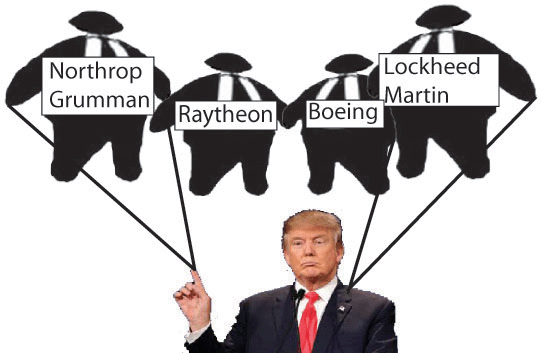
The most tangible agreement between the two leaders was the $110 billion sale of military equipment to Saudi Arabia that is effective immediately and could expand up to $350 billion over 10 years. The deal includes tanks, combat ships, missile defense systems, radar and communications, and cybersecurity technology. The State Department said the agreement could support “tens of thousands of new jobs in the United States.”
Trump was joined on the trip by the CEOs of several major U.S. companies, which announced their own agreements with the Saudis. Among them was a $15 billion arrangement with GE focused on power, oil and gas, and health care.
The president was trailed on the trip by a large number of advisers, including Tillerson, chief of staff Reince Priebus and chief strategist Steve Bannon. Trump’s son-in law, Jared Kushner, and daughter Ivanka, both senior advisers, were also part of the official delegation………https://www.apnews.com/0f8266623c3548e1952525d93011bd56
Possible leak found at Washington nuclear site, NewsFix, MAY 21, 2017, BY CNN WIRE, WASHINGTON — Authorities at Washington state’s Hanford nuclear waste site are investigating a possible leak after discovering radioactive material on a worker’s clothing. The discovery follows an incident two weeks earlier in which a site tunnel collapsed, sparking fears of radiation exposure.
Washington River Protection Solutions, a contractor working at the site, on Thursday detected high readings of radiation on a robotic device known as a crawler that workers were pulling out of a nuclear waste tank. Contamination was also discovered on the clothing of one of the workers.
“Established decontamination procedures were followed, which involves removing the contaminated clothing. Further surveying the worker showed no contamination remained. No other workers were affected, and all members of the crew were cleared for normal duty,” said WRPS spokesman Peter Bengtson.
The Double-Shell Tank AZ-101 contains 800,000 gallons of nuclear waste, according to the Washington Department of Ecology, which oversees the Hanford site. The nuclear plant is located in the south-central part of Washington state, about 45 miles from Yakima.
Using leak-detection instruments, WRPS said it did not find liquid escaping the tank. However, workers are preparing a plan to conduct a visual inspection by video.
Beachfront Nuclear Wasteland in Southern California? Nuclear storage plan at San Onofre beach leaves out tribal voices, Indian Country Today Dina Gilio-Whitaker • May 15, 2017
A controversial plan to temporarily store more than three million pounds of spent nuclear fuel 100 feet from one of Southern California’s most popular beaches, San Onofre, is meeting with fierce resistance from local communities, including tribal members. The problem for the Native population is that while the formal decision-making process systematically involved a wide variety of stakeholders including local and state governments, community groups, environmentalists, academics, military, and business, education, and labor leaders, tribal governments were excluded.
The Backstory
Halfway between Los Angeles and San Diego, and with eight million people living within a 50-mile radius, the San Onofre Nuclear Generating Station (SONGS) looms above what is otherwise a pristine stretch of coastline. It is surrounded by San Onofre State Park, one of the state’s busiest parks, which sits within the Camp Pendleton Marine Base. San Onofre is the traditional territory of the Acjachemen people, who know the area as Panhe. Prior to colonization, San Onofre was also territory shared by the San Luis Rey Band of Mission Indians (Luiseño). Both are state-recognized tribes. All these factors mean there are many different people with strong opinions about nuclear waste storage near their communities.
The aging “nuke plant,” as local residents call it, is owned primarily by Southern California Edison, and was permanently shut down in 2013 after a discovery that it was leaking radioactive gas. It is scheduled for full decommissioning; at issue is how and where to store the accumulated radioactive waste in the short term before a long-term plan can be worked out.
“To the best of our knowledge, our tribal government was never contacted by Edison,” Rebecca Robles, Acjachemen tribal member and co-director of the United Coalition to Protect Panhe, told ICMN. Other local tribal leaders declined to comment……
Spent fuel rods currently stored in cooling pools in SONGS’ two reactors need to be removed to dry storage, which according to studies is safer. SONGS planned to move more than 100 steel casks encased in concrete containers and bury them onsite just 100 feet from the high-tide mark in an area already plagued by erosion. In addition, ocean levels at that site are rising faster than expected, according to a recent study by the U.S. Geological Survey. Google Earth images highlight the reason that residents are so alarmed by the location of the storage, as the San Diego Union-Tribune reported.
With increased awareness of the issue has come increased public criticism. Critics believe burying the waste so close to the beach in an earthquake-prone region is a recipe for disaster, in light of the 2011 Fukushima catastrophe, according to the Orange County Register.
They also believe that the 5/8-inch steel casks that SONGS plans to use are far too flimsy, according to a report by the citizen group San Onofre Safety.
Because SONGS is in the coastal zone it is subject to California Coastal Commission rules, and was granted a permit by the commission to temporarily store the waste for 20 years. In November 2015 the community watchdog group Citizen’s Oversight filed a lawsuit against the Coastal Commission, demanding that the permit be revoked and another site found, Reuters reported. Citizen’s Oversight and the state are now negotiating a settlement, Fox 5 News reported on April 7.
Decisions Made Without Tribal Input……. State law AB 52 requires consultation with tribal governments before it issues permits for development-related projects, prompting questions about why local Native nations weren’t consulted in this case……
It remains to be seen if or how the lawsuit negotiations will affect the location of the waste storage site. No matter what happens, however, this is only the beginning stage of the interim storage at SONGS and there will be a need for the Community Engagement Panel for years to come to monitor the issue. That means there is still plenty of reason for a tribal appointment.https://indiancountrymedianetwork.com/news/environment/beachfront-nuclear-wastelandsouthern-california/
Temporary cover in place over breached Hanford radioactive waste tunnel, BY ANNETTE CARY, acary@tricityherald.com 21 May 17, Heavy plastic was pulled over the top of a Hanford waste storage tunnel on Saturday, helping keep the radioactive contents of the tunnel contained while a more permanent fix is planned.
“Since this event began, our focus has been on protecting our workers, the public and the environment,” said Doug Shoop, manager of the DOE Richland Operations Office. “Installing this cover will provide additional protection as we evaluate other actions to further ensure the safe storage of the waste.”
The approximately 20-by-20-foot breach in the top of tunnel already had been filled with 53 truckloads of sand and soil to prevent any radioactive contamination exposed in the tunnel from becoming airborne……..
It is planned to keep rain from soaking into the eight feet of soil above the tunnel, which would add more weight to the roof. It also should help keep radioactive particles out of the atmosphere should more of the tunnel collapse.
It will be held in place by almost 150 concrete ecology blocks, each weighing 3,800 pounds, and cables from the ecology blocks criss-crossing across the berm.
Blocks had been placed along the plastic on the western side of the tunnel as it was rolled out on Friday. By 5 p.m. Saturday, a crane had placed ecology blocks along a third of the eastern side, with sandbags serving as temporary weights.
Work was expected to continue through Saturday night to place the rest of the blocks. The cable lacings are planned to be added on Monday…….
Next week DOE and CH2M will work with the state Department of Ecology, a Hanford regulator, on additional actions to ensure the safe storage of the waste until a decision is made on permanent disposal of the waste.
Department of Ecology officials have said filling the tunnel with grout is being considered.
SCANA executives have received $3.5 million in bonuses since 2008, according to public records.
The bonuses were awarded during the same time period in which SCANA subsidiary South Carolina Electric & Gas raised electric rates nine times for residential customers, public records show.
Bonuses came as costs have skyrocketed for two AP1000 reactors under construction at the V.C. Summer Nuclear Facility in Fairfax County. SCANA is a 55 percent owner of the reactors; Santee Cooper owns 45 percent.
The reactors are now years behind schedule and at least $2.5 billion over budget, government records show.
Westinghouse, the lead contractor at V.C. Summer, filed for Chapter 11 bankruptcy on March 29. SCANA and Santee Cooper are temporarily assuming costs of construction at V.C. Summer per terms of an interim assessment agreement reached with Westinghouse in April.
SCANA awarded bonuses to executives in 2008-2009 and 2012-2014, according to filings with the Securities and Exchange Commission. Individual bonus amounts ranged $36,600 to $500,000.
The bonuses are in addition to salary and compensation figures appearing in special reports published by the Aiken Standard.
Plant Vogtle: Georgia’s nuclear ‘renaissance’ now a financial quagmire By Russell Grantham and Johnny Edwards – The Atlanta Journal-Constitution May 19, 2017
Southern Company’s chief executive has said more than once that the giant utility’s project to build two more nuclear reactors at Plant Vogtle would be history-making.
He may be right, but not in the way he meant.
Years behind schedule, billions over budget, and with a key contractor’s bankruptcy clouding its future, the troubled Vogtle project near Augusta is fast becoming Exhibit A for why no U.S. utility before Atlanta-based Southern had tried building a new reactor in 30-plus years.
Most Georgians who get electric bills could eventually pay for overruns on the project that are likely to grow. Customers of Southern subsidiary Georgia Power already pay a Vogtle-related surcharge that adds about $100 a year to the average residential bill, with the ultimate effect on ratepayers yet to be determined.
Also uncertain is how the project will get done.
On March 29, Westinghouse Electric, the company that designed the new Vogtle reactors and eventually became the primary contractor on the project, filed for bankruptcy. As part of its Chapter 11 restructuring, the company is expected to ditch the fixed-cost contracts that led to billions in losses on its work at Plant Vogtle and a similar nuclear project in South Carolina.
Under an interim deal announced a week ago, Southern and Georgia Power plan to take over running the Vogtle expansion, which is not quite half-done. Westinghouse will still help, but in a smaller role.
Beyond that they face a more elemental decision: spend billions more finishing the reactors, convert the project to another type of power plant such as natural gas, or just abandon it — leaving two dormant cooling towers and skeletal buildings.
A Georgia Power spokesman said the company is doing a “full-scale” study to “determine the best path forward.”
The utility has acknowledged that Westinghouse’s bankruptcy will mean more delays and costs. The elected members of the Georgia Public Service Commission eventually will determine the actual construction costs to be borne by ratepayers.
Richard Nephew, a senior research scholar at the Center on Global Energy Policy at Columbia University, said the utility underestimated the costs of replacing a vanished industry of nuclear construction workers and suppliers.
……….Westinghouse’s financial meltdown has rattled even the most loyal Plant Vogtle supporters – those living in the shadows of the towers in rural Burke County, population 23,000, who rely on the plant for a stable economy and a flush tax digest……..
History repeats itself
Delays, cost overruns and contractor snarls were not part of the picture government and industry officials painted in 2009 when state regulators approved the project to add the new reactors.
In addition to arguing it was needed to help power Georgia’s growth, Fanning called the Vogtle expansion a “national priority” to help revive the U.S. nuclear power industry. It would be a “renaissance,” he said.
But construction of Plant Vogtle’s first two reactors had provided a vivid example of the potential complications.
Plant Vogtle was conceived around 1970, with an original cost estimate of about $660 million. Construction was expected to take about eight years. Then, Three Mile Island happened. Regulations tightened. Demand for materials and interest rates shot up in the 1980s.
Construction took 13 years. The final price tag: around $9 billion…….
However the Vogtle expansion plays out from here, it won’t likely be held up as the model it was intended to provide.
FirstEnergy CEO Chuck Jones personally went before the Ohio Senate, saying subsidies would prop up their two struggling nuclear plants.
If passed, FirstEnergy customers would see about a $5 increase to their monthly electric bills.
Time might be running out to save these plants. As Jones explains, the subsidiary FirstEnergy Solutions which controls all the power generation could soon declare bankruptcy.
“They’re looking at that right now. That decision could happen anywhere between today and six months from now.”
Jones pointed out that he does not make decisions for FirstEnergy Solutions.
The nuclear credits bill has stalled in the House and Senate and will likely not come back up until the fall.
Ohio House Sidelines Bailout of 2 FirstEnergy Nuclear Plants Opponents are praising a decision to suspend deliberations on a proposed bailout of Ohio’s two nuclear plants, even as Akron-based FirstEnergy continues to push for the deal. US News, May 19, 2017, By JULIE CARR SMYTH, AP Statehouse Correspondent COLUMBUS, Ohio (AP) — Opponents are praising a decision to suspend deliberations on the proposed financial rescue of Ohio’s two nuclear plants, even as Akron-based FirstEnergy continues to push for the deal.
House Public Utilities Chairman Bill Seitz, a Cincinnati Republican, discontinued testimony on legislation containing the proposal Wednesday after vocal protests by consumer, business, and environmental groups and energy competitors.
“I am not sensing a keen desire on the part of the House members to vote on this and doubt that we will have more hearings in the near future unless something cataclysmic should happen,” cleveland.com quoted Seitz as saying.
The plan calls for a special fee charged to customers that the company argues is necessary to secure the future of its aging Davis-Besse and Perry plants. The two facilities produce 14 percent of Ohio’s electricity.
FirstEnergy CEO Chuck Jones took his case to the Ohio Senate on Thursday, testifying for more than an hour before the Senate Public Utilities Committee on separate legislation containing the bailout plan……..
Exactly how much the plan would generate for the nuclear plants isn’t clear because subsidies are based on a complex formula involving plant emissions. Recently approved subsidy deals in New York and Illinois aimed at stopping unprofitable nuclear plants from closing prematurely cost billions.
The Environmental Defense Council has placed the price tag for the Ohio proposal at $5.25 billion. The Ohio Consumers’ Counsel, representing utility ratepayers, calculated the costs to each of FirstEnergy’s 2 million residential customers at $57 a year, on average, for up to 16 years, with the potential that the Public Utilities Commission of Ohio could allow upward adjustments.
Seitz’s decision to sideline the proposal was praised by the Coalition Against Nuclear Bailouts, a group of more than 50 organizations that has joined forces to fight the plan. The coalition includes the Ohio Oil and Gas Association, the Ohio Manufacturers’ Association, associations representing bars, bowling alleys and other small businesses, and a host of local community representatives.
Commissioner Pete Gerken of Lucas County, which includes Toledo, said the proposal would cause families and businesses in FirstEnergy’s territory to “foot the hefty bill.”
“Further, this proposed bailout would pick winners and losers in the energy generation market and could drive private investment, jobs and tax revenues for local governments and schools out of Lucas County and other areas of the state,” he said.
The service said the crew members of the WC-135 nuclear-sniffing aircraft determined the Chinese pilots of the Su-30 jets were being “unprofessional.” The encounter was still under investigation.
“The issue is being addressed with China through appropriate diplomatic and military channels,” Pacific Air Forces spokeswoman Lt. Col. Lori Hodge said in a released statement.
The WC-135 Constant Phoenix is capable of detecting nuclear weapons activity and was deployed last month to Kadena Air Base on Japan’s far southern island of Okinawa as the North Koreans were ramping up missile testing.
Since then, the Trump administration has been looking to China to pressure the regime of Kim Jong Un to give up its ambitions for a nuclear-tipped intercontinental ballistic missile that could reach the U.S. mainland.
However, there is deep friction between China and the U.S. over that country’s territorial claims in the East China Sea, which includes the Korean peninsula and Japan.