What’s Behind Trump’s ‘Baseless Claims’ About Iran’s ‘Nuclear Weapons’, Sputnik, 27 May 17, Commenting on the recent remarks of Donald Trump regarding Iran, which Tehran labelled as ‘Iranophobia’, Iranian political analyst Ali Reza Rezakhah explained to Sputnik Persian what the real purpose behind the comments of the US leader is and who he’s really talking to.
On Monday, US President Donald Trump promised that Tehran will never develop a nuclear weapon.”Iran will never have a nuclear weapon that I can tell you,” Trump told reporters before the meeting with Israeli Prime Minister Benjamin Netanyahu.
Trump’s remarks came the day after the Arab Islamic American Summit was held in the Saudi capital of Riyadh, where the US president said that Iran has been supporting terrorists, militias and extremist groups that spread destruction and chaos across the Middle East.
Tehran was quick to label Trump’s remarks as “Iranophobia,” accusing the US and its leader of “repetitive and baseless claims” about Iran.
“The American president tried to encourage the countries of the region to purchase more arms by spreading Iranophobia,” spokesman for the Iranian Foreign Ministry Bahram Qassemi said a day after the US President finished his trip to Saudi Arabia.
Sputnik Persian sat down with Iranian political analyst and expert in American studies Ali Reza Rezakhah to talk on the war of words between the US administration and the Iranian government.
“Tehran has never voiced its intention to possess any nuclear arms,” Ali Reza Rezakhah reminded Sputnik.
Moreover, he further explained, Iran has announced that the use of any weapons of mass destruction, and nuclear arms in particular, is banned by Islam. A corresponding fatwah (a legal opinion in the Islamic faith) on the ban of stockpiling and use of nuclear weapons has been issued by Iran’s Supreme leader Ayatollah Ali Khamenei.Besides, the peaceful nature of the Iranian nuclear program and the absence of any intentions to possess nuclear arms have been stipulated in the Joint Comprehensive Plan of Action, commonly known as Iran’s nuclear deal.
“Donald Trump’s remarks, therefore, are nothing but pure PR and bait for the mainstream media. The words have been said to please the Israeli Prime Minister,” Ali Reza Rezakhah told Sputnik.
He echoed the words of Bahram Qassemi, saying that Trump’s visit to both Riyadh and Tel Aviv and his rampant remarks are the new wave of “Iranophobia”, which the US leader is trying to spread.
He further noted that regardless his low ratings, Donald Trump might get certain success in his efforts.
“‘Iranophobia’ might become a basis for creation of a new terrorist coalition of an international caliber. And Trump’s visit to Saudi Arabia and Israel come as a proof to it,” he said…….https://sputniknews.com/middleeast/201705271054047376-trump-iranophobia-new-coalition/
May 29, 2017
Posted by Christina Macpherson |
Iran, politics international, USA |
Leave a comment
Blair’s statement echo’s Secretary of Defence Jim Mattis’ recent admission that a fight with the North would be “”tragic on an unbelievable scale.”
 Here’s why the US would have to be absolutely insane to attack North Korea https://www.businessinsider.com.au/us-attack-north-korea-insane-2017-5?r=US&IR=T ALEX LOCKIE, MAY 26, 2017, Despite reports of US and Chinese military buildups, North Korea’s increased pace of provocations, and President Donald Trump’s administration’s repeated claims that “all options are on the table,” — the US would have to be absolutely insane to attack North Korea.
To the untrained eye, the preparations for war are all there.
The US has deployed the world’s most advanced missile defence system to South Korea to protect against ballistic missiles.
The world’s most advanced jets, the F-35, has been sent to Japan.
And the US has sent a carrier strike group, the most powerful unit of naval power in existence, near North Korea’s shores.
The US has permanently stationed 25,000 members of the world’s best organised fighting force right of the North’s borders — and they just finished a massive military exercise.
But even the best systems in the world can’t stop a determined foe with a handful of nukes.
Adm. Dennis Blair, former Director of National Intelligence under Obama, recently told a crowd at the Harvard Club that there’s just no way to safely knock out all of North Korea’s nuclear capabilities in one go. “If I were to run the national intelligence again and the president comes to me and says, ‘Here is General [Jim] Mattis’ strike plan and can you ensure me that this will take out of all the North Korea nuclear capabilities?’ — it won’t be easy to say yes,” said Blair, according to the South China Morning Post.
Blair conceded that before he’d advocate an attack on North Korea, he’d accept it as a nuclear-armed state.
Blair’s statement echo’s Secretary of Defence Jim Mattis’ recent admission that a fight with the North would be “”tragic on an unbelievable scale.”
The US has 2,300 nuclear weapons, any one of which could hit North Korea in a moment’s notice. North Korea may have a dozen or so nuclear weapons, and only the ability to hit a few, close targets within an hour or so of planning.
But it only takes a single nuclear detonation to make conflict unthinkable. Unlike the surgical and virtually unpunished April 7 US strike on a Syrian airfield, North Korean missiles would likely return fire thick and fast.
Experts believe North Korea would probably respond with artillery fire that would light up Seoul and its 10 million residents. Decoy missiles would streak across the sky to overwhelm missile defences. And ground forces would pour in through hidden tunnels.
The US and South Korea would undoubtedly smash North Korean forces in time, but not before a missile touched down, or another catastrophic act of war befell thousands, if not hundreds of thousands, of innocent South Koreans.
According to Bonnie Glaser, director of the China Power Project at the Center for Strategic International Studies, there’s only one military option that even begins to make sense for North Korea.
“If North Korea has a ballistic missile on a launchpad that we think is armed with a nuclear warhead,” then the US would seek to eliminate that, one, single missile,” said Glaser. “But even a strike on a missile on a launchpad could result in retaliation.” After all, how should the North Koreans know that incoming missiles from the US had a limited objective? The risk remains that they’d misinterpret a limited strike for a full-on attack.
And the idea of eliminating a single, consolidated threat from North Korea is simply a dream. North Korea may well be beyond using launch pads, as their recent missile tests have all taken off from mobile launchers, many of which have tank-like treads to allow them to fire from hidden, wilderness locations.
All three options for dealing with North Korea — ineffective sanctions, conceding to nuclear blackmail, and military action — all are terrible. But the most terrible and unlikely is direct military action.
May 27, 2017
Posted by Christina Macpherson |
North Korea, politics international, USA, weapons and war |
Leave a comment

 https://www.aol.com/article/news/2017/05/26/us-first-icbm-intercept-test-north-korea-threat-nuclear-weapons/22111626/ THOMSON REUTERS May 26th 2017 WASHINGTON, May 26 The United States will test an existing missile defense system to try to intercept an intercontinental ballistic missile (ICBM) next week, U.S. officials said on Friday, at a time when North Korea is trying to develop one.
The test, scheduled for Tuesday, is the first time the United States will try to intercept an ICBM.
The United States has used the Ground-Based Midcourse Defense (GMD) system, managed by Boeing Co. and in place to counter attacks from rogue states such as North Korea, to intercept other types of missiles but never an ICBM.
While U.S. officials believe Pyongyang is some years away from mastering re-entry expertise for perfecting an ICBM, it is making advances. This week the head of the U.S. Defense Intelligence Agency said that if left unchecked, North Korea is on an “inevitable” path to obtaining a nuclear-armed missile capable of striking the United States.
The remarks are the latest indication of mounting U.S. concern about Pyongyang’s advancing missile and nuclear weapons programs, which the North says are needed for self-defense.
U.S. officials said that the test had been planned well in advance and was not in reaction to any specific event.
The Missile Defense Agency said an interceptor based out of Vandenberg Air Force Base in California, one of 36 in California and Alaska, will be used in the test to shoot down a target similar to an ICBM over the Pacific Ocean.
The system has carried out successful intercepts in nine out of 17 attempts dating back to 1999. The most recent test was in 2014. Last year a science advocacy group said the system has no proven capability to protect the United States. (Reporting by Idrees Ali; Editing by James Dalgleish)
May 27, 2017
Posted by Christina Macpherson |
USA, weapons and war |
Leave a comment
Nuclear industry prices itself out of power market, demands taxpayers keep it afloat, Think Progress, Joe RommFollow, Dr. Joe Romm is Founding Editor of Climate Progress, “the indispensable blog,” as NY Times columnist Tom Friedman describes it, 25 May 17
Nuclear power is so expensive even some conservatives are turning on it The nuclear industry is so uncompetitive that half of U.S. nuclear power plants are no longer profitable. And if existing nukes are uneconomic, it’s no surprise that new nuclear plants are wildly unaffordable.
New York and Illinois have already agreed to more than $700 million a year in subsidies, and if all northeast and mid-Atlantic nukes got similar subsidies, it would cost U.S. consumers $3.9 billion a year. Things are so bad for the nuclear industry that, recently, even conservatives have started to publicly oppose the subsidies the industry needs to survive.
“Ever since the completion of the first wave of nuclear reactors in 1970, and continuing with the ongoing construction of new reactors in Europe, nuclear power seems to be doomed with the curse of cost escalation,” explained one 2015 journal article, “Revisiting the Cost Escalation Curse of Nuclear Power.”
At the same time, nuclear’s main competition — natural gas, energy efficiency, and renewables — have gotten much cheaper.
The nuclear industry has essentially priced itself out of the market for new power plants, at least in market-based economies. Even the nuclear-friendly French — who get more than three fourths their power from nukes — can’t build an affordable, on-schedule next generation nuclear plant in their own country.
Last week, the Atlanta Journal-Constitution reported on the umpteenth cost overruns in Georgia Power’s effort to built two new reactors, with the headline, “Plant Vogtle: Georgia’s nuclear ‘renaissance’ now a financial quagmire.” The Westinghouse plants, originally priced at a whopping $14 billion are “currently $3.6 billion over budget and almost four years behind the original schedule.” Westinghouse filed for bankruptcy in March.
The Georgia debacle should not shock anyone. Bloomberg explained two years ago that “even as sympathetic an observer as John Rowe [former chair of the U.S.’s largest nuclear utility] warns that the new units at Vogtle will be uneconomical when — or if — they’re completed.”
As a result, the industry has started demanding new subsidies to keep their plants open — beyond the staggering $100 billion and more in subsidies the nuclear industry has received over the decades.
Yet, Bloomberg reported on Wednesday that “Even the promise of state subsidies wasn’t enough to help a struggling nuclear power plant in the biggest electricity market emerge a victor in a closely watched auction” in Illinois. Exelon, however, claimed it hadn’t taken the subsidies — which have not been officially awarded — into account.
And here’s the last straw: You know the industry is in trouble when even conservatives start penning pieces dissing it. This week saw two such pieces:
- “Nuclear Subsidies: A Case of Pure Waste”
- “Why nuclear power subsidies must end”
-
The first is by Bill O’Keefe, former CEO of the conservative (and climate-science-denying) George C. Marshall Institute. He argues, “Favoring nuclear power with heavy subsidies distorts the energy market, increases costs to electricity users, and discourages the development of new energy technologies.”
The second is by William F. Shughart II, research director at the libertarian (and climate-science-denying) Independent Institute. Shughart argues, the subsidies “reward poor management and bad judgment and would cost homeowners and businesses billions.” So nuclear power is on its last legs. ….
-
The fact is that the rapid advances in renewables, batteries and other storage, demand response, efficiency, and electric vehicles mean that integrating low-cost renewables into the grid will almost certainly be far easier and cheaper and faster than people realize.
The bottom line is that existing nuclear plants can make a plausible case for a modest short-term subsidy. But whether or not you agree with those subsidies, the future belongs to renewables and efficiency. https://thinkprogress.org/nuclear-demands-subsidies-b8bfa9bdd8fa
May 27, 2017
Posted by Christina Macpherson |
politics, USA |
Leave a comment
 Pennsylvania residents shouldn’t bear cost of propping up nuclear industry Philly.com MAY 25, 2017
Add a new name to the list of groups coming hat-in-hand looking for financial help from Harrisburg: the nuclear power industry.
No bills have been introduced yet, but the industry seems intent on asking for tax breaks or tax credits in Pennsylvania, along the lines of the hundreds of millions of dollars in subsidies recently granted in New York state and Illinois.
A leader in the movement is Exelon Corp., which operates three of Pennsylvania’s five nuclear plants. In other states, the industry sought and won “zero-emission credits” arguing, that much like wind and solar power, nuclear plants produce clean, carbon-free energy.
Recently, a group of state legislators – many with nuclear plants in their districts – formed a Nuclear Energy Caucus to promote the industry’s cause in Harrisburg……
We don’t believe taxpayers should be asked to subsidize industries that can’t compete in the open market.
We realize that subsidies are part of the political landscape, especially in the energy sector. The government has given subsidies and grants to encourage growth of new industries – wind and solar got such subsidies in their early days. But the theory behind those breaks was that once those industries reached a larger scale, they could fend for themselves.
What’s different now is that we have mature industries that are big businesses – and we include coal on this list – that want government to intervene to artificially protect their market share. Even with actions taken by the Trump administration to help the coal industry, most economists believe use of coal will continue to decline because it remains both “dirty” and expensive.
Is the situation in the nuclear industry different? No one is predicting a sudden or even long-term demand for nuclear power in this country. Utilities aren’t building new plants, in the same way they are not building new coal-fired plants. Demand for electricity generally has been flat since the Great Recession.
That means that subsidies given today could end up becoming permanent price supports – for the industry’s bottom line……http://www.philly.com/philly/opinion/editorials/pennsylvania-residents-cost-nuclear-industry-subsidies-energy.html
May 27, 2017
Posted by Christina Macpherson |
politics, USA |
Leave a comment
 DONALD TRUMP’S PICK FOR EPA ENFORCEMENT OFFICE WAS A LOBBYIST FOR SUPERFUND POLLUTERS https://theintercept.com/2017/05/24/donald-trumps-pick-for-epa-enforcement-office-was-a-lobbyist-for-superfund-polluters/ Sharon Lerner May 24 2017,RESIDENTS OF HOOSICK FALLS, New York, recently took comfort in EPA administrator Scott Pruitt’s announcements that the agency will be prioritizing the Superfund program. This small village northeast of Albany is one of eight sites the EPA last year proposed adding to the National Priorities List, as the list of polluted sites covered by the Superfund is known, because the community’s drinking water had elevated levels of PFOA, which has been associated with kidney cancer, testicular cancer, and thyroid disease, among other health problems.
Since the contamination was discovered in 2014, “there’s been a lot of fear,” said Rob Allen, the mayor of Hoosick Falls. Testing has shown many people in Hoosick Falls, including Allen’s four children, have elevated levels of PFOA in their blood. Allen and others in the town are still awaiting the official Superfund designation, which they hope will help speed the process of cleaning up the pollution and securing a new water source. “We need all the help we can get,” he explained.
Since 1980, Superfund has been the federal government’s answer to the worst cases of toxic pollution. The program assesses giant environmental messes, ranks them according to the hazard they pose to the environment or human health, and if they’re dangerous enough, adds them to the list and arranges to clean them up. At its best, Superfund removes environmental pollution so sites can be used again and measurably alleviates health dangers. According to one 2011 study published in the American Economic Review, babies living near Superfund sites that had yet to be remediated had a 20 to 25 percent increased rate of birth defects. After the cleanups, the rates of birth defects dropped.
But Superfund’s progress has slowed to a near halt in recent years, in part due to a lack of funding. A tax on polluting industries originally paid into a fund for the cleanups (hence the name Superfund) expired in 1995, leaving regular taxpayers to pick up the tab when the government can’t identify a polluter — or when a polluter doesn’t have enough money to pay.
Since then, as fewer cleanups have been completed, the number of people exposed to dangerous pollution has climbed. In 2010, there were 75 Superfund sites where the government had yet to bring toxic exposure to humans under control. By last year, that number was up to 121, according to the most recent EPA data.
Pruitt announced his plans to emphasize Superfund on a visit to a lead-contaminated public housing site in Indiana in April. On May 22, he reiterated his commitment to the program by announcing a new Superfund Task Force, which will “provide recommendations on how the EPA can streamline and improve the Superfund program.” In an accompanying memo, the EPA administrator once again promised to restore Superfund and the EPA’s land and water cleanup efforts “to their rightful place at the center of the agency’s core mission.”
But Pruitt’s pledges to protect human health and the environment by focusing on Superfund are belied by his own priorities and personnel choices for the program…..Albert Kelly, whom Pruitt announced May 22 as his choice to chair the Superfund Task Force, is an Oklahoma banker who has no prior experience with the program or with environmental issues at all, according to his résumé. Kelly, who has donated twice to Pruitt’s campaigns in Oklahoma, has spent the past 33 years working at Spiritbank, which is headquartered in Tulsa, and most recently served as its chairman. The “core competencies” listed on his résumé, which The Intercept obtained by FOIA, include motivational speaking, business development, and “political activity.”
Meanwhile, Susan Bodine, whom Trump nominated on May 12 to be assistant administrator for the EPA’s Office of Enforcement and Compliance Assurance, does have plenty of experience with environmental issues — though most of it representing polluting industries. According to her LinkedIn account, from 2009 until 2015, Bodine was a partner at Barnes & Thornburg LLP, the same firm that is representing FRRC, the group of industries directly affected by EPA cleanup rules. While at Barnes & Thornburg, Bodine represented the American Forest and Paper Association from 2011 to 2014. Member companies in that industry group have hundreds of EPA enforcement actions against them, including violations of the Clean Water Act and Clean Air Act.
Bodine’s close ties to these companies make her a poor choice to lead the enforcement office, according to Frank O’Donnell, president of Clean Air Watch. “She is the classic revolving door appointment,” said O’Donnell.“The office of enforcement is responsible for everything — clean air, clean water, toxic waste — the core of our environmental protections. Companies will cut corners if they think they won’t get caught.” Bodine’s nomination comes while the Trump administration is blocking efforts to disclose waivers granted to former lobbyists working in federal agencies and the White House.
Because the enforcement office handles negotiations between the companies responsible for the pollution and the EPA, Bodine would be in a position to decide how extensive some cleanups are — and how much polluters have to spend cleaning them.
Bodine’s past lobbying could also compromise her role with the Superfund program. Seven of the companies that belong to the American Forest and Paper Association are named as responsible parties in dozens of Superfund sites, according to the EPA website. International Paper, one member of the group Bodine represented — whose CEO met with Pruitt last week to discuss jobs, according to a tweet from Pruitt — is a responsible party in 12 Superfund sites
May 27, 2017
Posted by Christina Macpherson |
climate change, environment, politics, USA |
Leave a comment
 The Pentagon Can’t Believe Trump Told Another President About Nuclear Subs Near North Korea
“We never talk about subs!” three defense officials told BuzzFeed News after a transcript of a call between President Trump and Philippines President Rodrigo Duterte was published. BuzzFeeed News, May 25, 2017,Nancy A. Youssef BuzzFeed News World Reporter Pentagon officials are in shock after the release of a transcript of a call between President Donald Trump and his Philippines counterpart revealed that the US military had moved two nuclear submarines towards North Korea.
“We never talk about subs!” three officials told BuzzFeed News, referring to the military’s belief that keeping submarines’ movements secret is key to their mission.
While the US military will frequently announce the deployment of aircraft carriers, it is far more careful when discussing the movement of nuclear submarines. Carriers are hard to miss, and that, in part, is a reason the US military deploys them. They are a physical show of force. Submarines are, at times, a furtive complement to the carriers, a hard-to-detect means of strategic deterrence.
According to the transcript, released Wednesday, Trump called Philippines President Rodrigo Duterte April 29, in part to discuss the rising threat from North Korea. During that call, while discussing ways to mitigate North Korean leader Kim Jong Un’s nuclear ambitions, Trump said: “We have two submarines — the best in the world. We have two nuclear submarines — not that we want to use them at all. I’ve never seen anything like they are but we don’t have to use this, but [Kim] could be crazy, so we will see what happens.”
During the same call, Trump also called the North Korea leader a “madman with nuclear weapons” and celebrated Duterte for doing an “unbelievable job on the drug problem.” The Filipino leader has supported the alleged extrajudicial killing of 8,000 people since he took office in June, part of his purge to rid his nation of drugs. Duterte has bragged about committing murder himself, called former president Barack Obama a “son of a bitch” and once threatened to suspend the bilateral agreement between his nation and the United States that allows US troops to visit the Philippines.
“Keep up [the] good work, you are doing an amazing job,” Trump told Duterte during the call.
A US official who had previously seen a version of the transcript confirmed to BuzzFeed News that the published version appeared accurate.
By announcing the presence of nuclear submarines, the president, some Pentagon officials privately explained, gives away the element of surprise — an irony given his repeated declarations during the campaign that the US announces far too many of its military plans when it comes to combatting ISIS.
Moreover, some countries in the region, particularly China, seek to develop their anti-sub capability. Knowing that two US submarines are in the region could allow them to test this.
Finally, it is unclear why Duterte would need to know the specific number of subs in the region. The Philippines is not a part of US military efforts to deter North Korea, so why would Duterte need to know such details?
In the past, the US Navy has acknowledged that nuclear submarines were part of a deploying strike group. By doing so, it tells the public the general deployment schedule and regional destination. But saying that submarines are in the region is not the same as saying how many there are and that they are near North Korea, as Trump did during the phone call…..https://www.buzzfeed.com/nancyyoussef/the-pentagon-is-facepalming-hard-over-trumps-disclosure-of?utm_term=.faYzombE1#.smDnV0vd8
May 26, 2017
Posted by Christina Macpherson |
politics international, USA, weapons and war |
Leave a comment
BBC News 24 May 2017 The United Nations has warned that President Donald Trump’s plans to cut contributions to peacekeeping will make such work “impossible”.
May 26, 2017
Posted by Christina Macpherson |
politics international, USA, weapons and war |
Leave a comment
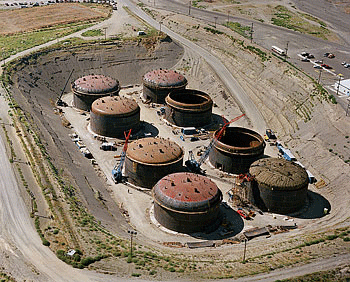
A predictable nuclear accident at Hanford http://thebulletin.org/predictable-nuclear-accident-hanford10774, Hugh Gusterson, May 17 Last week’s accident at the Hanford Nuclear Reservation should have come as no surprise.
On May 9, workers discovered a 20-foot-diameter hole where the roof had collapsed on a makeshift nuclear waste site: a tunnel, sealed in 1965, encasing old railroad cars and equipment contaminated with radiation through years of plutonium processing. Potential radiation levels were high enough that some workers were told to shelter in place while others donned respirators and protective suits as they repaired the hole.
The Hanford complex, which dates back to 1943, produced the plutonium for the atomic bomb dropped on Nagasaki. Half the size of Rhode Island, it is often described as the most contaminated place in the United States. Until its last reactor closed in 1987, it churned out plutonium for the roughly 70,000 nuclear weapons the United States built during the Cold War. As the historian Kate Brown documents in her book Plutopia, which explores the uncanny similarities between Hanford and its Soviet counterpart Ozersk, Hanford has been a slow-motion environmental disaster since its opening, constantly excreting radioactive contaminants into the air and water.
 More dangerous than the tunnels are the giant tanks of liquid nuclear waste: 177 of them containing 56 million gallons of radioactive soup whose composition is only approximately known. The contents of some have to be stirred periodically to prevent the formation of hydrogen bubbles that would cause the tanks to explode. One million gallons of this witches’ brew have already leaked into the groundwater from tanks that were built to last only 20 years. The US government projects that it will cost more than $107 billion to clean up the site, with remediation finished by 2060. Few knowledgeable people put much credence in either number. Continue reading →
May 26, 2017
Posted by Christina Macpherson |
USA, wastes |
2 Comments
 Hanford Nuclear Cleanup Budget Slashed in Energy Proposal, Bloomberg Business, By Chuck McCutcheon, 25 May 17 Washington state’s Hanford Nuclear Reservation, scene of a recent collapse of a tunnel containing nuclear waste, would see its funding slashed under President Donald Trump’s new budget proposal…..
Trump’s budget blueprint calls for reducing cleanup at Hanford from $921 million to $716 million, a 22 percent reduction. That comes as the budget proposes to boost overall departmental defense-related environmental cleanup of materials from $5.28 billion to $5.54 billion.
Hanford Cleanup Needed
Washington state’s congressional delegation, including Democratic Sens. Patty Murray and Maria Cantwell, long have pressed various administrations to commit to cleaning up Hanford. The site in eastern Washington has milllons of gallons of highly radioactive wastes stored in 177 aging underground tanks, some of which have leaked.
“Previous administrations and Congress have repeatedly supported the legal and moral obligation of the federal government to clean up the Hanford site, and we urge you to continue this important work to protect health and safety,” the two senators and Rep. Dan Newhouse (R-Wash.) said in a May 19 letter to Perry.
The Hanford tunnel, containing radioactive wastes that were byproducts of producing plutonium for nuclear weapons, partially collapsed on May 9, prompting nearby workers to evacuate. A worker’s clothing also was exposed to radioactive contamination in what Washington Gov. Jay Inslee (D) called an “alarming incident.”…. https://www.bna.com/hanford-nuclear-cleanup-n73014451452/
May 26, 2017
Posted by Christina Macpherson |
politics, USA, wastes |
Leave a comment
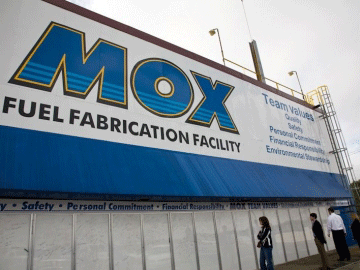
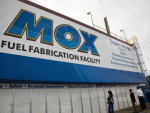 Platts 23rd May 2017 The Trump administration is proposing to end construction of a facility deigned to convert 34 mt of plutonium from surplus nuclear weapons to nuclear reactor fuel, concluding it would “be irresponsible to pursue this approach when a more cost-effective alternative exists.”
The administration, which Tuesday unveiled its proposed fiscal 2018 budget, said it will direct CB&I Areva MOX Services to develop a plan “as soon as practical,” to halt construction of the Mixed Oxide Fuel Fabrication Facility at the Savannah River Site in South Carolina and securely shut the facility by late 2018.
The 2018 fiscal year starts October 1. Congress must authorize and appropriate fiscal 2018 spending and the president must sign the budget bill. The $340 million that Congress appropriated in an omnibus budget resolution for fiscal 2017 was earmarked primarily for the installation of ductwork and to seal openings in the facility used during
construction.
The fiscal 2018 proposal states appropriations for the MOX project after this fiscal year are “to be determined,” with no dollar amount specified. A justification for terminating the MOX project that the US Department of Energy provided Tuesday noted that the facility’s $4.8 billion cost projected in 2007, with a startup date of 2015, had ballooned
to $17.2 billion by 2016, with 2048 the earliest date, by which mix-oxide fuel could be produced. DOE now estimates the completion cost at up to $26 billion.
DOE noted that analysis it and “external independent analyses” have conducted “have consistently concluded that the MOX approach to plutonium disposition is significantly costlier and would require a much higher annual budget than an alternate disposition method, ‘Dilute and Dispose.'” https://www.platts.com/latest-news
May 26, 2017
Posted by Christina Macpherson |
- plutonium, reprocessing, USA |
1 Comment
Nuclear Reactor Involved In US History’s Worst Meltdown At Risk Of Shutting Down, Daily Caller ,ANDREW FOLLETT, Energy and Science Reporter, 24 May 17 THE PENNSYLVANIA POWER PLANT RESPONSIBLE FOR THE LARGEST NUCLEAR MELTDOWN IN U.S. HISTORY FACES EARLY RETIREMENT, ACCORDING TO NUCLEAR INDUSTRY OFFICIALS.
Exelon Corporation announced Wednesday that it would have trouble selling electricity generated by the Three Mile Island (TMI) and Quad Cities nuclear power plants in 2020. Exelon didn’t sell any of the stations’ power during advanced auction in Pennsylvania, New Jersey and Maryland.
Exelon’s other nuclear plants in the region were able to sell their power for the 2020-2021 planning year, but the company says TMI hasn’t been profitable for five years — the site of a partial nuclear meltdown in the 1970s.
“The failure of the TMI plant, in particular, to clear the PJM capacity auction is the latest data point that all is not well with the U.S. electricity marketplace and that nuclear energy plants are at risk for premature closure if the current market is not reformed and innovated,” David Blee, executive director of the Nuclear Infrastructure Council, told The Daily Caller News Foundation.
In March 1979, TMI’s number 2 reactor partially melted down, causing the most serious accident in U.S. commercial nuclear operating history. The event spurred environmentalist campaigns to prevent other nuclear power plants from being built, and has tarnished the industry’s reputation ever since….
…..TMI’s possible closure is not an isolated incident. About half of U.S. nuclear reactors are at risk of closing early…In the past two years, six states have shut down nuclear plants, and “dozens” of other plants across the U.S. are facing challenging economic conditions, placing them at risk of imminent retirement. Decommissioning reactors can cost up to $1.5 billion and take up to 60 years to complete….
May 26, 2017
Posted by Christina Macpherson |
business and costs, USA |
Leave a comment
‘Coding error’ caused false nuclear alert to reach public, BY BILL GALLO JR. , bgallo@njadvancemedia.comFor NJ.com 25 May 17 LOWER ALLOWAYS CREEK TWP.— Authorities say a “coding error” is to blame for an inaccurate emergency alert broadcast Tuesday night that said there was a problem at one of Salem County’s nuclear power plants.
The alert was sent out during a regularly scheduled drill to test the readiness of emergency officials in case of an actual emergency at PSEG Nuclear’s Artificial Island generating complex in Lower Alloways Creek Township.
“At 8:45 p.m., a training message was created in order to test an electronic communications system,” New Jersey State Police said in a statement issued Wednesday afternoon.
“The message was intended for a small group of emergency management personnel who were participating in the exercise. As a result of a coding error, the message was publicly broadcast. The coding error has since been identified and corrected.”…….http://www.nj.com/salem/index.ssf/2017/05/coding_error_caused_false_nuclear_alert_to_reach_p.html
May 26, 2017
Posted by Christina Macpherson |
incidents, USA |
Leave a comment
Buoyed by State Aid, U.S. Nuclear Plant Still Fails at Auction, Bloomberg, by Jim Polson, May 25, 2017
- Quad Cities fails to submit winning bid at PJM auction
-
Three Mile Island at risk of early retirement: Exelon
Even the promise of state subsidies wasn’t enough to help a struggling nuclear power plant in the biggest electricity market emerge a victor in a closely watched auction.
Exelon Corp. said its Quad Cities plant in Illinois didn’t clear at the annual auction of capacity rights by PJM Interconnection LLC. It was the first time the grid operator had held a sale since a handful of nuclear reactors in Illinois and New York won subsidies to stay open.
 In the run-up to the auction, opponents of subsidies had feared Exelon might undercut rivals in the knowledge that Quad Cities would be a recipient of state aid. With reactors reeling under competition from cheap shale gas and renewables, more states could now face pressure to help out ailing nuclear plants, according to Kit Konolige, a utilities analyst for Bloomberg Intelligence.
“Exelon could make the other argument, that even with the subsidy it wasn’t able to clear,” Konolige said by phone on Wednesday. “That’s how bad its economics were.”……..
Exelon said the plant has not yet been selected to receive zero emissions credits under the Future Energy Jobs Act, which is designed to promote a clean energy future for Illinois, and is expected to come into force in June…..
Exelon’s Three Mile Island station, scene of the worst accident in the history of U.S. commercial nuclear energy, may not be so lucky. After failing to clear at the past three PJM auctions, the plant is at risk of early retirement. It hasn’t made a profit in five years and remains “economically challenged” given the lack of federal or Pennsylvania energy policies that value zero-emissions nuclear power, the company said.Exelon’s other nuclear plants in PJM cleared in the auction. Oyster Creek didn’t take part, since it’s scheduled to shut in 2019. https://www.bloomberg.com/news/articles/2017-05-24/buoyed-by-state-aid-u-s-nuclear-plant-still-fails-at-auction
May 26, 2017
Posted by Christina Macpherson |
business and costs, USA |
Leave a comment
New Arizona contract reveals record low price for large scale solar in US, and stunning reduction in cost of battery storage. The new combined solar and storage deal of below 4.5c/kWh cuts previous prices by more than 60% – far cheaper than a peaking gas plant.
http://reneweconomy.com.au/stunning-new-lows-in-solar-and-battery-storage-costs-13929/
May 26, 2017
Posted by Christina Macpherson |
renewable, USA |
Leave a comment