President Donald Trump’s erratic behavior, Twitter tirades and general instability has followed him off the campaign trail and into the White House, jeopardizing the relative progress we have made to reduce the dangers posed by nuclear weapons. Despite the U.S. intelligence community’s reports that Russia interfered in the election to swing it in Trump’s favor, tensions between these two nuclear-armed nations remain worryingly high. Moreover, Trump’s rhetoric and posturing toward North Korea are increasing the risk of nuclear conflict on the Korean peninsula. A war with North Korea would be catastrophic.
With that in mind, Maine’s own Stephen King recently sent out a pointed tweet: “That this guy has his finger on the nuclear trigger is worse than any horror story I ever wrote.”
I couldn’t agree more.
Trump’s sole control of the United States nuclear arsenal is worse than any nightmare King could turn into a novel. But the real danger lies in the fact he can launch thousands of our nuclear weapons within the time it takes to order a cup of coffee — and there are no checks and balances in place stop him.
The framers of our Constitution purposefully gave the legislative branch of government the power to declare war because, as James Madison put it, the executive was not “ safely to be trusted with it.” American democracy is built on a system of checks and balances, ensuring that no one entity retains absolute power. But in a shocking disregard for this principle, ultimate authority over whether nuclear weapons are used rests solely with the president.
It takes approximately five minutes to launch a nuclear weapon. Once the president gives the order to launch, the Pentagon and everyone down the chain of command must comply with the commander-in-chief’s directive. Short of disobeying a direct order or an outright coup, no mechanism exists as a stopgap on this power.
This is, at its core, completely undemocratic. The decision to use nuclear weapons should be undertaken only with the utmost caution and not left up to any single individual, let alone one so erratic.
Growing alarm over this very real possibility isn’t isolated, and it isn’t occurring in a vacuum. Earlier this month, former nuclear commanders around the world launched a crisis group to serve as a “shadow security council” in order to advise world leaders in reducing the growing danger of a nuclear conflict. In January, The Bulletin of the Atomic Scientists moved the Doomsday Clock, which signals how close humanity is to destruction, closer to midnight. And former Secretary of Defense Bill Perry, who oversaw the U.S. nuclear arsenal for decades and played a supporting role in the Cuban Missile Crisis, continues expressing his alarm over the skyrocketing risks of a nuclear exchange.
Several members of Congress also have taken note of the great power that is vested in the executive branch when it comes to nuclear weapons. In February, U.S. Sen. Ed Markey, D-Massachusetts, and U.S. Rep. Ted Lieu, D-California, introduced the Restricting First Use of Nuclear Weapons Act, which would prevent any president from launching nuclear weapon in a pre-emptive first strike without congressional authorization. The legislations is backed by at least 500,000 Americans who signed a petition calling on all members of Congress to co-sponsor it.
We have an opportunity to write a new page in the American history books for the courage of Maine leaders in reducing the threat of nuclear weapons. Let Stephen King write the horror stories. If U.S. Sens. Susan Collins and Angus King co-sponsor this common-sense legislation, they would be acting to uphold Samantha Smith’s legacy of preventing nuclear war.
Diane Russell served eight years in the Maine House of Representatives. She currently serves as the national security political director at Women’s Action for New Directions. Follow her on Twitter: @MissWrite.
Cleanup at Idaho Nuclear Landfill on Hold After Pit Collapse https://www.usnews.com/news/best-states/idaho/articles/2017-05-18/cleanup-at-idaho-nuclear-landfill-on-hold-after-pit-collapse
Officials are trying to determine what caused the side of a pit at a nuclear waste landfill in Idaho to collapse. May 18, 2017, By REBECCA BOONE, Associated Press BOISE, Idaho (AP) — Some cleanup efforts at a nuclear waste landfill in Idaho were placed on hold while workers try to figure out what caused a collapse in a dig area that sent an excavator into a pit.
The excavator was digging up transuranic waste — which is waste contaminated with highly radioactive elements.
No radiation was released during the May 11 incident, and no one was injured, said Erik Simpson with Fluor Idaho, a contractor hired to clean up the site at the Idaho National Laboratory.
The excavator was digging at the 97-acre (392,545-sq. meter) Subsurface Disposal Area near Idaho Falls when the side of the pit collapsed.
Simpson said the excavator slid partway into the 21-foot (6 -meter) deep pit. The operator remained in his protective cab for about 90 minutes.
New York’s nuclear “bailout” faces court challenges and questions from lawmakers, Mc Alester News capital, By Joe Mahoney | CNHI State Reporter May 18, 2017 ALBANY — The Cuomo administration’s effort to drive subsidies to three upstate nuclear-power plants is being challenged in both the courts and the halls of the statehouse.
The cost of what critics call a “nuclear bailout” is already being reflected in higher utility bills across the state.The opponents warn the plan will lead to higher costs for taxpayers and consumers as power bills increase for municipalities, school districts, universities and hospitals.
Under the subsidy program, which has been approved by the Public Service Commission, New York utilities are buying power at inflated rates from Exelon, a Chicago company that owns the reactors at Nine Mile Point on the shores of Lake Ontario, James FitzPatrick Nuclear Power Plant in Oswego County and the R.E. Ginna Nuclear Plant in Wayne County.
OPPOSITION FORCES Legislation to derail the program is pending in both houses of the State Legislature, though the fate of the measure is unclear. Meanwhile, lawsuits challenging the subsidy have been filed against the state by a group of owners of gas-fired power plants. The group contends the subsidy is illegal because it interferes with the federal government’s ability to regulate energy prices.
On a separate but related front, Hudson River Sloop Clearwater, an environmental group, is challenging the arrangement in state court. It contends state regulators failed to follow proper procedures in approving the subsidy last year and that ratepayers will be left facing “unreasonable and unjust” costs.
The New York Public Interest Research Group, a consumer watchdog, has joined Clearwater’s court action. Its legislative director, Blair Horner, said court arguments in both lawsuits are expected to be heard within the next several weeks.
Horner noted several lawmakers have concerns that they were left out of the loop when Gov. Andrew Cuomo pushed through a subsidy that is expected to cost billions of dollars.
“It’s sort of astonishing to them that they were cut out of the process,” he said…….
DEMONSTRATION Those fighting the nuclear subsidy have stepped up their campaign to convince Cuomo to pull the plug on it.
Representatives of NYPIRG and other groups opposed to it, calling themselves Stop the Cuomo Tax, staged a demonstration this week outside the governor’s Manhattan office.
“Too many of us have trouble paying our utility bills already, and now Governor Cuomo is raising our rates by almost $8 billion to fund a giant giveaway to Exelon,” one of the protestors, Renata Pumarol, deputy director of New York Communities for Change, said in a statement.
FirstEnergy nuclear hearings suspended in Ohio House, Cleveland.com By John Funk, The Plain May 17, 2017 CLEVELAND, Ohio — The chairman of the Ohio House Public Utilities Committee has suspended further hearings — and a vote — on a proposed bill allowing FirstEnergy to create a special customer charge to subsidize its nuclear power plant fleet.
“We have heard over 10 hours of testimony on this bill [House Bill 178]. I have given proponents and opponents a chance to make their case,” said William Seitz, a Cincinnati Republican who chairs the committee.
“I am not sensing a keen desire on the part of the House members to vote on this and doubt that we will have more hearings in the near future unless something cataclysmic should happen.”
Cataclysmic events might include a decision by FirstEnergy Solutions to seek bankruptcy protection from its creditors or a decision by the company to immediately close its four nuclear power plants.
FirstEnergy Solutions, the unregulated subsidiary of FirstEnergy, is legally the owner of all of the company’s power plants. FirstEnergy Solutions has been operating with junk bond ratings for some time.
Its parent has tried to distance itself from the company, even creating a separate board of directors, which includes two FirstEnergy employees. But FirstEnergy recently had to guarantee a cash settlement between FirstEnergy Solutions and several railroad companies claiming breach of contract when FirstEnergy Solutions closed coal-fired power plants along Lake Erie and declined further deliveries…….http://www.cleveland.com/business/index.ssf/2017/05/firstenergy_nuclear_hearings_s.html
Thousands of workers were forced to shelter after a roof collapsed at a waste site created in the 1950s and mostly ignored since then, Center for Public Integrity, By Peter CaryPatrick Maloneemail, May 13, 2017
A series of warnings by state and federal experts, stretching back more than thirty years, preceded this week’s cave-in of a tunnel in Hanford, Washington, that holds lethally radioactive debris from the U.S. nuclear weapons program, according to government documents.
A report in 1980 for the Energy Department, which oversees safety and cleanup work at the site, said that wooden beams holding up the tunnel had lost a third of their strength by then. A contractor for the department pointed to the issue again in 1991, warning that by the year 2001, the beams would be further degraded.
A group of academic experts, working under contract to the department, said more alarmingly in a 1,969-page report in August 2015 that the roof of the tunnel in question had been seriously weakened and that a “partial or complete failure” could expose individuals even 380 feet away to dangerous levels of radiation.
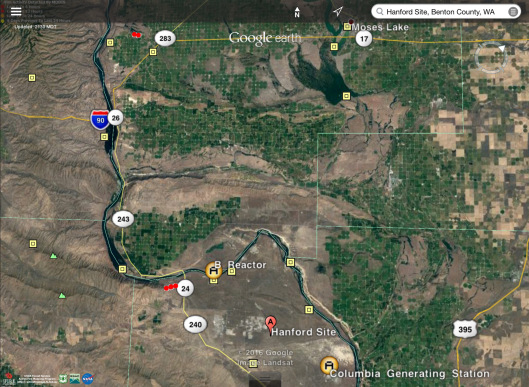
No action was taken by the department in response, and earlier this month — the precise date remains uncertain because conditions at the site were not closely monitored — a portion of the roof collapsed at the tunnel, creating a 20-foot square hole. Afterward, the managers of the Hanford site were forced on May 9 to order 3,000 workers to shelter indoors. But instead of shoring up the beams inside the tunnel in question, they poured in 54 new truckloads of dirt.
The tunnel was one of two at the Energy Department’s Hanford reservation used as dumping grounds from 1960 to 2000 for radioactive machine parts, vessels, and other equipment. It was, in short, a tangible expression of the department’s policy of covering over some of its nuclear bomb-making detritus and effectively pretending it isn’t there.
The neglect followed a blunt warning 26 years ago from the State of Washington — cited in a 1991 Energy Department contractor’s report — that the tunnels were not a safe repository and that the wastes should be moved elsewhere.
Under an agreement overseen by a federal court in eastern Washington, the department was supposed to start crafting a way to deal with the tunnel’s lethal dangers by September 2015, but it missed the deadline and promised to do it later this year as part of an overall agreement with the state and the Environmental Protection Agency to push back completion of the site’s overall cleanup from 2024 to 2042. (Hanford remains the most toxic site in America and the government’s most costly environmental cleanup task.)…….
In the 1991 report, by Los Alamos Technical Associates, Inc., the authors made clear after conducting an internal inspection of the tunnel that the DOE knew the timbers holding up the roof had been substantially weakened as early as 1980. It predicted that by 2001, they would be at 60 percent of their original strength and recommended another evaluation in 2001. But records indicate that it never happened.
A Department of Ecology inspection in 2015 noted that because the tunnels were closed up, “no permanent emergency equipment, communications equipment, warning systems, personal protective equipment, or spill control and containment supplies” were located inside — deficiencies that could complicate emergency efforts in the case of a tunnel fire or other safety incident.
Overcoming the military-industrial complex: nuclear has always been a centralized industry, with just a few firms that have very close contacts to the government. And keeping nuclear skills for military purposes seems to be a driver in the UK’s push for new nuclear.
The US (and Australian) nuclear camp critiques studies for 100% renewables. Without reading them. Energy Transition ,by Craig Morris, 15 May 2017
Over the past year, the Anglo world has become interested in nuclear as a complement for wind and solar towards “deep decarbonization,” or a (nearly) 100% carbon-free supply of energy or possibly just electricity. Today, Craig Morris reviews a few papers by Americans and Australians and advises them to tackle the best European studies for 100% renewables head-on, not ignore them.
The first paper is by Stephen Brick and Samuel Thernstrom. Thernstrom has been calling nuclear “an essential part of the puzzle” since at least 2010. The paper is peer-reviewed; unfortunately, none of the reviewers noticed the oversights I found. But let’s start off with a contention the authors state in the introduction:
“In seeking to demonstrate that renewables can by themselves replace all fossil fuels and nuclear energy, these studies run the risk of treating renewables as a societal end in itself, instead of just one among a suite of technologies that could be used to achieve the combined goals of environmental protection, cost-containment, and electric system reliability.”
Why shouldn’t renewables be an end in themselves? Assuming nuclear power (plus whatever) is the cheapest low-carbon option, might other impacts society dislikes relativize the low price? To name just a few examples (and we’ll leave out whatever nuclear risks may or may not exist):
Overcoming the military-industrial complex: nuclear has always been a centralized industry, with just a few firms that have very close contacts to the government. And keeping nuclear skills for military purposes seems to be a driver in the UK’s push for new nuclear.
Stronger economic growth in communities, especially rural ones: if communities can make their own energy, why would they want to pay some out-of-town corporation, even if the energy is slightly cheaper? People simply are willing to pay more for quality, and local jobs are a quality (not to mention being energy-independent). The price is relative when you pay it back to your community…….
the real problem here is that lower consumption does not jibe with nuclear historically. Nuclear originally promised nearly unlimited electricity, and the technology’s supporters say more energy is needed, not less, especially in developing countries. Here is one pro-nuclear group attacking, for instance, renewables advocate Amory Lovins’ call for efficiency. Nuclear proponents often depict the efficiency aims (= lower consumption) called for by renewables proponents as unrealistic.
In contrast, the renewables camp sees efficiency as crucial because, for instance, we don’t have enough sustainable biomass to support our wasteful habits today. In addition to efficient devices, “sufficiency” – changing lifestyles to make do with what Mother Nature gives us – is therefore crucial. Switching to an electric car is not enough; we will need to walk and cycle more, both of which require compact neighborhoods (a societal, not technical, issue)………
The overlooked update
What’s worse, in their 2017 paper Heard at al. discuss Mathiesen’s 2009 paper on a 100% renewable Denmark as though nothing had happened since. The six-page summary (PDF in English) of the follow-up 2014 scenario is admittedly sparse on details, but we can see a plan taking shape. In 2015, Mathiesen, not unknown to my readers, and his team then fleshed everything out in a 159-page PDF (in English), including a new scenario called the IDA Energy Vision. As you can see below, [table on original] biomass is still based as much as possible on waste, and the rest is mainly wind power. This is what a 100% scenario looks like when you do the footwork for a given country. It would look much different in, say, Saudi Arabia, with very little wind but ample solar. It would also look different in countries with lots of hydropower. One conclusion is thus that investigating 100% renewables is hard without saying where.
In the end, we are left with a discussion in the English-speaking world held by nuclear advocates about 100% renewable energy, in which too little notice is taken of the main studies in two leading countries investigating “deep decarbonization” without nuclear or CCS: Denmark and Germany. What’s worse, not a single journalist covering these papers, including Vox.com’s David Roberts (one of the best) pointed out the oversight. America’s best minds write about 100% renewables, and no one notices the gaps. As President Trump might say: sad. https://energytransition.org/2017/05/the-us-nuclear-camp-critiques-studies-for-100-renewables-without-reading-them/
Hotspot on Unloading Equipment Reveals Failed Radiation Shielding, Beyond Nuclear 17 May 17 Savannah River Site (SRS), South Carolina— According to a U.S. federal agency document just released on Friday May 12, the first of 100-150 truckloads of highly radioactive liquid waste from Canada has been unloaded at the Savannah River Site, and the transfer container has not provided fully adequate radiological shielding to protect workers.
A document published by the Defense Nuclear Facilities Safety Board (DNFSB), a U.S. federal agency, has confirmed that the first truck shipment of “Target Residue Material (TRM),” or “liquid Highly Enriched Uranium (HEU),” arrived from Chalk River Nuclear Lab, Ontario, Canada at the U.S. Department of Energy’s (DOE) HCanyon in SRS, the week ending April 21. (The document was not made publicly available until May 12, however).
Power plant owners limit Toshiba’s Westinghouse liabilities: sources, Reuters, By Tom Hals and Jessica DiNapoli , 15 May 17 WILMINGTON, DEL/NEW YORKThe owners of the unfinished Vogtle power plant in Georgia led by Southern Co (SO.N) agreed to cap Toshiba Corp’s (6502.T) responsibility for its guarantees on the much-delayed nuclear project, helping ease the Japanese electronics maker’s financial stress, people familiar with the matter said on Sunday.
The agreement pegs Toshiba’s guarantees for the unfinished Vogtle plant at about $3.6 billion, payable over at least three years, the people said, adding the deal was not yet final.
The deal is also contingent on the owners of the incomplete V.C. Summer power plant in South Carolina, including utility company SCANA Corp (SCG.N), coming to a similar agreement with Toshiba, said the people, who could not be identified because the talks are not public………http://uk.reuters.com/article/us-toshiba-accounting-southern-co-idUKKCN18A120
Rod Ewing also told the Spokane Spokesman-Review it was “surprising” that mounds of dirt and pressure-treated timber were used to address the problem.
“How can waste be left in a tunnel? Whose idea was that?” Ewing said in an interview with the newspaper. “I’ve been to Hanford many, many times for conferences and things like that, and I don’t recall anyone saying that there was waste in tunnels underground. I can’t imagine why that would be the case.”
On May 9, part of a railcar tunnel collapsed near the Plutonium Uranium Extraction Plant. U.S. Department of Energy officials have claimed there was no release of radioactive materials.
The Hanford Nuclear Reservation is 400 kilometres southeast of Vancouver, B.C.
On a site the size of the City of Seattle, it has 56 million gallons of untreated nuclear waste left over from the U.S. nuclear-weapons program.
The video below explains the scope of the problem and why it should be of concern.
The Waste That Remains From Arming Nuclear Weapons
“The current unfolding crisis at Hanford, the bursting barrel at Waste Isolation Pilot Plant (WIPP) in New Mexico in 2014, and the exploding radioactive waste dump in Beatty, Nevada in 2015, show that radioactive waste management is out of control,” Kevin Kamps, radioactive waste watchdog at Beyond Nuclear, said in a news release earlier this week.
Beyond Nuclear notes that the Hanford site was part of the Manhattan Project and was a “major supplier of military plutonium”.
“It houses 177 storage tanks containing liquid radioactive sludges, some of which have been leaking radioactive effluent that could eventually threaten the Columbia River,” the group states on its website. “Cleanup at the site did not begin until 1989.”
According to Beyond Nuclear, the Hanford tunnel collapse may have been caused by vibrations from nearby road works.
The Centre for Public Integrity pointed out on its website that a 2015 report noted that this tunnel “had been seriously weakened and that a ‘partial or complete failure’ could expose individuals even 380 feet away to dancerous levels of radiation”.
“No action was taken by the department in response, and earlier this month—the precise date remains uncertain because conditions at the site were not closely monitored—a portion of the roof collapsed at the tunnel, creating a 20-foot square hole,” wrote Peter Cary and Patrick Malone. “Afterwards, the managers of the Hanford site were forced on May 9 to order 3,000 workers to shelter indoors. But instead of shoring up the beams inside the tunnel in question, they poured in 54 new truckloads of dirt.”
The U.S. government is spending US$2 billion per year on a clean-up operation that’s not expected to be finished for another 75 years.
The media is failing to challenge Trump’s attack on the planet, Grist By Emily Atkinon May 12, 2017It may seem like a distant memory now, given President Donald Trump’s firing of FBI Director James Comey, but the top political news at the beginning of this week was the administration’s unexpected dismissal of nine government scientists from the 18-member Environmental Protection Agency board that oversees the department’s scientific research. The EPA reportedly plans to replace some of those board members with representatives from the polluting industries the agency is supposed to regulate.
This was just the latest brazen assault on climate policy by the Trump administration. By sheer number of actions, Trump has done more on the environment than in any other area since becoming president. He’s signed at least eight anti-environmental executive actions, and ordered delays and reviewsof anti-pollution rules. He’s appointed climate change deniers to cabinet positions, and scrubbed scientifically accurate information about climate change from EPA websites. And Trump is considering whether to leave the Paris climate agreement, which is casting a dark shadow over talks in Bonn, Germany, where representatives from 200 countries are discussing the terms of the deal.
Which makes it all the more bewildering that reporters with access to the president have failed to press him on the subject. Two more examples of this media failure surfaced on Thursday, when The Economist and Time each published separate, wide-ranging interviews with Trump — and neither featured a single question about the administration’s environmental agenda.
Time and The Economist’s omissions might seem reasonable, given the looming threat of a constitutional crisis. But both interviews were conducted before Trump fired Comey; while The Economist sat down with Trump on May 4, Time did so on Monday night, when the fired EPA scientists was major news. These omissions might also seem reasonable by journalistic standards; reporters get a limited amount of time with the president, and can’t ask about everything. But being a good journalist means asking questions that haven’t been asked before, and most journalists have failed to ask Trump about his science and environmental policy since he took office in January.
Here is a rough, and likely incomplete, list of sit-down interviews with Trump since he took office. The numbers indicate how many questions were asked about his environmental agenda: Continue reading →
Marcus Atkinson, of Australia, is touring the U.S. promoting a film opposing uranium mining in his country and heard about the White Mesa protest.
“We would like to use this case in our next film to raise international awareness that uranium is too dangerous and is not the answer to our energy needs,” he said.
Ute protesters march to Utah uranium mill, Ute Mountain Utes concerned about health impacts from White Mesa mill, The Journal, By Jim Mimiaga Journal Staff Writer May 13, 2017 White Mesa, Utah – About 80 protesters opposed to the White Mesa uranium mill in southeast Utah marched three miles along U.S. Highway 191 to the mill’s entrance Saturday.
The protest was organized by members of Ute Mountain Ute tribe, which has a small reservation community three miles from the mill. The mill, which is owned by Energy Fuels, of Toronto, is the only conventional uranium mill operating in the country.
Protesters carried anti-nuclear signs, including “No Uranium, Protect Sacred Lands,” “Water is Life,” and “No Toxic Waste.”
They are concerned about the mill’s potential health impacts on air and water quality, and they object to containment cells at the mill that accept radioactive waste from around the country.
“The dust blowing from uranium ore piles is a concern. Our water comes from wells that are not far from those waste cells. Those things are a big worry for the community,” said Antonio Cly, 22, of the Ute Mountain tribe. He is studying the mill as a student at the University of Utah.
Thelma Whiskers, a Ute elder and founder of the White Mesa Concerned Community group, said her family has been fighting the mill all their lives, and the march was a way to raise awareness of the issues to pass on to the younger generation. Continue reading →
Mississippi Taxing – Nuclear Power And Accusations Of Racism, Forbes, Peter J Reilly , 14 May 17Claiborne County, Mississippi is home to the Grand Gulf Nuclear Generating Station operated by Entergy. Having one of those things in the neighborhood is a little nerve wracking. The Nuclear Regulatory Agency defines a plume exposure pathway zone and a larger ingestion pathway zone in the vicinity of the plant, in the event something goes really wrong. On the upside, a power plant could mean a lot of tax revenue and Claiborne County shows up on lists as one of the poorest counties in the country.
Only under Mississippi law a county doesn’t get to tax a nuclear power plant. The state taxes the plant and divvies up the money among counties in the plant’s service area. Some residents claim that the reason for that law is that Claiborne County, home to Mississippi’s only nuclear power plant, has a population that is over 80% African American. That was what the lawsuit Doss v Claiborne County Board of Supervisors was all about. Spoiler alert – it did not go well for the disgruntled residents. As is common in these sort of cases, they foundered on the rock of standing.
Some History Claiborne County has significance in the history of the civil rights movement………
Racism. Voting rights legislation and enforcement had allowed African Americans to gain control of government in Claiborne County and the change in the law prevented them from having access to substantial revenue to improve infrastructure and spend on education. In the wake of Brown v Board of Education white Mississippians had largely abandoned the public schools for segregation academies. Professor Crosby, who was the only white student in her graduating class at Port Gibson High School tends to favor the racism narrative, although she has not studied the power plant issue closely.
Professor Andrew Kahrl of the University of Virginia whose research focuses on “the social, economic, and environmental history of land use, real estate development, and racial inequality in the 20th century United States” has little doubt. A recent article by Professor Kahrl in “The Power To Destroy: Discriminatory Property Assessments and the Struggle for Tax Justice in Mississippi” in the Journal of Southern History included a discussion of Evan Doss Jr.’s struggle to clean up discriminatory assessments in the seventies wrote me:
“As someone who has studied the history of taxation in Claiborne County, specifically, and in Southern states, in general, I can say that the state legislature’s decision in 1986 to strip this majority black county of its taxing authority over Grand Gulf was racially motivated. As my article shows, white-controlled local governments in Mississippi had, for generations, worked to prevent tax revenues from being used to the benefit of black communities as well as shifting the burden of local taxation disproportionately onto black taxpayers through various forms of discriminatory assessment and administration.
Westinghouse bankruptcy threw fate of reactors into question
Southern has appealed to Trump administration for help
Utility owner Southern Co. has agreed to take the lead on building two nuclear reactors at its Vogtle power plant in Georgia from bankrupt contractor Westinghouse Electric Co. as soon as next month.
The Atlanta-based utility owner said in a statement late Friday that an interim contract with Westinghouse will be extended to June 3 while the companies finalize and gain approval for a new service agreement. Just last week, Southern Chief Executive Officer Thomas Fanning said Toshiba Corp.’s Westinghouse unit had “given every indication” it wanted out of the pact to build reactors but was refraining from a decision under the contract that was due to expire Friday.
Westinghouse’s bankruptcy in March threw into question the fate of four U.S. nuclear reactors — the two at Southern’s Vogtle plant and another two being built at Scana Corp.’s V.C. Summer station in South Carolina. The projects were the first to gain U.S. approval for construction in more than 30 years and were once seen as ushering in a new wave of nuclear generation in the country. Fanning has said his company could take over the work at Vogtle if Toshiba provides $3.7 billion to finish it as promised. The deal is said to also depend in part on Scana agreeing to follow suit, so the two companies will be able to share resources.
The companies reached an agreement in principle that “allows for the transition of project management from Westinghouse” to Southern once their current engineering and construction contract is rejected in Westinghouse’s bankruptcy case, Southern said in its statement. “During this time, work will continue at the site and an orderly transition of project management will begin.”
Westinghouse has meanwhile already laid out plans to ditch the money-losing business of building reactors and instead focus on servicing and decommissioning work. It set up agreements with both Southern and Scana to give them more time to decide whether they wanted to continue construction.
In March, less than 24 hours after Westinghouse filed for bankruptcy, Southern’s Fanning said in a Bloomberg Television interview that he flewto Tokyo just to “look the CEO of Toshiba in the eye” and remind him that his company had a “moral commitment” to getting the Vogtle project done. Both Fanning and Georgia regulators have appealed to the Trump administration for help in finishing the project.
In April, Scana and Westinghouse agreed to extend a review of the V.C. Summer nuclear project until June 26.
In Westinghouse’s bankruptcy, the most significant debts are held by Apollo Global Management LLC, which financed an $800 million operating loan, and parent Toshiba. The Chapter 11 case has moved slowly, with Westinghouse recently asking for a two-week delay until May 26 to file a full schedule of its assets and debts.
Two experts resign from EPA posts to protest the agency’s science committee shake-up, WP By Chris MooneyMay 12 In an expanding controversy over the role of science in the Trump administration, two expert advisers to the Environmental Protection Agency resigned Friday in protest at the dismissal of half of the members of a key science committee.
Carlos Martín, an engineer with the Urban Institute, and Peter Meyer, an economist with the E.P. Systems Group, an environmental and economic research firm, posted a joint resignation letter on Twitter, saying they were standing down to protest the agency’s decision to remove the scientists.
“We cannot in good conscience be complicit in our co-chairs’ removal, or in the watering down of credible science, engineering, and methodological rigor that is at the heart of that decision,” they wrote.
Martín and Meyer had advised the EPA science’s branch on research related to environmental contaminants and spills, the disposal of waste, and techniques for environmental cleanups.