Subsidizing coal and nuclear power plants would not be legal, says PJM, By John Funk, The Plain Dealer, CLEVELAND, Ohio— The independent company that manages competitive wholesale power markets in Ohio and 12 other states believes a federal proposal to subsidize the owners of old nuclear and coal plants is unworkable and would not even be legal.
The U.S. Department of Energy proposal “is simply unworkable,” said Andrew Ott, CEO of PJM Interconnection, in a press conference today. “We believe it is contrary to law.”
PJM intends to file formal comments later today with the Federal Energy Regulatory Commission regarding the proposal from the DOE.
The DOE in September, following intense lobbying from the coal industry and from FirstEnergy and other traditional utilities, proposed that FERC require PJM and other grid managers to credit the owners of the big coal and nuclear plants for providing “resiliency” to the grid because they store fuel on-site and run 24 hours a day. They also generate power at higher prices than new gas turbine plants.
In other words, the DOE wants PJM’s fiercely competitive markets to accept higher priced power from old coal and nuclear plants at whatever it cost to generate — plus a profit — the way the old plants did business before de-regulation……..
PJM’s announcement that it will oppose a direct handout to old coal and nuclear because it would distort competitive markets came just three days after the Public Utilities Commission of Ohio announced it would argue against the proposal, primarily because it could raise customer electric rates.
PUCO Chairman Asim Haque said the DOE had not done a cost analysis of the impact the plan would have on power prices before ordering the FERC to weave it into competitive market pricing. The PUCO was to file its formal arguments later today…….
The formal comments of PJM and PUCO will reach the FERC on the heels of comments from the independent developers building gas turbine plants.
Last winter, and to the delight of utility executives, a bipartisan majority in the Illinois State Legislature offered them a generous gift they had long sought: a $16.4 billion bailout to keep a pair of nuclear plants in operation.
The executives had lobbied hard for this, warning of the loss of 4,200 jobs and carbon-free electricity if the money-losing Clinton and Quad Cities nuclear plants closed. The two plants, owned by Chicago-based Exelon Corporation, were in jeopardy of closing because they were losing a combined $100 million a year due to the increasing availability of cheap natural gas and renewables.
With less than an hour remaining in the legislative session, the state legislature passed the Future Energy Jobs Act, a multi-billion-dollar bailout that provides taxpayer subsidies to keep the nuclear plants operating for at least another 10 years. The cost of power for Chicago-area ratepayers has increased 16 percent since May due to higher capacity charges coupled with the nuclear subsidies. Power rates will go up at least an additional 5 percent next May based on capacity charges that have already been set. For consumers in a typical suburban Chicago household, the increases will boost their annual electricity bill by at least $140.
The ripple effects from the bailout may well lead to future increases on top of the new surcharges. Subsidizing the two nuclear plants has the unintended consequence of potentially harming the owners of unsubsidized, competing power plants. The PJM Interconnection, an organization that sets the rules for wholesale power markets, is contemplating changes that would compensate the owners of natural gas and coal plants. Simply put, households and businesses in Illinois could be paying twice to keep the same nuclear plants open.
What has yet to be determined is how much electricity bills will rise as a result of the bailout. They’re already on the upswing due to earlier changes PJM made to reward nuclear plant operators and owners of other “base-load” plants that run most of the time for their reliability during periods of intense heat or cold.
And the same basic story applies at a broader level. Nuclear subsidies are expected to raise the electricity bills of New Yorkers by $7.6 billion over 12 years, thanks to the bailout of three nuclear plants in upstate New York. The New York State Legislature approved the bailout on a promise to save 2,600 jobs. The Exelon Corporation stands to benefit the most from the bailout. The company owns two of the plants and, since the bailout last year, purchased a third plant. Other states considering bailouts of nuclear plants are Ohio, Pennsylvania, New Jersey, and Connecticut.
Now, on top of that, Energy Secretary Rick Perry recently called on the Federal Energy Regulatory Commission to come up with a new pricing system to reward power plants that help ensure reliability by storing months’ worth of fuel on site. This is an attempt to help financially-distressed coal and nuclear plants nationwide.
There was a time not too long ago when market competition, one of the most basic cost-control methods, was a driving force in the electricity market, and everyone benefitted from it. History clearly shows that market competition lowers costs, boosts performance, and spurs innovation. In the end, consumers get reliable power at competitive prices.
What we don’t need, and can’t afford, is another round of misguided nuclear bailouts that saddle households and businesses with higher electricity bills. If greater use were made of low-carbon natural gas and renewables, and if more failing nuclear plants were closed, the country and economy would be better off. As it is now, in a quest to shield some utilities from the marketplace, more nuclear plants will receive taxpayer subsidies, the growth of more competitive power, along with more jobs, may be slowed. And millions more will be wasted to perpetuate a cycle that not only abuses consumers but promotes what is at best a dubious energy policy.
Mark J. Perry (@Mark_J_Perry) is a contributor to the Washington Examiner’s Beltway Confidential blog. He is a scholar at the American Enterprise Institute and a professor of economics and finance at the University of Michigan’s Flint campus.
Jimmy Carter says he is willing to go to North Korea on peace mission
Former president adopts markedly conciliatory tone about Trump
Carter: ‘We greatly overestimate China’s influence on North Korea’, Guardian, Martin Pengelly, 23 Oct 17, In an interview marked by conciliatory remarks regarding Donald Trump and his administration, Jimmy Carter said he was willing to travel to North Korea in an attempt to soften tensions between Washington and Pyongyang.
Speaking to the New York Times mostly about foreign policy, the 93-year-old former president also said Trump was not solely to blame for damage to America’s world image…….
Carter said he was “afraid” of nuclear conflict between the US and North Korea. “They want to save their regime [and have] now got advanced nuclear weaponry that can destroy the Korean peninsula and Japan, and some of our outlying territories in the Pacific, maybe even our mainland.” Carter had indicated a willingness to talk peace with North Korea last month, according to an academic at the University of Georgia…….
Climate Change Will Bring Major Flooding to New York Every 5 Years And that’s only counting the floods caused by hurricanes and tropical storms. The Atlantic ROBINSON MEYER 25 OCT 17
New York is a city on the water. For hundreds of years, its rivers and harbor have worked to its advantage, bringing it speedy transportation and pleasant temperatures.
The next couple hundred years may not be as smooth sailing. Global warming, caused by the release of carbon-dioxide pollution into the atmosphere, will cause the seas to rise and the storms to intensify around the city. A new study from an all-star list of climate scientists attempts to estimate how a few of climate change’s symptoms—higher seas, large storm surge, and more intense hurricanes—will intersect in New York over the next 300 years.
It isn’t pretty. Sea-level rise will make every tropical cyclone that hits New York more likely to release damaging floods. For instance, storm floods of nearly seven-and-a-half feet once occurred only a couple times per millennium. In today’s somewhat warmed climate, 7.5-foot floods are projected to happen every 25 years. By 2030, these floods will occur every five years.
In what has been interpreted by some as an attack on Donald Trump, actor makes remarks in a speech at the White House, Guardian, 24 Oct 17, The actor Leonardo DiCaprio has said he thinks that those who don’t believe in climate change should not hold public office.
Speaking at the White House ahead of a screening of his new documentary, Before the Flood, DiCaprio said such rejection indicated an inability to engage with the rational world.
“If you don’t believe in climate change, you don’t believe in facts, and science, and empirical truths,” he said.
“And, in my humble opinion, [you] should not be allowed to hold public office.”
The words were interpreted as a slight against presidential candidate Donald Trump, who has frequently tweeted his scepticism – despite denying he had made such claims in last week’s presidential debate……Before the Flood premiered in September at the Toronto film festival, where DiCaprio told the audience: “We cannot afford, at this critical moment in time, to have leaders in office that do not believe in the modern science of climate change.” https://www.theguardian.com/film/2016/oct/04/leonardo-dicaprio-climate-change-donald-trump-before-the-flood-documentary
Reclassify waste to shift the nuclear landscape, The US Department of Energy should classify and dispose of nuclear rubbish according to risk.Nature, 24 October 2017 The United States has a single deep geological repository for nuclear waste. Since 1999, the Waste Isolation Pilot Plant (WIPP), 655 metres down in a massive salt formation near Carlsbad, New Mexico, has received 12,000-odd shipments of what it calls transuranic waste. This is clothing, tools and other detritus from the nuclear-weapons programme that are contaminated by elements heavier than uranium. It’s more hazardous than low-level waste, which can be buried closer to the surface, but not as dangerous as high-level waste, for which a disposal site has yet to be found.
WIPP was closed for three years after radiation escaped from a ruptured drum in 2014. It was given the all-clear to reopen only in January; an enquiry determined that the drum had been packed improperly before shipment from the Los Alamos National Laboratory in northern New Mexico. Concerns remain about safety, as well as the long-term risk of human intrusion into a facility that will remain dangerous for thousands of years after its eventual closure. But by and large, WIPP has functioned as designed, and it could do even more to help the US Department of Energy (DOE) address the fallout from the country’s nuclear-weapons programme.
Much high-level waste — produced during the reprocessing of spent nuclear fuel into plutonium — is highly radioactive and dangerous. But the evidence suggests that some of the waste that is labelled ‘high level’ technically qualifies as transuranic. This material is still barred from direct disposal at WIPP, purely because of how it was produced. But labels can be changed. If wastes that meet the transuranic criteria could be shipped to WIPP, it would save considerable time and effort as the DOE continues to struggle with the country’s radioactive legacy. ………
After spending some $11 billion on the as-yet-unfinished vitrification plant over the past two decades at Hanford, some may hesitate to change course. But as former DOE secretary Steven Chu said, the worst thing you can do in a multi-decade project such as nuclear-waste clean-up is to close the door to alternatives. In this case, the solution is simple enough: nuclear waste should be managed on the basis of the risk it poses and not the process that produced it. http://www.nature.com/news/reclassify-waste-to-shift-the-nuclear-landscape-1.22880
Ex-energy regulators denounce Trump bid to boost coal, By MATTHEW DALY, WASHINGTON (AP), 24 Oct 17 — Eight former federal energy regulators — including five former commission chairs — oppose a Trump administration plan to bolster nuclear and coal-fired power plants, arguing it would raise prices and disrupt electricity markets.The former officials, who served under presidents from both parties, call the plan “a significant step backward.”
The plan by Energy Secretary Rick Perry would reward nuclear and coal-fired power plants for adding reliability to the nation’s power grid. Perry says the plan is needed to help prevent widespread outages such as those caused by Hurricanes Harvey, Irma and Mari
The plan aims to reverse a steady tide of retirements of coal and nuclear plants, which have lost market share as natural gas and renewable energy flourish. President Donald Trump has vowed to revive the struggling coal industry and expressed strong support for nuclear power, while casting a skeptical eye toward renewable energy such as wind and solar power.
The Federal Energy Regulatory Commission is considering the plan and could decide by mid-December.
A letter signed by eight former energy commission members said “subsidizing resources” such as coal and nuclear plants “so they do not retire would fundamentally distort markets … and inevitably raise prices to customers.”
The plan could backfire as investors lose confidence in energy markets, the former officials said. “This loss of faith in markets would thereby undermine reliability,” they wrote.
The letter was signed by officials who served under every president since Ronald Reagan, including former FERC chairs Elizabeth Moler, James Hoecker, Pat Wood III, Joseph Kelliher and Jon Wellinghoff. Moler, Hoecker and Wellinghoff are Democrats, while Wood and Kelliher are Republicans.
The American Public Power Association also urged FERC to reject the plan, saying in a statement Monday it would “impose significant costs on customers without any justification.”…..https://www.apnews.com/9c2b530d60bd4b8fac4630ab05c0c614
E.P.A. Cancels Talk on Climate Change by Agency Scientists https://www.nytimes.com/2017/10/22/climate/epa-scientists.html By LISA FRIEDMANWASHINGTON— The Environmental Protection Agency has canceled the speaking appearance of three agency scientists who were scheduled to discuss climate change at a conference on Monday in Rhode Island, according to the agency and several people involved.
So-called “golden parachutes,” written into the contracts of those executives in case of a sale or takeover, could trigger payments estimated at $28 million for Chief Executive Kevin Marsh and roughly $12 million each for two other SCANA leaders, according to The State newspaper’s review of the company’s federal filings.
As the power bills rose, so did SCANA’s executive pay.
Total compensation for SCANA’s company’s executive team rose to $14 million in 2016 from $8.5 million in 2007, the year S.C. legislators passed a law that green lighted the nuclear project.
“That’s just absolute insanity,” state Rep. Kirkman Finlay, R-Richland, said Thursday. “How do you pay a bonus on a plant that is a year from being bankrupt?”……
HOW MUCH COULD EACH GET?
Golden parachutes written into the contracts of SCANA’s top executives ensure each could be paid millions of dollars if the Cayce-based company is sold. According to the utility, here is how much each would have been owed if those provisions were triggered in December 2016:
▪ Chief executive Kevin Marsh: $28 million
▪ Chief nuclear officer Stephen Byrne: $12.8 million
▪ Chief financial officer Jimmy Addison: $11.8 million
▪ Senior vice president Keller Kissam: $5 million
▪ Former SCANA general counsel Ronald Lindsay: $8.8 million (1)
(1) Subsequently, retired and no longer eligible for a payout
U.S. says cyberattacks have targeted nuclear, energy, aviation, water and critical manufacturing industries, Japan Times, 21 Oct 17 REUTERS TORONTO/HOUSTON– The U.S. government issued a rare public warning that sophisticated hackers are targeting energy and industrial firms, the latest sign that cyberattacks present an increasing threat to the power industry and other public infrastructure.
The Department of Homeland Security and Federal Bureau of Investigation warned in a report distributed by email late on Friday that the nuclear, energy, aviation, water and critical manufacturing industries have been targeted along with government entities in attacks dating back to at least May.
The agencies warned that hackers had succeeded in compromising some targeted networks, but did not identify specific victims or describe any cases of sabotage.
The objective of the attackers is to compromise organizational networks with malicious emails and tainted websites to obtain credentials for accessing computer networks of their targets, the report said.
U.S. authorities have been monitoring the activity for months, which they initially detailed in a confidential June report first reported by Reuters. That document, which was privately distributed to firms at risk of attacks, described a narrower set of activity focusing on the nuclear, energy and critical manufacturing sectors……..
It hopes its case will make the Perry proposal dead on arrival once the Federal Energy Regulatory Commission moves through the comment period and rules on the plan. But even the public comment period is not legally necessary, according to the law school’s Harvard Environmental Policy Initiative.
“The commission has no legal obligation to accommodate” Perry’s notice of proposed rule-making, the law school’s environmental policy arm said in a five-page legal analysis filed with FERC Thursday. “Its simplest path forward is to reject the [proposal] because it is fundamentally inadequate to provide the basis for a final rule.”
Harvard’s analysis was sent ahead of the Oct. 23 deadline for submitting public comments on the proposed rule that would implement the Perry grid plan. The plan has attracted a growing number of detractors from nearly all segments of the energy industry, conservative and liberal think tanks, former FERC chairmen and members of Congress.
Perry’s proposal seeks to provide market-based incentives for coal and nuclear power plants that are able to store 90 days of fuel onsite in the event of a severe supply disruption from a hurricane or other severe weather.
The core of Harvard’s legal case stems from Perry’s lack of basis for taking the action under the Federal Power Act, the law from which the commission derives its authority over the power grid.
“Critically, the [rule-making] does not propose that wholesale rates are currently unjust and unreasonable or unduly discriminatory,” Harvard’s comments read. “This glaring omission dooms DOE’s proposal under section 206 of the Federal Power Act and allows the commission to issue a swift rejection without weighing in on the merits.”
FERC must justify any regulation that provides cost recovery or incentives for fuel resources on the Federal Power Act’s primary charge that the commission must protect energy prices from becoming burdensome on the consumer. Harvard argues that the Energy Department does not address this central tenant of FERC’s authority in proposing the regulation and therefore the commission can reject it at any time.
The legal analysis refutes the Energy Department’s argument that “wholesale markets do not price ‘resiliency'” and therefore FERC must take action. Perry’s resilience argument “does not substitute for an explicit proposed finding that current rates are unjust and unreasonable,” according to the analysis.
On top of the legal flaws, the Energy Department “does not define ‘resiliency,’ nor has the commission ever used that word in connection with wholesale rates,” the Harvard analysis said. So, there is no common definition to debate or discuss. Harvard goes even further by saying the proposal should not be considered adequate for public comment.
“DOE’s bare assertion that rates do not account for undefined attributes does not provide adequate notice necessary for meaningful public comments,” according to the analysis.
The analysis could provide a legal argument for challenging the Perry plan in court, although groups haven’t reached that stage. Typically, lawsuits come after a regulation is finalized. Perry wants FERC to finalize the rule within 60 days of the proposal appearing in the Federal Register, which points to December.
A group of eight former FERC chairmen and commissioners also filed commentsThursday, calling the proposal “a significant step backward from the commission’s long and bipartisan evolution to transparent, open, competitive wholesale markets.”
“Pursuing the worthy goal of a resilient power system, the commission’s adoption of the published proposal would instead disrupt decades of substantial investment made in the modern electric power system, raise costs for customers, and do so in a manner directly counter to the commission’s long experience,” the former FERC officials stated.
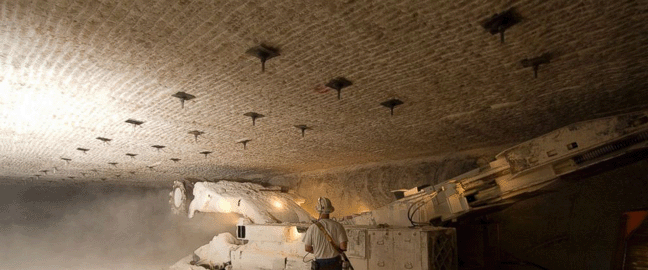
US nuke waste repository in New Mexico will get more space, abc news, By SUSAN MONTOYA BRYAN, ASSOCIATED PRESS, ALBUQUERQUE, N.M. — Oct 17, 2017, Workers are expected to begin mining operations at the U.S. nuclear waste dump in New Mexico for the first time in three years following a radiation release that contaminated part of the underground repository, the Energy Department said Tuesday.
The work to carve out more disposal space from the ancient salt formation where the repository is located will begin later this fall and should be completed by 2020, the department said in a statement.
Workers will remove more than 112,000 tons (101,605 metric tons) of salt, making way for seven disposal rooms. Each will have space for more than 10,000 drums containing up to 55 gallons (208 liters) of waste.
The repository, named the Waste Isolation Pilot Plant, began accepting shipments of radioactive waste from defense sites and national laboratories earlier this year after being closed for nearly three years.
It’s working to catch up with the nation’s multibillion-dollar program for cleaning up tons of waste left behind by decades of bomb-making and nuclear research. The waste includes radioactive tools, gloves, clothing and other debris.
Trump Plan for Coal, Nuclear Power Draws Fire From Environmental, Oil Groups
Critics from factions often at odds are calling Trump administration’s proposal a bailout for struggling power plants, By Timothy Puko Oct. 22, 2017 WASHINGTON—A Trump administration proposal aimed at shoring up coal-fired and nuclear power plants across the nation has generated opposition from an array of energy and consumer interests, including some who are often at odds on energy policy.
EPA’s climate change website reappears, missing the word ‘climate’, Mashable, BY ANDREW FREEDMAN, On April 28, the Environmental Protection Agency (EPA) abruptly took down its long-standing treasure trove of online climate change resources, and put up a message stating that they were being updated to reflect the new priorities of the Trump administration.
It’s becoming more and more clear that one of those priorities is to downplay the threat of climate change. And one way way to do that is to ignore it altogether.
To that end, on Friday, a group that monitors federal websites for changes in climate change content reported that the some of the climate websites taken down in April have returned to the EPA’s site, with all references to climate change removed.
According to the Environmental Data and Governance Initiative’s website monitoring group (EDGI), an EPA website that previously offered climate and energy resources for state, local, and tribal governments has been stripped of its references and links to climate science and policy. Prior to April 28, the site had contained programs and tools to assist these government entities in becoming more energy efficient, using more renewable energy, and developing climate change policies.
Instead, that main site is now a page on “energy resources,” including a “Clean Energy Finance Tool,” Energy Information Administration state reports, newsletters, and other resources with links to previously existing EPA climate sites removed as well. The new webpage, which went online in late July, but was just analyzed in detail on Friday, omits about 15 mentions of the word “climate” from the main page for local governments.
“Large portions of climate resources that were formerly found on the previous website have not been returned, and thus have ultimately been removed from the current EPA website,” the EDGI web monitoring group stated.
he EPA’s voluminous climate change website had previously been maintained under both Republican and Democratic administrations dating back at least to the first Bush administration, and it had served as a valuable tool for teachers and students, researchers, and government officials looking for data and advice on climate resilience efforts.
However, the site has become another casualty of an administration that appears hellbent on erasing as much climate science and climate policy from the books as possible.
Since becoming EPA administrator, Scott Pruitt has pursued an aggressive agenda of dismantling the Obama administration’s climate change regulations, culminating in his action on Oct. 10 to withdraw the Clean Power Plan, which would limit greenhouse gas emissions from power plants.
Pruitt has said he doesn’t believe that science shows greenhouse gases from burning fossil fuels are the main cause of global warming, even though scientific evidence demonstrates exactly that link.
As talks of military confrontation between the US and North Korea continue to escalate, Today Show host Matt Lauer raised an incredible question: What if White House officials really did have to physically stop President Donald Trump from starting a nuclear war?
As ridiculous as the idea may seem, there have been reports circulating in which WH aides suggest that Chief of Staff John Kelly and Secretary of Defense James Mattis may have formulated a plot to physically apprehend Trump before he reaches the nuclear football.
These reports inspired Lauer to ask Brennan the following:
“I feel weird asking you this, but you’ve read the same stories I’ve read. You know the key players around the president in Mattis, Mcmaster and John Kelly. Stories are going around out there that if the president inches closer to some kind of a nuclear confrontation with North Korea, that those guys are going to do something. They’re going to lock him in a room. They’re going to tackle him. You’re smiling. But these are the stories that are out there. And they will prevent him from carrying out any action that would cause that. Is that all nonsense?”
Despite the preposterous, slapstick image that Lauer’s question conjures up — Kelly or Mattis leaping like an NFL safety at Trump while he’s mid-nuclear launch — the always professional Brennan calmly clarified that the president alone has “unilateral authority” on military action. The former CIA director said Mattis’ options for protest include trying to talk the president out of it or tendering his resignation — the possibility of tackling Trump was not a listed option, though.
When asked whether or not he would follow unethical orders from his authorities, Brennan said that in certain cases — such as a command to bring back waterboarding — he would choose getting fired over following directives.
As for the Mattis, Kelly, and H.R. McMaster, Brennan commended all of them, saying, “They’re patriots… They understand the gravity of this situation, and I don’t think Trump does.”