Trump team drawing up fresh plans to bolster US nuclear arsenal Congress and US allies briefed on progress of Nuclear Posture Review Pence: ‘There’s no greater force for world peace than the US nuclear arsenal’, Guardian, Julian Borger 29 Oct 17,
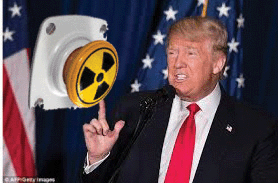
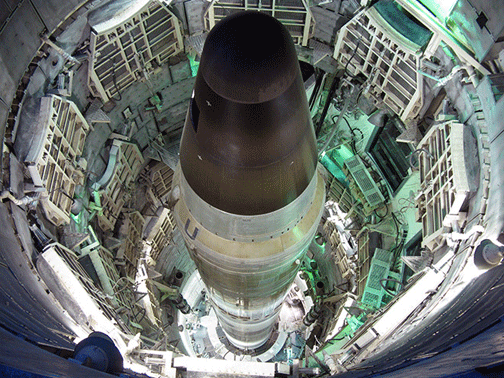
The Trump administration is working on a nuclear weapons policy that is intended to mark a decisive end to the era of post-cold war disarmament, by bolstering the US arsenal and loosening the conditions under which it would be used.
A draft of the new Nuclear Posture Review (NPR) was presented in September at a White House meeting between Donald Trump and his top national security advisers. Congress and US allies have been briefed on the progress of the new draft.
The document is still being debated with a target for completion by the end of this year or the beginning of next. Among the new elements under consideration are a low yield ballistic missile intended primarily to deter Russia’s use of a small nuclear weapon in a war over the Baltic states; a sea-launched cruise missile; a change in language governing conditions in which the US would use nuclear weapons; and investments aimed at reducing the time it would take the US to prepare a nuclear test.
Trump has frequently voiced his intention to build up the US arsenal. According to one report, he was outraged at a meeting with military leaders in July when he was shown a downward sloping graph of the US weapons stockpile since the cold war, and had to be talked out of ordering a tenfold increase.
The White House denied the report but it has repeatedly made clear it aims to adopt a more aggressive nuclear stance………
Like much else about Trump’s presidency, the new policy is aimed at erasing the legacy of his predecessor. Barack Obama began his administration with a major speech in Prague in April 2009, committing the US to disarmament and the eventual elimination of nuclear weapons globally………
On Thursday, Christopher Ford, special assistant to the president on weapons of mass destruction and counterproliferation, told a meeting on nuclear threats organised by the Ploughshares Fund: “The traditional post-cold war approach of seeking to demonstrate disarmament bona fidesby showing steady numerical movement towards elimination, while trying to avoid steps that could actually undermine US national security, has largely run its course and is no longer tenable, especially given evolving security conditions.
“So it’s time to explore alternative approaches – and we are.”
Ford did not provide further details, as he said the NPR was still being worked on. Several sources briefed on its progress said elements under consideration include:
A low-yield ballistic missile, possibly using the Trident D5 missile but using only the first, fission, part of its two-stage warhead.
Bringing back nuclear Tomahawk sea-launched cruise missiles, which were dropped from the arsenal in 2013.
Reducing the lead time the US would need to resume nuclear testing from its current level of three years.
A relaxation of constraints laid down in Obama’s 2010 NPR, which pledged the US would only used its nuclear weapons in “extreme circumstances to defend the vital interests of the United States or its allies and partners” and never against non-weapons states in compliance with their non-proliferation obligations.
Any change in the US arsenal would have to be approved by Congress, which controls the funding for the nuclear weapons programme and which is already concerned that its ballooning cost is eating away at conventional capabilities.
Democrats push bill to stop a Trump pre-emptive strike on North Korea
Conyers-Markey legislation has two Republican backers in House
President’s threat to ‘totally destroy’ North Korea fuelled nuclear war fears, Guardian, Julian Borger 27 Oct 17, Congressional Democrats have introduced legislation aimed at preventing Donald Trump from launching a pre-emptive attack on North Korea, as concerns grew about the administration’s failure to explore talks with Pyongyang.
The new legislation prohibiting an attack on North Korea without congressional authority was launched by Democrats John Conyers in the House and Ed Markey in the Senate. It has two Republicans among the 61 backers in the House, but at present no formal Republican backing in the Senate.
“As a veteran of the Korean war, I am ashamed that our commander-in-chief is conducting himself in a reckless manner that endangers our troops stationed in South Korea and our regional allies,” Conyers said.
“President Trump’s provocative and escalatory rhetoric, with threats to unleash ‘fire and fury’ and ‘totally destroy’ North Korea, cannot be allowed to turn into reality,” Senator Markey said. “As long as President Trump has a Twitter account, we must ensure that he cannot start a war or launch a nuclear first strike without the explicit authorization of Congress.”
The bill’s supporters acknowledge that it will not pass without attracting more Republican support, but they argue that it helps focus attention on the unlimited authority of a US president to order the use of nuclear weapons, many of which can be launched within a few minutes. No official has the power to stop or even delay the launch.
Senator Dianne Feinstein, speaking at a conference organised by the Ploughshares Fund, an non-proliferation advocacy group said she once asked a former head of US Strategic Command if he would carry out a launch order even if he knew it was a catastrophically bad decision. “He looked me straight in the eye and said: Yes,” Senator Feinstein recalled……..
Ted Lieu, the Democratic congressman who co-authored the bill in January to limit the president’s power to launch a first strike said the best recruiter for Republican support was Trump’s behaviour.
To shore up the INF, the United States could propose something the Russians have already advocated—that the INF Treaty be expanded to ban this category of ballistic missiles globally.Such a move would not immediately apply to the most troubling nuclear-tipped missiles, those with ranges far in excess of 1,000 kilometers. But a worldwide INF could be a first step toward an eventual goal of banning all ballistic missiles.
Ballistic missiles have beneficial purposes; they place satellites in orbit, and those satellites provide the world with vital communications capabilities and navigation and weather information. Ballistic missiles send astronauts and space stations into Earth orbit and research probes far across the solar system.
But ballistic missiles armed with nuclear warheads are enablers of apocalypse. There is no effective defense against these missiles, even though the United States has spent more than 30 years and $500 billion trying to build radars that can track them and interceptor missiles that will shoot them down.
Military ballistic missiles have other negative characteristics. The short time needed for them to reach target (if the United States and Russia are the assumed combatants, 10 to 30 minutes) creates pressure to launch first in a conflict. In a crisis, ballistic missiles on high alert can wind up becoming the leading edge of a devastating war begun by miscalculation.
Because of the obvious dangerousness of ballistic missiles, there is a long history of official efforts to limit or eliminate them. Those efforts have shown that agreements to reduce the dangers of ballistic missiles can catalyze improved relations between potential adversaries. The landmark 1987 Intermediate-Range Nuclear Forces (INF) treaty required Washington and Moscow to eliminate all ballistic missiles with ranges between 500 and 1,000 kilometers. Both nations recognized that these missiles could not be defended against and their proximity to the Cold War boundaries of Europe meant they were highly destabilizing in a crisis. A total of 2,692 missiles (including a small number of cruise missiles) were eliminated under the treaty.
Acknowledging the danger of nuclear ballistic missiles, President Reagan proposed an agreement requiring their total elimination to Soviet leader Gorbachev at their summit in Reykjavik, Iceland in 1985. The Soviets did not accept the proposal because Reagan insisted that America’s program to build missile defenses remain unconstrained. That program—known then as the Strategic Defense Initiative and today as the National Missile Defense Program—has yet to develop effective means to defeat ballistic missiles.
In the mid 1990s, Alton Frye, then Washington director of the US Council on Foreign Relations, advocated an international ban on offensive ballistic missiles, an idea whose time has perhaps come again. Many political and technical challenges would need to be addressed to negotiate and enforce new international limitations on ballistic missiles. But model institutional and scientific mechanisms for such efforts exist in the form of preceding treaties, including INF and New START. Procedures and technologies for inspection, verification, and enforcement of agreements limiting or banning all types of ballistic missiles have already been proven. Political will, as usual is the major missing ingredient.
While Perry proposes to eliminate only land-based ballistic missiles and retain submarine-based missiles, such a move could create powerful international momentum to negotiate new international limits or bans on certain types of ballistic missiles—with an ultimate goal of banning all nuclear-armed ballistic missiles. If a united international community were to seriously consider such a course, it could bring increased pressure on North Korea, Iran, and other nations to suspend or roll back their offensive ballistic missile programs. If they refused, the possibility of using military force against their nuclear and ballistic missile programs would gain legitimacy and support.
One place to start seeking new limits on ballistic missiles has been in the news for months: the INF Treaty, which the United States and Russia have accused one another of violating. Russia’s support of the treaty has weakened over the years because it is forbidden to deploy ballistic missiles with ranges between 500 and 1,000 kilometers, but its neighbors who are not party to the treaty are permitted to do so. China has many such missiles, and Turkey, South Korea, and Japan could develop them in the future. To shore up the INF, the United States could propose something the Russians have already advocated—that the INF Treaty be expanded to ban this category of ballistic missiles globally.
Such a move would not immediately apply to the most troubling nuclear-tipped missiles, those with ranges far in excess of 1,000 kilometers. But a worldwide INF could be a first step toward an eventual goal of banning all ballistic missiles. A renewed focus on the danger of these weapons—accompanied by US statements that it is willing to eliminate its land-based ICBMs under the right conditions—might elicit greater support from Russian and China in efforts to defuse the North Korean crisis and control Iranian missile testing.
Like the nuclear weapons ban treaty the UN recently adopted, a ballistic missile ban would require sustained, long-term effort to achieve anything like full success. But the United States has everything to gain from taking a leadership role and asserting that offensive ballistic missiles are dangerous and destabilizing weapons that should eventually be eliminated from the arsenals of all nations.
Pentagon Chief Mattis Stresses Diplomacy in North Korea Crisis, NBC News , by ASSOCIATED PRESS, 27 Oct 17 PANMUNJOM, Korea — On his first visit to the tense but eerily quiet frontier between North and South Korea as U.S. secretary of defense, Jim Mattis conveyed the message he hopes will win the day: Diplomacy is the answer to ending the nuclear crisis with the North, not war.
Non-partisan analysis reveals the cost of energy secretary Rick Perry’s proposal to give handouts to some of the country’s oldest and dirtiest power plants, Guardian, Oliver Milman, 27 Oct 17, A Trump administration plan to subsidize coal and nuclear energy would cost US taxpayers about $10.6bn a year and prop up some of the oldest and dirtiest power plants in the country, a new analysis has found.
The Department of Energy has proposed that coal and nuclear plants be compensated not only for the electricity they produce but also for the reliability they provide to the grid. The new rule would provide payments to facilities that store fuel on-site for 90 days or more because they are “indispensable for our economic and national security”.
Rick Perry, the energy secretary, said the subsidies were needed to avoid power outages “in times of supply stress such as recent natural disasters”.
The plan would provide a lifeline to many ageing coal and nuclear plants that would otherwise go out of business, primarily due to the abundance of cheap natural gas and the plummeting cost of renewables.
The Department of Energy noted 531 coal-generating units were retired between 2002 and 2016, while eight nuclear reactors have announced retirement plans in the past year.
Donald Trump has vowed to arrest this decline and end the “war” on mining communities by repealing various environmental regulations put in place during the Obama administration.
Perry’s pro-coal market intervention would cost taxpayers as much as $10.6bn a year over the next decade, according to a joint analysis by the non-partisan groups Climate Policy Initiative and Energy Innovation. Just a handful of companies, operating about 90 plants on the eastern seaboard and the midwest, would benefit from the subsidies, the report found.
“The irony of putting costs on consumers for resources that are no longer competitive is really striking,” said Brendan Pierpoint, energy finance consultant at Climate Policy Initiative. “It would serve to keep a lot of uneconomic plants in the market that currently can’t compete with the changing dynamics of cheap gas and the falling cost of renewables.”
The Trump administration has raised concerns that the growth of intermittent wind and solar energy could undermine the so-called “baseload” power provided by coal and nuclear, pointing to power outages during the Polar Vortex cold wave that swept over North America in 2014.
However, recent studies of the grid have found that it has not been weakened by the loss of coal and nuclear plants and is barely affected by power outages. Also, coal-fired plants are not immune to natural disasters, with facilities going offline during the Polar Vortex and Hurricane Harvey, which hit Texas this year.
An unlikely alliance of renewable energy advocates and the American Petroleum Institute has complained that Perry’s plan tips the scales in favor of a failing coal industry and has vowed to fight the proposal. The rule would also jar with the supposed free market principles of an administration that has attacked subsidies for wind and solar, as well as intervention in healthcare insurance markets.
“Perry’s obsession with propping up these expensive, dirty facilities will cost Americans real money,” said Mary Anne Hitt, a campaigner at the Sierra Club.
“These ageing coal plants are making Americans sick, and now Secretary Perry wants to force us to pay tens of billions of dollars to Wall Street to keep them running, so they can continue polluting our air and water.”
Perry’s plan has to be approved by the Federal Energy Regulatory Commission (FERC), which is housed within the Department of Energy but is an independent agency. Two of FERC’s three commissioners were appointed by Trump, with one,Neil Chatterjee, already voicing support for subsidizing coal and nuclear. Perry has asked for a ruling on his request by 27 November.
The aggressively pro-fossil fuels stance of the Trump administration has been advanced elsewhere this week, with the House of Representatives approving a budget plan that would open the way for oil drilling in a vast Arctic wildlife refuge in Alaska.
Meanwhile, the interior department has released a plan to sweep away the regulatory “burdens” that slow down or prevent mining and drilling on public lands.
US Military Strike Against North Korea Pose Risk Of ‘Unacceptable War’: Expert, International Business Times, BY SUMAN VARANDANI@SUMAN09A mid the ongoing tensions in the Korean Peninsula of a possible nuclear threat from North Korea, the United States had said that further provocation from Pyongyang could result in a preventive military strike. However, a renowned American expert on the North Korean issue has told Yonhap News Agency that the U.S. would not remove all of North Korea’s nuclear and ballistic missile capabilities.
“A preventive military strike would not destroy all of North Korea’s capabilities. It would risk a wider war that would inflame South Korea and Japan and potentially cause millions of casualties,” Michael Green, vice president for Asia at the Center for Strategic and International Studies (CSIS), said last week in Washington, D.C., in his meeting with South Korean journalists.
Green proposed economic sanctions as the most viable tool to end North Korea’s nuclear weapons program. While mentioning about other ways in which the U.S. military strike could backfire, Green said: “It would also threaten the U.S. because North Korea has an ability even without ballistic missiles to transfer nuclear weapons to terrorist groups, so a preventive military strike would not get all of North Korea’s nuclear capabilities and would risk an unacceptable war.”
Green also claimed that diplomatic negotiations with Pyongyang would also not yield any concrete result as to stopping the Kim Jong Un regime’s nuclear advancement, given the country’s track record of breaking previous agreements.
“We shouldn’t end sanctions or military exercises in order to have dialogue with Pyongyang because then we will prove there’s no cost to North Korea for the path it’s on,” Green said, suggesting that the U.S. build “infrastructure of sustained consequence” for North Korea to facilitate diplomacy work with the regime. “We now have to restore deterrence and restore credibility if we have any chance in medium to long run diplomacy.”……http://www.ibtimes.com/us-military-strike-against-north-korea-pose-risk-unacceptable-war-expert-2605939
India-US nuke deal signed without ground work: Ex-US Senator PTI|Oct 26, 2017, WASHINGTON: The landmark India-US civil nuclear deal was “dead at the very beginning” as it was signed without ground work, a former top Republican Senator has alleged, describing the agreement as more of an “arms deal” for American defence manufacturing companies.
Former Senator Larry Pressler, who has served as chairman of the US Senate’s Arms Control Subcommittee, told a Washington audience that the deal was much-praised “but there is no chance of it being implemented as the liability issues have not been addressed and it has not been worked through.”
He said that the India-US civil nuclear deal “was dead at the very beginning.
Pressler said that there was “no groundwork done” in India or the US on the civil nuclear deal.
The India-US nuclear cooperation agreement was signed in October 2008, ending India’s isolation by the West in the nuclear and space arena. The deal has given a significant boost to India’s nuclear energy production.
Pressler was speaking at an event organised by The Hudson Institute, a top American think-tank, to discuss his latest book ‘Neighbours in Arms: An American Senator s Quest for Disarmament in a Nuclear Subcontinent’.
“…There was nothing to it really. If you look into it, it is more of an arms sale agreement,” he alleged.
Pressler claimed the then US president Barack Obama’s visit to New Delhi was “largely an arms sale trip”.
How a State Department Study Prevented Nuclear War With China, The U.S. considered preemptive strikes to prevent Mao from attaining nuclear weapons.The Diplomat By Franz-Stefan Gady, October 25, 2017, The People’s Republic of China (PRC) under Mao Zedong was the nuclear “rogue state” of the 1960s in the eyes of the United States. The PRC was viewed by officials in two consecutive U.S. administrations — John F. Kennedy and Lyndon B. Johnson — as both extremist and irrational, a country where the prevailing U.S. Cold War strategies of containment and deterrence would not apply. President Kennedy reportedly saw a nuclear China as “the great menace in the future to humanity, the free world, and freedom on earth.” Lyndon B. Johnson told a reporter in 1964 during the ongoing presidential campaign that “we can’t let [Barry] Goldwater [Johnson’s opponent] and Red China both get the bomb at the same time. Then the shit would really hit the fan.”
Given the possible disastrous consequences of a nuclear-armed PRC for the United States, both the Kennedy and Johnson administrations discussed the option of launching preventive strikes on Chinese nuclear weapon facilities. Amid these deliberations, a member of the U.S. Department of State’s Policy Planning Council, Robert H. Johnson, compiled two studies arguing that a nuclear China will not significantly alter the military balance of power in Asia and that, as a corollary, the United States would not need to take radical steps, including military action, in the foreseeable future. Johnson’s papers helped to broaden the discussion about possible policy options vis-à-vis China and may have contributed to the United States not launching a preventive attack on Chinese nuclear facilities in the early 1960s.
China: The Rogue State of the 1960s……..
The State Department Responds While Kennedy was considering preventive war against China’s nuclear weapons capability, several U.S. State Department officials grew skeptical about the White House’s alarmism and militancy. The then-head of the State Department’s Policy Planning Council (PPC), Walt Rostow, noted in July 1963 that even if Beijing developed nuclear weapons, its “desire to preserve its nuclear force as a credible deterrent might tend to make China even more cautious than it is today in its encounters with American power.” Rostow’s opinion was influenced by the first draft of a study titled “A Chinese Communist Nuclear Detonation and Nuclear Capability,” compiled by PPC staffer Robert H. Johnson in close cooperation with officials from the Pentagon, the CIA, the Arms Control and Disarmament Agency, and the U.S. Information Agency.
A 100-page version of the paper was distributed in October 1963 to select officials. It is unclear, however, whether Kennedy ever saw it. Its conclusion was distinctly non-alarmist. Most importantly, the report concluded that “apart from serving as an additional inhibition on some levels of U.S. attack upon the mainland, a Chinese nuclear capability need impose no new military restrictions on the U.S. response to aggression in Asia (…)” Even intercontinental ballistic missiles would not “eliminate this basic asymmetry.” Furthermore: “The basic military problems we will face are likely to be much like those we face now: military probing operations (…) relatively low-level border wars” and “‘revolutionary wars’ supported by the ChiComs [Chinese Communists].”
In short, the study suggested that the United States pursue status-quo policies vis-à-vis China (“present policies require no change”) anchored on nuclear deterrence.
The Impact
According to the scholars William Burr and Jeffrey T. Richelson, the study had an immediate impact……..
Robert H. Johnson’s reports helped accentuate the reasons against preventive war. They offered U.S. policymakers alternatives to more hawkish views on how to deal with a nuclear China. ……..
Considering the current U.S. administration’s disjointed responses to North Korea’s nuclear weapons program and the repeated talk of the possible necessity of military action, getting the government to “sing from the same sheet” on a very complex issue is no minor achievement. Indeed, our best hope may be that somewhere in the D.C. bureaucracy a 21st century incarnation of Johnson can get the ear of a senior administration official with access to U.S. President Donald Trump and offer a nuanced perspective on the nuclear standoff on the Korean Peninsula.
How Steve Bannon and Sean Hannity ginned up the Hillary Clinton uranium story, Pro-Trump conservatives want to talk about their own Russia narrative. The only problem is that it’s nonsense, Salon.com, MATT GERTZ, MEDIA MATTERS, 10.26.2017 This article originally appeared on Media Matters.
President Donald Trump has spent much of his presidency engulfed by congressional and criminal investigations into Russian efforts to help him win the 2016 presidential election. But today, Rep. Devin Nunes, R-Calif., the chairman of the House Intelligence Committee, announced he was joining a new congressional probe — one that appears to revolve around the purported Russian ties of Trump’s opponent in that race, former Secretary of State Hillary Clinton.
This is no accident. Like the work of the House Select Committee on Benghazi before it, this is a partisan investigation with a political purpose, with its roots in the conspiratorial muck of the right-wing media. But while the Benghazi probe — as Republican leaders eventually acknowledged — was an offensive push to damage Clinton’s political standing in the lead-up to the 2016 election, the new one is a defensive move aimed at protecting Trump by diverting attention to his former opponent. The effort’s loudest champion is Sean Hannity, the Trump propagandist and sometime adviser who has claimed for months that the “real collusion” with Russia revolves around a bogus conspiracy theory linking Clinton to the 2010 sale of the uranium mining company Uranium One to the Russian government.
The story begins with Breitbart.com head Stephen Bannon. In 2012, long before he became the Trump campaign’s chief executive and joined Trump’s White House as chief strategist, Bannon launched the Government Accountability Institute, a nonprofit conservative investigative research organization. Three years later, GAI’s president, the discredited author Peter Schweizer, authored the bestselling book “Clinton Cash.” The book, built on GAI’s research, alleged that Bill and Hillary Clinton “typically blur the lines between politics, philanthropy, and business.” It was a trainwreck of sloppy research and shoddy reporting but was heavily promoted by mainstream outlets thanks to a cunning media strategy overseen by Bannon and taken up by Trump during the campaign.
One of the book’s bogus allegations was Schweizer’s claim that Hillary Clinton played a “central role” in approving the purchase of Uranium One by the Russian State Atomic Nuclear Agency. Schweizer speculated that she did so because of the money given to the Clinton Foundation and her husband by Russians and people linked to the deal. But this made no sense, and several reporters assessing Schweizer’s claims rejected them. The State Department had one of nine votes on the committee that approved the deal; the State Department rep said Clinton never intervened on the issue; there were critical questions about the timing of the donations Schweizer referenced; and even Schweizer said he had no direct evidence Clinton had intervened.
The false allegations might have been forgotten in the wake of the election. But in January, the U.S. intelligence community announced that Russia interfered with the 2016 presidential election on the orders of Russian President Vladimir Putin, with the aim of harming Clinton’s campaign because “Putin and the Russian Government developed a clear preference for President-elect Trump.” Reporting from a host of news outlets ever since has suggested that Trump’s campaign aides and associates had a series of troubling interactions with Russians, triggering congressional investigations and eventually a criminal probe by special counsel Robert Mueller. With Trump’s presidency hanging in the balance, his allies have searched for a way to rebut the charges.
Hannity eventually settled on the old “Clinton Cash”allegations. Claiming that there is no evidence to support what he terms “black-helicopter, tinfoil-hat conspiracy theories about so-called Trump-Russia collusion,” the Fox host declared that the “real collusion” is between Clinton and Russia, as demonstrated by the Uranium One tale. He pushed that argument over and over again to his audience of 3 million, making it in more than two dozen monologues over the summer.
Then a week ago, Hannity tweeted this: “FBI uncovered Russian bribery plot…”
Hannity was promoting a report by John Solomon, the executive vice president of The Hill, which purported to advance the Uranium One story. According to Solomon’s anonymous sources, “Russian nuclear officials had routed millions of dollars to the U.S. designed to benefit former President Bill Clinton’s charitable foundation during the time Secretary of State Hillary Clinton served on a government body that provided a favorable decision to Moscow.” Solomon provides no evidence that the Clintons were aware this was happening, and of course the underlying conspiracy theory that Clinton pushed the Uranium One deal through still makes no sense. But it’s something the right-wing press can use to try to shift attention away from Trump……
Feeding into the right-wing narratives about efforts by nefarious deep-state actors to tear down the president, Circa’s reporting received glowing reviews from Trump’s most conspiratorial supporters.
But Circa’s biggest fan is Hannity……..
Hannity heavily promoted Solomon’s story on his Fox show, devoting extensive segments to the “explosive” “bombshell” on the night it broke and the next twonights. He’s hosted Solomon, Carter, and Schweizer, harangued the rest of the press for not covering the story and declared Uranium One “one of the biggest scandals this country has ever seen.” And on the night the story broke, he made clear what he thought should happen next:
Hannity heavily promoted Solomon’s story on his Fox show, devoting extensive segments to the “explosive” “bombshell” on the night it broke and the next twonights. He’s hosted Solomon, Carter, and Schweizer, harangued the rest of the press for not covering the story and declared Uranium One “one of the biggest scandals this country has ever seen.” And on the night the story broke, he made clear what he thought should happen next:
And now Nunes — who had to recuse himself from Russia-related investigations earlier this year due to ethics charges that resulted from his effort to do the White House’s bidding and scuttle the Trump-Russia investigations — is taking a hand. At a press conference today, he announced that he would be launching an investigation into the Uranium One allegations. He will be working alongside the House Oversight Committee, helped by the former chairman of the Benghazi Committee, Rep. Trey Gowdy, R-S.C.
When there’s a congressional investigation into a Clinton, Fox knows how to respond:
“Fox programming is now basically 24/7 about Hillary Clinton and Uranium.”
The New York Times yesterday detailed how Republican congressmen, including Nunes and Gowdy, are trying to “wrap up the investigations” into Trump’s Russia ties as quickly as possible. “Congressional investigations unfortunately are usually overtly political investigations, where it is to one side’s advantage to drag things out,” Gowdy told the Times. He knows that from experience. A year into Trump’s presidency, egged on by sycophantic media allies like Hannity, the first congressional investigation into a Clinton has begun. It won’t end anytime soon. https://www.salon.com/2017/10/25/how-steve-bannon-and-sean-hannity-ginned-up-the-hillary-clinton-uranium-story/
Regulators absolve Duke Energy customers of lingering Levy costs, By Malena Carollo, Times Staff Writer, October 25, 2017 TALLAHASSEE— For Duke Energy Florida customers, the never-built Levy Nuclear Project is finally,officially behind them. Per a unanimous decision by regulators Wednesday, Duke customers, who have doled out nearly $1 billion for Levy costs from 2009 to 2015, will not have to pay any more.
“I think that this settlement as a whole benefits consumers and is ultimately in the public interest,” said Ronald Brisé, commissioner with the Florida Public Service Commission, at Wednesday’s hearing
“We feel like the cost of Levy being written off is a small price to pay for moving forward,” Harry Sideris, president of Duke’s Florida operations, said in an interview with the Tampa Bay Times in late August.
The nuclear elephant-in-the-room resulted from Progress Energy, Duke’s predecessor, asking ratepayers for money up front for a future nuclear facility in Levy County. It was intended to reduce energy costs going forward, and paying ahead of time would speed the process along.
Though ratepayers were charged the upfront costs, Duke pulled the plug on the project in 2013.
According to Duke representatives at the Wednesday PSC hearing, customers will also not be charged for the cost of the land that the facility was meant to be built on. It will be considered for potential solar or natural gas facilities.
The agreement also signals a significant shift toward use of solar power. Over the next four years, Duke will add 700 megawatts of solar power, about 75 megawatts of which will come online by early 2019.
Struggling Puerto Rico children’s hospital gets solar power from Tesla, http://abcnews.go.com/US/struggling-puerto-rico-childrens-hospital-solar-power-tesla/story?id=50721869By J.J. GALLAGHER Oct 25, 2017,A children’s hospital in Puerto Rico that was forced to run off generators and ration diesel fuel in the wake of Hurricane Maria now has a solar power system that will supply all of its electricity needs. Tesla and Puerto Rico’s governor touted the project yesterday, sending out multiple official tweets and Facebook posts, and officials said today that the system is already providing solar-generated electricity to the hospital.
The Hospital del Nino is located in the capital San Juan and serves about 3,000 children across the island. The hospital also houses some 30 children with serious medical needs that require round-the-clock care.
A hospital spokesperson told Primera Hora last month that they were forced to ration diesel fuel and take other measures to ensure a constant flow of electricity.
Hurricane Maria also knocked down all of the trees surrounding the hospital, resulting in heat from the withering tropical sun beating down on the building and its surroundings.
Tesla’s system works with solar panels that generate electricity during the day and batteries that store the power and distribute it when the sun isn’t shining. Earlier this month, Tesla CEO Elon Musk tweeted that his company could bring solar power to Puerto Rico. Puerto Rico Gov. Ricardo Rossello replied “let’s talk” and later said the two had a “great initial conversation.”
Less than three weeks later, officials say the hospital is up and running with a solar system that supplies all of its electricity needs.
“I’ve never seen a team arrive so fast and work so fast. They built this in a week,” Rafael Pagán, the hospital’s chairman of the board, told Telemundo.
Just 25 percent of Puerto Rico’s 3.4 million residents have electricity, according to the latest figures, and some 3,758 people are still in shelters nearly two months after Maria ravaged the island, causing widespread damages and killing 51 people.
Rossello has promised to fully restore electricity to the island by Christmas, a goal that analysts have cast doubt upon.
Repairing Puerto Rico’s badly damaged electrical grid could take months and cost billions of dollars. Musk has put forth his so-called solar microgrids, that produce energy locally through solar energy, as an alternative.
ABC News’ Joshua Hoyos contributed to this report.
Authors, Joanna Burger, K. F. Gaines, J. D. Peles, W. L. Stephens Jr., C. Shane Boring, I. L. Brisbin Jr., J. Snodgrass, A. L. Bryan, Jr., M. H. Smith, M. Gochfeld First published: June 2001
Abstract
This study examined radiocesium (137Cs) levels in fish from the vicinity of the Department of Energy’s Savannah River Site (SRS), a former nuclear weapons production facility in South Carolina. Fish from the Savannah River were sampled above (upstream), along, and below (downstream) the SRS, and from Steel Creek, a tributary that runs through the SRS. There was some off-site contamination of 137Cs in the Savannah River watershed due to low-level releases from past nuclear production on the SRS. The null hypotheses tested were that there would be no differences in 137Cs levels as a function of location along the river, and between species collected from the river and from Steel Creek on the SRS. For six of eight species of fish collected from the Savannah River, there were no differences in 137Cs levels in muscle from fish collected above, along, or below the SRS; exceptions were bowfin and shellcracker. Fish collected from Steel Creek had significantly higher levels (by about an order of magnitude) of 137Cs in muscle tissue than fish collected in the Savannah River. However, no fish from either Steel Creek or the Savannah River had 137Cs levels above the European Economic Community limit for fresh meat of 0.6 Bq/g. Lifetime cancer risk was calculated using the cancer slope factor of 3.2 × 10⁻¹¹/pCi, and various fish consumption scenarios reflecting actual data from Savannah River fishermen. Using mean 137Cs concentrations and median fish consumption for 70 years for Black males—the group with the highest consumption—the excess lifetime risk associated with the eight species of fish in the Savannah River ranged from 9.0 × 10⁻⁷ to 1.0 × 10⁻⁵. The same calculation for fish from Steel Creek gave risk estimates from 1.4 to 8.0 × 10⁻⁵. The 95% level for consumption by Blacks, however, was about 70 kg/year. Black fishermen consuming that amount of bass from Steel Creek would sustain a lifetime risk of 3.1 × 10⁻⁴, whereas the same consumption of Savannah River bass would yield a risk estimate of 1.5 × 10⁻⁵.
US Preparing to Put Nuclear Bombers Back on 24-Hour Alert, Defense One, BY MARCUS WEISGERBER OCTOBER 22, 2017 BARKSDALEAIRFORCEBASE, LA. — THE U.S. Air Force is preparing to put nuclear-armed bombers back on 24-hour ready alert, a status not seen since the Cold War ended in 1991.
That means the long-dormant concrete pads at the ends of this base’s 11,000-foot runway — dubbed the “Christmas tree” for their angular markings — could once again find several B-52s parked on them, laden with nuclear weapons and set to take off at a moment’s notice…….
Goldfein and other senior defense officials stressed that the alert order had not been given, but that preparations were under way in anticipation that it might come. That decision would be made by Gen. John Hyten, the commander of U.S. Strategic Command, or Gen. Lori Robinson, the head of U.S. Northern Command. STRATCOM is in charge of the military’s nuclear forces and NORTHCOM is in charge of defending North America……http://www.defenseone.com/threats/2017/10/exclusive-us-preparing-put-nuclear-bombers-back-24-hour-alert/141957/
National Day of Remembrance commemorating atomic energy workers RIVER BENDER.com October 24 2017 ST. PETERS, MO – Each year on Oct. 30th atomic energy workers across the nation are commemorated for the National Day of Remembrance. “……Many atomic energy workers unknowingly worked with hazardous chemicals and radiation without consent or proper protective gear during this construction. As a result, countless numbers of individuals are now sick or deceased because of occupational induced illnesses……… Today, the sacrificial work displayed by nuclear weapons workers for their nation and families is remembered……..
Atomic Resource Coalition (ARC) extends a thank you to all those who have served. The price that has been paid does not go a day unnoticed.
ARC is a 501(c)(3) non-profit corporation that assists and educates current and former atomic energy workers, as well as their family members, about the benefits which may be available to them under the Department of Labor’s Energy Employees Occupational Illness Compensation Program Act. Workers and survivors of workers that have been effected by an occupational illness at a nuclear weapons plant are encouraged to contact ARC to see if they qualify for medical benefits and/or monetary compensation. https://www.riverbender.com/articles/details/national-day-of-remembrance-commemorating-atomic-energy-workers-24387.cfm
“NO BAILOUT!” BACKLASH BUILDS: 10,000+ COMMENTS AGAINST NUCLEAR, COAL HANDOUTS TO BE DELIVERED TO FERC https://www.nirs.org/press/no-bailout-backlash-builds-10000-comments-nuclear-coal-handouts-delivered-ferc/Signers Oppose Crowding Out Renewables With “Old, Unsafe and Dying” Energy WASHINGTON, D.C.///October 11, 2017///More than 10,000 comments were submitted today for the record at the Federal Energy Regulatory Commission (FERC) in opposition to Trump Administration plans for the Commission to enact massive bailouts of the coal and nuclear industry at the expense of renewable energy and with the added downside of higher bills for consumers. The comments were delivered at 9 a.m. shortly after an 8:45 a.m. protest organized by the Nuclear Information and Resource Service (NIRS) outside the main entrance of FERC at 888 First St NE, Washington, D.C.
NIRS noted that the stakes for wind, solar, and the pocketbooks of U.S. ratepayers is very high. A November 2016 report by NIRS concluded that a federal bailout for nuclear alone could add up to $280 billion by 2030. When a major nuclear reactor project in South Carolina failed this year, ratepayers were left holding the bag for $9 billion or more—even though they will never see a single electron of electricity for their steep investment.
NIRS Executive Director Tim Judson said: “Survey after survey shows that Americans want more clean and safe renewable energy and there is very little support for perpetuating the old, unsafe and dying coal and nuclear industries. To artificially prop up these dirty energy industries and then to force consumers to pay the bill to enrich these already astonishingly profitable companies would have to rank as one of the most anti-environment and anti-consumer steps of the last 50 years.”
Most of the 10,000 individuals’ public comments to FERC submitted by NIRS read as follows:
“Call off your plans to promote coal and nuclear power, and commit to a transition to 100% clean, efficient, renewable energy. Nuclear and coal are two of the dirtiest, most polluting, dangerous, and uneconomical energy sources in the world.”
“If you really want to revive our economy, create jobs, revitalize local communities, and boost small businesses—then clean energy is the only way to go. Our green energy economy can keep the lights on and create millions more jobs than dirty energy could ever provide. Solar and wind are already creating twice as many jobs as coal and nuclear combined—that is ten times as many for the amount of energy generated, and at lower cost.”
“Renewable energy is now providing more electricity than nuclear power. Wind and solar are growing by leaps and bounds, are already cheaper than coal and nuclear, and will soon be the cheapest sources of power available.”