U.S. House to vote on non-nuclear Iran sanctions next week
Patricia Zengerle WASHINGTON (Reuters) 21 Oct 17, – The U.S. House of Representatives will vote next week on new sanctions on Iran’s ballistic missile program and on Lebanon’s Iran-backed Hezbollah militia, senior House Republicans said on Friday, seeking to take a tough line against Iran without immediately moving to undermine the international nuclear deal.
President Donald Trump defied both allies and adversaries on Oct. 13 by refusing to certify that Iran is complying with an international agreement on its nuclear program, and threatened that he might ultimately terminate the accord.
That threw the fate of the agreement between Iran, the United States and other world powers into the hands of Congress, by opening a 60-day window in which Congress could reimpose, or
“snap back,” sanctions on Iran’s nuclear program that were lifted under the agreement.
However, many of Trump’s fellow Republicans – who all opposed the deal reached under former Democratic President Barack Obama – have said they see no immediate need to do so.
Congressional aides said that, for now, House lawmakers are focusing on clamping down on Iran in other ways such as the missile and Hezbollah sanctions……https://www.reuters.com/article/us-iran-nuclear-congress/u-s-house-to-vote-on-non-nuclear-iran-sanctions-next-week-idUSKBN1CP2A7
Defense Nuclear Facilities Safety Board – (nuisance to the nuclear industry) to be got rid of?
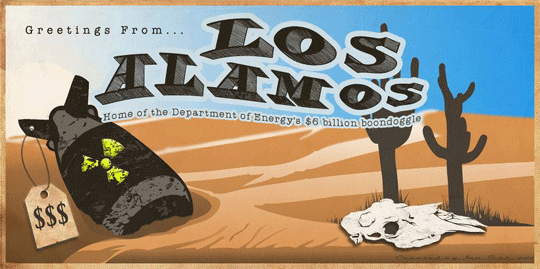 Efforts underway to remove ‘redundant’ nuclear safety board, Santa fe – New Mexican , By Rebecca Moss | The New Mexican, Oct 19, 2017
NBC News poll shows that three quarters of Americans fear that Trump is leading them into war
Three-quarters of Americans think Trump is going to lead them into war http://www.independent.co.uk/news/world/americas/us-politics/trump-war-poll-americans-think-president-lead-conflict-a8009401.html

Unlike the President, most Americans don’t think diplomacy is a waste of time, Andrew Buncombe New York ,@AndrewBuncombe
U.S. threats of war with North Korea are ‘dangerous and short-sighted’ – Hillary Clinton
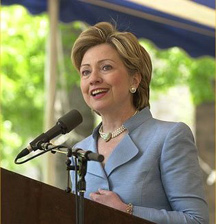 Hillary Clinton says US threats of war with North Korea are ‘dangerous and short-sighted’, Express UK, 19 Oct 17, HILLARY Clinton has declared that “cavalier” threats to start war on the Korean peninsula were “dangerous and short-sighted”, urging the United States to get all parties to the negotiating table.
Mrs Clinton told the World Knowledge Forum in the South Korean capital of Seoul: “There is no need for us to be bellicose and aggressive (over North Korea).”
Tension between Pyongyang and Washington has soared following a series of weapons tests by North Korea and a string of increasingly bellicose exchanges between US President Donald Trump and North Korean leader Kim Jong Un.
Mrs Clinton said, without mentioning Mr Trump by name: “Picking fights with Kim Jong Un puts a smile on his face.”
Ms Clinton also indirectly referred to Trump’s social media comments on North Korea, saying, “The insults on Twitter have benefited North Korea, I don’t think they’ve benefited the United States”…….. http://www.express.co.uk/news/world/868114/Hillary-Clinton-US-threats-of-war-North-Korea-dangerous-short-sighted
North Korea’s belligerant response to USA-South Korea military drills
North Korea warns US of ‘unimaginable’ nuclear strike http://thehill.com/policy/defense/356166-north-korea-warns-us-of-unimaginable-nuclear-strike, BY OLIVIA BEAVERS – 10/19/17 North Korea is warning that the United States will face an “unimaginable” nuclear strike for conducting ongoing joint naval drills with the South Korean military on the Korean peninsula.
“The U.S. is running amok by introducing under our nose the targets we have set as primary ones,” the state-controlled news agency KCNA warned Thursday, Newsweek reported. “The U.S. should expect that it would face unimaginable strike at an unimaginable time.”
KCNA also reportedly blamed the U.S. for “creating tension on the eve of war” by participating in civilian evacuation drills in South Korea over the weekend.
The remarks come amid escalating tensions between Washington and Pyongyang.
President Trump has recently stepped up his rhetoric against North Korea and leader Kim Jong Un, whom he’s dubbed “Little Rocket Man.”
During his first address to the United Nations General Assembly last month, Trump threatened to “totally destroy North Korea” if it continued to threaten the U.S. and its allies.
The high-stakes war of words comes after North Korea conducted a series of intercontinental ballistic missile and nuclear tests to display its progress toward developing a nuclear missile capable of striking the U.S.
Trump administration set to unravel protection rules on ionising radiation?

EPA Says Higher Radiation Levels Pose ‘No Harmful Health Effect’, Bloomberg, By Ari Natter,
- Trump administration guidelines may be prelude to easier rules
“The position taken could readily unravel all radiation protection rules.” https://www.bloomberg.com/news/articles/2017-10-16/epa-says-higher-radiation-levels-pose-no-harmful-health-effect
FACT CHECK: Did Hillary Clinton Tell FBI’s Mueller to Deliver Uranium to Russians in 2009? ‘Secret Tarmac Meeting’?
 Did Hillary Clinton Tell FBI’s Mueller to Deliver Uranium to Russians in 2009 ‘Secret Tarmac Meeting’? Snopes, 19 October 17,
Hyperpartisan web sites mischaracterized a State Department cable alerting the U.S. Embassy in Russia of a transfer of criminal evidence obtained in a sting operation.
CLAIM: Then-Secretary of State Clinton ordered then-FBI Director Robert Mueller to deliver highly enriched uranium to the Russians in a secret plane-side meeting in 2009.
WHAT’S FALSE: There was nothing nefarious in the transfer of the ten-gram sample, which was done at the request of Russian law enforcement and with the consent of the government of Georgia, whose agents had participated in its confiscation.
ORIGIN: In May and June 2017, a number of hyperpartisan news and opinion web sites published articles reporting that former Federal Bureau of Investigation director Robert Mueller, who in mid-May was named special counsel in the Justice Department’s investigation into alleged ties between the Trump presidential campaign and Russian officials, was himself enmeshed in “secret dealings” with Russia related to his 2009 delivery of a sample of highly enriched uranium (HEU) to Moscow ordered by Hillary Clinton.
The conspiracy web site Intellihub noted that the transfer was revealed in a WikiLeaks release of a classified State Department cable:
Former Secretary of State Hillary Clinton facilitated the transfer a highly enriched uranium (HEU) previously confiscated by the U.S. Department of Energy (DOE) during a 2006 “nuclear smuggling sting operation involving one Russian national and several Georgian accomplices,” a newly leaked classified cable shows.
So-called “background” information was provided in the cable which gave vague details on a 2006 nuclear smuggling sting operation in which the U.S. government took possession of some HEU previously owned by the Russians.
The secret “action request,” dated Aug. 17, 2009, was sent out by Secretary of State Clinton and was addressed to the United States Ambassador to Georgia Embassy Tbilisi, the Russian Embassy, and Ambassador John Beyrle. It proposed that FBI Director Robert Mueller be the one that personally conduct the transfer a 10-gram sample of HEU to Russian law enforcement sources during a secret “plane-side” meeting on a “tarmac” in the early fall of 2009.
The WikiLeaks release was announced via Twitter on 18 May, the day after Mueller was appointed special counsel:
……….Intellihub characterized the plane-side transfer of uranium “shocking” and “rather reminisce [sic] of the infamous [then-Attorney General] Loretta Lynch/Bill Clinton meeting which occurred on a Phoenix, Arizona, tarmac back in June of 2016” (which meeting was cited by former FBI Director James Comey as the reason he concluded the Department of Justice wasn’t capable of an independent investigation into Hillary Clinton’s e-mail issues at the State Department).
Read in its entirety, however, the cable itself reveals nothing questionable or nefarious about the transfer of evidence between Mueller and a similarly placed Russian law enforcement official in Moscow. It merely asked the U.S. Embassy in Moscow to inform the Russian government that the transfer, which was postponed from an earlier date, would take place on 21 September 2009.
Moreover, it provided a complete explanation of why the transfer was taking place:…….
The 2006 sting operation was widely reported after the fact by U.S. newspapers, including the Washington Post:
Republic of Georgia authorities, aided by the CIA, set up a sting operation last summer that led to the arrest of Russian man who tried to sell a small amount of nuclear-bomb grade uranium in a plastic bag in his jacket pocket, U.S. and Georgian officials said.
The operation, which neither government has publicized, represents one of the most serious cases of smuggling of nuclear material in recent years, according to analysts and officials.
Despite partisan attempts to make it appear conspiratorial, the transfer of the sample of confiscated uranium was simply an instance of cooperative law enforcement between three countries: the U.S., Georgia, and Russia. The Russia government requested a sample of the uranium for forensic testing, the Georgian government signed off on it, and the U.S. government carried out the delivery.
The total amount of HEU confiscated in the sting was 3.5 ounces (about 100 grams). The amount Mueller delivered to the Russians was ten grams (the weight of four U.S. pennies). https://www.snopes.com/hillary-clinton-robert-mueller-uranium/
Abolish nuclear safety agency – secret advice from its chair, Sean Sullivan, to President Trump !

 GOP chair of nuclear safety agency secretly urges Trump to abolish it https://www.publicintegrity.org/2017/10/19/21217/gop-chair-nuclear-safety-agency-secretly-urges-trump-abolish-it
Proposal follows radiation mishaps and exposures; Dems oppose the move, By Patrick Malone
 emailR. Jeffrey Smithemail, 20 Oct 17,
Economically, the nuclear industry is in collapse
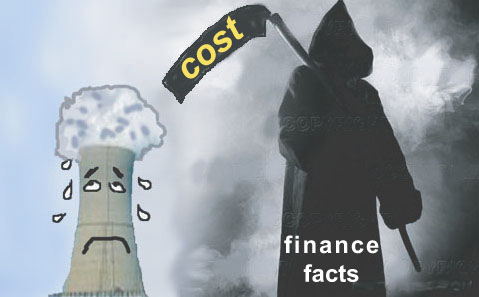
Bulletin of Atomic Scientists 17th Oct 2017, Mark Cooper: In 2008, the “nuclear renaissance” hype was in full swing. South Carolina was one of the first states to hop on the bandwagon. Public
and investor-owned utilities rushed to sign a contract for two new reactors at the V. C. Summer nuclear station before the design for the Westinghouse AP1000 reactors was finalized, to avoid the price run-up that was expected to occur when orders for dozens of reactors were signed.
There was no rush of orders, but there were 17 formal revisions before the design was
finalized, and perhaps many hundreds more made in a more informal manner.
Adecade later, the nuclear industry is in shambles. Billions of dollars were spent on the two now-abandoned reactors at V. C. Summer, and only two other reactors remain under construction, at a plant in Georgia. The South Carolina reactors were so far behind schedule and over budget that they
triggered the bankruptcy of the reactor vendor (Westinghouse), the near-bankruptcy of its corporate parent (Toshiba), and the resignation of the CEO of the utility (Santee Cooper) that owns 45 percent of the V. C. Summer project.
The nuclear industry’s collapse is stunning, but it should come as no surprise. This is exactly what happened during the first round of nuclear construction in the United States, in the decade between
1975 and 1985. History is repeating itself because of a dozen factors and trends that render nuclear power, new and old, inevitably uneconomic.
https://thebulletin.org/dozen-reasons-economic-failure-nuclear-power11196
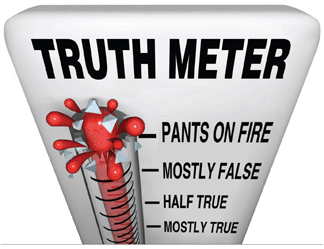
Politifact rates Nikki Haley Mostly False on her claim that Congress had no input on Iran nuclear deal

 Haley wrongly says Congress had no input on Iran nuclear deal, Politifact, By Allison Colburn Defending President Donald Trump’s decision to decertify the Iran nuclear deal, United Nations ambassador Nikki Haley said Congress now has a voice on the issue that it didn’t have in the past.
Trump’s decision allows Congress to potentially kill the agreement or tack on new conditions………
Here, we are fact-checking Haley’s claim that Congress was “never allowed” to debate or discuss the agreement.
Much of the responsibility for U.S. foreign policy falls under the authority of the executive branch. Congress does play a significant role, however, in foreign trade and commerce, immigration, foreign aid, the defense budget and any declarations of war. The Senate authorizes treaties and confirms the president’s cabinet nominees.
To avoid needing Senate approval for an agreement with a foreign power, the president can simply avoid calling the agreement a treaty. The Obama administration said the Iran deal was neither a treaty nor an executive agreement. Instead, the State Department said in a letter that the deal “reflects political commitments” between the seven nations involved.
When the president negotiates a deal that is not deemed a treaty, Congress — if it wants a say on the deal — must convince the president to give the legislative branch the power to approve or block the final deal.
That’s exactly what Congress did when it passed the Iran Nuclear Agreement Review Act of 2015, a bill that had bipartisan support and allowed Congress the right to review any agreement reached in the negotiations. Obama initially threatened to veto the bill but did not.
Senators considered a separate, and ultimately unsuccessful, measure that would have given them the the power to block the agreement through a resolution of disapproval. A procedural vote on the resolution fell short of the 60 votes needed to override a Democratic filibuster.
Despite the resolution’s failure, by passing the Iran Nuclear Agreement Review Act, Congress was able to have some authority and say in the final agreement.
Sen. Bob Corker, R-Tenn., who spearheaded the bill, has touted the legislation for taking “power back from the president” and forcing the executive office to be transparent………
Haley said Congress was never allowed to debate or discuss the Iran nuclear agreement while Obama was in office.
Though Congress had to fight for the right to disapprove of the deal, the passage of the Iran Nuclear Agreement Review Act of 2015 allowed Congress to not only vote on the deal but to also hold public hearings and debate. The Senate ultimately did not have the votes to block the deal, but the act included a requirement for the president to frequently monitor Iran’s progress in meeting the agreement’s conditions.
So Congress did have input, even if Obama initially tried to avoid it.
We rate this claim Mostly False. http://www.politifact.com/truth-o-meter/statements/2017/oct/19/nikki-haley/haley-wrongly-says-congress-had-no-input-iran-nucl/
America’s EPA now deliberately obscuring the truth on ionising radiation and health
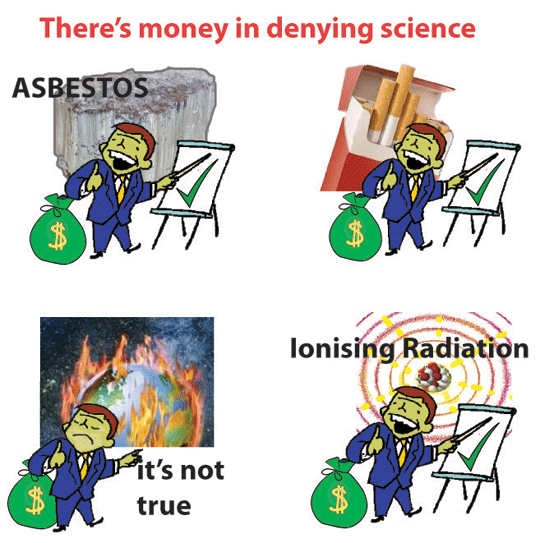
The EPA issued a public guidance in September, advising local officials to respond to a possible nuclear emergency by claiming that 5,000-10,000 millirems exposure “usually result[s] in no harmful health effects.” The watchdog group Public Employees for Environmental Responsibility (PEER) said past studies funded by the US government declared that level to be highly carcinogenic.
“National Research Council of the National Academy of Sciences, and EPA itself, have long estimated that 10,000 millirems could be expected to induce excess cancers in every 86th person exposed,” PEER said on Monday.
The non-profit criticized the agency for failing to cite which “radiation safety experts” it used to justify the declaration.
The EPA also didn’t say how long a human should be safe, when exposed to radiation at the 5,000-10,000 millirem range. It did note, however, that 75,000 millirem exposure “in a short amount of time (usually minutes too hours)” can cause acute radiation sickness.
“Although cancer has been associated with high doses of radiation received over short periods of time, the cancers usually do not appear for many years, even decades,” the guidance noted, ominously.
PEER Executive Director Jeff Ruch said the threshold cited by the agency could lead to a dangerous hands-off approach, should catastrophe strike.
“This signals that in the event of a Fukushima-type accident EPA will allow public consumption of radiation-contaminated drinking water for months,” Ruch said.
“Dr. Strangelove is alive and lurking somewhere in the corridors of EPA,” he added.
PEER noted that it is planning on suing the EPA to challenge the legality of the radiation exposure claims. The group said that the guidance violates the Safe Drinking Water Act.
The agency advice on radiation exposure–a supplement to a “Protective Action Guide”–was crafted, in its own words, “to help emergency planners prepare public communications prior to and during” radiological and nuclear emergencies.
In January, just before President Obama left office, the EPA issued the initial Protective Action Guide. It set the allowable threshold for the general population at 500 millirems, and the threshold for babies, children, and pregnant and nursing women at 100 millirems.
“Some commenters…believe the proposed PAG was too conservative and that EPA should consider establishing the PAG in the 2,000 to 10,000 [millirem] range,” the agency said in January, in the Federal Register.
PEER was critical of these limits, reacting to them by saying they also violated Safe Drinking Water Act rules.
“For decades, EPA had taken the position that ‘There is no known safe amount of radiation,’” the watchdog said on Monday.
USA would consider direct talks with North Korea, eventually – Deputy Secretary of State John J Sullivan
US OFFICIAL SAYS NOT RULING OUT EVENTUAL DIRECT TALKS WITH NORTH KOREA, Eye Witness News, 18 Oct 17,
Tension has soared following a series of weapons tests by North Korea and a string of increasingly bellicose exchanges between Donald Trump and Kim Jong Un. Reuters |
TOKYO/UNITED NATIONS – The United States is not ruling out the eventual possibility of direct talks with North Korea, Deputy Secretary of State John J Sullivan said on Tuesday, hours after Pyongyang warned nuclear war might break out at any moment.
Talks between the adversaries have long been urged by China in particular, but Washington and its ally Japan have been reluctant to sit down at the table while Pyongyang continues to pursue a goal of developing a nuclear-tipped missile capable of hitting the United States.
“Eventually, we don’t rule out the possibility of course of direct talks,” Sullivan said in Tokyo after talks with his Japanese counterpart……..http://ewn.co.za/2017/10/17/us-official-says-not-ruling-out-eventual-direct-talks-with-north-korea
Authorities always knew that nuclear fallout shelters would not work
 Nuclear Fallout Shelters Were Never Going to Work, History // OCTOBER 16, 2017 “…….[IN 1961] the federal government was devising a way for 50 million Americans to survive a nuclear war by scurrying to the nearest basement. The National Fallout Shelter Survey and Marking Program had begun……….
With North Korea’s intercontinental ballistic missiles, or ICBMs, pointed west and President Trump’s atomic sabre-rattling, fears of nuclear war have crept slowly back into the public consciousness. If the headlines rekindle some of the old unease about air-raid sirens and mushroom clouds, they’re also an occasion to consider a singular relic of the period that, oddly enough, never left us—the fallout-shelter sign.
Dented and faded now, the Kennedy-era signs still cling to the sides of buildings across the country. “They’re an enduring symbol of the Cold War,” says popular-culture historian Bill Geerhart, who since 1999 has maintained CONELRAD.com, a meticulous chronicling of the duck-and-cover era. “They outlasted everything, including the Berlin Wall. They’re tangible artifacts of that era.” And though their original purpose has vanished, the signs still have much to say. They are the products of an ill-conceived program, designed to appease a population with little faith in that program even working.
Kennedy was privately skeptical about the value of a public shelter program……. While fallout shelters would do nothing to safeguard people from an actual bomb, they would, in the words of JFK’s civil-defense chief Steuart L. Pittman, give “our presently unprotected population some form of protection.”……..
In fact, the untenability of the shelters was public knowledge before they had even opened. A November 1961 story on the front page of The Washington Post bemoaned that most of the designated shelters would be little more than “cold, unpleasant cellar space, with bad ventilation and even worse sanitation.”
Conditions were a serious problem, but location was a bigger one. Two-thirds of the fallout shelters in the U.S. were in “risk areas”—neighborhoods so close to strike targets that they’d likely never survive an attack in the first place. In New York, for example, most of the government shelters could be found in Manhattan and Brooklyn—despite the fact that a 20-megaton hydrogen bomb detonated over Midtown would leave a crater 20 stories deep and drive a firestorm all the way to the center of Long Island. Even out there, Life magazine said, occupants of a fallout shelter “might be barbequed.”……..
Anyone who read the newspapers understood not just that an inbound ICBM would leave them only 15 minutes, if that long, to get to a fallout shelter—but also that few structures in the city would survive a strike anyway. …….
Looking back on the civil-defense program in 1976, The New York Times observed: “the only reminders of fallout shelters [now] are the yellow-and-black signs placed outside buildings.”
That’s where thousands remain to this day—eerie reminders of a tense past that, as recent headlines remind us, feels unwantedly familiar. “They couldn’t have come up with a more ominous symbol,” reflected Eric Green, keeper of the Civil Defense Museum website, whose personal collection of fallout-shelter artifacts includes over 140 signs. “That’s the most ominous looking sign—the black and yellow and those triangles. It looked like exactly what it meant: This is the end.” http://www.history.com/news/nuclear-fallout-shelters-were-never-going-to-work
Trump’s “Relation to Reality” is Dangerous to Us All
Here’s how Trump’s ‘malignant narcissism’ will end his presidency, according to psychiatrists — and it’s going to be wild HTTPS://WWW.RAWSTORY.COM/2017/09/HERES-HOW-TRUMPS-MALIGNANT-NARCISSISM-WILL-END-HIS-PRESIDENCY-ACCORDING-TO-PSYCHIATRISTS-AND-ITS-GOING-TO-BE-WILD/ SARAH K. BURRIS, 12 SEP 2017
Dr. Lance Dodes is one of 27 psychiatrists and mental health experts who came together to give an educated assessment of President Donald Trump for a new book. In an interview with Salon, Dodes explained the consensus among the professors is that “the evidence suggesting that Donald Trump may have serious mental health problems is overwhelming.”
Psychiatrist Robert Jay Lifton on Duty to Warn: Trump’s “Relation to Reality” is Dangerous to Us All
No other medical practitioner is restricted by confidentiality the way psychiatrists are, but Trump is no one’s patient. Many trained in mental health can observe Trump and match his speech and behavior patterns to specific disorders. That’s as far as anyone can go without doing an actual in-person exam of Trump.
Dodes began with a diagnosis of “antisocial personality” and the qualities that people who have that exhibit. Comparing it to Trump, he thinks this is one of Trump’s problems.
“It is people who lie and cheat,” Dodes explained as part of the qualities Trump exhibits. “Everybody lies some of the time, but in this instance we mean people who lie as a way of being in the world, to manage relationships and also to manage your feelings about yourself. People who cheat and steal from others. People who lack empathy … the lack of empathy is a critical aspect of it. People who are narcissistic.”
He went on to say that Trump’s case of “malignant narcissism” is particularly acute because he also seems detached from reality when he is agitated. An example is Trump’s boasting of his crowd size being the largest in history, despite proof to the contrary.
“That is very troublesome because what it means is that he needs to believe it,” Dodes told Salon. “He is able to give up reality in exchange for his wished-for belief. Sometimes we call that a delusion.”
He said that in the past many have refrained from using the word “delusional” to describe Trump because it can be confused with people who think they’re the Queen of England or the second coming of Christ. However, “Trump has a fluid sense of reality, which is a sign of a very sick individual,” Dodes said.
Sociopathy is another sign of a mentally ill person. The intersection of cheating, lying and having an emotional disorder typically converge to sociopathy.
“It is not just bad behavior that people have to lie and cheat the way he does, it is an incapacity to treat other people as full human beings,” Dodes said. “That is why his focus is on humiliating others to aggrandize himself, as he did in the Republican primaries when he was debating and calling people names.”
Trump has done the same with women, LGBT people, immigrants, those with special needs and others. Part of being a human being is seeing the plight of others and feeling something. When Trump fails to see the harm in separating immigrants from children it shows his lack of empathy.
Trump manages to score supporters regardless and Dodes explained this is because many search for strong leaders while others are suspicious of them.
“As children, we all want to believe that our parents are good and strong and great and will protect us forever,” he told Salon. “So if you have someone who comes along say, ‘I am good and strong and great and I will protect you forever,’ a certain number of people will follow that person.” For many, Trump is the strong parent being attacked by media or Democrats and they want to protect him.
People trust that they’ll speak up for him, the problem, according to Dodes, is that Trump is a liar, so it’s “a one-sided bargain.”
“Trump is a very primitive man. He is also a man who has a fundamental, deep psychological defect,” he said. “It is expressed in his inability to empathize with others and his lack of genuine loyalty to anyone. You will notice that Trump wants everyone to be loyal to him, but he is loyal to nobody.”
Being a narcissist doesn’t make someone evil or dangerous, according to Dodes, but Trump’s other questionable qualities are what make it concerning and defines it as “malignant.”
As for how this all ends for Trump, Dodes has two possible scenarios for the presidency. First, if there’s a “Reichstag fire”-type event that Trump can use to attack his opposition, the country will rally around him. Dodes thinks it will be North Korea and he’ll end up dropping bombs on the country and the dominoes will begin to fall in Asia.
The second piece involves the Republican Party and the point at which they abandon Trump to preserve their own political careers. They’ll either invoke the 25th Amendment or impeach him. If that happens, Dodes thinks Trump will “cut bait” and leave a mess for someone else to clean up.
“Trump will resign and say, ‘I am still the best and the only savior, and these evil people and their evil media have forced me out,’” Dodes told Salon. “He will keep his constituency, he’ll leave with honor in his own mind and by the way, keep his businesses.”
America’s nuclear industry wants to ‘self assess’ for safety, efficiency: that’s not a good idea
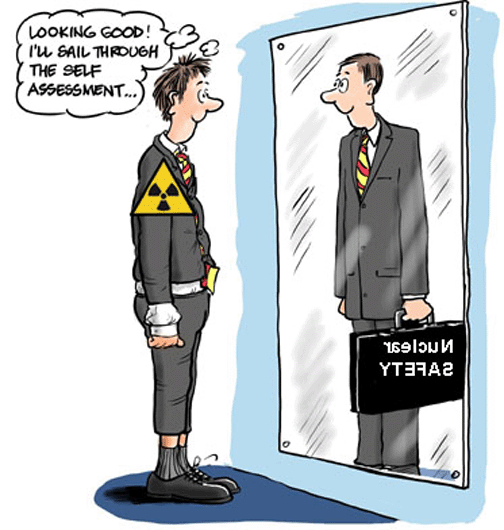
Why NRC Nuclear Safety Inspections are Necessary: Columbia Generating Station, UCS, DAVE LOCHBAUM, DIRECTOR, NUCLEAR SAFETY PROJECT | OCTOBER 17, 2017 The Nuclear Regulatory Commission (NRC) adopted its Reactor Oversight Process (ROP) in 2000. The ROP is far superior to the oversight processes previously employed by the NRC. Among its many virtues, the NRC treats the ROP as a work in progress, meaning that agency routinely re-assesses the ROP and makes necessary adjustments.
Earlier this year, the NRC initiated a formal review of its engineering inspections with the goal of making them more efficient and more effective. During a public meeting on October 11, 2017, the NRC working group conducting the review outlined some changes to the engineering inspections that would essentially cover the same ground but with an estimated 8 to 15 percent reduction in person-hours (the engineering inspections and suggested revisions are listed on slide 7 of the NRC’s presentation). Basically, the NRC working group suggested repackaging the inspections so as to be able to examine the same number of items, but in fewer inspection trips.
The nuclear industry sees a different way to accomplish the efficiency and effectiveness gains sought by the NRC’s review effort—they propose to eliminate the NRC’s engineering inspections and replace them with self-assessments. The industry would mail the results from the self-assessments to the NRC for their reading pleasure.
UCS is wary of self-assessments by industry in lieu of NRC inspections. On one hand, statistics might show that self-assessments increase safety just as a community firing all its law enforcement officers would see a statistical decrease in arrests, suggesting a lower crime rate. I have been researching the records publicly available in ADAMS to compare the industry’s track record for finding latent safety problems with the NRC’s track record to see whether replacing NRC’s inspections with industry self-assessments could cause nuclear safety to go off-track.
This commentary is the first in a series that convinces us that the NRC’s engineering inspections are necessary for nuclear safety and that public health and safety will be compromised by replacing them with self-assessments by industry.
Columbia Generating Station: Not so Cool Safety Moves………
UCS Perspective
Under the Atomic Energy Act as amended, the NRC is tasked with establishing and enforcing regulations to protect workers and the public from the inherent hazards from nuclear power reactor operation.
Owners are responsible for conforming with applicable regulatory requirements. In this case, the owner made a series of changes that resulted in the plant not conforming with applicable regulatory requirements for the air temperature within the control room. But there’s no evidence suggesting that the owner knew that the changes were illegal yet made them anyway hoping not to get caught. Nevertheless, ignorance of the law is still not a valid excuse. The public is not adequately protected when safety regulations are not met, regardless of whether the violations are intentional or inadvertent.
This case study illustrates the vital role that NRC’s enforcement efforts plays in nuclear safety. The soundest safety regulation in the world serves little use unless owners abide by it. The NRCs inspection efforts either verify that owners are abiding by safety regulations or identify shortfalls. Self-assessments by owners are more likely to sustain mis-interpretations and misunderstandings than to flush out safety problems.
The NRC’s ROP is the public’s best protection against hazards caused by aging nuclear power reactors, shrinking maintenance budgets, and emerging sabotage threats. Replacing the NRC’s engineering inspections with self-assessments by the owners would lessen the effectiveness of that protective shield.
The NRC must continue to protect the public to the best of its ability. Delegating safety checks to owners is inconsistent with that important mission. http://allthingsnuclear.org/dlochbaum/why-nrc-inspections-are-necessary-columbia
1 This Month





PLEASE OPPOSE HR 8255 AND S.3639 – bills would accelerate satellite deployment, with no environmental review or safeguards – https://ncstd5li.quorum.us/campaign/169331/
To see nuclear-related stories in greater depth and intensity – go to https://nuclearinformation.wordpress.com
-
Archives
- October 2026 (67)
- September 2026 (339)
- August 2026 (330)
- July 2026 (355)
- June 2026 (287)
- May 2026 (306)
- April 2026 (356)
- March 2026 (251)
- February 2026 (267)
- January 2026 (308)
- December 2025 (358)
- November 2025 (359)
-
Categories
- 1
- 1 NUCLEAR ISSUES
- business and costs
- climate change
- culture and arts
- ENERGY
- environment
- health
- history
- indigenous issues
- Legal
- marketing of nuclear
- media
- opposition to nuclear
- PERSONAL STORIES
- politics
- politics international
- Religion and ethics
- safety
- secrets,lies and civil liberties
- spinbuster
- technology
- Uranium
- wastes
- weapons and war
- Women
- 2 WORLD
- ACTION
- AFRICA
- Atrocities
- AUSTRALIA
- Christina's notes
- Christina's themes
- culture and arts
- Events
- Fuk 2022
- Fuk 2023
- Fukushima 2017
- Fukushima 2018
- fukushima 2019
- Fukushima 2020
- Fukushima 2021
- general
- global warming
- Humour (God we need it)
- Nuclear
- RARE EARTHS
- Reference
- resources – print
- Resources -audiovicual
- Weekly Newsletter
- World
- World Nuclear
- YouTube
-
RSS
Entries RSS
Comments RSS

