U.S. pursues direct diplomacy with North Korea despite Trump rejectionArshad Mohammed, Matt Spetalnick WASHINGTON (Reuters) 1 Nov 17, – The United States is quietly pursuing direct diplomacy with North Korea, a senior State Department official said on Tuesday, despite U.S. President Donald Trump’s public assertion that such talks are a waste of time.
Using the so-called “New York channel,” Joseph Yun, U.S. negotiator with North Korea, has been in contact with diplomats at Pyongyang’s United Nations mission, the official said, at a time when an exchange of bellicose insults between Trump and North Korean leader Kim Jong Un has fueled fears of military conflict.
While U.S. Secretary of State Rex Tillerson on Oct. 17 said he would continue “diplomatic efforts … until the first bomb drops,” the official’s comments were the clearest sign the United States was directly discussing issues beyond the release of American prisoners, despite Trump having dismissed direct talks as pointless.
There is no sign, however, that the behind-the-scenes communications have improved a relationship vexed by North Korea’s nuclear and missile tests, the death of U.S. university student Otto Warmbier days after his release by Pyongyang in June and the detention of three other Americans.
Word of quiet engagement with Pyongyang comes despite Trump’s comments, North Korea’s weapons advances and suggestions by some U.S. and South Korean officials that Yun’s interactions with North Koreans had been reined in.
“It has not been limited at all, both (in) frequency and substance,” said the senior State Department official………
At the start of Trump’s presidency, Yun’s instructions were limited to seeking the release of U.S. prisoners.
“It is (now) a broader mandate than that,” said the State Department official, declining, however, to address whether authority had been given to discuss North Korea’s nuclear and missile program.
In Beijing, Foreign Ministry spokeswoman Hua Chunying said China welcomed any dialogue between the United States and North Korea.
“We encourage North Korea and the United States to carry out engagement and dialogue,” Hua told reporters, adding that she hoped talks could help return the issue to a diplomatic track for resolution.
…… Speaking at the United Nations on Sept. 19, Trump vowed to “totally destroy” North Korea if it threatened the United States or its allies, raising anxieties about the possibility of military conflict.
Twelve days later, after Tillerson said Washington was probing for a diplomatic opening, Trump said on Twitter that his chief diplomat was “wasting his time trying to negotiate with Little Rocket Man” – his mocking nickname for the North Korean leader.
Democratic U.S. senators introduced a bill on Tuesday they said would prevent Trump from launching a nuclear first strike on North Korea on his own, highlighting the issue days before the Republican’s first presidential trip to Asia.
…… The New York channel is one of the few conduits the United States has for communicating with North Korea, which has itself made clear it has little interest in serious talks before it develops a nuclear-tipped missile capable of hitting the continental United States.
The last high-level contact between Yun and the North Koreans was when he traveled to North Korea in June to secure the release of Warmbier, who died shortly after he returned home in a coma, the State Department official said.
……. The official said, however, that “the preferred endpoint is not a war but some kind of diplomatic settlement” and suggestions that Washington is setting up a binary choice for Pyongyang to capitulate diplomatically or military action were “misleading.”
Diplomacy, the official said, “has a lot more room to go.”
But Trump’s threats against North Korea are believed to have complicated diplomatic efforts.
The climate report, obtained by NPR, notes that the past 115 years are “the warmest in the history of modern civilization.” The global average temperature has increased by about 1.8 degrees Fahrenheit over that period. Greenhouse gases from industry and agriculture are by far the biggest contributor to warming.
The findings contradict statements by PresidentTrump and many of his Cabinet members, who have openly questioned the role humans play in changing the climate.
“I believe that measuring with precision human activity on the climate is something very challenging to do,” EPA Administrator Scott Pruitt said in an interview earlier this year. “There’s tremendous disagreement about the degree of impact.”
That is not consistent with the conclusions of the 600-plus-page Climate Science Special Report, which is part of an even larger scientific review known as the fourth National Climate Assessment. The NCA4, as it’s known, is the nation’s most authoritative assessment of climate science. The report’s authors include experts from leading scientific agencies, including the National Oceanic and Atmospheric Administration, NASA and the Department of Energy, as well as academic scientists.The report states that the global climate will continue to warm. How much, it says, “will depend primarily on the amount of greenhouse gases (especially carbon dioxide) emitted globally.” Without major reductions in emissions, it says, the increase in annual average global temperature could reach 9 degrees Fahrenheit relative to pre-industrial times. Efforts to reduce emissions, it says, would slow the rate of warming.
“This is good, solid climate science,” says Richard Alley, a geoscientist at Penn State University, who says he made minor contributions to the report’s conclusions on sea level rise. “This has been reviewed so many times in so many ways, and it’s taking what we know from … a couple of centuries of climate science and applying it to the U.S.”
The assessments are required by an act of Congress; the last one was published in 2014. Alley says this year’s goes further in attributing changes in weather to the warming climate, especially weather extremes. “More heat waves and fewer cold snaps, this is very clear,” he says. The report also notes that warmer temperatures have contributed to the rise in forest fires in the West and that the incidence of those fires is expected to keep rising.
Some of the clearest effects involve sea level rise. “Coastal flooding, you raise the mean level of the ocean, everything else equal you get more coastal flooding,” Alley says. The report notes that sea level has risen 7 to 8 inches since 1900, and 3 inches of that occurred since 1993. The report says that rate is faster than during any century over the past 2,800 years.
The report also points out that heavy rainfall is increasing in intensity and frequency across the U.S., especially in the Northeast, and that is expected to keep increasing.
Other connections are harder to nail down, Alley says, such as whether a particular hurricane can be attributed to climate change.
“The Climate Science Special Report is like going to a doctor and being given a report on your vital signs,” says environmental scientist Rachel Licker of the Union of Concerned Scientists. She notes that the authors assessed more than 1,500 scientific studies and reports in making their conclusions.
Alley adds that the new report “does a better job of seeing the human fingerprint in what’s happening.” He says that while he hasn’t read all of it yet, he sees no evidence that it has been soft-pedaled or understates the certainty of the science.
Alley notes that “there’s a little rumbling” among climate scientists who are concerned that the Trump administration will ignore this effort. “I think the authors really are interested in seeing [the report] used wisely by policymakers to help the economy as well as the environment.”
The report has been submitted to the Office of Science and Technology Policy at the White House. Trump has yet to choose anyone to run that office; it remains one of the last unfilled senior positions in the White House staff.
The South’s legacy of abandoned nuclear reactors, The Slate, BY CAROLINE PEYTON AND SPECIAL TO THE STATE’S EDITORIAL BOARDNOVEMBER 02, 17 COLUMBIA, SC “……..The cancellation of the V.C. Summer expansion project testifies to innumerable missteps, but our collective amnesia has missed the bigger story: The South’s long, messy nuclear history is a catalog of modest successes and epic failures.
Sadly, the V.C. Summer project shutdown is nothing new for the South. It has happened at least 22 times since the 1970s. Some plants existed merely as blueprints, while others were canceled mid-construction. Across the region, half-finished projects stand as emblems of bungled industry efforts. At its core, this history has been defined by secrecy, miscalculations and decisions made by the few at the expense of ordinary people.
In the 1950s and 1960s, Southern politicians envisioned regional transformation through atomic energy; the South would become an “energy breadbasket.” A network of elected officials, utility companies and industry lobbyists sold these projects as job creators, an endless source of cheap energy and boons to the rural communities located near reactors.
This building spree resulted in more than 40 commercial nuclear reactors operating at 23 sites and earned the South industry admiration for its “nuclear friendly citizenry.” Yet those reactors represent only a fraction of what could have been; approximately 35 additional reactors were proposed for Southern states, including a half-dozen where construction had started and billions of dollars were spent on the nuclear road to nowhere.
So what happened to those ill-fated reactors? By the late 1970s, projections for energy demands declined, construction costs didn’t match initial projections, and the accident at Three Mile Island soured public opinion. Local concerns mattered too.
In South Carolina, the failed nuclear fuel reprocessing plant in Barnwell County, along with the staggering influx of radioactive waste, helped spawn the South’s largest anti-nuclear protest. Protestors flocked to Barnwell denouncing South Carolina’s role as the nation’s trash can.
In Mississippi, infuriated ratepayers gathered outside the Grand Gulf nuclear plant and burned their utility bills. Other plants were plagued with serious safety issues and community opposition, like the now-operating Waterford 3 reactor in Louisiana.
The most notorious episode occurred with the Tennessee Valley Authority, where a corporation fought landowners in Hartsville, Tenn., to build the “world’s largest nuclear plant” — only to pull the plug. What remains in this bucolic setting are half-finished remnants and a lone cooling tower, fittingly called a “used beer can” by residents. TVA ultimately canceled seven reactors after spending billions, which tarnished its legacy, permanently marred local landscapes and exacerbated a climate of distrust.
Today, the cavernous structures attract photographers seeking dystopian backdrops. Mostly though, they continue to rust away, a symbol of a beleaguered industry that has never resolved fundamental problems — namely projects mired in secrecy and unrealistic cost estimates.
Despite industry reforms since the 1970s, V.C. Summer’s collapse sounds familiar to those well-acquainted with the region’s nuclear past. Bad legislation, the Base Load Review Act of 2007, placed the cost burden upon the ratepayers and limited SCE&G and SCANA’s accountability. A secret report, along with internal emails between SCE&G and state-owned Santee Cooper, reveal a troubling array of warning signs and uncorrected problems.
While it’s true that there were new problems here, such as the Westinghouse bankruptcy, the broad outlines of the V.C. Summer fiasco could have been ripped from any headline in the late 1970s. In the case of those canceled projects, no genuine attempt at restitution was made. Those abandoned plants offer guidance for today.
Legislators and public service commissions must prioritize ratepayers first, better understand the risks involved in large-scale reactor projects and let history inform their decisions as well. If the industry wants to retain the South’s “nuclear-friendly citizenry,” it, too, must confront the nuclear ghosts of its past, and reject the hubris, secrecy and overblown projections that have doomed so many plans and, in some cases, left Southerners with little more than nuclear ruins.
House Tax Bill Trims Wind Tax Credit, Extends Nuclear Provision, Bloomberg, By Ari Natter,
GOP measure preserves threatened wind and solar tax credits
Legislation could change is it winds through Congress
Tax credits cherished by the wind and solar industry remain under a rewrite of the tax code revealed by House Republicans, but the measure would trim the wind energy’s production tax credit by more than a third.
The bill, unveiled by House GOP leaders Thursday, also extends an estimated $6 billion tax credit for the nuclear industry, which would benefit Southern Co. Without the extension, the credit may have gone unused before the 2021 deadline. Southern’s Vogtle project in Georgia faces construction delays and is not on track to be completed before the deadline.
The bill also adds tax credits for other energy sources, such as geothermal, small-scale wind and fuel cells that were left out of a 2015 budget and spending deal.
The House tax overhaul cuts the wind industry’s 2.3-cent-per-kilowatt hour tax credit to 1.5 cents. The solar industry’s 30 percent tax credit remains unchanged. Under that 2015 deal the wind credit begins phasing down this year before expiring in 2020 and the solar industry’s credit winds down before expiring in 2022. Those phaseouts continue as planned, but projects would now need to be completed by those dates to qualify…….
Russia AND the US send nuclear bombers to North Korea as tensions with Kim Jong-un soar
The US sent a nuclear-capable B-2 stealth bomber from Whiteman Air Force Base in Missouri on a long-range mission to the Pacific this weekend, The Sun, By Sam Webb, 31st October 2017,
RUSSIA and the US have flown nuclear bombers near North Korea as tensions grow over tyrant Kim Jong-un’s atomic threats.
President Donald Trump sent a nuclear-capable B-2 stealth bomber from Whiteman Air Force Base in Missouri on a long-range mission to the Pacific this weekend.
And the Russian Defence Ministry today announced that US and Japanese jets escorted Russia’s missile-carrying Tupolev-95MS strategic bombers during flights over the Sea of Japan and the Pacific.
A spokesman said: “Two strategic bombers Tupolev-95MS of Russia’s Aerospace Force have carried out routine flights over international waters of the Sea of Japan and the western part of the Pacific Ocean.
At certain sections of the route the Tupolev-95MS crews were accompanied by a pair of F-18 fighters (of the US Air Force), and a pair of F-15, F-4 and F-2A fighters (of the Japanese Air Force).”
US nuclear arsenal to cost $1.2tn over next 30 years, independent CBO report finds https://www.theguardian.com/world/2017/oct/31/us-nuclear-arsenal-cost-cbo-report CBO finds total price tag marks 25% increase from previous estimate
Nuclear Posture Review under way and expected by end of the year, Guardian, Julian Borger 1 Nov 17, The cost of the US nuclear arsenal over the next 30 years will be over $1.2tn, even before any new weapons ordered by the Trump administration, and is unlikely to be affordable without cuts elsewhere in the defence budget, according to a independent congressional report.
The total price tag marks nearly a 25% increase from previous estimate, taking in the modernisation programme established under the Obama administration, which account for $400bn, the Congressional Budget Office (CBO) found. The costs would peak in the 2020s and the 2030s.
A new Nuclear Posture Review is under way and expected around the end of the year. Trump has repeatedly vowed to bolster the nuclear stockpile, and the defence department is reportedly considering the development of a low-yield warhead for a ballistic missile, and reintroducing a sea-launched cruise missile, among a variety of new options.
The CBO report warns that such new capabilities would increase the total bill for the US arsenal yet further.
“If these plans reach fruition, it would be the largest nuclear build-up since the Reagan administration. This is not affordable,” said Stephen Schwartz, an independent nuclear analyst and editor of the book, Atomic Audit: The Costs and Consequences of US Nuclear Weapons Since 1940.
Pursuing nuclear modernization will be challenging in the current environment,” the report said, adding that it would compete with parallel ambitions to upgrade the navy and the air force, and increase the size of the army.
It is the first comprehensive costing of the US nuclear weapons programme. The report offers three approaches for cost reductions to make it affordable. One would keep the programme as is currently planned but delay elements of it, bringing potential savings of 5%.
The second looks at ways of reducing the programme but keeping to the existing ceiling agreed with Russia of 1550 deployed strategic warheads. One variant of that approach examined by the CBO would be to do without one leg of the nuclear ‘triad’, intercontinental ballistic missiles (ICBMs) and keeping air-launched and sea-launched weapons. That would generate savings of 10%, the report said.
The third approach would incorporate a reduction of the deployed strategic stockpile to 1000 warheads, a cut the defence department under the Obama administration said could be made without affecting the US nuclear deterrent, which would save 5% to 11% of the total.
“The report blows apart the “do everything or do nothing” false choice repeatedly posited by Pentagon officials,” Kingston Reif, the director for disarmament and threat reduction policy at the Arms Control Association, said. “But perhaps the biggest contribution of new CBO nuclear cost study is the evaluation of options to manage and reduce the mammoth price tag.”
Reif added: “Meanwhile, the Trump administration is reportedly considering adding new weapons to the arsenal, which would increase the budget train-wreck odds, and undermine US security.”
IT’S known as the birthplace of the atomic bomb. But a letter written to the bomb’s laboratory has us all extremely concerned. Matt Young@MattYoung, IN 2011 something alarming happened at a United States nuclear weapons laboratory that was deliberately kept quiet.
According to The Centre for Public Integrity, a pair of workers with “cavalier attitudes” at the Los Alamos National Laboratory stuffed “so much plutonium into a small space that they came close to triggering an accidental nuclear chain reaction, all to get some photos”.
“Plutonium is the unstable, radioactive, man-made fuel of a nuclear explosion, and it isn’t amenable to showboating,” it said. “When too much is put in one place, it becomes ‘critical’ and begins to fission uncontrollably, spontaneously sparking a nuclear chain reaction, which releases energy and generates a deadly burst of radiation.”
And it gets much, much worse.
Los Alamos National Laboratory in Santa Fe, New Mexico — responsible for the design of nuclear warheads — was a top secret facility during World War II and the birthplace of the atomic bomb.
But it is in a state of chaos — in fact, it has been for years.
A damning letter by the Defense Nuclear Facilities Safety Board, released this week and seen by news.com.au, said it had found “numerous weaknesses” in the lab’s safety standards dating back to 2014.
It had also failed recent safety tests indicating how it would respond to an emergency including radioactive leaks or earthquakes.
Referred as Project Y after it was established in 1943, the laboratory was one of a series of top secret labs in the United States given codewords to maintain secrecy at the time.
It was known as the “heart” of the nuclear project and was primarily responsible for the Manhattan Project, which developed the first ever nuclear weapons. The scientists within its labs were responsible for the creation of several atomic bombs, including the Fat Man, which was detonated in the Japanese city of Nagasaki in August, 1945.
It is also responsible for the hydrogen bomb.
Since the end of WWII, the lab continued its focus on bomb designs. It is still open today and is one of the largest science and technology institutions in the world with a focus on national security, space exploration and nuclear fusion, among other “non-war” technology.
“Though the world is rapidly changing, this essential responsibility (nuclear) remains the core mission,” it states on its website.
It is also “responsible for the safety, security, and effectiveness of the nuclear explosive packages in the stockpile”.
But over the years, more and more mistakes have begun to leak from its labs, with critical, radioactive material breached, dumped and mishandled.
Last week, the US Department of Energy, which is responsible overseeing the United States’ nuclear arsenal, put out a final request for proposals to manage the site.
Government Scientist Blocked from Talking About Climate and Wildfires
Critics are accusing the Trump administration of stifling the dissemination of taxpayer-funded science, Scientific American , By Brittany Patterson, ClimateWire on October 31, 2017
A U.S. Forest Service scientist who was scheduled to talk about the role that climate change plays in wildfire conditions was denied approval to attend the conference featuring fire experts from around the country.
William Jolly, a research ecologist with the agency’s Rocky Mountain Research Station in Missoula, Mont., was supposed to give a 30-minute presentation titled “Climate-Induced Variations in Global Severe Fire Weather Conditions” at the International Fire Congress in Orlando, Fla., next month. The event is hosted by the Association for Fire Ecology (AFE).
The travel denial follows reports last week that U.S. EPA blocked three scientists from making presentations at a conference in Rhode Island featuring climate change. Critics accused the Trump administration of stifling the dissemination of taxpayer-funded science……..
Jolly’s presentation was slated to be part of a special session exploring the connection between wildfire and climate change. It focuses on what scientists can learn about fire behavior in a warming future by looking at clues from the past, according to Anthony Westerling, a professor at the University of California who is moderating the session.
“It’s kind of weird that they would make it hard for a government scientist to take part in this because managing wildfire is a huge challenge logistically and financially on a vast array of federal lands,” he said. “These scientists, by participating in these kinds of society meetings, share their thoughts and hear other people’s thoughts, which is important because their work is supposed to form how these lands are managed and how we prepare for and adapt under climate change.”
Jolly is not the only scientist whose request was denied. No travel authorizations were given to researchers from the Rocky Mountain Research Station’s Human Dimensions Science Program, according to AFE. That includes Karin Riley, a research ecologist who studies the relationship between climate and wildfire. Riley is vice president of AFE’s board of directors.
Three U.S. Geological Survey researchers who are scheduled to give presentations at the wildfire conference next month have been in limbo for months while their travel request is reviewed. All three scientists are slated to speak about climate change…….
The science shared at the Fire Congress draws on real world catastrophes. The United States is experiencing its most expensive fire season in history, with more than 8.8 million acres burned, according to the National Interagency Fire Center.
Massive fires have rained chaos on communities in Montana and California, in part due to climate change increasing the number of fires and making them more severe. A 2015 report by the Forest Service found that modern fire seasons are 78 days longer and burn twice as many acres as they did in 1970. The agency predicted that the number of acres burned could double again by 2050 (Climatewire, Aug. 6, 2015)……. https://www.scientificamerican.com/article/government-scientist-blocked-from-talking-about-climate-and-wildfires/
California governor heads to Europe for climate talks http://m.startribune.com/california-governor-heads-to-europe-for-climate-talks/454332843/?section=nationBy KATHLEEN RONAYNE , ASSOCIATED PRESS October 31, 2017 SACRAMENTO, Calif. — California Gov. Jerry Brown is continuing his international fight against climate change with an 11-day trip to Europe starting Saturday including stops at the Vatican and a United Nations conference in Germany.
Brown is a chief adversary to Republican President Donald Trump in the battle over U.S. climate policy, promising to help the country reach its emissions reductions targets even as Trump withdraws from an international climate accord. He’s been named the special adviser for states and regions at the U.N. Climate Change Conference in Bonn, Germany.
“While the White House declares war on climate science and retreats from the Paris Agreement, California is doing the opposite and taking action,” Brown said in a statement announcing the trip. “We are joining with our partners from every part of the world to do what needs to be done to prevent irreversible climate change.”
The non-profit California State Protocol Foundation, which accepts donations from private businesses, pays for Brown’s international travel. Travel for Brown’s staff members will be partially covered by money from the non-profit Climate Registry and the Climate Action Reserve, a program that deals with carbon offset projects, spokesman Evan Westrup said.
Brown’s November trip follows visits to China and Russia earlier this year to promote international collaboration on climate change. Next year, he plans to host a summit in San Francisco.
He will give a speech Saturday to the Vatican Pontifical Academy of Sciences symposium. During the week, Brown will address European Parliament leaders, the state parliament in Baden-Wurttemberg Germany, meet with representatives from national scientific academies and serve on several panels at the U.N. conference.
Govs. Kate Brown of Oregon, Jay Inslee of Washington and Terry McAuliffe of Virginia — all Democrats — will join him on a panel about states’ roles in fighting climate change. California Senate leader Kevin de Leon, also a Democrat, is scheduled to speak Friday at a Vatican workshop on climate.
Swamp Tales: Puerto Rico Cancels $300 Million Trump Crony Electrical Grid Rebuild Contract, The Progressive, by Harvey Wasserman October 30, 2017, The swampish saga would be hard to invent. In early October, Puerto Rico’s Energy Power Authority awarded a $300 million tax-funded contract to reconstruct the island’s hurricane devastated power grid to a two-person, two-year-old firm based in the small Montana hometown of Trump Interior Secretary Ryan Zinke. The company is financially backed by a major donor to Donald Trump’s 2016 presidential campaign.
About eighty percent of Puerto Rico is still without power. Many hospitals are still dark. Local citizens needing medical treatments such as surgeries or dialysis have been forced to flee to places where electric power is available.
Puerto Rico’s power grid centers on antiquated oil, gas, and coal generators, the median age of which is forty-four years. Just two percent Puerto Rico’s juice came from wind and solar. One wind farm, on the south side of the island, survived Hurricane Maria largely intact, as did at least one small commercial solar array.
For Puerto Rico’s 3.4 million residents, restoring power is a matter of life and death. But the $300 million dollar contract was handed, with no public hearings, legislative discussion or long-term planning, to Whitefish, an obscure company from rural Montana.
At least one Zinke relative—his son—has worked on part-time contract for Whitefish. Zinke claims he had nothing to do with the deal.
Anti-Trump sentiment is rampant throughout the island, fed by a lack of concern expressed by the President for Puerto Ricans’ dire situation, and capped by a recent visit in which he pitched paper towels to a crowd of bewildered local residents. When San Juan mayor Carmen Yulin Cruz questioned the contract with Whitefish, the company threatened to stop work, then apologized.
The Puerto Rican power company’s contract astoundingly exempted Whitefish from official audits, stating, “In no event shall [governmental bodies] have the right to audit or review the cost and profit elements.” It also waived “any claim against Contractor related to delayed completion of the work,” meaning Whitefish was empowered to pretty much take as long as it wanted to complete the job……..
the uproar should also focus on the growing demand that the electric power systems in Puerto Rico and the rest of the Caribbean be reconstructed around renewables and microgrids, rather than fossil-fired central distribution networks.
Most likely those systems will not be built by Trump cronies flown in at huge expense, who then must dodge rocks and bottles being thrown by angry locals.
#NukeGate: SCANA’s Failed Gambit https://www.fitsnews.com/2017/10/31/nukegate-scanas-failed-gambit/ Crony capitalist utility screws up the one card it had to play October 31, 2017. By FITSNewsSouth Carolina’s crony capitalist government-run utility, used to dictating terms to its bought-and-paid for politicians, got dealt a measure of its own medicine this week when state lawmakers – themselves badly exposed by the Palmetto State’s ongoing #NukeGate debacle – refused to play ball with the company.
What happened? SCANA attempted to use the planned ouster of two top corporate officials – CEO Kevin Marsh and top nuclear office Stephen Byrne – as a means of “cutting a deal” with state legislators.
As we exclusively reported on Saturday morning, “early reports indicated the besieged Cayce, S.C.-based company may have been attempting to use Marsh’s ouster as a ‘bargaining chip’ – a way for SCANA to gain leverage in its multi-front war with lawmakers, state and federal investigators and aggressive attorneys currently pressing a multitude of claims against the company.”
No such leverage was available, however … meaning SCANA essentially screwed up the one card it had to play (a card which, frankly, should have been played a long time ago).
This week reporters John McDermott and Andy Shain of The (Charleston, S.C.) Post and Courierconfirmed that leaders in the S.C. House of Representatives “refused to cut a deal with SCANA for Marsh and Byrne’s departure.” Oy …
Compounding the damage of this botched overture, SCANA has decided to replace Marsh from within – elevating its current finance chief Jimmy Addison to the role of CEO.
:Marsh, Addison and Byrne are among the top SCANA executives who made bank while presiding over #NukeGate – a multi-billion command economic intervention in the energy marketplace that has failed spectacularly, leaving Palmetto State taxpayers and ratepayers on the hook for a pair of new nuclear reactors that now may never be built.
In fact, ratepayers are continuing to pay $37 million per month on these reactors, even though work on the project has been abandoned.
To recap: SCANA and its state-owned partner, Santee Cooper, spent the past decade building a pair of next-generation AP1000 pressurized water reactors in Jenkinsville, S.C. at a cost of $9.8 billion. The money was spent, but the reactors were never finished. In fact they’re not even half-finished – with the cost to complete them ranging anywhere from $9-16 billion.
Unable to pony up that kind of cash, Santee Cooper pulled the plug on the project on July 31 … killing an estimated 5,600 jobs, squandering billions of dollars in investment (including more than $2 billion raised through rate increases on consumers) and throwing the state’s energy future into chaos.
Recently released documents revealed executives at the two utilities knew over a year-and-a-half ago that the project was doomed – yet continued to raise rates on consumers anyway. Not surprisingly, the project’s failure has spawned numerous lawsuits and a pair of criminal investigations – one state, one federal.
It’s also cratered SCANA’s stock price and prompted a desperate effort on the part of current governor Henry McMaster to unload Santee Cooper … for a song.
While members of the S.C. House leadership were correct to rebuke any overture from SCANA, they remain squarely on the hook for this multi-billion dollar disaster. Same with their colleagues in the State Senate and former South Carolina governor Mark Sanford, who failed to veto the now notorious legislation that enabled SCANA and Santee Cooper to effectively socialize their investment risk on this failed project.
U.S. sends nuclear-capable B-2 stealth bomber on mission in Pacific ahead of Trump visit to Asia, Japan Times, BY JESSE JOHNSON,STAFF WRITER, 29 Oct 17, The U.S. military sent a nuclear-capable B-2 stealth bomber from Whiteman Air Force Base in Missouri on a long-range mission to the Pacific area of operations over the weekend, it said Sunday, a day after Pentagon chief Jim Mattis highlighted rival North Korea’s “accelerating” atomic weapons program during a visit to South Korea.
The U.S. military’s Strategic Command said in a statement that the type of long-range mission conducted was to “familiarize aircrew with air bases and operations in different geographic combatant commands, enabling them to maintain a high state of readiness and proficiency.”
In a message likely intended to reassure Japan and South Korea ahead of U.S. President Donald Trump’s visit to Asia, which kicks off later this week, the statement also referred to the B-2 mission as “a visible demonstration of commitment to our allies and enhancing regional security.”
The flight path of the B-2 was unclear, and Strategic Command did not respond to a request for comment, but the last time one of the stealth bombers flew near the Koreas was during a rare show of force over the peninsula in 2013. Military experts say that any U.S. strike on North Korea would almost certainly involve the powerful bombers……..
The weekend flight of the B-2, which can carry conventional as well as nuclear bombs, comes just ahead of Trump’s Asia tour, which is scheduled to kick off with a visit to Japan between Nov. 5-7. That visit will include talks with Prime Minister Shinzo Abe that are expected to focus on the North Korean nuclear crisis……
On Saturday Mattis blasted North Korea for “outlaw” behavior and vowed that the U.S. would never accept a nuclear North.
“North Korea has accelerated the threat that it poses to its neighbors and the world through its illegal and unnecessary missile and nuclear weapons programs,” he said, adding that U.S.-South Korean military and diplomatic collaboration thus has taken on “a new urgency.”
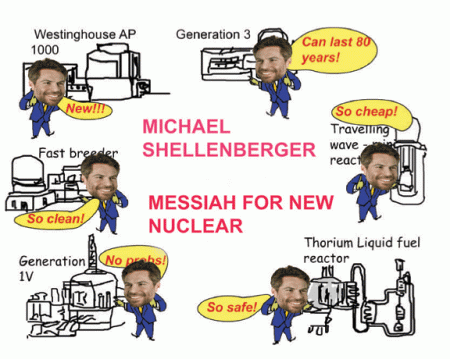
Michael Shellenberger is visiting Australia this week. He has been a prominent environmentalist (of sorts) since he co-authored the 2004 essay, The Death of Environmentalism. These days, as the President of the California-based ‘Environmental Progress’ lobby group, he is stridently pro-nuclear, hostile towards renewable energy and hostile towards the environment movement.
Shellenberger is visiting to speak at the International Mining and Resources Conference in Melbourne. His visit was promoted by Graham Lloyd in The Australian in September. Shellenberger is “one of the world’s leading new-generation environmental thinkers” according to The Australian, and if the newspaper is any guide he is here to promote his message that wind and solar have failed, that they are doubling the cost of electricity, and that “all existing renewable technologies do is make the electricity system chaotic and provide greenwash for fossil fuels.”
Trawling through Environmental Progress literature, one of their recurring themes is the falsehood that “every time nuclear plants close they are replaced almost entirely by fossil fuels”. South Korea, for example, plans to reduce reliance on coal and nuclear under recently-elected President Moon Jae-in, and to boost reliance on gas and renewables. But Shellenberger and Environmental Progress ignore those plans and concoct their own scare-story in which coal and gas replace nuclear power, electricity prices soar, thousands die from increased air pollution, and greenhouse emissions increase.
Fake scientists and radiation quackery
Environmental Progress’ UK director John Lindberg is described as an “expert on radiation” on the lobby group’s website. In fact, he has no scientific qualifications. Likewise, a South Korean article falsely claims that Shellenberger is a scientist and that article is reposted, without correction, on the Environmental Progress website.
Shellenberger says that at a recent talk in Berlin: “Many Germans simply could not believe how few people died and will die from the Chernobyl accident (under 200) and that nobody died or will die from the meltdowns at Fukushima. How could it be that everything we were told is not only wrong, but often the opposite of the truth?”
There’s a simple reason that Germans didn’t believe Shellenberger’s claims about Chernobyl and Fukushima ‒ they are false. Shellenberger claims that “under 200” people have died and will die from the Chernobyl disaster, but in fact the lowest of the estimates of the Chernobyl cancer death toll is the World Health Organization’s estimate of “up to 9,000 excess cancer deaths” in the most contaminated parts of the former Soviet Union. And of course there are higherestimates for the death toll across Europe.
Shellenberger claims that the Fukushima meltdowns “killed precisely no one” and that “nobody died or will die from the meltdowns at Fukushima”. An Environmental Progress report has this to say about Fukushima: “[T]he science is unequivocal: nobody has gotten sick much less died from the radiation that escaped from three meltdowns followed by three hydrogen gas explosions. And there will be no increase in cancer rates.”
In support of those assertions, Environmental Progress cites a World Health Organization report that directly contradicts the lobby group’s claims. The WHO report concluded that for people in the most contaminated areas in Fukushima Prefecture, the estimated increased risk for all solid cancers will be around 4% in females exposed as infants; a 6% increased risk of breast cancer for females exposed as infants; a 7% increased risk of leukaemia for males exposed as infants; and for thyroid cancer among females exposed as infants, an increased risk of up to 70% (from a 0.75% lifetime risk up to 1.25%).
Applying a linear-no threshold (LNT) risk factor to the estimated collective radiation dose from Fukushima fallout gives an estimated long-term cancer death toll of around 5,000 people. Nuclear lobbyists are quick to point out that LNT may overestimate risks from low dose and low dose-rate exposure ‒ but LNT may also underestimate the risks according to expert bodies such as the US National Academy of Sciences’ Committee on the Biological Effects of Ionizing Radiation.
US refusal to accept N. Korea as nuclear power leaves little room for talks By KIM GAMEL | STARS AND STRIPES October 29, 2017 SEOUL, South Korea – Defense Secretary Jim Mattis insisted the United States will never accept North Korea as a nuclear power, warning the communist state will face a massive military response if it attacks.
But he also clung to diplomatic efforts aimed at resolving the standoff over the North’s nuclear weapons program.
The mixed messages reflect the lack of good options in dealing with the North, which conducted its sixth and most powerful nuclear test on Sept. 3 and has made rapid progress in developing a missile that could threaten the U.S. mainland.
U.S. policy has been aimed at forcing Pyongyang to abandon its nuclear ambitions. but North Korea has defiantly persisted with its efforts despite punishing economic sanctions and diplomatic pressure.