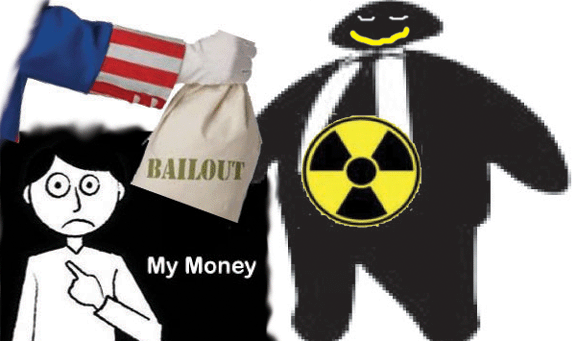
TheFederal Energy Regulatory Commission’s (FERC) recent rejection of Secretary of Energy Rick Perry’s plan to force electricity customers across the country to pay billions of dollars to prop up uneconomic coal and nuclear plants is only the tip of the iceberg in the fossil fuel industry’s bailout efforts.
Today, there are still numerous proposals making their way through state legislatures, public utility commissions, electric market operators, and Congress that will unfairly prop up fossil fuel plants that can’t compete in America’s modern energy markets.
These proposals are rooted in the entitled belief by fossil fuel billionaires that any competition that outperforms their lumbering, polluting power plants — especially clean energy resources like solar, wind, and energy efficiency — is somehow illegitimate.
The proposals themselves have gotten traction recently because over the past decade, clean energy resources have displaced hundreds of coal and nuclear plants as American customers have steadily cut down on their electricity usage and demanded cleaner, safer energy at a lower cost. As a consequence, these new resources have also created a vibrant clean energy economy that employs hundreds of thousands of workers.
Fossil fuel billionaires are fearful that this trend will create a permanent shift away from their dirty and dangerous energy, and are subsequently trying to force electricity customers to pay hundreds of millions, and sometimes billions, of dollars to prop up their plants.
The most egregious example of this political cronyism was Perry’s directive to FERC to create new rules that would have forced electricity customers to pay extra money for the energy produced by uneconomic coal and nuclear plants.
This expensive, foolish directive was rejected by FERC. Despite its failure, however, there are still numerous other proposals which are not as well publicized, but equally costly attempts by fossil fuel billionaires to prop up their plants.
Washington energy lobbyists, for example, have already been busy pushing coal tax credits and the extension of nuclear industry tax incentives in this year’s spending packages.
In Indiana, Sierra Club caught the state’s public utility commission approving a massive bailout of two coal-burning power plants for a local utility, NIPSCO, and is considering legal action to overturn it. The bailout came after uncontested NIPSCO data was revealed which showed that retiring the plants, instead of bailing them out, would save customers as much as $420 million.
In Ohio, FirstEnergy has tried for years, and is still trying, to get the state government to bail out its obsolete coal and nuclear plants that can’t compete with the Midwest’s legion of wind farms. Consumer and environmental advocates have defeated this bailout multiple times, but the utility keeps coming back to try again.
In the Great Plain states, reports show that throughout the region, utilities have been taking advantage of loopholes to force customers to bail out local coal plants to the tune of $300 million over a two year period in the Southwest Power Pool, home to abundant cheap wind power.
Electricity markets that are supposed to be competitive and open to all resources aren’t immune from efforts to rig the system against cleaner energy.
For example, on the same day FERC rejected Energy Department’s misguided proposal, New England’s market operator filed a proposal that would obstruct states’ rights to pursue cost-effective renewable energy projects and make it easier to prop up dirtier, costly power plants that should retire. PJM, which manages the electric system for much of the Mid-Atlantic and Midwest, has also threatened to override public policies for clean energy in order to raise consumer costs and bail out unnecessary power plants, despite a massive surplus of electric capacity.
This recent, ongoing wave of proposals to bailout coal and nuclear plants on behalf of billionaires is a very real threat that will stifle innovation, increase costs, and corrupt democratic processes that have served us well for decades.
The backlash against these bailouts has been overwhelming thus far, but it will only be effective if it can stop all of them in their tracks. A reliable, affordable, and clean energy future hangs on the decisions we make in 2018 and we must choose our decisions wisely.
UC grilled over LANL safety issues, Lamonitor.com, By Tris DeRoma, January 15, 2018 Three university systems went before the Regional Coalition of LANL Communities Friday to tell the coalition once again why they would be the best candidate to take on the job of operating and managing the Los Alamos National Laboratory.
The University of California, Texas A&M made full presentations while the University of Texas System gave a short statement at the end of the meeting during the public comment portion.
All three systems submitted bids to the National Nuclear Security Administration before the administration’s deadline.
UC Vice President for National Laboratories Kim Budil faced some tough questions before the coalition from Coalition Chairman and Santa Fe Mayor Javier Gonzales.
The University of California has been a partner in the lab’s operation since it’s inception in 1943.
“Clearly there were a lot of mistakes made of the last couple of years in Los Alamos that led to the shut down of WIPP (Waste Isolation Pilot Plant) and the threat that ultimately posed to the community for those mistakes,” Gonzales said. “I’m interested in how the University of California during that time and what levels of assurance as communities we would get, if you were selected, that it wouldn’t happen again.”
Gonzales also wanted to know, after all the years the university has been a part of the management of the laboratory, why there are “still families struggling, there’s still big challenges in poverty and opioid addiction … all of these other things that you shouldn’t have to solve on your own as a contractor, but quite honestly donated money to a foundation and feeling that might be the end of an obligation is not necessarily what I would use as a good corporate citizen.”
False Alarm Adds to Real Alarm About Trump’s Nuclear Risk , NYT, By THE EDITORIAL BOARD, JAN. 13, 2018 It was the sort of nightmare that had only ever been real for most people’s parents or grandparents — the fear of an impending nuclear attack. “Ballistic missile threat inbound to Hawaii,” read the emergency alert that residents of the Aloha State received on Saturday morning. “Seek immediate shelter. This is not a drill.”
The authorities quickly announced that the alert was a mistake. But it made tangible the growing fears that after decades of leaders trying to more safely control the world’s nuclear arsenals, President Trump has increased the possibility of those weapons being used.
At a time when many are questioning whether Mr. Trump ought to be allowed anywhere near the nuclear “button,” he is moving ahead with plans to develop new nuclear weapons and expanding the circumstances in which they’d be used. Such actions break with years of American nuclear policy. They also make it harder to persuade other nations to curb their nuclear ambitions or forgo them entirely.
Mr. Trump has boasted about the size and power of America’s nuclear arsenal, threatened to “totally destroy” North Korea, pushed for a massive buildup of an arsenal that already has too many — 4,000 — warheads and wondered aloud why the United States possesses such weapons if it isn’t prepared to use them.
Now, as he tries to force North Korea to abandon its nuclear weapons capability and ensure that Iran never acquires one, Mr. Trump is poised to make public a new policy that commits America to an increasing investment in those very weapons, according to a draft document made public by HuffPost and confirmed by The Times.
…….. The proposed nuclear policy says a more aggressive nuclear posture is warranted because the world is more dangerous, with China, North Korea and Iran cited as concerns. Yet blowing up the Iran deal would free Tehran to resume its nuclear activities and make the world less safe. In other words, Mr. Trump’s approach makes no sense.
Under the Nuclear Nonproliferation Treaty, signed in 1968, the United States and Russia promised to reduce the role and number of nuclear weapons. They made significant, although insufficient, progress. After reductions under a succession of past presidents, the American stockpile is 85 percent smaller than it was at the height of the Cold War. Negotiations on further reductions have stalled in recent years as Russia, threatened by America’s superior conventional arsenal, became more reliant on nuclear weapons, and there is no serious sign that Mr. Trump wants to revive the talks.
President Barack Obama made a down payment on a saner policy by narrowing to “extreme circumstances” the conditions under which nuclear weapons would be used and ruling out their use against most non-nuclear countries. Mr. Trump’s policy also talks about “extreme circumstances, ” but it dangerously broadens the definition to include “significant non-nuclear strategic attacks,” which could mean using nuclear weapons to respond to cyber, biological and chemical weapon attacks.
Until Mr. Trump, no one could imagine the United States ever using a nuclear weapon again. America’s conventional military is more than strong enough to defend against most threats. But Mr. Trump has so shaken this orthodoxy that Congress has begun debating limits on his unilateral authority to launch nuclear weapons. Expanding the instances when America might use nuclear weapons could also make it easier for other nuclear-armed countries to justify using their own arsenals against adversaries.
New Trump policy could strengthen role of nuclear weapons, Phil Stewart WASHINGTON (Reuters) 13 Jan 18,- President Donald Trump’s administration could pursue development of new nuclear weaponry and explicitly leave open the possibility of nuclear retaliation for major non-nuclear attacks, if a leaked draft policy document becomes reality.
The Pentagon did not comment on the document, which was published by the Huffington Post website and prompted sharp criticism from arms control experts, who voiced concerns it could raise the risks of nuclear war.
The Defense Department said on Friday it did not discuss “pre-decision, draft copies of strategies and reviews.”
“The Nuclear Posture Review has not been completed and will ultimately be reviewed and approved by the President and the Secretary of Defense,” the Pentagon said in a statement.
One source familiar with the document told Reuters the draft was authentic, but did not say whether it was the same version that will be presented to Trump for approval.
The Republican Trump’s predecessor, Democrat Barack Obama, declared his intent to reduce the role of nuclear weapons in his Nuclear Posture Review in 2010, the last time the policy document was crafted.
The Trump administration’s draft document, said, however, that Obama-era assumptions of a world where nuclear weapons were less relevant proved incorrect.
“The world is more dangerous, not less,” it said.
It more readily embraces the role of nuclear weapons as a deterrent to adversaries, and, as expected, backs a costly modernization of the aging U.S. nuclear arsenal.
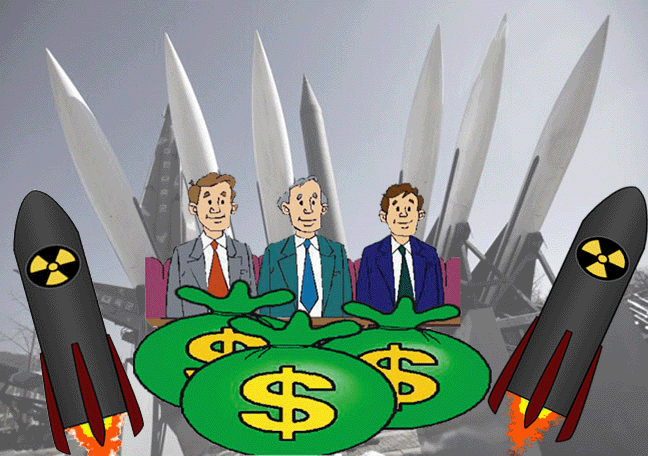
The Congressional Budget Office has estimated that modernizing and maintaining the U.S. nuclear arsenal over the next 30 years will cost more than $1.2 trillion.
…….. Kingston Reif, director for disarmament research at the Arms Control Association advocacy group, said the draft document was a departure from long-standing U.S. policy.
“It expands the scenarios under which the United States might use nuclear weapons and therefore increases the risk of nuclear weapons use,” Rief said.
Uranium Miners Pushed Hard for a Comeback. They Got Their Wish. NYT, By HIROKO TABUCHIMONUMENT VALLEY, Utah— Garry Holiday grew up among the abandoned mines that dot the Navajo Nation’s red landscape, remnants of a time when uranium helped cement America’s status as a nuclear superpower and fueled its nuclear energy program.
It left a toxic legacy. All but a few of the 500 abandoned mines still await cleanup. Mining tainted the local groundwater. Mr. Holiday’s father succumbed to respiratory disease after years of hacking the ore from the earth.
But now, emboldened by the Trump administration’s embrace of corporate interests, the uranium mining industry is renewing a push into the areas adjacent to Mr. Holiday’s Navajo Nation home: the Grand Canyon watershed to the west, where a new uranium mine is preparing to open, and the Bears Ears National Monument to the north.
The Trump administration is set to shrink Bears Ears by 85 percent next month, potentially opening more than a million acres to mining, drilling and other industrial activity. But even as Interior Secretary Ryan Zinke declared last month that “there is no mine within Bears Ears,” there were more than 300 uranium mining claims inside the monument, according to data from Utah’s Bureau of Land Management office that was reviewed by The New York Times.
The vast majority of those claims fall neatly outside the new boundaries of Bears Ears set by the administration. And an examination of local B.L.M. records, including those not yet entered into the agency’s land and mineral use authorizations database, shows that about a third of the claims are linked to Energy Fuels, a Canadian uranium producer. Energy Fuels also owns the Grand Canyon mine, where groundwater has already flooded the main shaft.
Energy Fuels, together with other mining groups, lobbied extensively for a reduction of Bears Ears, preparing maps that marked the areas it wanted removed from the monument and distributing them during a visit to the monument by Mr. Zinke in May.
Energy Fuels’ lobbying campaign, elements of which were first reported by The Washington Post, is part of a wider effort by the long-ailing uranium industry to make a comeback.
The Uranium Producers of America, an industry group, is pushing the Environmental Protection Agency to withdraw regulations proposed by the Obama administration to strengthen groundwater protections at uranium mines. Mining groups have also waged a six-year legal battle against a moratorium on new uranium mining on more than a million acres of land adjacent to the Grand Canyon.
For the Navajo, the drive for new mines is a painful flashback.
“Back then, we didn’t know it was dangerous — nobody told us,” Mr. Holiday said, as he pointed to the gashes of discolored rocks that mark where the old uranium mines cut into the region’s mesas. “Now they know. They know.”
Supporters of the mining say that a revival of domestic uranium production, which has declined by 90 percent since 1980 amid slumping prices and foreign competition, will make the United States a larger player in the global uranium market.
It would expand the country’s energy independence, they say, and give a lift to nuclear power, still a pillar of carbon-free power generation. Canada, Kazakhstan, Australia, Russia and a few other countries now supply most of America’s nuclear fuel.
……….President Trump has prioritized scrapping environmental regulations to help revitalize domestic energy production. His executive order instructing Mr. Zinke to review Bears Ears said that improper monument designations could “create barriers to achieving energy independence.”
In theory, even after President Barack Obama established Bears Ears in 2016, mining companies could have developed any of the claims within it, given proper local approvals. But companies say that expanding the sites, or even building roads to access them, would have required special permits, driving up costs.
……….
A bill introduced last month by Representative John Curtis, Republican of Utah, would codify Mr. Trump’s cuts to the monument while banning further drilling or mining within the original boundaries. But environmental groups say the bill has little chance of passing at all, let alone before the monument is scaled back next month.
“Come February, anyone can place a mining claim on the land,” said Greg Zimmerman, deputy director at the Center for Western Priorities, a conservation group.
………Fred Tillman, an environmental engineer with the United States Geological Survey, said during a recent visit to the mine that the groundwater flows in the region were too complex to rule out the risk of contamination.
“There are these big unknowns about the potential impacts on cultural resources, on biological resources, on water resources,” Dr. Tillman said.
A senator steps in Even as troubles persist on the ground, the industry pushback has continued.
In court, mining groups led by the National Mining Association have challenged a 20-year moratorium on mining in the Grand Canyon watershed, established in 2012 by the Obama administration. (The Canyon Mine predates the moratorium.)
The Arizona Chamber of Commerce, which represents mining interests, also backed an effort to defeat a separate proposal that would have permanently banned mining on 1.7 million acres surrounding the Grand Canyon. An Energy Fuels executive testified in Congress against the ban.
And with the help of Republican senators like John Barrasso of Wyoming, the industry has pressed the E.P.A. to withdraw an Obama-era proposalthat would strengthen groundwater protections at uranium mines.
The proposal would regulate a mining method called in-situ recovery, which involves injecting a solution into aquifers containing uranium and bringing that solution to the surface for processing — a method criticized by environmentalists as posing wider contamination risks.
the global deregulation of American firearms which could, in turn, according to critics, put such weaponry ever more easily in the hands of both criminal gangs and extremist groups
As Donald Trump might put it, major weapons contractors like Boeing, Raytheon, and Lockheed Martin cashed in “bigly” in his first year in office.
This year will undoubtedly be a banner year for arms companies. The only question is: Might it also mark the beginning of a future movement to roll back unconstrained weapons expenditures?
Tomgram: William D. Hartung, 2018 Looks Like an Arms Bonanza OpEd News.com, By Tom Engelhardt 11 Jan 18 This article originally appeared at TomDispatch.com.
Here’s a cheery note for you: the last mass killing of 2017 took place moments before midnight on New Year’s Eve. A 16-year-old New Jersey boy picked up a semi-automatic rifle, “lawfully acquired” by a member of his family, and killed his father, mother, sister, and a family friend. In doing so, he helped ensure that 2017 would be the deadliest year for mass killings in our modern history. (There is now, on average, slightly more than one mass killing a day in this country.) Nonetheless, guns of all sorts, including military-style assault rifles and even bump stocks like the 12 Stephen Paddock evidently used to turn his semi-automatics into functional automatics and slaughter 58 people from a hotel window in Las Vegas, are still readily available. Nowhere on Earth, not even in ravaged Yemen (which takes second place in gun ownership), is more weaponry available to more types of people. As the years go by here, such weapons are more easily and openly carried with only the most minimal of background checks (or less than that). Think about this: Americans, 4.4% of the people on this planet, own 42% of the guns and commit 31% of the mass killings.
Oh, and I did promise you that there was something cheery in all this, didn’t I? So here it is: the Trump administration, knowing a good thing when it sees it, is now hard at work ensuring that American weapons makers will make it a remarkably similar world. Its officials are intent, it seems, on recreating the planet in an American image. Keep in mind that U.S. arms makers like Lockheed, Raytheon, and General Dynamics already monopolize the global arms market in a way that should (but in this country regularly doesn’t) stagger the imagination. Continue reading →
Bulletin of Atomic Scientists 12th Jan 2018, After a lengthy hiatus, negotiations will soon resume between the United
States and Saudi Arabia on an agreement for civil nuclear cooperation.
Concluding a bilateral civil nuclear agreement (often called a “123
agreement,” after the section of the Atomic Energy Act mandating such
agreements for nuclear cooperation with other countries) would enable US
companies to participate in the Saudi Kingdom’s ambitious plans to build a
fleet of nuclear power reactors to meet its growing electricity
requirements.
Previous negotiations stalemated over the treatment of
uranium enrichment, with the United States insisting that Saudi Arabia
accept a legally binding commitment not to engage in enrichment or
plutonium reprocessing and the Saudis refusing to foreclose what they
regard as their sovereign right to pursue nuclear technologies of their
choosing for peaceful purposes. https://thebulletin.org/us-saudi-civil-nuclear-negotiations-finding-practical-compromise11426
City AM , New York, 13th Jan 2018, Renewable energy to be competitive with fossil fuels by 2020 as prices drop. The cost of generating renewable power is falling at an “unprecedented” rate, and by 2020, all renewable technologies will be price competitive with traditional fossil fuels, a new report says.
Since 2010, the cost of generating power from onshore wind has fallen by around a quarter, while solar photovoltaic (PV) electricity costs have dropped by 73 per cent, according to a report published today by the International Renewable Energy Agency (Irena).
Within just two years years, Irena expects solar energy generation costs to halve, and it said the best onshore wind and solar PV projects could be delivering electricity for an equivalent of 3 cents (2 pence) per kilowatt hour (kWh), or less.
The report said the current cost spectrum for fossil fuel power generation ranges from 5 to 17 cents per kWh. In comparison, all current commercial forms of green energy are expected to generate in the range of 3 to 10 cents per kWh by 2020.
170 MILLION IN U.S. DRINK RADIOACTIVE TAP WATER. TRUMP NOMINEE FAKED DATA TO HIDE CANCER RISK. https://www.ewg.org/research/170-million-us-drink-radioactive-tap-water-trump-nominee-faked-data-hide-cancer-risk#.WlvAYryWbGgBy Bill Walker, Editor in Chief, and Wicitra Mahotama, Environmental Analyst, 11 Jan 18, Drinking water for more than 170 million Americans contains radioactive elements at levels that may increase the risk of cancer, according to an EWG analysis of 2010 to 2015 test results from public water systems nationwide.
Radiation in tap water is a serious health threat, especially during pregnancy. But the Environmental Protection Agency’s legal limits for several types of radioactive elements in tap water are badly outdated. And President Trump’s nominee to be the White House environment czar rejects the need for water systems to comply even with those outdated and inadequate standards.
The nominee, Kathleen Hartnett White, former chair of the Texas Commission on Environmental Quality, admitted in a 2011 interview that the commission falsified data to make it appear that communities with excessive radiation levels were below the EPA’s limit. She said she did not “believe the science of health effects” to which the EPA subscribes, placing “far more trust” in the work of the TCEQ, which has a reputation of setting polluter-friendly state standards and casually enforcing federal standards.
Last month, after Hartnett White again admitted to the Senate Environment and Public Works Committee she knew the TCEQ had ignored the EPA’s radiation regulations, her nomination was sent back to the White House. But on Jan. 8, the White House renominated her, setting up another confirmation vote before the committee, and then by the full Senate.
EWG’s Tap Water Database compiles results of water quality tests for almost 50,000 utilities nationwide. EWG also mapped the nationwide occurrence of radium, the most common radioactive element found in tap water. From 2010 to 2015, more than 22,000 utilities serving over 170 million people in all 50 states reported the presence of radium in their water.
Radioactive elements enter groundwater from natural deposits in the earth’s crust, and the levels can be higher when uranium mining or oil and gas drilling unearth these elements from the rock and soil. They produce radiation called “ionizing” because it can release electrons from atoms and molecules, and turn them into ions.
The EPA has classified all ionizing radiation as carcinogenic. There is clear evidence that high doses of radiation cause cancer in various organs. The probability of developing cancer decreases with lower doses of radiation, but it does not go away.
The developing fetus is especially sensitive to ionizing radiation. At doses higher than are typically found in drinking water, radiation has been shown to impair fetal growth, cause birth defects and damage brain development. But there is no evidence of a dose threshold below which a fetus would be safe from these effects.
Six radioactive contaminants were included in EWG’s Tap Water Database, including radium, radon and uranium. By far the most widespread are two isotopes of radium known as radium-226 and radium-228, which contaminate tap water in every state. The EPA does not have a separate legal limit for each isotope, only for the combined level of the two.
From 2010 to 2015, 158 public water systems serving 276,000 Americans in 27 states reported radium in amounts that exceeded the federal legal limit for combined radium-226 and radium-228.
But federal drinking water standards are based on the cost and feasibility of removing contaminants, not scientific determinations of what is necessary to fully protect human health. And like many EPA tap water standards, the radium limits are based on decades-old research rather than the latest science.
The EPA’s tap water limits on the combined level of the radium isotopes and the combined level of alpha and beta particles were set in 1976. They were retained in 2000, when the uranium standard was established.
To more accurately assess the current threat of radiation in U.S. tap water, we compared levels of the contaminants detected by local utilities not to the EPA’s 41-year-old legal limits, but to the public health goals set in 2006 by the respected and influential California Office of Environmental Hazard Assessment..
California public health goals are not legally enforceable limits, but guidelines for levels of contaminants that pose only a minimal risk – usually defined as no more than one expected case of cancer in every million people who drink the water for a lifetime.
California has separate public health goals for radium-226 and radium-228 that are hundreds of times more stringent than the EPA limit for the two isotopes combined. The EPA standard for radium-226 plus radium-228 is 5 picocuries per liter of water. The California public health goal for radium-226 is 0.05 picocuries per liter, and for radium-228 it is just 0.019 picocuries per liter. The lifetime increased cancer risk at the EPA’s level is 70 cases per 1 million people.
California has the most residents affected by radiation in drinking water. Almost 800 systems serving more than 25 million people – about 64 percent of the state’s population – reported detectable levels of radium-226 and radium-228 combined.
Texas has the most widespread contamination. More than 3,500 utilities serving more than 22 million people – about 80 percent of the state’s population – reported detectable levels of radium-226 and radium-228 combined.
But while Kathleen Hartnett White was chair of the Texas Commission on Environmental Quality from 2003 to 2007, the state regularly and deliberately lowered the levels of radiation in tap water it reported to the EPA.
A 2011 investigation by KHOU-TV of Houston unearthed TCEQ emails documenting the deception. Instead of reporting the levels measured in laboratory tests, TCEQ would first subtract the test’s margin of error. Because TCEQ’s falsifying of data made it appear that the system met EPA standards, the system did not have to inform its customers that their tap water contained dangerous levels of radiation.
How dangerous?
In 2001, TCEQ reported to top state officials – including Hartnett White and then-Gov. Rick Perry, now Trump’s energy secretary – that some types of radiation in the tap water of some Texas communities posed an increased lifetime cancer risk of 1 in 400. The EPA’s increased lifetime cancer risk for five types of radioactive elements ranges from 2 to 7 in 100,000. But the practice continued until 2008, after an EPA audit caught the state cooking the books.
In a 2011 interview with KHOU-TV, Hartnett White defended the deception, saying the EPA’s standards were too protective and that it would cost small communities millions of dollars to comply. She said TCEQ continued its practice instead of challenging the federal rules in court because it would be “almost impossible” for the state to win:
As my memory serves me, [subtracting the margin of error] made incredibly good sense … We did not believe the science of health effects justified EPA setting the standard where they did … I have far more trust in the vigor of the science by which TCEQ assesses, than I do EPA.
KHOU investigative reporter Mark Greenblatt pressed Hartnett White: “But what if you’re wrong? What if you’re wrong and EPA’s right about there being a danger?”
“It would be . . . it would be regrettable,” she replied.
In November, in her confirmation hearing before the Senate Environment and Public Works Committee, she characterized TCEQ’s falsification of data as “one of these technical issues” and declared: “I would never, ever tell staff to underreport health hazards.”
In her written responses to follow-up questions from the committee, Hartnett White said she was “aware of the EPA’s interpretation of its rule,” but that she did not “recall EPA telling TCEQ during my tenure there that TCEQ’s methodology was not legal.” But KHOU’s investigation documented that in June 2004 the EPA warned the TCEQ if it did not stop the falsification, the federal agency could take over regulation of the state’s water systems.
The Environment and Public Works Committee voted along party lines to send Hartnett White’s nomination to the full Senate. But on Dec. 21, Senate Democrats refused to vote on the nomination before the end of the 2017 legislative session. On Jan. 8 the White House renominated her without comment. She will now face a second confirmation vote before the committee before a vote by the full Senate.
Installing a head of the Council for Environmental Quality who deliberately falsified data to get around federal regulations is an egregious betrayal of public trust. The fact that her deception left people at a serious risk of cancer makes it even more alarming.
The Senate should reject Hartnett White’s nomination. The EPA must also tighten its legal limits for radioactive contaminants and require more extensive radiation testing and better disclosure – including making sure that rogue state regulators like Hartnett White don’t try to hide risks.
Uranium Miners Pushed Hard for a Comeback. They Got Their Wish. NYT, By HIROKO TABUCHIJAN. 13, 2018 “………The Navajo town of Sanders, Ariz., a dusty outpost with a single stoplight, is a reminder of uranium’s lasting environmental legacy.
In Sanders, hundreds of people were exposed to potentially dangerous levels of uranium in their drinking water for years, until testing by a doctoral researcher at Northern Arizona University named Tommy Rock exposed the contamination.
“I was shocked,” Mr. Rock said. “I wasn’t expecting that reading at all.”
Mr. Rock and other scientists say they suspect a link to the 1979 breach of a wastewater pond at a uranium mill in Church Rock, N.M., now a Superfund site. That accident is considered the single largest release of radioactive material in American history, surpassing the crisis at Three Mile Island.
It wasn’t until 2003, however, that testing by state regulators picked up uranium levels in Sanders’s tap water. Still, the community was not told. Erin Jordan, a spokeswoman for the Arizona Department of Environmental Quality, said the department had urged the now-defunct local water company for years to address the contamination, but it had been up to that company to notify its customers.
Only in 2015, after Mr. Rock raised the alarm, did local regulators issue a public notice.
The town’s school district, whose wells were also contaminated with uranium, received little state or federal assistance. It shut off its water fountains and handed out bottled water to its 800 elementary and middle-school students.
The schools finally installed filters last May. Parents remain on edge.
It follows a similar letter calling for restrictions on the nuclear chain of command written while Trump was on the campaign trail. One year into the presidency, the nuclear officers say “the reality of this presidency is worse than we feared.”
“The president has had ample opportunity to educate and humble himself to the grave responsibilities of his office. Instead, he consistently shows himself to be easily baited, stubborn in his ignorance of world politics and diplomacy, and quick to brandish nuclear threats,” the group states.
They claim rising rhetoric against North Korea highlights the clear flaw in the process that could endanger millions around the world — that there are no checks on the President should he decide to order a nuclear strike.
“As former nuclear launch control officers, it was our job to fire nuclear missiles if the president so directed. Once the president orders a launch, we could have missiles leaving their silos in several minutes. They cannot be recalled.
“The missiles would reach their destination — whether Russia, China or North Korea — within 30 minutes. There is no act of greater consequence, and it should not rest in the hands of any one person.”
We and our nation cannot abide being hostages to the mood swings of a petulant and foolish commander-in-chief. No individual, especially Donald Trump, should hold the absolute power to destroy nations. That is a clear lesson of this presidency and one that we, as former stewards of the launch keys, embrace with full conviction,” the group said.
It comes following a warning from UK think tank Chatham House that an “unintended” nuclear strike is possible given heightened tensions and the vulnerability of many systems to cyber attack.
The International Security Department’s Dr Patricia Lewis and Dr Beyza Unalpublished the paper, Cybersecurity Of Nuclear Weapons Systems, which said the nine countries that have nuclear weapons often rely on strategic systems developed at a time when computers were “in their infancy”.
“The most severe consequence of a cyber attack on one or more nuclear weapons systems would be the inadvertent launch of missiles and/or the inadvertent detonation of a warhead that lead to a significant loss of life,” it said.
“Further consequences of such a cyber attack include sector-level impacts, such as in the medical sector, which may have to deal with casualties; disruption of workforces and operations of defence companies or vendors; as well as economic and reputational costs to countries and private companies. Such an event would also increase the likelihood of crisis and conflict.”
The report notes a mind-boggling number of ways cyber attackers could infiltrate a nuclear weapons system without a country being aware of it for years or until it’s too late.
The result could lead to confusion as countries try to ascertain whether they have been subject to a cyber attack or not, how to respond and which weapons to use. The authors claim it could lead to “inadvertent nuclear launches” based on an “unwitting reliance” on false information.
Making the problem worse is the sheer scale of digital infrastructure used to control everything from layouts of facilities to personnel, operational information, communication links, and weather and target information. Data hacks could be used to disrupt missiles once launched and take over nuclear armed submarines, the report claimed.
It comes during a state of heightened nuclear tension following heated rhetoric between the US and North Korea as well as greater Russian military activity and a build-up of NATO forces in Eastern Europe.
Trump supporters claim his refusal to rule out military options has helped achive an about face from North Korea, who is now engaged in a dialogue with the South and is subject to tough UN economic.
However veteran nuclear launch officer, Dr. Bruce Blair, who founded Global Zero to eliminate nuclear weapons said he could no longer watch as President Trump “holds us all hostage to his petulant mood swings.”
“Our weapons have the power to destroy entire nations, including our own nation if he initiates a nuclear war. As a former steward of the nuclear launch keys, I’ve learned about the stability, competence and temperament it takes to hold such a responsibility, and Donald Trump has shown us all he possesses none of those qualities,” he said.
Regulators to DOE: No more Hanford demolition until we say it’s safe http://www.tri-cityherald.com/news/local/hanford/article194318189.html, BY ANNETTE CARY, acary@tricityherald.com, January 11, 2018, Hanford regulators have ordered the Department of Energy not to restart demolition of the nuclear reservation’s highly radioactively contaminated Plutonium Finishing Plant until regulators agree the work can be done safely.
Demolition was stopped at the plant in mid December, after specks of radioactive contamination were discovered to have spread outside of a containment zone established around demolition work.
There is no estimate of when demolition of the plant may restart.The Washington State Department of Ecology and the Environmental Protection Agency notified DOE this week that they would use their authority under the legally binding Tri-Party Agreement to prevent a restart of work if they have concerns about the safety of the public or workers.
The Department of Ecology’s concerns have been growing as more is learned about the extent of the spread of radioactive contamination, said Alex Smith, manager of Ecology’s Nuclear Waste Program.
As recently as Jan. 3, more contamination was detected inside the radiological control area of the plant, indicating that the spread of contamination has not yet been controlled, EPA and Ecology officials said in a letter to DOE this week.
The contamination was found even though a pile of demolition rubble at the plant’s Plutonium Reclamation Facility was covered with fixative and soil multiple times, Ecology officials said.
Although the investigation of the contamination spread is continuing, the suspected source is the pile of rubble left from demolition of the Plutonium Reclamation Facility. The spread of contamination was found just hours after its demolition using heavy equipment was completed.
The facility was expected to be the most hazardous demolition work to be done at the Plutonium Finishing Plant. The facility, added to one end of the plant, was contaminated with plutonium that easily becomes airborne.
The halt to work covers both loading out rubble for disposal and the demolition of the remainder of the finishing plant.
Part of the plant that had the main plutonium processing lines remains standing. Plutonium came into the plant in a liquid solution and was formed into pucks and powder for shipment to the nation’s nuclear weapons production plants during the Cold War.
“We’re not going to go ahead until we are sure we can do it without another release,” Tom Teynor, DOE project director for the plant, said at a Hanford Advisory Board committee meeting Tuesday.
This week, in an abundance of caution, the control zone around the demolition project was expanded to include roughly eight times more area.
t includes not only the Plutonium Finishing Plant campus, but the U, TX and TY tank farms storing radioactive waste in underground tanks, and U Plant, one of five large processing facilities built at the Hanford nuclear reservation.
The access control area now includes several streets, including parts of 18th Street, Camden Avenue and Bridgeport Avenue, which are closed to traffic. Many specks of contamination had been found across Camden Street from the plant campus.
Access to other projects in the area must be approved by finishing plant officials, and no private vehicles are allowed. Instead, workers are driving government vehicles into work sites or are parking a mile away at the 200 West Pump and Treat facility and being shuttled to the plant in government vehicles.
By the latest figures, 16 government or contractor vehicles were found with specks of contamination, along with seven private vehicles. Surveying of government vehicles continues.
The private vehicle contamination was found in December — all on the exterior of the vehicles. No contamination was found at the homes of the seven workers.
The number of Hanford workers requesting checks to determine if they may have inhaled or ingested airborne specks of radioactive material had climbed to 269 by the end of the work week.
CH2M Plateau Remediation Co., the DOE contractor demolishing the plant, is bringing in corporate expertise as it studies the cause of the contamination spread to develop a plan to correct shortcomings before work resumes.
Doug Shoop, the manager of the DOE Hanford Richland Operations Office, is putting together a panel of independent experts to review the findings of the investigation and evaluate proposed actions to prevent another spread when demolition and load out work resumes.
The remaining demolition work is not expected to be as hazardous as the plant’s reclamation facility, but still includes some highly contaminated areas.
The Department of Ecology has asked to sit in on the expert panel discussions.
“We take this very seriously,” Teynor said. “The release was inexcusable. We are doing everything in our power to prevent it from happening again.”
Work this week has included adding soil to areas where specks of contamination were spread and applying fixative to contain any possible contamination, including to the roofs of buildings that support the demolition project.
With the plant taking longer to demolish than anticipated, more money will have to be found in the current fiscal year budget for the project.
That should not be a problem because the project is a priority, Teynor said.Annette Cary: 509-582-1533, @HanfordNews
Trump’s not killing the Iran deal — yet But this could be the last time he extends it. Vox, By Zeeshan Aleem@ZeeshanAleemzeeshan.aleem@vox.comPresident Donald Trump has decided to extend the Iran nuclear deal once more — but it may be the last time he does it.
The president announced Friday that he wouldn’t reimpose economic sanctions on Iran over its nuclear program, a move that would have effectively killed the Obama administration’s landmark nuclear deal in Tehran in 2015 and isolated the US from allies around the world.
Trump is legally required to decide every 120 days whether or not he’ll put the sanctions back into effect. In his statement Friday, the president said he’d reimpose the measures next time the deadline comes around unless European allies put stricter limitations on what Iran is allowed to do under the pact.
“Today I am waiving the application of certain nuclear sanctions, but only in order to secure our European allies’ agreement to fix the terrible flaws of the Iran nuclear deal,” Trump said in a statement. “This is a last chance.”
According to senior administration officials, Trump wants to establish new sanctions on Iran tied to the way it handles its ballistic missile program, inspections of its nuclear sites by international monitors, and any expansion of the Iran’s nuclear program that causes the country to come within a year of “nuclear breakout,” the amount of time it would take to produce enough fuel for a single nuclear weapon.
Trump also said he expects Congress to craft new legislation that would “deny Iran all paths to a nuclear weapon — not just for ten years, but forever.”
The Trump administration also announced new sanctions against 14 Iranian nationals and organizations for behavior unrelated to the country’s nuclear program. Those measures are being imposed on Iran for its government’s human rights abuses and censorship, mainly tied to widespread national protests in Iran in recent weeks……
Trump’s decision to extend the deal is in some ways a surprising move — late last year he declared the deal wasn’t in the national security interests of the US. It represents a tentative win for Secretary of Defense James Mattis and other top aides, who have spent months lobbying the president to preserve the deal. And it prevents, at least for now, what could have been a nasty fight with America’s closest allies, who believe the deal is working and have made clear that the US would stand alone if Trump pulled out of it.
Canada is hosting the Vancouver Foreign Ministers’ Meeting on Security and Stability on the Korean Peninsula from Monday through Wednesday, the department said in a statement.
“The meeting will bring together nations from across the globe to demonstrate international solidarity against North Korea’s dangerous and illegal nuclear and ballistic missile programs,” it said.
U.S. Defense Secretary Jim Mattis will participate in the meeting’s welcome dinner on Monday, the State Department said.
Reporting by Blake Brittain; Editing by Phil Berlowitz
Why Trump’s national security adviser thinks it might soon be time to bomb North Korea, Business Insider, Australia , ALEX LOCKIE, JAN 11, 2018
President Donald Trump’s national security adviser, H.R. McMaster, has consistently expressed hawkish views on North Korea and is reportedly pushing for a “bloody nose” strike against the country’s government.
McMaster has a foreign policy vision that calls for the US to reverse decades of waning power by standing up to adversaries like Russia, China, North Korea, and Iran.
The US has been steadily declining in international efficacy and absorbing a constant stream of foreign policy losses, but it has managed to avoid a major war.
McMaster’s “bloody nose” idea could stop the erosion of US power, but it could also start such a war.
President Donald Trump’s national security adviser, H.R. McMaster, seems to think the US’s military and nuclear supremacy over North Korea cannot deter its leader, Kim Jong Un, from attacking the US – and that a strike is needed to stop him.
McMaster, who led the US’s counterinsurgency strategy in the Iraq War of the early 2000s, frequently provides some of the most hawkish US statements on North Korea, sometimes surpassed only by Trump.
Even before becoming Trump’s national security adviser, McMaster has stood at the forefront of piecing together a comprehensive US military strategy for the post-Cold War era………
Asked about the North Korean crisis by the BBC in December, McMaster said, “We’re not committed to a peaceful resolution – we’re committed to a resolution.”……..
One solution that’s increasingly discussed and apparently one of McMaster’s ideas is to teach North Korea a lesson with force. The “bloody nose” strategy, whereby the US carries out a limited strike on North Korea in response to some provocation, could achieve this.