Last year, months before South Carolina’s V.C. Summer project went belly up, a senior Westinghouse executive reportedly was demoted and sent to Canada after he identified problems with a key contractor, a nuclear industry trade publication says.
Nuclear Intelligence Weekly said in a recent report that Steve Hamilton, a senior vice president with Westinghouse Electric, filed federal whistleblower claims amid what the trade publication described as a high-stakes corporate “soap opera.”
The report adds to a growing body of allegations that Westinghouse ignored or hid early warning signs the nuclear projects were in trouble long before the problems were made public.
This trouble has since morphed into a chain reaction of political and economic uncertainty: Acquisition-hungry monopolies are circling around SCANA and Santee Cooper, and ratepayers are on the hook for billions of dollars for a pair of unfinished reactors.
Hamilton was a key player in Westinghouse’s nuclear team during the construction of new reactors at V.C. Summer — a senior vice president and chief quality officer in the company’s Pennsylvania headquarters, according to a company press release.
But then Toshiba — Westinghouse’s parent company — reportedly directed Hamilton to investigate Westinghouse’s purchase of Stone & Webster, its construction subsidiary working on the V.C. Summer project, the trade publication said. Both the V.C. Summer expansion in Fairfield County and a twin reactor project in Georgia had numerous delays and costly overruns.
Hamilton reportedly brought in a team of independent forensic experts to identify what went wrong with the Stone & Webster purchase and aftermath, but Hamilton’s report and its findings were buried, the publication said. Nuclear Intelligence Weekly did not specify details of Hamilton’s findings.
Hamilton is now on a special assignment to “build the company’s commercial and operational footprint in Canada,” according to another Westinghouse press release last May. Hamilton did not return phone calls and emails from The Post and Courier seeking comment.
Hamilton filed complaints under a federal whistleblower law to both the U.S. Nuclear Regulatory Commission and Department of Labor, the trade publication said. Both agencies said they don’t comment on whistleblower complaints or the status of any investigations.
The complaint reportedly alleges that Jose Gutierrez, Westinghouse’s chief executive officer, unsuccessfully pressured Hamilton to change the audit team’s findings, the publication reported.
Hamilton also reportedly made allegations about improprieties at the company’s fuel fabrication facility in Columbia, not far from the V.C. Summer site. The plant employs about 1,000 people and makes uranium fuel assemblies for use in nuclear plants.
The Nuclear Regulatory Commission temporarily shut down the plant in 2016 after more than 220 pounds of enriched uranium were found in a ventilation scrubber. In noting its concerns, the NRC wrote about “a perceived lack of a questioning attitudemay have resulted in delays” in identifying the uranium build-up problem.
Westinghouse declined to comment.
The allegations highlight a pattern of stumbles and deception that led to the $9 billion nuclear boondoggle in South Carolina and billions of dollars in overruns at the Vogtle project in Georgia.
Last year, The Post and Courier reported that another Westinghouse official wrote an in-depth analysis in 2011 that identified risky construction strategies and shortcuts, including the use of unlicensed engineers. The analysis predicted massive overruns, a prediction that came true and eventually led to the project’s collapse.
The project’s failure has shaken the state, leading to resignations of top SCANA and Santee Cooper executives and calls for major changes in legislation that shifted construction costs onto ratepayers.
SCANA and Santee Cooper, the utilities that hoped to build two new reactors, are now considered takeover targets. Virginia’s Dominion Energy hopes to pick up SCANA, and NextEra reportedly is eyeing Santee Cooper. Westinghouse remains in bankruptcy.
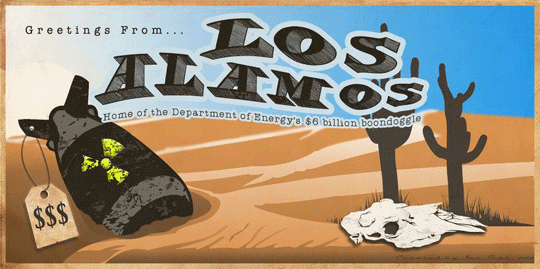
After safety breaches, new Los Alamos director pushes for accountability at nuclear weapons lab, Science , By April Reese, —The new director of Los Alamos National Laboratory here, Terry Wallace, took the helm earlier this month at a particularly challenging time in the U.S. nuclear weapons lab’s storied 75-year history. Repeated safety violations necessitated a temporary shutdown of much of the lab’s plutonium facility from 2013 to 2015, and further infractions in August 2017— including improper storage of plutonium metal that could have triggered an uncontrolled fission reaction—prompted the U.S. Department of Energy, Los Alamos’s overseer, to put the lab’s management contract out for bid. A consortium will continue to run the national laboratory until the winning bidder takes over the $2.5-billion-a-year operation this fall.
Since it was built in secret in 1943 to house the Manhattan Project, which created the first atomic bomb in 1945, Los Alamos has diversified its R&D portfolio. Its research areas now include everything from studying wildfire behavior to developing vaccines. But the lab’s central mission may well be updated in the coming months: President Donald Trump’s administration’s Nuclear Posture Review, leaked to the media earlier this month, signaled interest in developing new low-yield nuclear weapons, even as some of the lab’s most knowledgeable weapons experts are nearing retirement age. …….
We’re the only place [in the United States] that does large-scale work on plutonium. We must meet the expectations to be the safest and most secure site in the country. At the same time, the realization that those expectations are under a magnifying glass, sometimes I think we miss that.
We cannot have any accidents. We do things at times that are simply unacceptable……..
100 Hanford workers moving to new offices after radiation confusion, Tri City Herald, BY ANNETTE CARY, acary@tricityherald.com 19 Jan 18, One hundred workers are being moved out of the trailer village of offices at the Hanford nuclear reservation’s Plutonium Finishing Plant.
As careful surveying for radioactive contamination is continuing after a spread of radioactive particles was discovered in December, the “overwhelming presence of naturally occurring radon” in the trailer village offices is causing a problem, workers were told in a memo.
Any detection of radiation is treated as if it is a potential spread of radioactive particles from the open-air demolition of the plant until further analysis determines whether it is naturally occurring radon or a spread of contamination.
Radon, which is radioactive, is present in almost all rock, soil and water on the Earth’s surface.
The spread of contamination was found after workers finished demolishing most of the plant’s Plutonium Reclamation Facility in mid-December.
The demolition is suspected by Hanford officials as being the source of the airborne spread.
The control zone around the demolition project was broadly expanded on Jan. 7 to tightly regulate access to a wide area around the plant, including closing some roads. Some contamination spread from the plant across a road used by Hanford workers.
This week five more government or government contractor vehicles had possible contamination detected. They are in addition to 16 government and contractor vehicles previously detected with contamination and seven personal vehicles with exterior contamination.
However, the checks of vehicles include some that were used in radiological control areas, zones set up where it was known that radioactive material was likely to be present.
As of Wednesday, 271 workers had requested checks for possible inhalation or ingestion of radioactive particles from the contamination spread. Workers should receive their results in the next few weeks, according to Hanford officials.
The Plutonium Finishing Plant workers were being told to park at the 200 West Pump and Treat a mile away, and were being shuttled to the plant.
The world has been living with the threat of a nuclear apocalypse since the 1950s. Over the past decade, intelligence experts have increasingly warned about the threat of a catastrophic cyber attack. Now the two fears appear to have merged, with the US on the point of revising its defence policy — to allow the use of nuclear weapons, in retaliation for a devastating cyber attack. The Trump administration has not yet released America’s revised, “Nuclear Posture Review”. But the draft document has leaked to the press. According to the New York Times, it would change US policy to allow the first use of nuclear weapons, in response to “attempts to destroy wide-reaching infrastructure, like a country’s power grid or communications, that would be most vulnerable to cyberweapons”.
Developed nations are now almost completely reliant on the internet and functioning computer systems. That, however, increases their vulnerability to cyber warfare. Security experts lose sleep worrying about a range of nightmarish scenarios — including viruses that shut down transport infrastructure, such as air-traffic control; or that disrupt the operations of banks, causing the financial system to seize up. Among the most common horror scenarios are fears for the vulnerability of power generation and distribution.
In recent years, there have been some indications that these scenarios are moving from the pages of science fiction into reality. A computer virus that disrupted Britain’s National Health Service last year, seems to have originated in North Korea. As long ago as 2007, operatives in Russia unleashed a “denial-of-service” attack on Estonia, disrupting the operation of the internet there. A really concerted cyber attack, targeting critical infrastructure, could cause social turmoil and mass casualties. Experts have considered a number of responses to this threat. There are frequent calls for a new international treaty to establish some rules for cyber space. Intelligence agencies have also considered the possibilities for cyber-retaliation — and the balance between offensive and defensive capabilities. Introducing nuclear weapons into the equation is, however, a new departure. It demonstrates how seriously the US is now taking the threat of cyber warfare; and is clearly designed to massively increase America’s deterrence capacity.
At the same time, however, the policy shift carries considerable risks. By lowering the bar to the first use of nuclear weapons, it makes nuclear war more thinkable. The dangers of such a move are increased because concerns about nuclear proliferation are mounting — with North Korea’s nuclear weapons programme making rapid progress, and both Pakistan and Russia incorporating the early use of nuclear weapons into their war-fighting plans. Another danger is that any nation contemplating a cyber attack, may now also have to consider efforts to disable an adversary’s nuclear capability. The US, for example, has almost certainly considered whether, in the event of a war, there are cyber or electronic means of taking out North Korea’s nuclear missiles. Other nations will now have to make similar calculations about the US. gideon.rachman@ft.com
Pentagon Suggests Countering Devastating Cyberattacks With Nuclear Arms, NYT,
查看简体中文版 查看繁體中文版 By DAVID E. SANGER and WILLIAM J. BROAD JAN. 16, 2018 WASHINGTON— A newly drafted United States nuclear strategy that has been sent to President Trump for approval would permit the use of nuclear weapons to respond to a wide range of devastating but non-nuclear attacks on American infrastructure, including what current and former government officials described as the most crippling kind of cyberattacks.
For decades, American presidents have threatened “first use” of nuclear weapons against enemies in only very narrow and limited circumstances, such as in response to the use of biological weapons against the United States. But the new document is the first to expand that to include attempts to destroy wide-reaching infrastructure, like a country’s power grid or communications, that would be most vulnerable to cyberweapons.
The draft document, called the Nuclear Posture Review, was written at the Pentagon and is being reviewed by the White House. Its final release is expected in the coming weeks and represents a new look at the United States’ nuclear strategy. The draft was first published last week by HuffPost.
It called the strategic picture facing the United States quite bleak, citing not only Russian and Chinese nuclear advances but advances made by North Korea and, potentially, Iran.
………the biggest difference lies in new wording about what constitutes “extreme circumstances.”
In the Trump administration’s draft, those “circumstances could include significant non-nuclear strategic attacks.” It said that could include “attacks on the U.S., allied, or partner civilian population or infrastructure, and attacks on U.S. or allied nuclear forces, their command and control, or warning and attack assessment capabilities.”
The draft does not explicitly say that a crippling cyberattack against the United States would be among the extreme circumstances. But experts called a cyberattack one of the most efficient ways to paralyze systems like the power grid, cellphone networks and the backbone of the internet without using nuclear weapons.
……….It is relatively easy for presidents to change the country’s declaratory policy on the use of nuclear arms and quite difficult for them to reshape its nuclear arsenal, which takes not only vast sums of money but many years and sometimes decades of planning and implementation.
The price tag for a 30-year makeover of the United States’ nuclear arsenal was put last year at $1.2 trillion. Analysts said the expanded Trump administration plan would push the bill much higher, noting that firm estimates will have to wait until the proposed federal budget for the 2019 fiscal year is made public.
“Almost everything about this radical new policy will blur the line between nuclear and conventional,” said Andrew C. Weber, an assistant defense secretary during the Obama administration who directed an interagency panel that oversaw the country’s nuclear arsenal.
If adopted, he added, the new policy “will make nuclear war a lot more likely.”
U.S. tests nuclear power system to sustain astronauts on Mars –#SCIENCE NEWS, JANUARY 19, 2018, Will Dunham, WASHINGTON (Reuters) – Initial tests in Nevada on a compact nuclear power system designed to sustain a long-duration NASA human mission on the inhospitable surface of Mars have been successful and a full-power run is scheduled for March, officials said on Thursday.
Officials from the National Aeronautics and Space Administration and U.S. Department of Energy, at a news conference in Las Vegas, detailed the development of the nuclear fission system under NASA’s Kilopower project.
Months-long testing of the system began in November at the energy department’s Nevada National Security Site, with an eye toward providing energy for future human and robotic missions in space and on the surface of Mars, the moon or other solar system destinations………..
“Mars is a very difficult environment for power systems, with less sunlight than Earth or the moon, very cold nighttime temperatures, very interesting dust storms that can last weeks and months that engulf the entire planet,” said Steve Jurczyk, associate administrator of NASA‘s Space Technology Mission Directorate…….
President Donald Trump in December signed a directive intended to pave the way for a return to the moon, with an eye toward an eventual mission to Mars.
Trump said in an interview with Reuters on Wednesday that Russia was helping North Korea evade international sanctions and was probably helping supply Pyongyang with anything that China had stopped giving it. Reporting by Polina Devitt; Editing by Andrew Osborn
Here’s What A Nuclear Bomb Would Do To Your City https://patch.com/washington/bellevue/heres-what-nuclear-bomb-would-do-your-city Would you survive a nuclear attack? A new tool lets you see what a nuclear bomb would do to your city.By Neal McNamara , Patch Staff| BELLEVUE, WA – With the unfortunate nuclear false-alarm in Hawaii still fresh in our minds, aren’t you a little curious to see what would happen if a real nuclear weapon did strike the U.S.? A professor at the Stevens Institute of Technology has created a pretty scary tool that shows you the blast radius and an estimate of deaths in the event of an attack.
For a demonstration, we used the tool to look at what a nuke would do if it landed in downtown Bellevue. According to professor Alex Wellerstein’s “Nuke Map,” a 150 kiloton nuke – about the size most recently tested by North Korea – would kill about 56,000 people and leave 175,000 people injured.
The area in a 1,500-foot radius around the impact site would be incinerated by a fireball, while anyone within a 3-1/2 mile radius would suffer third-degree thermal radiation burns. The thermal radius includes residents of Mercer Island, Kirkland, Redmond, and Medina. And that doesn’t include nuclear fallout, which would affect a significantly larger area.
But take the “Nuke Map” with a grain of salt because it’s just a model. And take heart that nuclear confrontation with a country like North Korea is extremely, highly unlikely.
Brothers Sam and Gary Bencheghib have taken matters into their own hands. When they moved to Brooklyn, they were shocked to find several of the country’s most polluted waterways weren’t a country away but, literally, in their own backyards. For the earth-loving duo, it was a call to action.
The brothers — along with millions of residents in Queens and Brooklyn — live within a stone’s throw of three Superfund sites. Those are the places the EPA deems so polluted, toxic, or destroyed by a natural disaster that a fund has to be set up to clean up the area as quickly as possible. Among these, Newtown Creek is considered one of the most polluted spots in all of the United States. This is thanks to over a century of industrial waste being spewed into the river, raw sewage still being pumped into the waterway every day, and a semi-continual oil spill that’s seen 30 million gallons spilled into the water.
Add in the usual plastic waste that’s clogging our waterways and you have an American river that’s bafflingly poisoned.
The Gowan Canal is similarly toxic. The freshwater stream has been used for shipping of waster and toxic materials for so long that if you were to fall into the water, you’d have to be rushed to a hospital for decontamination procedures. Drinking the water would risk dysentery, arsenic poisoning, and, eventually, cancer.
The Bencheghib brothers know they cannot clean this up all by themselves. Their task is to bring awareness to the sites through their work with Make A Change World. The group aims to directly involve the average person is cleaning up the messes we’re making around the world — through an overuse of plastics and the under-regulated waste from industry.
Currently, “the bros” are focusing on their own backyard in Brooklyn, by highlighting the Superfund sites of Newtown Creek and Gowan Canal. These two sites are both earmarked for clean up operations to begin, but the process is slow and faces hurdles. Meanwhile, the current White House leadership plans to cut $327 million out of the EPA’s Superfund budget and has forbidden the EPA from speaking with citizens.
Luckily, the administration’s disinterest in the environment won’t have drastic effects on the clean up of Newtown Creek and Gowan Canal, as those sites have responsible parties who have been tasked with funding the lion’s share of the cleanup costs. WNYC reported back in November that the six major polluters of Newtown Creek were identified along with the 30 polluters of Gowan Canal. This means, hopefully, the cleanups will go forward unhindered.
Just down the street from Newtown and Gowan is a site called Wolff-Alport. This was the site of an earth metals extraction facility that shuttered in the 1950s. One of their extractions was the radioactive element thorium. That process has made the Wolf-Alport site the most radioactive spot in New York City. Since the company responsible for the radioactive pollution went out of business over 70 years ago, there’s no one to fine and, thereby, collect the funds to clean up the site. The whole tab falls on the shoulders of the EPA’s Superfund budget. WNYC talked to the EPA and they have an estimated cost of $39.9 million to clean up this radioactive site. Currently, there’s $650,000 in the account designated for that job. The acting deputy regional administrator for EPA said bluntly of the site that “What we do know is that people are actually being exposed.”
It would seem to reason that radioactive exposure to the citizens of New York would be a little higher on the list of sites the EPA and local, state, and the federal government would be rushing to clean up. That’s where Make A Change World comes in. 75 years is too long to wait for a radioactive, oil-soaked, or just plain toxic site to be cleaned up. Like the Bencheghib brothers, it’s time to take action in our backyards, in the voting booths, and in how we live our lives.
Michigan dusts off nuclear plans amid war of wordsJustin A. Hinkley, Lansing State Journal Jan. 18, 2018 “……..Michigan’s response to a nuclear attack is spelled out in its 342-page Emergency Management Plan that covers everything from floods to infrastructure failures to riots. The State Police plan for satellites falling out of the sky and meteor strikes, Kelenske said.
The 15 pages covering a nuclear bomb list 24 potential targets in Michigan. Most are in the Detroit region, though a potential target can be found in most every corner of the state, including Lansing, Battle Creek, Berrien County and two locations in the Upper Peninsula.
With Trump and Kim regularly trading trans-Pacific verbal barbs, state officials are reviewing those plans and making sure they’re updated.
“Clearly, when you have a threat on the horizon, we are going to take a look at it, look at our plans, make sure everything is still up to date,” Kelenske said.
Still, “we have to keep this in perspective,” he said. Residents should worry about — and prepare for — the floods, blizzards, thunderstorms, extreme temperatures and other natural disasters they’re far more likely to encounter.
In Lansing, emergency responders are trained in how to respond to nuclear bombs, biological and chemical attacks, and more.
However, “emergency management has not had to plan for a large scale nuclear event for many years,” Merritt and Tobin said in their statement. “It is not being ignored, in Michigan, it is just a very low possibility at this time.”
I received an email on Dec. 25 from a high school and college friend informing me that his kidney cancer had spread to his bones and that he was now in hospice.
Since we were mostly a close bunch in high school — just 128 grads in 1963 — I thought it appropriate to share my friend’s sad news with other classmates and ask for their good thoughts and prayers. Just 12 days later, my friend’s sister contacted me and said he had died peacefully at home. I relayed this sorrowful update to the class.
Among the responders was a classmate who told me that he and my now-departed friend, as well as other kids from the neighborhood, were all regular playmates. Their “playground” in this blue-collar city on the Delaware River was a swampy landfill that was once the location of a gas mantle factory from the 1890s through the 1940s. Gas mantles were small mesh socks coated with radium and thorium that covered a lamp’s gas jet. When ignited, they brightly illuminated America’s streets and houses before electrification.
Today the mantle factory’s former setting is a Superfund site, as classified by the Environmental Protection Agency in 1996. The feds have spent more than $350 million ridding the area and adjacent locales of hazardous wastes, including that deadly radium and thorium. As these elements decay, they give off gamma radiation and radon gas, both proven carcinogens.
The sensible reaction to this horror story would be to double our efforts to protect the environment so today’s and tomorrow’s kids won’t suffer the same horrible fate as these afflicted adults. But then we don’t live in sensible times.Under EPA Administrator Scott Pruitt, the agency is slowly being dismantled. He and President Donald Trump have already canceled or overridden some key environmental regulations on coal waste and vehicle emissions, and the 2018 appropriations bill cuts the EPA’s budget for the Superfund program and climate change research.
Pruitt is on record denying the existence of global warming and, as a result of his staff’s disgust with his beliefs and a federal job freeze and buy-outs, more than 700 employees — 200 or more of them scientists — have left the agency in the last year. According to the union representing EPA staff, Pruitt’s ultimate goal is to cut “at least 3,100 full-time employees.”
Will this make our environment safer? Better yet, do you pack apples in your kids’ lunches? Last February, Pruitt withdrew a proposed ban on pesticides containing chlorpyrifos, used on apples, oranges and cherries across the country. This was despite the EPA’s own scientists, supported by the 66,000-member American Academy of Pediatrics, arguing that even low exposure levels to chlorpyrifos during early childhood increases the risk of learning disabilities, including reduced IQ and developmental delay, and behavioral problems, like ADHD. For expectant and new mothers, the agency’s scientists concluded that even the smallest amounts of the chemical can impact the brain development of fetuses and infants.
Chlorpyrifos are considered so toxic that their use has been banned in homes, schools, day care facilities, parks, hospitals, nursing homes and malls since 2000. But Pruitt says they are OK for your fruit bowl. The pesticide has also proven hazardous to farmworkers and approximately 1,800 critically threatened or endangered species.
A not-so-much fun fact is that Dow Chemical, the manufacturer of Lorsban which contains chlorpyrifos, underwrote President Trump’s inaugural parties to the tune of $1 million. Draw your own conclusions.
As things go, it’s not an especially big leap from a toxic playground in New Jersey in 1955 to an apple orchard in Maryland in 2018. The difference is that today we are supposed to be more discerning because some of us have reaped a sad harvest of family and friends who didn’t know a Superfund from Superman when they were growing up.
So what lessons have we learned? For me it is the undying power of greed — the greed that once caused a company to bury its toxic wastes instead of properly disposing of them, and the greed evinced by the current administration that’s at the beck and call of its corporate benefactors, whether they produce energy or chemicals. This hasn’t changed over the years, even when the guinea pigs are our own sons and daughters.
Frank Batavick writes from Westminster. His column appears Fridays. Email him at fjbatavick@gmail.com.
Federal responsibility in nuclear attack alerts is unclear, AP, By CALEB JONES, HONOLULU (AP) 18 Jan 18, — A timeline shows Hawaii officials botched efforts to immediately correct a false missile alert over the weekend, taking more than 20 minutes to contact federal authorities for approval they didn’t need and then taking another 15 minutes to cancel the alert that was sent to mobile devices statewide.
The astonishing error and dismal response has prompted both state and federal investigations and left one of the state’s U.S. senators wondering aloud if top brass at the Hawaii Emergency Management Agency should be replaced.
“I think (Gov.) David Ige has a tough decision in front of him, and it’s his call,” Sen. Brian Schatz told reporters Wednesday. Either way, the state has a long road ahead in restoring the public’s confidence in the alert system, the Democrat said.
Nearly 40 minutes passed between the time Hawaii officials fired off the bogus alert about an incoming missile over the weekend and the moment the notice was canceled.
The confusion raises questions about whether any state should be solely responsible for notifying the public of such an event. The debate comes as North Korea claims it is testing weapons that could deliver a nuclear-tipped ballistic missile to Hawaii, Guam and even the U.S. mainland.
Hawaii is the only state in the nation with a pre-programmed alert that can be quickly sent to wireless devices if a ballistic missile is heading toward the U.S. FEMA said Hawaii did not require its approval to cancel the alert on Saturday.
U.S. Reps. Colleen Hanabusa and Tulsi Gabbard, both of Hawaii, have asked the House Armed Services Committee to hold a hearing on the issue.
They said in a letter to the committee Tuesday that it’s understandable for states to have primary jurisdiction over warnings for floods, hurricanes and other natural disasters.
“However, when it comes to matters of national security, including whether a ballistic missile has been launched against the United States, one must question whether any state emergency management agency is best suited for that role,” the letter says………
President Donald Trump did not make any public comments about the false alert on Saturday. He was at his golf club in West Palm Beach, accompanied by House Majority Leader Kevin McCarthy.
50 years ago, a US military jet crashed in Greenland – with 4 nuclear bombs on board The Conversation, Timothy J. Jorgensen
Director of the Health Physics and Radiation Protection Graduate Program and Associate Professor of Radiation Medicine, Georgetown University January 18, 2018 Fifty years ago, on Jan. 21, 1968, the Cold War grew significantly colder. It was on this day that an American B-52G Stratofortress bomber, carrying four nuclear bombs, crashed onto the sea ice of Wolstenholme Fjord in the northwest corner of Greenland, one of the coldest places on Earth. Greenland is part of the Kingdom of Denmark, and the Danes were not pleased.
The bomber – call sign HOBO 28 – had crashed due to human error……
The Thule crash revealed that the United States had actually been routinely flying planes carrying nuclear bombs over Greenland, and one of those illicit flights had now resulted in the radioactive contamination of a fjord.
The radioactivity was released because the nuclear warheads had been compromised. The impact from the crash and the subsequent fire had broken open the weapons and released their radioactive contents, but luckily, there was no nuclear detonation.
To be specific, HOBO 28’s nuclear weapons were actually hydrogen bombs. As I explain in my book, “Strange Glow: The Story of Radiation,” a hydrogen bomb (or H-bomb) is a second-generation type of nuclear weapon that is much more powerful than the two atomic bombsdropped on Hiroshima and Nagasaki. Those two bombs were “fission” bombs – bombs that get their energy from the splitting (fission) of very large atoms (such as uranium and plutonium) into smaller atoms.
In contrast, HOBO 28’s bombs were fusion bombs – bombs that get their energy from the union (fusion) of the very small nuclei of hydrogen atoms. Each of the four Mark 28 F1 hydrogen bombs that HOBO 28 carried were nearly 100 times more powerful than the bomb dropped on Hiroshima (1,400 kilotons versus 15 kilotons).
Fusion bombs release so much more energy than fission bombs that it’s hard to comprehend. For example, if a fission bomb like Hiroshima’s were dropped on the Capitol building in Washington, D.C., it’s likely that the White House (about 1.5 miles away) would suffer little direct damage. In contrast, if just one of the Mark 28 F1 hydrogen bombs were dropped on the Capitol building, it would destroy the White House as well as everything else in Washington, D.C. (a destructive radius of about 7.5 miles). It is for this reason that North Korea’s recent claim of achieving hydrogen bomb capabilities is so very worrisome.
Nuclear Explosion Power Comparison
After the crash, the United States and Denmark had very different ideas about how to deal with HOBO 28’s wreckage and radioactivity. The U.S. wanted to just let the bomber wreckage sink into the fjord and remain there, but Denmark wouldn’t allow that. Denmark wanted all the wreckage gathered up immediately and moved, along with all of the radioactively contaminated ice, to the United States. Since the fate of the Thule Air Base hung in the balance, the U.S. agreed to Denmark’s demands……… https://theconversation.com/50-years-ago-a-us-military-jet-crashed-in-greenland-with-4-nuclear-bombs-on-board-87155
The US has stepped up its bomber presence in Guam to include the nuclear-capable B-2 and B-52 bombers.
The deployment comes as part of a mission to keep bombers in Guam constantly, but it’s still rare to see all three US strategic bombers in Guam at once.
North Korea has specifically threatened the bomber fleet in Guam, and the recent deployment marks the clearest possible signal ling between Washington and Pyongyang.
The US deployed every type of strategic and nuclear-capable bomber to Guam amid soaring tensions between the Washington and Pyongyang in a move sure to rattle North Korea.
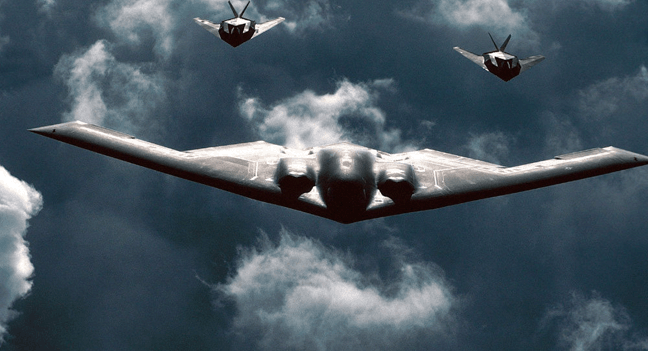
The B-1B Lancer bomber, the B-2 Spirit stealth bomber, and the B-52H — the workhorse bomber that dropped tens of thousands of tons of munitions during the Vietnam War — will be in Guam, the Pentagon has confirmed to Business Insider.
North Korea can’t stand US bomber deployments to Guam, where the US hosts massive military bases in relative proximity to Pyongyang. North Korean media statements usually react strongly and issue threats in response to the US flying B-1 training missions over the Korean Peninsula.
In statements, North Korea refers to the B-1 bomber as a nuclear asset, although the plane has been modified not to carry nuclear weapons as the result of an arms control pact with Russia. The B-2 and B-52 do have nuclear capability, and make up the air-launched component of the US’s nuclear triad.
Unlike in-ground nuclear silos and under-sea secretive submarines, the nuclear-capable bombers in the US Air Force’s fleet enable the US to signal its resolve and intentions during times of high tensions.
While some may interpret the deployment of the nuclear-side of the bomber fleet as an escalation, the deployment is part of a mission called Continuous Bomber Presence, wherein the US has maintained a bomber presence in the Pacific at all times to assure allies, enable readiness, and promote regional stability since 2004.
But it’s still rare to find all three in Guam at once. The three bombers first flew together in Guam in August 2016, and this deployment is the first time since that they’ve all been gathered together in the South Pacific.
Sending all three strategic bombers to Guam sends the strongest message bomber deployments could possibly spell out.
Hawaii: Here’s what would happen if there was a real nuclear attack, ABC News By Anne Barker, 16 Jan 18, Consider the following scenario: a nuclear missile is launched from North Korea on a direct path for Honolulu.
For at least five minutes, Hawaiians are blissfully unaware of the danger.
Suddenly, the US Pacific Command detects the missile in mid-air and sends an alert to Hawaii’s State Warning Point, which instantly activates its public warning system.
Sirens begin blaring across the state and an alert is sent to mobile phones, radio and television.
Panicked residents and visitors have no more than 15 minutes to find somewhere to find cover — but there are no public fallout shelters.
Twenty minutes after launch, a nuclear bomb detonates 1,000 feet above the Hawaiian capital, and thousands are killed and many more are left with burns and radiation poison.
Although Saturday’s missile warning was a false alarm, US authorities believe there’s a very high likelihood that Hawaii — particularly Honolulu and the island of Oahu — would be the primary target of a North Korean nuclear attack.
The “Emergency Preparedness” document, published in November by Hawaii’s Emergency Management Authority, warns that Hawaiian residents and visitors would have “less than 12 to 15 minutes” to seek shelter in the event of a real nuclear missile threat.
Such an attack would “likely occur without prior warning”, it warns.
What would the toll be?
It says that a single-kiloton range nuclear weapon detonated at 1,000 feet could kill almost 18,000 people and cause 50,000 to 120,000 trauma and burn casualties.
As well as widespread building collapses and structural fires, up to 30 per cent of survivors would suffer acute radiation syndrome.
The document, while offering advice to residents on how to survive a nuclear attack, also confirms that Hawaii has no public fallout shelters or shelter supply caches.
Instead, it advises people to seek shelter in a building away from windows, or lie flat on the ground.