Scientists aim to limit Trump’s power to launch nuclear vweapons
 A group of scientists is trying to limit Trump’s nuclear authority, CNBC 25 Jan 18
- A plan pushed by group of scientists would cut presidential authority to unilaterally order nuclear strikes.
- As commander in chief, the U.S. president currently has the authority to order the military to launch nuclear missiles.
- This proposal would require the vice president and speaker of the House to also approve any nuclear strike.
- “No one person should be able to order a nuclear attack,” wrote one of the scientists proposing the plan.
The plan would require that the president first obtain approval from the next two officials in the presidential succession chain — the vice president and speaker of the House, according to a paper in the Bulletin of the Atomic Scientists, a global disarmament advocacy.
As commander in chief, the U.S. president currently has the authority to order the U.S. military to launch nuclear missiles.
Back in November, there was discussion in the Senate Foreign Relations Committee about limiting the president’s nuclear strike authority after some Democratic lawmakers cited Trump’s “unstable” behavior.
“No one person should be able to order a nuclear attack,” said paper co-author Lisbeth Gronlund, a senior scientist and co-director of the Global Security Program at the Union of Concerned Scientists (UCS). “There’s no reason to maintain this dangerous policy, since there are viable alternatives that would allow other officials to take part in any decision to use nuclear weapons, whether it’s a first use or a launch responding to a nuclear attack.”
According to the paper, “the risks are not hypothetical. During the Watergate scandal, President [Richard] Nixon was drinking heavily and many advisers considered him unstable. During the 1974 impeachment hearings, Nixon told reporters that ‘I can go back into my office and pick up the telephone and in 25 minutes 70 million people will be dead.'”
The paper was co-authored by David Wright, a UCS senior scientist, and University of Maryland professor Steve Fetter.
The authors of the paper said the “proposal applies to any use of nuclear weapons, regardless of whether it would be the first use of nuclear weapons or in response to a nuclear attack or warning of an attack.”………
military generals can essentially refuse to follow what they consider “illegal orders,” retired Gen. Robert Kehler testified at the Senate Foreign Relations Committee hearing in November. Kehler is the former commander of the U.S. Strategic Command. https://www.cnbc.com/2018/01/24/scientists-seek-to-limit-trumps-power-in-ordering-a-nuclear-strike.html
Lawsuit against Nuclear Subsidies headed for Court Trial
 Challenge to N.Y. Nuclear Subsidies Will Go to Trial, Power, 01/25/2018 | Sonal Patel A lawsuit challenging subsidies for New York’s nuclear plants will head to trial after the state’s Supreme Court rejected motions to dismiss it.
The measure deals a small setback for Exelon Corp., whose subsidiaries own the R.E Ginna and Nine Mile Point nuclear plants in upstate New York. Defendants in the lawsuit also include Entergy Corp., which owns Indian Point 2 and 3, and the New York State Public Service Commission (PSC).
Exelon had successfully lobbied the state to approve the Clean Energy Standard in August 2016, a program that requires all six New York investor-owned utilities and other energy suppliers to pay for the intrinsic value of carbon-free emissions from nuclear power plants by purchasing “Zero-Emission Credits” (ZECs) between 2017 and 2029.
The measure has drawn strong opposition. The lawsuit filed by several citizens’ groups—including the Nuclear Information Research Service, Beyond Nuclear, New York Public Interest Research Group, Indian Point Safe Energy Coalition, Promoting Health and Sustainable Energy, and Goshen Green Farms—charges that PSC failed to follow the law by giving up more than $7.6 billion in ratepayer funds over 12 years to the companies’ financially ailing nuclear plants.
Specifically, the groups argued that the PSC failed to follow requirements in the State Administrative Procedure Act, and that the PSC’s actions were arbitrary and capricious—both by misapplying the social cost of carbon metric as a legal basis to include nuclear reactors in the Clean Energy Standard, and by declaring the reactors “publicly necessary.” Other stated causes of action allege that the PSC violated pubic service law by setting rates that are “unjust, unreasonable, unjustly discriminatory, and unduly preferential.”
The state and nuclear plant owners sought to dismiss the lawsuit, arguing that some claims are untimely because they were filed outside of the four-month statute of limitations after the Clean Energy Standard became final and binding. Respondents also argued that petitioners lack sufficient standing to pursue some claims, because alleged economic injuries were outside a defined zone of interests.
On Monday, Judge Roger D. McDonough dismissed claims by 56 of the 61 petitioners on the basis that they were time-barred. However, he denied five of the six objections posed by the respondents, ruling that the lawsuit should be fully heard rather than preempted by the respondents’ objections. “The Court declines to entertain such discussions without the benefit of answers and the full administrative record,” he wrote.
The ruling notes that at least three of the nuclear plants—James A. Fitzpatrick, R.E. Ginna, and Nine Mile Point Unit 1 and Unit 2—have received an estimated $360 million in subsidies over the past nine months. McDonough ruled, however, that while Indian Point was eligible for ZECs amounting to about $2 billion, contentions concerning that plant were not ripe for adjudication as the plant has not yet received them.
The citizens’ groups hailed the decision as a major victory for the rule of law. …….. http://www.powermag.com/challenge-to-n-y-nuclear-subsidies-will-go-to-trial/
The dangers of transporting nuclear waste – Las Vegas Mayor warns
 In D.C., Goodman highlights dangers of transporting nuclear waste, https://lasvegassun.com/news/2018/jan/25/in-dc-goodman-highlights-dangers-of-transporting-n/ By Yvonne Gonzalez (contact)Thursday, Jan. 25, 2018
Nuclear waste coming to Nevada from all corners of the country would be dangerous, Las Vegas’ mayor told bipartisan city leaders in Washington, D.C. Mayor Carolyn Goodman was in the capital for the U.S. Conference of Mayors winter meetings. She spoke to fellow members about the nation’s aging infrastructure and other risks associated with bringing nuclear waste to Nevada, where a proposed repository at Yucca Mountain has been a political football for years. The American Society of Civil Engineers gives the nation’s infrastructure an average D+ rating.
“Anywhere it’s transported is at risk because of the tunnels, the bridges, the railroads, the roads,” she said. “An accident … puts millions and millions of people around the country at risk for loss of life, cancer and everything else.”
The conference of mayors has expressed concern about the transportation of nuclear waste since as early as 2002, although the group has not explicitly come out against the dumpsite. Goodman said she is talking to mayors at this winter’s meetings and working to get a resolution passed.
“You have to tell them that this stuff is being transported through their city or 50 miles away and the spill-out from an accident” will impact them, she said.
The mothballed Yucca Mountain project could see movement under President Donald Trump, who has called for funding to prepare for the licensing process. The proposed project stalled years ago under President Barack Obama and then-Sen. Harry Reid, a Nevada Democrat.
Henderson Mayor Debra March and Bob Halstead, executive director of the Nevada Agency for Nuclear Projects, were among the Nevada contingent to hold the reception. Halstead and Sen. Dean Heller, R-Nev., spoke to the audience about concerns associated with the project. Rep. Mark Amodei, R-Nev., is the only member of Nevada’s delegation who has not signed onto legislation calling for consent-based siting for nuclear waste storage.
“The issues are very very concerning,” Goodman said. “It’s not so much about Nevada as it is about the people throughout the country who are placing their residents and their visitors at risk.”
Workers demolishing Hanford’s Plutonium Finishing Plant still vulnerable to airborne radiation
 Hanford radioactive monitoring not protecting workers, By Annette Cary, Tri-City Herald, January 25, 2018 New test results show that monitoring for airborne radioactive contamination has not protected Hanford nuclear reservation workers as the site’s highly contaminated Plutonium Finishing Plant is demolished.
Two more Hanford workers have inhaled or ingested small amounts of airborne radioactive material, with tests for 180 workers still pending, according to the Department of Energy.
The most recent results were for the first 91 workers who requested testing after a spread of radioactive material was discovered in mid-December.
In addition, air samples collected and analyzed at sites outside the demolition zone around the plant show that airborne radioactive contamination was not found in 2017 by other monitoring methods meant to more quickly warn of a potential danger to workers.
A memo with the latest results for both checks for radioactive contamination of workers and for air monitoring results was sent to Hanford workers Wednesday afternoon by Doug Shoop, manager of the DOE Hanford Richland Operations Office.
In one case, airborne contamination that appeared to be linked to demolition of the plant was found about 10 miles away, near the K Reactors along the Columbia River, workers were told. The finding follows an earlier discovery of airborne contamination in June at the Rattlesnake Barricade, a secure entrance to Hanford just off public Highway 240…….. http://www.columbian.com/news/2018/jan/25/hanford-radioactive-monitoring-not-protecting-workers/
Victims of Fukushima nuclear radiation, on both sides of the Pacific
 Fukushima heroes on both sides of the Pacific still fighting effects of radiation, stress and guilt, Following the catastrophic earthquake and tsunami of 2011, selfless Japanese workers battled nuclear-reactor meltdown, and thousands of US troops provided disaster relief. Today, many are counting the cost to their mental and physical health, SCMP, BY ROB GILHOOLY, 25 JAN 2018 Christmas Day saw dozens of masked men descend on Futaba, in the northeast of Japan’s main island of Honshu. They moved deliberately along deserted streets, clearing triffid-like undergrowth and preparing to demolish derelict buildings. Their arrival marked the beginning of an estimated four-year government-led project to clean up Futaba, which has succumbed to nature since its residents deserted almost seven years ago.
Futaba is one of two towns (the other being neighbouring Okuma) on which sits the 350-hectare Fukushima Daiichi Nuclear Power Plant, which experienced multiple reactor meltdowns and explosions in March 2011, contaminating huge swathes of land and forcing the evacuation of 160,000 residents – all the result of the magnitude-nine undersea Tohoku earthquake and the devastating mega-tsunami that hit on March 11, claiming up to 21,000 lives.
Despite 96 per cent of Futaba still being officially designated as uninhabitable due to high radiation levels, the government has set spring 2022 as the return date for its 6,000 or so residents. That the government has also built a 1,600-hectare facility to store up to 22 million cubic metres of nuclear waste in the town has led to doubts that many will return.
I find it difficult to believe anyone would want to go back,” says Ryuta Idogawa, 33, a former employee at Fukushima Daiichi operator Tokyo Electric Power Co (Tepco), and one of the so-called “Fukushima 50” – a hardcore of station workers who remained on-site after 750 others had been evacuated, battling to bring the melting reactors under control at great risk to their own safety.
“They say time heals,” Idogawa adds, “but that depends how deep the wounds are.”
On the other side of the world, members of a different and larger group of people than the Fukushima 50 are suffering health problems, ostensibly as a result of the disaster. For more than seven weeks following the catastrophe, the United States mounted a massive disaster relief mission, dubbed Operation Tomodachi (the Japanese word means “friend”). The initiative directly or indirectly involved 24,000 US service personnel, 189 aircraft and 24 naval ships, at a total cost US$90 million.
While the mission was lauded a success by the US and Japanese governments, during Operation Tomodachi, thousands of US sailors were inadvertently exposed to a plume of radiation that passed over their ships, which were anchored off the Pacific coast of Japan. Since then, several hundred have developed life-changing illnesses, such as degenerative diseases, tumours and leukaemia, and defects have been detected in foetuses of some pregnant women. All are a result, they claim, of being irradiated by the plume.
According to one report, 24 sailors, who were in their late teens or 20s at the time, are living with a variety of cancers. At least six have died since 2011, while others suffer post-traumatic stress disorder (PTSD).
“Unlike the nuclear plant workers, these sailors had no protective clothing, in fact some of them literally had no shirts on their backs because they had given all their clothing away to people they saved from the tsunami waves,” says Charles Bonner, a lawyer at one of three law offices representing 402 sailors who have filed a US$5 billion lawsuit against Tepco and General Electric Co, a suit that has been given the go-ahead to be heard in a US federal court. (Fukushima Daiichi’s Reactor No. 1 – the plant’s oldest reactor – was built by American manufacturer General Electric Co.)
“And because they had given away all their bottled water to tsunami survivors, they were drinking desalinated water that also had been contaminated,” Bonner continues. “I do not doubt the psychological impact of the disasters on the plant workers, but at least they had masks and protective clothing, as required by law. The sailors, however, knew nothing of their exposure and were literally marinated in the radiation.”……….
lawyer Bonner says that while his team represents more than 400 sailors, there were a further 69,600 American citizens – military and civilian – potentially affected by the radiation, and who have yet to join the class lawsuit.
He also expresses indignation at the Royal Society study and the viewpoint of cancer expert Thomas, insisting that the health of the young US service men and women aboard the ships was endangered and in many cases compromised by Operation Tomodachi. “[The sailors] were certified by the Navy as healthy and fit, so why are they getting cancer and other illnesses?” he asks. “That can only be because they were exposed to radiation. It can’t just be a coincidence.”…….. http://www.scmp.com/magazines/post-magazine/long-reads/article/2130359/fukushima-heroes-both-sides-pacific-still
Bill to subsidise New Jersey’s nuclear power stations – unaffordable handout to the industry
THE NUCLEAR SUBSIDY BATTLE IS NOT OVER, NJ Spotlight , STEVEN S. GOLDENBERG | JANUARY 24, 2018
New Jersey citizens and businesses can ill afford the massive wealth transfer and regulatory capitulation that PSEG’s bill would impose. Opponents of PSEG’s nuclear subsidy bill applauded former Assembly Speaker Vincent Prieto’s refusal to post the bill for a vote in the Legislature’s lame-duck session, effectively killing the bill. However, the PSEG subsidy fight is far from over, as the identical bill has already been reintroduced and scheduled for a hearing in the new legislative session. It now falls to the Murphy administration to decide whether to support this badly flawed, one-sided bill that would provide unjustified regulatory perks, including billions of dollars in unwarranted subsidies, to PSEG’s profitable nuclear plants. For the reasons that follow, Gov. Murphy should follow the lead of the former speaker and reject the bill.
It is a sad truth that literally every provision in the bill favors the interests of PSEG over ratepayers and competitors, with no apparent effort having been made to strike a fair balance between them. The bill would shift all financial risks associated with the future operation of the nuclear plants to ratepayers, and the out-of-market subsidy created would wreak havoc on the functioning of the interstate wholesale energy markets, paving the way to even higher energy costs in the future.
The bill would afford PSEG a continuing $320 million per year subsidy — an amount arbitrarily established by PSEG without regard to the alleged future losses of the nuclear plants, while conveniently sidestepping the Board of Public Utilities’ century-old ratemaking processes that are used to establish just and reasonable rates. It is noteworthy that the bill is devoid of any provision that would obligate PSEG to provide a single tangible benefit to anyone in return for the financial windfall it would receive…….
Because there is no issue regarding the nuclear plants’ current profitability, the relief the bill would provide is unwarranted. New Jersey should follow Connecticut’s recent example and require PSEG, as a condition precedent to the receipt of any future relief, to make comprehensive financial disclosures regarding the current and projected profitability of the nuclear plants…….http://www.njspotlight.com/stories/18/01/23/op-ed-nuclear-subsidy-battle-is-not-over/
Space travel damages astronauts’eyes
 How does space travel affect the eye? Astronauts’ retinal nerves found damaged after months in orbit http://www.ibtimes.co.uk/how-does-space-travel-affect-eye-astronauts-retinal-nerves-found-damaged-after-months-orbit-1656000
The finding comes as Nasa continues to prepare for missions to Mars and beyond. By Shubham Sharma, As Nasa continues to prepare for manned deep-space missions to Mars and beyond, a new study has highlighted a major concern for the agency – the affect of long-term space travel on astronauts’ retinal nerves, which ultimately degrades their ability to see.Nearly 50% of astronauts report cases of vision impairment after spending a prolonged time in space, sometimes months or maybe years after returning to Earth. The cases vary from person to person but the new study, published in the journal JAMA Ophthalmology and reported by Live Science, factors something that could be the key trigger for these problems.
After studying pre- and post-flight optical scans of 15 astronauts who had spent around six months in space, researchers noted a significant change in their optic nerves, the delicate transmitter that takes visual information from the retina to the vision centres of the brain, helping a person register what they see.
As per the report, the analysis of Bruch membrane openings, the gaps at the back of the eyeball through which these nerves travel, revealed that their delicate tissues were significantly swollen and warped.
The critical damage was noted weeks after the astronauts’ return to Earth and has been touted as the first direct observational evidence that highlights the critical effect of long-term space travel on optic nerves. Some of the study subjects already had vision-related problems but the patterns in the deformity could not be ignored.
Though the actual cause of this condition remains unknown, the researchers believe it could be due to the difference between normal and cosmic pressures. According to them, when astronauts reach space, the pressure increases and the eyes take their time to adjust to that change. However, when they come back to Earth, the pressure goes down suddenly, which the eyes fail to deal with.
As of now, it cannot be said for certain if this is the exact reason, but whatever it may be, Nasa will have to study this problem carefully before going ahead with its deep-space missions. The success of any manned program, whether to the Moon, Mars or any other distant planet, will depend on astronauts and how they react to changes in their surroundings several thousand kilometres away from Earth.
Poll shows that Americans fear Trump’s ability to launch nuclear weapons, and doubt his mental stability
The majority of Americans are afraid of Trump’s ability to launch nuclear missiles. They also don’t have a lot of faith in his mental stability. Vox, By We may no longer be teaching American schoolchildren how to “duck and cover,” but a new Washington Post/ABC News poll shows the threat of nuclear war is once again on the minds of the American populace. A new poll finds most Americans don’t trust President Trump with the power to launch nuclear weapons, and a majority are at least “somewhat” concerned that he’ll launch an unjustified attack.
The poll comes less than a month after Trump’s tweet comparing the size of his “nuclear button” to North Korean leader Kim Jong Un’s.
Democrats are far more likely than Republicans to report fear, for example, with almost six in 10 Democrats saying they are “very concerned” about Trump ordering an unjustified nuclear attack, compared to about three in 10 independents and fewer than one in 10 Republicans.
Gender also plays a role, with twice as many women as men saying they are “very” concerned Trump could launch a nuclear attack — 42 percent versus 22 percent.
Those who are most concerned about him launching a nuclear attack without justification are also those who have the least confidence in his mental stability. Only 48 percent of respondents said they thought Trump was mentally stable when asked about the president’s description of himself as a “very stable genius.” Forty-seven percent, meanwhile, don’t think he’s mentally stable.
Eighty-four percent of those who say Trump is not mentally stable are at least somewhat concerned that he could launch an unwarranted nuclear attack, while 72 percent of those who say Trump is stable trust him to handle nuclear weapons……… https://www.vox.com/policy-and-politics/2018/1/23/16923020/americans-afraid-trump-nuclear-missiles-launch-mental-stability
USA will want to withdraw from Iran nuclear deal – Mike Pence
Mike Pence confirms US intention to withdraw from Iran nuclear deal, The US vice president’s visit to Israel has prompted anger from Palestinians over US policy in the Middle East. The Independent ,By Ken Thomas, January 23 2018 US vice president Mike Pence has reiterated to Israeli leaders that the Trump administration plans to pull out of the landmark 2015 Iran nuclear deal unless the pact is amended.
The remarks came as Mr Pence wrapped up his visit to Israel. On Monday, he repeatedly referred to Jerusalem as Israel’s capital, speaking alongside the country’s prime minister Benjamin Netanyahu. He also used a high-profile speech to the parliament to announce plans to speed up the timing of the opening of the US Embassy in Jerusalem, moving it from Tel Aviv, by the end of 2019.
On Tuesday, Mr Pence met with Israeli president Reuven Rivlin and vowed the United States would counter the Iranian nuclear threat………https://www.independent.ie/world-news/mike-pence-confirms-us-intention-to-withdraw-from-iran-nuclear-deal-36520699.html
NASA getting excited about plutonium powered space missions
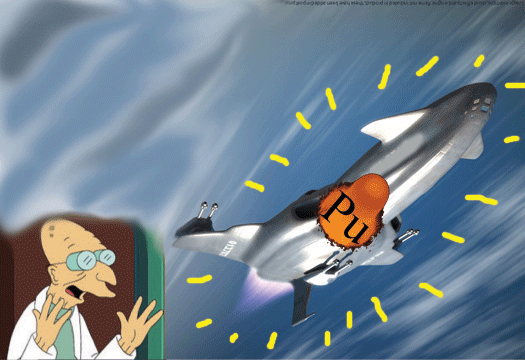 NASA Pushes for Nuclear-Powered Space Missions, Scientific American, 24 Jan 18,
The space agency’s Kilopower project could end a half-century hiatus for U.S. reactors in space, By Harrison Tasoff, SPACE.com on January 23, 2018 “…….
In 2012, Los Alamos National Laboratory and NASA’s Glenn Research Center in Ohio conducted a successful proof-of-concept test of the reactor, and NASA gave them the go-ahead to continue development and testing at the Nevada National Security Site. Right now, the team is conducting component testing to determine the reactivity-worth of each of the reactor’s parts, namely how they react to the neutron radiation generated by the fission reaction. This phase of testing should be completed this week, according to officials at the conference. Then the project will progress to cold-critical testing, which will test the reactor’s components, this time with the enriched uranium fuel core inside, officials said at the conference. Full power testing is scheduled to begin in mid-March.
NASA’s interest in sending astronauts to Mars has provided the primary impetus behind the Kilopower project: The power demands for a human mission to Mars will be far greater than the requirements for previous robotic missions…..
“A successful Kilopower test will be a great leap forward for space nuclear power,” Jurczyk said…….https://www.scientificamerican.com/article/nasa-pushes-for-nuclear-powered-space-missions/
Ontario’s nuclear dreams no match for the reality of falling electricity demand
Angela Bischoff, Outreach Director, 23 Jan 18, Since 2005, demand for electricity in Ontario has been steadily falling. In 2017, it fell a further 3.6% meaning that demand has dropped by 16% since 2005. That is the equivalent of taking 2.5 million homes off the grid – like unplugging all the houses and apartments in the City of Toronto twice over.
Ontario is not alone in seeing a sustained drop in demand. This is a trend that has taken hold in many countries and provinces thanks to new technologies such as super-efficient LED lighting and smart controls, cost-effective energy efficiency programs, and economic changes. In fact, reducing the need to generate electricity in the first place has become Ontario’s lowest cost way of addressing our energy needs – the province paid on average just 2.2 cents to save a kilowatt-hour of electricity in 2016.
But oddly, the Wynne government shows no signs of recognizing the growing mismatch between its plans to spend billions of dollars on re-building aging nuclear reactors and the ever-decreasing need for the power they would produce. In fact, in order to justify continuing to operate the 47-year-old Pickering Nuclear Station – the highest cost nuclear plant in North America – the province is currently curtailing 26% of the potential annual output of our cleaner and safer wind and solar power plants.
Does it make sense to pay 7 times more to re-build aging nuclear reactors than to enhance energy efficiency? Should we rebuild nuclear reactors that have to run 24/7 when demand is falling and supply patterns are being rapidly changed by the introduction of increasingly low-cost renewable sources? These are questions the government seems determined to ignore.
Instead of simply ignoring the numbers, a far better way to act on these trends is to strike a deal with Quebec to import low-cost, flexible water power; continue to expand our cost-effective conservation programs; and embrace new renewable energy opportunities right here at home.
Shame on Trump – Uranium mines in Bears Ears?
The implications of the story written by Hiroko Tabuchi were staggering: an area of long-held federal land only recently protected by President Barack Obama at the end of his administration for its significance to five Native American tribes could one day be pocked with uranium mines.
Tabuchi found that there are more than 300 uranium mining claims inside Obama’s boundaries for the national monument, nearly a third of which are tied to the Lakewood-based Energy Fuels Resources.
“The vast majority of those claims fall neatly outside the new boundaries of Bears Ears,” Tabuchi wrote…….
The valleys, buttes and desert landscape of Bears Ears are largely untouched and full of historical significance to the five Indian nations whose ancestors left their artifacts, ruins and hieroglyphics across the land as evidence that they were there first. Bears Ears deserves protection.
As Trump celebrated shrinking Bears Ears last month at the Utah Capitol, he said: “I’ve come to Utah to take a very historic action to reverse federal overreach and restore the rights of this land to your citizens.”
Trump is wrong. The land is still all federally owned, outside of the control and taxation of local entities. What Trump’s ruling did do was open up the possibility of private interests taking what they want from the land. Until Tabuchi’s reporting, we were all supposed to believe no one wanted this land for private gain. Now we all know the sad truth. https://www.denverpost.com/2018/01/20/uranium-mines-in-bears-ears-shame-on-trump/
Quiet preparations for war with North Korea – USA manouvres
The US appears to be quietly preparing for nuclear war with North Korea. https://www.businessinsider.com.au/us-appears-quietly-preparing-nuclear-war-north-korea-2018-1?r=US&IR=T, ALEX LOCKIE– JAN 20, 2018,
Daniel Ellsberg – we can dismantle the “dizzyingly insane and immoral” Doomsday Machine
From the beginning of the Atomic Age, says Ellsberg, the true purpose of our nuclear arsenal, the whole terrifying array of warheads and delivery systems in all their vast numbers and varieties, has not been the “defense” of our country. It has not been, as trumpeted by politicians and generals (and as believed by citizens and schoolchildren), to “deter” an adversary from launching a nuclear attack against the U.S. It is the maintenance of a first-strike nuclear force —not so much for the purpose of launching a deliberate surprise attack on anyone else, but to be ready to respond instantly
 Dismantling Doomsday: Daniel Ellsberg on the Risk of Nuclear Apocalypse https://undark.org/article/book-review-ellsberg-doomsday-machine/ The whistleblower who gave us the Pentagon Papers unveils another secret history — this one ‘dizzyingly insane and immoral.’01.19.2018 Mark Wolverton
DANIEL ELLSBERG is perhaps the premier whistleblower of all time, the man who in 1971 dragged the Pentagon Papers out of top-secret darkness into the light. Yet even as excerpts from the papers’ 7,000 pages were being published by The New York Times, The Washington Post, and other newspapers, Ellsberg was sitting on an entire second set of secrets, having nothing to do with Vietnam: all his material on nuclear policy, such as the operational plans for general nuclear war that he had drafted for the Joint Chiefs of Staff in his job as a RAND Corporation defense analyst.
Ellsberg’s new book, “The Doomsday Machine: Confessions of a Nuclear War Planner,” is his revelation of what was in those lost papers, made possible not only by his prodigious memory and note-keeping but also the declassification and release of much of the material through official channels and Freedom of Information Act requests (many filed by Ellsberg himself). Speaking with the authority of an insider who was intimately involved with nuclear strategy and policymaking at the highest levels, he reveals that practically everything the American public believes about nuclear war and nuclear weapons is, quite simply, a “deliberate deception.” Continue reading
Legal cases to begin, as shareholders sue, over $9 billion nuclear power project debacle

 Shareholder lawsuits against SCANA over nuclear debacle debut in federal court. http://www.thestate.com/news/politics-government/article195428354.html COLUMBIA, SC
A federal judge in Columbia on Thursday designated lead lawyers and plaintiffs in two types of shareholder lawsuits against SCANA over its bungled V.C. Summer expansion.
The lawsuits charge SCANA and its top officers with misconduct and breaches of fiduciary duty in their handling of the failed $9 billion construction project.
Cayce-based SCANA, the corporate parent of the SCE&G utility, denies any wrongdoing.
The moves, involving nearly 20 lawyers, were the initial steps in moving the lawsuits forward. U.S. District Judge Margaret Seymour also dealt a mild setback to SCANA, rejecting its plea to give one group of shareholders suing the company only three weeks to amend their lawsuits.
“I would like to make sure that whatever is filed (by the plaintiffs) in this court is complete,” said Seymour, granting lawyers for the shareholders 60 days to amend their lawsuits against SCANA and some of its top executives.
The numerous lawsuits against SCANA in both state and federal courts are expected to take months, if not years, to play out.
On Thursday, Seymour:
▪ Designated the New York firms of Bernstein Litowitz and Labaton Sucharow as the lead attorneys in one class of shareholder lawsuits against Cayce-based SCANA. The Motley Rice law firm of Charleston was named local liaison counsel.
The lawsuits allege shareholders suffered huge losses when SCANA’s stock price plummeted — from almost $75 a share to the just more than $42 Thursday — after the nuclear project failed. They also allege SCANA misled shareholders about the project for years, propping up its share price.
If shareholders prevail, SCANA will have to pay monetary damages to numerous shareholders, including pension funds and individuals.
▪ Designated the Weiser law firm of Philadelphia and Bernstein Liebhard of New York as lead counsel in a second group of lawsuits, called “shareholder derivative” actions. S.C. liaison counsel include Bill Hopkins of Pawleys Island and Eric Bland of Columbia.
In the cases, the plaintiffs allege SCANA and its officers exposed the utility to liability by violating federal securities laws – including laws that require them to be open with regulators and the public – by their handling of the nuclear project.
SCANA and its officers artificially drove up the utility’s stock price by issuing false public statements and using a “strategy of deception and misdirection” about the nuclear project’s progress, cost and completion schedule, the lawsuits allege.
The goals of the shareholder derivative lawsuits include forcing top SCANA officers and board members to give back all “profits, benefits and other compensation,” including annual incentive bonuses.
Another group of lawsuits against SCANA is pending in state court. Those suits, mostly brought by ratepayers who claim they were cheated when SCANA hiked their monthly bills for years to pay for the failed project, were not affected by Thursday’s actions.
Seymour — who has 20 years’ experience as a federal judge, and widely is regarded as fair, low key and methodical — is overseeing one of South Carolina’s most complex, high-stakes legal battles in years.
Although many of the almost 20 lawyers in the Columbia courtroom Thursday came from Atlanta, New York and Philadelphia, S.C. lawyers also were present.
South Carolinians I.S. Leevy Johnson, Stephen Pugh and George Johnson are representing SCANA. The attorneys for the various plaintiffs suing SCANA included South Carolinians Bland, Hopkins and Marlon Kimpson, a Democratic state senator from Charleston.
1 This Month





PLEASE OPPOSE HR 8255 AND S.3639 – bills would accelerate satellite deployment, with no environmental review or safeguards – https://ncstd5li.quorum.us/campaign/169331/
To see nuclear-related stories in greater depth and intensity – go to https://nuclearinformation.wordpress.com
-
Archives
- October 2026 (58)
- September 2026 (339)
- August 2026 (330)
- July 2026 (355)
- June 2026 (287)
- May 2026 (306)
- April 2026 (356)
- March 2026 (251)
- February 2026 (267)
- January 2026 (308)
- December 2025 (358)
- November 2025 (359)
-
Categories
- 1
- 1 NUCLEAR ISSUES
- business and costs
- climate change
- culture and arts
- ENERGY
- environment
- health
- history
- indigenous issues
- Legal
- marketing of nuclear
- media
- opposition to nuclear
- PERSONAL STORIES
- politics
- politics international
- Religion and ethics
- safety
- secrets,lies and civil liberties
- spinbuster
- technology
- Uranium
- wastes
- weapons and war
- Women
- 2 WORLD
- ACTION
- AFRICA
- Atrocities
- AUSTRALIA
- Christina's notes
- Christina's themes
- culture and arts
- Events
- Fuk 2022
- Fuk 2023
- Fukushima 2017
- Fukushima 2018
- fukushima 2019
- Fukushima 2020
- Fukushima 2021
- general
- global warming
- Humour (God we need it)
- Nuclear
- RARE EARTHS
- Reference
- resources – print
- Resources -audiovicual
- Weekly Newsletter
- World
- World Nuclear
- YouTube
-
RSS
Entries RSS
Comments RSS

