The health cost of America’s uranium and nuclear industries

To make and maintain America’s nukes, some communities pay the price https://www.pri.org/stories/2018-01-30/make-and-maintain-americas-nukes-some-communities-pay-price Things That Go Boom, January 30, 2018 · By Laicie Heeley Prior to the 1970s, the US and other countries conducted more than 500 nuclear weapons tests in the atmosphere. The tests blanketed the world with radioactive fallout, and in 2002, a study by the CDC and National Cancer Institute found that any person living in the US since 1951 has been exposed.
Trump ready to spend $716 Billion on weapons in fiscal 2019 budget
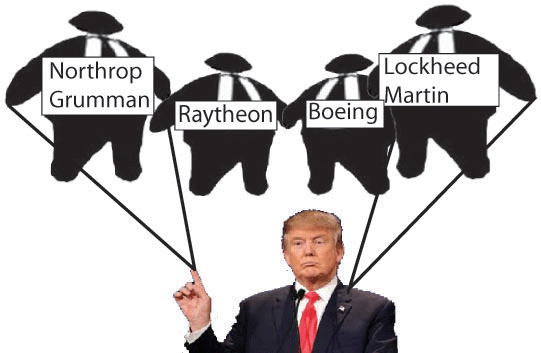 Pentagon Wins as Trump Readies a $716 Billion Budget Request, Bloomberg, By
-
Big increase for Pentagon would deepen the U.S. deficit
-
-
Mattis has raised alarm over U.S. ‘competitive edge’ eroding
President Donald Trump will propose $716 billion in defense spending in his fiscal 2019 budget request, a 7.2 percent from his request for this year that backs the Pentagon’s push for a major buildup, a U.S. official said.
The funding would include $597 billion for the Defense Department’s base budget, with the rest going for its war-fighting account and to other government programs such as the Energy Department’s nuclear weapons program, said the official, who spoke on condition of anonymity in advance of the release of Trump’s second proposed budget next month.The amount is a sharp increase from the $668 billion total Trump proposed last year for fiscal 2018 and also offered as a placeholder for fiscal 2019. Currently, the Pentagon is operating under stopgap funding at fiscal 2017 levels, which totaled $634 billion. The plan, reported earlier Friday by the Washington Post, represents a victory of defense hawks over those trying to constrain deficit spending.
The U.S. official confirmed Trump’s next proposed budget will include major increases on procurement spending over the $124 billion sought this year.Mattis’s PushDefense Secretary Jim Mattis has pushed for a jump in defense spending to match the breadth of the new National Defense Strategy he released this month……….
-
- Ultimately, Trump’s proposal will be measured by the amount it exceeds the caps in the Budget Control Act of 2011.Unless Congress waives the budget limits, as it’s done three times in the past, the cap for fiscal 2019, which begins Oct. 1, is $563 billion for defense-related spending, including $534 billion for the base defense budget.
War-Fighting Fund
The official said more than $90 billion of Trump’s budget proposal would come from the war-fighting fund — known as Overseas Contingency Operations — that’s exempt from caps. While the fund is supposedly for pressing war needs, it’s often used as a tool to bulk up overall defense funding. Trump’s war-fighting budget for the current year includes $10 billion for weapons acquisition……..https://www.bloomberg.com/news/articles/2018-01-26/trump-is-said-to-seek-716-billion-for-defense-in-2019-budget
USA’s “Defense”strategy – in reality an attack strategy

America’s National Defense Is Really Offense https://www.globalresearch.ca/americas-national-defense-is-really-offense/5627508, By Philip Giraldi, Global Research, January 28, 2018
Pentagon plans US-South Korean war games as soon as Winter Olympics are over
US-South Korean war games will go on after Olympics, Pentagon says , By KIM GAMEL | STARS AND STRIPES, January 26, 2018SEOUL, South Korea — U.S. military exercises with South Korea will be held after the Olympics as planned despite a demand for a complete suspension from the North, the Pentagon said.
The planned war games cast a shadow over hopes that the recent détente between the two Koreas may lead to a broader dialogue with the United States after months of saber rattling over the North’s nuclear weapons program.
Defense Secretary Jim Mattis reiterated that military options remain at the ready to make sure diplomats have leverage in pressuring Pyongyang to denuclearize…….
Washington agreed to delay them until after the Olympics, which will be held on Feb. 9-25 in the South Korean alpine town of Pyeongchang. Mattis has said they would resume after the March 8-18 Paralympics.
But North Korea, which agreed to participate in the Winter Games as part of rare talks with the South, demanded a complete suspension……..
North Korea has frequently responded to the exercises — and similar drills held by the allies in the fall — with missile tests and a stream of bellicose rhetoric…….
Some 28,500 U.S. servicemembers are based in South Korea, which remains technically at war with the North after their 1950-53 conflict ended in an armistice instead of a peace treaty.https://www.stripes.com/news/us-south-korean-war-games-will-go-on-after-olympics-pentagon-says-1.508583
gamel.kim@stripes.com
Twitter: @kimgamel
America is unprepared for medical consequences of a nuclear attack
U.S. not medically prepared for nuclear threats, http://www.thegazette.com/subject/opinion/guest-columnist/us-not-medically-prepared-for-nuclear-threats-20180128, Alan Moy, 28 Jan 18
These countries have a history of supporting terrorist groups. It has been acknowledged by our government that highly enriched uranium can be smuggled into this country to build a 10-kiliton improvised nuclear bomb, like that dropped on Hiroshima in 1945. A nuclear threat would even include a dirty bomb that combines a conventional explosive with radioactive isotopes, which could contaminate an area and leave a residual radioactive “hot zone” that is too dangerous for even first responders to enter. Also, radioactive particles can disperse into the air and create a “plume” that could extend hundreds of miles away from ground zero and create a contamination area that would last for years.
A nuclear blast would instantly release a massive pressure wave and heat that would incinerate everything within half a mile and kill an estimated 75,000 to 100,000 people. Another 100,000 to 200,000 would suffer complexed radiation burns, while others would be exposed to high doses of radiation that would cause acute radiation syndrome that is characterized by bone marrow failure and gastrointestinal, cardiac, neurological and pulmonary toxicity. The starkest fact about a nuclear bomb attack is that it destroys the capacity to respond from a medical and civil service perspective. There will be a loss of local government services from firefighters, police and hospitals, along with loss of water, sewage and utilities. There will be a loss of communication systems to direct survivors where to evacuate for treatment.
The management of mass casualties from nuclear detonation is far more complex than for natural disasters. Hot zones are too dangerous for first responders to enter to render medical assistance to casualties. Yet, victims would still need to be evacuated somehow. According to the report, most U.S. cities lack medical preparedness to manage the aftermath of a nuclear explosion. FEMA has not devoted enough attention to address this issue. This makes it important for cities and states to develop plans for the worse case scenarios. Each state should have a plan of preparedness that includes special medical triage centers; coordinated schemes from state military and local police to provide mobile communication assets and protection against civil unrest; and specialized trained hospitals that can medical manage the injuries associated with a nuclear bomb. There needs to be a statewide plan from the governor’s office from each state, along with each state’s department of public health, to ensure there is sufficient medical preparedness.
Several government officials stated they were unable to take steps forward out of being accused of inciting fearmongering. However, developing a comprehensive preparedness program against nuclear threats should not just stop with military action but should include a medical preparation program regardless of how politically undesirable the subject may be. Preparedness should be mandated at every local and state government level.
• Alan Moy is CEO of Cellular Engineering Technologies and scientific director of the John Paul II Medical Research Institute.
Supreme Court judge backs Hudson River Sloop Clearwater in battle over upstate nuke plant bailout
 Early victory for Hudson River Sloop Clearwater in battle over upstate nuke plant bailout, Jan. 26, 2018 Environmental groups scored an early-round victory in the legal battle over the state’s plan to bail out three upstate nuclear power plants with billions of dollars in subsidies backed by ratepayers….
Legislation to protect Georgia consumers from Vogtle nuclear power costs
 Georgia Senate bill aims to protect consumers’ pocketbooks from Vogtle, Savannah
  Now, January 27, 2018, By Mary Landersmary.landers@savannahnow.com Legislation co-sponsored by state Sen. Lester Jackson, D-Savannah, seeks to limit the money paid by ratepayers — particularly schools — for Georgia Power’s expansion of Plant Vogtle.
The troubled expansion is five years behind schedule and its price tag has nearly doubled to $27 billion. Despite a staff recommendation that the project is uneconomic and a finding that the company will make $5 billion in profits from the delays, the Georgia Public Service Commission in December gave the green light to complete the expansion with few added consumer safeguards.
Senate Bill 355, sponsored by Rome Republican Chuck Hufstetler and introduced Wednesday, would amend the Georgia Nuclear Energy Financing Act to limit in several ways the ongoing collection of a nuclear fee while these reactors are being built and prevent the utility from automatically collecting the same nuclear fee on future projects. It would also provide for a refund if the reactors never become operational…….. http://savannahnow.com/news/2018-01-26/georgia-senate-bill-aims-protect-consumers-pocketbooks-vogtle
UK govt pays £100m for advice on renewing nuclear arsenal
£100m cost of advice on renewing nuclear arsenal, Mark Hookham, Defence Correspondent, The Sunday Times More than £100m has been spent helping ministers decide whether to overhaul or replace Britain’s arsenal of nuclear warheads.
Diablo Canyon Nuclear Plant – another scare, with fire event
Fire at Rickety Diablo Canyon Nuclear Plant Gives California a Scare — Shutdown Slated for 2025, bureau EnviroNews Headline News , by Shad Engkilterra on January 27, 2018 , (EnviroNews USA
No plan for vote on financial rescue for Ohio nuclear plants
http://www.the-review.com/news/20180128/no-plan-for-vote-on-financial-rescue-for-ohio-nuclear-plants COLUMBUS, Ohio (AP) — A state lawmaker says there are no plans to hold more hearings on a proposal to increase electrical bills to help keep Ohio’s two nuclear power plants operating.
Akron-based FirstEnergy Corp. has been pushing for the financial rescue that it says is needed to keep the Davis-Besse nuclear plant near Toledo and the Perry plant near Cleveland operating.
The legislation would give FirstEnergy’s plants an extra $180 million a year.
Republican Sen. Bill Beagle leads the Senate’s Public Utilities Committee. He says he doesn’t anticipate taking up a vote on the plan.
A FirstEnergy executive said earlier this week that the plants will likely close without a financial rescue.
The company has been saying the plants can’t compete with cheaper natural gas plants in the current market.
State of Nevada raises new concerns on plan to license Yucca Mountain as nuclear waste dump
Nevada raises new concerns about Yucca Mountain licensing plan, Las Vegas Review Journal, By Gary Martin Review-Journal Washington Bureau, January 26, 2018 – WASHINGTON — Nevada has detailed fresh concerns about plans to expedite licensing of Yucca Mountain as a nuclear repository in a report that was delivered Friday by the state’s congressional delegation to key House members.
Rep. Dina Titus, D-Nev., distributed the state’s report to lawmakers on the House Energy and Commerce and the House Appropriation committees asking that they review it before moving forward on the Nuclear Waste Policy Amendments Act.
The amendments bill passed out of the Energy Committee on a 49-4 vote last June, and is largely expected to pass in the full House, which has yet to schedule a vote.
Nevada Gov. Brian Sandoval has led the state’s opposition to storing nuclear waste at Yucca Mountain, noting that “no amount of monetary benefits can compensate for the coerced selection of an unsafe site.”
In the report, the state said the bill does not address the amount of funding that would be needed for expediting the licensing application by the Department of Energy and the participation of federal, state and local governments in the process before the Nuclear Regulatory Commission.
The state also says in its report that the bill ignores potential adverse economic impacts that could result in developing Yucca Mountain, noting the uncertainty of liability of DOE contractors……https://www.reviewjournal.com/local/local-nevada/nevada-raises-new-concerns-about-yucca-mountain-licensing-plan/
Is a Better American Nuclear Arsenal Good for the Asia-Pacific?
U.S. modernization efforts risk sparking a nuclear arms race with China. The Diplomat, By Kim Mu Kwan (Harry) 26 Jan 18, Since the end of the Cold War, the United States has been a leader of nuclear disarmament efforts. It gradually reduced its nuclear weapons stockpile through a series of arms reduction treaties with Russia. In 2009, then-President Barack Obama also affirmed “America’s commitment to seek the peace and security of a world without nuclear weapons.”
US stealth bombers in Guam getting ready for a pre-emptive nuclear strike on North Korea?
 US stealth bombers in Guam appear to be readying for a tactical nuclear strike on North Korea, Business Insider, ALEX LOCKIE, JAN 25, 2018,
Trump May Consider Preemptive Strike on North Korea – CIA Director
CIA Boss Gives Latest Indication Trump May Consider Preemptive Strike on North Korea, Daily Beast The spy agency is briefing the president about military options on North Korea, which outside analysts warn could escalate to nuclear war. SPENCER ACKERMAN, 01.23.18 THE CENTRAL INTELLIGENCE AGENCY IS BRIEFING President Donald Trump on the risks and opportunities of a limited attack on North Korea, its director suggested on Tuesday.
CIA Director Mike Pompeo would not discuss the “wisdom of a preemptive strike” on Pyongyang or its nuclear weapons program, he told an audience at the conservative American Enterprise Institute. But in rare public remarks, Pompeo portrayed North Korea as an urgent priority for the agency, and disclosed aspects of its role in setting back Kim Jong Un’s nuclear program during his first year at Langley……..
A former North Korean spy, Kim Hyon-hui, indicated to NBC News that Trump’s goal of denuclearizing a country that has been a nuclear state for over a decade is not achievable diplomatically: “North Korea won’t give up its nuclear weapons. They’re its lifeline.”……….
Trump has given reason to doubt Pompeo’s statement that he is looking to resolve the Korea nuclear crisis peacefully. In October, he said Secretary of State Rex Tillerson was “wasting his time” attempting negotiations with Kim. After Tillerson stated publicly last month that he was willing to talk with North Korea without any precondition, the White House again shut him down. All that followed Trump’s infamous August declaration that North Korean provocations would be “met with fire and fury like the world has never seen.”……. https://www.thedailybeast.com/cia-director-mike-pompeo-gives-latest-indication-trump-is-considering-preemptive-strike-on-north-korea
Epic crisis in USA’s nuclear industry – Trump’s trying to stop solar power will not save nukes
 Trump’s Assault on Solar Masks an Epic Crisis in the Nuclear Industry, The Progressive , by Harvey Wasserman, January 25, 2018 As Donald Trump launches his latest assault on renewable energy—imposing a 30 percent tariff on solar panels imported from China—a major crisis in the nuclear power industry is threatening to shut four high-profile reactors, with more shutdowns to come. These closures could pave the way for thousands of new jobs in wind and solar, offsetting at least some of the losses from Trump’s attack.
Like nearly everything else Trump does, the hike in duties makes no rational sense. Bill McKibben summed it up, tweeting: “Trump imposes 30% tariff on imported solar panels—one more effort to try and slow renewable energy, one more favor for the status quo.”………
the burgeoning U.S. market for cheap Chinese panels has birthed a very large industry. More than a quarter-million Americans now work in photovoltaics, with most of the jobs in building desert arrays or perching the panels on rooftops. Except for the very marginal pressure from Suniva and SolarWorld, solar advocates have focussed on the rapid spread of low-cost panels, even if they come from China.
Powered largely by Chinese product, the cost of a solar-generated watt of power has dropped from $6.00 in the late 1990s to around $0.72 in 2016. Further drops are considered inevitable. At that price, there is virtually no economic margin for any other new energy production construction except wind and natural gas. Even gas—with its uncertain long-term supply—is on the cusp of being priced out.
Thus, the industry’s reactionto Trump’s solar panel tariff has been fierce.
“We are not happy with this decision,” Abigail Ross Hopper, president of the American Solar Energy Association, told Reuters. “It’s just basic economics—if you raise the price of a product, it’s going to decrease demand for that product.” Trump’s move is predicted to drop upcoming solar installations by 10 to 15 percent and cost some 23,000 jobs.
Sustainable energy professor Scott Sklar, in an email to The Progressive, estimated that Trump’s 30 percent tariff will, after four years, “retard the solar market by 9 percent, cause the loss of thousands of U.S. jobs, and not save the two companies that brought the anti-competitive tariff request initially. The tariff was a political statement to China rather than specifically addressing the health of the U.S. solar industry and increasing U.S. solar jobs.”
Two major developments in the nuclear power industry further illustrate the absurdity of Trump’s decision.
In California, the Public Utilities Commission has gutted a major agreement that would have kept two mammoth reactors at Diablo Canyon operating for several more years. The landmark deal—cut between Pacific Gas & Electric, the host communities around San Luis Obispo, the reactors’ union workers and two environmental groups—called for PG&E to collect some $1.3 billion from ratepayers.
But the California commission cut PG&E’s take to about $300 million. To continue running the two fast-deteriorating old reactors would require massive capital repairs. The company also has admitted that all of Diablo’s power can be otherwise produced with zero- and low-carbon green technologies.
While Trump’s tariffs may slightly alter the math, they’re not expected to make photovoltaics, wind, geothermal, or increased efficiency more expensive than the power Diablo might generate in the coming seven years. Thus, Diablo opponents like Linda Sealey of the San Luis-based Mothers for Peace are extremely hopeful for early shutdowns.
“We think this makes it likely they’ll shut as early as 2020,” she told me January 18 on California Solartopia at KPFK radio in Los Angeles. “They just can’t compete.”
A parallel fate may soon overtake Ohio’s ancient Perry and Davis-Besse reactors on Lake Erie. Because the increasingly decrepit nuclear plants have been priced out of the market and face huge capital repairs, their owner FirstEnergy has been desperately begging the Ohio legislature for massive bailouts, which it has so far resisted. As a result FirstEnergy is poised to go bankrupt, and may soon be bought out by financiers expected to insist the two reactors finally shut. A decision is expected in April.
The shutdown of four more major reactors would be a huge blow to the downwardly spiraling atomic energy industry. California’s booming solar business employs more than 100,000 Americans, more than are currently digging coal nationwide. The void left by Diablo’s shutdown would generate thousands of Golden State jobs and billions in renewable revenue.
In northern Ohio, massive wind potential is also poised to create far more jobs than are currently in place at the two reactors, with energy to be generated far more cheaply. Overall, the closure of these four high-profile plants would thus accelerate the already rapid run away from nuclear power toward renewable sources, regardless of any attempt by the Trump Administration to alter the course.
Harvey “Sluggo” Wasserman’s “California Solartopia Show” is broadcast at KPFK-Pacifica 90.7FM in Los Angeles. His “Green Power & Wellness Show” is podcast at prn.fm. His History of the US and Solartopia! are at www.solartopia.org, which will publish his America at the Brink of Rebirthlater this year. http://progressive.org/dispatches/trumps-assault-on-solar-masks-an-epic-crisis-in-nuclear-180125/
1 This Month





PLEASE OPPOSE HR 8255 AND S.3639 – bills would accelerate satellite deployment, with no environmental review or safeguards – https://ncstd5li.quorum.us/campaign/169331/
To see nuclear-related stories in greater depth and intensity – go to https://nuclearinformation.wordpress.com
-
Archives
- October 2026 (58)
- September 2026 (339)
- August 2026 (330)
- July 2026 (355)
- June 2026 (287)
- May 2026 (306)
- April 2026 (356)
- March 2026 (251)
- February 2026 (267)
- January 2026 (308)
- December 2025 (358)
- November 2025 (359)
-
Categories
- 1
- 1 NUCLEAR ISSUES
- business and costs
- climate change
- culture and arts
- ENERGY
- environment
- health
- history
- indigenous issues
- Legal
- marketing of nuclear
- media
- opposition to nuclear
- PERSONAL STORIES
- politics
- politics international
- Religion and ethics
- safety
- secrets,lies and civil liberties
- spinbuster
- technology
- Uranium
- wastes
- weapons and war
- Women
- 2 WORLD
- ACTION
- AFRICA
- Atrocities
- AUSTRALIA
- Christina's notes
- Christina's themes
- culture and arts
- Events
- Fuk 2022
- Fuk 2023
- Fukushima 2017
- Fukushima 2018
- fukushima 2019
- Fukushima 2020
- Fukushima 2021
- general
- global warming
- Humour (God we need it)
- Nuclear
- RARE EARTHS
- Reference
- resources – print
- Resources -audiovicual
- Weekly Newsletter
- World
- World Nuclear
- YouTube
-
RSS
Entries RSS
Comments RSS

