 Nuclear weapons budget gets boost in US spending bill, Defense News, By: Joe Gould and Aaron Mehta WASHINGTON 11 Sept 18
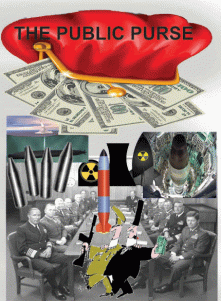
— Congress could, in the coming days, finalize a nuclear weapons budget that adds $458 million in 2019 over last year, after a conference committee released a compromise funding plan on Monday.
The plan calls for $44.6 billion in Department of Energy appropriations, with $11.1 billion for weapons activities within the National Nuclear Security Administration, a semiautonomous office of the Department of Energy that has oversight for the U.S. nuclear warhead stockpile.
The number includes full funding of life-extension programs for nuclear weapons at $1.92 billion, which supports NNSA’s efforts to sustain and upgrade U.S. nuclear warheads and their supporting infrastructure, in line with the administration’s Nuclear Posture Review.
Still, there are questions whether NNSA’s five major modernization programs will be funded in the future — and the bill orders cost estimates related to several capabilities……
The Nuclear Posture Review, released Feb. 2, called for the development of two new nuclear weapons capabilities, as well as heavy investment in infrastructure to support the nuclear arsenal. A Government Accountability Office report warned last year that five major modernization programs that will be underfunded in the coming years.
Lawmakers are expected to vote later this week on a funding package that also includes the full-year appropriations for Veterans Affairs, military construction, the legislative branch and a few other agencies. Congress has until the end of September to finalize all of its government-spending bills, or face a possible partial government shutdown.
The nuclear weapons funding looks like a win for President Donald Trump, who had sought to expand America’s nuclear arsenal and requested a 17.5 percent increase for NNSA over the previous year’s request as the administration seeks to refresh and improve America’s nuclear arsenal.
September 12, 2018
Posted by Christina Macpherson |
USA, weapons and war |
Leave a comment
 Bipartisan senators seek to revive nuclear energy investment, Utility Dive, Iulia Gheorghiu
Dive Brief:
- Sen. Lisa Murkowski, R-Alaska, introduced a nuclear energy bill with a group of bipartisan senators Thursday, seeking more action from the Department of Energy (DOE) in support of advanced nuclear energy goals.
- The bill would extend the maximum length for federal power purchase agreements (PPA) from 10 years to 40, to accommodate the long life and costs of nuclear plants.
- The bill also seeks to enhance federal investment in the nuclear industry, establishing facilities to test and develop advanced nuclear reactors and to develop domestic capabilities to produce the type of uranium needed for advanced reactors.
Dive Insight:While nuclear advocates are already lauding the ambitious scope of the bill, it may not have much chance to pass based on other policy priorities this late into the legislative session.
“But it will definitely be a top priority for us next year and shows very solid bipartisan momentum for advanced nuclear,” Darren Goode, spokesperson for the conservative consulting group ClearPath, wrote Utility Dive via email.
ClearPath supports advanced nuclear reactor development and the group’s president, Jay Faison, recently penned a piece with Murkowski regarding the need for nuclear energy in rural communities.
“Whether it gets done in this session or it gets reintroduced the next session, directionally, I think it’s a key message from the congress to the executive branch,” Chris Colbert, chief strategy officer for the advanced nuclear developer NuScale Power, told Utility Dive.
NuScale is the closest company to commercial deployment of a small modular reactor in the U.S., with the first plant to use NuScale technology scheduled to be online in 2026, Colbert said. The PPA extension would “clearly help with near-term deployment for the NuScale plant,” he said. The plant will have a 60-year life, making the possibility of a 40-year PPA “that much stronger to help with the project.”
The bill seeks to extend PPAs since more than a decade is needed to pay for the initial capital costs for nuclear reactors. Besides creating an extension for federal PPAs, the bill directs the DOE to partner with industry and purchase a longer-term nuclear PPA as part of a pilot program to use the new technology to increase reliability and resilience for critical grid assets.
The plant using NuScale technology, under development at the Idaho National Laboratory, is a testament to the importance of federal funding, research and development. Republican Idaho Sens. James Risch and Mike Crapo co-sponsored the bill and praised the ongoing work in their statements.
“The research and advances in nuclear energy being achieved by the experts at Idaho National Lab will be supported well into the future under this legislation,” Crapo said in a statement. he bill directs the DOE to establish specific advanced nuclear reactor R&D goals and a 10-year strategic plan for the DOE Office of Nuclear Energy to meet those goals, while also creating an education program to help meet nuclear energy workforce needs……..https://www.utilitydive.com/news/bipartisan-senators-seek-to-revive-nuclear-energy-investment/531917/
September 12, 2018
Posted by Christina Macpherson |
politics, USA |
Leave a comment
 NRC To Inspect San Onofre Nuclear Plant After Waste Canister Incident, NPR, 10 Sep 18, The transfer of nuclear waste to storage canisters at the San Onofre nuclear power plant in southern California has been put on hold, after a near accident last month. The plant closed in 2013.
RACHEL MARTIN HOST: The San Onofre nuclear power plant in Southern California was officially shut down back in 2013. But a plan to transfer the spent fuel into storage canisters on the site has run into problems. The efforts to store the waste have been put on hold after a near accident last month. The Nuclear Regulatory Commission is sending an inspection team there this week to review what happened. Alison St. John of member station KPBS has the story.
SOUNDBITE OF WAVES CRASHING)
ALISON ST JOHN, BYLINE: The waves break against aseawall here at San Onofre State Beach. Behind me, surfers skim the water. This is one of the top five most popular state parks in California with 2.5 million visitors a year. To my left, just on the other side of the seawall, lie rows and rows of concrete bunkers. Many of them are already full of high-level nuclear waste from the nuclear power plant that’s been decommissioned.
MIKE AGUIRRE: It’s a ticking time bomb. It’s a sword of Damocles, and it’s hanging over our head.
ST JOHN: In 2015, attorney Mike Aguirre filed suit against the California Coastal Commission for granting a permit to store the waste on-site right next to the Pacific Ocean.
AGUIRRE: There will be a major problem – incident – at San Onofre sometime. It may be in the short term. It may be in the long term.
ST JOHN: The nuclear power plant shut down six years ago after its operator, Southern California Edison, discovered a radioactive leak in new steam generators. With no permanent storage site for the nation’s nuclear waste, Edison decided to store the highly radioactive spent fuel rods on-site in partially buried canisters embedded in concrete about 100 feet from the high-tide line.
AGUIRRE: San Onofre is a national problem if there’s a major incident there because it will affect the economy of this whole region.
ST JOHN: Concern was heightened when this happened. At a recent community meeting, David Fritch, a safety inspector, stood up to speak.
(SOUNDBITE OF ARCHIVED RECORDING)
DAVID FRITCH: I may not have a job tomorrow for what I’m about to say, but that’s fine ’cause I made a promise to my daughter that if no one else talked about what happened, I would.
ST JOHN: Fritch described a near accident when a canister of radioactive spent fuel being transferred from a cooling pond got hung up as it was being lowered into a concrete vault………….
GREG JACZKO: Realistically, they’re not going to move them out.
ST JOHN: Jaczko headed the Nuclear Regulatory Commission in 2012 when San Onofre was shut down.
JACZKO: So those permits will be extended, the operational period will be extended repeatedly, and you will have a de facto burial site there.
ST JOHN: Jaczko is one of a growing number of voices raising the alarm about the decision to bury the spent fuel near the beach. An estimated 8 million people live within 50 miles of San Onofre. And of course there’s earthquakes and the possibility that sea level rise could eventually reach the bottom of the canisters before they’re moved. The Nuclear Regulatory Commission will evaluate Edison’s handling of the near miss accident and decide when the company can resume transferring the waste from cooling pools into the bunkers by the sea. For NPR News, I’m Alison St. John in San Diego.(SOUNDBITE OF ARCHIVED RECORDING) https://www.npr.org/2018/09/10/646213870/nrc-to-inspect-san-onofre-nuclear-plant-after-waste-canister-incident
September 12, 2018
Posted by Christina Macpherson |
safety, USA |
Leave a comment
BBC 10th Sept 2018 , California has passed a law committing to exclusively carbon-free
electricity sources by 2045, setting it against US President Donald Trump’s
energy policy. “There is no understating the importance of this measure,”
Governor Jerry Brown said, and vowed to honour the 2015 Paris climate deal.
Last year Mr Trump said he would pull the US out of the deal and negotiate
a new “fair” deal for US businesses. California is the second US state
after Hawaii to commit to carbon-free energy. Were it to be an independent
country, California would have the fifth largest economy in the world, trailing
only Germany, Japan, China and the US. At a signing ceremony in
the state capital Sacramento, Mr Brown vowed to meet the terms of the Paris
agreement and to “continue down that path to transition our economy to zero
carbon emissions”. Under the terms of the legislation, all utility c
ompanies must get 60% of their energy from renewable sources by 2030. By
2045, all Californian electricity must come from carbon-free or renewable
energy.
https://www.bbc.co.uk/news/world-us-canada-45476865
Time 10th Sept 2018 Gov. Jerry Brown signed a bill Monday that puts California – the
world’s fifth largest economy if it was an independent country – on an
ambitious path: using 100% clean electricity by 2045.
,http://time.com/5391881/brown-signs-bill-100-percent-clean-energy-california/
September 12, 2018
Posted by Christina Macpherson |
renewable, USA |
Leave a comment
Bloomberg By Zainab Fattah, September 9, 2018,
Exercises to ensure free movement in Gulf, Red Sea chokepoints
- Iran said it’ll halt exports from Hormuz if it’s oil barred
The U.S. Navy is conducting exercises this month to ensure its readiness to guarantee freedom of movement through Persian Gulf and Red Sea waterways amid escalating threats from Iran to disrupt shipping across important choke points.
The exercises, with regional and global allies, are part of the U.S. 5th Fleet Theater Counter Mine and Maritime Security Exercise, Commander Scott A. Stearney told reporters from NAVCENT headquarters in Manama. One exercise is taking place in Djibouti, which sits on one side of the Bab Al Mandab strait, a crucial pinch point for global shipping at the south end of the Red Sea……. https://www.bloomberg.com/news/articles/2018-09-09/u-s-navy-conducts-military-exercises-in-gulf-amid-iran-tension
September 12, 2018
Posted by Christina Macpherson |
Iran, politics international, USA, weapons and war |
Leave a comment
 Wildfire burns at Hanford nuclear reservation https://www.tri-cityherald.com/news/local/article218057675.html, BY ANNETTE CARY, acary@tricityherald.com, September 08, 2018 RICHLAND, WA
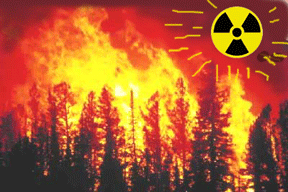
A wildfire burned an estimated 3,000 acres on the Hanford nuclear reservation early Saturday morning, and a larger fire was burning uncontained on Saddle Mountain.
The nuclear reservation fire burned to the east of Highway 240 in the southern end of Hanford, said Rae Moss, spokeswoman for Hanford contractor Mission Support Alliance.
No buildings or areas with radioactive waste were involved, she said. The fire was discovered about 3:20 a.m. and the Hanford Fire Department had it contained at 6:50 a.m., according to Mission Support Alliance.
Highway 240 was closed from Highway 225 to the Highway 24 until about 4:30 a.m., according to the Washington Department of Transportation.
Hanford workers were told to use the Wye Barricade entrance to the site just north of Richland rather than the Yakima Barricade secure entrance.
The cause of the fire has not been announced, but a thunderstorm passed through the Mid-Columbia overnight.
The thunderstorm was the likely cause of two more fires that started on the Saddle Mountain area of the Hanford Reach National Monument north of the Columbia River. The reach includes the original security zone around the nuclear reservation.
The fires started about 10:30 p.m. Friday and merged.
The combined size was estimated at about 12,000 acres, with 30 percent of the fire contained at 10 a.m. Saturday.
September 10, 2018
Posted by Christina Macpherson |
climate change, USA |
Leave a comment
 Rise for Climate: thousands march across US to protest environment crisis https://www.theguardian.com/environment/2018/sep/08/rise-for-climate-protests-san-francisco-new-york. 9 Sep 18
Protests spearheaded by march in San Francisco ahead of climate change summit in the city next week
Tens of thousands of people took part in marches and other events across the US on Saturday, calling for a swift transition to renewable energy in order to stave off the various perils of climate change.
The
Rise for Climate protests was spearheaded by what organizers called the largest ever climate march on the US west coast. The march, which snaked through the heart of San Francisco, came ahead of a climate change summit in the city next week that will gather mayors and business leaders from around the world.
The San Francisco march, which called for California governor Jerry Brown to end fossil fuel extraction in the state, attracted around 30,000 people, organizers said.
An array of activities, including rallies, voter registration drives and vigils, were scheduled to take place across the US, in cities such as Boston, Miami and Portland, Oregon. Events were also planned in Puerto Rico. In New Orleans, protesters planned to agitate for the halt of the Bayou Bridge pipeline, an extension of the controversial Dakota Access project that last year spurred a lengthy standoff at the Standing Rock reservation.
Hundreds of other actions took place in cities around the world, as part of a coordinated effort to counter what climate activists see as the dangerously regressive policies of Donald Trump’s administration, which has sought to dismantle rules to lower greenhouse gas emissions and has thrown open vast areas of land and water to drilling.
“Today, people across the country are rising up for climate, jobs and justice in their communities to fight back against Trump’s toxic agenda and to send a message to every politician that the time for action is now,” said Michael Brune, executive director of environment group the Sierra Club.
“Families living in the shadows of coal plants and oil refineries, losing homes and livelihoods to wildfires and extreme weather, and struggling to make a living wage are coming together because we know we don’t have time to waste.”
The activists’ ire is largely aimed at governors who though relatively progressive on climate issues, such as Brown and New York governor Andrew Cuomo, are deemed not to be ambitious enough in phasing out fossil fuels. On Thursday, several thousand people took part in a climate march in New York City. Ten activists were arrested after blocking the street in front of Cuomo’s Manhattan office.
A week of protests are planned surrounding the summit in San Francisco, with organizers hoping to draw attention to air pollution and social inequity that has tainted California’s economic growth.
“Climate change, economic inequality, the housing crisis, increased criminalization, attacks on immigrant communities – all these challenges are driven by systemic devaluation of the lives of people of color and choosing profit over people and the planet,” said Gladys Limon, executive director of the California Environmental Justice Alliance.
“We are standing up to life destructive industries, from big oil to natural gas companies, that obstruct progress toward a healthy, sustainable and just society.”
September 10, 2018
Posted by Christina Macpherson |
climate change, USA |
Leave a comment
by Jeff Gillan , 9 Sept 18, LAS VEGAS (KSNV) — Nevada’s elected officials reacted with alarm Thursday to a Department of Energy proposal to send a ton or more of weapons-grade plutonium to the Nevada National Security Site.
The security site, formerly known as the test site, has seen small amounts of plutonium before but that was for weapons testing.
This proposal, from the Department of Energy, would be the first time, according to Nevada officials, that plutonium would be stored here, potentially indefinitely.I have been made aware that @Energy intends to store plutonium in Nevada with no timeline for removal. I will fight this at every level,” Governor Brian Sandoval, R-Nevada, tweeted.
The plutonium up to a ton would be sent here by 2020 from South Carolina because a facility there has not been finished that would re-purpose the material. Another ton would be scheduled to be sent here in 2021.
“Doe is addressing South Carolina’s concerns by screwing Nevada,” tweets Congresswoman Dina Titus…….
Plutonium, at the security site, is a separate issue [from Yucca nuclear waste dump plan] . However, conservationists see another agenda by sending plutonium here.
“This is about a test run to see what storage and transportation of nuclear material looks like to Nevada,” says Andy Maggi, the Executive Director of the Nevada Conservation League.
State officials reacted to the proposal with alarm.
“Not only does shipping up to one metric ton of plutonium across the country likely present risks to those living along the proposed transportation routes, storing this material just a few miles from #LasVegas could threaten the health and safety of Nevadans and our tourism economy,” tweets Sen. Dean Heller, R-Nevada.
“I have serious concerns with (Department of Energy) Secretary Perry recklessly pushing this proposal forward without properly assessing the impact that transporting and storing up to one metric ton of weapons-grade plutonium would have on Nevadans’ health and safety. I urge DOE to conduct a full environmental analysis,” said Rep. Jacky Rosen, D-Nevada, in a statement.
Yucca Mountain will take years – if ever – to become operational. One worry is also that DOE could reclassify the plutonium as nuclear waste and send it to Yucca when it’s ready.
“That’s not an inconceivable scenario,” says Greg Lovato, the Administrator of Nevada’s Division of Environmental Protection.
In the meantime, Nevada plans to fight plutonium coming here.
“We’re looking at all legal options because we believe that the supplemental analysis issued by the department is insufficient for this type of activity,” says Bradley Crowell. https://news3lv.com/news/local/department-of-energy-introduces-plan-to-store-plutonium-in-nevada
September 10, 2018
Posted by Christina Macpherson |
- plutonium, USA |
Leave a comment
There’s renewed anger in Chatsworth, Simi Valley, over Santa Susana Field Lab clean-up By SARAH FAVOT |September 2, 2018 Frustrated with the pace of cleanup of a former rocket engine test site on the border of San Fernando and Simi valleys, area residents have stepped up their call for the safe disposal of hazardous and radioactive materials.
Criticism of the massive, long-planned clean-up is not new. But tension re-emerged Thursday night, as the state’s Department of Toxic Substances Control (DTSC) held a public hearing at El Camino Real Charter High School in Woodland Hills. DTSC officials, who are overseeing the cleanup, wanted to hear comments about the U.S. Department of Energy’s proposed plans to decontaminate and demolish the former Hazardous Waste Management Facility and Radioactive Materials Handling Facility at the site of the Santa Susana Field Laboratory.
Nestled between Simi Valley and Chatsworth, the land was developed in the 1940s to test rocket engines and conduct nuclear research. Boeing now owns most of the site, which has been the focus of residents’ ire over stalled clean-up and the management of those clean-up.
“This is a crime against humanity,” said Melissa Bumstead, who led a protest before the hearing, referring to what she said has been the mishandling of the clean-up of radioactive materials at the site.
Bumstead believes that her daughter’s cancer was caused by the release of radiation from the site. She said during hospital visits she met other parents who live within a few miles of the site whose children also had cancer. Some others who spoke at the meeting said they have cancer or have fought cancer.
In 1989, the Department of Energy released a report admitting that a partial meltdown of a sodium reactor had occurred in 1959 in Area IV of the land, where the two facilities set to be closed are located.
The Radioactive Materials Handling Facility, one of the buildings set for closure and demolition, was used to treat and store radioactive and mixed waste. Mixed waste has both chemical and radiological constituents. Radioactive waste included uranium and plutonium. The facility’s permit expired in 2003.
The Hazardous Waste Management Facility was used for storage and treatment of non-radiological alkaline metal wastes. The building ceased operation in 1997……….
Some of the residents who gave public comments Thursday night have attended many other DTSC meetings. Many echoed sentiments of frustration and mistrust with the agency. Some held up yellow signs during the meeting that read “DTSC lied, Our kids died” and “Broken Promises.”
“It’s the same old stuff,” Dorri Raskin, of Northridge, said. “It’s very frustrating. It’s disappointing with the lies.”
Another public hearing on the plan will be held Sept. 8 at the Simi Valley Senior Center, 3900 Avenida Simi, Simi Valley at 10:30 a.m.
Public comment on the plans has been extended to Oct. 12. Comments can be emailed or sent to Laura Rainey, DTSC senior engineering and project manager, 5796 Corporate Ave., Cypress, CA 90630, laura.rainey@dtsc.ca.gov.
Correspondent Marianne Love contributed to this report.
September 10, 2018
Posted by Christina Macpherson |
USA, wastes |
Leave a comment
we can now add “preventing war” to the list of nuclear energy’s superior characteristics – Shellenberger
Who are we to deny weak nations the nuclear weapons they need for self-defense? – Shellenberger
We “should be glad that North Korea acquired the bomb” according to Shellenberger. And on it goes ‒ his enthusiasm for nuclear weapons proliferation knows no bounds.
Understanding of the power-weapons connections, combined with opposition to nuclear weapons, is one of the motivations driving opposition to nuclear power.

Nuclear lobbyist Michael Shellenberger, learns to love the bomb, goes down a rabbit hole, NUCLEAR MONITOR , 7 Sept 18 Author: Jim Green ‒ Nuclear Monitor editor and national nuclear campaigner with Friends of the Earth Australia, NM865.4744 [original has many footnotes and references]
In 2015, Nuclear Monitor published a detailed critique of the many ways nuclear industry insiders and lobbyists trivialize and deny the connections between nuclear power (and the broader nuclear fuel cycle) and nuclear weapons proliferation.
Since then, the arguments have been turned upside down with prominent industry insiders and lobbyists openly acknowledging power-weapons connections. This remarkable about-turn has clear origins in the crisis facing nuclear power and the perceived need to secure increased subsidies to prevent reactors closing and to build new ones. Continue reading →
September 8, 2018
Posted by Christina Macpherson |
spinbuster, USA |
Leave a comment
 President Trump is not well. Congress must curb his power to start a nuclear war. The fate of the earth depends on it The Inquirer, Will Bunch September 6, 2018 Within seconds after someone at the New York Times hit the “send” button about 4 p.m. on Wednesday, an op-ed by a supposed senior official in the Trump administration — the identity known to less than a handful of Times editors — instantly became the lodestar, to borrow a suddenly popular word, of those hoping to end Donald Trump’s presidency before Jan. 20, 2021.
The most depressing thing about the anonymous op-ed from this high-level Trump insider was not its assertions that the “amorality” of America’s 45th president is a threat to the nation’s welfare, or that the commander-in-chief is fundamentally antidemocratic, or that The Donald’s leadership style is “impetuous, adversarial, petty and ineffective.” Nor is it the less-than-“cold comfort” (to steal another hot phrase) that there’s some sort of “resistance” within the White House, claiming it’s somehow saving America from the absolute worst of Trump.
No, the most depressing thing is that a majority of Americans already knew most, if not all, of these things about the short-fingered vulgarian currently ensconced in 1600 Pennsylvania Avenue from the day he descended from Trump Tower in June 2015 to launch his hate-laden, xenophobic campaign. And the people elected him anyway. And that now that he’s here, President Trump seems impossible to remove. ……
Even if the overall tone of the Woodward book and the Times’ op-ed is to confirm what we already instinctively knew about Trump’s unfitness for office and the massive dysfunction that stems from that, the post-Labor Day bombshells still raised enough questions for four or five different potential columns. There’s the fun but wildly overrated parlor game of speculating who wrote the anonymous diatribe (cough, cough, director of intelligence Dan Coats? … maybe, although he denies it) to questioning whether the Times should have granted anonymity (yes … although other journalists disagree) to whether going semi-public with the view from inside the White House “resistance” was an act of courage … or cowardice (more on that in a minute).
But there’s one issue raised by the new Trump revelations that soars above all others, because it’s an issue of life and death, for thousands if not millions of human beings, and — in the most extreme worst-case scenario — for the future of the entire planet. And that is the alarming number of times that Trump — invoking the awesome (and not in the good sense of the word)
powers that we’ve ceded to the American president to unilaterally wage war — has pushed America to the brink of spectacularly ill-advised military conflicts, even ones that could ultimately involve nuclear weapons.
— Just one month into his presidency, according to Woodward’s Fear, Trump ordered the chairman of the Joint Chiefs of Staff, Gen. Joseph Dunford, to begin drawing up plans for a preemptive military strike against nuclear-armed North Korea — a request that “rattled” the Marine Corps veteran. The fact that, for the time being, Trump has chosen to get along with — if not venerate — North Korean strongman Kim Jong Un is indeed cold comfort, especially as we gain more insight into the dangerous, flip-flopping mind of the American president. Military experts say a war of the type that Trump coveted would kill 20,000 South Koreans a day — and that’s before it went nuclear.
— An emotional reaction to a disturbing event — an April 2017 lethal chemical attack traced to the Syrian government — provoked a Trump command that was both troubling and potentially illegal. The president called in the secretary of defense, James Mattis, and issued an order to assassinate the Syrian dictator, Bashar al-Assad. “Let’s f–ing kill him! Let’s go in. Let’s kill the f–ing lot of them,” Trump said, according to Woodward. The book says the Trump cabinet member assured the commander-in-chief that he’d take care of it, even as he told a top aide he’d do no such thing. Instead, America bombed a Syrian airfield,killing an unknown number of soldiers and civilians. There seems to be little discussion of how any of this might affect the tinderbox that is the Middle East.
— With surprisingly little fanfare, the Trump administration continues to actively weigh a military invasion of Venezuela, where the socialist government of Nicolás Maduro has been imploding, with a sometimes violent crisis bringing economic despair and a growing number of refugees. As with other proposed military interventions, the main proponent of this highly dubious course of action is the president himself — with top advisers continually trying to convince the commander-in-chief that a U.S. invasion would not only destabilize South America but turn much of the region against us. At one point last year, Trump reportedly raised his enthusiasm for an invariably bloody incursion with four top leaders from the region, adding, “My staff told me not to say this.”
“Under existing laws, the president of the United States can start a nuclear war – without provocation, without consultation and without warning,” Massachusetts Democratic Sen. Ed Markey told a hearing last year. “It boggles the mind.” It’s even more mind-boggling the more we know about the ugly state of mind of the current president. Markey and Capitol Hill lawmakers introduced landmark legislation that would prevent any U.S. president — not just Trump but those who come after him — from launching a nuclear first strike without a declaration of war by Congress. Not surprising, their bill has so far gone nowhere in a do-nothing Congress dominated by Trump allies. And while there are legitimate questions about how such a law would work in practice (hopefully the world never finds out), the measure would provide a sound legal basis for military leaders to refuse an unlawful and irrational order.
The president is not well. With the Woodward and Times revelations, it’s vitally important — not just for America but for the world — that the House and Senate curb the president’s ability to unilaterally start a nuclear war, and soon, before Donald Trump’s agitated and disturbed mind deteriorates any further. And it’s not just the practical thing to do. It would also be the first baby step toward the much harder moves that lie ahead — the courage to acknowledge that Trump is not in any sense fit to sit in the Oval Office, and to take the bold but necessary constitutional steps to remove him………..
Markey and Capitol Hill lawmakers introduced landmark legislation that would prevent any U.S. president — not just Trump but those who come after him — from launching a nuclear first strike without a declaration of war by Congress. Not surprising, their bill has so far gone nowhere in a do-nothing Congress dominated by Trump allies. And while there are legitimate questions about how such a law would work in practice (hopefully the world never finds out), the measure would provide a sound legal basis for military leaders to refuse an unlawful and irrational order.
September 8, 2018
Posted by Christina Macpherson |
politics, USA, weapons and war |
Leave a comment
Senators from both parties look to the military to save nuclear power https://www.washingtonexaminer.com/policy/energy/senators-from-both-parties-look-to-the-military-to-save-nuclear-powerm by John Siciliano, September 06, 2018 A bipartisan bill introduced in the Senate on Thursday would leverage the buying power of the U.S. military to help along the struggling nuclear energy industry, if the Pentagon is OK with paying above market rates.
“Our bipartisan bill will help rejuvenate the U.S. nuclear industry by providing the tools, resources, and partnerships necessary to drive innovation in advanced reactors,” said Sen. Lisa Murkowski, R-Alaska, chairwoman of the Energy and Natural Resources Committee and a sponsor of the legislation.
The bipartisan legislation, called the Nuclear Energy Leadership Act, would establish at least one power purchase agreement with the Defense Department, or another federal agency, by Dec. 31, 2023, to buy electricity from a commercial nuclear reactor.
Joining Murkowski on the bill are Democratic Sens. Cory Booker of New Jersey, Richard Durbin of Illinois, Joe Manchin of West Virginia, Sheldon Whitehouse of Rhode Island, and Chris Coons of Delaware. Republicans James Risch and Mike Crapo of Idaho and Shelley Moore Capito of West Virginia also cosponsored the bill.
Since the Defense Department is the largest consumer of energy in the federal government, its role would seem paramount in implementing the legislation once passed.
But the cost for the nuclear-powered electricity would be higher than the market rate, as the bill is focused on driving ahead advanced and “first-of-a-kind” technology, according to the bill.
“An agreement to purchase power … may be at a rate that is higher than the average market rate,” reads the bill.
The bill would also extend the maximum length of federal power purchase agreement from 10 to 40 years, according to a summary of the bill issued by the Nuclear Energy Institute.
The industry group explains that the length of the agreement is important for new reactors, which need the extra revenue from longer agreements to pay for the initial capital costs. The current 10-year agreements used in energy contract with federal facilities are not sufficient.
The industry group says the longer federal agreement could also help the existing fleet of reactors, which are currently not being “adequately compensated for their carbon-free electricity, by establishing longer term, guaranteed revenue streams.”
“This legislation sends an unmistakable signal that the U.S. intends to re-commit itself as a global leader in clean, advanced nuclear technology,” said Maria Korsnick, the nuclear group’s president. “Next generation nuclear technology is being aggressively pursued globally, and in order for the American nuclear industry to compete with state-owned or state-sponsored developers in rival nations — especially China and Russia — we must have significant collaboration between the federal government, our national labs, and private industry in order to accelerate innovation.”
September 8, 2018
Posted by Christina Macpherson |
business and costs, politics, USA, weapons and war |
Leave a comment
 Top-secret ‘doomsday machine’ documents reveal terrifying nuclear apocalypse plans https://metro.co.uk/2018/09/04/top-secret-doomsday-machine-documents-reveal-terrifying-nuclear-apocalypse-plans-7911916/ Jasper Hamill 4 Sep 2018 It’s no secret that the US and Russia spent much of the 20th century devising hideously elaborate ways of blowing each other up. Now declassified documents written in 1964 have revealed the true extent of the apocalyptic atomic broadside Washington planned to unleash against its greatest enemy. A pair of top-secret memos written by top military chiefs shows the US was intending to implement an ‘overkill’ strategy which would have flattened Russian cities and killed tens of millions of people.
They demonstrate how generals were considering the possibility of unleashing thousands of nukes in a bid to cause ‘95% damage’ to targets such as military facilities and ‘urban-industrial centres’ including major cities. The files also document plans to blow up 30% of all the people living in 30 Chinese cities, saying this outcome would be ‘desirable’. The secret files were unearthed by George Washington University’s National Security Archive and shed light on a secret nuclear strategy called the Single Integrated Operational Plan (SIOP), which is often referred to as a ‘doomsday machine’ and has never been declassified. Researchers are only able to learn about this highly disturbing scheme by reading other documents which discuss it, meaning the release of the two memorandums is a major step forward in understanding the grim fate which would have befallen the world if a nuclear war erupted.
‘US nuclear war plans [made] during the Johnson administration included the option of a retaliatory strike against nuclear, conventional military, and urban-industrial targets with the purpose of removing the Soviet Union “from the category of a major industrial power” and destroying it as a “viable” society,’ wrote the National Security Archive in a statement. ‘The document, the Joint Staff’s review of SIOP guidance in June 1964, showed continued acceptance by policymakers of the cataclysmic nuclear strike options that had been integral to the plan since its inception. Accordingly, the SIOP set high damage requirements – 95% for the top priority nuclear targets – ensuring that it remained an “overkill” plan, referring to its massively destructive effects. ‘Prepared and continually updated by the Joint Strategic Target Planning Staff, the SIOP has been characterized by some as a “doomsday machine”.’ The latest declassified document is a review of SIOP conducted by the Joint Staff, a group of senior military leaders.
It lays out plans for retaliatory and preemptive strikes against Russia or China which range in severity from an assault aimed at knocking out nuclear weapons facilities to a blitzkrieg designed to ‘destroy the will and ability of the Sino-Soviet bloc to wage, remove the enemy from the category of a major industrial power and assure a post-war balance of power favourable to the United States’. The plans also expose a scheme to use ‘population loss as the primary yardstick for effectiveness in destroying the enemy society with only collateral attention to industrial damage’, the National Security Archive added. What this means is that the US was willing to bomb Russia back to the Stone Age and viewed the destruction of its population as a valid strategy of war…. https://metro.co.uk/2018/09/04/top-secret-doomsday-machine-documents-reveal-terrifying-nuclear-apocalypse-plans-7911916/?ito=cbshare
September 6, 2018
Posted by Christina Macpherson |
Reference, Russia, USA, weapons and war |
Leave a comment
 No more nukes: Duke Energy writes new nuclear out of its long-range plan, By John Downey – Senior Staff Writer, Charlotte Business Journal
Sep 6, 2018, For the first time in 13 years,
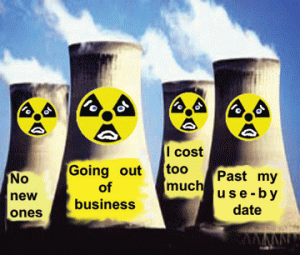
Duke Energy Carolinas is not proposing any new nuclear construction in its 15-year road map for new power plants.
September 6, 2018
Posted by Christina Macpherson |
business and costs, USA |
Leave a comment