How does climate change increase the severity of Hurricane Florence?
 Here’s how climate change is fueling Hurricane Florence A novel forecast looks at the size and fury of the storm with and without human-caused warming, Science News, BY CAROLYN GRAMLING , SEPTEMBER 13, 2018
Real-time storm forecasts continuously update as new data become available. But what would happen if, from a single starting point — in this case, the state of the atmosphere on September 11 — Florence roared ahead in two parallel worlds: one with and one without the influence of human-caused climate change?
In that hypothetical scenario, Florence was bigger than if it would be if it had occurred in a world with no human-caused warming, climate modeler Kevin Reed of Stony Brook University in New York and colleagues conclude in a study posted on the university’s website September 12. And thanks to warmer sea surface temperatures and more available moisture in the air, it would dump 50 percent more rain on the Carolinas, the researchers predict.
The goal of such climate change attribution studies is to determine whether — and by how much — human-driven climate change might have caused a particular extreme event, such as a hurricane, a heat wave or a flood. It’s an increasingly high-profile area of research, particularly after three studies last year found that a trio of extreme events in 2016 simply could not have happened without climate change (SN: 1/20/18, p. 6).
Until now, such studies have been conducted only when the event is long over. Reed and his colleagues got a jump on that question, conducting the first attribution study for an extreme event that is still in progress. It’s not yet clear what role such real-time attribution studies might play in society; they could aid emergency planning, policy making and even climate-related litigation.
In the meantime, what this study reveals is that “dangerous climate change is here now,” says study coauthor Michael Wehner, a climate scientist at Lawrence Berkeley National Laboratory in California. “The chances and magnitude of dangerous extreme weather have already been significantly increased.”
Reed talked with Science News about what a forecast attribution study is, how the new study suggests climate change may have altered Florence’s rainfall and size, and the future of real-time attribution. His responses are edited for space and clarity………https://www.sciencenews.org/article/how-climate-change-fueling-hurricane-florence
Oyster Creek nuclear power station to close on Monday
 America’s Oldest Operating Nuclear Power Plant to Retire on Monday OilVoice Press – OilVoice 14-Sep-2018 The Oyster Creek Nuclear Generating Station, located 50 miles east of Philadelphia in Forked River, New Jersey, is scheduled to retire on Monday, September 17. The plant first came online on December 1, 1969, making it the oldest commercially operated nuclear power plant in the United States. Oyster Creek was previously expected to retire on December 31, 2019, but its retirement was accelerated by more than a year to coincide with the plant’s fuel and maintenance cycle…………
Oyster Creek will be the sixth nuclear power plant to retire in the past five years. After Oyster Creek’s retirement, the United States will have 98 operating nuclear reactors at 59 plants. Twelve of these reactors, with a combined capacity of 11.7 gigawatts, are scheduled to retire within the next seven years.
Oyster Creek is one of four nuclear power plants—along with Palisades Power Plant, Pilgrim Nuclear Power Station, and Three Mile Island Nuclear Generating Station—that have planned retirement dates more than a decade before their operating licenses expire. Economic factors have played a significant role in decisions to continue operating or to retire nuclear power plants, as increased competition from natural gas and renewables has made it increasingly difficult for nuclear generators to compete in electricity markets……..
According to Exelon, Oyster Creek will undergo a six-step decommissioning process. The typical decommissioning period for a nuclear power plant is about 60 years, so parts of the Oyster Creek plant structure could remain in place until 2075. …..https://oilvoice.com/Opinion/22263/Americas-Oldest-Operating-Nuclear-Power-Plant-to-Retire-on-Monday
9 nuclear waste sites are in the potential path of Hurricane Florence
 U.S. needs a safer way to store nuclear waste, As Hurricane Florence bears down on the Carolinas, the country is confronting a reality it normally
  ignores. Newsday, The Editorial Board, September 13, 2018
As Hurricane Florence bears down on the Carolinas, the United States is confronting a reality it normally ignores. This nation has no permanent, safe disposal site for the 90,000 metric tons of nuclear waste it has created in power and weapons plants. This waste is largely stored where it was generated, often in vulnerable above-ground tanks — at 80 sites in 35 states, including New York.
Nine of those sites, from northern Georgia to North Carolina, are in the potential path of Florence. Several were built with the same technology as the Fukushima power plant in Japan, whose reactors and waste storage were tragically compromised by a tsunami in 2011……..
Hurricane Florence will be biggest challenge yet to North Carolina’s Brunswick nuclear power station
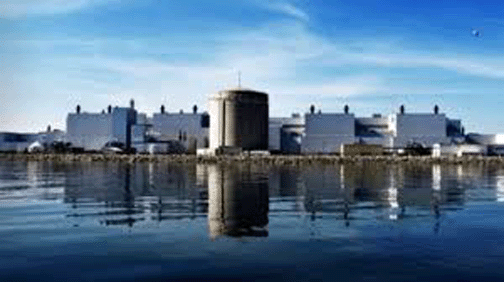
A NUCLEAR PLANT BRACES FOR IMPACT WITH HURRICANE FLORENCE, Wired, MEGAN MOLTENI13 Sept 18 I N MARCH 11, 2011, a one-two, earthquake-tsunami punch knocked out the safety systems at the Fukushima Dai-ichi nuclear power plant, triggering an explosion of hydrogen gas and meltdowns in three of its six reactors—the world’s worst nuclear disaster since Chernobyl. Fukushima’s facility was built with 1960s technology, designed at a time when engineers underestimated plant vulnerabilities during natural disasters. In the US, 20 plants with similar designs are currently operating.
One of them is slated for a head-on collision with Hurricane Florence. Duke Energy Corp’s dual-reactor, 1,870-megawatt Brunswick plant sits four miles inland from Cape Fear, a pointy headland jutting out into the Atlantic Ocean just south of the city of Wilmington, North Carolina. Brunswick has survived decades of run-ins with hurricanes, but Florence could be its biggest test yet. The plant perches near the banks of the Cape Fear River, which drains 9,000 square miles of the state’s most densely populated regions. Like Hurricane Harvey in 2017, Florence is predicted to stall out for days, pounding the Carolinas with unrelenting amounts of water, leading to life-threatening storm surges and catastrophic flooding. NOAA’s National Hurricane Center is projecting 110 mile-per-hour winds, waves as high as 13 feet, and in some places, up to 40 inches of rain.
Duke Energy Corp’s dual-reactor, 1,870-megawatt Brunswick plant sits four miles inland from Cape Fear, a pointy headland jutting out into the Atlantic Ocean just south of the city of Wilmington, North Carolina. Brunswick has survived decades of run-ins with hurricanes, but Florence could be its biggest test yet. The plant perches near the banks of the Cape Fear River, which drains 9,000 square miles of the state’s most densely populated regions. Like Hurricane Harvey in 2017, Florence is predicted to stall out for days, pounding the Carolinas with unrelenting amounts of water, leading to life-threatening storm surges and catastrophic flooding. NOAA’s National Hurricane Center is projecting 110 mile-per-hour winds, waves as high as 13 feet, and in some places, up to 40 inches of rain.
They’re part of a sweep of changes nuclear plants around the US have adopted post-Fukushima……….
Duke predicted a maximum storm surge of 7 feet at the plant’s safety-related buildings. But the plant was originally designed to cope with only 3.6 feet of expected surge, according to the NRC’s 2017 summary assessment of Duke’s hazard reevaluation report, which has not been made public.
In a letter earlier this year, the NRC reminded Duke that the plant’s current design falls short of the reevaluated flood risks. According to Burnell, Duke has since submitted an assessment of how it will cope—including the use of those steel door reinforcements—which the NRC is still evaluating. “The review is not complete but there’s nothing in there to this point that causes us any concern,” says Burnell………….
Storms can be unpredictable, however. Dave Lochbaum, who directs a nuclear safety watchdog group at the Union of Concerned Scientists, has spent a lifetime studying nuclear failures. Brunswick troubles him because in 2012, Duke found hundreds of missing or damaged flood protections at the plant, such as cracked seals and corroded pipes. According to the group, none of the NRC’s subsequent reports have mentioned repairs. “Hopefully they’ve been fixed,” says Lochbaum. “But we’ve not been able to confirm that with the available documentation.”………
In its 2012 post-Fukushima review, Florida Power & Light told the NRC that flood protections at its St. Lucie plant on South Hutchinson Island were adequate, despite failing to discover six electrical conduits with missing seals in one of the emergency core cooling systems. Two years later, a freak storm inundated Florida’s central coast with record rainfall, flooding one of the plant’s reactors with 50,000 gallons of stormwater. The deluge submerged core cooling pumps, rendering them useless. Had the reactor faltered during the storm, the plant would not have been able to maintain a safe and stable status beyond 24 hours, according to an NRC notice of violation issued to FPL after the incident………https://www.wired.com/story/a-nuclear-plant-braces-for-impact-with-hurricane-florence/
Danger of toxic wastes sites, as Hurricane Florence heads to USA coast
Officials prep toxic waste sites, nuclear power plants ahead of Hurricane Florence’s arrival, By Amanda Schmidt, AccuWeather staff writer, September 12, 2018, Hurricane Florence could cause an environmental and public health disaster, as heavy rains may overwhelm pits holding toxic waste from power plants, industrial sites or animal-manure lagoons. This toxic waste could wash into homes and threaten drinking water supplies………
North Carolina nuclear stations- danger of spent nuclear fuel over-heating , in the event of an accident

“While concerns about nuclear power safety often focus on the fuel in the reactor core, spent fuel stored in pools also can be a major source of radioactivity during an accident. If water drains from the pool for even a few hours or the cooling system is interrupted for several days, the spent fuel could overheat and its cladding could break open, releasing radioactive material. And because the pools are located outside the thick, concrete containment walls, it is more likely that this radioactive material would reach the environment”
The report was done back in 2011, so not sure if things have improved since then. https://www.ucsusa.org/…/nuclear-power-safety-in-north…
https://www.facebook.com/groups/1021186047913052/permalink/2113650401999939/?comment_id=2114177665280546¬if_id=1536813900482985¬if_t=group_commentUSA – new sanctions on Chinese and Russian companies, over North Korea nuclear program
U.S. announces fresh sanctions over N.K. nuclear program, http://english.yonhapnews.co.kr/northkorea/2018/09/13/0401000000AEN20180913011200315.html
2018/09/13 WASHINGTON, Sept. 13 (Yonhap) — The United States on Thursday sanctioned two companies in China and Russia for allegedly facilitating North Korea’s nuclear weapons program.
The Department of the Treasury also sanctioned a North Korean individual in the latest set of sanctions aimed at denuclearizing the regime.
JEA and the city of Jacksonville sue to get out of Georgia nuclear contract

 JEA sues to get out of Georgia nuclear contract https://www.news4jax.com/news/jea-sues-to-get-out-of-nuclear-plant-contract, Lawsuit filed in Florida court same day Georgia utility filed federal suit, By Steve Patrick – News4Jax digital managing editor, September 12, 2018 JACKSONVILLE, Fla. – JEA and the city of Jacksonville have filed a complaint with a Florida court asking for declaratory judgment on an agreement with the Municipal Electric Authority of Georgia (MEAG Power) agreeing to power electricity from Plant Vogtle, a nuclear power plant under construction in Georgia.
JEA entered into the power purchase agreement in 2008. The power provided under the agreement was to be from two new Plant Vogtle units that would provide power to JEA customers in addition to ratepayers across Georgia beginning in April 2016. The project was expected to cost $9.5 billion in direct costs ($14.8 billion total, including indirect and financing costs). The total cost of the portion attributable to JEA was $1.4 billion. The project cost was capped under the 2008 agreement.
Today, the project’s total cost-to-completion estimates have increased to more than $30 billion, with no guarantees that costs could grow beyond that and with a delayed completion date of November 2021.
A new unlimited cost-plus reimbursement agreement was implemented without JEA’s approval in June 2017 after the project’s initial general contractor, Westinghouse, declared bankruptcy. The amended agreement has increased JEA’s liability to more than $2.9 billion, although that amount is uncapped and has continued to rise.
The city and JEA’s complaint seeks to clarify the validity of the amended purchase power agreement. It was never approved by the Jacksonville City Council and the JEA and city lawyers believe the agreement violates the Florida Constitution, and therefore should be void and is unenforceable.
The suit was filed in an effort to protect JEA’s ratepayers from the escalating costs from the project.
“It has become clear that this purchase agreement should be considered ‘ultra vires’ since it was implemented without the approval of the City Council, which violates Florida law,” JEA Interim Managing Director Aaron Zahn said. “A favorable judgment from the court deeming the agreement void will have the added benefit of providing relief to ratepayers across northeast Florida from having to shoulder the financial burden of this project.”
The complaint was filed in the Fourth Judicial Circuit Court of Florida Tuesday, the same day that MEAG Power filed a breach of contract lawsuit against JEA in the Federal Court for the Northern District of Georgia.
Hinkley nuclear project: Court orders EDF to provide full project risk report to Central Works Council (CCE)
Point. EDF will again have to consult the Central Works Council (CCE) on
the construction of two EPR reactors as part of the Hinkley Point project
in England, the CCE announced Wednesday in a statement.
the courts in June 2016 to request the submission of additional information
on this major project. A court of appeal was right, saying that EDF had not
communicated to staff representatives “objective, accurate and complete
information up to the technical and financial issues raised by the project
HPC” and therefore had them not allowed “to give a reasoned opinion on this
project,” writes the CCE in a statement.
one month and asked management to consult the EAC again within two months
adds the latter.
https://www.usinenouvelle.com/article/edf-devra-a-nouveau-consulter-le-cce-sur-hinkley-point.N740494
 |
ReplyForward
|
New Jersey’s nuclear subsidy means a loss to electricity consumers
 Consumers lose in nuclear subsidy plan, New Jersey’s nuclear subsidy idea was a loser from the start. Legislators earlier this year bowed to Public Service Enterprise Group’s insistence on financial help from consumers to keep South Jersey nuclear plants afloat — meaning to make them more profitable — and signed off on a $300 million plan.
Of course, lawmakers told us that the money merely represented a maximum, and that a Board of Public Utilities review would determine how much assistance — if any — the plants would receive. That process began last week, and officials have been tossing around a lot of political-sounding comments about extensive scrutiny of the nuclear applications — as if awards weren’t already essentially a done deal.
In a press release, BPU President Joseph Fiordaliso said the board and its staff take their responsibilities seriously, and will determine whether subsidies are warranted. Yet legislators and the governor have already decided they are; that was the whole argument in favor of the subsidies bill, that the plants wouldn’t stay open without help, that New Jersey needs nuclear power, and that the $300 million figure was an appropriate number to put in place. The final subsidies may not hit that number on the nose, but we can certainly assume they won’t be far off.
It’s also no secret New Jersey consumers will be forced to foot the profitability bill not only for PSEG’s South Jersey plants, but also for nuclear plants in other states that contribute to the PJM Interconnection regional energy grid.
What will those states be doing to benefit us? Nothing, basically…………https://www.northjersey.com/story/opinion/editorials/2018/09/12/editorial-nj-consumers-lose-nuclear-subsidy-plan/1270890002/
environmentalists have maintained that the subsidy bill will prop up an outdated source of power at the expense of wind and solar energy, one more part of the governor’s often confusing, hopscotch approach to satisfying the state’s energy needs. Rival power companies have called the nuclear subsidy unfair to a company that reported $558 million in net income for the first three months of this year. And large power users said the subsidy would drive up costs and discourage innovation.
All of this, however, begs the question: Why couldn’t the amount of the subsidies have been determined before legislators created the pot of cash from which they will be taken? The plants aren’t losing money; they’re just not generating enough profit. PSEG won’t open its books to the public. Yet lawmakers felt compelled to announce to one and all upfront that as much as $300 million might be needed to get the job done. That taints everything moving forward………https://www.northjersey.com/story/opinion/editorials/2018/09/12/editorial-nj-consumers-lose-nuclear-subsidy-plan/1270890002/
Hurricane Florence downgraded from Category 4 to Category 2 – less dangerous

By Chelsea Prince Zachary Hansen, The Atlanta Journal-Constitution Sept 13, 2018 Hurricane Florence has weakened to a Category 2 storm in the Atlantic Ocean, according to the 11 p.m. projection by the National Hurricane Center.

Fukushima in America? Twelve Nuclear Power Plants in Path of Hurricane Florence
At least twelve operating nuclear reactors are in the predicted path of Hurricane Florence, which has been upgraded to a category 4 storm as it surges toward the U.S. East Coast. According to the U.S. Nuclear Regulatory Commission, which offers an interactive map of active nuclear reactors, two plants are vulnerable to both heavy rainfall and the expected storm surge which could bring a surge of up to 20 feet of ocean water pouring into coastal areas.
Those two reactors, located NE of Myrtle Beach, North Carolina, are known as “Brunswick Steam Electric Plant, Unit 1” and “Brunswick Steam Electric Plant, Unit 1.”
Each unit produces nearly 1,000 MWe of electricity, and they are both built on the General Electric “Type 4” power plant design, which is almost identical to the GE nuclear power plant design used in the Fukushima-Daiichi reactors in Japan. All of these reactors are designed and constructed as “boiling-water reactors” or BWRs. The designs are decades old, and they are subject to catastrophic failures and even core meltdowns that release radioactive isotopes directly into the atmosphere and surrounding areas……… https://www.naturalnews.com/2018-09-1
Nuclear authorities make reassuring noises about Hurricane Florence, and don’t mention radioactive waste dumps

at left – Dr Pangloss who famously proclaimed “Everything for the best, in the best of all possible worlds”
Six nuclear power plants are in Hurricane Florence’s path, officials say, CNN, By Ellie Kaufman, Gregory Wallace and Rene Marsh, CNN September 13, 2018 “……..The six nuclear power plants in North and South Carolina sit directly in the storm’s projected path, according to Mary Catherine Green, spokeswoman for Duke Energy, which owns all six.
At least 6 nuclear reactors are in the path of Hurricane Florence

As the Associated Press reported on Monday, “The storm’s potential path also includes half a dozen nuclear power plants, pits holding coal-ash and other industrial waste, and numerous eastern hog farms that store animal waste in massive open-air lagoons.”
The plants thought to lie in the path of the hurricane, which is expected to make landfall on the Southeastern U.S. coast on Thursday, include North Carolina’s Brunswick Nuclear Power Plant in Southport, Duke Energy Sutton Steam Plant in Wilmington, and South Carolina’s V.C. Summer Nuclear Station in Jenkinsville.
“Florence will approach the Carolina coast Thursday night into Friday with winds in excess of 100mph along with flooding rains. This system will approach the Brunswick Nuclear Plant as well as the Duke-Sutton Steam Plant,” Ed Vallee, a North Carolina-based meteorologist, told Zero Hedge. “Dangerous wind gusts and flooding will be the largest threats to these operations with inland plants being susceptible to inland flooding.”
In 2015, the Huffington Post and Weather.com identified Brunswick as one of the East Coast’s most at-risk nuclear power plants in the event of rising sea levels and the storm surges that come with them.
As of Tuesday afternoon, Hurricane Florence was thought to have the potential to cause “massive damage to our country” according to Jeff Byard, associate administrator of the Federal Emergency Management Agency (FEMA).
The storm was labeled a Category 4 tropical storm with the potential to become a Category 5 as it nears the coast, with 130 mile-per-hour winds blowing about 900 miles off the coast of Cape Fear, North Carolina.
Meteorologists warned of hurricane-force winds in the region by mid-day Thursday, with storm surges reaching up to 12 feet or higher.
Critics becoming more concerned about safety issues in Texas nuclear waste storage plan
 A Texas waste storage plan is back. So is the opposition, Edward Klump, E&E News reporter, Energywire: Tuesday, September 11, 2018 A proposal to send used nuclear fuel to West Texas didn’t end last year, but it did stall during a trip to corporate purgatory.
Now a joint venture called Interim Storage Partners LLC has the plan moving forward again. The Nuclear Regulatory Commission recently restarted its review of a consolidated interim storage application for a site in Andrews County, Texas. And the NRC staff’s safety, security and environmental reviews could be finished in summer 2020.
Critics are worried about what’s brewing. They’re asking questions and hoping for more public meetings. Some would like to halt the project. One of the chief opponents knows the proposal won’t be easy to stop, but she’s working to rally Texans and others against the plan.
“Most people don’t even know this is happening,” said Karen Hadden, executive director of the Texas-based Sustainable Energy and Economic Development Coalition. “The public is unaware, and they’re unaware of the risks that they are about to be exposed to.”
The project is another flashpoint in a long-running debate over nuclear energy and associated waste after a number of U.S. nuclear plants stopped producing power or announced plans to close. Congress has considered legislation that could help pave the way for interim storage facilities in Texas and New Mexico as well as a longer-term site at Yucca Mountain in Nevada. Hadden has voiced concern about those three sites and potential plans to transport nuclear waste across the country.
The spent fuel storage plan for West Texas is tied to Waste Control Specialists (WCS), which has endured financial issues and houses low-level radioactive waste in the region. A plan by Valhi Inc. to unload WCS to EnergySolutions collapsed in 2017. Early this year, J.F. Lehman & Co. announced that an investment affiliate had acquired WCS. That was followed in March by news of a planned venture involving Orano USA and WCS (Energywire, March 19).
The new Orano-WCS entity — now called Interim Storage Partners, or ISP — later sought a restart of the NRC review that was halted in 2017. In August of this year, the NRC said the revised application was acceptable but that additional information would be sought.
“The NRC staff has reviewed your request and concludes that the revised license application provides information sufficient to resume its detailed review,” the NRC said in a letter.
Jeff Isakson, chief executive of ISP, said in a recent statement that ISP looked forward “to an energized and timely process.”
‘Snickering and giggling’
ISP said its venture initially is intended to store used nuclear fuel from shutdown reactor locations. That would lower the burden on U.S. taxpayers and allow sites to be redeveloped, it said. The application is for 40 years, though it could be extended by decades…….
A license application with the NRC said Orano USA ultimately is majority owned and controlled by an entity of the French government. But ISP has said its governing officers and management board members are U.S. citizens……..
Much of nuclear waste critics’ focus had turned to an interim storage proposal from Holtec International for New Mexico. That plan is also under review at the NRC (Greenwire, May 9).
While Hadden said there was “a nice reprieve” on the West Texas proposal, she said “the threat is ever-present and on the burner now.”
Instead of using the proposed interim sites or Yucca Mountain, Hadden would like to see the United States pursue a new location for a permanent repository that’s geologically sound and uses improved storage technology.
A public step in the process for the West Texas site was evident in late August: a meeting about the emergency response plan. Representatives of the NRC, ISP and other interested parties attended in person in Maryland or on the phone.
The meeting covered aspects of the response plan and gave people a chance to interact. At one point, a speaker said that “nobody lives anywhere near us.” That was followed by a description of the location as “in the middle of stinking nowhere.” The remarks drew laughter as well as an unhappy response from a listener on the phone who wasn’t sure who made them.
“There was a statement made about this site being in the middle of nowhere, and there was some snickering and giggling,” said Monica Perales, an attorney. “I live in the middle of nowhere, and that’s not appreciated.”
In an interview last week, Perales said the attitude during the meeting “made me feel as though we in West Texas are expendable.”
………Critics remain concerned about transportation, including the potential effects on cities and the potential for terrorists to target waste.
Hadden has called for public meetings in places such as Dallas, Houston, San Antonio, Midland, El Paso and Andrews County to discuss issues related to possible interim nuclear waste storage in Texas. She’s working on a public awareness campaign that’s expected to take place later this month and run into October, featuring a full-scale mock radioactive waste transport cask.
Hadden argued future NRC requests for additional information could bring up new issues the public should be able to examine, so NRC deadlines should be extended. Critics say there is already a new financial situation to analyze in terms of ISP’s involvement.……….https://www.eenews.net/stories/1060096457
1 This Month





PLEASE OPPOSE HR 8255 AND S.3639 – bills would accelerate satellite deployment, with no environmental review or safeguards – https://ncstd5li.quorum.us/campaign/169331/
To see nuclear-related stories in greater depth and intensity – go to https://nuclearinformation.wordpress.com
-
Archives
- October 2026 (19)
- September 2026 (339)
- August 2026 (330)
- July 2026 (355)
- June 2026 (287)
- May 2026 (306)
- April 2026 (356)
- March 2026 (251)
- February 2026 (267)
- January 2026 (308)
- December 2025 (358)
- November 2025 (359)
-
Categories
- 1
- 1 NUCLEAR ISSUES
- business and costs
- climate change
- culture and arts
- ENERGY
- environment
- health
- history
- indigenous issues
- Legal
- marketing of nuclear
- media
- opposition to nuclear
- PERSONAL STORIES
- politics
- politics international
- Religion and ethics
- safety
- secrets,lies and civil liberties
- spinbuster
- technology
- Uranium
- wastes
- weapons and war
- Women
- 2 WORLD
- ACTION
- AFRICA
- Atrocities
- AUSTRALIA
- Christina's notes
- Christina's themes
- culture and arts
- Events
- Fuk 2022
- Fuk 2023
- Fukushima 2017
- Fukushima 2018
- fukushima 2019
- Fukushima 2020
- Fukushima 2021
- general
- global warming
- Humour (God we need it)
- Nuclear
- RARE EARTHS
- Reference
- resources – print
- Resources -audiovicual
- Weekly Newsletter
- World
- World Nuclear
- YouTube
-
RSS
Entries RSS
Comments RSS

