Nuclear Plant Closures Bring Economic Pain to Cities and Towns, Pew, STATELINE ARTICLE, September 5, 2018, By: Martha T. Moore “…….. Aging nuclear power plants are closing, doomed by the high cost of refurbishing them and the low price of natural gas. That is causing fiscal pain for municipalities that rely on revenue from the plants, and creating political pressure for state subsidies to forestall further shutdowns……….
Six reactors have shut down in the past five years, and eight more reactors are scheduled to close by 2025 at plants in California, Iowa, Massachusetts and Michigan. Nuclear power operators have said they will close a further five reactors at four plants in Ohio and Pennsylvania if those states don’t offer subsidies.
The closure of Indian Point, announced in January 2017, capped decades of controversy over its safety, and was a victory for environmental groups and Democratic Gov. Andrew Cuomo, who had long opposed the plant.
But the closure presents the local Hendrick-Hudson school district, where 2,500 children practice evacuation drills annually and nurses have iodide pills on hand in case of a radiation leak, with a budget crisis. About one-third of the district’s annual $79 million budget comes from Indian Point’s payment in lieu of taxes. By 2024, three years after the power plant huts, the yearly payments will have dwindled from $25 million to $1.35 million. ……..
Many nuclear power plants have curried public favor by being good corporate citizens. In Londonderry, for example, Three Mile Island runs a golf tournament for the local fire department that raises enough money to cover the $50,000 annual mortgage payment on the firehouse.
Redevelopment of Three Mile Island isn’t an option, Letavic said, because of the nuclear waste that will remain on the site, which is in the middle of the Susquehanna River……
In Lacey Township on the New Jersey shore, the nation’s oldest operating nuclear plant, Oyster Creek, will shut down in September after 49 years. The town gets $11 million in annual taxes from Oyster Creek and has identified itself so closely with the nuclear plant that its municipal seal bears the symbol of an atom as well as a sailboat and a pheasant. …….
Asking for State Help
Four states have moved to shore up nuclear power plants financially despite opposition from some environmental groups, consumer advocates and the coal and natural gas power industries.
In 2016, New York passed a $7.6 billion package to help three upstate nuclear power plants — though not Indian Point. And Illinois passed legislation directing $2.4 billion to two plants in the state through “zero emissions credits”
……..In New Jersey, where 40 percent of the state’s electricity comes from nuclear plants, the state will subsidize two plants at a rate of $300 million a year under a bill enacted in May. (Oyster Creek was not included in the subsidy plan.) Connecticut enacted legislation last October that could allow its sole nuclear plant, the Millstone reactor in Waterford, to sell electricity at higher prices if Dominion Energy, its owner, can show the reactor is financially strapped. ………
As part of the nuclear subsidy packages, some states have increased requirements for obtaining power from renewable sources: New York and New Jersey will require half of their power to come from renewables by 2030, and Connecticut will require 40 percent by that date. Illinois will require a quarter of its power to come from renewables by 2025.https://www.pewtrusts.org/en/research-and-analysis/blogs/stateline/2018/09/05/nuclear-plant-closures-bring-economic-pain-to-cities-and-towns
September 6, 2018
Posted by Christina Macpherson |
business and costs, employment, USA |
Leave a comment
 Plans Move Forward for Privately Funded Storage of Nuclear Waste, Power 09/05/2018 |
 Darrell Proctor The Trump administration has revived the discussion of using Yucca Mountain in Nevada as a repository for the nation’s nuclear waste. Nevada officials remain opposed to the idea of putting spent nuclear fuel in long-term storage at a site about 100 miles from Las Vegas.But while a bill to resurrect Yucca Mountain as a storage site moves through Congress, other groups have stepped forward with plans to site, build, and operate nuclear waste storage and disposal facilities in areas including Texas and New Mexico. Those plans have reignited the debate about what the U.S. should do with its nuclear waste, along with the discussion of whether the federal government or the individual states should take the lead in developing long-term storage plans.
The Nuclear Regulatory Commission (NRC) says at least 12 U.S. reactors are committed to closing over the next five years, joining the more than 20 reactors shuttered over the past 10 years across the country. That’s lot of spent nuclear fuel, in multiple locations, in need of safe storage, whether at an interim site or at a facility designed for long-term storage……….
Interim Storage Sites in Development
 Two members of Wednesday’s panel represented companies developing interim storage sites. Interim Storage Partners (ISP), a joint venture of Orano USA [Orano – formerly AREVA] and Waste Control Specialists (WCS), is pursuing a license for a consolidated interim storage facility (CISF) for used nuclear fuel at an existing WCS disposal site in Andrews County, Texas. Holtec International, which has been acquiring nuclear plants that have closed or are scheduled to close in order to carry out their decommissioning, is developing a CISF in southeastern New Mexico, in a remote area between Carlsbad and Hobbs……..
Joy Russell, vice president of corporate business development and chief communications officer for Holtec, 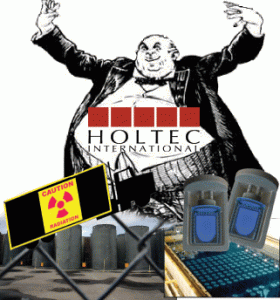 said her company formed a business unit—Comprehensive Decommissioning International—in a 2018 joint venture with SNC-Lavalin after SNC-Lavalin in 2017 acquired Atkins, a nuclear waste solutions company. Russell said the New Mexico site encompasses about 1,000 acres, with “about 500 acres being used to build the facility.” Russell said the site, known as HI-STORE CIS, would use the company’s HI-STORM UMAX technology, which stores loaded canisters of nuclear waste in a subterranean configuration.
Russell said her group has a public-private partnership with the Eddy Lee Energy Alliance, representing Eddy and Lee counties in New Mexico, for the project, which she said has support from both local and state officials.
“We’re doing educational outreach in New Mexico,” said Russell. “We do township meetings, where we testify before the mayor and town council. We meet one-on-one with candidates. We had to start with the basics. What people think of when they hear nuclear fuel, they think of the fuel you put in your car, and how that could leak into the ground. We have to educate people on what [nuclear] fuel is. We focus on safety, security, and technology.”
Russell agreed that public concerns centers on the transport of nuclear waste. “The number-one thing I hear, all the time, about consolidated interim storage is transportation.” Holtec also has its license application before the NRC for review; Russell said it expect the agency will complete its review in July 2020, putting the New Mexico site on a timeline to receive its first shipment of spent fuel in 2023.
Revisiting Yucca Mountain
Congress first chose Yucca Mountain as a storage site for nuclear waste in 1987. Years of research into the site followed; estimates are that $15 billion was spent on the project. Sproat noted his efforts on licensing for Yucca Mountain before his retirement from the DOE, with a license application submitted to the NRC in 2008. The Obama administration ended funding for the project and halted the licensing process in 2009.
Meanwhile, the Nuclear Waste Fund (NWF), which collected money from the states to finance waste storage projects, was ordered by a federal court in late 2013 to stop collecting that money until the federal government made provisions for collecting that waste………….. https://www.powermag.com/plans-move-forward-for-privately-funded-storage-of-nuclear-waste/?pagenum=1
September 6, 2018
Posted by Christina Macpherson |
business and costs, USA, wastes |
Leave a comment

 Tropical Storm Gordon Warning For US Gulf Coast: Reminder Of The Dangers Of Mixing Severe Weather With Nuclear Power; Another Tropical Storm In Atlantic , Mining Awareness, 4 Sept 18
It’s that time again. Time for tropical storms and hurricanes, and time to remember the increased dangers of nuclear power stations (orange skulls on map) during severe weather, which can lead to power outages and power surges, as well as storm surges, flooding and more.
Nuclear power stations are dangerous and unreliable electricity sources in extreme weather. One of the most dangerous, and often ignored, things about nuclear energy is that nuclear power stations always have need for backup energy supplies for cooling of the nuclear reactors, and spent fuel pools, as dramatically demonstrated by the never-ending Fukushima Daiichi nuclear disaster. If they lose offsite power, then they are dependent upon backup generators, which can fail to start, fail once started or run out of fuel. In Louisiana, a thunderstorm led to a scram at River Bend Nuclear Power Station due to a power surge, followed by a loss of cooling, supposedly the next day. Loss of cooling can lead to a nuclear meltdown, if not corrected quickly enough.
September 5, 2018
Posted by Christina Macpherson |
safety, USA |
Leave a comment
 More leaks discovered at troubled SC nuclear fuel factory; feds investigating, The State.com BY SAMMY FRETWELL, sfretwell@thestate.com August 31, 2018 HOPKINS
September 3, 2018
Posted by Christina Macpherson |
incidents, USA |
Leave a comment

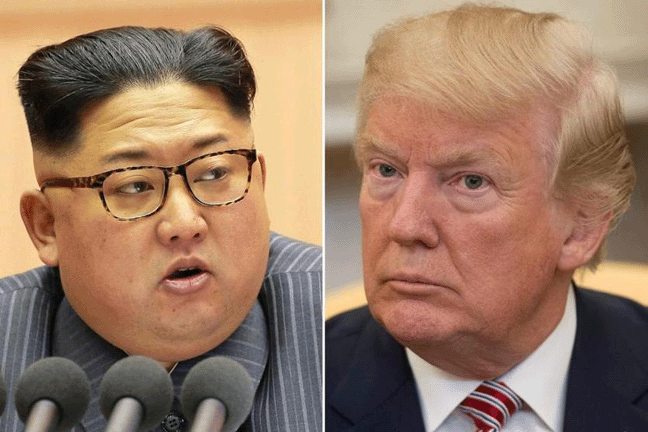
 The current US negotiating strategy with North Korea is doomed, Bulletin of the Atomic Scientists, By Perry World House, August 30, 2018 US negotiations with North Korea over the latter’s nuclear weapons program appear to have hit a major roadblock. While North Korea has temporarily suspended nuclear and missile testing and partially destroyed its nuclear test site, both steps are reversible, and North Korea has largely balked at US President Donald Trump’s demand for “complete, verifiable, and irreversible denuclearization.” Consequently, negotiations with Pyongyang may be on the verge of breakdown. Trump recently cancelled his secretary of state’s planned trip to the country, and the administration has gone back and forth in the last few days about whether Washington will continue to suspend joint military exercises with South Korea, a concession Trump made to North Korean leader Kim Jong-un during their historic summit in June. Given this critical juncture in negotiations, it is time to reevaluate what talks can actually achieve. It would be great if Kim agreed to hand over all of his nuclear weapons, but the reality is that North Korea will not be completely, verifiably, or irreversibly denuclearizing anytime soon. Therefore, if the Trump Administration wants to salvage the negotiations, it needs a new strategy.
Why North Korea won’t denuclearize. The first step to a successful negotiating strategy is understanding how your opponent thinks. So why does North Korea want nuclear weapons in the first place? For the same reason Israel, France, India, and others wanted them—security. Specifically, security against the United States.
North Korea’s murderous dictator has good reason to worry about an American intervention to overthrow his regime. First of all, the United States is much more powerful than North Korea. While the size of North Korea’s entire economy is about $40 billion at most, America spends over $700 billion on its military alone. Second, this fact, combined with Washington’s long history of military interventions, is enough to make any despot shake in his shoes. Finally, the specific history between the United States and North Korea is not reassuring to Kim. The two countries fought against each other in the Korean War, President George W. Bush branded North Korea part of the “axis of evil,” and Trump threatened Pyongyang with “fire and fury like the world has never seen.”
Like many relatively weak countries facing a threat, North Korea turned towards nuclear weapons not because its leader is crazy, but to deter a stronger power. By threatening to punish the United States and its allies with a nuclear response if it is attacked, North Korea is able to effectively dissuade Washington from such attempts. Since Kim’s top priority, like most autocrats, is regime security, he will only give up the protection of his nuclear weapons if he is very confident that he can retain his power without them. Though Trump committed to guaranteeing North Korea’s security in the Singapore Declaration, a number of recent historical episodes will make it difficult to convince Kim he can remain safe if he surrenders all his nuclear weapons.
One example involves Libya. In 2003, Libyan dictator Muammar Gaddafi agreed to give up his nascent nuclear weapons program and permit international inspections. In return, US President George W. Bush promised that Libya could “regain a secure and respected place” among nations. However, just eight years later, in 2011, the United States led a NATO military intervention in Libya that resulted in the brutal killing of Gaddafi. In recent months John Bolton, Trump’s national security advisor, has repeatedly said that Washington has the “Libya model” in mind for North Korea, probably the least reassuring example that could be communicated to Kim.
A second leader who did not do well after suspending his nuclear weapons program was Iraq’s Saddam Hussein. While states that possess nuclear weapons can almost always effectively deter military intervention, states that do not, like Iraq in 2003, are vulnerable. In a fate not much better than Gaddafi’s, Saddam was removed from power by an American military intervention in 2003 and ultimately hung in 2006…….
Trump personally undermined American negotiating credibility in two ways; one indirect and one direct. Indirectly, he hurt Washington’s credibility by withdrawing from the Iran nuclear deal, even though, according to the International Atomic Energy Agency, Iran was complying with its terms. The Trump Administration has now moved to severely punish Iran for its compliance by instituting tough sanctions………..
Given this record, North Korea is very unlikely to agree to fully denuclearize in the short or medium-term, and demanding that it do so is only likely to lead to negotiation failure. To make real progress on this issue, the White House will need to take a different tack.
What Washington’s strategy should be. The Prussian statesman Otto von Bismarck said, “politics is the art of the possible, the attainable.” If North Korea will not be handing over its entire nuclear stockpile anytime soon, what possible, attainable options might curtail the threat? The most extreme option, of course, would be to launch a massive military attack against North Korea in an effort to destroy all of its nuclear weapons and infrastructure—the “fire and fury” Trump threatened. However, such an operation would be reckless to the point of insanity. North Korea has the ability to deliver nuclear missiles to South Korea, Japan, and American military bases in the Pacific. If even one or a handful of nuclear missiles survived an American first strike, hundreds of thousands could die beyond those killed in the initial US attack. Furthermore, even if the United States could reliably locate and destroy all of North Korea’s nuclear weapons in a first strike, Pyongyang would still be able to inflict tens of thousands of casualties daily using conventional and chemical weapons. Given that there is no imminent threat from North Korea’s nuclear program, a preventive war of this type would be nonsensical.
The most sensible option to address the nuclear threat from North Korea would be to pursue an approach dubbed “less for less” by nuclear scholar James Acton. Rather than demanding total denuclearization, the United States should seek a smaller-scale deal that puts significant restrictions on North Korea’s nuclear program in return for moderate sanctions relief and other limited concessions. ……….
Though the prospect of living with a nuclear-armed North Korea for the foreseeable future may seem unacceptable, the world has survived with a nuclear-armed Russia for the last 69 years, China for the last 54 years, Pakistan for the last 20 years, and, yes, North Korea for the last 12 years. Just as North Korea’s nuclear weapons have effectively deterred the United States from a major military intervention, America’s vastly superior nuclear arsenal and conventional capabilities will almost certainly deter North Korea.
This column was written by Joshua A. Schwartz, a PhD candidate in political science at the University of Pennsylvania. https://thebulletin.org/2018/08/the-current-us-negotiating-strategy-with-north-korea-is-doomed/?utm_source=Bulletin%20Newsletter&utm_medium=iContact%20email&utm_campaign=August31
September 3, 2018
Posted by Christina Macpherson |
North Korea, politics international, USA |
Leave a comment
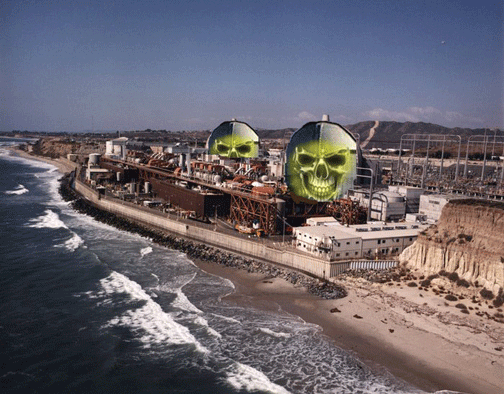
Environmental Group Wants Immediate Removal of Nuclear Waste From San Onofre Area, https://www.theinertia.com/environment/an-environmental-group-is-pushing-for-the-transport-of-nuclear-waste-away-from-san-o-stat/ Dylan Heyden, 30 Aug 18,
The ever-evolving situation at the San Onofre Nuclear Generation Station and its nuclear waste problem has become a hot-button issue for residents of San Clemente, Oceanside, and beyond. It’s immensely complex, but allow me, if you will, to oversimplify.
Spent nuclear fuel goes through a years-long cooling process in pools before it can be moved to dry storage where it further cools until it is safe for transport to long-term storage. “Long-term” storage facility, though, is a misnomer. It’s essentially the permanent resting place for nuclear waste stored in extremely thick metal canisters. The problem at San Onofre and many decommissioned nuclear generation stations across the country, though, is there is no long-term storage facility. Or rather, one was planned for an area called Yucca Mountain in Nevada, but in 2011 the Feds pulled the plug. As a result, short-term solutions have become defacto long-term solutions, which is where we are today at San Onofre.
Back in February, Southern California Edison and contractors involved in the SONGS decommissioning process began transferring spent nuclear fuel from pools to dry storage – or dry cask storage. Tens of thick metal canisters of spent nuclear fuel have since been stored on site adjacent to the generators beneath a concrete pad called the Independent Spent Fuel Storage Installation (ISFSI).
When I toured the facility back in May (more on that later), SoCal Edison employees were adamant that public safety was of the utmost importance, and that these thick metal casks were not “buried in the sand” but rather safely stored in concrete for the interim. Employees also emphasized that Southern California Edison’s goal is to move the spent fuel as expeditiously and safely as possible. “Don’t forget, our families go in the ocean nearby, too,” many said.
But Congressional gridlock and an inability to designate a feasible long-term storage site means what was once thought to be a safer short-term solution (dry storage is passive and doesn’t require energy to cool as in cooling pools) may need re-thinking.
That’s why a group of activists, called the Physicians for Social Responsibility Los Angeles recently launched a letter-writing campaign urging the California State Lands Commission to authorize the local transfer of spent nuclear fuel to an area further east in Camp Pendleton.
“3.6 million pounds of highly radioactive nuclear waste at San Onofre Nuclear Generating Station near San Diego is currently in the process of being buried on the beach, just 100 feet from the ocean and a mere few feet above the water table,” their website reads. “Send in a comment on the Draft Environmental Impact Report (EIR) and demand a better solution: the nuclear waste should be moved off the beach to a new, above-ground concrete-reinforced temporary storage facility located further east in Camp Pendleton—where it can be protected from sea level rise and potential terrorist attack.”
A sub-group of PSRLA called the Committee to Bridge the Gap has created a petition page, urging concerned citizens to put their name on a letter voicing their discontent.
According to their website, the group claims this revised plan has garnered the support of former Nuclear Regulatory Commission Chief Greg Jaczko, U.S. government advisor on nuclear waste Tom English, and retired Navy Admiral Len Herring.
The campaign explains that the failure to even consider the idea of moving the fuel east of the primary ISFSI site is a serious oversight on the part of those involved in the decommissioning process.
The letter PSRLA is urging residents to sign implores the State Lands Commission to step in. “As public servants and members of the CSLC you have a moral duty to protect our safety. Please do not take that responsibility lightly,” it says.
August 31, 2018
Posted by Christina Macpherson |
opposition to nuclear, USA, wastes |
Leave a comment

America Has Dropped 1,032 Nuclear Weapons (On Itself) In the form of nuclear tests. https://nationalinterest.org/blog/buzz/america-has-dropped-1032-nuclear-weapons-itself-30042 by Kyle Mizokami, 31 Aug 18,
During the early years of nuclear testing it was anticipated that nuclear weapons would be used on the battlefield, and that the Army and Marine Corps had better get used to operating on a “nuclear battlefield.” During the 1952 Big Shot test, 1,700 ground troops took shelter in trenches just seven thousand yards from the thirty-three-kiloton explosion. After the test, the troops conducted a simulated assault that took them to within 160 meters of ground zero. This test and others like them led to increases in leukemia, prostate and nasal cancers among those that participated.
In 2002, the Centers for Disease Control estimated that virtually every American that has lived since 1951 has been exposed to nuclear fallout, and that the cumulative effects of all nuclear testing by all nations could ultimately be responsible for up to eleven thousand deaths in the United States alone. The United States did indeed learn much about how to construct safe and reliable nuclear weapons, and their effects on human life and the environment. In doing so, however, it paid a terrible and tragic price.
Continue reading →
August 31, 2018
Posted by Christina Macpherson |
Reference, USA, weapons and war |
1 Comment
Why the U.S.-North Korea Nuclear Talks Have Stalled, Bloomberg, By David Tweed, August 29, 2018 Just a few months after Donald Trump’s historic handshake with Kim Jong Un in June, nuclear talks between the U.S. and North Korea are going nowhere.
Last week the U.S. president publicly acknowledged for the first time that discussions weren’t going according to plan, canceling a trip to Pyongyang by Secretary of State Michael Pompeo. North Korean state media then accused the U.S. of “double-dealing attitudes” and returning to “gunboat diplomacy.”
The problem is, neither side can agree on what the Singapore Declaration signed by both leaders actually means. Pompeo asserts that Kim accepted the “final, fully verified denuclearization of North Korea.” North Korean Foreign Minister Ri Yong Ho says all four provisions must be implemented simultaneously, not denuclearization first.
……… The failure to formally resolve the 1950-53 Korean War lies at the heart of the dispute, with each side using the continued threat of attack to justify its own military activities. Thus, the agreement between Trump and Kim — like earlier deals by their predecessors — included a pledge to “build a lasting and stable peace regime on the Korean Peninsula.”
Signing a peace treaty without a disarmament deal carries risks for the U.S. because it could legitimize Kim’s control over half of the peninsula and undermine the rationale for stationing 28,000 or so American troops in South Korea. Although Trump suspended some military drills with South Korea, he has so far refused to accept a symbolic peace declaration. That’s prompted the North Koreans to accuse the U.S. of backtracking on its commitments.
Denuclearization
Despite Trump’s post-summit claim that North Korea was “no longer a nuclear threat,” his agreement with Kim provided no timetable for giving up his nuclear weapons. Even the phrase “complete denuclearization” — a term preferred by North Korea’s that could be read to include nuclear-capable U.S. bombers and submarines — was left open to negotiation.
While Kim has followed through on pledges to refrain from weapons tests and dismantle testing facilities, those were moves he committed to before meeting with Trump. Pompeo has conceded before the U.S. Senate that Kim’s regime continues producing fissile material and has provided no inventory of its nuclear program and facilities. North Korea has warned that the U.S.’s focus on “denuclearization first” risks derailing talks.……… https://www.bloomberg.com/news/articles/2018-08-29/why-u-s-north-korea-nuclear-talks-have-stalled-state-of-play
August 31, 2018
Posted by Christina Macpherson |
North Korea, politics international, USA |
1 Comment
 Senator requests documents on Michael Cohen’s ‘pay to play’ work for nuclear developer
Illinois senator wants communications between DOE and President Trump’s former lawyer. Think Progress, MARK HAND, AUG 29, 2018 A Democratic senator wants more information about efforts by Michael Cohen, President Donald Trump’s embattled former attorney who recently pleaded guilty to committing multiple felonies, to get the Department of Energy (DOE) to approve a huge nuclear loan application for one of his clients.
Franklin Haney, who donated $1 million to Trump’s inaugural fund, reportedly hired Cohen to secure a $5 billion loan guarantee from DOE. Haney agreed to pay Cohen $10 million if he succeeded in getting the department to approve the loan guarantee.
Sen. Tammy Duckworth (D-IL) sent a letter on Tuesday to Energy Secretary Rick Perry asking him for more information on how the agency is evaluating the loan application. She wants the department to provide a list of DOE political appointees, career employees, and contractors who had contact with Cohen or Haney — or representatives of either — in regard to the loan application for the Bellefonte Nuclear Plant project in Alabama.
Duckworth is also seeking all memorandums, meeting notes, emails, and any other records related to Haney’s loan application and communications with Cohen.
“This unseemly pay-to-play arrangement raises serious questions of conflict-of-interest, corrupt practices, and potential violations of lobbying disclosure laws,” Duckworth wrote in her letter to Perry.
Haney, a Tennessee real-estate mogul who owns the Bellefonte Nuclear Plant site in Alabama, reached the agreement with Cohen just days before federal agents raided Cohen’s home, office, and hotel room, the Wall Street Journal reported earlier this month.
The Wall Street Journal article noted that Cohen lobbied several DOE officials to support Haney’s loan application and speed up the review process, even though public records show that Cohen has never registered as a lobbyist.
Duckworth said she is requesting the documents to help her office better understand how the DOE is evaluating Haney’s loan application. In her letter, she asked Perry for a “prompt and thorough response” to the document requests.
Duckworth is a member of the Senate Energy and Natural Resources Committee, which has congressional oversight jurisdiction over DOE the Nuclear Regulatory Commission (NRC), and the Senate Environment and Public Works Committee.
Earlier this year, Duckworth introduced legislation to protect whistleblowers who are employed by DOE and the NRC. Currently, DOE and NRC whistleblowers are at risk of retaliation, even when they report critical public safety concerns, because of administrative law rulings that allow the two agencies to dismiss any whistleblower claim brought against them under the Energy Reorganization Act’s employee protection authorities.
Earlier this month The Wall Street Journal also reported that Haney agreed to pay Cohen a monthly retainer for his work on behalf of the nuclear plant. The loan application submitted by Haney’s company, Nuclear Development LLC, is still pending at DOE.
In 2016, Nuclear Development entered into a contract to purchase the partially completed Bellefonte Nuclear Plant from the Tennessee Valley Authority (TVA) at auction for $111 million and invest up to an additional $13 billion to complete construction of the nuclear energy facility.
The site includes two partially constructed nuclear reactors, which are 55-percent completed, two high-voltage switchyards, reinforced containment buildings, and used fuel storage pools and high capacity cranes for fuel loading……….
federal authorities are also currently investigating whether Cohen engaged in unregistered lobbying in connection with his consulting work for corporate clients after Trump entered the White House. It is unclear if the deal with Haney’s Nuclear Development LLC is part of the investigation into Cohen’s consulting work or if it will be incorporated into the investigation……….https://thinkprogress.org/senator-requests-documents-on-michael-cohens-pay-to-play-work-for-nuclear-developer-47f3a26acbc6/
August 31, 2018
Posted by Christina Macpherson |
secrets,lies and civil liberties, USA |
Leave a comment
Under siege: Safety in the nuclear weapons complex, Bulletin of the Atomic Scientists, By Robert Alvarez, August 30, 2018 The Defense Nuclear Facilities Safety Board—which oversees and reports on safety practices in the US nuclear weapons complex—is under siege. Congress created the board almost 30 years ago to address years of lax safety practices. Now, the Energy Department is seeking to block the board’s access to safety information, excluding the board from overseeing worker protection at dozens of facilities and blocking board staff from interacting with contractors that operate the department’s nuclear sites. At the same time, the board is undergoing an internal crisis that affects staff morale and, ultimately, its critical role in ensuring the safety of the government’s largest high-hazard research and industrial enterprise.
Largely unknown to the general public, the Defense Nuclear Facilities Safety Board is a small organization, but it has played a critical role in dragging the US nuclear weapons complex away from decades of operating outside the mainstream of nuclear safety practice. With an annual budget of $31 million, the board oversees safety at 10 Energy Department sites that employ 110,000 people and occupy a land base larger than the states of Delaware and Rhode Island combined. These sites store and handle some of the world largest and potentially most dangerous inventories of nuclear materials. Since its inception the board has been largely responsible, among other things, for:
Removing and safely packaging large amounts of unsafe nuclear explosive materials from several sites.- Reducing explosion and fire hazards, a dominant concern.
- Increasing emergency planning and response to major nuclear accidents.
- Upgrading antiquated safety systems at nuclear facilities.
Despite this record of achievement, the board now faces difficulties that include the actions of some if its own members, who either don’t want or can’t seem to execute its mission. Last year, Sean Sullivan, the acting chairman installed at the request of Senate Republicans, tried to secretly convince the Trump White House to get rid of the board entirely, claiming it was “a relic of the Cold-War era defense-establishment.” Sullivan failed and was compelled to resign after his effort was revealed to the public.
As he attempted to eliminate the safety board, Sullivan also created a “secondary proposal” that would impose deep staffing cuts; outlined in a letter to the Office of Management and Budget, this fallback proposal was meant to go into effect if efforts to terminate the board went nowhere. The new acting chair of the safety board, Bruce Hamilton (also selected by Senate Republicans), unveiled the secondary proposal on August 15. The plan would “restructure by reducing the size of the workforce and relocating most of the technical staff to defense nuclear sites. This restructuring would reduce agency employees by at least 32 percent, down to 82 from the current 120.”
Although the restructuring plan has some positive elements—notably an addition of inspectors in the field—the deep budget and staff cut could disrupt and cripple the safety board’s effectiveness. Contention among board members is a symptom of crisis that has led to a loss of staff morale and high turnover. More than 60 percent of its technical staffers have left in less than the last four years. In May, the inspector general who oversees the safety board reported that it was ranked last by employees of 28 small federal agencies in terms a being a desirable place to work. According to the inspector general, more than a third of the safety staff surveyed in 2017 planned to leave, largely because of a “stark disagreement among board members, on how and when [safety] reporting requirements should be issued.” According to the inspector general, “two board members [Sullivan and Hamilton] routinely disapproved staff reports that included reporting requirements and instead proposed amendments to remove the reporting requirements.”
The restructuring plan cannot be considered in isolation from the Trump administration’s aggressive dismantlement of oversight across the government, especially in light of the Energy Department’s constantly stumbling efforts to build new nuclear weapons at its antiquated facilities. The Congressional Budget Office has estimated that US nuclear weapons laboratories and supporting activities will cost $261 billion over the next three decades. The board’s restructuring plan is expected to begin by October 18 of this year and follows the Trump administration’s playbook of slashing safety oversight in federal agencies, as has happened with the Chemical Safety Board, responsible for investigating industrial chemical accidents. Unless Congress intervenes, the restructuring of the Defense Nuclear Facilities Safety Board will proceed.
Safety and conflict in the nuclear weapons complex. Unlike the commercial nuclear power industry, which consists of a relatively small number of reactor designs, the nuclear weapons complex includes a host of one-of-a-kind facilities, many built 50 to 70-plus years ago. Over the decades, each Energy Department site in the complex has created its own unique culture, shaped by secrecy, isolation, and demands of the Cold War nuclear arms race. Since making the most dangerous weapons in the world involves working with some of the world’s most dangerous materials, the employees in the nuclear weapons complex need a high degree of protection against workplace exposure to radiation and toxic materials. The United States is already paying a stiff price for the harm caused to the workers who made nuclear weapons through the 1980s. To date, 120,599 deceased and sick nuclear weapons workers have been paid $15.37 billion in compensation and medical care.
Via a semi-autonomous subunit known as the National Nuclear Security Administration (NNSA), the Energy Department manages the US nuclear weapons complex in an unusual manner. In the complex, private contractors control at least 10 times more employees than federal managers. And unlike the rest of the government, the Energy Department self-regulates its workplace safety performance, primarily through a system of “orders” that are not on their own legally binding, but rather are enforced as requirements in contracts with private companies. With its origins in what the US Governmental Accountability Office has described as an “undocumented policy of blind faith in its contractor’s performance,” this regime is largely dependent on an honor system, in which contractors are expected to self-report their safety problems. ………
Though the Cold War is long over, the Energy Department’s antiquated, contractor-dominated management system—in which safety goal posts are easily moved behind closed doors—continues to endure and, in some cases, thrive. Without the meaningful oversight of the Defense Nuclear Facilities Safety Board, the nuclear weapons complex will predictably march back to a time, in the no-so-distant past, when public and worker safety was an afterthought—with serious consequences. https://thebulletin.org/2018/08/under-siege-safety-in-the-nuclear-weapons-complex/
August 31, 2018
Posted by Christina Macpherson |
safety, USA |
Leave a comment
|
 Trump Administration Muzzles Nuclear Weapons Safety Watchdog, The administration, working in open alliance with profit-making contractors, is scaling back the safety group’s authority and slashing its staff. Daily Beast By Patrick Malone, Center for Public Integrity, 30 Aug 18 Trump Administration Muzzles Nuclear Weapons Safety Watchdog, The administration, working in open alliance with profit-making contractors, is scaling back the safety group’s authority and slashing its staff. Daily Beast By Patrick Malone, Center for Public Integrity, 30 Aug 18
|
|
August 31, 2018
Posted by Christina Macpherson |
safety, USA, weapons and war |
Leave a comment
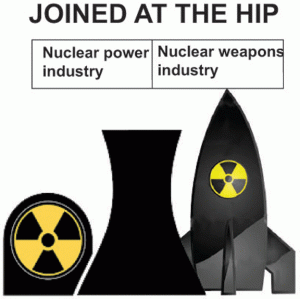 NNSA, TVA agree to ‘down-blend’ uranium to produce tritium for weapons, Oak Ridge Today AUGUST 29, 2018, BY JOHN HUOTARI
 The National Nuclear Security Administration and the Tennessee Valley Authority announced last week that they intend to enter into an agreement to “down-blend” highly enriched uranium to low-enriched uranium in order to help produce tritium, a key “boosting” component in nuclear weapons.The highly enriched uranium used for the “down-blending” is processed, packaged, and shipped from the Y-12 National Security Complex in Oak Ridge, according to the NNSA. Y-12 is the main storage facility for certain categories of highly enriched uranium, which can be used in nuclear weapons and in naval reactors.
Low-enriched uranium, or LEU fuel, is used in a commercial power reactor run by TVA at the Watts Bar Nuclear Plant Unit 1 near Spring City in Rhea County, southwest of Oak Ridge. Tritium is produced there by irradiating lithium-aluminate pellets with neutrons in rods known as tritium-producing burnable absorber rods, or TPBARs.
The irradiated rods are then shipped to the Savannah River Site, an NNSA production facility near Aiken, South Carolina. The Savannah River Site extracts the tritium from the irradiated rods, purifies it, and adds it to the existing inventory, according to the NNSA’s Fiscal Year 2018 Stockpile Stewardship and Management Plan.
Tritium is a radioactive isotope of hydrogen that has two neutrons and one proton. It has been described as an essential component in every nuclear weapon in the U.S. stockpile. It occurs naturally in small quantities but must be manufactured to obtain useful quantities. It enables weapons to produce a larger yield while reducing the overall size and weight of the warhead in a process known as “boosting,” the U.S. Department of Energy said in an environmental impact statement about 20 years ago.
But unlike other nuclear materials used in nuclear weapons, tritium decays at a rate of 5.5 percent per year—its half-life is about 12 years—and it must be replenished periodically…….
The new agreement follows a determination by U.S. Energy Secretary Rick Perry on August 21 that allows the NNSA to continue transfers of enriched uranium from DOE’s inventories in support of national security, the NNSA said in a press release.
The rest of this story, which you will find only on Oak Ridge Today, is available if you are a member: a subscriber, advertiser, or recent contributor to Oak Ridge Today. https://oakridgetoday.com/tag/tritium-production/
August 31, 2018
Posted by Christina Macpherson |
business and costs, USA, weapons and war |
Leave a comment
https://www.militarytimes.com/veterans/2018/08/29/lawmaker-presses-for-quicker-action-to-help-clean-up-crews-of-a-deadly-military-nuclear-accident/, By: Leo Shane III WASHINGTON — Veterans exposed to radioactive debris more than five decades ago haven’t made much progress in the courts to have their illnesses recognized by the Department of Veterans Affairs, so now they’re hoping Congress can intervene.
“These veterans were exposed to nuclear materials without any warning or protection that today would be considered routine,” Blumenthal said. “The quickest way to get them what they deserve now is for Congress to act.”
Veterans involved in the accident have been unsuccessfully petitioning VA on their case since the mid-1970s, after a host of strange cancers and other illnesses began appearing among individuals involved in the Palomares incident.
In January 1966, seven airmen were killed and four more injured when a B-52 crashed into a KC-135 during a refueling mission off the coast of Spain. The B-52 was carrying four nuclear weapons at the time of the accident, and two of them exploded near the town of Palomares, spreading radioactive plutonium over hundreds of acres.
U.S. officials quickly ordered military personnel into the area to collect contaminated debris, crops and soil in an effort to repair the damage.
But veterans involved in that clean up say they were given no protective clothing or respiratory devices, and told very little about the potential long-term health effects about exposure to the nuclear material.
John Garman, one of the first airmen on the scene, said he remembers loading thousands of 55-gallon drums with contaminated top soil that was sent back to the United States for safe disposal.
“The civilians who buried those barrels in South Carolina were covered under federal law, but not us,” said Garaman, who developed bladder cancer at age 35 and multiple respiratory problems in later years. “Since I first filed in 1981, the VA has denied all of my claims.”
Department officials have long insisted that not enough scientific evidence exists to classify all of the health problems as service-related illnesses, and spotty Air Force records of the work and contamination levels have added to the problem.
Last December, the Veterans Legal Services Clinic at Yale Law School filed suit against VA to force recognition of the illnesses and benefits payouts, but that case has yet to move forward. Officials from Vietnam Veterans of America said many of the affected troops are elderly or deceased, meaning further delays could prove tragic.
Blumenthal called VA’s refusal to address the Palomares issue the latest in a long line of controversial decisions related to wartime exposure.
Recently, VA has come under criticism for its opposition to grant presumptive benefits status to so-called “blue water veterans” who served in ships off the coast of Vietnam and claim extensive Agent Orange contamination in their daily work. Several veterans groups have also accused the department of not doing enough to document illnesses connected to the use of burn pits in Iraq and Afghanistan.
VA officials have warned that deivating from long-held scientific standards for benefits awards could create financial problems for the department, by opening up support payments to tens of thousands of additional veterans.
Blumenthal said he does not believe this group presents a significant new financial burden for the department. But, he also called the cost issue irrelevant.
“This is about the principle of helping these veterans,” he said.
August 31, 2018
Posted by Christina Macpherson |
health, USA, weapons and war |
Leave a comment
Ken Raskin 31 Aug 18 They detonated 5 nuclear bombs under parachute Colorado and Rangley. Not so far from Aspen Colorado. The radionuclides have been pouring into the headwaters of the Colorado river and Colorado for years. Rangely and Parachute have 15 times normal average for cancer.

Following the Project Gasbuggy test, two subsequent nuclear explosion fracturing experiments, 5 nuclear bombs total, were conducted in western Colorado in an effort to refine the technique. They were Project Rulison in 1969 and Project Rio Blanco in 1973. In both cases the gas radioactivity was still seen as too high and in the last case the triple-blast rubble chimney structures disappointed the design engineers. Soon after that test the ~ 15-year Project Plowshare program funding dried up. The underground aquifer and gas still radioactive
These early fracturing tests were later superseded by hydraulic fracturing technologies.
August 31, 2018
Posted by Christina Macpherson |
environment, USA |
Leave a comment