Utility consultant: SCE&G ignored ‘stop signs’ about failed nuclear project, Greenville News,Tom Barton, The State Nov. 13, 2018SCE&G ignored numerous warning signs before walking away from a failed $9 billion nuclear expansion project, an industry consultant told the S.C. Public Service Commission on Monday.
“Let me be blunt: You have a utility that bet the farm and lost,” Scott Rubin, an independent utility consultant and attorney from Pennsylvania, testified Monday on behalf of AARP South Carolina. “By the end of this year, customers will have paid $2.2 billion for absolutely nothing — not a single watt of electricity.”
Rubin’s testimony came on the eighth day of PSC hearings into the failed effort by SCE&G, a SCANA subsidiary, to build two nuclear reactors in Fairfield County. The commission also is considering SCE&G’s future electric rates and a proposal by Richmond-based Dominion Energy to buy its parent, Cayce-based SCANA.
Beyond Nuclear 11th Nov 2018, As members of Three Mile Island Alert, a watchdog group, we are resolutely
opposed to the present attempts by utilities in Pennsylvania and Ohio to
secure huge subsidies to keep their aging and financially failing nuclear
power plants operational well beyond their “expiration dates”.
Such a decision would have national implications. The diversion of billions of
dollars into nuclear subsidies would distort markets and state regulatory
decisions and result in lower investment in renewable resources and energy
efficiency.
This in turn would prolong the uneconomic existence of a
resource that is not clean energy.
The Union of Concerned Scientists, in its new report, argues that the trajectories of existing renewable energy
and efficiency standards are insufficient to prevent a dangerous increase
in CO2 emissions, and that a price on carbon could serve to better mitigate
carbon emissions as long as nuclear reactors remain operational.
This latter requirement is roundly contradicted by reports over the last several
years that show that, even in Pennsylvania, a state with one of the highest
greenhouse gas (GHG) emissions rates, GHG reduction goals can be met under
the Environmental Protection Agency’s Clean Power Plan targets through
planned power plant retirements. https://beyondnuclearinternational.org/2018/11/11/no-nuclear-bailouts-for-pennsylvania-and-ohio/
2,000 people agree: DOE plan for Hanford tank waste is not good, Tri City Herald, BY ANNETTE CARY, acary@tricityherald.com – 14 Nov 18, RICHLAND, WA
More than 2,000 people submitted comments or signed petitions critical of a proposal for closing Hanford’s underground radioactive waste storage tanks, according to a coalition of environmental and Hanford watchdog groups.
The Department of Energy sought comments on a draft evaluation that concluded no significant threat to the environment would be posed by its plan to close an initial group of Hanford tanks.
The 16 single-shell tanks that make up the group called the C Tank Farm have been emptiedof about 96 percent of the radioactive and hazardous chemical waste they once held. The waste was left from the past processing of irradiated uranium fuel to remove plutonium for the nation’s nuclear weapons program.
DOE has proposed stabilizing the tanks, which still hold about 64,000 gallons of nuclear waste, by filling them with concrete-like grout and leaving them in the ground in central Hanford…….
Hanford Challenge, Columbia Riverkeeper and the Nuclear Resources Defense Council submitted comments jointly, challenging the legality of reclassifying the waste as low level waste and calling the proposal not protective of human health and the environment.
The proposal must be withdrawn, they said.
DOE has said it is committed to an open, transparent process and will consider comments from states, tribal nations and the public before making a final determination.
The public comment period on the draft evaluation closed last week, but there will be other chances for public comment before a final decision is made.
DOE has asked the Nuclear Regulatory Commission to do a technical review and a public meeting will be held with DOE and NRC, likely in early 2019.
DOE could issue a final evaluation and determination, including a response to the NRC
review and public comments, in the spring.
Additional regulatory steps would be needed before grouting the C Farm Tanks would be allowed to proceed. A separate public comment period would be required to modify DOE’s dangerous waste permit issued by the Department of Ecology.
Work underway on massive fans for nuclear waste repositoryhttps://apnews.com/2cefc1ad7dd34f22a8dd7e1ee86aaabcCARLSBAD, N.M. (AP) 14 Nov 18— The U.S. Energy Department says a New York-based company is building several massive fans to be used in a new multimillion-dollar ventilation system for the federal government’s only underground nuclear waste repository.
Officials say the six fans being made by the Encorus Group will significantly increase the amount of air in the underground portion of the Waste Isolation Pilot Plant in southern New Mexico.
Each fan will stand 20 feet tall and weigh 44,000 pounds.
Construction of the ventilation system is expected to wrap up in early 2021. he ventilation overhaul was prompted by a radiation release in 2014 that contaminated portions of the repository and forced its closure for nearly three years. The release resulted from an inappropriately packed drum of waste that came from Los Alamos National Laboratory.
Nuclear fallout: $15.5 billion in compensation and counting
They built our atomic bombs; now they’re dying of cancer
Nearly 33,500 former nuclear site workers died due to radiation exposure- report
Nuclear Fallout: This story produced in partnership with ProPublica and the Santa Fe New Mexican. (Richly illustrated with photographs, videos, charts, documents interactive map) Wave 3, By Jamie Grey and Lee Zurik|November 12, 2018 LOS ALAMOS, NEW MEXICO (InvestigateTV)– Clear, plastic water bottles, with the caps all slightly twisted open, fill a small refrigerator under Gilbert Mondragon’s kitchen counter. The lids all loosened by his 4- and 6-year old daughters because, at just 38, Mondragon suffers from limited mobility and strength. He blames his conditions on years of exposure to chemicals and radiation at the facility that produced the world’s first atomic bomb: Los Alamos National Laboratory.
Gilbert Mondragon, 38, pulls the cap off a plastic water bottle that had been twisted open by his young daughters. He hasn’t the strength for those simple tasks anymore and blames his 20-year career at the Los Alamos National Lab. He quit this year because of his serious lung issues, which he suspects were caused by exposures at the nuclear facility. (InvestigateTV/Andy Miller)
Mondragon is hardly alone in his thinking; there are thousands more nuclear weapons workers who are sick or dead. The government too recognizes that workers have been harmed; the Department of Labor administers programs to compensate “the men and women who sacrificed so much for our country’s national security.”
But InvestigateTV found workers with medical issues struggling to get compensated from a program that has ballooned ten times original cost estimates. More than 6,000 workers from Los Alamos alone have filed to get money for their medical problems, with around 53 percent of claims approved.
The Los Alamos lab, the top-secret site for bomb design in 1943, has had numerous safety violations and evidence of improper monitoring, federal inspection reports show. Continue reading →
Nuclear watchdog group causes stir with call to financially support existing nuclear plants, “Hard choices” are needed in the face of dire climate projections, Union of Concerned Scientists says. Think Progress MARK HAND, NOV 9, 2018 The Union of Concerned Scientists (UCS) surprised environmental advocates and energy officials on Thursday when it called for keeping existing nuclear power plants open for as long as safely possible to provide a wider window for transitioning to renewable energy resources…….
Among the critics of the UCS report, Gregory Jaczko, former chairman of the Nuclear Regulatory Commission during the Obama administration, said nuclear reactors “are a bad bet for a climate strategy.”
Jaczko, who has major concerns with the safety of nuclear power, noted that nuclear power was the cornerstone of Japan’s strategy to cut carbon emissions. But then the Fukushima accident occurred in 2011 and “wiped out all their greenhouse gas progress,” he said Friday in a statement.
According to Jaczko, the UCS report does not reflect the reality that renewable energy resources are getting cheaper faster than expected and in some cases are the least expensive source of electricity.
“In contrast, nuclear has only gotten more expensive,” he said. “New nuclear is a financial boondoggle.”
THE DEPARTMENT OF TOXIC SUBSTANCES CONTROL DENIES RISK THAT IT CREATED BY DELAYING THE LONG PROMISED CLEANUP. November 9, 2018, Denise Duffield, 310-339-9676 or dduffield@psr-la.org, Melissa Bumstead 818-298-3182 or melissabumstead@sbcglobal.net, Nov 9, 2018Last night, the Woolsey fire burned the contaminated Santa Susana Field Laboratory (SSFL), a former nuclear and rocket engine testing site. Footage from local television showed flames surrounding rocket test stands, and the fire’s progress through to Oak Park indicates that much of the toxic site burned.
A statement released by the California Dept. of Toxic Substances Control (DTSC) said that its staff, “do not believe the fire has caused any releases of hazardous materials that would pose a risk to people exposed to the smoke.” The statement failed to assuage community concerns given DTSC’s longtime pattern of misinformation about SSFL’s contamination and its repeated broken promises to clean it up.
“We can’t trust anything that DTSC says,” said West Hills resident Melissa Bumstead, whose young daughter has twice survived leukemia that she blames on SSFL and who has mapped 50 other cases of rare pediatric cancers near the site. Bumstead organized a group called “Parents vs. SSFL” and launched a Change.org petition demanding full cleanup of SSFL that has been signed by over 410,000 people. “DTSC repeatedly minimizes risk from SSFL and has broken every promise it ever made about the SSFL cleanup. Communities throughout the state have also been failed by DTSC. The public has no confidence in this troubled agency,” said Bumstead.
Nuclear reactor accidents, including a famous partial meltdown, tens of thousands of rocket engine tests, and sloppy environmental practices have left SSFL polluted with widespread radioactive and chemical contamination. Government-funded studies indicate increased cancers for offsite populations associated with proximity to the site, and that contamination migrates offsite over EPA levels of concern. In 2010, DTSC signed agreements with the Department of Energy and NASA that committed them to clean up all detectable contamination in their operational areas by 2017. DTSC also in 2010 committed to require Boeing, which owns most of the site, to cleanup to comparable standards. But the cleanup has not yet begun, and DTSC is currently considering proposals that will leave much, if not all, of SSFL’s contamination on site permanently.
Dr. Robert Dodge, President of Physicians for Social Responsibility-Los Angeles, shares the community’s concerns. “We know what substances are on the site and how hazardous they are. We’re talking about incredibly dangerous radionuclides and toxic chemicals such a trichloroethylene, perchlorate, dioxins and heavy metals. These toxic materials are in SSFL’s soil and vegetation, and when it burns and becomes airborne in smoke and ash, there is real possibility of heightened exposure for area residents.”
Dodge said protective measures recommended during any fire, such as staying indoors and wearing protective face masks, are even more important given the risks associated with SSFL’s contamination. Community members are organizing a campaign on social media to demand that DTSC release a public statement revealing the potential risks of exposure to SSFL contamination related to the fire.
But for residents such as Bumstead, worries will remain until SSFL is fully cleaned up. “When I look at that fire, all I see is other parents’ future heartache,” said Bumstead, “And what I feel is anger that if the DTSC had kept its word, we wouldn’t have these concerns, because the site would be cleaned up by now.”
Physicians for Social Responsibility-Los Angeles (PSR-LA) is the largest chapter of the national organization Physicians for Social Responsibility and has worked for the full cleanup of SSFL for over 30 years.. PSR-LA advocates for policies and practices that protect public health from nuclear and environmental threats and eliminate health disparities.
Parents vs. SSFL is a grassroots group of concerned parents and residents who demand compliance with cleanup agreements signed in 2010 that require a full cleanup of all radioactive and chemical contamination at the Santa Susana Field Laboratory.
A controversial new report from the Union of Concerned Scientists suggests that closing aging US nuclear plants — and not subsidizing the cost of building new ones — will increase carbon emissions. The assumption is that nuclear plants that close will be replaced by coal or natural gas-fired plants.
An increase in greenhouse gas emissions in the US is of course unacceptable given the accelerating climate change crisis we now face. However, the evidence so far, that closed nuclear plants will largely be replaced by natural gas and coal, is not borne out by the actual evidence.
California, which has only one nuclear power plant still operating at Diablo Canyon, will replace it, and the already shuttered San Onofre reactors, entirely with renewable energy. When Nebraska closed its flooded Ft. Calhoun nuclear plant, it was wind energy, not fossil fuels, that stepped in to fill the new generation void.
The UCS report advocates for nuclear power to be included in a National Low-Carbon Electricity Standard (LCES) or any national carbon pricing. But its caveat is that any operating plant considered for this benefit must retain a position in the Nuclear Regulatory Commission’s (NRC) highest safety rating category. This relies on a critical supposition, shown to be to unfounded, that the NRC exercises sufficient due diligence in actually assessing safety at US nuclear plants.
Following a major revision of its reactor safety oversight process in 2000, the NRC listed one nuclear plant— Davis-Besse in Ohio — as being maintained as one of the safest reactors in the country. In fact, while holding its newly top-rated position as a “Column 1” facility, Davis-Besse was in perilous condition. An undetected leak of corrosive reactor coolant had been allowed to eat through a 6 ¾ inch-thick carbon steel wall of the reactor pressure vessel head.
In February 2002, during a scheduled refueling outage, the extensive damage from corrosion was accidentally discovered to have eaten right down to the vessel’s corrosion-resistant stainless steel inner liner. The 3/16th-inch inner steel liner had stretched under the reactor’s operational pressure and was bulging into the throughwall cavity — ready to burst into a loss-of-coolant nuclear accident that by one scientific account could have occurred within two months.
All during the time of operation, FirstEnergy Nuclear, the operator of Davis-Besse, and the onsite NRC inspectors, ignored the thick accumulation of iron oxide particulate settling on catwalks inside the reactor building, and the daily replacement of containment air filters, without investigating where the cloud of rust was originating.
The NRC has since revised its oversight process once again. But neither the federal agency nor the nuclear industry have demonstrated an improvement in “safety culture” and continue to fall short in questioning and reporting the development of reactor hazards.
A February 2017 report, also published by the Union of Concerned Scientists, contradicts the presumption of reliability on the NRC Reactor Oversight Process. It states, “The percentage of the NRC workforce that feared retaliation for raising concerns is comparable to, and sometimes higher than, the percentage of nuclear plant workers who feared retaliation” for questioning the safety of operating nuclear power stations.
In fact, the former UCS senior reactor safety engineer, David Lochbaum, also an author on the latest report, is quoted in the 2017 analysis, “the data suggest that the NRC’s management is just as dismissive of indications that it has a poor safety culture. When it comes to chilled work environments, the NRC may have the largest refrigerator in town.”
The November 2018 UCS report also makes the assertion that offering low-carbon incentives to both renewables and new and existing nuclear plants will raise all boats. However, this is not supported by the reality on the ground. For example, the decision by New York to prop up its aging and uneconomical upstate nuclear plants is costing the state nearly $500 million per year – 200 times as much as it is spending on developing renewables. Preventing the early closure of nuclear plants serves as a hindrance to renewable energy development, exacerbating, rather than ameliorating carbon emissions and the climate crisis.
Paul Gunter is the Director of the Reactor Oversight Project at Beyond Nuclear.
Divided Congress to clash over Space Force, nuclear arsenal, The Hill, BY REBECCA KHEEL – 11/11/18
Democrats next year will control the gavels for the defense and foreign policy committees in the House for the first time since 2010.
The party has been itching to check President Trump on a host of issues, from his relationship with Saudi Arabia to the ballooning defense budget.
But to get legislation through Congress, House Democrats will need to work with the Senate, which is still in Republican hands. And the chairmen poised to lead the defense and foreign policy panels in the upper chamber are seen as staunch Trump allies.
Here are the top foreign policy and defense fights to watch in a divided Congress:
U.S.-Saudi relations
Lawmakers in both parties have been eyeing ways to punish Saudi Arabia over the killing of U.S.-based journalist and Saudi critic Jamal Khashoggi.
House Democrats have said responses should include an end to U.S. military support for the Saudi-led coalition in neighboring Yemen’s civil war. Democratic lawmakers were already opposed to U.S. backing because of civilian casualties, but Khashoggi’s murder has given the issue new urgency……….
Space Force
The Trump administration has said it wants the establishment of a “Space Force” included in next year’s defense policy bill. That position has contributed to increasingly diverging opinions between House and Senate lawmakers……….
Defense budget
Smith [Rep. Adam Smith (D-Wash.), who’s poised to be chairman of the House Armed Services Committee] has said this year’s defense budget of $716 billion is “too high,” and in a Thursday letter announcing his run for chairman he vowed to target “inefficiency and waste” at the Pentagon……….
Nuclear weapons
One of Smith’s longtime concerns has been the U.S. nuclear arsenal. He opposed the Obama administration’s modernization plans, arguing they weren’t affordable.
With the Trump administration’s Nuclear Posture Review calling for new capabilities, Smith has stepped up his criticism, vowing to scrutinize the nuclear budget to look for savings in the overall defense budget.
In his Thursday letter, Smith said Democrats must “take substantial steps to reduce America’s overreliance on nuclear weapons.”
Adding to Democrats’ nuclear anxiety is Trump’s intention to withdraw from a Cold War-era arms accord with Russia known as the Intermediate-Range Nuclear Forces (INF) Treaty. Smith and Engel wrote a letter to the administration last month warning they “will neither support, nor enable, a precipitous course of action that increases the risk of an unconstrained nuclear arms race.”
L.A.’s Secret Meltdown; Simi Valley, CA(1959)Largest Nuclear Incident in U.S. history.
LA’s Nuclear Secret: Part 1 link https://www.nbclosangeles.com/investigations/LA-Nuclear-Secret-327896591.html– Sep 22, 2015 Tucked away in the hills above the San Fernando and Simi valleys was a 2,800-acre laboratory with a mission that was a mystery to the thousands of people who lived in its shadow,By Joel Grover and Matthew GlasserThe U.S. government secretly allowed radiation from a damaged reactor to be released into air over the San Fernando and Simi valleys in the wake of a major nuclear meltdown in Southern California more than 50 years ago — fallout that nearby residents contend continues to cause serious health consequences and, in some cases, death. LA’s Nuclear Secret: Timelines, Documents, FAQ
Those are the findings of a yearlong NBC4 I-Team investigation into “Area Four,” which is part of the once-secret Santa Susana Field Lab. Founded in 1947 to test experimental nuclear reactors and rocket systems, the research facility was built in the hills above the two valleys. In 1959, Area Four was the site of one of the worst nuclear accidents in U.S. history. But the federal government still hasn’t told the public that radiation was released into the atmosphere as a result of the partial nuclear meltdown.
Now, whistleblowers interviewed on camera by NBC4 have recounted how during and after that accident they were ordered to release dangerous radioactive gases into the air above Los Angeles and Ventura counties, often under cover of night, and how their bosses swore them to secrecy.
In addition, the I-Team reviewed over 15,000 pages of studies and government documents, and interviewed other insiders, uncovering that for years starting in 1959, workers at Area Four were routinely instructed to release radioactive materials into the air above neighboring communities, through the exhaust stacks of nuclear reactors, open doors, and by burning radioactive waste.
How It Began
On July 13, 1959, the day of the meltdown, John Pace was working as a reactor operator for Atomics International at Area Four’s largest reactor, under the watch of the U.S. government’s Atomic Energy Commission.
“Nobody knows the truth of what actually happened,” Pace told the I-Team.
In fact, Pace said, the meltdown was verging on a major radioactive explosion.
“The radiation in that building got so high, it went clear off the scale,” he said.
To prevent a potentially devastating explosion, one that in hindsight the 76-year-old Pace believes would have been “just like Chernobyl,” he and other workers were instructed to open the exhaust stacks and release massive amounts of radiation into the sky.
“This was very dangerous radioactive material,” he said. “It went straight out into the atmosphere and went straight to Simi Valley, to Chatsworth, to Canoga Park.”
Pace and his co-workers frantically tried to repair the damaged reactor. Instead, he said they realized, their efforts were only generating more radioactive gas. So for weeks, often in the dark of night, Pace and other workers were ordered to open the large door in the reactor building and vent the radiation into the air.
“It was getting out towards the public,” he said. “The public would be bombarded by it.”
Pace said he and his co-workers knew they were venting dangerous radiation over populated areas, but they were following orders.
“They felt terrible that it had to be done,” he said. “They had to let it out over their own families.”
Area Four workers “were sworn to secrecy that they would not tell anyone what they had done,” Pace explained.
He remembered his boss getting right in his face and saying, “You will not say a word. Not one word.”
That was more than five decades ago, but radioactive contamination didn’t just vanish. It remains in the soil and water of Area Four and in some areas off-site, according to state and federal records obtained by the I-Team. And, evidence suggests that the fallout could be linked to illnesses, including cancer, among residents living nearby.
Arline Mathews lived with her family in Chatsworth, downwind of Area Four during some of the radiation releases. Her middle son, Bobby, was a champion runner on the Chatsworth High School track team for three years, running to the Santa Susana Field Lab and back to school every day. Bobby died of glioblastoma, a rare brain cancer often linked to radiation exposure. Mathews said there is no known family history of cancer and she blames the radiation from Area Four for her son’s illness.
“He was exposed to the chemical hazardous waste and radioactivity up there,” Mathews said. “There’s no getting over the loss of son.”
The Government Cover-up
Six weeks after the meltdown, the Atomic Energy Commission issued a press release saying that there had been a minor “fuel element failure” at Area Four’s largest reactor in July. But they said there had been “no release of radioactive materials” to the environment.
“What they had written in that report is not even close to what actually happened,” Pace said. “To see our government talk that way and lie about those things that happened, it was very disappointing.”
In 1979, NBC4 first broke the story that there was a partial meltdown at Area Four’s largest reactor, called the Sodium Reactor Experiment. But at the time, the U.S. government was still saying no radiation was released into the air over LA.
But during its current yearlong investigation, the I-Team found a NASA report that confirmed “the 1959 meltdown… led to a release of radioactive contaminants.”
For years, NASA used part of the site for rocket testing and research.
More Radioactive Releases
After filing a Freedom of Information request, the I-Team obtained more than 200 pages of government interviews with former Santa Susana workers. One of those workers, Dan Parks, was a health physicist at Area Four in the 1960s.
In the early 60s, Parks said, he often witnessed workers releasing radiation into the sky through the exhaust stacks of at least three of Area Four’s ten nuclear reactors.
“They would vent it to the atmosphere,” he said. “The release was done with the flick of a switch.”
Radioactive Waste Up in Smoke
Parks said he often witnessed workers releasing radioactive smoke into the air when they disposed of barrels of radioactive waste from Area Four’s 10 nuclear reactors.
“We were all workers,” he said. “Just taking orders.”
Workers would often take those barrels of waste to a pond called “the burn pits” and proceed to shoot the barrels with a high-powered rifle causing an explosion. The radioactive smoke would drift into the air over nearby suburbs and toward a summer camp for children.
“It was a volatile explosion, beyond belief,” Parks said.
Whatever direction the wind was blowing, the radioactive smoke would travel that way.
“If the wind was blowing to the Valley, it would blow it in the Valley,” he said.
Ralph Powell, who worked as a security officer at Area Four in the mid-60s, recalled being blanketed by that radioactive smoke.
“I saw clouds of smoke that was engulfing my friends, that are dying now,” Powell said.
Powell believes it wasn’t just his friends who suffered the consequences. He fears he may have exposed his own family to radiation, tracking it home on his clothes and car.
While Powell was working at Area Four, his son Michael was diagnosed with leukemia — a cancer linked to radiation exposure — and died at age 11.
“I suspect it caused the death of my son,” he said. “I’ve never gotten that out of my mind.”
Toxic Chemical Contamination
In addition to the radiation, dozens of toxic chemicals, including TCE and Perchlorate, were also released into the air and dumped on the soil and into ground and surface water from thousands of rocket tests conducted at the Santa Susana Field lab from the 1950s to 80s. The tests were conducted by NASA, and by Rocketdyne, a government aerospace contractor.
According to a federally funded study obtained by the I-Team, “emissions associated with rocket engine testing” could have been inhaled by residents of “West Hills, Bell Canyon, Dayton Canyon, Simi Valley, Canoga Park, Chatsworth, Woodland Hills, and Hidden Hills.”
Contamination Moves into Neighborhoods
Radiation released at Area Four continues to contaminate the soil and water of the Santa Susana Field Lab.
In 2012, the U.S. Environmental Protection Agency completed a $40 million soil test of the site and found 423 hot spots — places contaminated with high levels of man-made radiation.
Other studies and government documents obtained by the I-Team show that radiation has moved off-site, and has been found in the ground and water in suburbs to the south, northeast and northwest of the Field Lab.
“Radiation doesn’t know any boundaries,” said Dr. Robert Dodge, a national board member of the Nobel Prize-winning nonprofit Physicians For Social Responsibility, which studies the health effects of radiation.
Dodge, who has reviewed numerous government and academic studies about the contamination at Santa Susana, said he believes the contamination has spread far beyond the facility’s borders.
“If the wind is blowing and carrying radiation from Santa Susana, it doesn’t stop because there’s a fence,” he said.
One of the places radiation has been found, in a 1995 study overseen by the U.S. EPA, was the Brandeis-Bardin Institute in Simi Valley. The Institute is a nationally-known center of Jewish learning, and the home to Camp Alonim, a beloved summer sleepaway camp that has hosted some 30,000 children.
In December 1995, The Brandeis-Bardin Institute filed a federal lawsuit against the present and past owners of the Santa Susana Field Lab, alleging that toxic chemicals and radiation from the field lab “have subsequently seeped into and come to be located in the soil and groundwater” of Brandeis “is injurious to the environment” and “will cause great and irreparable injury.”
Brandeis settled the lawsuit in a confidential agreement in 1997.
A spokesman for the Brandeis-Bardin Institute, Rabbi Jay Strear, told NBC4 that the groundwater and soil is “tested routinely,” and the results have shown the “the site is safe.”
The I-Team asked Brandeis-Bardin to provide NBC4 with those test results showing the site is safe and free of hazardous substances. The Institute refused, and in an email said “we are not in a position to devote the required staff time to respond to your more detailed inquiries, nor do we see the necessity for doing so.”
A government scientist who has studied the contamination at Santa Susana told the I-Team he thinks there’s a continued threat of radiation and toxic chemicals flowing from the field lab to places like Brandeis-Bardin, via groundwater and airborne dust.
Clusters of Cancer
Researchers inside and out of government have contended that the radiation and toxic chemicals from Santa Susana might have caused many cancer cases.
“The radiation that was released in 1959 and thereafter from Santa Susana is still a danger today,” Dr.Dodge said. “There is absolutely a link between radiation and cancer.”
The I-Team tracked down dozens of people diagnosed with cancer and other illnesses who grew up in the shadow of Santa Susana — in Canoga Park, West Hills, Chatsworth, Thousand Oaks, Simi Valley. Many of them believe their cancers were caused by radiation and chemicals from the field lab.
Kathryn Seltzer Carlson, 56, and her sisters, Judy and Jennifer, all grew up in Canoga Park around the time of the nuclear meltdown and for years after, and all have battled cancer.
“I played in the water, I swam in the water, I drank the water” that ran off the Santa Susana Field Lab, said Carlson, who finished treatment for ovarian cancer earlier this year and is now undergoing chemotherapy for lymphoma. “I’ve had, I don’t know how many cancers.”
Bonnie Klea, a former Santa Susana employee who has lived in West Hills since the 60s, also battled bladder cancer, which is frequently linked to radiation exposure.
“Every single house on my street had cancer,” Klea said.
A 2007 Centers for Disease Control study found that people living within two miles of the Santa Susana site had a 60 percent higher rate of some cancers.
“There’s some provocative evidence,” said Dr. Hal Morgenstern, an epidemiologist who oversaw the study. “It’s like circumstantial evidence, suggesting there’s a link” between the contamination from Santa Susana and the higher cancer rates.
Silence From the Government
For more than two months, the I-Team asked to speak with someone from the U.S. Department of Energy (DOE), the federal agency that’s responsible for all nuclear testing, to ask why workers were ordered to release dangerous radiation over Los Angeles, why the DOE has never publicly admitted this happened, and what it plans to do to help get the site cleaned up.
The DOE emailed the I-Team, “We will not have anyone available for this segment.”
So the I-Team showed up at a public meeting this month about Santa Susana and asked the DOE’s project manager for the site, Jon Jones, to speak with us. He walked away and wouldn’t speak.
Will the Contamination Ever Be Cleaned Up?
Community residents, many stricken with cancer and other radiation-related illnesses, have been fighting for years to get the government and the private owners of the Santa Susana Field Lab to clean up the contamination that remains on the site.
But efforts in the state legislature and state agencies that oversee toxic sites have, so far, stalled.
But residents, with the support of some lawmakers, continue to fight for a full cleanup.
“People are continuing to breathe that (radiation) in and to die,” Chatsworth resident Arline Mathews said.
“See that this is done immediately, before more lives are lost.”
President Trump has called for new and more “usable” nuclear weapons, is seeking to abandon key arms control agreements, and Congress has been plowing ahead with a $2 trillion shopping spree to rebuild the Cold War nuclear arsenal. There has been essentially no effective check on this excessive and dangerous spending.
As of Tuesday night, that will change in January when Democrats take over the House.
Without real oversight, pro-nuclear bomb enthusiasts have had a free hand to promote Trump’s new “low-yield” warhead for Trident missiles; to undermine crucial international agreements like the Intermediate-Range Nuclear Forces (INF) Treaty; and to push for high-cost missile, submarine and bomber programs that we do not need.
Once these programs get off the ground, they become too big to stop. If we don’t act soon, we will be locked in to an excessive Cold War-style arsenal for the next 50 years. As new U.S. weapons are built, and Russia responds in kind, we will find ourselves back in an arms race that only defense contractors can win.
But now there is hope on the horizon. The elections have brought new leaders into power who share the widespread conviction that the United States has more nuclear weapons than it needs to be secure and that spending less on nukes can actually make us safer.
Rep. Adam Smith (D-Wash.) is poised to be the next chairman of the House Armed Services Committee. Rep. Smith has been a leading voice calling for saner nuclear policies for years and shows no signs of letting up.
Speaking at a conference in September, Smith said that, if he gets the gavel, nuclear weapons policy would be at the top of his list of things that will change.
“I think the Republican party and the nuclear posture review contemplates a lot more nuclear weapons than I — and I think most Democrats — think we need. We also think the idea of low-yield nuclear weapons are extremely problematic going forward,” Smith said. “When we look at the larger budget picture, that’s not the best place to spend the money.”
Smith added that the expected price tag for building new nuclear weapons meant the U.S. “certainly can’t afford it.
When Smith becomes the committee’s next chairman in January, proponents of nuclear sanity can once again start to think big. In addition to cancelling the “low-yield” and dangerous Trident warhead, Smith may seek to cancel the destabilizing $30 billion nuclear air-launched cruise missile, which he has said would “siphon limited resources from preserving nuclear deterrence without adding to our national security.”
Next, he could take on the wasteful and dangerous $200 billion program to build new ground-based nuclear missiles. Cancelling this weapon would help to reduce the risk of the United States accidentally or mistakenly launching its nuclear missiles in response to a false warning of a nuclear attack.
Finally, there is greater public concern than ever that President Trump cannot be trusted with his absolute and sole authority to launch nuclear weapons.
Most Americans do not realize that the president has unlimited nuclear launch authority with no real checks or balances from anyone. But once informed, they are very concerned. President Trump could order a nuclear war as easily as he could send a tweet.
This situation is both dangerous and unnecessary. The risks of having nuclear weapons ready to launch within minutes outweigh any perceived benefits, especially if the sole decision-maker cannot be trusted.
Rep. Smith has introduced a bill to make it U.S. policy to never launch nuclear weapons first in a conflict. Other bills would prohibit the first use of nuclear weapons without congressional approval.
These fixes would put legal limits on the president’s ability to launch nuclear weapons unilaterally, without provocation, and would provide a tremendous safeguard to our democracy and our national security.
Congress has been a blank check for the forces of nuclear overkill and overspending for far too long. It is time to bring bold, principled leadership back to nuclear policy, before it is too late.
Tom Z. Collina is director of policy for Ploughshares Fund, a public grantmaking foundation that supports initiatives to prevent the spread and use of nuclear weapons, and to prevent conflicts that could lead to their use.
When America lost a nuclear bomb, Fosters.com, By D. Allan Kerr news@seacoastonline.com 11 Nov 18, In January 1966, an American B-52 bomber collided mid-air with a refueling tanker off the coast of Spain. The resulting fiery crash claimed the lives of seven crew members.
While the loss of life was devastating, there was potential for even greater catastrophe – the B-52 was carrying four fully-loaded hydrogen bombs.
Three of the bombs were located within 24 hours, in the vicinity of a Spanish fishing village called Palomares. The fourth was nowhere to be found.
With the Cold War mired in a deep chill, the United States dispatched an entire Navy armada to try to locate the missing bomb, which was believed to have gone into the Atlantic Ocean. Among those involved in the search was a 23-year-old Navy officer named Donald Craig.
Craig was an ensign at the time, having graduated the previous year from Officer Candidate School at Newport, Rhode Island. He was serving aboard his first vessel, the minesweeper USS Sagacity (MSO 469).
As it happened, Sagacity was near Barcelona, Spain, on a Mediterranean cruise when the tragedy occurred. The minesweeper was dispatched to the scene and over the next several weeks took part in the massive search for the missing nuke.
Craig is now 76 years old, retired, and a longtime resident of Kittery Point, Maine. He still recalls the hunt for the missing nuclear bomb, and the race to get to it before the Soviet Union.
He also remains frustrated on behalf of fellow veterans who say they are dealing with adverse health effects from radiation exposure during the incident – with no assistance from the government that sent them there.
“We knew nothing,” Craig said recently of the possible aftereffects. “We were just out there doing our job.”
A disaster begins
It should have been a routine operation…………
At one point the Navy lost the bomb again in the process of bringing it to the surface, and it sank even deeper into the ravine. Eventually, the bomb and an unmanned vehicle, which had become entangled in its parachute lines, were hauled onto the deck of the submarine rescue ship USS Petrel nearly three months after the initial tragedy.
But then the United States government had to deal with a whole separate controversy – the environmental repercussions of an unleashed hydrogen bomb.
Plutonium blowing in the wind
Members of the U.S. Air Force and residents of Palomares were all exposed to radioactivity from the two bombs that had broken apart on land. Craig recalls winds of about 30 knots at the time.
“Plutonium was blowing in the wind, it was all over the place there,” he said. “They (Air Force personnel) were sitting on the edge of the crater eating their lunches.”
An area of about one square mile was contaminated, including the village’s tomato crop. American servicemen removed this soil and brought it back to South Carolina for disposal.
But in a rather bizarre attempt to show there was no danger, the U.S. government fed the contaminated tomatoes to our troops for “breakfast, lunch and dinner,” according to a June 2016 New York Times article. The U.S. ambassador to Spain and the Spanish minister of tourism swam at a nearby beach in front of a crowd of reporters to prove the waters were safe.
“If this is radioactivity, I love it!” Ambassador Angier Biddle Duke told the media.
Somehow, no civilians on the ground were seriously harmed by falling debris from the aircraft collision. America pledged to the Spanish government the site would be cleared of contamination.
“The main objective here is to leave Spain as we found it,” Duke told LIFE magazine back in 1966.
But as recently as 2015, then-Secretary of State John Kerry and Spain’s foreign minister agreed to negotiate a binding agreement to resume cleanup efforts and further removal of contaminated soil from the site. While no substantive findings have verified serious health issues among the villagers, studies of wildlife such as snails have turned up high radioactive levels.
Craig, however, is particularly outraged by the treatment of Air Force veterans who took part in cleanup efforts at Palomares and now say they are suffering ill health effects as a result. The 2016 Times article featured several former servicemen now suffering from cancer and other ailments.
The Air Force has long insisted there were no serious adverse effects from the incident, so these conditions are not covered under Veterans Administration benefits. An estimated 1,600 veterans took part in the cleanup.
“That shouldn’t happen. They should absolutely be taken care of,” Craig said. ”(The government) did not look after their safety, and there are a lot of people suffering for it now.”
Last year, a number of veterans filed a lawsuit in Connecticut over disability benefits they were denied because the Pentagon refused to release records and reports related to the incident………….
November 9, 2018 LOS ANGELES (CBSLA) — A red flag warning denoting a high risk of wildfire has been extended until Tuesday, as two fires continued to roar across Los Angeles and Ventura counties today.Gusty, strong off-shore winds fueled the flames of the Woolsey and Hill fires, burning from West Hills to Camarillo and south to PCH late into the evening.
The Hill Fire erupted at 2:04 p.m. Thursday in the area of Hill Canyon in Santa Rosa Valley; less than a half-hour later, the Woolsey Fire ignited in the area of Rocketdyne, south of the City of Simi Valley. The flames were kicked up by heavy wind gusts, reaching speeds up to 60 mph.
Friday, winds were back in the teens and single-digits across the area, helping firefighters as they tried to get a better handle on the flames.
The National Weather Service said Friday dry conditions and gusty winds would continue through Saturday evening before Santa Ana winds redevelop, however, bringing continued Red Flag conditions to both counties Sunday through Tuesday, with wind gusts expected between 40-55 mph.
Officials warn residents to use caution with ignition sources.
House Democrat to introduce new bill punishing Saudi Arabia over Khashoggi, It would block a controversial nuclear deal that’s very important to Saudi Arabia. Vox By Alex Ward@AlexWardVoxalex.ward@vox.com Nov 9, 2018A House Democrat will soon introduce legislation to punish Saudi Arabia over the murder of journalist Jamal Khashoggi — by trying to halt an impending nuclear deal with the country.
Obtained exclusively by Vox, the bill — nicknamed the “No Nuclear Weapons for Saudi Arabia Act of 2018” — if passed would be the strongest rebuke to Saudi Arabia yet since the uproar over Khashoggi’s fate.
Khashoggi, a US resident, was killed by Saudi officials inside the country’s consulate in Istanbul last month. That led to a major international outcry over his death, including from many in the US who wanted to see the Washington-Riyadh relationship curtailed.
Most of the discussions on how to do that center on stopping billions of dollars in arms sales to the kingdom, but President Donald Trump has repeatedly said he doesn’t want to jeopardize money coming into the United States, and some members of Congress privately worry that stopping weapons shipments to Saudi Arabia might negatively impact jobs.
So instead of doing that, Rep. Brad Sherman (D-CA) wants to stop a major nuclear deal between the US and Saudi Arabia that’s been under negotiation for months, and which he has long railed against.
“I don’t think this bill would’ve passed prior to the events in Istanbul,” Sherman told me. “Now I think we have a chance.” It’s also very possible a Republican will co-sponsor the bill when it’s officially introduced in the next 10 congressional days.
The legislation would do three main things:
Force Trump to submit a “123 Agreement,” or a set of rules that make it legal for the US to sell nuclear technology to another country, for congressional approval.
Force the administration to tell Congress that Saudi Arabia will abide by the agreement’s “Gold Standard” (more on that below) and an inspections agreement with the International Atomic Energy Agency, the world’s nuclear watchdog
Require the administration to write reports on Saudi Arabia’s probe into Khashoggi’s murder and the state of human rights in the kingdom
Sherman’s bill could completely block Saudi Arabia’s plans to obtain nuclear technology from the United States, especially since there’s growing bipartisan support to reprimand Riyadh over Khashoggi.
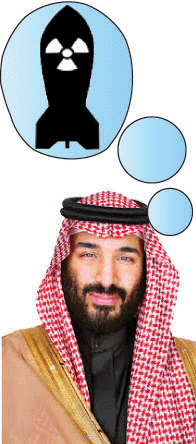
It would come as a big blow to Saudi Arabia: Crown Prince Mohammed bin Salman, the kingdom’s de facto ruler, more commonly known as MBS, launched a project on Monday to build his country’s first nuclear research reactor.
There’s also some bipartisan support to stop nuclear talks with Riyadh in the Senate.
Sens. Edward Markey (D-MA) and Marco Rubio (R-FL), for example, have sent letters to Trump requesting he at least suspend negotiations with Saudi Arabia over the nuclear deal. It’s unclear if either of them will draft parallel legislation to the House version, although a spokesperson for Rubio’s office told me the senator “possibly” could consider a bill in the future. …….
American companies have already lined up to sell and build nuclear parts for Saudi Arabia, …….
Saudi Arabia could accelerate a nuclear arms race in the Middle East
There’s legitimate concern about what Riyadh would do with a brand new nuclear reactor if this indeed happens.
On March 18, MBS openly admitted on CBS’s 60 Minutes that obtaining a nuke was a possibility……..
California’s Woolsey Fire Now Threatening Malibu Went Through The Site Of A Nuclear Accident First, Forbes, Eric Mack 9 Nov 18 out of control and heading into populated areas of Malibu. All residents must evacuate immediately. ”
A mandatory evacuation is now in effect for the entire city of Malibu in southern California as a fast-moving fire dubbed the Woolsey Fire burns through the suburban hills and canyons between Simi Valley and the Pacific coast.
“MANDATORY evacuation now in effect for all of City of Malibu, and all areas south of 101 Fwy from Ventura County line to Las Virgenes / Malibu Cyn, southward to the ocean due to Woolsey Fire. Use PCH to evacuate, avoid canyons,” reads a 10 a.m. PT update from the city.
UPDATE: According to the latest alert from the city of Malibu at 12:27 p.m. PT, the Woolsey Fire “is now burning out of control and heading into populated areas of Malibu. All residents must evacuate immediately. “
A mandatory evacuation is now in effect for the entire city of Malibu in southern California as a fast-moving fire dubbed the Woolsey Fire burns through the suburban hills and canyons between Simi Valley and the Pacific coast.
“MANDATORY evacuation now in effect for all of City of Malibu, and all areas south of 101 Fwy from Ventura County line to Las Virgenes / Malibu Cyn, southward to the ocean due to Woolsey Fire. Use PCH to evacuate, avoid canyons,” reads a 10 a.m. PT update from the city. ……….
The blaze began with a brush fire ignited near the closed Santa Susana Field Laboratory (also referred to as the Rocketdyne facility) south of Simi Valley Thursday afternoon and has since grown to over 10,000 acres and claimed an undetermined number of structures.
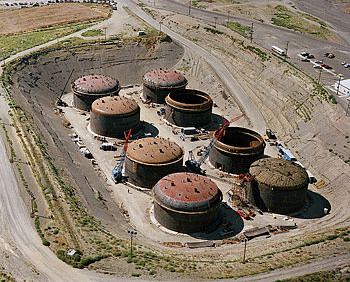




 THE SANTA SUSANA FIELD LABORATORY (ROCKETDYNE) BURNED IN THE WOOLSEY FIRE, THREATENING TOXIC EXPOSURES FROM CONTAMINATED DUST, SMOKE, ASH AND SOIL. https://www.psr-la.org/woolsey-fire-burns-nuclear-meltdown-site-that-state-toxics-agency-failed-to-clean-up/