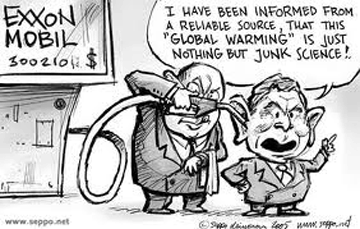
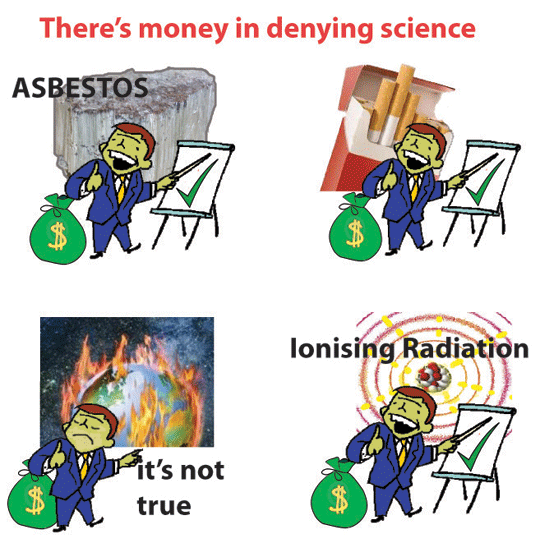
The strategy of muddling the public’s impression of climate science has proved to be highly effective. In 2017, polls found that almost ninety per cent of Americans did not know that there was a scientific consensus on global warming.
What is certain is that the industry’s campaign cost us the efforts of the human generation that might have made the crucial difference in the climate fight
How Extreme Weather Is Shrinking the Planet, New Yorker, by Bill McKibben November 18, 2018 “………The climatologist James Hansen testified before Congress about the dangers of human-caused climate change thirty years ago. Since then, carbon emissions have increased with each year except 2009 (the height of the global recession) and the newest data show that 2018 will set another record. Simple inertia and the human tendency to prioritize short-term gains have played a role, but the fossil-fuel industry’s contribution has been by far the most damaging. Alex Steffen, an environmental writer, coined the term “predatory delay” to describe “the blocking or slowing of needed change, in order to make money off unsustainable, unjust systems in the meantime.” The behavior of the oil companies, which have pulled off perhaps the most consequential deception in mankind’s history, is a prime example.
As journalists at InsideClimate News and the Los Angeles Times have revealed since 2015, Exxon, the world’s largest oil company, understood that its product was contributing to climate change a decade before Hansen testified. In July, 1977, James F. Black, one of Exxon’s senior scientists, addressed many of the company’s top leaders in New York, explaining the earliest research on the greenhouse effect. “There is general scientific agreement that the most likely manner in which mankind is influencing the global climate is through carbon-dioxide release from the burning of fossil fuels,” he said, according to a written version of the speech which was later recorded, and which was obtained by InsideClimate News. In 1978, speaking to the company’s executives, Black estimated that a doubling of the carbon-dioxide concentration in the atmosphere would increase average global temperatures by between two and three degrees Celsius (5.4 degrees Fahrenheit), and as much as ten degrees Celsius (eighteen degrees Fahrenheit) at the poles.
Exxon spent millions of dollars researching the problem. It outfitted an oil tanker, the Esso Atlantic, with CO2 detectors to measure how fast the oceans could absorb excess carbon, and hired mathematicians to build sophisticated climate models. By 1982, they had concluded that even the company’s earlier estimates were probably too low. In a private corporate primer, they wrote that heading off global warming and “potentially catastrophic events” would “require major reductions in fossil fuel combustion.”
An investigation by the L.A. Times revealed that Exxon executives took these warnings seriously. Ken Croasdale, a senior researcher for the company’s Canadian subsidiary, led a team that investigated the positive and negative effects of warming on Exxon’s Arctic operations. In 1991, he found that greenhouse gases were rising due to the burning of fossil fuels. “Nobody disputes this fact,” he said. The following year, he wrote that “global warming can only help lower exploration and development costs” in the Beaufort Sea. Drilling season in the Arctic, he correctly predicted, would increase from two months to as many as five months. At the same time, he said, the rise in the sea level could threaten onshore infrastructure and create bigger waves that would damage offshore drilling structures. Thawing permafrost could make the earth buckle and slide under buildings and pipelines. As a result of these findings, Exxon and other major oil companies began laying plans to move into the Arctic, and started to build their new drilling platforms with higher decks, to compensate for the anticipated rises in sea level.
The implications of the exposés were startling. Not only did Exxon and other companies know that scientists like Hansen were right; they used his nasaclimate models to figure out how low their drilling costs in the Arctic would eventually fall. Had Exxon and its peers passed on what they knew to the public, geological history would look very different today. The problem of climate change would not be solved, but the crisis would, most likely, now be receding. In 1989, an international ban on chlorine-containing man-made chemicals that had been eroding the earth’s ozone layer went into effect. Last month, researchers reported that the ozone layer was on track to fully heal by 2060. But that was a relatively easy fight, because the chemicals in question were not central to the world’s economy, and the manufacturers had readily available substitutes to sell. In the case of global warming, the culprit is fossil fuel, the most lucrative commodity on earth, and so the companies responsible took a different tack.
A document uncovered by the L.A. Timesshowed that, a month after Hansen’s testimony, in 1988, an unnamed Exxon “public affairs manager” issued an internal memo recommending that the company “emphasize the uncertainty” in the scientific data about climate change. Within a few years, Exxon, Chevron, Shell, Amoco, and others had joined the Global Climate Coalition, “to coordinate business participation in the international policy debate” on global warming. The G.C.C. coördinated with the National Coal Association and the American Petroleum Institute on a campaign, via letters and telephone calls, to prevent a tax on fossil fuels, and produced a video in which the agency insisted that more carbon dioxide would “end world hunger” by promoting plant growth. With such efforts, it ginned up opposition to the Kyoto Protocol, the first global initiative to address climate change.
In October, 1997, two months before the Kyoto meeting, Lee Raymond, Exxon’s president and C.E.O., who had overseen the science department that in the nineteen-eighties produced the findings about climate change, gave a speech in Beijing to the World Petroleum Congress, in which he maintained that the earth was actually cooling. The idea that cutting fossil-fuel emissions could have an effect on the climate, he said, defied common sense. “It is highly unlikely that the temperature in the middle of the next century will be affected whether policies are enacted now, or twenty years from now,” he went on. Exxon’s own scientists had already shown each of these premises to be wrong.
On a December morning in 1997 at the Kyoto Convention Center, after a long night of negotiation, the developed nations reached a tentative accord on climate change. Exhausted delegates lay slumped on couches in the corridor, or on the floor in their suits, but most of them were grinning. Imperfect and limited though the agreement was, it seemed that momentum had gathered behind fighting climate change. But as I watched the delegates cheering and clapping, an American lobbyist, who had been coördinating much of the opposition to the accord, turned to me and said, “I can’t wait to get back to Washington, where we’ve got this under control.”
He was right. On January 29, 2001, nine days after George W. Bush was inaugurated, Lee Raymond visited his old friend Vice-President Dick Cheney, who had just stepped down as the C.E.O. of the oil-drilling giant Halliburton. Cheney helped persuade Bush to abandon his campaign promise to treat carbon dioxide as a pollutant. Within the year, Frank Luntz, a Republican consultant for Bush, had produced an internal memo that made a doctrineof the strategy that the G.C.C. had hit on a decade earlier. “Voters believe that there is no consensus about global warming within the scientific community,” Luntz wrote in the memo, which was obtained by the Environmental Working Group, a Washington-based organization. “Should the public come to believe that the scientific issues are settled, their views about global warming will change accordingly. Therefore, you need to continue to make the lack of scientific certainty a primary issue in the debate.”
The strategy of muddling the public’s impression of climate science has proved to be highly effective. In 2017, polls found that almost ninety per cent of Americans did not know that there was a scientific consensus on global warming. Raymond retired in 2006, after the company posted the biggest corporate profits in history, and his final annual salary was four hundred million dollars. His successor, Rex Tillerson, signed a five-hundred-billion-dollar deal to explore for oil in the rapidly thawing Russian Arctic, and in 2012 was awarded the Russian Order of Friendship. In 2016, Tillerson, at his last shareholder meeting before he briefly joined the Trump Administration as Secretary of State, said, “The world is going to have to continue using fossil fuels, whether they like it or not.”
Connecticut utility regulators say Millstone Nuclear Power Plant ‘at risk’ of closing, New Haven Register, By Luther Turmelle, November 17, 2018 A tentative ruling by state utility regulators may boost efforts by the owner of the Millstone Nuclear Power Plant to have the electricity it produces considered in ‘zero carbon’ auction that the state’s Department of Energy and Environmental Protection conducts to procure power.
Commissioners with Connecticut’s Public Utilities Regulatory Authority ruled that the Waterford-based power plant “is at risk of retirement.” Dominion Energy, the Virginia-based company that owns Millstone, has claimed for several years that economic conditions in the nation’s energy markets are making it difficult for the utility to keep operating the plant if it not allowed to compete for lucrative long-term contracts that are awarded to the winners of the zero-carbon auction.
“This interim decision does not reach the issue of whether a purchase power agreement with Millstone should be selected by DEEP or approved,” the tentative ruling says in part. “But (it) addresses solely the basis on which such a bid may be evaluated.”
Dominion officials release a statement Friday following PURA’s ruling say they are pleased with the decision made by regulators.
“They have been given access to our confidential information, have done their own analysis, and reached their own conclusion, Millstone is at risk,” the statement says in part. “We are now focused on the zero carbon procurement at the Department of Energy & Environmental Protection. We made numerous offers that would both ensure Millstone’s continued operations and provide benefits to Connecticut ratepayers ranging from the hundreds of millions of dollars to billions of dollars.”
DEEP officials are expected to announce the winners of the zero carbon auction by the end of the year. PURA’s determination that Millstone is at risk of closing will be a factor that DEEP officials will take into account as they try to determination the winners of the auction from a field of dozens of renewable energy sources that submitted proposals earlier this year……….
Joel Gordes, a West Hartford-based energy industry consultant, said PURA’s commissioners erred in their draft ruling.
Ticking time bomb giant stockpile of nuclear waste endangers USA
A Fukushima waiting to happen? Huge stockpile of nuclear waste on California fault line threatens US https://www.rt.com/usa/444089-california-nuclear-san-onofre/16 Nov, 2018 Millions of pounds of toxic waste are being buried under the site of a privately owned former nuclear power plant in California. The only problem? Experts warn that it sits on a major fault line — and in a tsunami zone.
The San Onofre nuclear plant, located just 108 feet from a popular beach, was shut down in 2015 after a leak was discovered. Now, the Southern California Edison energy company is burying the nuclear waste at the failed site — a move which has been approved by federal regulator
Charles Langley, the executive director of Public Watchdogs, told RT that the situation at San Onofre is of “grave concern” because spent nuclear fuel and water “don’t mix.”
Langley claimed that research carried out by experts which highlighted the extreme risks of storing the waste at the facility was “suppressed” by the very government agency responsible for protecting public health and safety.
“There are actually fault lines that run underneath the facility. We’ve documented this in geological reports that were suppressed by the Nuclear Regulatory Commission. It’s in a Tsunami zone and it’s also extremely vulnerable to terrorist attacks.”
So far, 29 of 73 canisters of waste are below the surface of the ground. Langley warns, however, that the canisters are unequipped to store the toxic nuclear waste. The warranty for the containment system is only for 10 years “and the canisters themselves are only guaranteed to last 25 years,” he said.
Nina Babiarz, a board member at Public Watchdogs, told RT that “there should have been a requirement for an underground monitoring system before one can even went in the ground.”
Babiarz believes the San Onofre plant is a ticking time bomb.
“It’s still very prevalent to me that this not only could happen, but it has happened at Three Mile Island, of course it has happened at Chernobyl, it’s happened at Fukushima — and lest we forget, it could happen at San Onofre,” she said.
Edison refused to answer any of RT’s questions. On its website, however, the company says they are “being proactive in seeking out options for the relocation of the fuel, including an off-site facility.”
But San Onofre is not the only nuclear site causing concern to scientists and environmentalists in California.
The Santa Susana Field Laboratory — a highly classified former nuclear testing site, which was the location of the worst nuclear meltdown in nuclear history — was scorched in the California wildfires. During the 1959 disaster, 459 times more radiation was leaked there than during the infamous 1979 Three Mile Island meltdown in Pennsylvania.
Physicians for Social Responsibility say that the toxic materials in the soil and vegetation could become airborne in smoke and ash. More than half a million people live within 10 miles of the area.
Investigative journalist Paul DeRienzo told RT that given the site’s classified status, it’s no surprise that Americans don’t know much about the place.
“It was a tremendous accident [in 1959] that gave off more radiation than Three Mile Island did — and other than that, very little is known. It’s a highly classified site and whatever we learn about it, we learn in dribs and drabs over a long period of time,” DeRienzo said.
Asked whether government assurances that the site is safe could be believed, DeRienzo warned against trusting official guarantees.
“You can’t, because it’s classified, because a lot of the things that happened at Santa Susana were classified and therefore there are things that they’re just never going to tell you and only accidentally does it come out,” he said.
Nov. 13 (UPI)— U.S. Vice President Mike Pence vowed to work toward the complete denuclearization of North Korea and fully enforce sanctions during a joint press conference with Japan’s prime minister on Tuesday.
Pence, who is expected to attend the APEC meeting in Papua New Guinea on Saturday instead of President Donald Trump, said the United States stands firmly against countries that threatened freedom and openness in the region, including North Korea, NHK reported……
2 Hanford whistleblowers sue. They say they lost their jobs for raising safety concerns, Tri City Herald, BY ANNETTE CARY, acary@tricityherald.com, November 15, 2018 RICHLAND, WA
The company building the Hanford vitrification plant is defending itself in federal court against two former employers who said they lost their jobs after raising concerns about the plant’s safety.
Bechtel National holds the Department of Energy contract to build and start up the $17 billion plant to turn about 56 million gallons of radioactive waste into a stable glass form for disposal.
Government Accountability Project USA https://www.whistleblower.org/blog/034224-urgent-action-requested-sign-petition-below Watchdog and Advocacy Coalition Report Warns of Systemic Attacks on Science The Report Exposes Chronic Interference With Federal Science and Public Health and Safety Measures Under the Trump Administration and Makes Critical Recommendations to Congress
A report released today by a coalition of prominent watchdog and advocacy groups – including Government Accountability Project – chronicles a litany of recent attacks on federal science and scientists by Trump administration officials intent on undermining the critical regulatory role government plays in safeguarding public health and safety. The report, “Protecting Science at Federal Agencies: How Congress Can Help,” arose out of mounting concerns that some of our elected officials are chronically crippling key science programs, and ignoring, suppressing, censoring, and distorting scientific information in order to weaken regulatory functions that serve to protect human health and the environment but disadvantage certain industry interests. Government Accountability Project was the lead contributor to the chapter on whistleblowing and scientific integrity, as well as a contributor to the chapter on reduced communications. The report concludes that widespread, politically-motivated interference in sound science causes unsound policy decisions, and Congress must act swiftly and decisively to reverse this dangerous trend to get the nation back on course.
The new report walks through countless troubling examples of deliberate efforts by Trump administration agency heads and political appointees to dismantle federal science programs, discredit scientific data, disconnect scientific fact from decision-making, and destroy public trust in government. Many current high-level political appointees lack adequate experience and credentials for the positions they are assigned to manage and often bring with them serious conflicts of interest. Meanwhile, Congress has been lax, even negligent, in carrying out its oversight responsibilities. This must change.
The watchdog and public interest groups who authored this report share a strong concern that we are witnessing an epidemic of intentional ignorance and scientific blind spots at the highest levels of government, at a time when all Americans face escalating threats to our health and wellbeing – such as a broken health care system and runaway climate change. Collectively we put forth a set of thoughtful recommendations for the incoming 116th Congress to consider that include specific legislative proposals as well as a call for greatly improved oversight to hold government officials accountable to the public they serve.
The U.S. government invests well over $100 billion a year on scientific research and technology development, and federal agencies have traditionally relied heavily on scientific findings to support complex regulatory and policy decisions. Now, science itself is under attack: this administration is systematically dismantling a host of science advisory committees and hampering them from providing scientific information and guidance to federal regulatory program managers. Blatant disregard of fact-based evidence – even wholesale rejection of facts themselves – fostered by the Trump White House place all of us at greater risk by exposing us to toxic chemicals, polluting our air and water, eroding and blocking access to adequate health care, compromising national security, and raising the risk of exposure to dangerous climate change impacts.
Climate Science & Policy Watch, a flagship program of Government Accountability Project, is especially troubled by the enormous disparity between the alarm bells rung in the most recent Intergovernmental Panel on Climate Change (IPCC) report, and the tepid U.S. response. As President Trump promotes a coal industry come-back and calls for fewer regulatory checks on rampant oil and gas extraction – thereby ramping up carbon emissions when we most need to be making significant cuts – we face the increasingly imminent threat of runaway climate change and its dangerous impacts. Global climate disruption is happening now, as evidenced by western-wildfires-turned-raging-infernos sweeping across California incinerating entire towns and communities; more hazardous hurricanes and unprecedented rainfall and flooding; storm surges and sea level rise inundating coastal areas. Our Environment, Energy, and Climate Change team members are increasingly troubled by the hundreds of regulatory rollbacks of environmental protection provisions across the federal government and the corruption in key agencies such as the Environmental Protection Agency (EPA), the Department of Interior (DOI), and the National Park Service (NPS). The EPA, FEMA, and NPS have all removed references to climate change on their respective websites. One EPA official has even taken it upon himself to weed out grant proposals with the words “climate change” from those eligible for funding. ………..
Sign this petition from Government Accountability Project urging Congress to update the most critical whistleblower legal rights: Government Accountability Project Petition
U.S. government ordered to remove deadly nuclear substance from South Carolina, BY EMILY BOHATCH ebohatch@thestate.com, October 26, 2018
South Carolina officials celebrated a victory Friday after a U.S. court ruled the federal government must remove a metric ton of plutonium from the state, according to a statement from the S.C. Attorney General’s Office.
Managers at the federal government’s nuclear waste repository in southern New Mexico have reported a rock fall in an area of the underground facility that is off-limits to employees. CARLSBAD, N.M. (AP)— Managers at the federal government’s nuclear waste repository in southern New Mexico have reported a rock fall in an area of the underground facility that is off-limits to employees.
The U.S. Energy Department says the fall happened Wednesday evening. Workers heard a loud thud while doing inspections underground so they left the area and all work was stopped.
Officials said there were no injuries.
Rock falls are not uncommon in areas where crews have been unable to perform regular maintenance to shore up the walls and ceilings of the salt caverns that have been excavated for disposal of radioactive waste.
This week’s rock fall happened in a disposal room that does not contain any waste. A team is planning an inspection before operations resume at the Waste Isolation Pilot Plant.
Army Corps of Engineers: $500 million Parks Township nuclear waste removal project is a ‘go’, TRIB LIVE,
MARY ANN THOMAS| Wednesday, Nov. 14, 2018, The Army Corps of Engineers released test results and announced to residents Wednesday it is ready to resume the $500 million cleanup of the nuclear waste dump in Parks Township.
The 44-acre dump, officially known as the Shallow Land Disposal Area, is off Route 66 near Kiskimere Street. It was owned in the 1960s by the Nuclear Materials and Equipment Corp. (NUMEC) which had plants in Apollo and Parks Township that produced nuclear fuels for Navy submarines, power plants and other government programs.
About 80 people attended the public meeting Wednesday at the Parks Township volunteer fire hall.
It featured a review of the project, which stalled seven years ago amid environmental test results.
The recent slowdown was an almost 18-month delay over a contract bid protest from the four bidders that didn’t win the $350 million contract to excavate the nuclear waste dump.
But the Army Corps reviewed the bids and recently lifted a stop-order on the federal contract that had been awarded to Jacobs Field Services to clean up the nuclear waste dump. …….
the recent groundwater tests show that beryllium, a metal used by the nuclear plants and buried on site found its way into the underground coal mines, which lie beneath the site.
By: Leo Shane III WASHINGTON — An appeals court will force Veterans Affairs officials to identify how many troops may have been exposed to radioactive debris from a 1966 plane crash, a move that supporters hope will be the precursor to a class-action lawsuit against the department for overdue benefits.
On Tuesday, the U.S. Court of Appeals for Veterans Claims made the unusual ruling demanding the records’ release six weeks after VA lawyers argued the information is nearly impossible to obtain, given aging and missing military records from the accident.
But the court, by a 6-3 ruling, gave the department 30 days to determine the number of military personnel assigned to the accident clean-up, the number of veterans who have applied for benefits connected to the event, and the number who have been denied compensation. That information will be used to decide how a lawsuit on the benefits denial may proceed.
Veterans involved in the accident have been unsuccessfully petitioning VA on their case since the mid-1970s, after a host of strange cancers and other illnesses began appearing among individuals involved.
In January 1966, seven airmen were killed and four more injured when a B-52 crashed into a KC-135 during a refueling mission off the coast of Spain. The B-52 was carrying four nuclear weapons at the time of the accident, and two of them exploded near the town of Palomares, spreading radioactive plutonium over hundreds of acres.
U.S. officials quickly ordered military personnel into the area to collect contaminated debris, crops and soil in an effort to repair the damage. But veterans involved in that cleanup say they were given no protective clothing or respiratory devices, and told very little about the potential long-term health effects from exposure to the nuclear material.
Earlier this year, the appeals court ruled in a separate case that veterans can file suit against the Department of Veterans Affairs as a class rather than individuals, in limited circumstances.
Since then, legal experts have been monitoring a host of lawsuits before the court to see which could be the first class recognized, a move which will set important precedents for future legal cases.
The three judges who argued against the records request in the Palomares lawsuit said the move would effectively force VA to justify the need for a class-action lawsuit against itself, and that the majority ignored concerns that Defense Department records for the incident may not exist.
But the majority opinion noted that no final decision on whether to recognize a class of Palomares has been made, and data on the denied benefits is the sole property of VA, inaccessible in any way for outsiders.
Plaintiffs in the lawsuit have contended that more than 1,600 veterans should be eligible for disability benefits related to the toxic exposure, but VA thus far has denied their requests because not enough scientific evidence exists to classify all of the health problems as service-related illnesses.
Smith aims to scrap Trump’s nuclear weapons policy, Defense News , By: Joe Gould, 13 Nov 18WASHINGTON —Rep. Adam Smith — set to become the next chairman of the House Armed Services Committee in the new Congress — and other Democratic lawmakers said Wednesday they hope to use their party’s takeover of the House to check the Trump administration’s expansive policies toward nuclear weapons.
Speaking at an event sponsored by the Ploughshares Fund, an anti-nuclear weapons group, Smith said he wants to see a redo of the Trump administration’s Nuclear Posture Review, to continue multilateral nuclear pacts and to advance a no-first-use policy toward nuclear weapons for the United States.
Smith also reiterated he wants a ban on a new low-yield submarine-launched nuclear weapon, a version of the W76-1 warhead for the Navy’s Trident II D5 ballistic missile, dubbed the W76-2. He introduced a bill to that effect in September.
It’s a tall order. In the House, where Democrats have picked up 34 to 40 seats, Smith’s ambitious proposals are likelier to become part of the next annual defense policy bill. However, those proposals would have a rougher road in negotiations with the GOP-led Senate Armed Services Committee; on the Senate floor, where GOP holds a majority; and in the Oval Office, where President Donald Trump wields the veto pen.
U.S. Advanced Nuclear Technology Projects to Receive $18 million from the U.S. Department of Energy, Office of Nuclear Energy, NOVEMBER 13, 2018 ,DOE AWARDS $18 MILLION FOR U.S. ADVANCED NUCLEAR TECHNOLOGY PROJECTS
WASHINGTON, D.C. – The U.S. Department of Energy (DOE) today announced funding selections for eleven domestic advanced nuclear technology projects. These projects, located across six states, will receive varying amounts for a total of approximately $18 million in funding, with project values totaling approximately $25 million. The projects are cost-shared and will allow industry-led teams, including participants from federal agencies, public and private laboratories, institutions of higher education, and other domestic entities, to advance the state of U.S. commercial nuclear capability…….https://www.energy.gov/ne/articles/us-advanced-nuclear-technology-projects-receive-18-million-us-department-energy
Fasken executive: High level nuclear storage could threaten area’s oil industry mrt, By Mella McEwen, MRT.com/Midland Reporter-Telegram, November 14, 2018Two applications for sites to serve as interim storage locations for high level nuclear waste in Andrews County and in Lea and Eddy counties, New Mexico, are drawing concern about the risks they pose.
“There is as much nuclear radiation in one cask as was released in Chernobyl in 1986, and they want to eventually bring 20,000 casks here,” said Tommy Taylor, director of oil and gas development for Fasken Oil and Ranch. “One cask has as much radiation as the nuclear bomb dropped on Nagasaki.”
Taylor addressed the Midland chapter, Society of Independent Professional Earth Scientists Wednesday in an effort to raise
awareness of the impact the sites could have, not just on Permian Basin communities but on the region’s oil and gas industry.
The Permian Basin is the No. 1 oil producing region in the U.S. It has changed the geopolitical environment around the world,” he said. “This region is too important to U.S. security to allow this.”
SIPES member Stephen Robichaud agreed, pointing out that a serious leak from one of the casks could shut in 100 percent of the nation’s oil and gas production as well as the Ogallala Aquifer, a main source of water for the middle of the country.
Beyond the environmental impact, “we’re talking about monetary damages in the many trillions of dollars. The impact could be enormous,” Robichaud said……..
The applications are for interim storage sites, which Taylor said is between 40 and 100 years.
An attorney involved in hiring a consultant to study problems at a failed $9 billion nuclear expansion project Wednesday defended deleting items from that critical report.
Atlanta-based attorney George Wenick testified during Day 10 of S.C. Public Service Commission hearings into the failed effort by SCE&G, a SCANA subsidiary, to build two nuclear reactors in Fairfield County. The commission also is considering SCE&G’s future electric rates and a proposal by Dominion Energy to buy SCE&G’s parent, SCANA.
The report by the San Francisco-based Bechtel Corp., completed in February 2016, showed SCE&G knew the project was troubled long before it collapsed……
SCANA chief executive Jimmy Addison last week testified he never had read the damning Bechtel report and never intends to, calling it “history.” But, he added, he wished it had been disclosed to the Public Service Commission and the public in 2015.
At stake is who will pay for the failed nuclear project — SCE&G’s customers, SCANA’s shareholders or both — and how big the future power bills will be for SCE&G’s roughly 730,000 electric customers.
SCE&G increased the electric rates for its typical residential customer by about $27 a month to pay for the nuclear project before it pulled the plug on the unfinished reactors in July 2017. Subsequently, the PSC cut SCE&G’s nuclear-related rates temporarily.