Holtec nuclear waste dry storage system (Hi-STORM UMAX) is a lemon and must be recalled
 San Onofre: Defective Holtec Nuclear Waste Storage System Must Be Recalled. SanOnofreSafety November 8, 2018 (Holtec Board Member Norcross is a member of Trump’s Mar a Lago club.)
The NRC is investigating numerous Holtec failures at San Onofre, but has yet to issue a final investigation of these engineering failures. If it wasn’t for whistleblowers, we would not know about any of these serious safety problems that are still unresolved — and likely cannot be solved with this defective Holtec system.
Instead of requiring Holtec take their defective system back, as they likely can do under their limited manufacturing defect warranty, Edison plans to continue loading canisters in order to destroy the spent fuel pools as soon as possible. The pools cost them millions in overhead costs every year.
Instead, Holtec and Edison are advocating for H.R. 3053 (pending in the US Senate) and other bills that would remove critical safety requirements for both storage and transport and remove a number of federal and state rights, including transparency, input and oversight. The House already approved this bill, under the misguided assumption they can trust the NRC to protect our safety. The bill would allow the DOE to take title to the waste at the current San Onofre site, eliminating Edison’s liability and responsibility for this mess they created. All funding for waste management is currently mandatory. This unfunded bill makes funding discretionary with Congress.
The Holtec dry storage system is a lemon and must be recalled. Edison finally admitted their replacement steam generators were lemons, but waited until after they leaked radiation into Southern California. They need to declare this Holtec system a lemon before these containers leak and explode in Southern California.
- The NRC should revoke the license of this and other Holtec nuclear waste storage and transport systems. Holtec has repeatedly demonstrated they are not a qualified vendor. More Holtec Nuclear Waste issues here.
- Edison should stop loading canisters with fuel and return this system to Holtec. They should issue Requests for Proposals (RFPs) that meet NWTRB and NWPA safety requirements for both storage and transport. The RFP should include a system for replacing all existing thin-wall canisters at San Onofre with thick-wall transportable casks. This must be done before these canisters start leaking and exploding.
- The Governor should declare a state of emergency. The State of California should revoke San Onofre state permits until this is done. They should create a multi-agency committee to address these issues and facilitate the development of an expedited solution to this critical problem before Holtec and Edison destroy our economy, security, safety and future.
- The CPUC should stop funding this Holtec lemon and any further activities at San Onofre until this is done.
Congress and the President should mandate the NRC enforce safety standards as outlined above and force the NRC to stop misleading them about the safety of the systems they approve. Transporting these thin-wall cracking canisters to another location will no more solve our nuclear waste problems than rearranging the deck chairs on the Titanic would stop it from sinking. https://sanonofresafety.org/2018/11/08/san-onofre-defective-holtec-nuclear-waste-storage-system-must-be-recalled/
USA non proliferation experts, both Democrat and Republican Urge Trump to save nuclear treaty with Russia
 In Bipartisan Pleas, Experts Urge Trump to Save Nuclear Treaty With Russia, NYT, By Rick Gladstone, Nov. 8, 2018 Alarmed at what they see as disintegrating curbs on nuclear weapons, a bipartisan array of American nonproliferation experts has urged President Trump to salvage a Cold War-era treaty with Russia that he has vowed to scrap.
In letters sent to the White House this week that were seen by The New York Times, the experts said the pact, the Intermediate-Range Nuclear Forces Treaty, had reduced the risk of nuclear war.
Despite the treaty’s flaws, they said, the United States should work to fix the accord, not walk away from it.
“The INF Treaty has prevented the unchecked deployment of nuclear missiles in Europe,” stated one of the letters, sent Wednesday to the White House. It was signed by more than a dozen prominent figures in arms control, including former Secretary of State George P. Shultz and former Senators Richard Lugar and Sam Nunn.
Another letter, dated Tuesday and sent by the American College of National Security Leaders, a group of former high-level military officers, said: “The INF Treaty is a bedrock to our current arms control regime and serves rather than hampers American interests.”
There was no immediate comment from the Trump administration on the letters.
The treaty’s fate may come up this weekend if Mr. Trump sees President Vladimir V. Putin of Russia during a memorial event in France celebrating the centennial of the end of World War I. But there have been conflicting accounts from the White House and the Kremlin on whether the two will even meet.
……….In the letter signed by Mr. Shultz and others, the arms control experts recognized what they called Russia’s noncompliance with the treaty. But rather than move to terminate it, they called on Mr. Trump “to direct your team to redouble efforts to negotiate technical solutions to U.S. (and Russian) INF compliance concerns.”
Both letters also urged Mr. Trump to engage in negotiations with the Russians on prolonging the New Strategic Arms Reduction Treaty, or New START, which will expire in February 2021 unless both sides agree to an extension. That pact limits the number of long-range missiles, bombers and warheads in the American and Russian arsenals.
Should the treaty expire, the former military commanders said in their letter, it would be the first time since 1972 that the United States and Russia “have not been bound by a binding arms control agreement.” https://www.nytimes.com/2018/11/08/world/europe/trump-russia-arms-treaty.html
Radioactive groundwater found at Westingouse SC nuclear fuel factory
 ‘You guys have gotten me afraid.’ Radioactive groundwater found at SC fuel factory, The News and Observer, BY SAMMY FRETWELL, sfretwell@thestate.com November 09, 2018 , COLUMBIA, SC
Groundwater at Westinghouse’s nuclear fuel factory on Bluff Road is contaminated with unsafe levels of radioactive material from years-old leaks that state and federal regulators only learned about in the past year.
Recent tests found levels of radioactive uranium that exceed safe drinking-water standards at two test wells adjacent to the nuclear fuel-rod plant southeast of Columbia, the U.S. Nuclear Regulatory Commission said during a community meeting.
Thursday night’s meeting was held as part of Westinghouse’s application for a new 40-year license from the Nuclear Regulatory Commission to operate the Bluff Road plant.
………. Thursday night’s revelation of high uranium levels in two test wells follows news this year about other leaks and spills at the Westinghouse plant, a major employer in the Columbia area since opening in 1969.
The NRC did not learn about the 2011 leak until last year and, only recently, found out about the 2008 leak from the fuel rod plant. Westinghouse did not tell the agency at the time the leaks occurred because that was not required, the company and federal officials have said. The leaks occurred in the same area of the factory, three years apart.
The 2008 and 20111 leaks are not the only concern.
In July, Westinghouse told state and federal regulators it had discovered that a uranium solution leaked through a hole in the floor in another part of the plant this summer and contaminated the ground.
Unlike the 2008 and 2011 leaks, regulators say they haven’t found that the uranium that leaked this summer got through the ground and into the water table below. The company is cleaning up that leak by excavating nine feet of tainted soil, Westinghouse spokeswoman Courtney Boone said.
Residents living near the plant expressed concerns Thursday about the safety of the facility. About 70 residents attended Thursday’s meeting at a Garners Ferry Road conference center.
Residents are concerned groundwater pollution could affect the private wells from which they draw drinking water. They also worry about the possibility of a nuclear accident.
……….. Critics of the plant say Westinghouse should not get a 40-year operating license because of problems at the site. …. https://www.newsobserver.com/news/state/south-carolina/article221376635.html
Computer errors that almost started nuclear wars
 The argument from cyberspace for eliminating nuclear weapons NOVEMBER 9, 2018 “…….Computer errors that almost started nuclear wars
Unclassified reports reveal that problems within the computers of nuclear command and control date back to at least the 1970s, when a deficient computer chip signalled that 200 Soviet missiles were headed towards the U.S. Computer problems have persisted: In 2010, a loose circuit card caused a U.S. launch control centre to lose contact with 50 nuclear missiles. In both cases, the accident might have been mistaken for a deliberate attack. Failing to recognize the mistake could have resulted in the U.S. launching nuclear weapons.
These cases were presumably the result of unintentional errors, not deliberate actions. But hacking and other forms of targeted cyberattacks greatly increase the risk of accidental nuclear launch or other devastating actions. Overconfidence on the part of the officials overseeing the nuclear arsenal is therefore negligent and dangerous.
A more recent compounding factor is the ongoing, roughly trillion-dollar upgrade of the U.S. nuclear arsenal started by the Obama administration. This so-called modernization effort included upgrades to the nuclear command and control system. The Trump administration continues to make this a priority.
Modernization increases the possibility that changes to the nuclear command and control system will introduce new or reveal hitherto unknown vulnerabilities into the system. The evidence from the GAO report and other publicly available documents indicates that the officials in charge will be emphasizing speed, convenience, or cost over cybersecurity.
In its conclusion, the GAO report explained that the DOD “has taken several major steps to improve weapon systems cybersecurity.” But the DOD “faces barriers that may limit its ability to achieve desired improvements,” such as constraints on information sharing and workforce shortages. That is not reassuring.
There is a more basic problem that we have emphasized above: the risks associated with cyberattacks can be ameliorated but not fully eliminated. When this intrinsic risk is integrated with the sheer destructiveness of nuclear weapons, the only way to avoid a catastrophic accident at some point in time is to embrace efforts to abolish the weapons themselves.
- — Postdoctoral research fellow, University of British Columbia
- — Simons Chair in Disarmament, Global and Human Security at the Liu Institute for Global Issues, University of British Columbia
- This article first appeared on The Conversation– https://stuff.co.za/the-argument-from-cyberspace-for-eliminating-nuclear-weapons/
For USA the cost of not funding a nuclear waste solution is becoming greater than the cost of funding it.

Failure to Fund National Spent Nuclear Fuel Repository Leaves Decommissioning Funds Partially Unsupervised https://thesandpaper.villagesoup.com/p/failure-to-fund-national-spent-nuclear-fuel-repository-leaves-decommissioning-funds-partiall/1787983, Gina G. Scala, ggscala@thesandpaper.net Nov 07, 2018
As a result, the only option for U.S. nuclear power plants is to store spent fuel from the reactor vessels onsite. That includes decommissioned or decommissioning power plants, like the Oyster Creek Nuclear Generating Station. Just last month, the Nuclear Regulatory Commission approved an exemption request from Exelon Generation, which owns the Lacey Township-based nuclear plant, to withdrawal monies from the plant’s decommissioning trust fund for spent fuel management and site restorations costs without first obtaining NRC approval.
“We approved these changes after reviewing the fund and projected cash flow,” said Neil Sheehan, public information officer for the NRC’s Region 1 office, noting the federal agency has approved similar requests before.
Oyster Creek, once the nation’s oldest operating commercial nuclear power plant, was taken permanently offline in September. It was licensed to operate until April 2029, but under an agreement with the state of New Jersey to forgo building cooling towers, company officials agreed to close the plant by Dec. 31, 2019. Earlier this year, citing financial costs and better opportunities for employees, the decision was made to shut down plant operations in September.
In July, Exelon Generation announced it had reached a deal with Holtec International, a New Jersey-based energy technology company, to purchase the plant and take over its decommissioning duties.
“An important note is that this exemption was based on Exelon’s earlier plan to place the plant into SAFSTOR, or long-term storage, before dismantlement work begins,” Sheehan said. “Holtec will need to submit an exemption request for the same uses of the fund based on its proposed DECON, or immediate dismantlement, approach. We anticipate receiving that request in November.”
The timeline for the NRC to review Holtec’s request to use decommissioning trust funds would be similar to what it was for Exelon’s request, which was submitted on March 22, 2018, and approved on Oct. 19, 2018, according to Sheehan.
“Holtec would not be able to withdraw any money until the NRC determines if it qualifies to take over the Oyster Creek license,” he said. “If it gets the go-ahead, Holtec would be free to begin withdrawals if and when it receives approval for the exemption.”
On Aug. 31, Exelon and Holtec filed a joint application to begin the license transfer application, asking for a decision by May 1, 2019. The public has until Nov. 8 to file a request for a public hearing on the federal agency’s review of the transfer. Written comments are being accepted until Nov. 19.
From the beginning, Holtec officials have said they would like to immediately begin decommissioning Oyster Creek. It’s their intention to expedite the dismantling of the nuclear plant and return the site, located on 779 acres of land in the Forked River section of the township, to unrestricted use in less than a decade, with the exclusion of the Independent Spent Fuel Storage Installation, or spent fuel pad, on site. Exelon’s post-shutdown activity plans included taking the full 60 years permitted under federal law.
“We do track how decommissioning funds are used and where they stand,” Sheehan said. “The owners of permanently shut-down nuclear power plants must submit updates to us on an annual basis.”
While the NRC is currently reviewing applications for two potential interim sites to house spent nuclear fuel, one in Texas and the other in New Mexico, the House of Representatives earlier this year voted to revive the Yucca Mountain project to store radioactive nuclear waste.
“Electricity consumers have contributed $40 billion into the nuclear waste fund,” according to the Nuclear Energy Institute, the policy organization for nuclear technologies. “Meanwhile, taxpayers have been saddled with more than $6 billion in damages for the federal government’s inaction – an amount that grows by $800 million for every additional year the government does not act. The cost of not funding a solution is rapidly becoming greater than the cost of funding it.”
Prisoners in New York will learn about their radiation exposure due to body scans
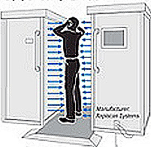 Body-scanned inmates will get radiation exposure stats, NY Post By Rich Calder and Tamar Lapin, November 8, 2018 “………The city Health Department has issued new regulations that would allow inmates to learn how much radiation they’ve absorbed from body scans in the clink.Upon request, the Correction Department would have to provide them with their “total accumulated radiation exposure,” according to a legal notice issued by the city Thursday. Body-scanned inmates will get radiation exposure stats, NY Post By Rich Calder and Tamar Lapin, November 8, 2018 “………The city Health Department has issued new regulations that would allow inmates to learn how much radiation they’ve absorbed from body scans in the clink.Upon request, the Correction Department would have to provide them with their “total accumulated radiation exposure,” according to a legal notice issued by the city Thursday.
The regulation was in response to a new state law authorizing correction officers to again use high-powered body scanners to spot nonmetal objects — such as ceramic knives — in the possession of inmates. As part of the law, the Health Department had to implement rules to make sure the scanners are safe — including “setting annual exposure limits and mandates for training and signage.”…… The Correction Department thought it had the problem solved in 2012 and 2013, after it purchased five “airport-style” body scanners with ionizing radiation that picked up every imaginable kind of weapon and contraband. But after a year’s use, the scanners were shelved when it was discovered they violated a little-noticed state law that said “ionizing radiation” may not be “applied to human beings” except by licensed medical personnel for a medical purpose…….. The new state law wipes out the scanner-use medical restriction…….https://nypost.com/2018/11/08/body-scanned-inmates-will-get-radiation-exposure-stats/ |
|
U.S. sailors in nuclear reactor part of USS Ronald Reagan allegedly used drug LSD
|
US Navy investigates sailors working in nuclear department of USS Ronald Reagan for taking LSD, Telegraph 7 NOVEMBER 2018 The US Navy has confirmed it is investigating 15 sailors working mainly in the nuclear reactor department of the aircraft carrier Ronald Reagan for allegations of LSD abuse.Lt. Joe Keiley, spokesman for the Seventh Fleet, based in Japan, said that two sailors are already heading to court-martial accused of using, possessing and distributing the hallucinogenic drug, while three are waiting to see whether they will be charged as well.
Another 10 sailors were administratively disciplined. Of the 15, 14 worked in the nuclear department. News of the LSD ring was first reported by The Wall Street Journal in February, but Lt Keiley confirmed that the initial investigation had resulted in charges. When the allegations were first reported, the Seventh Fleet – beset by a series of problems – issued a statement saying that “the Navy has zero tolerance for drug abuse and takes all allegations involving misconduct of our sailors, Navy civilians and family members very seriously.”…….. The Seventh Fleet has been plagued by problems over the past year. In 2017, two ships – the USS John S. McCain and the USS Fitzgerald – were involved in separate collisions with commercial vessels, killing 17 sailors. In August 2017 Vice Admiral Joseph Aucoin, commander of all US naval forces in the eastern Pacific, was fired as the result of a “loss of confidence in his ability to command,” the Navy said.https://www.telegraph.co.uk/news/2018/11/07/us-navy-investigates-sailors-working-nuclear-department-uss/ |
|
|
Trump’s Energy Secretary Rick Perry accidentally told the truth about Yucca Mt, contradicting Trump

 Think Progress 31st Oct 201*Yucca Mountain** One thing that unites Nevadans is opposition to President Donald Trump’s effort to turn the state into a huge nuclear waste dump. That’s why many
were surprised when Trump suggested he might abandon that policy after
touring the state recently with GOP Senator Dean Heller, who is in a tight
reelection race against Democrat Jacky Rosen.
But Trump’s Energy Secretary, Rick Perry, admitted on Friday the administration still supports
building the Yucca Mountain nuclear waste repository outside of Las Vegas.
In doing so, Perry effectively spoiled Trump’s effort to help Heller, as
Jon Ralston, editor of the Nevada Independent, explained to Bloomberg:
“Poor Rick Perry didn’t get the memo and accidentally told the
truth.”
https://thinkprogress.org/rick-perry-accidentally-told-the-truth-about-dumping-nuclear-waste-in-nevada-roiling-senate-race-c3945ba499d9/
North Korea warns it might return to developing nuclear weapons, if USA does not end sanctions
North Korea warns of returning to nuclear policy, News 24 2018-11-04 North Korea has warned the US it will “seriously” consider returning to a state policy aimed at building nuclear weapons if Washington does not end tough economic sanctions against the impoverished regime.
For years, the North had pursued a “byungjin” policy of simultaneously developing its nuclear capabilities alongside the economy.
In April, citing a “fresh climate of detente and peace” on the peninsula, North Korean leader Kim Jong Un declared the nuclear quest complete and said his country would focus on “socialist economic construction”.
But a statement issued by the North’s foreign ministry said Pyongyang could revert to its former policy if the US did not change its stance over sanctions.
“The word ‘byungjin’ may appear again and the change of the line could be seriously reconsidered,” said the statement carried by the official KCNA news agency late on Friday.
Sanctions
At a historic summit in Singapore in June, US President Donald Trump and Kim signed a vaguely-worded statement on denuclearisation.
But little progress has been made since then, with Washington pushing to maintain sanctions against the North until its “final, fully verified denuclearisation” and Pyongyang condemning US demands as “gangster-like”.
“The improvement of relations and sanctions are incompatible,” said the statement, released under the name of the director of the foreign ministry’s Institute for American Studies.
“What remains to be done is the US corresponding reply,” it added.
The statement is the latest sign of Pyongyang’s increasing frustration with Washington……..
In an interview with Fox News on Friday, US Secretary of State Mike Pompeo reiterated that sanctions will remain until Pyongyang carries out it denuclearisation commitments made in Singapore, adding he will meet with his North Korean counterpart next week. https://www.news24.com/World/News/north-korea-warns-of-returning-to-nuclear-policy-20181104
U.S. Secretary of State Mike Pompeo to resume nuclear talks with North Korea this week
Pompeo Resuming Nuclear Talks with N. Korea This Week, VOA, November 04, 2018 Ken Bredemeier,
U.S. Secretary of State Mike Pompeo says he is resuming denuclearization talks with North Korea this week in New York, meeting with Pyongyang’s second in command, Kim Yong Chol.
Progress on ending Pyongyang’s nuclear weapons programs has slowed in the months since the Singapore summit in June between U.S. President Donald Trump and North Korean leader Kim Jong Un, when the two leaders signed a general statement calling for the denuclearization of the Korean peninsula.
But Pompeo called the coming talks “a good opportunity” to move toward specifics of when and how North Korea might end its nuclear weapons program. The United States is seeking to finalize a deal by the end of Trump’s first term in office in January 2021.
Pyongyang said Friday it would “seriously” consider resuming its nuclear testing if U.S. economic sanctions against North Korea are not lifted, but Pompeo, in an interview on Fox News Sunday, dismissed the threat……..
Pompeo said there would be “no economic relief until we have achieved our ultimate objective,” the end of North Korea’s nuclear program.
The United States has said it would maintain the sanctions against North Korea until it has reached “final, fully verified denuclearization…….https://www.voanews.com/a/pompeo-resuming-nuclear-talks-with-n-korea-this-week-/4644158.html
Trump administration heads for the dodgy science of the radiation sceptics
| Is a Little Radiation Good For You? Trump Admin Steps Into Shaky Science, Discover Magazine, By Nathaniel Scharping | October 5, 2018
For decades, studies have shown that even low doses of radiation are harmful to humans. This week, the Associated Press reported that the Trump administration may be reconsidering that. The Environmental Protection Agency seemed to be looking at raising the levels of radiation considered dangerous to humans based on a controversial theory rejected by mainstream scientists. The theory suggests that a little radiation might actually be good for our bodies. In April, an EPA press release announced the proposal and included supporting comments from a vocal proponent of the hypothesis, known as hormesis. It prompted critical opinion pieces and sparked worry among radiation safety advocates.
The debate cuts to the heart of the debate over the effects of low doses of radiation and reveals how difficult it is to craft clear guidelines in an area where scientific evidence is not clear cut. Radiation DebateWhen radiation damages our DNA, the body steps in to make repairs. Hormesis suggests that hitting the body with a little more radiation should kick our defensive mechanisms into overdrive. According to proponents of the theory, this results in the production of anti-oxidants and anti-inflammatory compounds that reduce our risk for cancer and heart disease, among other things. That’s why hormesis backers want the EPA to raise the level of acceptable radiation, pointing out that it would also save millions in safety costs. It sounds convincing, and proponents have dozens of studies to point to that they say back up their claims. But, “Large, epidemiological studies provide substantial scientific evidence that even low doses of radiation exposure increase cancer risk,” says Diana Miglioretti, a professor in biostatistics at the University of California, Davis in an email. “Risks associated with low-doses of radiation are small; however, if large populations are exposed, the evidence suggests it will lead to measurable numbers of radiation-induced cancers.” Long-term studies of Hiroshima and Nagasaki bombing survivors show higher cancer risks. Marshall Islanders exposed to radiation from atomic bomb tests suffered a higher risk of thyroid disease. And patients who get CT scans, which deliver a dose of radiation equal to thousands of X-rays, saw cancer risks go up afterward. Researchers also found that radiation from childhood CT scans can triple the risk of leukemia and, at higher doses, triple the risk of brain cancers as well. Another found that low-dose radiation increased the risk of breast cancer among some some women. And large-scale reviews of the evidence for hormesis find that it is decidedly lacking. Two studies, one in 2006 by the National Research Council, and another in 2018 by the National Council and Radiation Protection and Measurements looking at 29 studies of radiation exposure find no evidence for hormesis, and reiterate that the evidence points toward radiation being bad for us even at low doses. Scientific UncertaintyIt’s difficult to study low doses of radiation, though, and that’s where much of the controversy comes from. At doses below a few hundred millisieverts (mSv), a radiation unit that accounts for its effects on the body, it becomes extraordinarily hard to separate out the effects of radiation from other things like lifestyle or genetics. Research on the effects of these small radiation doses often use data sets involving thousands of people to compensate for the minimal effect sizes, but even then it’s often not enough to be certain what’s happening. “Data collected at low doses (defined by the scientific community [as] exposures less than 100 mSv) suffers from a ‘signal to noise’ problem which limits our ability to conclusively state effects one way or another,” says Kathryn Higley, head of the school of nuclear science and engineering at Oregon State University in an email. A single CT scan delivers anywhere from 1 to 15 mSv, but some patients need many scans during the course of their treatment, increasing the total dose. Workers cleaning up after the Fukushima meltdown received radiation doses above 100 mSv in some cases. And current U.S. standards limit radiation workers to no more than 50 mSv of exposure per year. Many studies indicate that there are dangers at that level, but it’s often an assumption. Those studies base their suppositions on what’s called the linear no-threshold model, which extrapolates more reliable data from studies of higher doses of radiation to lower doses. Though it may be an educated guess, for decades large-scale studies have indicated this is true. ……….. The EPA in recent days appeared to back away from the suggestion that it supported hormesis. The agency released a statement in response to the APstory affirming that it intends to continue using the linear no-threshold model when constructing radiation guidelines, something that contradicts Calabrese’s comments in the April press release. “The proposed regulation doesn’t talk about radiation or any particular chemicals. EPA’s policy is to continue to use the linear-no-threshold model for population-level radiation protection purposes which would not – under the proposed regulation that has not been finalized – trigger any change in that policy,” said an EPA spokesman in response to a request for comment. Radiologist Rebecca Smith-Bindman says the vast bulk of the evidence suggests even small amounts of radiation are harmful. We shouldn’t base our policies on an unproven theory, she adds. “There is extensive evidence that ionizing radiation will cause cancer,” says Smith-Bindman, a professor of radiology at the University of California, San Francisco in an email exchange. “These data come from a range of different sources, including epidemiological data (such as studies of patients who have received diagnostic and therapeutic radiation and from environmental exposures and accidents), from animal studies and from basic science studies. While it is more difficult to precisely quantify the exposures — which will vary by many factors, such as age at exposure, and source of radiation, etc. — there is no uncertainty among the scientific community that radiation will cause cancer.” She says that pointing to issues with the linear no-threshold model misses the point. Though it may not be totally accurate at very low doses, she says it’s unfair to use that uncertainty to cast doubt on data about radiation where there’s solid evidence. …….. Miglioretti says “Based on the large body of evidence to date, I believe that revising the regulations to increase allowable radiation exposure limits will lead to an increase in the number of radiation-induced cancers in this country.” That’s in line with what multiple experts Discover contacted believe — that radiation can harm even at low doses and raising limits would endanger the public, though the increase in risk would likely be small. It’s not clear at the moment whether the EPA proposal to raise limits will pass, though it does follow in the footsteps of other Trump administration proposals to weaken safety standards. At the moment, it’s unclear what the effects on the public if the EPA raises radiation limits. “Perhaps it might make nuclear power plants less expensive to build. It might lower the cost of cleanup of radioactively polluted sites,” says David Brenner, director of the Center for Radiological Research at Columbia University in an email. “But [it] begs the question of whether cleanup to a less rigorous standard is desirable.” http://blogs.discovermagazine.com/crux/2018/10/05/epa-trump-administation-radiation-guidelines/#.W99ZFtIzbGg
|


The Twin Threats of Climate Change and Nuclear Annihilation- new documentary with Noam Chomsky
 New Documentary by ChomskySpeaks.org with Noam Chomsky Challenges Establishment over Twin Threats of Climate Change and Nuclear Annihilation https://www.prnewswire.com/news-releases/new-documentary-by-chomskyspeaksorg-with-noam-chomsky-challenges-establishment-over-twin-threats-of-climate-change-and-nuclear-annihilation-300743226.html
Renowned public intellectual calls out Democrats and Republicans for escalating nuclear dangers and decries Republican Party “dedicated to the destruction of life” NEWS PROVIDED BY
ChomskySpeaks.org
Nov 02, 2018 BOSTON, Nov. 2, 2018 /PRNewswire/ — Executive Producer Randall Wallace and Director Patrick Jerome launch the online documentary, “Noam Chomsky: Internationalism or Extinction” on the website: http://ChomskySpeaks.org. Based on a lecture by the public intellectual who is often described as the “most quoted living intellectual,” the documentary brings both the activist energy and desperate concerns of climate change and nuclear escalation that are causing mass extinctions.
Against these dire realities, Noam Chomsky surveys “the internationalism” of inter-state cooperation and social movements as solutions. He notes the complicity of both Democratic and Republican parties in escalating nuclear tensions and nuclear proliferation. At the same time, he condemns the Republican Party for profit-driven policies leading to climate-altering, carbon pollution. The documentary is a compelling and urgent warning explaining such ideas and tools as “the Anthropocene,” “the Doomsday Clock,” “species extinction,” “internationalism,” “denialism,” “non-proliferation,” “NATO expansion,” “climate accords,” and “climate debt” among many others.
Many non-partisan organizations collaborated in organizing the original lecture upon which the documentary is based; several also supported the production of the documentary as a starting point for further analysis. These included peace movement organizations in collaboration with the Boston-based movement-building center, encuentro5 (http://encuentro5.org) and the democracy movement’s Liberty Tree Foundation for the Democratic Revolution (http://LibertyTreeFoundation.org). The video adds to their efforts at expanding the public conversation about vital issues of the day. A grant from the Wallace Action Fund supported the documentary.
Chomsky concludes his lecture with sober reflection on the urgent challenges facing humanity: “The tasks ahead are daunting and they cannot be deferred.” Media Contact:
Suren Moodliar
617-968-0880
204337@email4pr.com SOURCE ChomskySpeaks.org, Related Links http://chomskyspeaks.org
U.S. Supreme Court upholds right of 21 young people to sue federal government about climate change inaction

 Independent 4th Nov 2018 , The Supreme Court has refused to halt a novel lawsuit filed by young
Americans that attempts to force the federal government to take action on
climate change, turning down a request from the Trump administration to
stop it before trial.
The suit, filed in 2015 by 21 young people who argue
that the failure of government leaders to combat climate change violates
their constitutional right to a clean environment, is before a federal
judge in Oregon. It had been delayed while the Supreme Court considered the
emergency request from the government.
https://www.independent.co.uk/news/world/americas/climate-change-lawsuit-trump-us-young-people-children-supreme-court-allows-julia-olsen-a8616136.html
Donald Trump ready to reimpose all nuclear sanctions on Iran
 Trump set to reimpose all nuclear sanctions on Iran The Hill, BY REBECCA KHEEL – 11/02/18 The Trump administration plans to reimpose the last set of sanctions lifted under the Iran nuclear deal early next week, administration officials announced Friday.
Secretary of State Mike Pompeo confirmed in a call with reporters that the administration will grant waivers to eight “jurisdictions” when it reimposes oil and gas sanctions on Monday.
“This part of the campaign about which we’re speaking today is simple: It is aimed at depriving the regime of the revenues that it uses to spread death and destruction around the world,” Pompeo said.
“We expect to issue some temporary allotments to eight jurisdictions, but only because they have demonstrated significant reductions in crude oil and cooperation on many other fronts and have made important moves toward getting to zero crude oil importation.”
Pompeo did not specify which eight jurisdictions are getting waivers, saying a list would be released Monday. Asked if the use of the word “jurisdiction” meant that the European Union, a group of 28 countries, is getting waiver, Pompeo said the E.U. is not being granted a waiver.
In May, Trump announced that he was withdrawing the United States from what he once called the “worst deal ever negotiated.”…………
Friday’s announcement drew immediate condemnation from those who supported the nuclear deal.
“These sanctions are a slap in the face to the Iranian people who have been squeezed between the repression of their government and the pressure of international sanctions for decades,” Jamal Abdi, president of the National Iranian American Council, said in a statement. “Impoverishing ordinary Iranians will not hurt the regime or achieve any of America’s security interests, but it will set back the Iranian people’s aspirations for years to come.” https://thehill.com/policy/defense/414526-trump-set-to-reimpose-all-nuclear-sanctions-on-iran
Former SCANA accountant tells how nuclear financial document was “doctored”
 SCANA accountant says CEO put her on medical leave over complaints about nuclear project, Independent Mail, COLUMBIA — In newly unsealed documents, a former SCANA employee says the utility’s then-chief executive, Kevin Marsh, put her on “special medical leave” after she went to him with concerns about a failing, $9 billion nuclear project.
Carlette Walker, once SCANA’s vice president of Nuclear Finance Administration, also testified that, in 2015, her bosses filed misleading testimony under her name with state regulators about how much the V.C. Summer Nuclear Station expansion project would cost.
Carlette Walker, once SCANA’s vice president of Nuclear Finance Administration, also testified that, in 2015, her bosses filed misleading testimony under her name with state regulators about how much the V.C. Summer Nuclear Station expansion project would cost.
“While I was out, they wrote testimony under my name, and they filed testimony under my name with the (lower cost) number that I had fought against,” Walker said in an April 24 deposition.
Walker’s full sworn statement — parts had been released before with sections blacked out, or redacted — was made public Thursday as the S.C. Public Service Commission began its weeks-long hearing into the nuclear-related power rates of SCE&G, SCANA’s electric subsidiary.
A spokesman for SCE&G said the utility would not comment except during the PSC hearing.
Previously, most of the pages of Walker’s 187-page deposition had been at least partially blacked out at SCE&G’s request. However, PSC hearing officer David Butler ruled Wednesday the entire document should be made public.
In her deposition, Walker said she had projected the cost to finish the floundering project was about $500 million higher than contractors had estimated. But, she said, her SCANA bosses submitted the contractors’ lower numbers — which she considered unrealistic — to regulators in her name while she was out of work on leave, taking care of her sick husband.
Another former SCE&G employee, Ken Browne, said in his deposition the contractor’s cost projections were based upon productivity rates that V.C. Summer construction workers never had attained. Work was going so slowly, the project could have taken far longer — until 2030 — to complete, Browne said.
According to Walker’s deposition, when Browne objected internally to SCE&G using the lower cost submitted to the PSC, under Walker’s name, he was “pretty much cussed out by (SCE&G outside attorney) Mitch Willoughby and put in his place, and so he just shut up.”
In the formerly redacted portions of her deposition, Walker said she went to both then-SCANA CEO Marsh and current CEO Jimmy Addison — then the company’s chief financial officer — with concerns about the nuclear project in the fall of 2015………. https://www.independentmail.com/story/news/2018/11/02/v-c-summer-nuclear-station-fiasco-scana-accountant-put-leave/1856615002/
1 This Month





PLEASE OPPOSE HR 8255 AND S.3639 – bills would accelerate satellite deployment, with no environmental review or safeguards – https://ncstd5li.quorum.us/campaign/169331/
To see nuclear-related stories in greater depth and intensity – go to https://nuclearinformation.wordpress.com
-
Archives
- October 2026 (19)
- September 2026 (339)
- August 2026 (330)
- July 2026 (355)
- June 2026 (287)
- May 2026 (306)
- April 2026 (356)
- March 2026 (251)
- February 2026 (267)
- January 2026 (308)
- December 2025 (358)
- November 2025 (359)
-
Categories
- 1
- 1 NUCLEAR ISSUES
- business and costs
- climate change
- culture and arts
- ENERGY
- environment
- health
- history
- indigenous issues
- Legal
- marketing of nuclear
- media
- opposition to nuclear
- PERSONAL STORIES
- politics
- politics international
- Religion and ethics
- safety
- secrets,lies and civil liberties
- spinbuster
- technology
- Uranium
- wastes
- weapons and war
- Women
- 2 WORLD
- ACTION
- AFRICA
- Atrocities
- AUSTRALIA
- Christina's notes
- Christina's themes
- culture and arts
- Events
- Fuk 2022
- Fuk 2023
- Fukushima 2017
- Fukushima 2018
- fukushima 2019
- Fukushima 2020
- Fukushima 2021
- general
- global warming
- Humour (God we need it)
- Nuclear
- RARE EARTHS
- Reference
- resources – print
- Resources -audiovicual
- Weekly Newsletter
- World
- World Nuclear
- YouTube
-
RSS
Entries RSS
Comments RSS

