With the US poised to begin its withdrawal the landmark Intermediate-Range Nuclear Forces (INF) treaty on February 2, there’s been an uptick in media focus on arms control and the nuclear weapons, even as the US public remains largely disengaged.
The INF treaty, signed by the US and Soviet Union in 1987, led to the elimination of nuclear and non-nuclear ground-launched ballistic and cruises missiles with a range of roughly 310 to 3,410 miles (500 to 5,500 km). Since 2013, however, the US has accused Russia of violating the treaty at least 30 times, pointing to Russia’s SSC-8 ground-launched cruise missile as posing “significant risks to Euro-Atlantic security.” Meanwhile, Russia denies violating the INF.
In December, US Secretary of State Mike Pompeo issued an ultimatum: the US would “suspend [treaty] obligations” in 60 days if Russian compliance could not be verified.
“Russia’s lawless conduct,” Pompeo warned, “will not be tolerated in the realm of arms control or anywhere else.”
Pompeo also expressed concern that INF non-compliant weapons (China, North Korea and Iran are not INF signatories) were being used to “threaten and coerce the United States and its allies in Asia.”
Russia counters that rocket launchers used by the Aegis Ashore system at a US naval base in Romania and slated for deployment in Poland and Japan could be used offensively and are in breach of the INF, charges flatly rejected by the United States.
With the INF teetering on the brink of collapse, many wonder if the New START treaty, which President Donald Trump called “one sided” and a “bad deal” will be the next to fall. In 2017, Trump told Reuters, “if countries are going to have nukes, we’re going to be at the top of the pack.”
INF’s demise comes as nuclear weapons arsenals are being “modernized,” non-nuclear weapons development is accelerating, and concerns of system vulnerability are on the rise. Arms control experts and world leaders worry that without INF, new weapons development could accelerate and expand.
In Honolulu, the East-West Center, a non-partisan educational institution, hosted an international gathering of visiting nuclear arms researchers, academics and reporters three days before the one-year anniversary of a ballistic missile warning scare that terrified many residents in Hawaii on January 13, 2018.
One of the speakers, David Santoro, director and senior fellow for nuclear policy at the Pacific Forum, said, “I think it’s very clear now that … the nuclear problem is coming back with a vengeance.”
“For a very long time we thought that this was a thing of the past — something we had to deal with during the Cold War,” Santoro said.
He warned that if the US withdraws from INF, extending the New STARTtreaty will be much more difficult, adding, “We have to extend New START by 2021, otherwise arms control between the US and Russia is gone.”
Denny Roy, a senior fellow at the East-West Center, said that as the US and China compete vigorously in the areas of security and economics, “We’ve even seen this competition intensify to the point where the gloves seem to be off,” he said, pointing to a shift under the Trump administration by characterizing China not as a partner-competitor, but as an unambiguous adversary. He also pointed to a bolder stance by Chinese President Xi Jinping in calling for an end to US strategic pre-eminence in global governance.
Roy said the US shouldn’t take for granted what he called China’s “minimal deterrent posture” which he described as being limited to second strike capability not developed to intimidate the US.
Roy suggested the US should avoid policy steps that would “provoke China into trying to compete as vigorously in the area of numbers of nuclear weapons as China competes with the United States in lots of other areas.”
China still has a relatively low number of nuclear weapons (less than 300) compared with both the US and Russia, each with well over 6,000. According to the Stockholm International Peace Research Institute (SIPRI), nine nations maintain more than 14,400 nuclear weapons.
“I think we are going to see increasing competition in other areas which will impact the nuclear relationship between [China and the US],” Santoro added. “There are a number of flashpoints that we need to worry about increasingly today,” pointing to Taiwan and the South China Sea as two examples.
According to Santoro, the nuclear weapons climate has become more complicated as what was once a “two-player game” has morphed into a “multi-player game.” He points to “severe nuclear competition” between India and Pakistan threatening potentially negative consequences for China’s defense strategy, which in turn affects the US-Russia nuclear relationship.
Santoro also mentioned the standoff between the US, NATO and Russia over the 2014 annexation of Crimea where, according to hacked European diplomatic cables reported by The New York Times, Russia is suspected of housing nuclear weapons.
For a country like North Korea, which is in a militarily weaker position than not just the US, but South Korea too, Santoro said nuclear weapons are “almost irresistibly desirable,” noting that from North Korea’s perspective, nuclear weapons are the one thing that ensures its survival.
“No other conventional capability or political arrangement can do it,” Santoro said. “They have seen what has happened to Iraq [and] Libya and constantly mention these cases as evidence that they need the ‘magic’ of nuclear weapons.”
On January 24, the Bulletin of the Atomic Scientists’ Science and Security Board announced the “Doomsday Clock” would remain at two minutes to midnight in 2019, a reflection that concerns go well beyond nuclear weapons.
Newly manufactured US low-yield “mini nukes,” precision-guided munitions, AI-enabled fully autonomous weapons, advanced cruise missiles, and the spread of sophisticated (but potentially vulnerable) missile defense systems around the world, and expanding into space and cyber domains come into play in the nuclear realm. Meanwhile, Russia, China and the US are pursuing their own hypersonic weapons.
On January 17, when the Trump administration unveiled its Missile Defense Review (video), Acting Secretary of Defense Patrick Shanahan delivered a stark warning about the defense capabilities of Russia, China, North Korea and Iran saying, “These threats are harder to see, harder to track, and harder to defeat.” Speaking directly to the four countries, he said, “We see what you are doing and we’re taking action.”
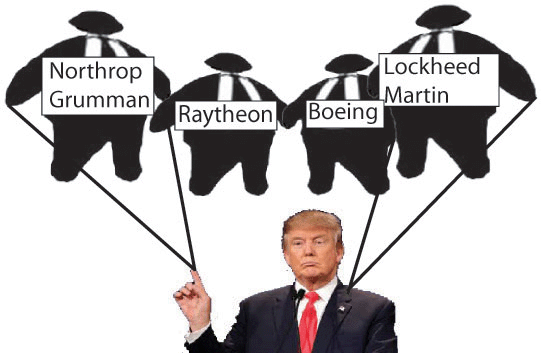
That action includes investing in ground and sea-based missile defenses with more interceptors, new kill vehicles, and improved coverage of priority regions like the Indo-Pacific. Shanahan, a former Boeing senior vice president of supply chain and operations, said, “We are focused on new capabilities for new threats,” referring to hypersonic weapons, space-based sensors and directed energy for boost phase missile intercept.
He went on to say the Missile Defense Review “includes a policy shift towards greater integration of offensive and defensive capabilities because missile defense necessarily includes missile offense” [italics added].
Cascading Crises
Today, with the speed of communications, an accident in judgment based on intentionally leaked or false information that spreads quickly through open sources like social media could easily create a situation that has cascading effects.
Jaclyn Kerr, an affiliate at Stanford University’s Center for International Security and Cooperation, expressed alarm about this risk while speaking to a group of journalists at the East-West Center, asking:
What if these effects have repercussions that cause catastrophe-type-level events that weren’t expected, like critical infrastructure damage — something was an implant in a network but it goes awry and leads to something actually failing and loss of life. But there’s no way to assess whether that was intentional or not, and that leads to a military attack in a different domain, conventional or otherwise, and it spirals out of control and nobody trusts the information coming from the other side because it’s an environment of disinformation.
She imagines new types of escalation dynamics not seen before.
For example, imagine a message sent in error (or intentionally) warning that New Delhi or Islamabad was moments away from a nuclear attack. The warning time for missiles launched between India and Pakistanwould be much shorter than the 20-30 minutes it would take for an ICBM to travel between Eurasia and North America.
Imagine a head of state who is irrational, impetuous and prone to making critical decisions based on cable television news and social media posts being “triggered” by a widely circulated (but unconfirmed) report of a spike in radiation coinciding with a seismic event in Ukraine, or an incident in the South China Sea, or the Taiwan Straits or the Baltic Sea. Or the Persian Gulf. Or Kashmir….
All of these scenarios and countless other mundane, but more likely events, such as a compromised weapons, energy, or other critical system, underscore the threats we face in 2019.
Faster, Smaller and More Complex
Andrew Futter, associate professor of International Politics at University of Leicester, looks at nuclear and conventional weapons and worries what could go wrong and how complexity can undermine safety.
“It worries me when I hear about modernization programs … the comingling of nuclear and conventional weapons,” Futter said, warning about the outcomes of technology driving human behavior, rather than the opposite. “Just because we can build things, doesn’t necessarily mean we should,” he said.
Most nuclear weapons states, Futter noted, prioritize being able to usethe weapons over keeping them safe, and with weapons on a permanent state of high alert and closely linked to warning systems, it creates a context where accidents may occur.
“We’re living in a nuclear climate where we have less and less time to do most things and we still have a lot of systems that are very tightly coupled between warning and use,” Futter said.
The January 2018 Hawaii ballistic missile scare, Futter contends, was merely a continuation of something that has gone on for a long time, citing a history of nuclear scares. The difference was, he suggested, that today identifying and diagnosing errors with potentially catastrophic results requires doing so in much smaller, more complex, faster-moving digitized systems.
This growth of newer, faster, more complicated systems, the modernization of nuclear and conventional weapons, and the deterioration of arms-control treaties like the INF, stand in sharp contrast to the low level of awareness of the threats by the American public, which is largely ignorant about nuclear issues, according to Alex Wellerstein, a historian of science at the Stevens Institute of Technology.
Wellerstein, creator of the popular Nuke Map, an online authoritative tool that offers a visual simulation of how a nuclear detonations of varying sizes would impact anywhere in the world, said, “Americans’ perceptions of nuclear threats have just been continuously going down.” One reason for this, he suggested, is a lack of nuclear weapons coverage outside of specialized news sources other than in times of crisis.
“There are a lot of nuclear threats out there. They don’t just occur during crisis periods and yet, the American approach to these things in the general public is, ‘Oh my god, crisis period — I care about it!” followed immediately by, “Oh good, we don’t have to think about it anymore again (until the next crisis period),” he said.
Others have expressed similar concerns, noting the lack of inclusion of nuclear weapons-related issues in American public education and the media.
Wellerstein pointed out that, owing in part to a decades-old aura of secrecy surrounding nuclear weapons, many people have a sense they aren’t well-informed on nuclear issues, with some Americans admitting they deliberately avoid nuclear weapons-related news.
In a world where nuclear issues are rapidly evolving, Wellerstein said he expects that “in a few years people are going to be in a whole new world without realizing it, and I think it’s going to be a rude shock when that finally hits home.”
Mourning Armageddon
In Hawaii, where the January 13, 2018, ballistic missile warning scare is still fresh in people’s minds, many recalled the event on the one-year anniversary, but quickly turned their attention elsewhere. One Oahu resident, a musician named Makana, saw the false alarm as an opportunity to reflect on the broader threat of nuclear war. While on a goodwill tour to Russia last October, he performed in school, clubs and elsewhere in Moscow and St. Petersburg.
During the tour he attended a meeting at the Russian Diplomatic Academy of the Russian Foreign Ministry just as Trump was announcing plans to withdraw from the INF treaty. Makana recalled one Russian general thundering, “End of INF treaty! This is very bad!” Recounting the incident, Makana described how, in his own naiveté, he replied, “I have an idea. We should make a BFF treaty,” to which Russians who understood the reference (“Best Friends Forever”) broke into laughter.
On the same visit, Makana visited a recently declassified Russian foreign ministry nuclear bunker. One hundred sixty feet below central Moscow, the bomb shelter was dark and eerie but, Makana noticed, had excellent acoustics.
On the spot, the musician created and recorded a song about the threat of nuclear war, releasing it as a video entitled Mourning Armageddon on the anniversary of the Hawaii missile alert scare.
At the end of the video, Makana cranks a hand-held air raid siren in the dim light. Pausing, he surveys the grim, tomb-like surroundings, breathes a heavy sigh, and says, “It’s a time machine to a place I hope never materializes.”