PSEG spokesman Joseph Delmar Sr. says the utility company’s Salem Unit 2 reactor was manually taken offline by control room operators early Thursday morning at 3:01 a.m. due to frazil icing conditions at the circulating water intake structure on the non-nuclear side of the power plant. ………Chris Franklin can be reached at cfranklin@njadvancemedia.com. Follow him on Twitter @cfranklinnews or on Facebook. Have a tip? Tell us. nj.com/tips. https://www.nj.com/salem/2019/02/its-so-cold-even-a-nuclear-reactor-in-nj-cant-do-its-job.html
Is Vogtle nuclear station expansion now further behind schedule? Report is delayed?
 Proposed deal would delay report on Georgia nuclear plant The News and Observer, THE ASSOCIATED PRESS, FEBRUARY 02, 2019 ATLANTA
Georgia utility regulators are being asked to delay a Georgia Power report showing whether the Plant Vogtle nuclear expansion has fallen further behind schedule.
Additional construction delays would increase the project’s costs — and that could lead to higher power bills for many Georgians, The Atlanta Journal-Constitution reported.
Some consumer and environmental groups are objecting to any delay in updates.
“The company and the project do not deserve this break in scrutiny at this critical time,” Sara Barczak, a director for the Southern Alliance for Clean Energy, wrote in an emailed statement to the Journal-Constitution.
“The ratepayers do not deserve this extended period of a lack of protection and transparency as their exposure potentially increases by more than a billion dollars,” Barczak said.
The delay also means the company won’t make its latest disclosure while the state legislature is in session, said Liz Coyle, the executive director of Georgia Watch.
“There is a lack of transparency in what is happening with schedule and budget at a time when the legislature could take some action,” Coyle said.
Georgia Power denied the move is an intentional effort to avoid the legislative session……….https://www.newsobserver.com/news/business/article225448705.html
USA’ s EPA appoints a radiation sceptic to head the panel on radiation
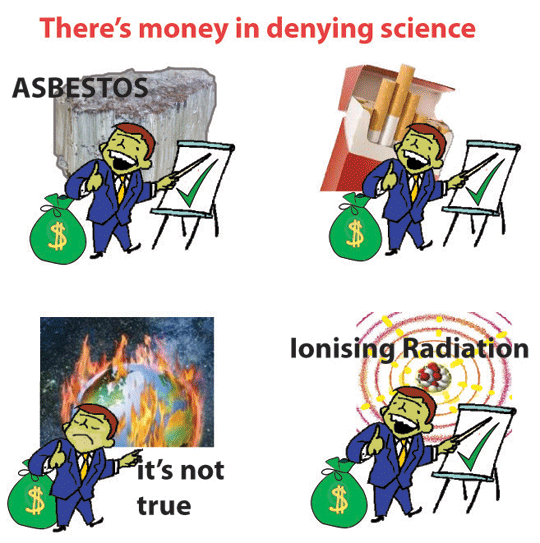
Skeptic on radiation limits will head EPA radiation panel, https://www.kwch.com/content/news/Skeptic-on-radiation-limits-will-head-EPA-radiation-panel-505198021.html By ELLEN KNICKMEYER, Associated Press 1 Feb 19, WASHINGTON (AP) — The Environmental Protection Agency has appointed a scientist who argues for easing regulations on lower-level radiation exposures to lead the agency’s radiation advisory committee.
Acting EPA head Andrew Wheeler on Thursday announced the appointment of Brant Ulsh, a health physicist, as one of the EPA’s science advisers and the panel chairman. Ulsh has been a leading critic of the EPA’s decades-old position that exposure to any amount of ionizing radiation is a cancer risk.
In a paper he co-wrote last year, Ulsh and a colleague argued that the position was based on outdated scientific information and forced the “unnecessary burdens of costly clean-ups” on facilities working with radiation.
The EPA under President Donald Trump has targeted a range of environmental protections, in line with Trump’s arguments that overly strict environmental rules have hurt U.S. businesses. Environmental and public health advocates say the rollbacks threaten the health and safety of Americans.
Some environmental groups and scientists have criticized what they say is the administration’s openness to an outlier position on radiation risks.
“Once again the Trump administration is moving to the fringe for its scientific advice, choosing someone who could undercut foundational protections from radiation,” Bemnet Alemayehu, a staff scientist at the Natural Resources Defense Council environmental advocacy group, said in a statement Friday. “We need sound science to dictate health protections, not dangerous theories.”
EPA spokesman John Konkus declined comment Friday, referring a reporter to a news release announcing the appointment.
Ulsh did not immediately respond to an email Friday asking for comment, including whether he intended to use the advisory position to encourage reconsideration of the EPA’s no-tolerance policy on lower doses of radiation exposure.
Last year, Ulsh told The Associated Press that “we spend an enormous effort trying to minimize low doses” at nuclear power plants, for example.
“Instead, let’s spend the resources on minimizing the effect of a really big event,” he said.
U.S. agencies have long maintained there is no threshold of radiation exposure that is risk-free.
The National Council on Radiation Protection and Measurements reaffirmed that last year after reviewing 29 public health studies on cancer rates among people exposed to low-dose radiation.
The EPA last year proposed a rule that would have instructed regulators to consider “models across the exposure range” when it comes to dangerous substances.
Environmental groups and some scientists expressed concern then that the directive could open the way for an agency retreat from its long-standing no-tolerance rule for ionizing radiation exposure. But the proposed rule did not mention radiation, and EPA officials denied it would have applied to radiation. It said the agency still follows its no-tolerance guidelines.
But the EPA’s proposal last year did specify consideration of a particular scientific model, called the U curve, put forward by Edward Calabrese, a toxicologist and leading proponent of the theory that exposure to radiation and other hazardous substances can actually be healthy at low doses
The EPA’s initial news release on the rule last April quoted Calabrese as praising the proposal, calling it a “major scientific step forward” in assessing the risks of “chemicals and radiation.”
EPA calendars obtained through the Freedom of Information Act show an appointment between Calabrese and EPA chief of staff Ryan Jackson on June 28, 2017, early in the tenure of Scott Pruitt, Wheeler’s predecessor.
Donald Trump confirms US withdrawal from INF nuclear treaty
 Guardian, Julian Borger, World affairs editor, Sat 2 Feb 2019
Announcement gives Russia 180 days to destroy violating missiles and launchers to avoid new arms race Donald Trump has confirmed that the US is leaving the Intermediate-range Nuclear Forces (INF) treaty, saying “we will move forward with developing our own military response options” to Russia’s suspect missile.In a written statement, Trump said that the US would be suspending its compliance with the 1987 treaty on Saturday, and would serve formal notice that it would withdraw altogether in six months.
He left the door open to the treaty being salvaged in that 180-day window, but only if Russia destroys all of its violating missiles, launchers and associated equipment. Since 2013, the US has alleged that Russia has developed a new ground-launched cruise missile which violated the INF prohibition of missiles with ranges between 500km and 5,500km.
Russia for several years denied the missile existed but has more recently acknowledged its existence, saying its range does not violate INF limits.
“This is in reality, under international law, Russia’s final chance,” a senior administration official said. “If there is to be an arms race, it is Russia that has undermined the global security architecture.”
In his statement, Trump warned that unless Russia destroyed its missile by August: “We will move forward with developing our own military response options and will work with Nato and our other allies and partners to deny Russia any military advantage from its unlawful conduct.”
Washington’s European allies have been anxious that the death of the INF treaty would lead to a return to the tense days of the 1980s, and an arms race involving short- and medium-range missiles on European soil………
, neither the Trump nor Pompeo gave any indication whether the administration would agree to extend the 2010 New Start treaty, the last remaining arms control agreement constraining the arsenals of the two major nuclear weapons powers.
Both the US and Russia have abided by the New Start limit of 1,550 deployed, strategic nuclear warheads, but the treaty expires in 2021, leaving little time to negotiate a five-year extension.
Alexandra Bell, a former state department arms control official and senior policy director at the Centre for Arms Control and Non-Proliferation, said: “New Start is working, it’s good for American national security and this administration is putting global security at risk by foot-dragging on extension.” https://www.theguardian.com/world/2019/feb/01/inf-donald-trump-confirms-us-withdrawal-nuclear-treaty
New Jersey nuclear reactor shut down due to extreme cold weather
 It’s so cold, even a nuclear reactor in N.J. can’t do its job,Feb 1, By Chris Franklin | For NJ.com
Nevada State Officials Are Outraged that the Trump Administration Secretly Shipped Plutonium in from South Carolina
“They lied to the State of Nevada, misled a federal court, and jeopardized the safety of Nevada’s families and environment,” Governor Sisolak said. Nevada officials say they are “outraged” by the Trump administration’s “reckless decision” to secretly ship 1,100 pounds of weapons-grade plutonium to a site north of Las Vegas, against the express wishes of state representatives.
Governor Steve Sisolak called the move an “unacceptable deception” that exposed the “sham” of the state’s ongoing negotiations with the Department of Energy (DOE) over the transfer of plutonium from South Carolina. Nevada Senator Jacky Rosen called the decision “deceitful and unethical” and said it jeopardized “the health and safety of thousands of Nevadans and Americans who live in close proximity to shipment routes,” according to The New York Times.
A federal judge ordered the transfer in 2017, but the move was challenged in court when Nevada sued the federal government to block it last November. Unbeknownst to Nevada officials, the DOE had already shipped the plutonium to Nevada, according to legal filings released Wednesday. Nevada officials were not notified because the transfer was classified due to its implications for national security, the DOE said.
“Although the precise date that this occurred cannot be revealed for reasons of operational security, it can be stated that this was done before November 2018, prior to the initiation of the litigation,” said Bruce Diamond, general counsel for the DOE’s National Nuclear Security Administration, in the filing.
The plutonium is being held at the Nevada National Security Site near Yucca Mountain, in the complex’s Device Assembly Facility (DAF).
This region has a rich tradition of anti-nuclear activism: Public figures like astronomer Carl Sagan and actor Martin Sheen were among the thousands of people arrested at the height of the local protest movement in the late 1980s and early 1990s.
Decades later, there is strong bipartisan opposition in Nevada to any expansion of the site’s role as a repository for spent nuclear material. In 2009, President Obama backed off of long-term plans to develop storage capabilities at Yucca Mountain. The Trump administration signaled its intention to reverse that decision last year by including $120 million in the DOE budget to prepare for new shipments.
Nevada’s November lawsuit against the transfer is now regarded as moot by the US Justice Department, the Associated Press reported, and the plutonium may remain at the DAF for nearly a decade before another planned transfer to New Mexico.
Despite assurances from the DOE that there will be no other imminent shipments, the state’s elected officials argue the lack of transparency over the move demands new preventative measures. Governor Sisolak said the state is pursuing “any and all legal remedies” against the federal government, including contempt of court orders.
“They lied to the State of Nevada, misled a federal court, and jeopardized the safety of Nevada’s families and environment,” Sisolak said in a statement. “My administration is working with our federal delegation, and we will use the full force of every legal tool available to fight back against the federal government’s reckless disregard for the safety of our state.”
Correction: An earlier version of this article referred to the plutonium shipment as nuclear waste. It does not far under that definition according to the DOE. The article has been updated to reflect this.
Dismantling process of pioneer nuclear station – it’s still dangerous
How do you dismantle a nuclear power plant? Very, very carefully. Before they can break apart this historic Army facility, they have to make sure it’s not radioactive, WP, By Michael E. Ruane, Behind the locked gates of Building 372 at Fort Belvoir in Virginia, past the door to the huge containment vessel where a sign warns of radiation, a large button on the control panel is covered in red plastic and reads: “manual scram.”
This is the emergency shutdown button, which nuclear legend says was pushed when it was time to scram.
But these days, the dark interior of the Army’s historic nuclear reactor, once called an “atomic-age miracle machine,” is a maze of rusted pipes, peeling paint and pressure gauges reading zero.
Keys in the control panel haven’t been turned in years, and switches are set to “off.”
The world’s first nuclear plant to supply energy to a power grid has been defunct for years. But the Army is preparing to break it up, check it for lingering radiation and haul it away piece by piece.
Dedicated in 1957, as the government was promoting “Atoms for Peace,” the facility was a training site and a prototype for small reactors that could produce power for bases in remote places around the world, the Army said. Built on the Potomac River’s Gunston Cove, it was called the SM-1, for stationary medium power plant No. 1.
“First nuclear power plant ever to put power on a grid, ever in the world,” said Hans B. Honerlah, a senior health physicist with the Army Corps of Engineers’ hazardous, toxic and radioactive waste branch.
The SM-1 trained hundreds of nuclear plant specialists before it was shut down in 1973. By then, the military’s need for such expensive plants had dwindled, said Charles Harmon, a former shift supervisor at the facility and an unofficial historian of the site. “The cost of the Vietnam War was making funds scarce,” Harmon said.
The plant’s uranium-235 fuel and reactor waste were removed in 1973 and ’74 and taken to a storage site in South Carolina. The 64-foot-high concrete-and-steel containment vessel that housed the smaller reactor vessel and other equipment was sealed.
But all these years later, there still is likely residual nuclear contamination of some of the internal structures, Army experts said.
[An atomic town revels in its plutonium past as tunnel collapse raises contamination concerns]
Before the site is torn down, experts will check everything for radiation and look for any impacts to the environment and historical record.
Honerlah said at Fort Belvoir earlier this month: “It’d be great to make it a museum, but it’s always going to be radioactive.
“It has to go away. It’s never going to not be radioactive. The goal . . . is to take the remaining radioactive components, remove them from the . . . facility here and take them” to a nuclear waste site, probably in western Texas………
Corps of Engineer officials said they hope to start the process next year. They said it would probably take five years to finish. “These facilities were really not built to be taken apart,” Barber said.
‘Atoms for Peace’
In 1954, the SM-1 was described by The Washington Post as a miracle machine that could provide power anywhere in the world……
Years before the nuclear plant disasters at Three Mile Island in 1979, Chernobyl in the Ukraine in 1986, and Fukushima in Japan in 2011, hopes were that nuclear power could be clean and safe. ……https://www.washingtonpost.com/history/2019/02/01/how-do-you-dismantle-nuclear-power-plant-very-very-carefully/?utm_term=.5704ad3cf0b4
Employee faked radiation test data at Swiss nuclear plant
https://www.swissinfo.ch/eng/safety-protocols_employee-faked-radiation-test-data-at-swiss-nuclear-plant/44723344T JANUARY 31, 2019 2:43 PMJAN 31, 2019 A worker at the Leibstadt nuclear power plant near Zurich was found to have fabricated data on safety tests that were not even performed. The authorities claim this did not affect the safe operation of the plant.
The employee concerned failed to perform biannual tests on three mobile radiation measuring devices since 2016. The devices need to be tested to ensure they function properly. Instead, the worker entered fabricated data into the inspection logs.
The devices in question are used to measure radiation from containers for radioactive fuel before they are transported to an interim storage facility at another location. Once at the interim storage facility, the radiation levels of the containers are measured again.
According to the Swiss Federal Nuclear Safety Inspectorate (SFNSI)external link, no significant differences in radiation levels were observed between the plant and the interim storage facility, indicating that the error did not pose a threat to safety. Personnel transporting the radioactive fuel did not show any unexpected level of exposure.
Axpo, the company that operates and owns the plant, will have to submit a detail report SFNSI by February and the latter will make the final conclusions public. A review of other inspection protocols will later be conducted by an independent body.
“Unfortunately, this case is not an isolated one. It is part of a series of incidents at the Leibstadt power plant linked to human error,” said Georg Schwarz, deputy director of SFNSI in a statement on Wednesday. “Steps must now be taken to sustainably improve the safety culture at this facility.”
SFNSI already conducts around a 100 announced and unannounced inspection of the plant every year. This number is expected to increase significantly in the current year.
Judge refuses to unseal criminal charges against Assange
January 31, 2019 FALLS CHURCH, Va. (AP) — A federal judge on Wednesday rejected a request to unseal criminal charges against Wikileaks founder Julian Assange that were mistakenly revealed in another case.
U.S. District Judge Leonie Brinkema said in a 10-page ruling that free-press advocates seeking to unseal the charges have no proof Assange has actually been charged.
The Reporters Committee for the Freedom of the Press sought to unseal the charges after a federal prosecutor inadvertently typed a reference to “the fact that Assange has been charged” in an unrelated case.
The government has acknowledged it made an error but has not publicly confirmed that charges against Assange have been filed.
After the mistake was made, news outlets including The Associated Press reported that Assange has indeed been charged. But those reports relied on anonymous sources.
The precise charges against Assange are unclear. The Wikileaks founder has been staying in the Ecuadorian Embassy in London since 2012 under a grant of asylum and has long expressed fear of a U.S. prosecution. WikiLeaks has served as a vehicle for release of thousands of classified U.S. military and diplomatic cables. In addition, WikiLeaks’ role in releasing emails hacked from the Democratic National Committee in 2016 has also been under scrutiny as special counsel Robert Mueller has investigated Russian interference in the 2016 election and whether the Trump campaign was involved.
Criminal charges typically remain secret and under seal until a defendant has been arrested to prevent a target from fleeing prosecution or destroying evidence. Lawyers for the free-press foundation said that rationale for secrecy no longer exists given the inadvertent disclosure and the fact that Assange has long assumed he has been charged.
Brinkema, though, wrote in her ruling that the Reporters Committee “has not demonstrated with sufficient certainty that Assange has been charged. Unlike in other high-profile cases, the Government has not affirmatively disclosed that charges have been filed. Although the Government acknowledges that it made a mistake … the nature of that mistake is fundamentally unclear.”
Katie Townsend, a lawyer for the Reporters Committee, said no decision has been made on whether to appeal. “The disclosure of the nature of the charges against Assange are a matter of public interest and should be made public,” she said.
Clean-up of molten salt nuclear reactor continuing – new plan to reduce the costs
Crews start project to reduce maintenance, operations costs at Molten Salt Reactor, Oak Ridge Today, JANUARY 22, 2019, BY JOHN HUOTARI Cleanup crews started a $4.7 million project this month to reduce maintenance and operations costs at the Molten Salt Reactor Experiment, which was shut down 50 years ago at Oak Ridge National Laboratory.The project is expected to save nearly $25 million in costs, the U.S. Department of Energy Office of Environmental Management said in an “EM Update” published Tuesday.
The cost-reduction project will relocate employees stationed at the decades-old facility. Personnel currently housed in the building will move to other site locations to help with other projects, the “EM Update” said……..
The Molten Salt Reactor Experiment operated for only four years in the 1960s, …….
Oak Ridge Today reported in November 2017 that DOE was, at the time, studying whether to entomb parts of the Molten Salt Reactor Experiment. Those parts were reported to be too radioactively “hot” for humans. The current status of the entombment proposal wasn’t immediately clear Tuesday evening.
In 2017, Jay Mullis, manager of the Oak Ridge Office of Environmental Management, said most of the fuel at the Molten Salt Reactor Experiment, a unique reactor that operated from June 1965 to December 1969, was removed about 10 years ago. That included uranium, plutonium, and some uranium-233.
Oak Ridge Today reported at that time that some residual fuel and fission products remained, including cesium and strontium.
The Oak Ridge Office of Environmental Management has previously estimated the cost of removing the salt from the Molten Salt Reactor Experiment and disposing of it at the Waste Isolation Pilot Plant in New Mexico at between $150 million to $200 million. It’s not clear if that estimate has changed.
In the meantime, several million dollars has been spent each year on surveillance and maintenance at the Molten Salt Reactor Experiment and liquid and gaseous waste operations at ORNL, including at what are known as “hot cells,” and costs were expected to increase. Federal officials had asked for $12 million for those surveillance and maintenance operations in fiscal year 2019, the current fiscal year. Oak Ridge Today did not immediately have information on Tuesday about what amount was actually appropriated.
In 2017, Mullis said the Molten Salt Reactor Experiment, which had a control room and reactor room, is degrading…….https://oakridgetoday.com/2019/01/22/crews-start-project-reduce-maintenance-operations-costs-molten-salt-reactor/
Low-flying choppers monitoring radiation in Atlanta (fears of nuclear terrorism?)
Low-flying choppers monitoring radiation https://wtkr.com/2019/01/27/low-flying-choppers-monitoring-radiation/JANUARY 27, 2019, BY CNN WIRE ATLANTA, GA (WGCL) – If you’re in downtown Atlanta or around Buckhead for the Super Bowl Experience or regular business, you might see some low-flying helicopters over the area.
The choppers are from the U.S. Department of Energy and are serving a specific purpose.
The Department of Energy’s National Nuclear Security Administration, or NNSA, is conducting the low-altitude flights as part of security operations for Super Bowl LIII. The choppers will measure naturally occurring background radiation, according to the NNSA.
The measurement of naturally occurring radiation will establish baseline levels and is considered a normal part of security and emergency preparedness, according to the NNSA. The agency said it was making the public aware of the flights to avoid any panic or alarm.
The helicopters, Bell 412 choppers, will fly in a grid pattern over the areas at 150 feet or higher at a speed of approximately 80 miles per hour, according to the Department of Energy. Flyovers will occur only during daylight hours and should take roughly three hours to complete per area scanned.
Washtenaw County’s preparations – in the event of a nuclear disaster
Here’s what could happen in a nuclear disaster in Washtenaw County, By Ryan Stanton | ryanstanton@mlive.com ANN ARBOR, MI , 1 Feb 19, – As Ann Arbor considers calling on the state and federal governments to better prepare for nuclear disaster, county officials note there already are some emergency plans in place.
Washtenaw County does not stockpile potassium iodide as some city officials are calling for in a proposed resolution, said Dave Halteman, the county’s emergency services director.
But in the event of an incident such as a meltdown at the Fermi 2 nuclear power plant in southeast Michigan, the county would reach out to the state’s Emergency Operations Center to initiate access to a national pharmaceutical stockpile through the Centers for Disease Control and Prevention.
“This plan has been in place for many years and the CDC stockpiles these pharmaceuticals in strategic locations all over the country,” Halteman said.
“However, given the potential time lapse in getting access to the national stockpile, I will continue to monitor Ann Arbor’s initiative to see how it might work on a county level.”
City Council will consider a resolution Monday, Feb. 4 calling for strengthening local emergency planning by stockpiling nonprescription potassium iodide in communities within 50 miles of the Fermi 2 plant, which is roughly 30 miles from Ann Arbor along Lake Erie.
The resolution would direct the city’s lobbying team to advocate to the state and U.S. Nuclear Regulatory Commission to provide the same level of KI protection to residents here as Canadian authorities provide to Ontario residents within 50 miles of the Fermi 2 plant.
The American Thyroid Association has called for pre-distribution of potassium iodide, also known as KI, to households within a 10-mile radius of nuclear power plants such as Fermi 2, and stockpiling it in public facilities such as schools, hospitals, clinics, post offices and police and fire stations in up to a 50-mile radius.
Timely ingestion of KI can reduce the effects of radiation and help prevent thyroid cancer in the event of a nuclear fallout, notes the resolution sponsored by Council Members Anne Bannister, D-1st Ward, and Chip Smith, D-5th Ward.
Without a local stockpile, it could take eight to 12 hours for CDC supplies to arrive, depending on the event, said Cindra James, the county’s public health preparedness administrator.
In some cases, it could be sooner based on local supplies, James said, noting the federal government has caches stockpiled “at various unknown locations that we aren’t privy to,” but those supplies can be accessed depending on need.
As far as potential evacuation of the county if there was a nuclear disaster, there’s no specific plan, but the county would coordinate with the state police and local law enforcement to close roads leading toward any hazard and redirect traffic away from the affected area, Halteman said.
The county’s outdoor warning sirens also would be activated followed by an emergency alert system message to inform the public via the media of the hazard and what actions to take, he said.
“We would also reach out to our transportation partners here in Washtenaw County to assist moving those without transportation,” he said, noting that could include the Ann Arbor Area Transportation Authority and local school bus systems.
“Certainly the response would be scaled up or down to accommodate the size of the evacuation area,” Halteman said…….. https://www.mlive.com/news/ann-arbor/2019/02/heres-what-could-happen-in-a-nuclear-disaster-in-washtenaw-county.html
Rapidly climbing costs to USA tax-payers for nuclear waste cleanup – rose by $100 billion in one year!
America’s Chernobyl’: Inside The Most Toxic Place In The Nation | TODAY
Cost to taxpayers to clean up nuclear waste jumps $100 billion in a year https://www.nbcnews.com/news/all/cost-taxpayers-clean-nuclear-waste-jumps-100-billion-year-n963586 , 30 Jan 19, An Energy Department report shows the projected cost for long-term nuclear waste cleanup overseen by DOE jumped $100 billion in just one year. Jan. 29, 2019, By Laura Strickler, WASHINGTON — The estimated cost of cleaning up America’s nuclear waste has jumped more than $100 billion in just one year, according to a DOE report — and a watchdog warns the cost may climb still higher.
The Energy Department’s projected cost for cleanup jumped from $383.78 billion in 2017 to $493.96 billion in a financial report issued in December 2018.
A government watchdog and DOE expert said the new total may still underestimate the full cost of cleanup, which is expected to last another 50 years. “We believe the number is growing and we believe the number is understated,” said David Trimble, director of the Government Accountability Office’s Natural Resources and Environment team.
The cost was calculated by the accounting firm KPMG under contract to DOE.
Eighty percent of the increase comes from new projections of the costs of cleaning up radioactive waste and hazardous chemicals at the Hanford site in southeastern Washington.
The 586-square-mile site, home to nine former production reactors and processing facilities, produced plutonium for America’s nuclear arsenal during the Cold War.
Cleaning up Hanford has already cost taxpayers $170 billion over 30 years, but government auditors say the most challenging parts of the clean-up work are yet to be done.
Still not cleaned up are 56 million gallons of what the DOE’s inspector general has described as “hazardous and highly radioactive waste.” The rise in projected cost is due to updated estimates for building and running a waste treatment plant, including “operating costs, tank farm retrieval and closure costs” at the site, according to the report. The report also refers to changes in “technical approach or scope” and “updated estimates of projected waste volumes.”
Trimble of the GAO believes the Energy Department “does not have a coherent strategic plan on how to address its cleanup mission.”
A spokesperson for the Energy Department said in an emailed statement that the office that oversees the cleanup is “committed to making progress on the ground at Hanford, and mitigating the years of escalating liabilities at the site.”
The spokesperson said DOE expects more cost increases “and is working with regulators and stakeholders on best options to treat and dispose of radioactive waste.”
Energy Secretary Rick Perry has proposed a reclassification of the radioactive waste at Hanford to make its disposal less expensive, a suggestion opposed by environmental groups in the Pacific Northwest.
In mid-December, DOE issued a financial report with a signed letter from U.S. Energy Department Secretary Rick Perry on the fourth page. Perry’s letter lists the agency’s accomplishments and describes the agency’s environmental cleanup activities. He cited the completion of an underground project at Hanford, but does not mention the projected increase in costs to taxpayers.
“PLAGUED WITH MISMANAGEMENT”
For decades, government auditors have raised serious concerns about the lack of clear goals for the site and long term problems with the cleanup.
A 2018 report from the DOE’s inspector general rolled up 38 investigations the IG had conducted on the environmental management efforts at Hanford.
The IG concluded Hanford has been “plagued with mismanagement, poor internal controls, and fraudulent activities, resulting in monetary impacts totalling hundreds of millions of dollars by the various contractors at the site.”
Bechtel, one of the large government contractors that manages site cleanup, was part of a group of contractors that paid a $125 million settlement in 2016, the largest settlement ever obtained by the agency’s inspector general.
The U.S. had alleged Bechtel improperly used federal taxpayer dollars to fund a multi-year lobbying effort in Congress to continue the funding of its contract.
Under the final settlement agreement, Bechtel National Inc. admitted no wrongdoing.
In response to the recent Energy Department report Bechtel spokesperson Fred deSousa notes that the waste treatment plant they are building in Hanford is “the most complex project of its kind in the world.” DeSousa also told NBC in his statement that the project has gone through multiple independent reviews resulting in changes to its contract. “Today the project is bigger, more robust, and has more stringent operating and safety margins,” he said.
The new Democratic chair of the House Energy and Commerce Committee says the committee will increase its oversight of Hanford.
“It is essential that DOE better manage and oversee its contractors to ensure that taxpayers, workers and the environment are being protected” said Rep. Frank Pallone, Jr., D-N.J. “The Committee will continue to have questions for DOE as to whether cleanup efforts at Hanford and other sites are being properly managed.”
Bill to prevent nuclear first strike without congressional approval introduced by U.S. Democrats
 Dems reintroduce bill to prevent nuclear first strike without congressional approval, https://thehill.com/policy/defense/427546-dem-lawmakers-reintroduce-bill-to-prevent-president-from-launching-nuclear
BY OWEN DAUGHERTY – 01/29/19 Rep. Ted Lieu (D-Calif.) and Sen. Ed Markey (D-Mass.) on Tuesday announced that they will reintroduce a bill that would stop the president from being able to launch a first strike nuclear attack without first having congressional approval.
At a press conference announcing the legislation, Lieu said the bill is needed because President Trump is “unpredictable and rash.”
“Trump’s brand is to be unpredictable and rash, which is exactly what you don’t want the person who possesses the nuclear football to be,” Lieu said, according to a press release. “We introduced this bill under the Obama administration but Trump’s presidency has highlighted just how scary it is that any president has the authority to launch a nuke without congressional consultation.”
The statement cited a Trump tweet from January 2018 that taunted North Korea over the size of his nuclear button.
“Will someone from his depleted and food starved regime please inform him that I too have a Nuclear Button, but it is a much bigger & more powerful one than his, and my Button works!” Trump wrote, referring to North Korean leader Kim Jong Un.
Markey added in the statement that no president “should have the power to launch a first use nuclear first strike absent such an attack without explicit Congressional approval.”
Lawmakers in the past, including Lieu and Markey, have introduced similar legislation, but it has stalled in Congress.
The legislation, called the Restricting First Use of Nuclear Weapons Act of 2019, will be introduced by Lieu in the House and Markey in the Senate.
New, powerful, submarine-launched nuclear weapon begins production in USA
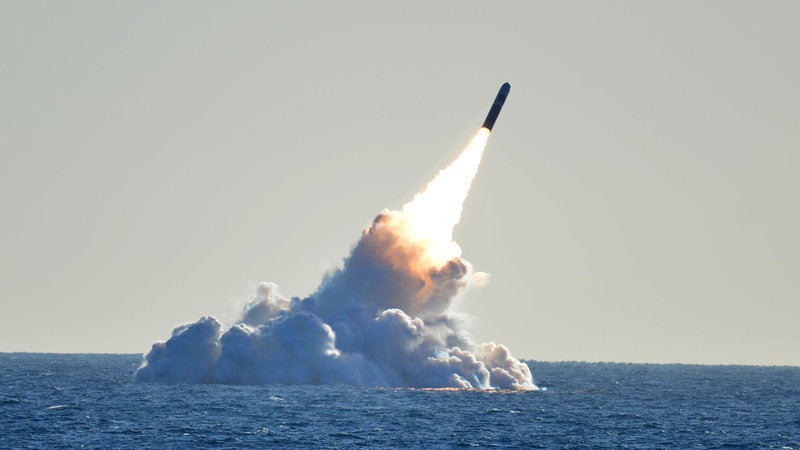
Trump Administration Begins Production Of A New Nuclear Weapon, NPR, January 28, 2019 “….The weapon is a variant of the Navy’s primary submarine-launched nuclear weapon, the W76-1. That warhead is a “strategic weapon,” meaning it makes a very big boom. The W76-1 is believed to have a yield of around 100 kilotons, according to Hans Kristensen, director of the nuclear information project at the Federation of American Scientists, an arms control advocacy group. By contrast, the bomb dropped on Hiroshima had a yield of about 15 kilotons.
1 This Month




PLEASE OPPOSE HR 8255 AND S.3639 – bills would accelerate satellite deployment, with no environmental review or safeguards – https://ncstd5li.quorum.us/campaign/169331/
To see nuclear-related stories in greater depth and intensity – go to https://nuclearinformation.wordpress.com
-
Archives
- September 2026 (339)
- August 2026 (330)
- July 2026 (355)
- June 2026 (287)
- May 2026 (306)
- April 2026 (356)
- March 2026 (251)
- February 2026 (267)
- January 2026 (308)
- December 2025 (358)
- November 2025 (359)
- October 2025 (375)
-
Categories
- 1
- 1 NUCLEAR ISSUES
- business and costs
- climate change
- culture and arts
- ENERGY
- environment
- health
- history
- indigenous issues
- Legal
- marketing of nuclear
- media
- opposition to nuclear
- PERSONAL STORIES
- politics
- politics international
- Religion and ethics
- safety
- secrets,lies and civil liberties
- spinbuster
- technology
- Uranium
- wastes
- weapons and war
- Women
- 2 WORLD
- ACTION
- AFRICA
- Atrocities
- AUSTRALIA
- Christina's notes
- Christina's themes
- culture and arts
- Events
- Fuk 2022
- Fuk 2023
- Fukushima 2017
- Fukushima 2018
- fukushima 2019
- Fukushima 2020
- Fukushima 2021
- general
- global warming
- Humour (God we need it)
- Nuclear
- RARE EARTHS
- Reference
- resources – print
- Resources -audiovicual
- Weekly Newsletter
- World
- World Nuclear
- YouTube
-
RSS
Entries RSS
Comments RSS

