Here’s how many billions the US will spend on nuclear weapons over the next decade, Defense News
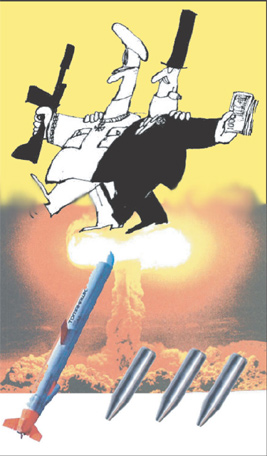
By: Aaron Mehta 26 Jan 19, WASHINGTON — If the U.S. carries out all of its plans for modernizing and maintainingthe nuclear arsenal, it will cost $494 billion over the next decade, an average of just less than $50 billion per year, a new government estimate has found.
The number, part of a biannual estimate put out by the Congressional Budget Office, is 23 percent over the previous estimate of $400 billion released in 2017. That 2017 figure was a 15 percent increase over the 2015 number.
$115 million nuclear contract draws scrutiny on Perry, Houston Chronicle, By James Osborne , January 25, 2019WASHINGTON— Energy Secretary Rick Perry’s decision to award a $115 million no-bid contract to develop an advanced nuclear enrichment facility in Ohio is drawing scrutiny from Senate Republicans.
The Department of Energy said this month it would award the contract to Centrus Energy, a former government-owned contractor that ceased enrichment operations in 2013 before declaring Chapter 11 bankruptcy.
In a letter to Perry this week, Sen. John Barrasso, R-Wyo., chairman of the Senate Environment and Public Works Committee, said the company had a Ohio is drawing scrutiny from Senate Republicans.The Department of Energy said this month it would award the contract to Centrus Energy, a former government-owned contractor that ceased enrichment operations in 2013 before declaring Chapter 11 bankruptcy
In a letter to Perry this week, Sen. John Barrasso, R-Wyo., chairman of the Senate Environment and Public Works Committee, said the company had a mixed history in fulfilling federal contracts for nuclear fuel and questioned whether the money it received would end up supporting the Russian state-owned firm TENEX, from which Centrus buys enriched uranium.
“This contract appears to use American taxpayer funding to bailout Centrus, an unsuccessful business that relies on commercial relationships with Russian state-owned corporations to stay in business,” Barrasso wrote. “Congress did not authorize or fund this project.”
Professor says nuclear energy is safest, most practical energy source, Waste from lifetime of nuclear energy use in US would fit in soda can, professor said, The Badger Herald, by COURTNEY ERDMAN · Jan 24, 2019 University of Wisconsin hosted an international relations professor Thursday, who argued nuclear energy was the safest, most practical power source, and the best one to transition the world away from fossil fuels. ……. Goldstein recognized that many people are also afraid of nuclear waste and how to dispose of it, but their fears are also unfounded.“The actual waste would fit in a soda can if you used your whole lifetime of American-style electricity from nuclear power,” Goldstein said. …….https://badgerherald.com/news/2019/01/24/professor-says-nuclear-energy-is-safest-most-practical-energy-source/
Environmentalists and nuclear watchdog groups are lining up against plans to build a $2.4 billion storage facility in southeastern New Mexico for spent nuclear fuel from commercial reactors around the United States., Jan. 23, 2019 BY SUSAN MONTOYA BRYAN, Associated Press, ALBUQUERQUE, N.M. (AP) — Environmentalists and nuclear watchdog groups are lining up against plans to build a $2.4 billion storage facility in southeastern New Mexico for spent nuclear fuel from commercial reactors around the United States.
Attorneys for the groups are scheduled Wednesday to make oral arguments before a panel with the U.S. Nuclear Regulatory Commission during a hearing in Albuquerque.
The panel will determine which groups have standing and which objections will be considered as part of the case.
New Jersey-based Holtec International has applied for a license to construct the facility about 35 miles (56 kilometers) east of Carlsbad. It would be capable of storing as much as 120,000 metric tons of high-level radioactive waste.
Opponents have concerns about the project’s legality, the safety of transporting the fuel across the country and potential environmental effects.
Does America Still Need the Nuclear Triad? The U.S. can deliver nuclear weapons from air, land, and sea. That could change.Jan 24, 2019 Popular Mechanics, By Kyle Mizokami
“……..Because the U.S. can launch nukes from the air, land, or sea, it would be practically impossible for another country to knock out America’s offensive capabilities and prevent the counterstrike.
The U.S. is currently working on replacing all three legs of the triad: bombers, intercontinental ballistic missiles, and submarine-launched missiles. It’s an overhaul that will cost hundreds of billions of dollars, and no doubt overshoot the Pentagon’s price estimates when all is said and done. But before we spend all that money, one must look around and ask the question: Is this still the best way? In the 21st century, does America really need three ways to launch nukes?………
During the Cold War, each arm of the triad justified its existence by doing something better than the other two. Strategic heavy bombers such as today’s B-2 Spirit and the longstanding B-52H Stratofortress could carry many nuclear bombs and strike multiple geographically distinct targets ……..
Intercontinental ballistic missiles (ICBMs) loft nuclear warheads into space on ballistic trajectories. They are buried by the hundreds in underground concrete silos scattered across America……
The third arm of the triad was nuclear-powered submarines carrying their own nuclear-tipped ballistic missiles……
But as the second decade of the 21st century draws to a close, the nuclear triad is showing its age. The B-2 Spirit bomber was introduced in the 1990s, while the B-52H has been flying since the early 1960s and may keep working for decades to come. The Minuteman III ICBM was first deployed in the early 1970s. The U.S. Navy’s Ohio-class ballistic missile submarines date to the 1980s and 1990s.
After decades of pushing back plans to replace all three arms, the U.S. is now faced with a situation where it needs to replace all three at once. The new B-21 Raider bomber, which will replace the B-2 bomber, will cost an estimated $97 billion dollars. The new ICBM, Ground Based Strategic Deterrent (GBSD), will cost around $100 billion. Finally, new ballistic missile submarines will cost $128 billion.
That adds up to a serious bill. The cost is about the equivalent of running the entire U.S. Armed Forces for five months. And the price tag could rise substantially if any of the programs run into expensive technical problems. If history is any guide, then at least one of them will.
Could the U.S. thrive in 21st century without a nuclear triad? To see a possible way forward, just look at the emerging colossus of China. The world’s most populous nation is building more aircraft carriers, more amphibious ships, and more modern combat aircraft than ever before. What China is not doing is significantly expanding its nuclear arsenal.
China has approximately 280 nuclear weapons, a number we can deduce from the amount of fissile material it has produced. That total represents about one sixth the number of deployed U.S. and Russian nuclear weapons. China’s nukes are spread between land-based ballistic missiles and submarine-launched missiles. It has no air-delivered nuclear weapons for its modest bomber force. In other words, China has a diad.
China is a “no first use” country, meaning it has vowed to never use nuclear weapons first. It also bother with advanced nuclear technologies such as anti-ballistic missile systems or placing multiple warheads on a single missile. Why not? China’s entire nuclear philosophy boils down to this: The country may very well be destroyed by a surprise nuclear attack, but enough Chinese nuclear weapons will survive to make the attack simply not worth it.
Essentially, China’s nuclear doctrine is assured destruction, but stripped of unnecessary complexities. China doesn’t lose any sleep over Russia or America’s overwhelming advantage in nuclear arms. As long as China can hit back and nuke at least a handful of American (or Russian) cities, the balance of terror remains.
Does China’s nuclear posture work? Even a strike against tiny North Korea runs the risk of a nuclear counterstrike by China, and the loss of just one American city would be a catastrophe.
……. it’s hard to ignore the stripped-down logic of the Chinese model, which says the only credibility necessary is the ability to strike back after an attack—the rest is just overthinking the issue.
If that’s truly the case, then what use is a triad? Could the U.S. get rid of one or two arms of the triad, spending that money elsewhere in the defense budget to enhance conventional capabilities?
………Could the U.S. cut ICBMs and rely on a force of submarines and bombers, or submarines alone? These are important questions the American people need to ask before spending $300 billion replicating the weapons of the Cold War. Perhaps the U.S. should stick with the nuclear triad—but at the very least, America needs a national conversation about what nuclear security means and how to achieve it. https://www.popularmechanics.com/military/weapons/a25983826/us-nuclear-triad/
My Turn: Martin Luther King’s quest to stop the nuclear arms race https://www.concordmonitor.com/KIngs-quest-to-stop-the-nuclear-arms-race-22786447By WILLIAM LAMBERS For the Monitor January 21, 2019, Civil rights champion Martin Luther King Jr. was also an activist for nuclear disarmament. Dr. King used his voice for peace during the Cold War nuclear arms race.
He can inspire us today to finish the journey of eliminating all nuclear weapons.
The year was 1958. The Soviet Union and the United States were developing and testing nukes at an alarming rate. In March, Dr. King received a letter from Norman Cousins and Clarence Pickett of the National Committee for a Sane Nuclear Policy. King was asked to support a statement urging an end to nuclear testing.
He joined the SANE movement right away. In April, Dr. King also signed an appeal by Protestant clergyman on halting nuke tests.
The public outcry against nuclear tests helped encourage President Dwight Eisenhower to start negotiations with the Soviets on a test ban treaty in 1958. In October, King joined a statement to the U.S. and Soviet negotiators in Geneva.
It read “an important beginning has to be made on one vital part of the problem of world peace, the permanent internationally inspected ending of nuclear weapons tests.”
Eisenhower proposed a suspension of nuclear tests during the talks. There were no nuclear tests by the U.S. or the Soviets from late 1958 into 1961. His successor President John F. Kennedy was able to produce a limited treaty with the Soviets in 1963 banning nuclear tests in the atmosphere, underwater and outer space. Underground tests did continue.
The 1996 Comprehensive Nuclear Test Ban Treaty, banning all tests including underground, has yet to be ratified by the U.S. Senate. President Donald Trump could ask the Senate to ratify this treaty and fulfill one of Dr. King’s goals of ending nuke tests forever.
Ending nuclear testing was seen as a critical step toward stopping the arms race. Dr. King understood the threat of nukes.
In 1957, in Ebony Magazine, King wrote “I definitely feel that the development and use of nuclear weapons of war should be banned. It cannot be disputed that a full-scale nuclear war would be utterly catastrophic. Hundreds and millions of people would be killed outright by the blast and heat, and by the ionizing radiation produced at the instant of the explosion.”
Dr. King recognized that spending on nuclear armaments robbed from society. King said, “A nation that continues year after year to spend more money on military defense than on programs of social uplift is approaching spiritual doom.”
The goal of eliminating nuclear weapons has been shared by successive leaders including presidents Ronald Reagan and Barack Obama. President Trump has yet to take action on eliminating nuclear weapons. Instead Trump has sought to scrap the Iran nuclear deal and the INF Treaty with Russia.
We have lost any momentum in reducing the nuclear danger. There are still close to 15,000 nukes worldwide, according to the Arms Control Association. Dr. King’s words can inspire us to jumpstart nuclear disarmament.
In his sermon “Loving Your Enemies” Dr. King said, “It is an eternal reminder to a generation depending on nuclear and atomic energy, a generation depending on physical violence, that love is the only creative, redemptive, transforming power in the universe.”
King wanted all people, all nations, to come together to work out their differences. Through what Dr. King called “a great fellowship of love” the world can achieve peace and nuclear disarmament.
Instead of nation’s wasting dollars on nukes we could feed the hungry, end disease and save the environment. As we celebrate Martin Luther King Day listen to his words and be inspired to take action for world peace.
(William Lambers is the author of “The Road to Peace” and “Ending World Hunger.”)
Business Green 21st Jan 2019 New York has embraced the campaign for a ‘Green New Deal’, with Governor
Andrew Cuomo declaring last week he will launch a major programme to build
a zero carbon economy for the state.
New York’s Green New Deal was hailed
as a “nation-leading clean energy and jobs agenda” by the Governor’s
office, as it pledged to “aggressively put New York State on a path to
economy-wide carbon neutrality”. The plan includes doubling the state’s
solar capacity by 2025 and quadrupling its offshore wind capacity by 2035,
as part of a legally binding goal to deliver 100 per cent zero-carbon power
for the state by 2040. https://www.businessgreen.com/bg/news/3069581/new-york-unveils-green-new-deal-with-plan-to-build-net-zero-economy
The Chronicle – Duke University By Carter Forinash | 01/21/2019 At the height of the Berlin Crisis of 1961, a University committee developed plans to house nearly 50,000 Duke and Durham community members in shelters across campus. …….
Nuclear disaster planning was based on the worst-case scenario—the use of a nuclear weapon on Greensboro, N.C. The committee’s report stated that prevailing winds would send more fallout toward the Durham community than a similar nuclear strike on Raleigh, N.C., despite its proximity.
In order to prepare for such an event, the Fallout Committee also organized community-wide presentations on the dangers of nuclear fallout, plans for fallout protection and housekeeping in shelters……..
A shelter for Durham?
Chief among the committee’s responsibilities was a plan to house University community members in on-campus fallout shelters in the event of a nuclear disaster.
By 1966, the committee has identified more than 100,000 approved spaces for fallout shelters in Duke buildings and had supplied more than 80,000 of them with fallout survival supplies, including nonperishable food, fresh water, medical supplies and bedding.
Along with standard medical supplies, each shelter would include a clergy member, a licensed physician and two nurses, according to a letter from Robert Cushman, dean of the Divinity School in 1962.
The thousands of shelters included room for 800 people in the basement of the Chapel and more than 1,000 across two floors of Page Auditorium. These spaces were mostly on West Campus or in the Duke Medical Center.
Major Problems at Hanford Nuclear Waste Site – King 5 Reports
by Anna KingFollow and John Notarianni Follow OPB Jan. 18, 2019 A new proposal from the Trump administration could dramatically change the way the government cleans up radioactive tank waste at the Hanford Nuclear Reservation in Washington.
In fall 2018, the Department of Energy released a proposal to downgrade the rating of some of the country’s high-level radioactive waste to a lower status. But critics say it could be bad news for places like Hanford.
The Hanford site in Washington is already “one of the most contaminated nuclear waste sites in North America,” according to the U.S. Government Accountability Office. Cleaning up the radioactive waste stored there is an ongoing process, and a federal report due out later this month estimates it will cost more than $240 billion to clean up the site.
Reporter Anna King covers Hanford and spoke to OPB “Weekend Edition” host John Notarianni about what’s at stake for waste reclassification.
John Notarianni:How much of the nuclear waste at Hanford could be subject to this reclassification?
Anna King: Congress is asking the U.S. Department of Energy things like, “What are you talking about? How much will this new plan save? And how much radioactive and chemical waste will be left at Hanford?” But so far, there have been few answers from the DOE.
Most at stake is 56 million gallons of radioactive sludge stored in aging underground tanks, not far from the Columbia River.
What’s at stake in this conversation is a proposed shift of some radioactive waste from high-level to low-level classification. What’s the difference?
The main difference between high-level and low-level radioactive waste is currently defined by the Nuclear Waste Policy Act. High-level waste is so hazardous that federal law requires it to be stored in a deep geologic repository, a la Yucca Mountain in Nevada.
That’s because it contains highly radioactive material. But that Yucca project has been on hold since the beginning of the Obama administration. Low-level waste could be buried at Hanford in shallow or near-surface disposal facilities under both DOE and NRC regulations.
Some of the tank waste will likely be classified TRU waste — or transuranic — which means it contains extremely long-lived radionuclides, and the Nuclear Waste Policy Act requires that waste to also be stored in a deep geologic repository. And that waste would have to be taken down to New Mexico to the Waste Isolation Pilot Plant, or WIPP — the only place that will take transuranic waste.
State officials and other Hanford watchdogs say they have several major concerns: There’s 56 million gallons of tank waste held in aging underground steel and concrete containers not far from the Columbia River.
Since 2002, the latest plan has been to build a massive plant to treat that waste. The idea is to bind it up in glass logs for long-term storage in a Yucca-type repository.
Sources say that if this was no longer the plan, and the waste was reclassified, that tank waste could be instead made into large blocks of grout and stored at Hanford, or hauled to another state or location and stored in a near-surface waste dump………..https://www.opb.org/news/article/hanford-nuclear-waste-federal-cleanup-plans/
Let’s talk about nuclear security — informally, SF Chronicle, By James Goodby and Kenneth Weisbrode Jan. 19, 2019
With the high-profile conclusion of Robert Mueller’s investigation, a U.S. threat to withdraw from a nuclear missile treaty, a worsening political situation in Ukraine, an ongoing conflict in Syria, not to mention recent reports that the FBI began a counterintelligence investigation of President Trump — the citizens of Russia and the United States should worry that their countries are soon reaching a point of no return.
Diplomats will say that few such points exist, and that professionals can and will continue to keep the channels of dialogue open. What’s missing here is not the capacity to talk but a political consensus on both sides to reaffirm why both countries still need to cooperate and how to go about finding it.
Mikhail Gorbachev and George P. Shultz recently called for a “broad strategic dialogue” among Americans and Russians to pull our nations out of their trough, or at least to look beyond it. Gorbachev and Shultz propose an “informal forum,” and that makes sense. The U.S.-Russia Bilateral Presidential Commission, nuclear arms control talks, and other formal arrangements appear to be stalled. The establishment of dialogue at a higher level — similar to efforts in the 1990s to encourage mutual investments and business opportunities — would probably be a nonstarter. What would an informal forum look like?………. https://www.sfchronicle.com/opinion/openforum/article/Let-s-talk-about-nuclear-security-informally-13547680.php
Seabrook nuclear power plant license to be extended NRC planning to allow an additional 20 years, The Eagle Tribune, By Jack Shea Staff Writer, 20 Jan 19, SEABROOK— The Nuclear Regulatory Commission is set to extend the operating license for the Seabrook nuclear power plant for an additional 20 years, despite an ongoing proceeding related to the plant’s degraded concrete.For several years, NextEra Energy, the plant’s owner, has been seeking a 20-year extension of its current license, which expires in 2030. The plant went online in 1990. Since 2016, NextEra has also been seeking an amendment to the license to express how it plans to deal with concrete degradation caused by alkali-silica reaction, which causes tiny cracks in concrete.
The NRC announced this week that it planned to issue a final no significant hazards consideration determination and license amendment to NextEra “on or about January 22.” The federal commission also said it plans to issue a renewed operating license for Seabrook “on or about January 30.”
………Last year, the local watchdog organization C-10 was granted the right to intervene in an Atomic Safety Licensing Board hearing on concrete degradation at the plant, which is set for this summer. C-10 Executive Director Natalie Hildt Treat expressed frustration this week with the NRC’s decision to approve the license extension before the hearing.
“For the NRC to grant the license amendment — and then approve a license extension out to 2050 – before the public hearing that the ASLB granted on the concrete is just crazy,” Treat said in a press release. “What’s the hurry? Seabrook still has 11 more years on its current operating license. We believe these actions could undermine the safety of the American citizens that NRC is charged with protecting.”
The recent joint operation to remove uranium from Nigeria could provide a template for denuclearisation on the Korean peninsula
Although the two countries have proved they can still work together, the challenges posed by North Korea are likely to prove far more challenging
China and America’s recent joint nuclear non-proliferation mission in West Africa could provide a precedent for dismantling North Korea’s nuclear arsenal, analysts have said, but warned that the scale and political complexity of the task will be far greater.
This week it emerged that Chinese and American nuclear experts had cooperated on a project to remove highly enriched uranium (HEU) from a reactor in Nigeria to prevent the material falling into the hands of terrorists.
The mission last year, which also involved British and Norwegian experts along with contractors from Russia and the Czech Republic, was completed within a day despite violent clashes in Kaduna province where the reactor was located, according to Defensenews.com.
The logistics and security arrangements needed to fly the material to China were completed within six weeks, showing the capacity of both the US and China to set aside their differences and cooperate when their mutual interests are at stake.
The Nigerian operation was not the first time the two countries had worked together to prevent nuclear proliferation in West Africa; a similar operation to remove HEU to China was carried out in Ghana in 2017.
Because neither China nor America’s interests are served by a nuclear-armed North Korea, similar work could be carried out in the future should talks on denuclearisation come to fruition.
Miles Pomper, a senior fellow at the James Martin centre for non-proliferation studies at the Middlebury Institute of International Studies at Monterey, said: “It is conceivable in the case of denuclearisation that North Korea’s nuclear weapons or material could be taken to China.
“Given the fact that China already has nuclear weapons, the US could likely accept that although the US would likely then push for their disassembly.”
Bruce Bennett, a senior defence researcher at the Rand Corporation, said the two countries would continue to cooperate on dismantling nuclear weapons.
Nuclear’s Bleak Odds in a Green New Deal
Ocasio-Cortez won’t rule out inclusion of nuclear, but some see sector as incompatible with ‘100% renewable’ focus Morning Consult , January 14, 2019 Lawmakers embracing a transition to 100 percent renewable energy under a Green New Deal have largely left out mention of whether nuclear energy should be included in such a policy package. While Rep. Alexandria Ocasio-Cortez, one of the Green New Deal’s biggest proponents, said she hasn’t ruled out nuclear energy from the platform, other advocates on the left hold long-running concerns that appear to lessen nuclear’s chances of inclusion in the deal.
Rep. Chellie Pingree (D-Maine) is one of over 40 lawmakers who have issued their support for Green New Deal concepts championed by the freshman Democratic representative from New York, who has floated a draft resolution that calls on lawmakers to work toward supplying 100 percent of U.S. power demand from renewables, building a national smart grid and putting money toward a drawdown of greenhouse gases.
“I think on nuclear energy, we all have a general resistance to it,” Pingree said, because of the unsolved quandary of how to deal with nuclear waste, along with remaining environmental and safety issues. “We all think of Japan.”……..
The Sunrise Movement, an environmental group formed in 2017 that has taken up the Green New Deal cause and staged climate protests last year outside the office of now-House Speaker Nancy Pelosi (D-Calif.) is still “working on a policy outline for what a Green New Deal includes and are consulting with experts and other organizations to develop that,” said Stephen O’Hanlon, who handles communications for the group, in an email. That plan will be ready soon, he said.
If the rest of the environmental community is any indication, nuclear’s outlook in a Green New Deal is even grimmer. The Green Party of the United States’ Green New Deal calls for a full phaseout of U.S. nuclear power. And on Thursday, hundreds of environmental groups wrote an open letter in support of a Green New Deal that supports transitioning completely away from nuclear, along with biomass resources and large-scale hydropower.
Mike McKenna, a Republican strategist who worked on President Donald Trump’s Energy Department transition team, said there is “zero chance” of nuclear getting into a Green New Deal…….
REGION — Nuclear waste storage facilities at the decommissioning San Onofre Nuclear Generating Station are “fatally flawed” and could cost Southern California nearly $13.4 trillion over a 50-year period if a major release of radiation occurs, according to two reports recently published by the Samuel Lawrence Foundation.
The reports were published during an ongoing Nuclear Regulatory Commission investigation into electric supply company Southern California Edison and its contractor, Holtec International, which designed and built the storage facility.
The investigation stems from an incident on Aug. 3, 2018, when a full canister of spent nuclear fuel came within a quarter-inch of falling 18 feet.
Edison’s plan is to move 73 canisters into the oceanfront storage vault, having already moved 29 by the reports’ publication.
After the August incident, regulators stopped any more canisters from being loaded into the vault, built to hold 3.6 million pounds of nuclear waste at the San Onofre site, located on Marine Corps Base Camp Pendleton on the coastal side of I-5.
The report notes how storage tanks at gas stations in California must be double-walled after experiencing how single-walled containers can leak gasoline into groundwater.
“With a double-walled fuel tank, if a leak occurs it can be detected and the storage container can be repaired or replaced before any gasoline is released,” the report states. “At San Onofre, we certainly should expect that some kind of leak prevention system would be in place to contain extremely toxic high-level radioactive waste.”
At an Aug. 9, 2018, community engagement panel discussing the decommissioning of San Onofre, Occupational Safety and Health Administration inspector David Fritch told attendees about a near-accident at the storage facility.
When workers using a crane were moving a canister containing spent nuclear fuel, it became lodged at the top of the cavity enclosure container into which it was being stored.
Investigations revealed the operators and managers could not see the canister as it was being lowered and became stuck for nearly an hour, hanging 18 feet in the air from the guide ring along the top of the container.
The San Onofre Nuclear Generating Station (SONGS) began operating in 1968 and closed in 2012 after continuous leaks were discovered in the plant’s steam generator tubes.
The first report, titled “San Onofre Nuclear Waste Problems,” examines damage caused to the “thin-walled, steel” canisters as they are lowered into the dry storage vaults. The report refers to this damage as “gouging” and considers it the most serious of the issues facing the storage facility.,
The Del Mar-based nonprofit Samuel Lawrence Foundation’s research determined that had the canister fallen, it could have hit the steel-lined concrete floor of the facility with “explosive energy greater than that of several large sticks of dynamite.” The damage could have caused a large radiation release, according to the report, and could have ruined the facility’s cooling system.
According to the report, each nuclear storage canister contains 37 spent fuel assemblies, which generate “enormous amounts of heat” and are cooled by an air duct system, which could have been blocked by the damage from a canister falling.
If that had happened, great quantities of water would be needed to cool the reaction and prevent or control a meltdown. That water would instantly become radioactive steam, similar to what happened during the 2011 Fukushima Daiichi nuclear disaster in Japan.
In the report, retired U.S. Navy Rear Adm. Len Hering, Sr., who previously served as a nuclear weapons safety officer, provided a scathing assessment of the storage facility’s management practices.
“I find that virtually none of the protocols that should be expected for the safe handling of this dangerous material are present,” he states in the report. “I find that personnel and companies are being hired virtually off the street, no specific qualification standards are present or for that matter even required, training is not specific to the risks of the material involved, and there is no fully-qualified and certified team assembled for this highly-critical operation.”
The report also addresses the risk of storing them so close to the Pacific Ocean, where rising sea levels, frequent high humidity and coastal fog make metal susceptible to short-term corrosion and stress-induced corrosion cracking.
According to the report, the mean high tide level is about 18 inches below the base of the oceanfront storage facility, which means sea level frequently exceeds that height.
It states it’s likely that the present groundwater table will leach into the vault and result in damp storage, which the vault is not designed for.
Rising sea levels due to climate change could make things worse, potentially causing the bottom seven feet of the storage canisters to be submerged and possibility create a similar crisis to Fukushima, where spent fuel was exposed to moisture.
In the second report, titled “Potential Economic Consequences from an Event at the San Onofre Nuclear Generation Station Interim Spent Fuel Storage Installation,” uses economic impact modeling software to estimate economic losses from diminished activities within evacuation zones of one, 10 or 50 miles over one year to 50 years.
In a scenario looking at contamination across a one-mile radius, the report states the most significant loss is likely the disruption of regional transportation for up to a year costing $266 million.
The 1-mile radius, which would only represent a minor event, would still affect I-5 and the rail line.
Looking at evacuation zones of 10 to 50 miles over a one- to 50-year period, residential property losses could amount to $11 billion to $500 billion depending on the evacuation scenario. In the 50-mile impact scenario, about $13.4 trillion in gross regional product could be at risk over a 50-year period.
The first report concludes that the nuclear waste at San Onofre requires “much better storage configuration” and needs to be moved to a “technically defensible storage facility” further away from major transportation corridors like I-5.
“If an accident, natural disaster, negligence, or an act of terrorism were to cause a large-scale release of radiation, the health and safety of 8.4 million people within a 50-mile radius would be put at risk,” the report states.
It also demands that a “complete analysis of canister loading procedure and comprehensive risk assessment” be conducted transparently by an independent party, and recommends a permanent stop to the loading of nuclear storage canisters into the seaside vault, to begin placing spent fuel into “reliable canisters that can be monitored, inspected and repaired” and to move them to a facility at a much higher elevation.